
- Home
- »
- Medical Devices
- »
-
U.S. Urinary Catheterization And CAUTI LandscapeGVR Report cover
![U.S. Urinary Catheterization & CAUTI LandscapeReport]()
U.S. Urinary Catheterization & CAUTI Landscape
Correlation Between Catheterization and CAUTI Risk
Urinary catheterization is a common medical procedure used to drain urine from the bladder, especially in critically ill, immobile patients who are undergoing surgery. However, it is also the leading cause of Catheter-associated Urinary Tract Infections (CAUTIs). The procedure creates a direct pathway for bacteria to enter the urinary tract, mainly when indwelling catheters are used for extended periods. The risk of infection increases with the duration of catheterization, and biofilms-bacterial colonies that form on catheter surfaces make these infections more difficult to treat. Improper insertion techniques and poor maintenance further elevate the risk. As a result, while urinary catheters serve essential clinical functions, their use must be carefully managed to prevent CAUTIs, which account for a significant portion of healthcare-associated infections.
A urinary catheter is a long, hollow, partially flexible tube that collects urine from the bladder and leads it to the drainage bag. It is available in various sizes and types and is manufactured from different polymers, mainly silicone and latex rubber, polyvinyl chloride (PVC), and polyurethane. Several clinical scenarios outline indications for catheter use, such as managing urinary retention with or without bladder outlet obstruction, managing immobilized patients, hourly urine output measurements in critically ill patients, and improved patient comfort for end-of-life care.
U.S. Catheter-associated Urinary Tract Infections, 2023
State
No. of Acute Care Hospitals Reporting
Inpatient Locations
Total
ICU
Wards
Alabama
90
511
142
369
Alaska
10
57
11
46
Arizona
76
433
100
333
Arkansas
52
322
71
251
California
334
2,639
554
2,085
Colorado
59
379
72
307
Connecticut
32
302
51
251
D.C.
8
115
28
87
Delaware
10
98
13
85
Florida
226
1,959
405
1,554
Georgia
110
855
183
672
Hawaii
16
100
24
76
Idaho
18
102
23
79
Illinois
133
1,010
198
812
Indiana
93
581
108
473
Iowa
40
240
45
195
Kansas
60
265
54
211
Kentucky
71
506
114
392
Louisiana
108
525
127
398
Maine
20
106
22
84
Maryland
46
452
76
376
Massachusetts
65
545
120
425
Michigan
100
799
155
644
Minnesota
49
351
65
286
Mississippi
63
372
77
295
Missouri
75
629
129
500
Montana
13
77
15
62
Nebraska
28
153
21
132
Nevada
30
249
48
201
New Hampshire
13
131
19
112
New Jersey
71
652
129
523
New Mexico
32
168
35
133
New York
178
1801
372
1429
North Carolina
105
859
168
691
North Dakota
10
71
10
61
Ohio
147
1161
232
929
Oklahoma
85
400
84
316
Oregon
35
272
52
220
Pennsylvania
189
1508
263
1245
Puerto Rico
33
180
52
128
Rhode Island
11
90
17
73
South Carolina
64
515
111
404
South Dakota
21
92
19
73
Tennessee
99
675
154
521
Texas
356
2138
473
1665
Utah
38
176
40
136
Vermont
7
38
7
31
Virgin Islands
2
.
.
.
Virginia
82
674
130
544
Washington
57
462
76
386
West Virginia
32
220
50
170
Wisconsin
86
497
90
407
Wyoming
13
36
11
25
All US
3,803
27,566
5,649
21,917
Source: CDC, National and State Healthcare-Associated Infections Progress Report, 2023
Prevention of CAUTI
In July 2024, the CDC published the clinical safety for preventing CAUTIs, which includes:
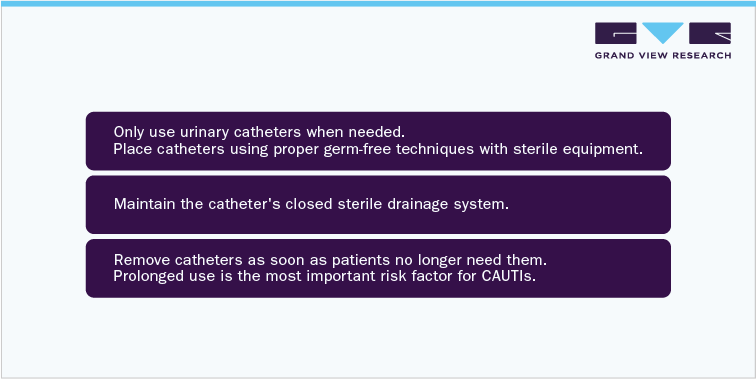
Healthcare facilities should follow the 2009 CDC Guideline for Prevention of Catheter-associated Urinary Tract Infections. The guideline emphasizes the proper use, insertion, and maintenance of urinary catheters in different healthcare settings. It also presents effective quality improvement programs that healthcare facilities can use to prevent CAUTIs.
Acute care hospitals must follow Strategies to Prevent Catheter-Associated Urinary Tract Infections in Acute Care Hospitals: 2022 Update.
Advancements in Antimicrobial Catheter Technologies
Silver Alloy Hydrogel-Coated Catheters (SAH)
Silver, one of the commonly used antimicrobial agents in medical devices to prevent microbial invasion, has been approved by the FDA for use in UCs. Bardex IC and Dover are the two most used and studied silver Foley catheters. Silver is coated onto both the external and internal surfaces of the catheters and used as an alloy along with gold or platinum, or nanoparticles, and polymers. Clinical studies have focused on SAH catheters reducing CAUTI incidence, particularly among critically ill patients. Combining silver's antimicrobial properties with hydrogel coatings inhibits bacterial growth and biofilm development. As per data published by NIH 2023, SAH catheters can effectively inhibit the formation of catheter-related bacterial biofilms in critically ill patients and reduce the incidence of CAUTIs compared with conventional siliconized latex Foley catheters; however, regular catheter replacement is still necessary.
Superhydrophobic Surfaces
The development of microtopographic superhydrophobic polymer surfaces on catheters has shown promise in preventing bacterial adhesion. These surfaces repel fluids and reduce microbial colonization, thereby decreasing infection risks.
The 2024 study published in ACS Biomaterials Science & Engineering evaluated four advanced surface coatings, superhydrophilic zwitterionic, liquid-like, liquid-infused, and superhydrophobic, to prevent catheter-associated urinary tract infections and encrustation. Among these, the super hydrophilic zwitterionic coating demonstrated the highest antifouling activity, reducing fibrinogen deposition by 72.3% and bacterial adhesion (Escherichia coli and Staphylococcus aureus) by over 75% compared to uncoated polyvinyl chloride surfaces. This coating also improved surface lubricity, decreasing the dynamic coefficient of friction from 0.63 to 0.35. While the super hydrophilic zwitterionic and hydrophobic liquid-like surfaces showed in retarding crystalline biofilm formation in the presence of Proteus mirabilis, their long-term antifouling efficacy may be compromised due to the proliferation and migration of colonized bacteria, as they do not possess bactericidal properties. These findings highlight the potential of ultralow fouling materials as urinary catheter coatings for preventing CAUTIs.
Integration of Technology in Infection Prevention
Technological advancements are playing a pivotal role in preventing infections associated with urinary catheterization. Electronic reminder systems, such as the CATH TAG, have been effective in reducing catheterization duration and subsequently decreasing CAUTI incidence by 23%. Additionally, diagnostic tools utilizing artificial intelligence, like flow microimaging, have demonstrated high specificity (96.5%) in rapid UTI diagnosis, potentially reducing unnecessary urine cultures.
Focus on Neurologic Bladder Dysfunction Patients
Neurologic bladder dysfunction (NBD), or neurogenic bladder, impacts millions of Americans and is often caused by conditions like spinal cord injuries, multiple sclerosis, Parkinson’s disease, strokes, diabetes, and spina bifida. These neurological conditions disrupt normal bladder control, leading to issues such as urinary retention or incontinence. Management of NBD often involves urinary catheterization, particularly for patients who cannot empty their bladders. Clean intermittent catheterization (CIC) is preferred for many mobile patients due to its lower risk of complications than long-term indwelling catheters. However, some individuals may still require indwelling catheters, increasing the risk of catheter-associated urinary tract infections (CAUTIs), a significant concern in acute and long-term care settings in the U.S.
A study published in The BMJ in March 2025 estimates that the number of Parkinson’s disease cases will exceed 25 million by 2050. This projection represents a 112% increase compared to 2021.
Top 5 U.S. States Based on the Death Rate (%) Due to PD, for 2022
Rank
State
Death Rate (%)
Number of Cases
1
Utah
12.4
343
2
Kansas
11.5
423
3
Nebraska
11.4
275
4
Tennessee
11.2
957
5
New Hampshire
11.1
218
Source: CDC


Customize this report to your needs - add regions, segments, or data points, with 20% free customization.
Or view our licence options:


ISO 9001:2015 & 27001:2022 Certified
We are GDPR and CCPA compliant! Your transaction & personal information is safe and secure. For more details, please read our privacy policy.


