
- Home
- »
- Medical Devices
- »
-
Canada Foot & Ankle Reconstruction Devices Market Report 2033GVR Report cover

Canada Foot and Ankle Reconstruction Devices Market (2026 - 2033)
Size, Share & Trends Analysis Report By Application (Hammertoe Correction, Midfoot Reconstruction), By End Use (Hospitals, Ambulatory Surgery Centers, Specialty Orthopedic Clinics), And Segment Forecasts
Market Size, 2025
$82.6MMarket Estimate, 2026
$87.4MMarket Forecast, 2033
$126.8MCAGR, 2026–2033
5.5%Canada Foot and Ankle Reconstruction Devices Market Summary
The canada foot and ankle reconstruction devices market size was valued at USD 82.6 million in 2025 and is projected to grow from USD 87.4 million in 2026 to USD 126.8 million by 2033, at a CAGR of 5.5% from 2026 to 2033. This growth can be attributed to the rising geriatric population with increasing prevalence of degenerative foot and ankle conditions. Growing adoption of minimally invasive procedures and advances in patient-specific, 3D-printed, and other advanced fixation technologies are also supporting the growth.
Key Market Trends & Insights
- By application: Hindfoot & ankle reconstruction / fusion (excluding TAR) segment dominated the market with the largest share of 35.4% in 2025.
- By end use: Hospitals (public & private) segment dominated the market with the largest share of 91.5% in 2025.
Market Size & Forecast
- Market Size in 2025: USD 82.6 Million
- Estimated Market Size in 2026: USD 87.4 Million
- Projected Market Size by 2033: USD 126.8 Million
- CAGR (2026-2033): 5.5%
Three ways to get this report
Buy it, customize it, or ask a question.Ask an Analyst
A direct answer, usually in 1 working day
- AccessReport author, directly
- Reply timeWithin 1 working day
- No sales callDirect answer only
- FormatEmail reply
- CostFree, no cost
Get the Full Report
What the study covers
- FormatsPDF · Excel · Dashboard
- Timeline2026–2033 annual, 2025 base
- Coverage20+ countries, 5 regions
- Companies10+ key players profiled
Customize the Report
20% free customization
- IncludeCountries, segments, points
- TailorTo your product definition
- ExtendDeeper competitor detail
- OrA fully bespoke study
- Turnaround5–10 working days
Osteoarthritis is more common with increasing age and commonly affects the feet, while severe cases may require surgical intervention, including joint replacement. Canada’s aging population is further increasing the pool of patients at risk of degenerative foot and ankle conditions; Statistics Canada reported 8.1 million Canadians aged 65 years and older as of July 2025.
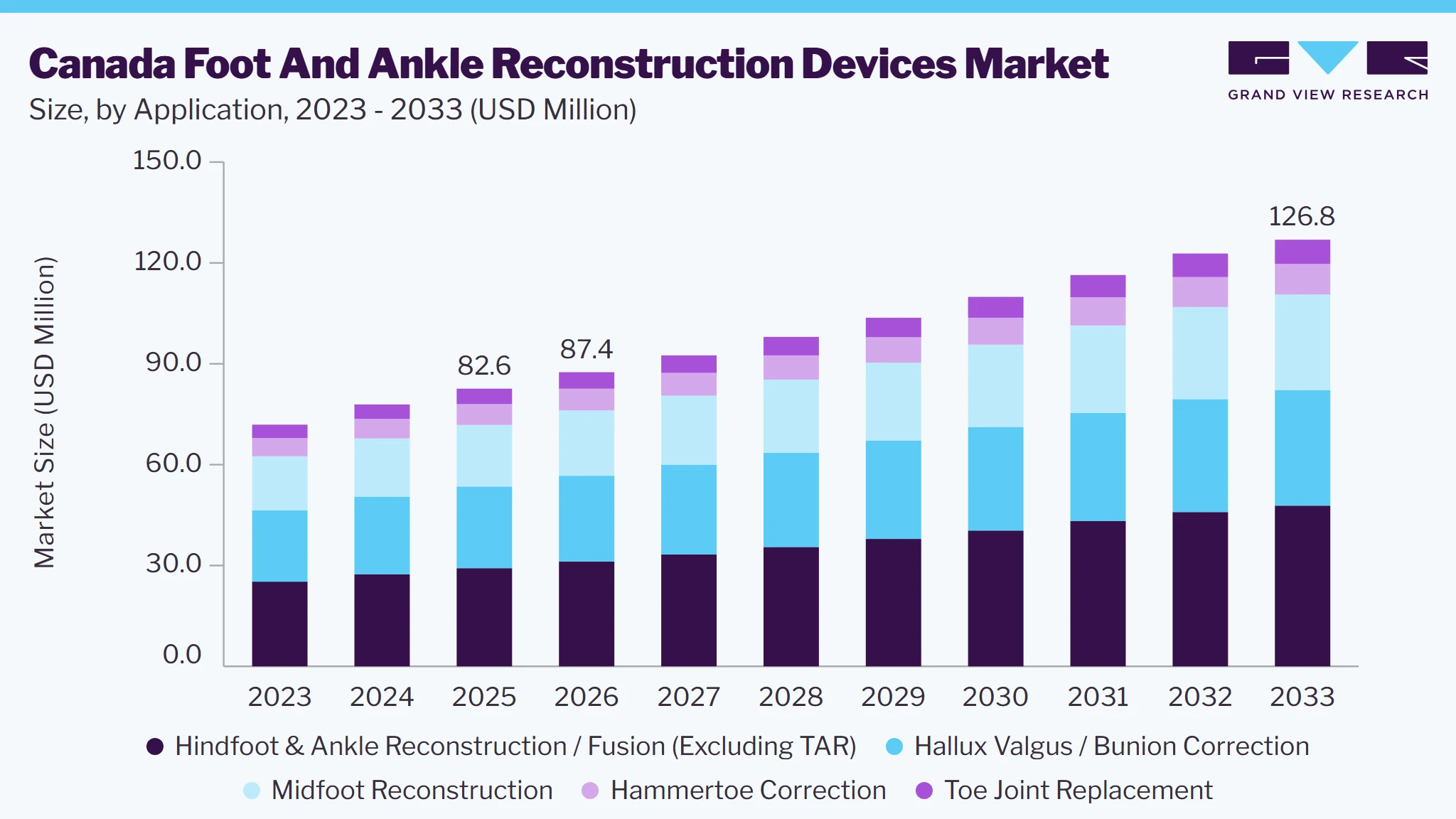 Source: Grand View Research, IR Documents, Primary Interviews, Paid DatabasesTo learn more about this report,
 Download Free Sample Report
 The growing burden of age-related degeneration and lower-extremity injuries is supporting demand for reconstructive procedures, including fusion, fixation, and joint replacement. For instance, in December 2025, Horizon Health Network reported the introduction of an advanced awake foot and ankle surgery approach at Saint John Regional Hospital, noting improvements in recovery and surgical wait times. The development reflects continued investment in specialized foot and ankle surgical care in Canada and supports the adoption of advanced reconstruction techniques and associated devices.
Market Dynamics
The increasing migration of cardiovascular and vascular procedures from hospitals to physician-led outpatient facilities is a major driver of the market. OBLs provide physicians with greater control over scheduling and procedural workflows while offering patients same-day treatment and recovery in a less complex care environment. According to a 2025 Journal of the American College of Cardiology (JACC) analysis, 65% of outpatient peripheral vascular interventions among Medicare beneficiaries were performed in OBLs in 2022, highlighting the growing role of office-based settings in cardiovascular care. The continued shift of appropriate cardiovascular interventions toward lower-cost outpatient settings is therefore increasing procedure volumes and supporting OBL expansion.
Increasing product recalls represent a significant restraint for the market, as they can increase costs for manufacturers and healthcare providers, disrupt the availability of critical products, and delay surgical procedures. Foot and ankle reconstruction devices, including plates, screws, fixation systems, staples, fusion devices, and other implants, are designed to remain in the body and are therefore subject to stringent requirements related to mechanical strength, fixation stability, material quality, sterility, and long-term performance. When post-market surveillance identifies defects such as improper screw-plate engagement, material degradation, breakage, or manufacturing inconsistencies, manufacturers may need to recall affected products, issue field corrections, or notify hospitals and surgeons.
For instance, in April 2024, Zimmer Inc. recalled its ZPLP Distal Lateral Fibular Plate in Canada. The device is used in orthopedic applications involving the fibula, making the recall relevant to the broader foot and ankle reconstruction ecosystem. According to Health Canada, a thread-form issue in the locking holes could prevent locking screws from properly mating with the plate. The recall followed an investigation into 24 complaints. Such incidents can increase caution among surgeons and hospitals when selecting fixation systems, particularly when alternative products are available. They may also increase scrutiny of implant compatibility, product quality, and intraoperative verification, potentially affecting product adoption and purchasing decisions.
The expansion of soft-tissue reconstruction solutions represents a significant opportunity for the market, particularly as surgeons adopt specialized devices for repairing ligaments, tendons, and other soft tissues around the ankle and foot. Soft-tissue orthopedic devices are projected to be the fastest-growing product segment in Canada's broader foot and ankle devices market, indicating increasing demand for technologies beyond conventional bone fixation. This opportunity is supported by the increasing need to treat Achilles tendon injuries, lateral and medial ankle instability, syndesmotic injuries, tendon disruptions, and ligament injuries, for which devices such as suture anchors, knotless anchors, suture tapes, augmentation implants, and biologically reinforced scaffolds can provide soft-tissue-to-bone fixation or reinforcement. For instance, Health Canada issued a Class III license in May 2025 for the VERSALOOP Anchor, an all-suture anchor specifically indicated for soft-tissue-to-bone fixation involving ligament or tendon disruption and reconstruction; importantly, its indications include the foot and ankle.
Furthermore, the manufacturers in the space are developing more advanced solutions. CONMED's Hercules Knotless Suture Anchor portfolio includes systems designed for Achilles repair, lateral ligament stabilization, and midfoot procedures, while its BioBrace-reinforced solution combines a bioinductive implant with a knotless anchor. Similarly, Smith+Nephew's Q-FIX Soft Suture Anchor System is designed for medial/lateral ankle repair, midfoot and forefoot reconstruction, hallux valgus reconstruction, metatarsal ligament/tendon repair, and Achilles tendon repair, while its ULTRABRACE augmentation system combines suture anchors with suture tape to reinforce ligament repairs. These developments demonstrate a shift toward low-profile, knotless, all-suture, adjustable-tension, and biologically reinforced reconstruction technologies, creating opportunities for companies to differentiate their products and address increasingly complex foot and ankle procedures.
Fragmented provincial procurement and purchasing systems represent a significant challenge for the market, as manufacturers cannot rely on a single national purchasing mechanism to secure broad hospital access. In Canada, provinces and territories have substantial responsibility for healthcare procurement, resulting in differences in procurement structures, purchasing policies, evaluation criteria, and the use of group purchasing organizations (GPOs) and shared-service organizations. The Competition Bureau of Canada has identified the fragmentation and complexity of the Canadian healthcare system as a barrier to procurement, with jurisdictions differing in their levels of centralization, priorities, legislation, policies, and regulatory authorities.
As a result, manufacturers of fixation plates, screws, fusion systems, total ankle implants, and specialty reconstruction systems may need to manage different tendering processes, pricing arrangements, clinical evaluations, and contracting requirements across jurisdictions. This challenge is more relevant for specialized foot and ankle products, which may require surgeon input, product evaluation, training, and clinical validation in addition to commercial assessment. For example, Mohawk Medbuy Corporation (MMC) states that its sourcing process may involve clinical, technical, business, and financial evaluations, along with product validation where required. These requirements can extend procurement timelines and increase the resources manufacturers need to secure and maintain hospital access.
Market Concentration & Characteristics
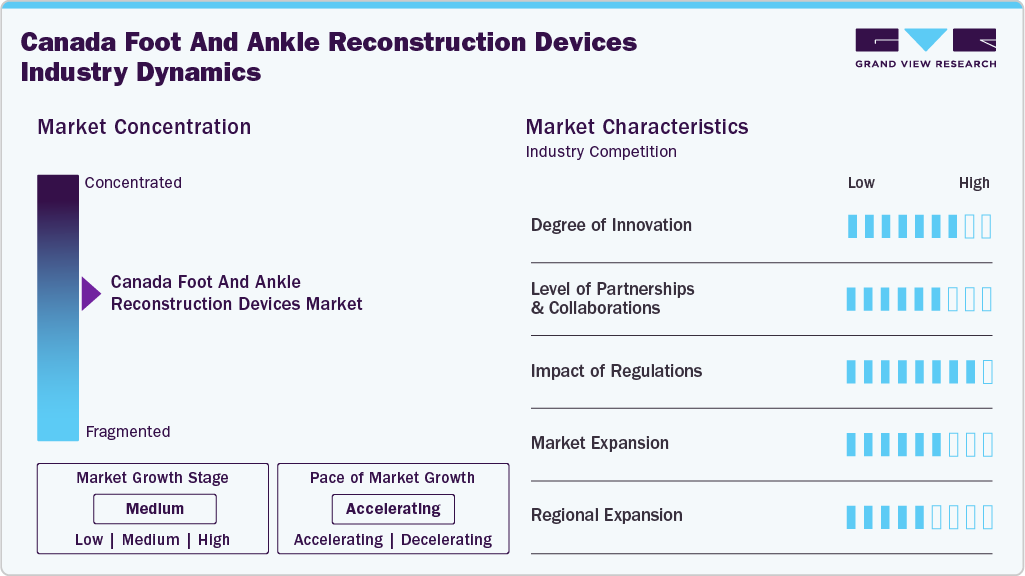
The chart below illustrates the relationship between market concentration, market characteristics, and market participants. The x-axis represents the level of market concentration, ranging from low to high, while the y-axis represents key market characteristics, including degree of innovation, industry competition, service substitutes, impact of regulations, partnership and collaboration activities, and geographic expansion.
The market is moderately fragmented, with established orthopedic device manufacturers competing across reconstruction, fixation, joint replacement, and minimally invasive solutions. The degree of innovation is high, driven by advancements in minimally invasive techniques, patient-specific implants, 3D printing, and advanced fixation technologies. The level of industry competition is high, the availability of service substitutes is low, the impact of regulations is high, partnership and collaboration activities are medium, and geographic expansion is medium.
 To learn more about this report, Download Free Sample Report
 Innovation is medium-to-high, driven by advances in total ankle arthroplasty systems and patient-specific implant design. For instance, in September 2025, Stryker launched its Incompass Total Ankle System at the American Orthopedic Foot & Ankle Society (AOFAS) Annual Meeting, a system built on insights from its established Infinity and Inbone platforms and described by the company as reflecting "20 years of experience" aimed at giving surgeons greater flexibility and improving patient outcomes. This launch illustrates how device makers are continuing to refine implant design and instrumentation to address more complex ankle reconstruction cases.
The level of partnerships and collaboration activity is medium, as manufacturers pursue targeted acquisitions to expand their reconstructive device portfolios. For instance, in September 2024, Stryker added the Osteotomy Truss System and Ankle Truss System to its Foot & Ankle portfolio, products it recently acquired from 4WEB Medical, with the expanded lineup first showcased at the AOFAS Annual Meeting held in Vancouver, Canada. This reflects a broader industry pattern of consolidating specialized implant technology through acquisition rather than solely through in-house development.
The impact of regulations on the industry is high, as device manufacturers must comply with Health Canada's evolving medical device licensing framework. For instance, in November 2025, Health Canada published updated IMDRF table-of-contents guidance for medical device license applications, part of its ongoing series of guidance updates governing how manufacturers submit and manage device license applications. Such regulatory updates require reconstruction device manufacturers to continuously monitor and adapt their submission and compliance processes.
The market is supported by increasing investment in orthopedic surgical capacity and the expansion of community-based surgical services. For instance, in December 2025, the Ontario government announced a CAD 125 million investment to establish four new community surgical and diagnostic centers licensed to provide orthopedic surgeries, with the expansion expected to support up to 20,000 additional publicly funded orthopedic procedures. The initiative is intended to increase access to orthopedic care, reduce surgical wait times, and expand procedure capacity across the province, creating a broader infrastructure base for orthopedic reconstruction services, including foot and ankle procedures.
Regional expansion is medium, with meaningful differences in surgical access and infrastructure investment across provinces. According to CBC News reporting on a June 2025 CIHI report, Nova Scotia's wait times for hip and knee replacements are now the shortest on record, a result attributed in part to Dartmouth General Hospital opening a new orthopedic surgery center in 2019 and hiring three additional orthopedic surgeons. This kind of province-level infrastructure investment illustrates how regional expansion in reconstructive orthopedic capacity is uneven across Canada, shaping where device manufacturers may prioritize market entry and surgeon engagement.
Analyst Perspective
The market is experiencing steady growth, driven by the rising prevalence of foot and ankle deformities among the aging population, increasing burden of degenerative and traumatic conditions, and growing physician preference for minimally invasive, procedure-specific fixation solutions. In addition, innovations in 3D-printed and patient-specific implants, robotics and computer navigation, advanced imaging, and minimally invasive surgical instrumentation are increasing procedural precision and efficiency. The increasing importance of delivering durable fixation outcomes, reducing revision rates, supporting outpatient care pathways, and enabling faster surgeon adoption is strengthening the competitive advantage of manufacturers with integrated, procedure-specific reconstruction platforms.
Pricing Analysis
ASP Per Device by Application (USD)
- Canada foot and ankle reconstruction devices market, ASP per device by application (USD)
Segment
2021
2022
2023
2024
2025
2026
2027
2028
2029
2030
2031
2032
2033
CAGR 2021-2025 (Historical)
CAGR 2025-2033 (Forecast)
Hallux Valgus / Bunion Correction
480.0
Hammertoe Correction
349.8
Midfoot Reconstruction
650.3
Hindfoot & Ankle Reconstruction / Fusion (Excluding TAR)
1,050.2
Toe Joint Replacement
2,000.3
Key Takeaways:
ASP variation across applications is primarily driven by differences in implant complexity, fixation requirements, procedural intensity, and the extent to which procedures use specialized or higher-value constructs. Replacement procedures command a premium relative to fixation-led reconstruction, while forefoot deformity procedures generally have lower device values because they rely more heavily on smaller screws, K-wires, staples, and other relatively standardized fixation products.
Case Study Analysis: Single- vs. Two-Screw Fixation in Minimally Invasive Hallux Valgus Surgery
Clinical Need: Hallux valgus is a common forefoot deformity that can cause pain, functional limitations, and reduce quality of life. The increasing adoption of minimally invasive surgery (MIS) has created demand for fixation systems that can provide effective deformity correction while minimizing surgical trauma, operative time, radiation exposure, and implant-related complications.
Clinical Evidence: A 2025 systematic review published in Cureus evaluated whether single-screw fixation could provide outcomes comparable to the conventional two-screw construct in minimally invasive hallux valgus surgery. The review analyzed five studies, comprising two clinical studies involving 153 patients and 162 feet and three biomechanical studies. The clinical studies evaluated radiographic correction, patient-reported outcomes, operative parameters, and complications.
Treatment Approach: The review compared minimally invasive metatarsal osteotomy procedures using either one or two metatarsal screws. Two-screw fixation is commonly used to improve construct stability, particularly rotational stability, whereas single-screw fixation has the potential to simplify the procedure and reduce implant use.
Clinical Findings: Both fixation strategies demonstrated comparable radiographic correction and patient-reported clinical outcomes in the available comparative clinical studies. Single-screw fixation was associated with shorter operative time and lower fluoroscopy exposure. Hardware-related complications requiring removal were also higher in the two-screw groups in the reported studies, including rates of 32% versus 3% in one study and 1.9% versus 0% in another.
Biomechanical Findings: Despite these advantages, biomechanical evidence indicated that single-screw constructs may provide less rotational stability than two-screw configurations. This suggests that two-screw fixation may remain preferable for patients requiring greater construct stability or presenting with more complex deformities.
Market Relevance: The findings highlight an opportunity for manufacturers of foot and ankle fixation devices, minimally invasive surgical systems, and orthopedic screws to develop solutions that balance fixation stability with reduced implant burden and procedural complexity. A shift toward single-screw fixation in appropriately selected patients could potentially reduce implant consumption, operating-room time, fluoroscopy exposure, and hardware-removal procedures.
Strategic Implication: The study indicates that the competitive opportunity is not limited to increasing the number of fixation components used per procedure. Manufacturers can differentiate through optimized screw designs, improved rotational stability, minimally invasive instrumentation, and fixation systems that reduce operative time and hardware-related complications. However, adoption of single-screw approaches is likely to remain patient- and deformity-specific because current comparative evidence is limited and carries a high risk of bias.
Application Insights
The hindfoot & ankle reconstruction/fusion (excluding TAR) segment held the largest revenue share of 35.4% in 2025. Demand is underpinned by the rising burden of end-stage ankle arthritis, post-traumatic joint damage, and age-related fractures, as osteoporosis and fragility-related injuries increasingly translate into complex hindfoot and ankle deformities requiring surgical stabilization. Because procedures in this segment span ankle fusion, subtalar fusion, triple arthrodesis, TTC fusion, and calcaneal or supramalleolar osteotomy, fixation needs vary considerably, sustaining demand for anatomically contoured plates, compression screws, and intramedullary nailing systems. For instance, in October 2025, Zimmer Biomet, through its Paragon 28 subsidiary, launched the Gorilla Pilon Fusion Plating System to expand its offering for primary ankle fusion, pilon fractures, and complex hindfoot injuries. The system incorporates anatomically contoured dual-column plating and instrumentation for open and percutaneous approaches, while its accompanying Phantom TTC Trauma Nail extends fixation options for complex tibiotalocalcaneal fusion cases, reflecting the segment's shift toward integrated, procedure-specific reconstruction platforms.
The toe joint replacement segment is expected to grow at a significant CAGR over the forecast period. Growth is supported by the prevalence of hallux rigidus among middle-aged and older adults and a growing patient and surgeon preference for motion-preserving alternatives to first-MTP arthrodesis. Unlike fusion, which eliminates joint movement to relieve pain, arthroplasty techniques such as synthetic cartilage implants, hemiarthroplasty, and total first-MTP arthroplasty aim to resurface or replace damaged joint components while preserving function, making them attractive for patients with higher functional demands. The coexistence of bone-preserving options like PVA hydrogel cartilage implants alongside cobalt-chromium or titanium hemiarthroplasty and total arthroplasty systems provides a graduated set of solutions matched to disease severity and bone stock, positioning the segment as a higher-value, technologically differentiated opportunity within the broader forefoot and toe-focused device landscape.
End Use Insights
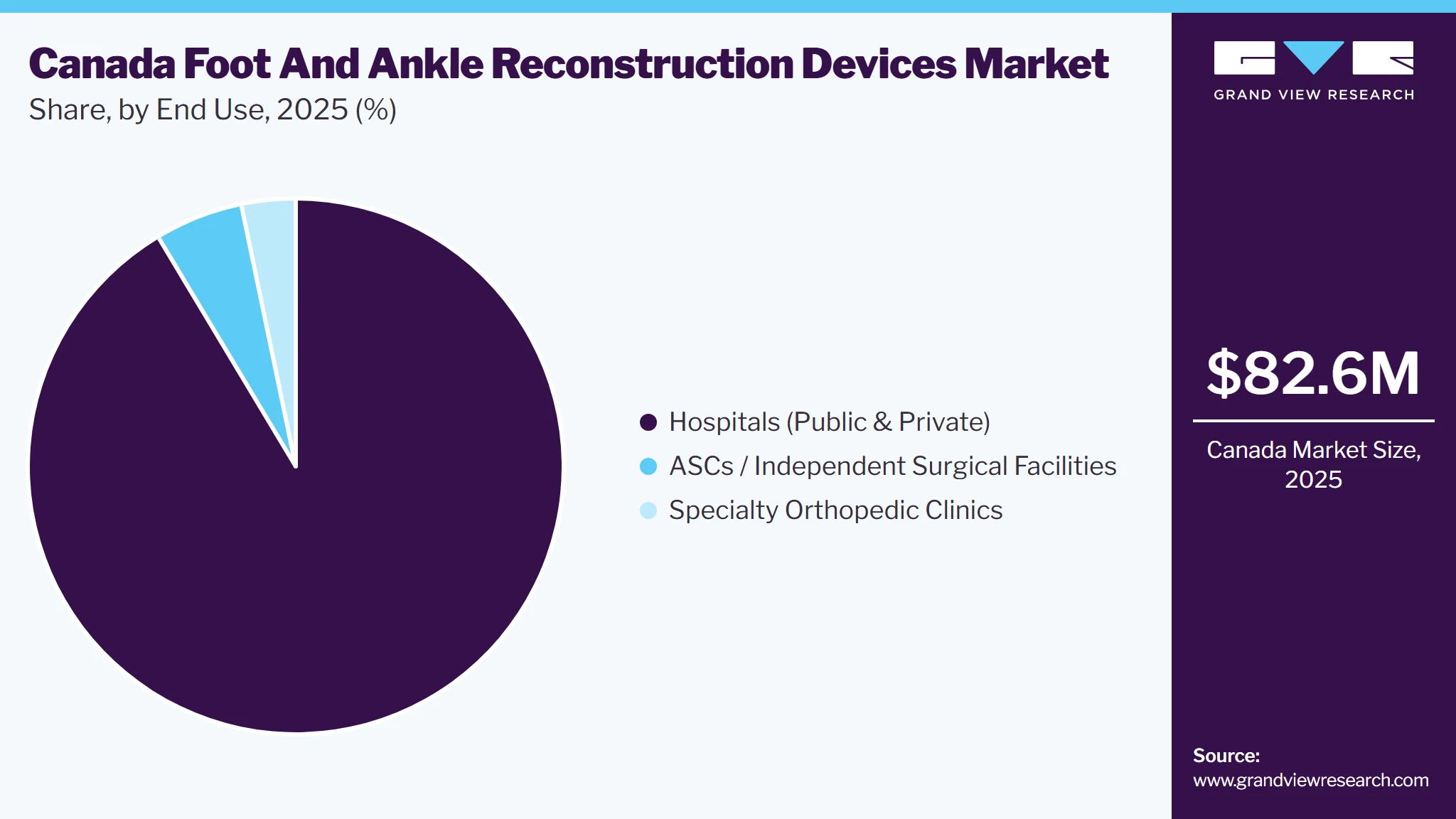
The hospitals (public & private) segment held the largest revenue share of 91.5% in 2025. Hospitals continue to provide the infrastructure necessary for complex orthopedic interventions, including fracture fixation, hindfoot and ankle reconstruction, Charcot reconstruction, multi-column midfoot procedures, and revision surgeries that require advanced operating-room capability, anesthesia support, and multidisciplinary care. Several Canadian institutions function as quaternary referral and training centers for these procedures, including St. Michael's Hospital and Toronto Western Hospital in Toronto, St. Paul's Hospital in Vancouver (affiliated with UBC), The Ottawa Hospital, and University Hospital in London (affiliated with Western University), each maintaining dedicated foot and ankle fellowship or specialist programs. As outpatient migration accelerates, hospitals are expected to concentrate increasingly on complex and limb-salvage cases, which may help offset volume losses with higher device value per procedure.
 To learn more about this report, Download Free Sample Report
 The ASCs / independent surgical facilities segment is expected to grow at a significant CAGR of 13.3% over the forecast period. This rapid expansion is driven by the ongoing migration of lower-acuity, elective procedures away from hospitals toward independent and community-based surgical settings, supported by shorter hospital stays, improved system efficiency, and provincial efforts to use alternate surgical facilities to reduce public wait lists. Forefoot procedures, selected deformity corrections, and minimally invasive interventions are particularly well suited to this shift. Private operators such as Clearpoint Health Network, which offers bunion surgery, hammertoe correction, and foot and ankle arthroscopy across its facility network, and Gateway Surgery in Calgary, Alberta, which provides dedicated reconstructive services through specialist surgeons, illustrate the growing role of ASCs in delivering streamlined, procedure-specific care supported by compact instrumentation and standardized fixation kits designed for efficient same-day workflows.
Key Canada Foot and Ankle Reconstruction Devices Company Insights
The Canada foot and ankle reconstruction devices market players are focusing on devising innovative business growth strategies in the form of product portfolio expansions, partnerships & collaborations, mergers & acquisitions, and business footprint expansions.
Key Canada Foot and Ankle Reconstruction Devices Companies
-
Paragon 28 Inc
-
Stryker
-
DePuy Synthes (Johnson & Johnson MedTech)
-
Zimmer Biomet
-
Smith+Nephew
-
Arthrex, Inc.
-
Acumed LLC
-
CONMED Corporation
-
Orthofix Medical, Inc.
-
Enovis Corporation (DJO, LLC)
-
Globus Medical
-
Vilex LLC
Competitive Benchmarking
Category
Operating Strategies
Competitive Edge
Weakness
Established Players (e.g. Stryker, DePuy Synthes (Johnson & Johnson MedTech), Zimmer Biomet, Smith+Nephew, Arthrex, Inc., Enovis)
- Leverage existing orthopedic sales infrastructure and hospital contracts to introduce newer foot & ankle systems into established accounts.
- Build broader offerings across MIS, bunion correction, midfoot, hindfoot and ankle reconstruction.
- Prioritize large hospitals, orthopedic centers, and high-volume foot & ankle practices, where surgeon relationships and access to operating-room teams support recurring use of fixation systems and instrumentation.
- Portfolio breadth and account penetration are major advantages, allowing mature players to serve multiple reconstruction needs for the same surgeon or institution and reducing the need for hospitals to work with multiple suppliers.
- Strong regulatory, quality, and supply-chain capabilities provide an advantage in maintaining consistent product availability across Canada's geographically dispersed healthcare system.
- Established systems can create surgeon switching inertia, but this can also work against mature players when competitors introduce simpler, more procedure-specific or MIS-focused solutions.
- Competition increasingly shifts from basic fixation availability toward clinical differentiation, surgical efficiency, implant design, and ease of use, requiring continuous portfolio upgrades.
Emerging Players (e.g., Globus Medical, Acumed LLC, Orthofix Medical Inc., CONMED Corporation, VILEX, LLC))
- Target specific high-value reconstruction procedures or unmet surgeon needs rather than attempting to replicate the full portfolios of larger orthopedic manufacturers.
- Expand the portfolio progressively from an initial niche into adjacent foot & ankle reconstruction procedures once surgeon familiarity and account penetration have been established.
- Greater product specialization and responsiveness allow emerging companies to address specific gaps in incumbent portfolios, particularly where surgeons are seeking improved fixation, compression, implant profile, instrumentation, or procedural efficiency.
- Focused portfolios can enable faster product development and commercialization around specific foot & ankle techniques, compared with larger companies managing extensive orthopedic portfolios.
- Smaller portfolios may limit the ability to provide a complete reconstruction solution, making it harder to displace mature suppliers that can cover multiple procedures within a single account.
- Expansion into additional provinces and hospital systems may require substantial investment in regulatory support, surgeon training, distributor development, inventory, and clinical evidence generation.
Recent Developments
-
In January 2026, Zimmer Biomet launched the Brachiator mini-rail external fixation system, developed in collaboration with Paragon 28, to enable precise, multiplanar correction and stabilization of foot and ankle bone deformities and fractures.
-
In September 2025, Enovis Corporation introduced the Pecaplasty Wires First System, a next-generation minimally invasive bunion correction technology designed to provide a more predictable, reproducible approach to percutaneous bunion surgery.
-
In September 2024, Enovis Corporation unveiled its Tarsoplasty Percutaneous Lapidus System at the AOFAS Annual Meeting in Vancouver, strengthening its minimally invasive portfolio for Lapidus procedures and bunion correction.
Canada Foot and Ankle Reconstruction Devices Market Report Scope
Report Attribute
Details
Market size in 2025
USD 82.6 million
Estimated market size in 2026
USD 87.4 million
Projected market size by 2033
USD 126.8 million
Growth rate
CAGR of 5.5% from 2026 to 2033
Actual Data
2021 - 2025
Forecast Data
2026 - 2033
Quantitative units
Revenue in USD million, and CAGR from 2026 to 2033
Report coverage
Revenue forecast, company ranking, competitive landscape, growth factors, and trends
Segments covered
Application, end use
Country scope
Canada
Key companies profiled
Paragon 28 Inc; Stryker; DePuy Synthes (Johnson & Johnson MedTech); Zimmer Biomet; Smith+Nephew; Arthrex, Inc.; Acumed LLC; CONMED Corporation; Orthofix Medical, Inc.; Enovis Corporation (DJO, LLC); Globus Medical; Vilex LLC
Customization scope
Free report customization (equivalent up to 8 analysts working days) with purchase. Addition or alteration to country, regional & segment scope.
Pricing and purchase options
Avail customized purchase options to meet your exact research needs. Explore purchase options
Canada Foot and Ankle Reconstruction Devices Market Report Segmentation
This report forecasts revenue growth at the country level and provides an analysis of the latest industry trends and opportunities in each of the segments from 2021 to 2033. For this study, Grand View Research, Inc. has segmented the Canada foot and ankle reconstruction devices market report on the basis of application and end use:
-
Application Outlook (Revenue, USD Million, 2021 - 2033)
-
Hallux Valgus / Bunion Correction
-
Hammertoe Correction
-
Midfoot Reconstruction
-
Hindfoot & Ankle Reconstruction
-
Toe Joint Replacement
-
-
End Use (Revenue, USD Million, 2021 - 2033)
-
Hospitals
-
Ambulatory Surgery Centers (ASCs)
-
Specialty Orthopedic Clinics
-
Research Methodology
The Canada foot and ankle reconstruction device market figures in this report are based on a proven research process that combines executive interviews with secondary research from proprietary databases, company filings, and recognized regulatory and institutional sources. Market size is built through value-chain sizing-reconciling supply-side and demand-side estimates-and triangulated with bottom-up and top-down approaches. Every estimate passes multiple levels of expert validation before publication, with each Canada foot and ankle reconstruction device segment quantified using the revenue-capture definitions in the table below.
Segment Definition
Segment - Application
Revenue capture definition
Hallux Valgus / Bunion Correction
Surgical procedures performed to correct hallux valgus (bunion) deformity and restore alignment of the first ray and first metatarsophalangeal (MTP) joint. The segment includes distal and shaft-level metatarsal osteotomies, minimally invasive bunion correction, Akin osteotomy, and first tarsometatarsal (TMT) arthrodesis (Lapidus) when performed primarily for hallux valgus/bunion correction. Associated fixation devices include plates, screws, staples, and procedure-specific fixation systems.
Hammertoe Correction
Surgical procedures performed to correct deformities of the lesser toes, particularly abnormal flexion involving the proximal interphalangeal (PIP) joint. The segment includes PIP arthrodesis, intramedullary fixation, K-wire fixation, and associated procedures such as flexor tendon transfer and Weil metatarsal osteotomy when performed as part of hammertoe correction. Devices include intramedullary implants, K-wires, screws, plates, staples, and soft-tissue fixation products.
Midfoot Reconstruction
Surgical procedures performed to restore structural alignment, arch stability, and load-bearing function across the midfoot, including the TMT and intertarsal joints, for indications such as Lisfranc injuries, post-traumatic arthritis, progressive collapsing foot deformity (PCFD), midfoot instability, and Charcot neuroarthropathy. The segment includes ORIF, primary arthrodesis, medial column fusion, osteotomy, and complex multi-column reconstruction. First-TMT/Lapidus procedures performed primarily for hallux valgus are excluded and allocated to Hallux Valgus / Bunion Correction.
Hindfoot & Ankle Reconstruction /
Fusion (Excluding TAR)
Surgical procedures targeting the ankle and hindfoot to restore alignment, stability, or function, including ankle fusion, subtalar fusion, triple arthrodesis, tibiotalocalcaneal (TTC) fusion, calcaneal osteotomy, supramalleolar osteotomy, and other reconstructive procedures. Total ankle replacement (TAR), including total ankle arthroplasty, is excluded from the segment and associated market estimates. Devices include anatomically contoured plates, compression screws, intramedullary nails, and procedure-specific fixation systems.
Toe Joint Reconstruction
Surgical procedures performed to correct structural deformities, instability, malalignment, or other conditions affecting the toes beyond the primary hallux valgus and hammertoe indications. Procedures may include corrective osteotomies, arthrodesis, fixation, and other reconstructive interventions involving the lesser toes. Associated devices include screws, plates, staples, K-wires, intramedullary implants, and other toe-specific fixation systems.
By End Use
Revenue capture definition
Hospitals (Public & Private)
Public and privately operated hospitals where foot and ankle reconstruction procedures are performed, including complex fusion, trauma, revision, Charcot, multi-column midfoot, and other procedures requiring hospital-based operating-room infrastructure, anesthesia support, or multidisciplinary care.
ASCs / Independent Surgical Facilities
Ambulatory and independent surgical facilities providing eligible foot and ankle reconstruction procedures without requiring an overnight hospital stay. The segment primarily captures selected elective, lower-acuity, minimally invasive, and standardized procedures that are suitable for outpatient surgical pathways.
Specialty Orthopedic Clinics
Dedicated orthopedic facilities and specialty clinics providing selected foot and ankle surgical procedures, particularly elective and lower-complexity interventions that can be managed through specialized outpatient or community-based surgical pathways.
Estimation Model
Section
Key Summary
1.1 Research Approach
Hybrid research approach combining secondary and primary research within a shared validation and forecasting framework. Market assessment is based on device revenue mapped by manufacturer, Canadian allocation, application-level (QFD) scoring, procedure volumes, population/prevalence data, regulatory licensing, and primary interviews with clinical and commercial stakeholders. Secondary research establishes the evidence base; primary research validates assumptions not directly observable in public sources.
1.2 Market Estimation Framework
Market size is estimated using two independently developed models (1) a supply-side, bottom-up company revenue model, and (2) a demand-side epidemiological validation model plus a QFD-based allocation layer and a forecasting/scenario layer. The demand-side model is not blended into the market total; it is used only to quantify the gap between realized commercial revenue and the clinical revenue ceiling.
1.2.1 Demand Model
An independent epidemiological funnel starts with the Canada population by age cohort and narrows it using condition prevalence, symptomatic/severe disease share, annual specialist engagement, and conservative-to-surgical conversion. Procedure volume is translated into an independent revenue ceiling using device utilization and ASP. In 2025, this demand-side ceiling is ~10.1% above the supply-side market base, narrowing to ~9.3% by 2033 (the "saturation bridge").
1.2.2 Revenue Model
Market value is built manufacturer-by-manufacturer using the narrowest disclosed revenue line covering the company's foot and ankle portfolio (10-K filings, SEC exhibits, named private-company estimates where no public filing exists). Revenue is allocated to Canada using a company-specific factor based on direct sales presence, distributor coverage, and regulatory licensing, then narrowed to the five in-scope applications (with Total Ankle Replacement removed). Primary-research calibration adjusts for list-to-net pricing, indirect sales, and regional coverage gaps.
1.2.3 Vendor Model
Market and competitive estimates are validated using company-level revenue mapping, Canadian-allocation, and cross-checks through a competitive/pipeline primary-research module. Validation draws on financial disclosures (Stryker, J&J MedTech, Zimmer Biomet, Smith+Nephew, Enovis, Orthofix, CONMED, and others), named private-company database estimates, M&A activity, product launches, and regulatory (MDALL) listings. The 2025 output shows the top three platforms hold ~70%-75% share, led by Stryker, with a xx% residual pool of smaller/regional suppliers.
1.3 Forecast Development
The 2026-2033 forecast extends the calibrated 2025 base using application-specific assumptions for procedure volume and device spend per procedure. Growth rates are informed by historical utilization, clinical demand trends, elective procedure/ambulatory capacity expansion, site-of-care migration (hospital to ASC/clinic), provincial procurement conditions, and expected shifts in technology mix (e.g., MIS, 3D-printed/patient-specific implants). Base, bull, bear, and sensitivity scenarios are produced.
1.4 Segmentation Method
Segmentation is derived through Quality Function Deployment (QFD): five Canadian clinical/procurement requirements (e.g., primary fixation stability, provincial GPO/tender pricing compliance, MIS compatibility, 3D-printed/patient-specific implants, bio-absorbable/no-hardware-removal) are weighted on a 1-5 importance scale and scored per company-application relationship on a 1/3/9 scale. This reallocates each company's already-sized revenue across the five clinical applications and by end use, without changing the total market value.
1.5 Scope & Assumptions
Market is measured in USD based on device revenue realized in Canada across five foot and ankle reconstruction applications (Hindfoot & Ankle Reconstruction/Fusion, Hallux Valgus/Bunion Correction, Midfoot Reconstruction, Hammertoe Correction, Toe Joint Replacement) and three end-use settings (Hospitals, ASCs/Independent Surgical Facilities, Specialty Orthopedic Clinics). Total Ankle Replacement (TAR) is explicitly excluded. Estimates incorporate population/prevalence data, regulatory licensing (MDALL), company financial disclosures, primary research (33 IDIs and 96 survey responses in 2025), and Bank of Canada exchange rates for CAD-to-USD conversion.
Delivered Customizations
This report has been delivered with the following In-depth customizations
CLIENT REQUEST
CUSTOMIZATION DELIVERED
VALUE ADDS
Volume Analysis by Product Segment
Developed a comprehensive volume assessment of the Canada foot and ankle reconstruction devices market, covering fixation plates, screws, staples, fusion devices, fixation systems, total ankle implants, and specialty reconstruction products. The analysis provides segment-level procedure and unit volumes from 2021 to 2033, supported by application, procedure type, and adoption trends.
Enables stakeholders to identify high-volume product segments, assess procedure-driven demand, optimize inventory and production planning, and identify segments with strong volume growth potential.
Pricing Analysis by Product Segment
Conducted a detailed pricing and ASP analysis from 2021 to 2033 across major foot and ankle reconstruction device segments. The analysis evaluates historical and forecast pricing trends, product-level price differences, technology mix, procedure complexity, and changes in purchasing and procurement dynamics across Canada.
Helps stakeholders assess pricing opportunities, understand ASP movements, support pricing strategy, evaluate revenue growth drivers, and identify segments with favorable pricing potential.
Company-Level Market Share Analysis
Developed a detailed competitive assessment covering key manufacturers of foot and ankle reconstruction devices in Canada, with company-level revenue and market share analysis for 2021-2033, where applicable. The analysis evaluates company presence across major product segments, product offerings, strategic positioning, and competitive strengths.
Provides a clear view of the competitive structure, helps identify market leaders and challengers, supports competitor benchmarking, and enables companies to prioritize strategic opportunities across high-potential product segments.
Frequently Asked Questions About This Report
The Canada foot and ankle reconstruction devices market size was estimated at USD 82.6 million in 2025 and is expected to reach USD 87.4 million in 2026.
The Canada foot and ankle reconstruction devices market is expected to grow at a compound annual growth rate of 5.5 % from 2026 to 2033 and is anticipated to reach USD 126.8 million by 2033.
In terms of application, the hindfoot & ankle reconstruction / fusion (excluding TAR) segment dominated the market with the largest market share of 35.4% in 2025.
In terms of end use, the hospitals (public & private) segment dominated the market with the largest market share of 91.5% in 2025.
The market growth can be attributed to the rising geriatric population, increasing prevalence of degenerative foot and ankle conditions, growing adoption of minimally invasive procedures, and advances in patient-specific, 3D-printed, and other advanced fixation technologies.
Some of the key companies in the market include Paragon 28 Inc; Stryker; DePuy Synthes (Johnson & Johnson MedTech); Zimmer Biomet; Smith+Nephew; Arthrex, Inc.; Acumed LLC; CONMED Corporation; Orthofix Medical, Inc.; Enovis Corporation (DJO, LLC); Globus Medical; Vilex LLC
About the Author(s)
Medical Devices Research Team
Healthcare · Medical DevicesThis report was authored by the medical devices research team at Grand View Research - comprising two research analysts, one senior research analyst, and one industry expert - with specialized expertise in the medical devices segment of the healthcare industry. All findings are based on proprietary healthcare databases, executive interviews, and regulatory analysis, subject to internal peer review prior to publication.
Last Updated:
Speak to Analyst

Customize this report to your needs - add regions, segments, or data points, with 20% free customization.
Or view our licence options:


ISO 9001:2015 & 27001:2022 Certified
We are GDPR and CCPA compliant! Your transaction & personal information is safe and secure. For more details, please read our privacy policy.


