
- Home
- »
- Medical Devices
- »
-
Continuous Passive Motion Devices Market Size, Growth Report, 2026-2033GVR Report cover

Continuous Passive Motion Devices Market (2026 - 2033)
Size, Share & Trends Analysis Report By Type (Knee Joint, Shoulder Joint), By Design (Portable Devices, Fixed Devices), By Demographics, By Region, And Segment Forecasts
Market Size, 2026
$898.6MMarket Estimate, 2026
$945.3MMarket Forecast, 2033
$1,348.0MCAGR, 2027–2033
5.2%Continuous Passive Motion Devices Market Summary
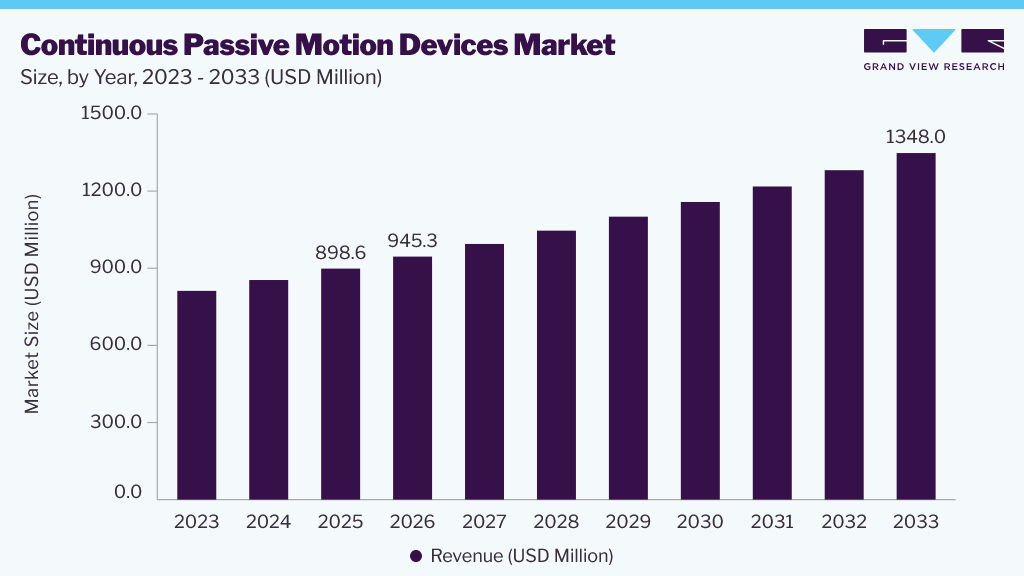
The global continuous passive motion devices market size was valued at USD 898.6 million in 2025 and is projected to grow from USD 945.3 million in 2026 to USD 1,348.0 million in 2033, at a CAGR of 5.2% from 2026 to 2033. North America dominated the market, accounting for a revenue share of 45.0% in 2025. This growth can be attributed to the rising prevalence of orthopedic disorders, such as knee replacement surgeries and ligament reconstruction. Patients have increasingly sought CPM devices as they help prevent joint stiffness and enhance the range of motion after orthopedic surgery on joints, including the knee, hip, ankle, and shoulder.
 Source: Grand View Research, IR Documents, Primary Interviews, Paid DatabasesTo learn more about this report,
 Download Free Sample Report
Key Market Trends & Insights
- By type: The knee joint CPM devices segment held the largest market share of around 42.0% in 2025.
- By design: The portable devices segment held the largest market share in 2025
- By demographics: The adults segment held the largest market share of over 57.0% in 2025
Regional Highlights
- Largest regional market: North America (45.0% revenue share, 2025)
- Fastest-growing regional market: Asia Pacific (highest CAGR, 2026-2033)
Market Size & Forecast
- Market size in 2025: USD 898.6 Million
- Estimated market size in 2026: USD 945.3 Million
- Projected market size by 2033: USD 1,348.0 Million
- CAGR (2026-2033): 5.2%
Prism AI by Grand View Research Free to tryAsk a question about the continuous passive motion devices marketTry asking✓Every figure cited from GVR research Prefer the report? Download free sample →CPM therapy is a non-invasive, drug-free method for managing pain and improving joint mobility after surgery. Advanced CPM devices can be effectively used at home and in outpatient settings to enhance postoperative rehabilitation while maintaining cost-effectiveness. The market has witnessed a considerable rise in demand for CPM devices as patients have become increasingly aware of these benefits, thereby contributing to market growth.
Furthermore, the development of portable and lightweight designs has made CPM devices more practical and user-friendly, leading to widespread adoption. Such characteristics enable users to ensure proper limb movement as the first stage of rehabilitation following trauma and soft-tissue medical procedures. Moreover, the U.S. Food and Drug Administration (FDA) and European Medicines Agency (EMA) have approved several CPM devices for clinical and home care use. Stringent regulations ensure patient safety and treatment efficacy.
Analyst Perspective
The global CPM devices market is witnessing steady growth, driven by the rising number of orthopedic surgeries, the increasing prevalence of musculoskeletal disorders, and the growing emphasis on effective postoperative rehabilitation. Knee joint CPM devices remain the largest revenue-generating segment due to their widespread use following knee replacement and ligament reconstruction procedures. The market is also shifting toward portable, home-based rehabilitation solutions that improve patient convenience, support recovery outside clinical settings, and help reduce healthcare costs. Although the market is relatively mature and product innovation is limited, the expanding adoption of outpatient rehabilitation services and the growing aging population are expected to keep the demand for CPM devices afloat.
Type Insights
The knee joint CPM devices segment dominated with a market share of around 42.0% in 2025, owing to their widespread adoption after knee arthroplasty, ACL reconstruction, and other knee surgeries for outpatient knee rehabilitation. These devices facilitate control, repetitive motion, prevent muscle stiffness, and promote healing by enhancing blood flow and nutrient diffusion. They also allow elderly patients to maintain joint mobility without active effort, reducing pain and swelling. Furthermore, the increasing penetration of rehabilitation services and government regulations has considerably increased patient adoption of knee joint CPM devices.
The hip joint CPM devices segment is expected to register the fastest CAGR over the forecast period. The rising number of joint reconstruction surgeries, including hip replacements, has propelled market growth as these devices are widely used after hip arthroplasty and other hip surgeries. Patients with limited mobility benefit from passive motion, as they can control it without active effort.
Design Insights
The portable devices segment dominated the market in 2025 and is projected to experience strong growth over the forecast period due to their rising adoption for enhanced patient recovery. The market has witnessed a major shift towards home-based care driven by patient preference for cost-effectiveness. This has led patients to easily operate these devices at home for continued therapy beyond hospital stays. The convenience of using these devices promotes consistent rehabilitation, leading to faster recovery times. Moreover, innovations in materials, miniaturization, and wireless connectivity in portable devices, including wearable sensors, mobile apps, and cloud-based data storage, have enhanced patient monitoring. This has resulted in the huge adoption of smart CPM devices, which incorporate real-time monitoring and precise motion control, preventing joint stiffness. These devices adapt to individual needs, optimizing therapy parameters based on patient progress.
The fixed CPM devices segment is anticipated to grow at the fastest CAGR of 4.5% over the forecast period. These devices offer consistent, controlled motion without user intervention, ensuring reliable therapy. Their safe implementation encourages adoption among patients and healthcare providers. Additionally, fixed devices are versatile and used beyond joint surgeries, including for osteoarthritis, fractures, and trauma-related injuries.
Demographics Insights
The adults segment dominated the market with a share of over 57.0% in 2025, owing to the increasing prevalence of joint replacement surgeries, such as knee and hip arthroplasty, among the geriatric population. With the growing elderly population, joint-related conditions such as loss of bone mass and density have become more common, necessitating post-surgical rehabilitation and promoting CPM adoption. The increasing number of orthopedic procedures among older adults is further driving demand for postoperative rehabilitation. For instance, in March 2026, researchers from the American Academy of Orthopedic Surgeons (AAOS) reported that over 35,000 orthopedic procedures are performed annually on patients in their 50s, 60s, and beyond who remain athletically active. This trend is expected to increase demand for postoperative rehabilitation solutions, including Continuous Passive Motion (CPM) devices, particularly among older adults recovering from orthopedic procedures. Additionally, trauma-related injuries and ligament reconstruction surgeries contribute to the need for joint rehabilitation. CPM therapy aids recovery by providing controlled motion without active effort.
The children (below 18) segment is projected to emerge at the fastest CAGR over the forecast period. Pediatric joint surgeries, such as ACL reconstruction or fracture repair, have considerably driven demand for CRM devices as children with orthopedic disorders or post-surgical needs benefit from CPM therapy. Moreover, the increasing awareness about post-surgical rehabilitation among parents and healthcare providers has resulted in major adoption of pediatric-focused CPM devices. These devices ensure gentle, controlled motion without causing harm to young patients.
Regional Insights
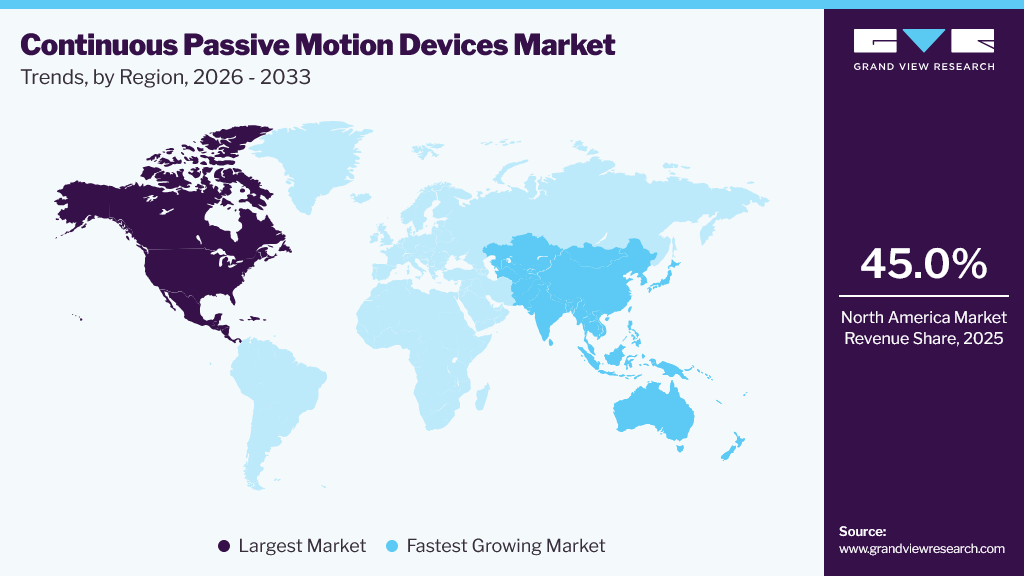
North America dominated the market, accounting for a revenue share of 45.0% of the global revenue in 2025, owing to the rising prevalence of musculoskeletal disorders, including osteoarthritis and other joint-related conditions, in the region. The increasing volume of orthopedic procedures continues to support demand for postoperative rehabilitation solutions. For instance, in November 2024, the American Academy of Orthopaedic Surgeons (AAOS) reported that the American Joint Replacement Registry (AJRR) had surpassed 4 million recorded hip and knee arthroplasty procedures, representing an 18% increase compared with the previous year. Furthermore, ongoing technological advancements have led to innovations in CPM device design, portability, and patient safety, improving rehabilitation outcomes and driving broader market adoption.
 To learn more about this report, Download Free Sample Report
The CPM devices market in the U.S. is significantly propelled by the rising number of joint reconstruction surgeries, particularly for knee and hip arthroplasty, among the growing geriatric population. These devices play a crucial role in post-surgical rehabilitation, preventing muscle stiffness and enhancing joint mobility. CPM devices serve older adults who benefit from passive motion therapy following joint surgeries. Additionally, adherence to U.S. FDA regulations to ensure device safety and efficacy has fostered market trust and increased adoption.
Asia Pacific Continuous Passive Motion Devices Market Trends
The continuous passive motion devices market in Asia Pacific is projected to experience the fastest growth during the forecast period. The region witnessed a surge in joint reconstruction surgeries, including knee and hip arthroplasty, owing to the aging population and the growing lifestyle-oriented orthopedic conditions. Regional innovation is also supporting market expansion. For instance, in November 2024, the Indian Institute of Technology (IIT) Ropar announced the development of a patented, fully mechanical Continuous Passive Motion (CPM) machine for knee rehabilitation, as reported by the Ministry of Science & Technology, India. The lightweight, portable, and electricity-free device is designed for home-based postoperative recovery, improving accessibility to CPM therapy across resource-constrained settings. Moreover, innovations in CPM device design, portability, safety, and ease of use are improving patient comfort, supporting home-based rehabilitation, and contributing to broader market adoption.
Key Continuous Passive Motion Devices Companies Insights
The continuous motion devices market is fragmented, featuring key players including The Furniss Corporation, Surgi-Care Inc., BTL Corporate, and others. These companies strive to dominate the market by undertaking advanced product development, strategic partnerships and increased R&D efforts.
Key Continuous Passive Motion Devices Companies
The following key companies have been profiled for this study on the continuous passive motion devices market:
-
The Furniss Corporation Ltd.
-
Surgi-Care, Inc.
-
Bio-Med International Pvt Ltd.
-
CHINESPORT Spa Cap. (Chinesport Rehabilitation)
-
BTL Corporate
-
Chattanooga (DJO, LLC)
-
Kinetec Medical Products Ltd
-
Kinex Medical Company, LLC
-
HMS Medical Systems
Recent Developments
-
In July 2025, Enovis launched the Manafuse Bone Growth Stimulator, a portable, battery-powered device utilizing Low-Intensity Pulsed Ultrasound (LIPUS) technology to accelerate fracture healing and improve patient outcomes, further expanding its musculoskeletal rehabilitation portfolio.
-
In March 2026, the Medicare Durable Medical Equipment Medicare Administrative Contractors (DME MACs) revised their payment guidance for Continuous Passive Motion (CPM) machines, clarifying coverage for patients undergoing total knee replacement and revision procedures, while reinforcing reimbursement requirements for home-based CPM therapy.
Continuous Passive Motion Devices Market Report Scope
Report Attribute
Details
Market size in 2025
USD 898.6 million
Estimated market size in 2026
USD 945.3 million
Projected market size by 2033
USD 1,348.0 million
Growth rate
CAGR of 5.2% from 2026 to 2033
Base year for estimation
2025
Historical data
2021 – 2024
Forecast period
2026 – 2033
Quantitative units
Revenue in USD million/billion, and CAGR from 2026 to 2033
Report coverage
Revenue forecast, company ranking, competitive landscape, growth factors, and trends
Segments covered
Type, design, demographics, region
Regional scope
North America; Europe; Asia Pacific; Latin America; MEA
Country scope
U.S.; Canada; Mexico; Germany; UK; France; Italy; Spain; Denmark; Sweden; Norway; China; Japan; India; Australia; Thailand; South Korea; Brazil; Argentina; South Africa; Kuwait; Saudi Arabia; UAE
Key companies profiled
The Furniss Corporation Ltd.; Surgi-Care, Inc.; Bio-Med International Pvt Ltd.; CHINESPORT Spa Cap. (Chinesport Rehabilitation); BTL Corporate; Chattanooga (DJO, LLC); Mirion Technologies, Inc.; Kinetec Medical Products Ltd; Kinex Medical Company, LLC; HMS Medical Systems
Customization scope
Free report customization (equivalent to 8 analyst working days) with purchase. Addition or alteration to country, regional & segment scope.
Pricing and purchase options
Avail of customized purchase options to meet your exact research needs. Explore purchase options
Continuous Passive Motion Devices Market Report Segmentation
This report forecasts revenue growth at the global, regional, and country levels and provides an analysis of the latest industry trends and opportunities across each sub-segment from 2021 to 2033. For this study, Grand View Research has segmented the global continuous passive motion devices market report based on type, design, demographics, and region:
-
Type Outlook (Revenue, USD Million, 2021 - 2033)
-
Knee Joint CPM Devices
-
Shoulder Joint CPM Devices
-
Hip Joint CPM Devices
-
Ankle Joint CPM Devices
-
Others
-
-
Design Outlook (Revenue, USD Million, 2021 - 2033)
-
Portable Devices
-
Fixed Devices
-
-
Demographics Outlook (Revenue, USD Million, 2021 - 2033)
-
Children (Below 18)
-
Adult (18 and above)
-
-
Regional Outlook (Revenue, USD Million, 2021 - 2033)
-
North America
-
U.S.
-
Canada
-
Mexico
-
-
Europe
-
Germany
-
UK
-
France
-
Italy
-
Spain
-
Denmark
-
Sweden
-
Norway
-
-
Asia Pacific
-
China
-
Japan
-
India
-
Australia
-
South Korea
-
Thailand
-
-
Latin America
-
Brazil
-
Argentina
-
-
Middle East and Africa (MEA)
-
South Africa
-
Saudi Arabia
-
UAE
-
Kuwait
-
-
Frequently Asked Questions About This Report
The global continuous passive motion devices market size was valued at USD 898.6 million in 2025 and is estimated at USD 945.3 million in 2026
The global continuous passive motion devices market is expected to grow at a CAGR of 5.2% from 2026 to 2033, reaching USD 1,348.0 million in 2033
North America dominated with an approximately 45.0% revenue share in 2025
The knee joint CPM devices segment accounted for the largest revenue share of approximately 42.0% in 2025
Key players in the market include The Furniss Corporation Ltd., Surgi-Care, Inc., Bio-Med International Pvt Ltd., CHINESPORT Spa Cap. (Chinesport Rehabilitation), BTL Corporate, Chattanooga (DJO, LLC), Mirion Technologies, Inc., Kinetec Medical Products Ltd, Kinex Medical Company, LLC, HMS Medical Systems, and others.
About the Author(s)
Medical Devices Research Team
Healthcare · Medical DevicesThis report was authored by the medical devices research team at Grand View Research - comprising two research analysts, one senior research analyst, and one industry expert - with specialized expertise in the medical devices segment of the healthcare industry. All findings are based on proprietary healthcare databases, executive interviews, and regulatory analysis, subject to internal peer review prior to publication.
Last Updated:
Speak to Analyst

Customize this report to your needs - add regions, segments, or data points, with 20% free customization.
Or view our licence options:


ISO 9001:2015 & 27001:2022 Certified
We are GDPR and CCPA compliant! Your transaction & personal information is safe and secure. For more details, please read our privacy policy.


