
- Home
- »
- Alcohol & Tobacco
- »
-
Organic Tobacco Market Size, Share & Trends Report, 2033GVR Report cover

Organic Tobacco Market (2026 - 2033)
Size, Share & Trends Analysis Report By Product (Flue-cured, Sun-cured, Fire-cured), By Application (Smoking, Smokeless), By Region (North America, Europe, Asia Pacific, Latin America, MEA), And Segment Forecasts
Market Size, 2025
$234.3MMarket Estimate, 2026
$252.9MMarket Forecast, 2033
$448.9MCAGR, 2026–2033
8.5%Organic Tobacco Market Summary
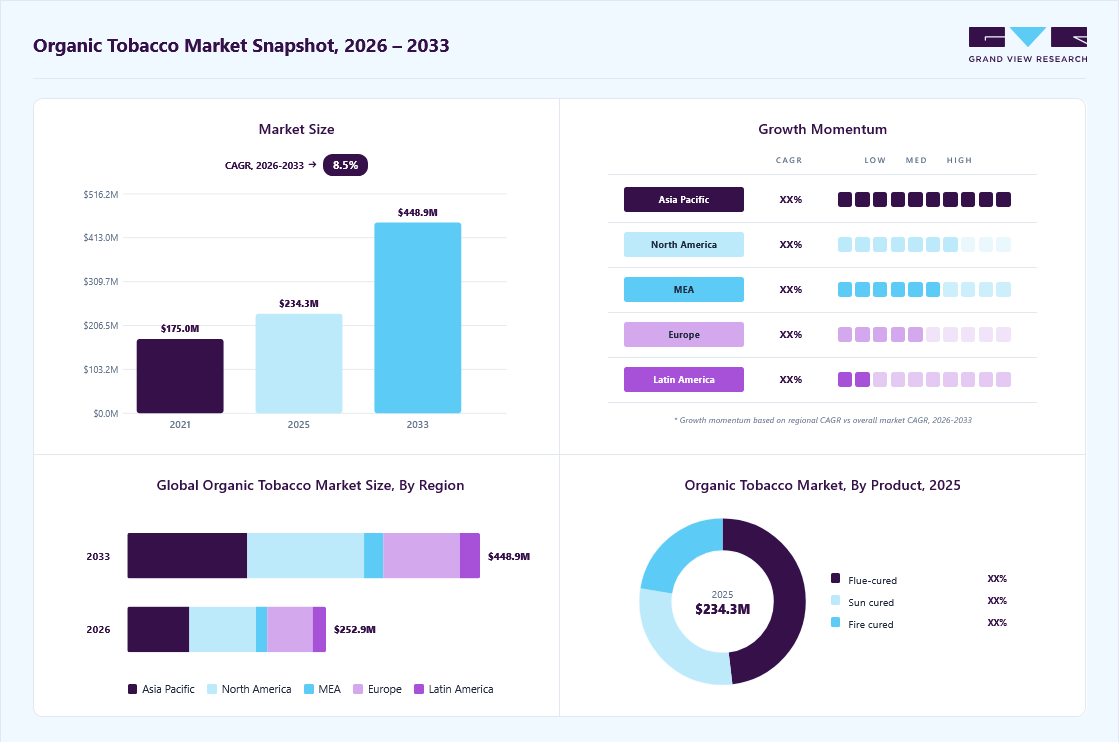
The global organic tobacco market size was valued at USD 234.3 million in 2025 and is projected to grow from USD 252.9 million in 2026 to USD 448.9 million by 2033, growing at a CAGR of 8.5% from 2026 to 2033. North America dominated the market, accounting for the largest global share of 33.6% in 2025. With a continued rise in the worldwide smoking population, a healthy number of both occasional and heavy tobacco users are considering moving towards organic tobacco offerings.
 Source: Grand View Research, IR Documents, Primary Interviews, Paid DatabasesTo learn more about this report,
 Download Free Sample Report
 Key Market Trends & Insights
- By products: Flue-cured segment led the market with the largest revenue share of 48.0% in 2025.
- By application: Smoking segment led the market with the largest revenue share of 84.1% in 2025.
Regional Highlights
- Largest regional market: North America (33.6% revenue share, 2025)
- Fastest-growing regional market: Asia Pacific (highest CAGR, 2026-2033)
- By country: The U.S. held the largest share of North America in 2025.
Market Size & Forecast
- Market size in 2025: USD 234.3 Million
- Estimated market size in 2026: USD 252.9 Million
- Projected market size by 2033: USD 448.9 Million
- CAGR (2026-2033): 8.5%
Three ways to get this report
Buy it, customize it, or ask a question.Ask an Analyst
A direct answer, usually in 1 working day
- AccessReport author, directly
- Reply timeWithin 1 working day
- No sales callDirect answer only
- FormatEmail reply
- CostFree, no cost
Get the Full Report
What the study covers
- FormatsPDF · Excel · Dashboard
- Timeline2026–2033 annual, 2025 base
- Coverage20+ countries, 5 regions
- Companies10+ key players profiled
Customize the Report
20% free customization
- IncludeCountries, segments, points
- TailorTo your product definition
- ExtendDeeper competitor detail
- OrA fully bespoke study
- Turnaround5–10 working days
This tobacco is considered to be a healthier alternative to conventionally grown tobacco due to the absence of chemicals that are extensively utilized in the general farming practices of this crop. Moreover, the broader trend of selecting natural and unprocessed food items has encouraged consumers to demand authentic, natural, and pure tobacco products, enabling steady expansion of the organic tobacco industry. Organic tobacco is being extensively grown by smaller local producers, which appeals to certain consumer segments who are interested in artisanal, small-batch products. These consumers prioritize quality over quantity and are more willing to pay a premium price for tobacco that is grown with organic techniques. This form of tobacco is especially popular in premium cigars and smokeless tobacco products, where consumers generally seek high-quality and flavorful experiences.
 To learn more about this report, Download Free Sample Report
 Government regulations and policies that promote sustainable farming practices are expected to favor healthy industry growth during the forecast period. Certain regions, such as Western Europe and North America, have placed strict regulations on tobacco farming and pesticide usage, which can drive demand for organic tobacco. In addition, bans on certain chemicals used in conventional tobacco cultivation may make organic tobacco more appealing to growers. The certification of organic tobacco, such as USDA Organic Certification and EU Organic Certification, provides a guarantee of its cultivation methods, which helps boost consumer confidence and increases market demand.
There has been a noticeable shift towards organic tobacco rolled cigarettes, which has positively impacted the global market. Increasing health awareness has forced consumers to shift their preference to organically prepared alternatives, as its consumption is considered less harmful in comparison to conventional tobacco. There has been a steady increase in the number of smokers globally who prefer the consumption of cigars and cigarettes prepared from organic tobacco instead of completely quitting their smoking habit. The demand for organic tobacco is expanding, but it remains a relatively niche segment compared to the broader tobacco market. Factors such as health concerns, sustainability, and an increasing preference for natural products are driving this trend. As the broader awareness and appeal regarding organic and eco-friendly products rises, organic tobacco could see a potential growth in its adoption, particularly among health-conscious and environmentally aware consumers.
Market Dynamics
The global organic tobacco market is witnessing strong growth, driven by increasing demand for premium tobacco products, rising preference for organically cultivated crops, and growing awareness of sustainable agricultural practices. Consumers are showing greater interest in tobacco products produced without synthetic pesticides and chemical fertilizers, encouraging manufacturers to expand certified organic tobacco cultivation and sourcing networks. In addition, the growing focus on product traceability, quality assurance, and environmentally responsible farming methods is strengthening market adoption. Continuous investment in organic farming capabilities and the expansion of premium tobacco product portfolios are expected to support sustained market growth during the forecast period.
Increasing consumer awareness regarding agricultural sustainability and reduced chemical usage is driving demand for organic tobacco. Manufacturers are focusing on certified organic cultivation methods that avoid synthetic pesticides and fertilizers, aligning with evolving consumer preferences for naturally produced tobacco products. The premium positioning and perceived product authenticity of organic tobacco continue to strengthen its market appeal among niche consumer segments.
Organic tobacco production faces challenges related to lower crop yields, stringent certification requirements, and higher labor-intensive farming practices. Dependence on specific growing conditions and compliance with organic standards can increase operational costs and limit large-scale production. These factors may impact supply consistency and pricing competitiveness across the market.
Growing demand for premium tobacco products presents opportunities for manufacturers to expand organic product portfolios. Investment in sustainable farming practices, traceable supply chains, and certified organic tobacco sourcing is creating avenues for product differentiation. Additionally, innovation in packaging, branding, and specialty tobacco blends is enabling companies to strengthen consumer engagement and capture value within the premium tobacco segment.
Analyst Perspective
The craft organic tobacco market is witnessing steady growth, supported by rising consumer interest in naturally cultivated, chemical-free tobacco products and increasing demand for premium, small-batch smoking experiences. Growing awareness regarding sustainable farming practices, product traceability, and clean-label preferences continues to influence purchasing decisions. Manufacturers are focusing on organic certification, artisanal processing methods, and differentiated product offerings to strengthen brand positioning. Future market development is expected to be driven by innovation in premium blends, expansion of direct-to-consumer sales channels, and increasing adoption of environmentally responsible cultivation practices. The market is also likely to benefit from rising demand for authentic and niche tobacco products among adult consumers.
Product Insights
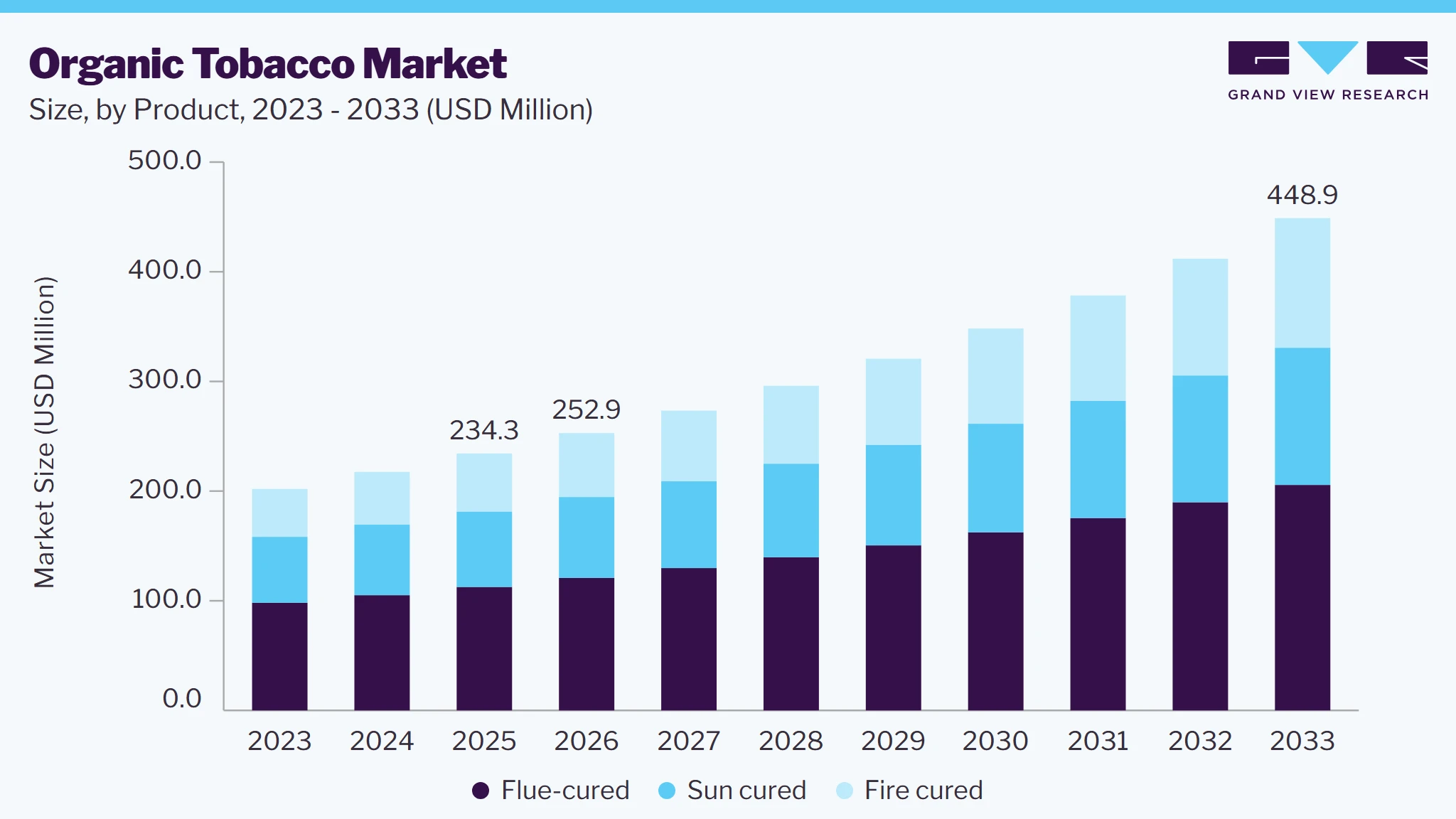
Based on products, the flue-cured segment led the market with the largest revenue share of 48.0% in 2025. This tobacco is grown using organic farming practices and subjected to flue-curing, which is a specific method of drying tobacco leaves. This type of tobacco is prized for its unique flavor profile, which is typically sweeter and milder compared to other curing methods. Flue curing is a very popular method, with around 90% of tobacco produced in the U.S. annually being of this type. Flue-curing is generally associated with high-quality cigarette tobacco, particularly in the production of Virginia tobacco varieties. Total Leaf Supply, based in Virginia, is a notable seller of flue-cured tobacco, such as Virginia Flue Cured, Organic Virginia Flue Cured Lemon Leaf, and Organic Virginia Flue Cured Orange Leaf.
Meanwhile, the fire-cured segment is expected to grow at the highest CAGR from 2026 to 2033. The fire-curing process involves exposing freshly harvested tobacco leaves to smoke and heat from burning wood or other natural materials, creating a unique flavor profile for the tobacco. This type of tobacco is used in smokeless products such as snuff and chewing tobacco, as well as cigars and a few pipe tobacco blends. Fire-cured organic tobacco has a full-bodied, earthy, and savory flavor, with traces of woodsmoke, spices, and sweetness. As synthetic chemicals are not utilized in the farming process, organic fire-cured tobacco generally has a purer flavor when compared to its conventionally grown counterpart.
Application Insights
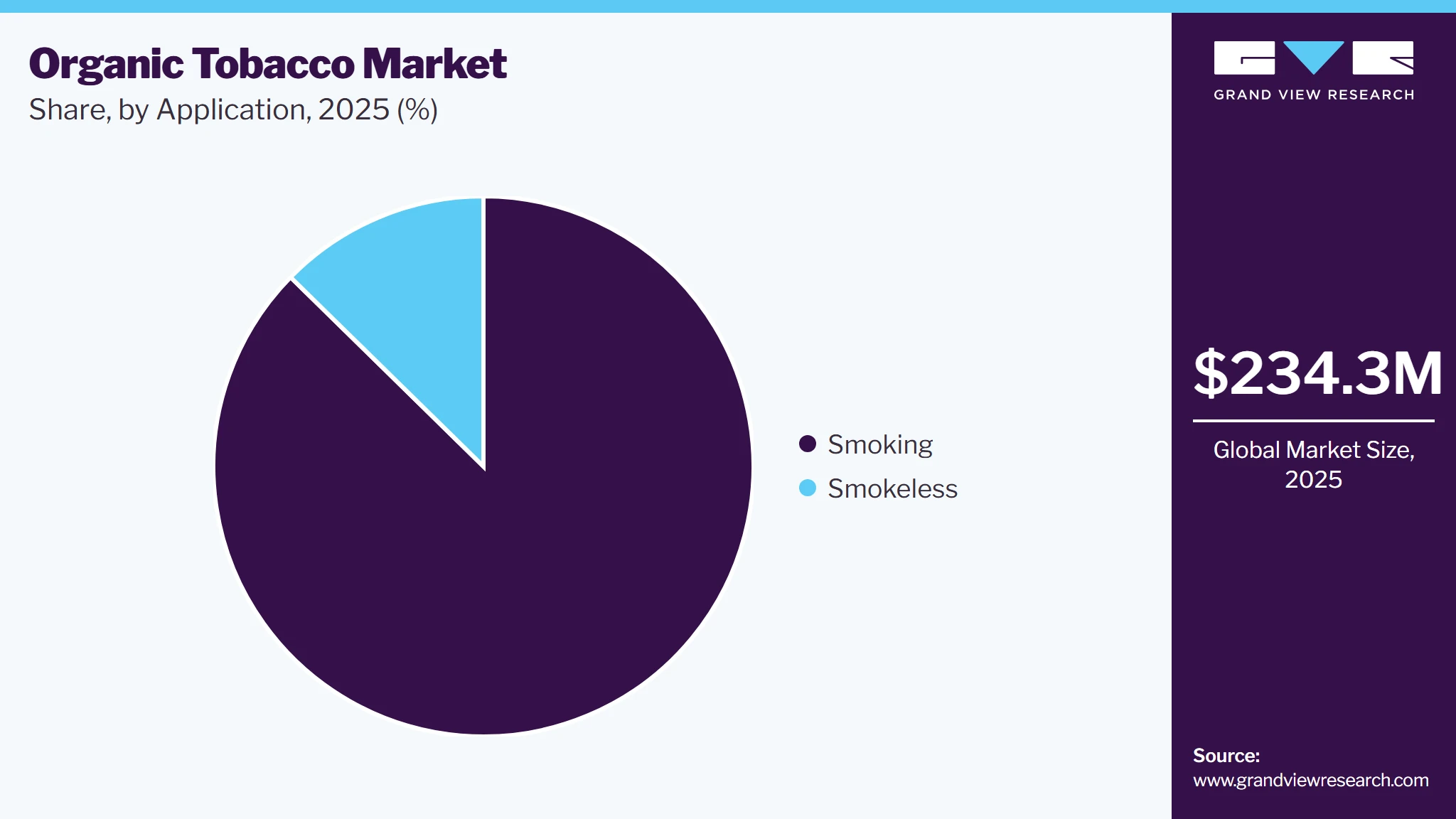
Based on application, the smoking segment led the market with the largest revenue share of 84.1% in 2025. The substantial cigarette smoking population globally has provided a major growth opportunity for organic tobacco companies by enabling them to propagate the advantages of their offerings over traditional tobacco products. Increasing health awareness and concerns about the harmful effects of smoking are prompting consumers to seek alternatives that are perceived to be cleaner or less harmful. Organic tobacco used in cigarettes is grown as per stringent organic farming guidelines. Improved regulatory support for organic tobacco farming and clearer certification standards can potentially help improve market confidence and consumer adoption in this segment.
 To learn more about this report, Download Free Sample Report
 Meanwhile, the smokeless segment is anticipated to expand at the highest CAGR from 2026 to 2033. Smokeless organic tobacco refers to products made from organic tobacco that do not require combustion and include chewing tobacco, snuff, and nicotine pouches. These products are designed for consumers who prefer alternatives to smoking, offering a way to consume nicotine without inhaling smoke. The organic element signifies that the tobacco used in these products is cultivated without synthetic chemicals, following organic farming standards. In contrast to traditional cigarettes, the absence of combustion in smokeless products means that users are not exposed to harmful chemicals created by burning tobacco, such as tar and carbon monoxide.
Regional Insights
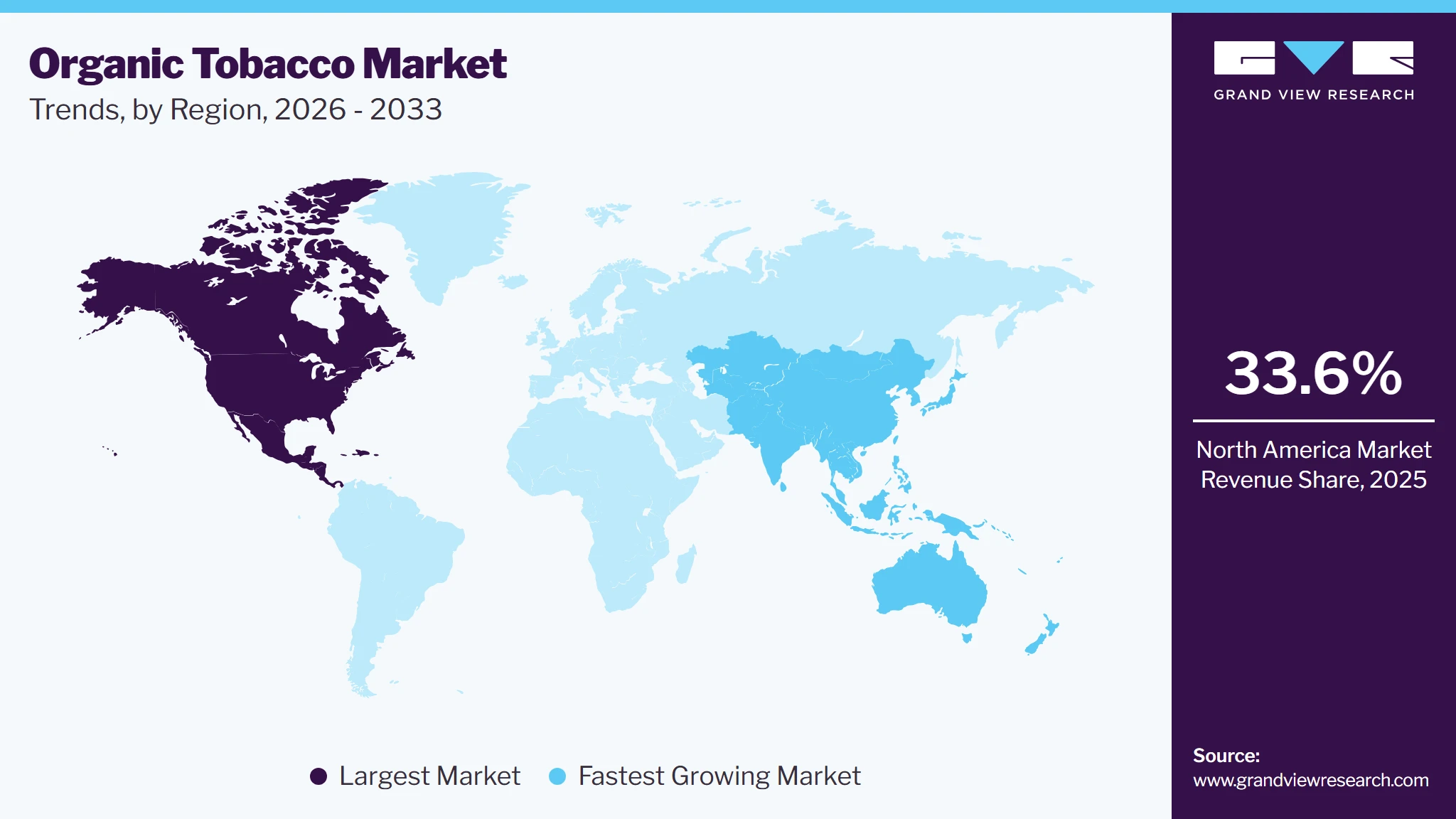
North America dominated the organic tobacco market with the largest revenue share of 33.6% in 2025. The demand for these products is driven by the continued steady growth of a health-conscious and environmentally aware consumer base and increasing premiumization of tobacco products. A growing number of smokers in regional economies are looking for products that are free from additives, preservatives, and chemicals that are commonly used in traditional cigarettes to enhance flavor, shelf-life, or burn rate. Organic tobacco, which is cultivated without synthetic pesticides or fertilizers and processed without chemicals, appeals to consumers who are concerned about what they are inhaling. As a result, the market is expected to expand at a moderate pace in economies such as the U.S. and Canada.
 To learn more about this report, Download Free Sample Report
 U.S. Organic Tobacco Market Trends
The organic tobacco market in the U.S. held the largest share in the North America region in 2025, as the demand for organic tobacco products has witnessed steady growth in recent years. The presence of several major regional and global tobacco companies that have diversified their offerings to include these products has boosted their popularity among consumers, particularly among the younger demographics. Shifting preference among American buyers to consume products that use organically-grown tobacco instead of quitting conventional smoking is projected to remain a major industry driver in the coming years.
Europe Organic Tobacco Market Trends
Europe accounted for a substantial revenue share in the global market in 2025 on account of a strong consumer preference for sustainability, health-consciousness, and premium products in the tobacco sector. Furthermore, tobacco regulations in the European Union (EU) are some of the strictest worldwide, with laws that govern every aspect, including packaging, labeling, advertising, and product ingredients. These regulations have compelled both producers and consumers to use products that are cleaner and have fewer additives. This regulatory environment supports the rise of organic and natural tobacco, as it complies with the broader trend of using healthier and more transparent products.
Asia Pacific Organic Tobacco Market Trends
The Asia Pacific region is anticipated to grow at the highest CAGR from 2026 to 2033. Rising awareness regarding the presence of toxic chemicals and other unwanted components in conventional tobacco items has provided an opportunity for manufacturers to market organic tobacco as a healthier and safer alternative for regional consumers. Additionally, countries such as Japan, Australia, and South Korea have seen a growing interest in premium and artisanal tobacco products in the past few years. Organic tobacco, with its emphasis on quality, purity, and natural cultivation methods, aligns with the increasing consumer preference for premium tobacco offerings that provide a distinctive experience.
China accounted for the largest revenue share in the Asia Pacific organic tobacco industry in 2025. The country leads in terms of tobacco consumption globally, with the World Health Organization stating that there are over 300 million smokers in China, which is around 33% of the overall global number. As a result, the country has significantly attracted companies involved in organic tobacco production to promote healthier alternatives to consumers. Major cities such as Beijing, Shanghai, and Guangzhou, where consumers are becoming more conscious of the risks associated with smoking, are expected to witness higher proliferation of these products. While organic tobacco remains a niche product, the Chinese government’s encouragement for sustainable agriculture is anticipated to make it easier for tobacco farmers to transition to organic practices in the near future.
Key Organic Tobacco Company Insights
Some major companies involved in the organic tobacco industry include Reynolds American, Japan Tobacco, and Mother Earth Tobacco, among others.
-
Japan Tobacco Inc. (JT) is known for manufacturing and selling cigarettes, smokeless tobacco, and reduced-risk products. The company’s tobacco business accounts for over 90% of its revenue, with the remaining share coming from its pharmaceutical and processed food business divisions. Some of the notable tobacco brands under the company include MEVIUS, Winston, Camel, and LD, while its smokeless and reduced-risk products, Ploom and Logic, are sold through the Japan Tobacco International (JTI) division.
-
Mother Earth Tobacco markets its products using non-processed tobacco leaves with no additives or artificial ingredients, catering to consumers seeking a rich and pure tobacco experience. Mother Earth Tobacco promotes the use of organic farming methods for growing its tobacco, which results in reduced emissions of greenhouse gases, improved soil productivity, and reduced exposure of farmers to toxic chemicals.
Key Organic Tobacco Companies
The following key companies have been profiled for this study on the organic tobacco market.
-
The Hershey's Company
-
Nestlé
-
The Kroger Co.
-
The J.M. Smucker Company
-
Torani
-
Bosco
-
Hollander Chocolate, Inc
-
Walder Farms
-
Amoretti
-
Gold's Pure Foods, LLC.
Competitive Benchmarking
Category
Operating Strategies
Competitive Edge
Weakness
Established Players (Japan Tobacco Inc.; Reynolds American Inc.; MAC BAREN; HBT Tobacco Industry and Trade LTDA; THE TOBACCO COMPANY)
- Expand organic tobacco portfolios through premium and specialty product offerings.
- Strengthen market presence through extensive distribution networks and long-term retail partnerships.
- Strong brand recognition and established consumer trust across multiple regional and international markets.
- Large-scale manufacturing capabilities and well-developed distribution infrastructure enabling broad market reach.
- High operational and supply chain costs associated with large-scale production and distribution management.
- Slower adaptability to rapidly changing consumer preferences compared to smaller niche competitors.
Emerging Players (Twaksak t/a Quinnington Tobacco; Leaf Only; RealOrganicVapors.com; Mother Earth Tobacco; SEKESA)
- Focus on niche organic tobacco products targeting health-conscious and specialty consumers.
- Enhance brand visibility through direct-to-consumer channels and digital marketing initiatives.
- Ability to quickly respond to evolving consumer preferences and emerging market trends.
- Greater flexibility in product innovation and customization compared to larger competitors.
- Limited financial resources and lower brand visibility relative to established market leaders.
- Restricted distribution networks and smaller production capacities, limiting market penetration.
Organic Tobacco Market Report Scope
Report Attribute
Details
Market size value in 2025
USD 234.3 million
Market size value in 2026
USD 252.9 million
Revenue forecast in 2033
USD 448.9 million
Growth rate
CAGR of 8.5 % from 2026 to 2033
Base year for estimation
2025
Historical data
2021 - 2024
Forecast period
2026 - 2033
Quantitative units
Revenue in USD million/billion, and CAGR from 2026 to 2033
Report coverage
Revenue forecast, company ranking, competitive landscape, growth factors, and trends
Segments covered
Product, application, region
Regional scope
North America; Europe; Asia Pacific; Central & South America; Middle East & Africa.
Country scope
U.S.; Canada; Mexico; Germany; France; UK; Italy; China; Japan; India; South Korea; Australia; Brazil; South Africa
Key companies profiled
The Hershey's Company; Nestlé; The Kroger Co.; The J.M. Smucker Company; Torani; Bosco; Hollander Chocolate, Inc; Walder Farms; Amoretti; Gold's Pure Foods, LLC.
Customization scope
Free report customization (equivalent up to 8 analysts' working days) with purchase. Addition or alteration to country, regional & segment scope.
Pricing and purchase options
Avail customized purchase options to meet your exact research needs. Explore purchase options
Global Organic Tobacco Market Report SegmentationThis report forecasts revenue growth at the global, regional, and country levels and provides an analysis of the latest industry trends in each of the sub-segments from 2021 to 2033. For this study, Grand View Research has segmented the global organic tobacco market report based on product, application, and region:
 To learn more about this report, Download Free Sample Report
 -
Product Outlook (Revenue, USD Million, 2021 - 2033)
-
Flue-cured
-
Sun-cured
-
Fire-cured
-
-
Application Outlook (Revenue, USD Million, 2021 - 2033)
-
Smokeless
-
Smoking
-
-
Regional Outlook (Revenue, USD Million, 2021 - 2033)
-
North America
-
U.S.
-
Canada
-
Mexico
-
-
Europe
-
Germany
-
U.K.
-
France
-
Spain
-
Italy
-
-
Asia Pacific
-
China
-
India
-
Japan
-
Australia
-
South Korea
-
-
Latin America
-
Brazil
-
-
MEA
-
South Africa
-
-
Research Methodology
The organic tobacco market figures in this report are based on a proven research process that combines executive interviews with secondary research from proprietary databases, company filings, and recognized regulatory and institutional sources. Market size is built through value-chain sizing - reconciling supply-side and demand-side estimates - and triangulated with bottom-up and top-down approaches. Every estimate passes multiple levels of expert validation before publication, with each organic tobacco segment quantified using the revenue-capture definitions in the table below.
Segment Definition
Segment - Product
Revenue capture definition
Flue-cured
This segment includes the sales of organically cultivated tobacco leaves cured through controlled heated-air drying processes, producing a mild flavor profile and consistent leaf quality for tobacco product manufacturing.
Sun cured
This segment includes the sales of organic tobacco leaves naturally dried under sunlight, offering distinctive aroma characteristics and supporting the production of traditional tobacco products.
Fire cured
This segment includes the sales of organic tobacco leaves cured using controlled wood-smoke exposure, resulting in rich flavor attributes and applications in specialty tobacco blends.
Estimation Model
The Four-Layer Estimation Model
Layer No.
Layer Name
Key Question
Description
01
Consumption Layer
Who is inclined toward organic tobacco products?
Identifies adult tobacco consumers seeking natural, additive-free, and sustainably cultivated tobacco products, including premium product users, environmentally conscious consumers, and individuals preferring chemical-free alternatives.
02
Availability Layer
Who can access organic tobacco products?
Assesses product availability across specialty tobacco retailers, convenience stores, online platforms, and licensed distribution networks. Considers regional regulations and retail penetration to estimate the accessible consumer base.
03
Purchase Adoption Layer
Who actively purchases organic tobacco products?
Applies adoption rates among accessible consumers by evaluating awareness levels, premium product acceptance, perceived product quality, and demand for organically cultivated tobacco offerings.
04
Monetisation Layer
How much revenue is generated?
Estimates market revenue by combining active purchasers with average annual spending on organic cigarettes, rolling tobacco, cigars, and related products across retail and online sales channels.
Delivered Customizations
This report has been delivered with the following In-depth customizations
Client Request
Customization Delivered
Value Adds
Cross-Segmentation Analysis for Organic Tobacco Products Across Applications
Detailed assessment of organic tobacco products, including sun-cured, flue-cured, and fire-cured tobacco across smoking and smokeless application segments.
Identifies high-growth product-application opportunities, supports portfolio optimization, highlights evolving consumer consumption trends, and enables targeted product development and market expansion strategies.
Value Chain Analysis
Comprehensive evaluation of the organic tobacco value chain covering organic cultivation, curing, processing, certification, manufacturing, distribution, and retail channels. The analysis assesses operational efficiencies, cost structures, supply chain integration, and key value creation stages.
Supports supply chain optimization, identifies cost-efficiency opportunities, strengthens sourcing and distribution strategies, enhances operational performance, and improves overall market competitiveness.
Company Share Analysis
Detailed assessment of leading organic tobacco manufacturers, including market share, product portfolio strength, production capabilities, distribution networks, and competitive positioning across product and application segments.
Enables competitive benchmarking, identifies market leaders, supports strategic planning, and provides actionable insights for market positioning, partnership opportunities, and business expansion initiatives.
Frequently Asked Questions About This Report
The global organic tobacco market size was estimated at USD 234.3 million in 2025 and is expected to reach USD 252.9 million in 2026.
The global organic tobacco market is expected to grow at a compound annual growth rate of 8.5% from 2026 to 2033 to reach USD 448.9 million by 2033.
Flue-cured segment led the organic tobacco market, fire cured while smokeless is the fastest growing segment.
Key factors that are driving the market growth include rising awareness among occasional as well as heavy smokers regarding the advantages of using organic flavored tobacco to quit smoking.
Asia Pasic is the fastest growing regional market.
Smoking segment led the organic tobacco market, while smokeless is the fastest growing segment.
North America dominated the organic tobacco market with a share of 33.6% in 2025.
MAC BAREN; Japan Tobacco Inc.; HBT Tobacco Industry and Trade LTDA; Twaksak t/a Quinnington Tobacco; Leaf Only; RealOrganicVapors.com; Mother Earth Tobacco; Reynolds American Inc.; SEKESA; THE TOBACCO COMPANY
About the Author(s)
Alcohol & Tobacco Research Team
Consumer Goods · Alcohol & TobaccoThis report was authored by the alcohol & tobacco research team at Grand View Research - comprising two research analysts, one senior research analyst, and one industry expert - with specialized expertise in the alcohol & tobacco segment of the consumer goods industry. All findings are based on proprietary consumer goods databases, executive interviews, and regulatory analysis, subject to internal peer review prior to publication.
Last Updated:
Speak to Analyst

Customize this report to your needs - add regions, segments, or data points, with 20% free customization.
Or view our licence options:


ISO 9001:2015 & 27001:2022 Certified
We are GDPR and CCPA compliant! Your transaction & personal information is safe and secure. For more details, please read our privacy policy.


