
- Home
- »
- Consumer F&B
- »
-
Sports Supplements Market Size & Share Report, 2026-2033GVR Report cover

Sports Supplements Market (2026 - 2033)
Size, Share & Trends Analysis Report By Product (Capsules/Tablets, Powder, Liquid, Bars), By Source (Animal-based, Plant-based), By Distribution Channel, By Region, And Segment Forecasts
Market Size, 2025
$97.4BMarket Estimate, 2026
$105.3BMarket Forecast, 2033
$188.7BCAGR, 2026–2033
8.7%Sports Supplements Market Summary
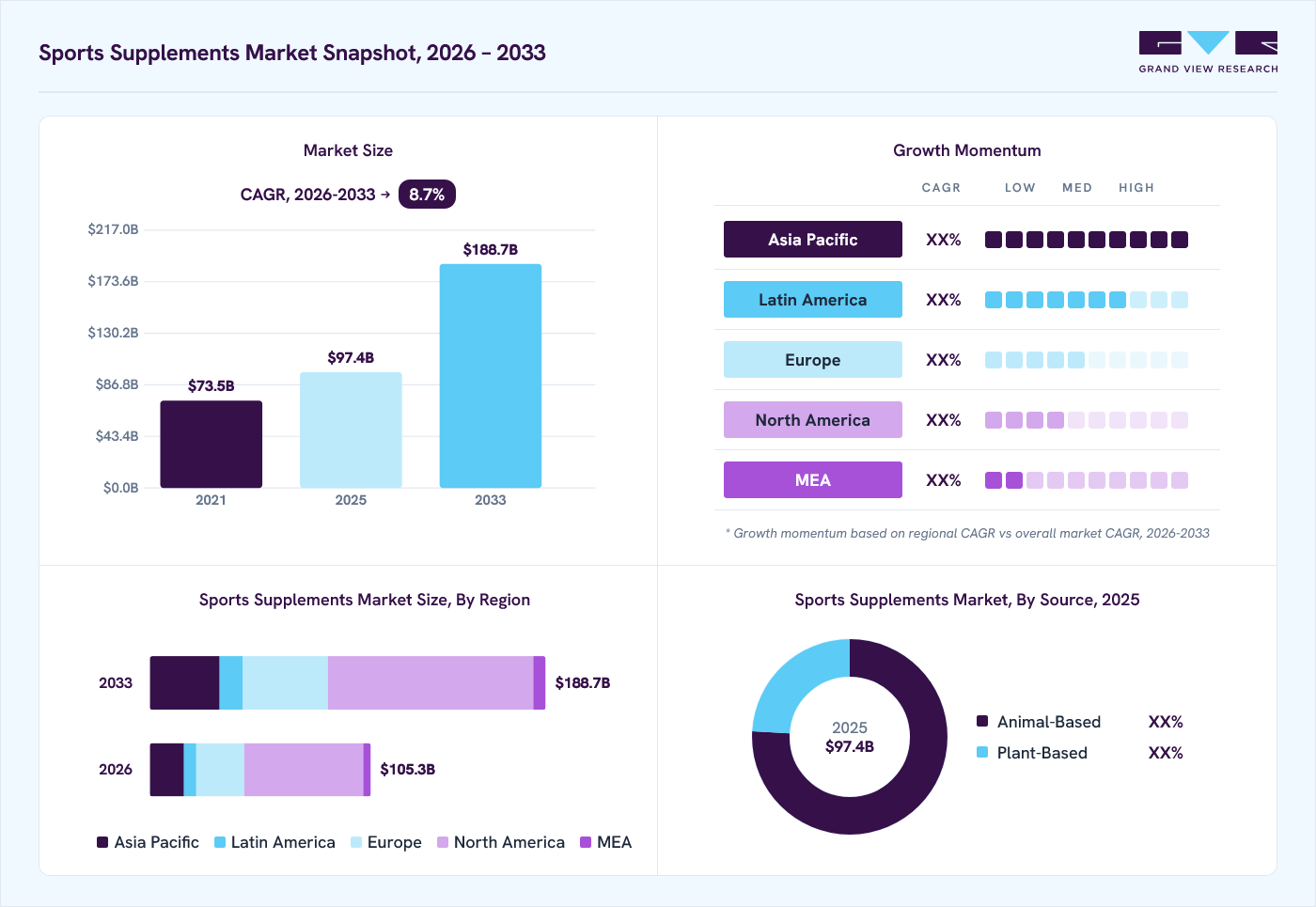
The global sports supplements market size was valued at USD 97.4 billion in 2025 and is projected to grow from USD 105.3 billion in 2026 to USD 188.7 billion by 2033, at a CAGR of 8.7% from 2026 to 2033. The market in North America dominated with a revenue share of 54.1% in 2025. The market has experienced significant growth over the past decade, driven by the rising adoption of fitness regimes and the increasing awareness of the importance of nutrition in maintaining an active lifestyle.
 Source: Grand View Research, IR Documents, Primary Interviews, Paid DatabasesTo learn more about this report,
 Download Free Sample Report
 Key Market Trends & Insights
- By product: Liquid segment held the largest market share of 56.7% in 2025.
- By source: Animal-based segment held the largest market share of 75.8% in 2025.
- By distribution channel: Supermarkets and hypermarkets segment held the largest market share of 33.9% in 2025.
Regional Highlights
- Largest regional market: North America (54.1% revenue share, 2025)
- Fastest-growing regional market: Asia Pacific (highest CAGR, 2026-2033)
- By country: The U.S. held the largest market share in 2025
Market Size & Forecast
- Market size in 2025: USD 97.4 Billion
- Estimated market size in 2026: USD 105.3 Billion
- Projected market size by 2033: USD 188.7 Billion
- CAGR (2026-2033): 8.7%
Three ways to get this report
Buy it, customize it, or ask a question.Ask an Analyst
A direct answer, usually in 1 working day
- AccessReport author, directly
- Reply timeWithin 1 working day
- No sales callDirect answer only
- FormatEmail reply
- CostFree, no cost
Get the Full Report
What the study covers
- FormatsPDF · Excel · Dashboard
- Timeline2026–2033 annual, 2025 base
- Coverage20+ countries, 5 regions
- Companies10+ key players profiled
Customize the Report
20% free customization
- IncludeCountries, segments, points
- TailorTo your product definition
- ExtendDeeper competitor detail
- OrA fully bespoke study
- Turnaround5–10 working days
The market encompasses a broad range of products, including protein powders, energy bars, dietary supplements, and ready-to-drink (RTD) beverages, designed to enhance athletic performance, support recovery, and improve overall health, driving the overall market during the forecast period.
 To learn more about this report, Download Free Sample Report
 Rising health and fitness awareness is expanding the sports supplement consumer base, particularly among Millennials and Gen Z, as more consumers adopt active lifestyles, join gyms, and participate in sports and recreational fitness activities. Social media and fitness influencers are further increasing product awareness and encouraging consumers to incorporate supplements into their wellness routines.
Growing focus on performance optimization and recovery is driving demand for targeted products such as protein supplements, pre-workouts, hydration products, energy bars, and recovery formulations. Consumers increasingly seek products designed around specific fitness objectives, creating opportunities for specialized and multifunctional sports nutrition solutions.
Product innovation and technological advancements are further supporting market development through plant-based proteins, improved formulations, and convenient delivery formats. At the same time, the expansion of e-commerce and digital retail platforms is improving product accessibility, enabling consumers to compare ingredients, reviews, prices, and product benefits before purchasing.
Market Dynamics
Growing health and fitness awareness is expanding the sports supplement consumer base beyond professional athletes and bodybuilders. Consumers increasingly seek products that align with specific goals such as muscle recovery, energy, hydration, sleep, and overall wellness, while greater access to fitness content, expert advice, and digital health platforms support more informed purchase decisions.
Consumers are also showing greater interest in personalized sports nutrition, with product selection increasingly influenced by individual fitness goals, dietary preferences, activity levels, and lifestyle patterns. For instance, in February 2025, Lumina Intelligence reported that 54.0% of consumers across the UK, Italy, France, Germany, and Spain used health or fitness apps and trackers, indicating the growing role of digital tools in shaping personalized nutrition and supplement choices.
This shift is creating opportunities for brands to differentiate through targeted formulations, science-backed claims, transparent labeling, and multifunctional benefits. For instance, in January 2026, Thorne partnered with Unrivaled as its official sports nutrition partner, supplying athletes with products such as protein, creatine, and magnesium, while supporting research on women’s sports nutrition, reflecting the growing demand for specialized products tailored to specific consumer groups.
Concerns about adulteration, hidden ingredients, contamination, and inaccurate labeling can constrain the sports supplement industry by undermining consumer confidence and heightening safety concerns, particularly for performance and bodybuilding products. For instance, in 2025, the U.S. FDA reported identifying more than 1,000 products marketed as dietary supplements or conventional foods that contained hidden drugs and chemicals, including those promoted for bodybuilding and performance enhancement. Such incidents can increase consumer caution, regulatory scrutiny, and the need for stronger product testing and certification, potentially affecting market adoption.
Growing preference for plant-based, clean-label, and sustainable nutrition is creating opportunities for sports supplement brands to expand beyond conventional whey-based products. Consumers are increasingly seeking protein powders, bars, and ready-to-drink products that deliver high protein content alongside recognizable ingredients, dietary compatibility, and environmental benefits. This creates scope for pea, rice, hemp, and blended protein formulations that can address performance and taste expectations.
Analyst Perspective
The sports supplements industry is evolving toward a mainstream active-lifestyle category, supported by rising fitness participation and demand for targeted nutrition. Growth opportunities are shifting toward protein, creatine, hydration, recovery, plant-based formulations, and convenient formats such as bars, RTDs, gummies, and capsules. Competitive differentiation is increasingly driven by clean-label ingredients, science-backed formulations, personalization, product innovation, and omnichannel distribution, while consumer trust and product quality remain critical to sustained market adoption.
Consumer Insights
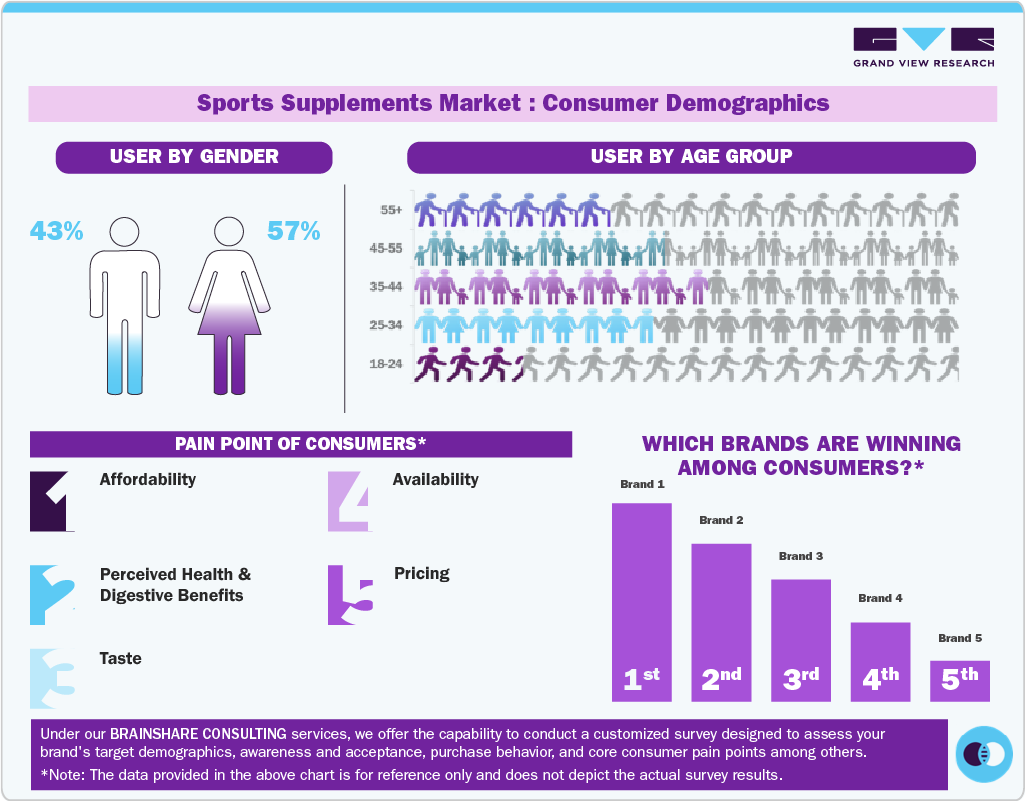
Consumers increasingly perceive sports supplements as everyday performance and wellness products, rather than offerings limited to professional athletes. They seek products that support energy, muscle recovery, hydration, and overall fitness, creating opportunities for multifunctional formulations. For instance, in April 2025, GNC India launched Creatine + Electrolytes, combining creatine with an electrolyte complex to address performance, hydration, and recovery needs among active consumers.
Consumers are also showing greater interest in plant-based and clean-label sports nutrition, particularly products that align with vegan lifestyles and ingredient-conscious purchasing. Convenience is another important consumer consideration, with users increasingly favoring portable, ready-to-consume formats that fit active, busy lifestyles. For instance, in March 2025, Per4m launched Hydrate Shots, a 100-ml, zero-sugar electrolyte product designed for convenient hydration before, during, or after physical activity.
 To learn more about this report, Download Free Sample Report
 Product Insights
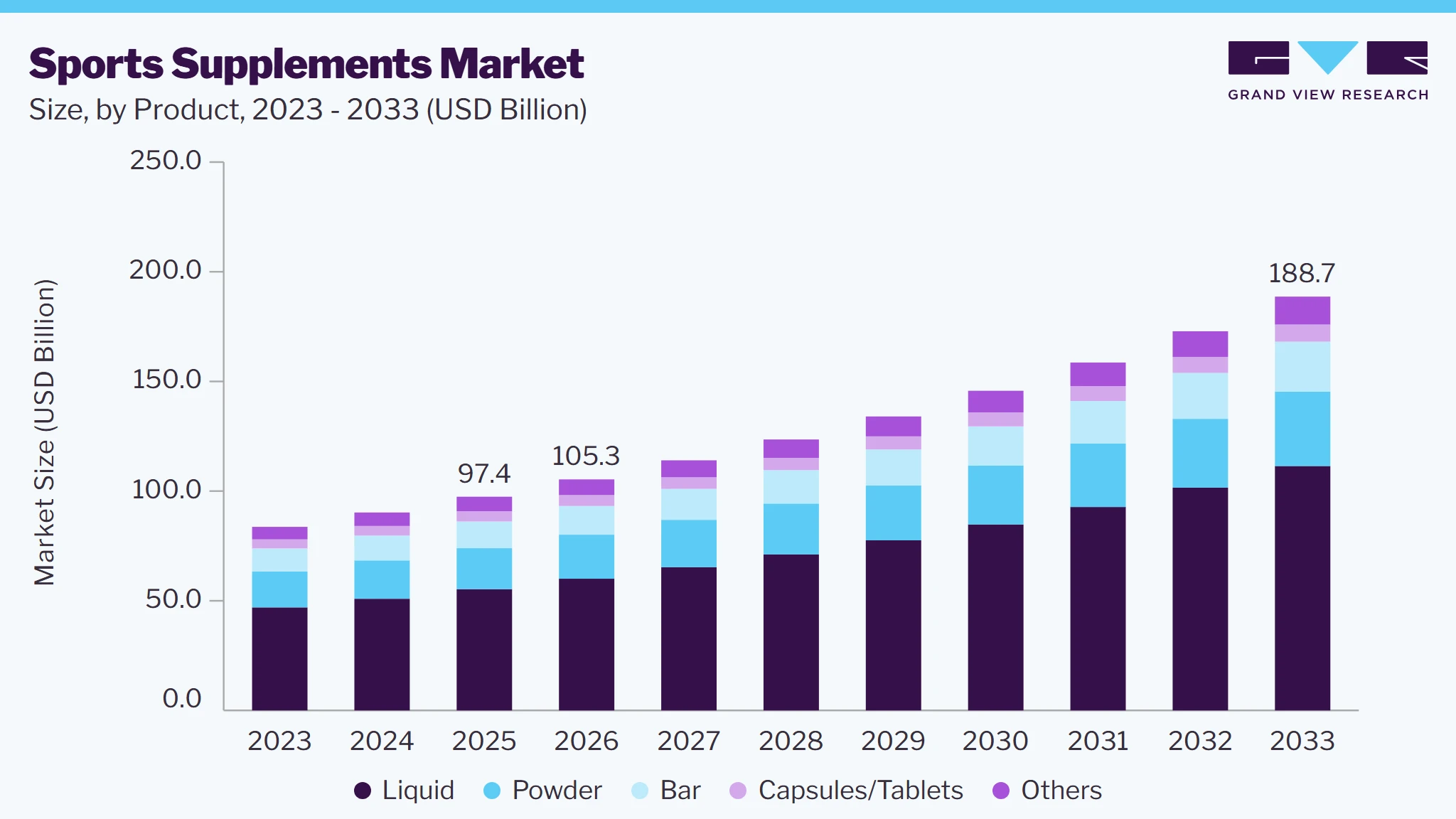
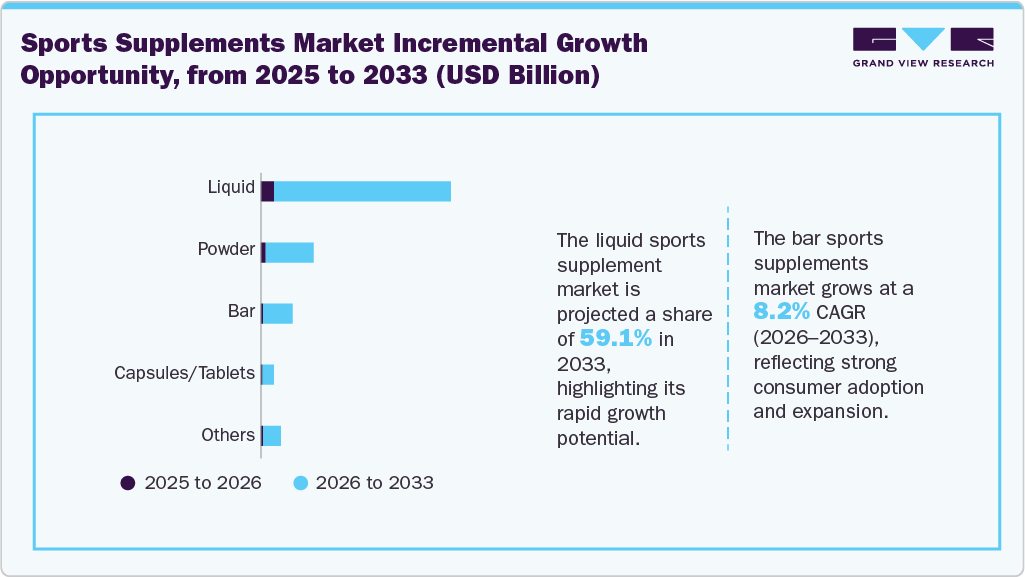
The liquid segment led the market with the largest revenue share of 56.7% in 2025. The market is seeing greater interest in capsule and tablet formats that combine convenience, plant-based materials, and targeted ingredient delivery. Manufacturers are responding with HPMC and pullulan capsules, liquid-filled formats, and designed-release technologies that can improve ingredient protection and formulation flexibility. For instance, in May 2025, Parkacre launched Vangard Performance, a sports nutrition range that included creatine monohydrate capsules and pre-workout capsules, demonstrating the growing use of capsule formats for performance-focused supplementation.
 To learn more about this report, Download Free Sample Report
 The bar segment is projected to grow at a significant CAGR of 8.2% from 2026 to 2033. Growing demand for convenient, multifunctional sports nutrition is encouraging brands to integrate multiple performance ingredients into ready-to-eat bar formats. For instance, in October 2025, JiMMYBAR launched its Creatine Protein Bar, combining 20 g of protein and 5 g of creatine in a ready-to-eat format, offering consumers a portable alternative to conventional protein powders and creatine supplements.
Source Insights
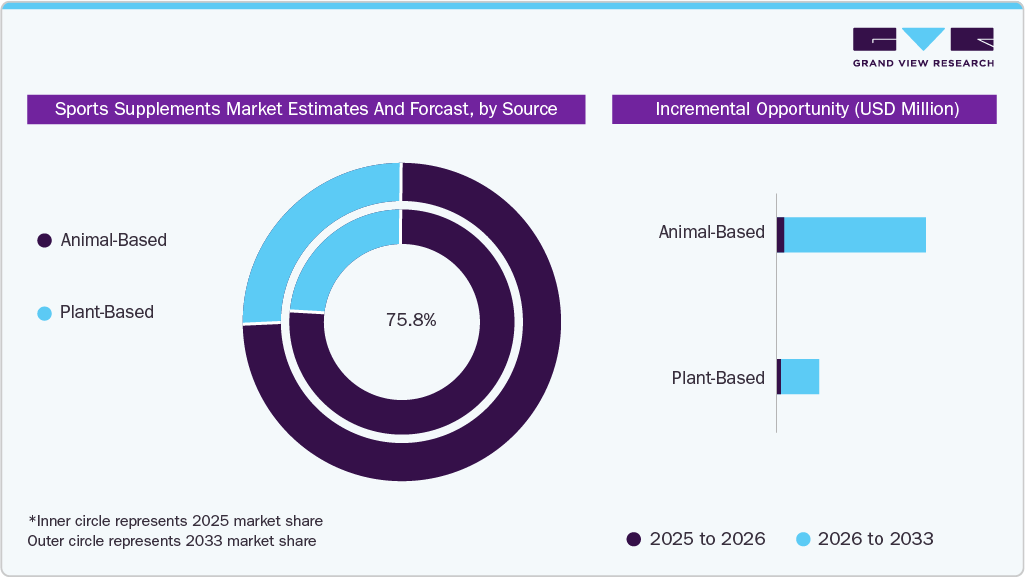
The animal-based segment led the market with the largest revenue share of 75.8% in 2025. Animal-based proteins, particularly whey, remain important in sports nutrition because consumers associate them with high protein quality, rapid absorption, muscle development, and post-workout recovery. This supports continued demand for whey-based powders and other dairy-derived protein supplements among performance-focused consumers.
 To learn more about this report, Download Free Sample Report
 The plant-based segment is projected to grow at the fastest CAGR of 10.1% from 2026 to 2033. Plant-based proteins are gaining traction in sports nutrition as consumers increasingly seek vegan, dairy-free, and sustainable alternatives that still deliver meaningful protein and performance benefits. Product innovation is moving beyond basic plant protein toward multifunctional formulations that combine protein with performance-enhancing ingredients and convenient formats.
Distribution Channel Insights
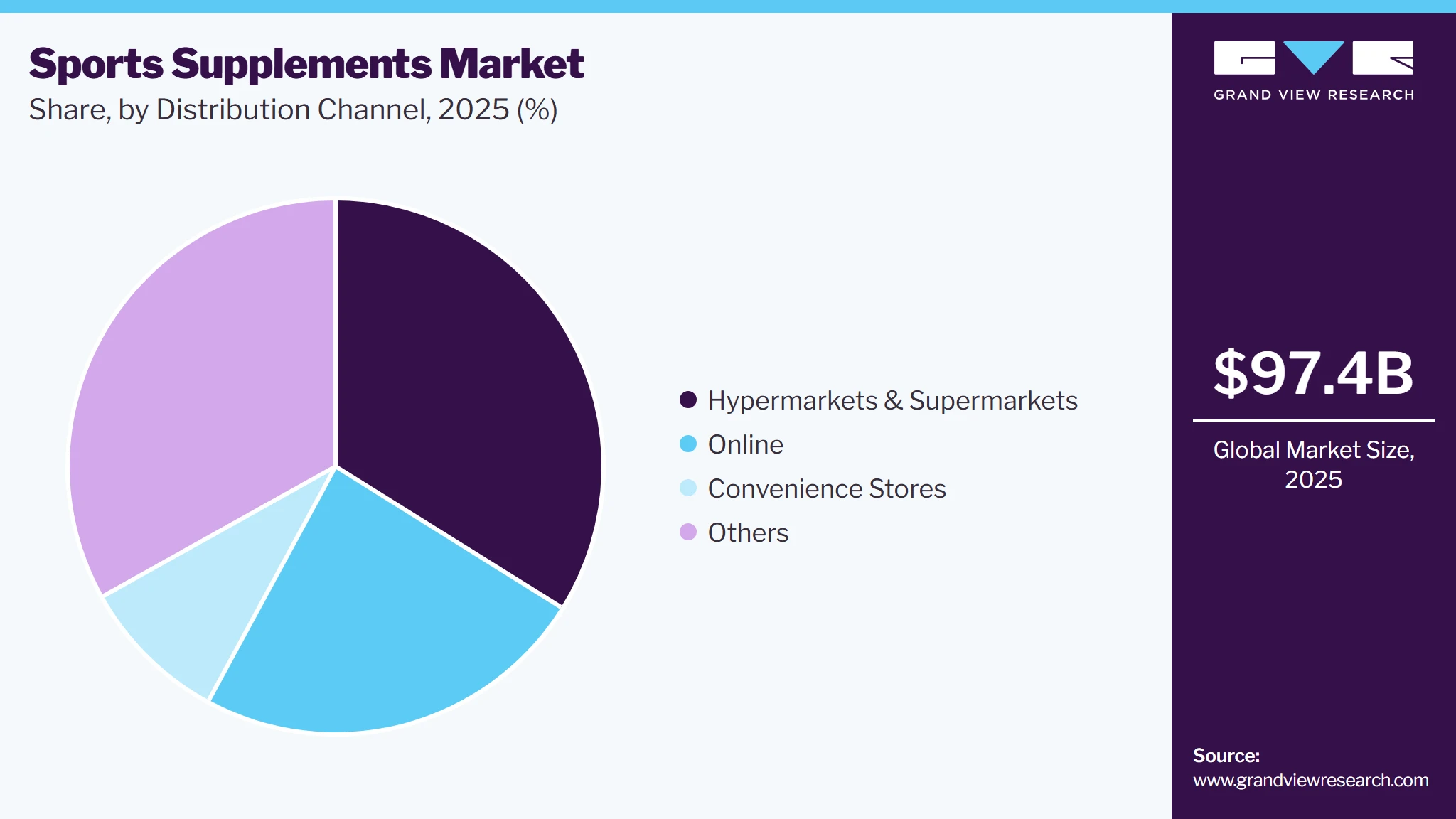
The supermarkets and hypermarkets segment led the market with the largest revenue share of 33.9% in 2025. Supermarkets and hypermarkets have become major players in the distribution of dietary supplements, highlighting their significant role in making sports nutrition and wellness products widely accessible to the general public. Their extensive reach, ample shelf space, and ability to stock a wide range of brands allow consumers to find both mainstream and niche supplements in one location, enhancing visibility and boosting impulse purchases.
In addition to accessibility, consumer behavior strongly favors the convenience of purchasing supplements alongside everyday groceries. Shoppers appreciate the convenience of picking up their protein powders, vitamins, or pre-workout drinks during regular grocery shopping, rather than visiting specialized stores. This one-stop shopping experience saves time and encourages consumers to the new products, as the diverse assortment in hypermarkets and supermarkets allows them to explore different brands and formulations in a familiar environment.
 To learn more about this report, Download Free Sample Report
 The online segment is projected to grow at the fastest CAGR of 10.2% from 2026 to 2033. Consumers today are increasingly turning to other stores for sports supplements due to the convenience they offer. Shopping from home eliminates the need to visit physical stores, allowing buyers to browse a wide range of products at any time, fitting easily into their busy lifestyles. Another reason is the access to a wider variety of products and detailed information.
Other platforms often stock both mainstream and niche brands that may not be available locally, while providing comprehensive product descriptions, nutritional facts, and customer reviews. This helps consumers make informed choices and select supplements that meet their fitness goals. Price and personalization also play a key role. E-commerce sites make it easy to compare prices, find discounts, and even subscribe to regular deliveries, offering convenience and value. In addition, personalized recommendations based on previous purchases or fitness preferences enhance the shopping experience, making others stores a preferred option for many fitness enthusiasts.
Regional Insights
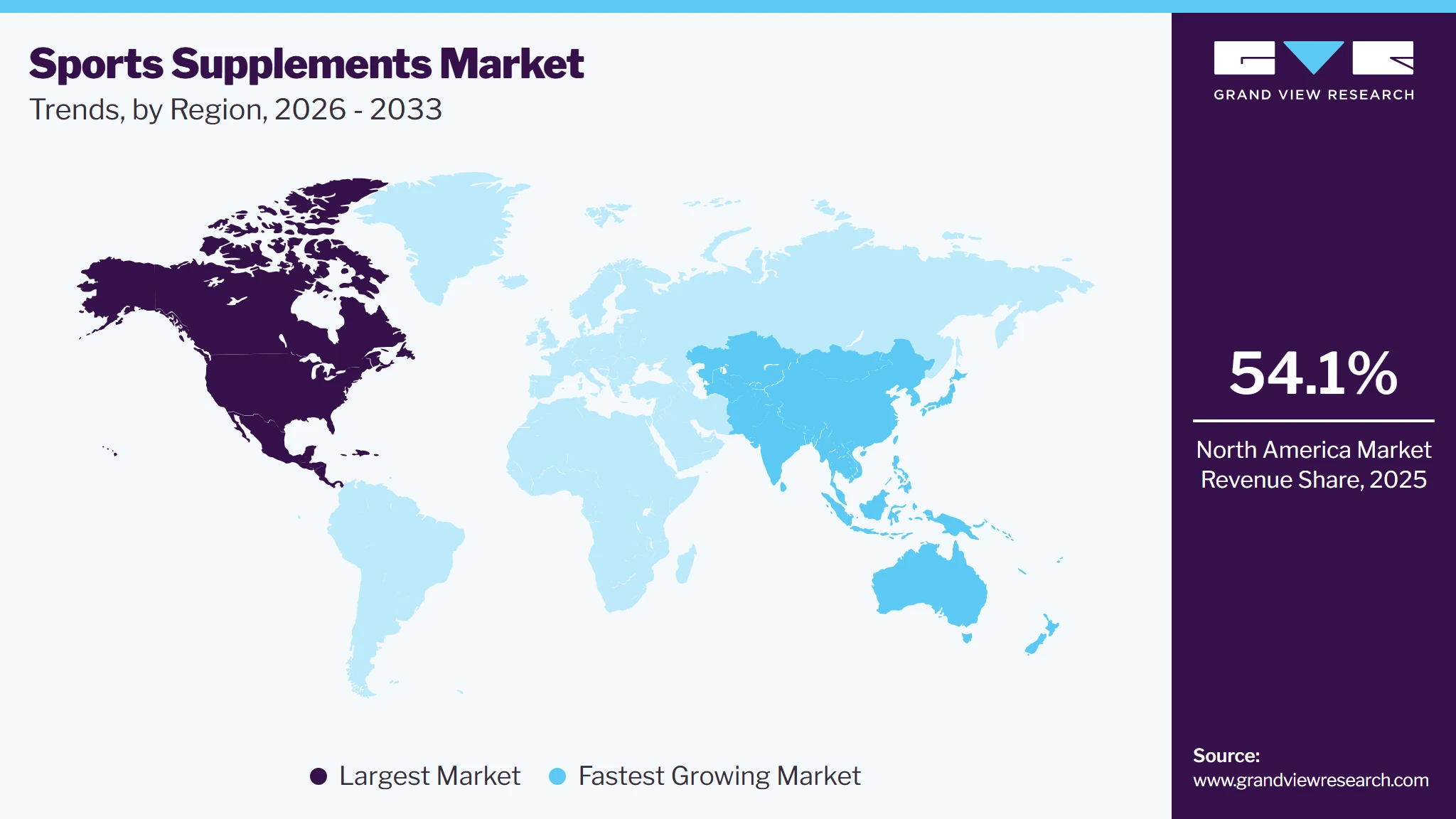
North America sports supplement market held the largest revenue share of 54.1% in 2025. In North America, growing health and wellness awareness is driving the consumption of port supplements. Consumers are increasingly focused on preventive health and functional nutrition, seeking ways to support overall well-being beyond regular meals. Supplements are viewed as a convenient solution to fill nutrient gaps, enhance immune function, and maintain energy levels, helping individuals stay active and healthy in their daily lives.
 To learn more about this report, Download Free Sample Report
 U.S. Sports Supplements Market Trends
The sports supplement market in the U.S. accounted for the largest market revenue share in North America in 2025. The U.S. market is supported by increasing focus on performance nutrition and demand for convenient, multifunctional products. Consumers are increasingly shifting toward portable formats that integrate supplementation into daily fitness routines. For instance, in April 2025, Thorne launched its Sports Performance line with Daily Electrolytes, its first on-the-go electrolyte product, offering NSF Certified for Sport supplementation for athletes across preparation, performance, and recovery.
Europe Sports Supplements Market Trends
The sports supplements market in Europe is projected to grow at a significant CAGR of 8.5% from 2026 to 2033. In Europe, growing participation in gyms, recreational sports, and endurance activities is expanding demand for sports supplements among younger and increasingly mainstream consumers. Products are increasingly viewed as convenient tools for performance, recovery, energy, and daily protein intake, rather than being limited to professional athletes. For instance, in July 2025, Team Picnic PostNL and DSM-Firmenich launched the up4 Sports Nutrition range to the public in the Netherlands, offering products developed and used by professional cycling athletes for training and competition. This highlights the region’s shift toward performance-oriented and convenient sports nutrition.
The UK sports supplement market is increasingly shaped by mainstream protein consumption, product premiumization, and the integration of sports nutrition into everyday diets. Consumers are showing greater interest in products that offer clear nutritional value while fitting easily into daily routines, creating demand for protein powders, bars, shakes, and specialized performance products across both specialist and mainstream retail channels. For instance, in October 2025, Glanbia introduced Isopure in the UK through retailers including Holland & Barrett, Boots, Sainsbury’s, Amazon, and Ocado, expanding access to whey-isolate-based sports nutrition beyond traditional specialist channels.
Asia Pacific Sports Supplements Market Trends
The sports supplements market in the Asia Pacific is projected to grow at the fastest CAGR of 10.7% from 2026 to 2033. The Asia Pacific market is entering a broader consumer adoption phase, supported by expanding fitness communities and increasing emphasis on protein intake and active living. Demand is shifting toward easy-to-consume, performance-oriented products such as protein beverages, powders, bars, and recovery formulations, particularly among urban consumers seeking nutrition solutions that complement work, exercise, and busy daily schedules.
Central & South America Sports Supplements Market Trends
The sports supplements market in Central & South America is projected to grow at a substantial CAGR of 9.5% from 2026 to 2033. The market is supported by rising health awareness, urbanization, and expanding digital commerce, increasing demand for protein powders, pre-workouts, energy products, and convenient sports nutrition formats.
Middle East & Africa Sports Supplements Market Trends
The sports supplements market in the Middle East & Africa is supported by encouraging demand for protein powders, sports drinks, energy bars, and weight-management supplements. The region's growing focus on fitness and preventive health is further expanding the consumer base beyond professional athletes.
Key Sport Supplements Company Insights
The sports supplement industry is experiencing increasing competition as established companies and emerging brands expand their product portfolios. Market participants are focusing on product differentiation through new formulations, flavors, packaging formats, and targeted offerings. Strategic partnerships, distribution expansion, and brand development are also shaping competitive positioning. The market remains fragmented across product categories, with opportunities for companies to strengthen their share through innovation and geographic expansion.
 To learn more about this report, Download Free Sample Report
 Key Sport Supplements Companies
The following key companies have been profiled for this study on the sports supplements market
-
Herbalife
-
Glanbia PLC
-
Abott
-
GNC Holdings, LLC
-
The Simply Good Foods Company
-
THG PLC
-
NOW Foods
-
SciTec, Inc.
-
Universal Nutrition
-
GlaxoSmithKline PLC (GSK) (Maxinutrition)
Recent Developments:
-
In August 2025, Silver Star Nutrition launched ELITE Whey Protein Isolate, a milk-derived whey protein supplement providing 20 g of protein per serving, demonstrating continued product innovation in the animal-based protein segment.
-
In April 2025, Nutrex launched its IsoFit Protein Bar at the Arnold Sports Festival South America in São Paulo, offering 13 g of protein per bar and expanding its sports nutrition portfolio into a convenient, ready-to-eat format.
-
In February 2025, VEGA introduced its rebranded performance nutrition line, including Protein + Creatine with 30 g of plant-based protein and 3 g of creatine per serving, alongside a ready-to-drink plant-based protein shake. The launch demonstrates how brands are integrating plant-based protein, performance functionality, and convenience to address the evolving requirements of active consumers.
Sports Supplements Market Report Scope
Report Attribute
Details
Market size in 2025
USD 97.4 billion
Estimated market size in 2026
USD 105.3 billion
Projected market size by 2033
USD 188.7 billion
Growth rate
CAGR of 8.7% from 2026 to 2033
Base year for estimation
2025
Historical data
2021 - 2024
Forecast period
2026 - 2033
Quantitative units
Revenue in USD billion, and CAGR from 2026 to 2033
Report coverage
Revenue forecast, company ranking, competitive landscape, growth factors, and trends
Segments covered
Product, source, distribution channel, region
Regional Scope
North America; Europe; Asia-Pacific; Central & South America; Middle East & Africa
Country scope
U.S.; Canada; Mexico; UK; Germany; France; Italy; Spain; China; Japan; India; Australia & New Zealand; Brazil; South Africa
Key companies profiled
Herbalife; Glanbia PLC; Abott; GNC Holdings, LLC; The Simply Good Foods Company; THG PLC; NOW Foods; SciTec, Inc.; Universal Nutrition; GlaxoSmithKline PLC (GSK) (Maxinutrition)
Customization scope
Free report customization (equivalent up to 8 analysts’ working days) with purchase. Addition or alteration to country, regional & segment scope.
Pricing and purchase options
Avail customized purchase options to meet your exact research needs. Explore purchase options
Global Sport Supplements Market Report Segmentation
This report forecasts revenue growth at the regional and country levels and provides an analysis of the latest industry trends and opportunities in each of the sub-segments from 2021 to 2033. For this study, Grand View Research has segmented the global sports supplements market report based on the product, source, distribution channel, and region.
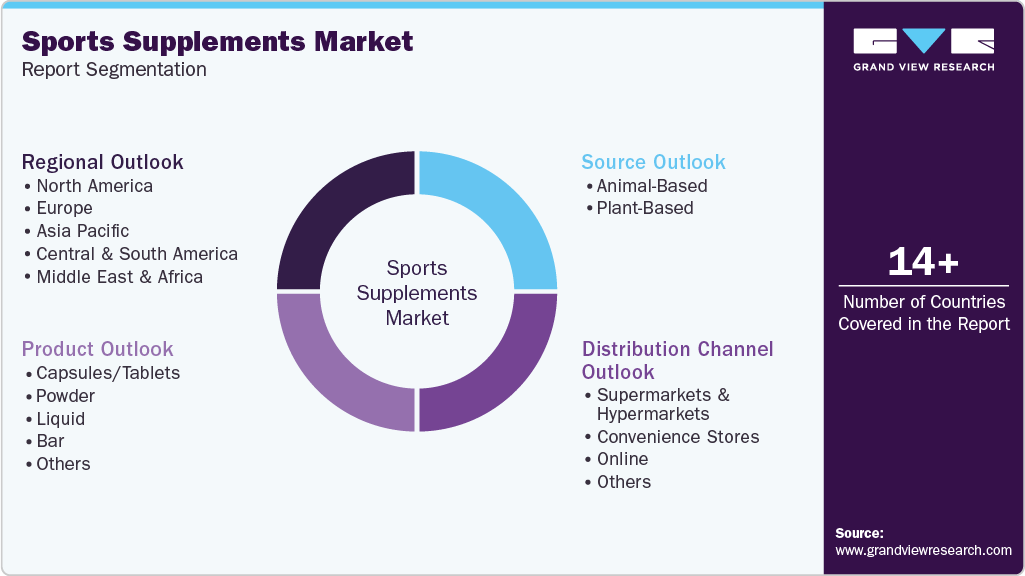 To learn more about this report, Download Free Sample Report
 -
Product Outlook (Revenue, USD Billion, 2021 - 2033)
-
Capsules/Tablets
-
Powder
-
Liquid
-
Bar
-
Others
-
-
Source Outlook (Revenue, USD Billion, 2021 - 2033)
-
Animal-Based
-
Plant-Based
-
-
Distribution Channel Outlook (Revenue, USD Billion, 2021 - 2033)
-
Supermarkets & Hypermarkets
-
Convenience Stores
-
Online
-
Others
-
-
Regional Outlook (Revenue, USD Billion, 2021 - 2033)
-
North America
-
U.S.
-
Canada
-
Mexico
-
-
Europe
-
UK
-
Germany
-
France
-
Italy
-
Spain
-
-
Asia Pacific
-
China
-
Japan
-
India
-
Australia & New Zealand
-
-
Central & South America
-
Brazil
-
-
Middle East & Africa
-
South Africa
-
-
Research Methodology
The sport supplements market figures in this report are based on a proven research process that combines executive interviews with secondary research from proprietary databases, company filings, and recognized regulatory and institutional sources. Market size is built through value-chain sizing-reconciling supply-side and demand-side estimates-and triangulated with bottom-up and top-down approaches. Every estimate passes multiple levels of expert validation before publication, with eachsport supplements segment quantified using the revenue-capture definitions in the table below.
Segment Definition
Product
Revenue capture definition
Capsules/Tablets
This segment includes the sales of sports supplements available in capsule and tablet formats.
Powder
This segment includes the sales of sports supplements available in powder formats.
Liquid
This segment includes the sales of sports supplements available in liquid formats.
Bar
This segment includes the sales of sports supplements available in bar formats.
Estimation Model
Layer Name
Key Question
Description
Consumption Profile Layer
Who consumes sports supplements?
Captures consumers purchasing sports supplements for muscle growth, performance, recovery, energy, hydration, and overall fitness, including athletes, gym-goers, recreational exercisers, and active-lifestyle consumers.
Market Reach Layer
Where are sports supplements accessible?
Covers distribution through specialty nutrition stores, gyms and fitness centers, pharmacies, supermarkets/hypermarkets, e-commerce platforms, and direct-to-consumer channels, determining product availability and consumer access.
Purchase & Retention Layer
What drives repeat purchases?
Focuses on product efficacy, ingredient quality, formulation, taste, convenience, brand trust, price, and fitness goals that influence purchase frequency and customer retention.
Value Generation Layer
How is revenue generated from sports supplements?
Represents monetization through premium formulations, differentiated product formats, specialized performance products, branded offerings, and higher-value functional supplements.
Customization Table
Client Request
Customization Delivered
Value Adds
Global Sports Supplements Market Landscape Assessment
Assessed category evolution, market maturity, key growth drivers, emerging trends, and competitive intensity across major sport supplement categories.
Helps prioritize high-growth categories, identify market whitespace, and shape an informed market-entry or expansion strategy.
Global Sports Supplements Regulatory & Food Safety Assessment
Reviewed regulatory frameworks, labeling requirements, permitted claims, and food-safety requirements across priority markets.
Reduces compliance risks, supports smoother commercialization, and highlights markets with more favorable regulatory pathways.
Global Sports Supplements Channel & Retail Assessment
Assessed retail formats, e-commerce presence, foodservice adoption, distribution models, and channel preferences across key sport supplement markets.
Helps identify the most effective routes to market, prioritize high-potential channels, and uncover opportunities for broader product distribution.
Frequently Asked Questions About This Report
North America dominated with a 54.1% revenue share in 2025.
Asia Pacific is the fastest-growing region over the forecast period.
Animal-Based held the largest revenue share in 2025, while plant-based is the fastest-growing area.
The supermarkets and hypermarkets segment led with a 33.9% revenue share in 2025.
Key players include Herbalife; Glanbia PLC; Abott; GNC Holdings, LLC; The Simply Good Foods Company; THG PLC; NOW Foods; SciTec, Inc.; Universal Nutrition; GlaxoSmithKline PLC (GSK) (Maxinutrition)
Key factors include accelerating demand for science-backed performance nutrition, increasing consumption of protein-enriched formulations for strength development and recovery optimization, and expanding product portfolios targeting endurance, functional fitness, and competitive sports segments.
The global sports supplements market size was valued at USD 97.4 billion in 2025 and is estimated at USD 105.3 billion for 2026.
The global sports supplements market is expected to grow at a CAGR of 8.7% from 2026 to 2033, reaching USD 188.7 billion by 2033.
The Liquid segment led with a 56.7% revenue share in 2025 and is the fastest-growing segment.
About the Author(s)
Consumer F&B Research Team
Consumer Goods · Consumer F&BThis report was authored by the consumer f&b research team at Grand View Research - comprising two research analysts, one senior research analyst, and one industry expert - with specialized expertise in the consumer f&b segment of the consumer goods industry. All findings are based on proprietary consumer goods databases, executive interviews, and regulatory analysis, subject to internal peer review prior to publication.
Last Updated:
Speak to Analyst

Customize this report to your needs - add regions, segments, or data points, with 20% free customization.
Or view our licence options:


ISO 9001:2015 & 27001:2022 Certified
We are GDPR and CCPA compliant! Your transaction & personal information is safe and secure. For more details, please read our privacy policy.


