
- Home
- »
- Renewable Energy
- »
-
Activated Carbon For Pharma & Healthcare Market Report, 2033GVR Report cover

Activated Carbon For Pharma & Healthcare Market (2026 - 2033)
Size, Share & Trends Analysis Report By Form (Powdered, Granular), By Application (API Production, Finished Drug Production), By Region (North America, Europe, Asia Pacific, MEA), And Segment Forecasts
Market Size, 2025
$479.7MMarket Estimate, 2026
$511.4MMarket Forecast, 2033
$741.9MCAGR, 2026–2033
5.5%Activated Carbon For Pharma And Healthcare Market Summary
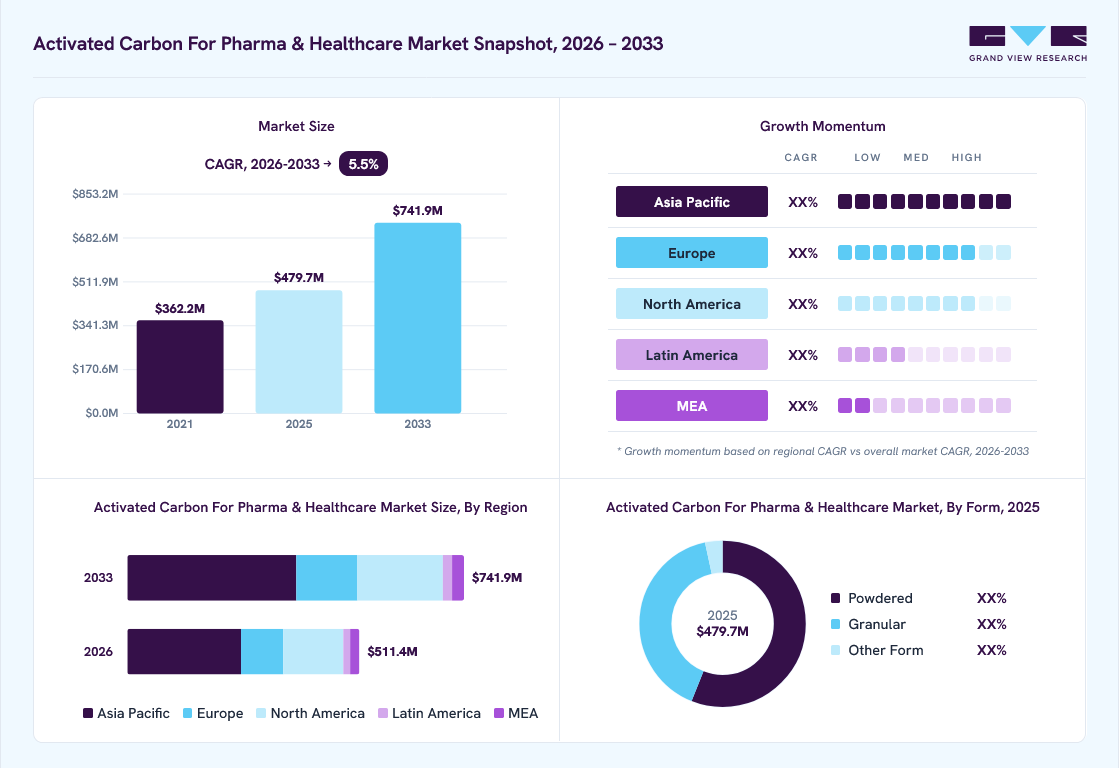
The global activated carbon for pharma and healthcare market size was valued at USD 479.7 million in 2025 and is projected to grow from USD 511.4 million in 2026 to USD 741.9 million by 2033, growing at a CAGR of 5.5% from 2026 to 2033. Asia Pacific dominated the market, accounting for the largest global share of 48.6% in 2025. Its exceptional purification and adsorption properties propel the rising demand for activated carbon in the pharmaceutical and healthcare sectors.
 Source: Grand View Research, IR Documents, Primary Interviews, Paid DatabasesTo learn more about this report,
 Download Free Sample Report
Key Market Trends & Insights
- By form: Powdered segment dominated the form segment at a revenue share of 56.0% in 2025.
- By application: API Production segment accounted for the largest share of 60.2% in 2025.
Regional Highlights
- Largest regional market: Asia Pacific (48.6% revenue share, 2025)
- By country: China held the largest share of Asia pacific in 2025.
Market Size & Forecast
- Market size in 2025: USD 479.7 Million
- Estimated market size in 2026: USD 511.4 Million
- Projected market size by 2033: USD 741.9 Million
- CAGR (2026-2033): 5.5%
Three ways to get this report
Buy it, customize it, or ask a question.Ask an Analyst
Analyst response in 1 business day
- AccessReport author, directly
- Reply timeWithin 1 working day
- No sales callDirect answer only
- FormatEmail reply
- CostFree, no cost
Get the Full Report
What the study covers
- FormatsPDF · Excel · Dashboard
- Timeline2026–2033 annual, 2025 base
- Coverage20+ countries, 5 regions
- Companies10+ key players profiled
Customize the Report
20% free customization
- IncludeCountries, segments, points
- TailorTo your product definition
- ExtendDeeper competitor detail
- OrA fully bespoke study
- Turnaround5–10 working days
It plays a crucial role in applications such as air and water purification in hospitals and pharmaceutical manufacturing, as it eliminates impurities and decolorants from medications. The growing demand for activated carbon in the healthcare sector is closely linked to the high incidence of hospital-acquired infections (HAIs) in the U.S. Each year, around 1.7 million inpatients-roughly one in every 20-contract an HAI, with 5%-10% of hospitalized patients affected and nearly 100,000 resulting deaths. These alarming figures surpass the incidence and mortality rates of many other reportable diseases, highlighting the urgent need for advanced air and water purification solutions Activated carbon, known for its effective filtration and adsorption capabilities, is increasingly being adopted to help maintain sterile environments and reduce the risk of infection in medical facilities.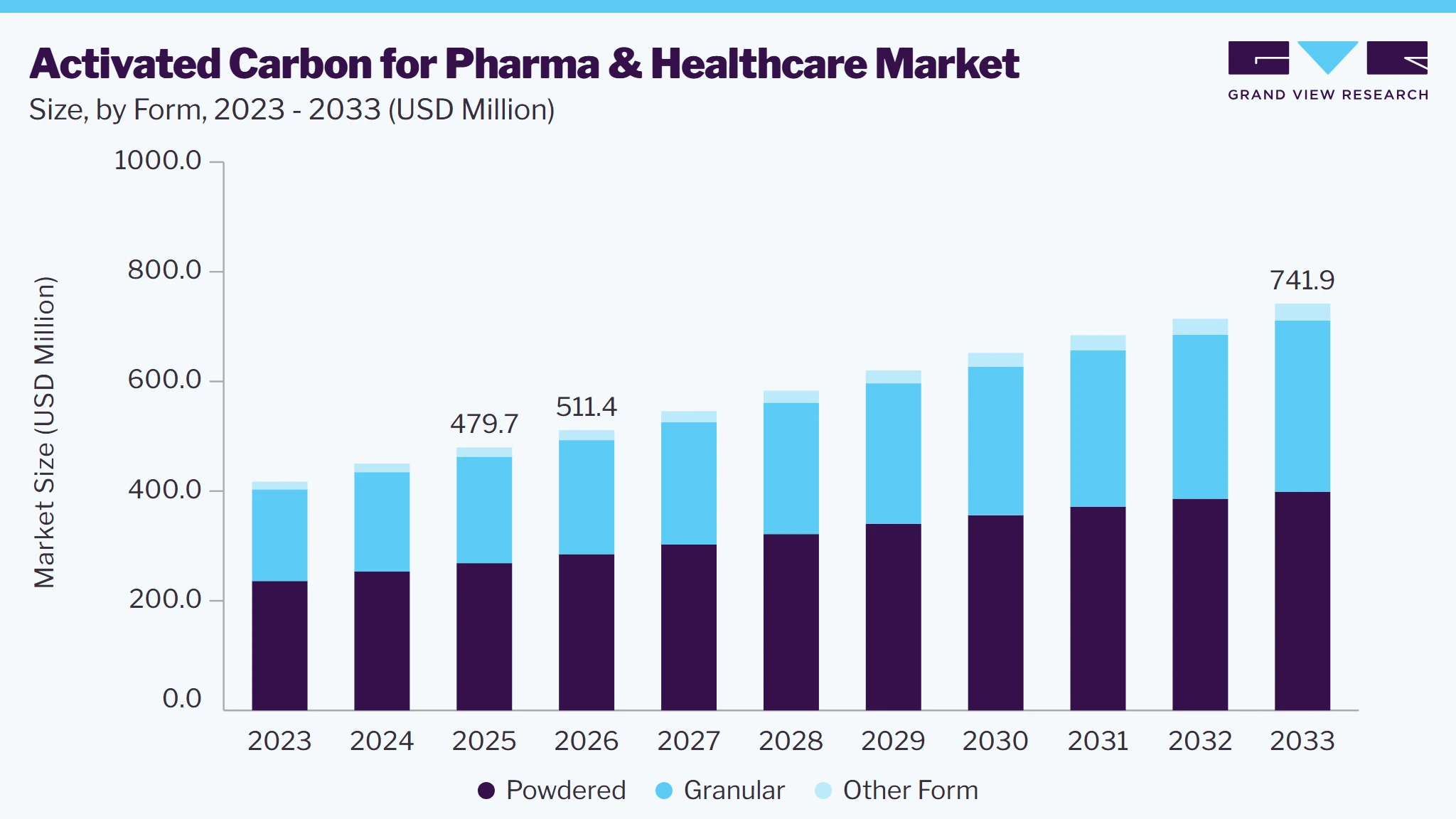 To learn more about this report, Download Free Sample Report
Furthermore, their demand is driven by their essential role in decolorization and purification. Its highly porous structure, enhanced through thermal activation, allows for efficient impurities, pigments, and dyes adsorption. This improves product quality, safety, and appearance. Activated carbon is widely used during production to trap unwanted substances, ensuring cleaner, more effective drugs. The industry's increasing R&D investments further fuel the need for high-performance purification solutions such as activated carbon. These factors fuel the demand for activated carbon for the pharma & healthcare industry.
Market Dynamics
The Activated Carbon for Pharma & Healthcare market is experiencing steady growth driven by increasing demand for durable, high-performance protective coatings across industries such as automotive, construction, industrial equipment, wood finishing, and aerospace. Activated Carbon for Pharma & Healthcare are widely valued for their excellent abrasion resistance, chemical resistance, weatherability, UV stability, and aesthetic finish. Growing infrastructure development, rising automotive production, and increasing investments in industrial manufacturing are supporting market expansion. In addition, the shift toward environmentally friendly coating technologies, including waterborne and low-VOC formulations, is creating new growth opportunities for the Activated Carbon for Pharma & Healthcare market.
The expanding automotive and construction sectors are major drivers of the Activated Carbon for Pharma & Healthcare market. Activated Carbon for Pharma & Healthcare are extensively used on vehicles, buildings, bridges, flooring systems, and industrial structures due to their superior durability, corrosion protection, and decorative properties.
In the automotive industry, manufacturers increasingly utilize Activated Carbon for Pharma & Healthcare to improve vehicle appearance, scratch resistance, and long-term performance. Rapid urbanization, commercial construction projects, and infrastructure modernization are driving demand for protective coatings that can withstand harsh environmental conditions. Rising investments in residential and non-residential construction activities, particularly in emerging economies, are expected to support continued market growth throughout the forecast period.
Fluctuations in the prices of key raw materials such as polyols, isocyanates, and petrochemical derivatives present significant challenges for polyurethane coating manufacturers. Changes in crude oil prices, supply chain disruptions, and geopolitical uncertainties can impact production costs and profit margins.
Stringent environmental regulations regarding volatile organic compound (VOC) emissions and hazardous chemical usage have increased compliance requirements for coating producers. Manufacturers must invest in research and development to formulate eco-friendly coatings while maintaining performance standards. These regulatory pressures may increase operational costs and slow adoption in price-sensitive markets.
The growing focus on sustainability and environmental protection is creating substantial opportunities for the Activated Carbon for Pharma & Healthcare market. Demand for waterborne, bio-based, low-VOC, and solvent-free Activated Carbon for Pharma & Healthcare is increasing across multiple end-use industries as companies seek to meet environmental regulations and sustainability goals.
Technological advancements in coating formulations are enabling the development of high-performance products with enhanced durability, faster curing times, self-healing capabilities, and improved resistance to chemicals and weathering. Emerging applications in renewable energy infrastructure, electric vehicles, smart buildings, and industrial maintenance coatings are further expanding market potential. Companies investing in sustainable raw materials, innovative coating technologies, and advanced application solutions are expected to strengthen their competitive position and capitalize on future market growth.
Analyst Perspective
The Activated Carbon for Pharma & Healthcare market is expected to witness steady growth owing to increasing pharmaceutical manufacturing, expanding biologics production, and growing emphasis on high-purity processing. Rising regulatory requirements for impurity control, solvent purification, and pharmaceutical water treatment are accelerating the adoption of pharmaceutical-grade activated carbon across API manufacturing and biopharmaceutical facilities. Additionally, increasing utilization in medical therapies such as hemoperfusion and poisoning treatment, coupled with investments in healthcare infrastructure and CDMO expansion, is expected to support long-term market growth. Manufacturers focusing on high-purity grades, regulatory compliance, and customized adsorption performance are likely to strengthen their competitive position across the pharmaceutical and healthcare
Form Insights
Powdered segment dominated the form segment at a revenue share of 56.0% in 2025. Powdered Activated Carbon (PAC) has proven effective in reducing pharmaceutical compounds in wastewater, with a 63-84% reduction in discharged carbamazepine and diclofenac at dosing levels of 10-25 mg/L. PAC is an essential tool for controlling pharmaceutical contaminants in municipal wastewater treatment. It also enhances sludge quality, increasing the dry weight by +1% while limiting the sludge production increase to 7-9%, contributing to more efficient waste management
The granular activated carbon segment is expected to grow at the fastest CAGR of 5.9% over the forecast period. The granular form is increasingly preferred by pharma and healthcare companies owing to its key properties, such as superior absorption, ease of handling and storage, and regeneration capacity. The ability of granular activated carbon to withstand the repeated cycles of filtration primarily drives the growing adoption. Increasing collaborations and supply contracts among market participants also contribute to the growth experience of this segment. In 2024, Arq, Inc., one of the key manufacturers of Granular Activated Carbon (GAC), announced that it secured multiple supply contracts for its GAC product, mainly designed for processes associated with raw material purification.
Application Insights
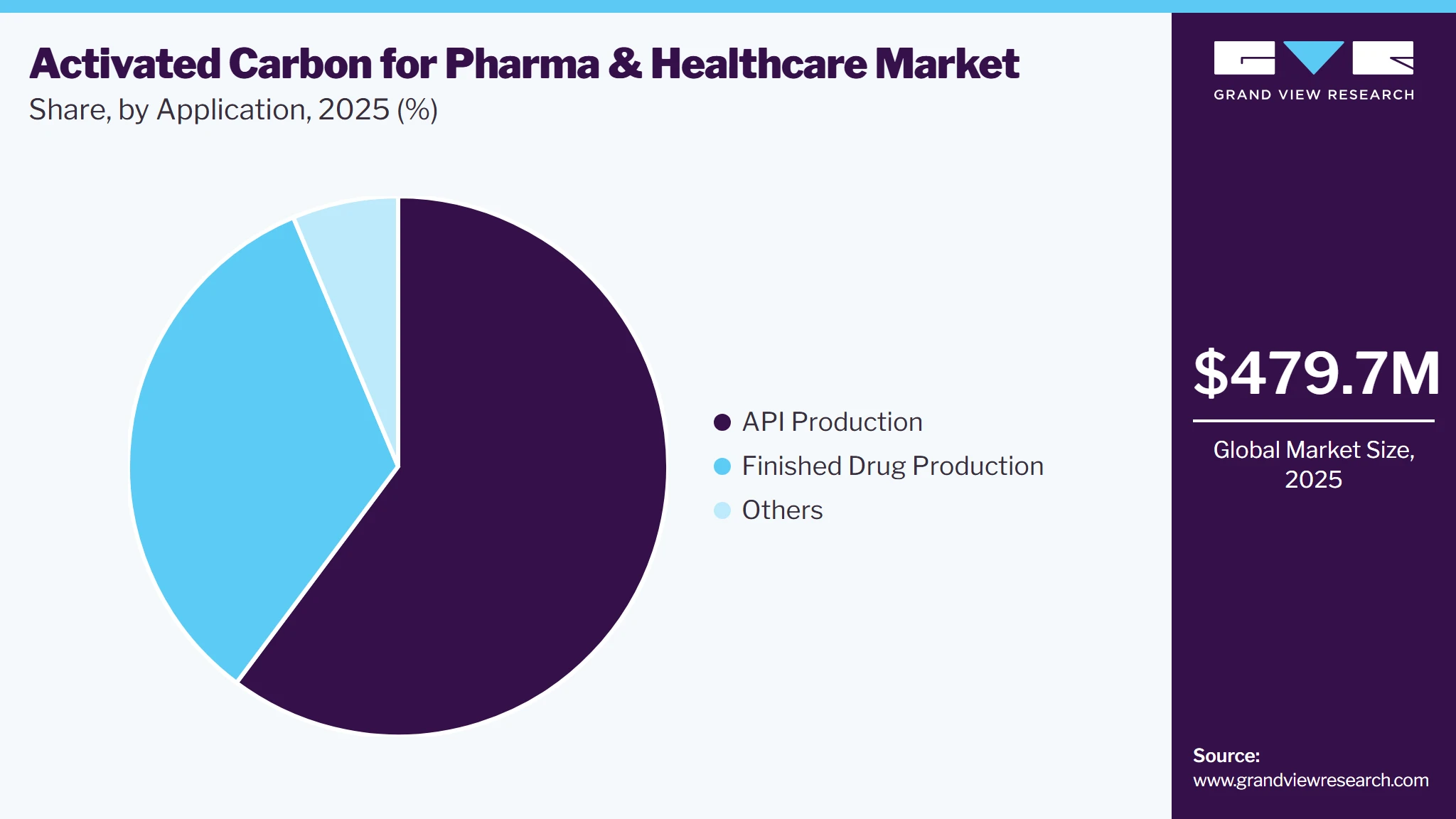
API Production segment accounted for the largest revenue share of 60.2% in 2025. During API production, which is the key component of medicines, responsible for their therapeutic effects, activated carbon helps remove impurities, decolorization, pH adjustment, stability, prevent contamination, and enhance product quality. The pharmaceutical industry is one of the most rapidly evolving sectors worldwide, with active pharmaceutical ingredients playing a central role.
The finished drug production segment is expected to grow significantly over the forecast period. Activated carbon plays a key role in pharmaceutical wastewater treatment, removing residual drugs and contaminants to ensure environmental compliance after drug production.
 To learn more about this report, Download Free Sample Report
Regional Insights
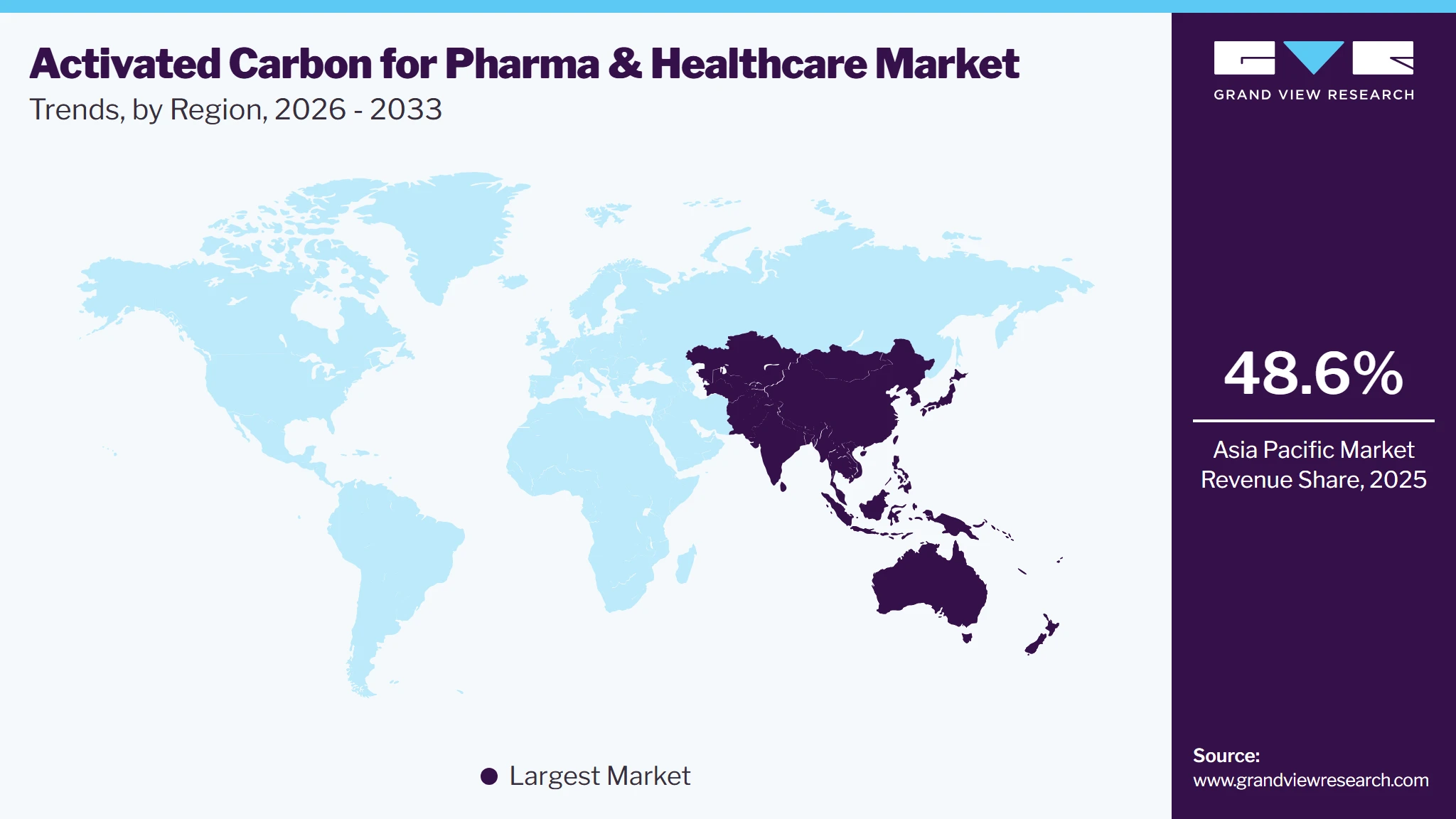
Asia Pacific accounted for 48.6% of the activated carbon for pharma & healthcare market revenue in 2025, making it the largest regional market. The demand is rising due to rapid industrialization and urbanization. Increased pharmaceutical production in Asian countries further drives the need for efficient purification. Leading companies such as Takeda Pharmaceutical Company Limited, Sun Pharmaceutical Industries Ltd., and Cipla contribute significantly to this demand, using activated carbon in various drug manufacturing and filtration processes.
 To learn more about this report, Download Free Sample Report
China Activated Carbon For Pharma & Healthcare Market Trends
China held the highest market revenue share in Asia Pacific in 2025. China’s expanding pharmaceutical and healthcare sectors fuel demand for activated carbon, essential for purifying APIs and intermediates in drug production. Since 2021, the industry has grown at an average annual rate of 9.3%, driven by the 14th Five-Year Plan, according to the Ministry of Industry and Information Technology. Strict environmental regulations on pharmaceutical emissions and waste management have increased the use of activated carbon for air and water purification. In addition, activated carbon tablets and capsules are widely used in hospitals and pharmacies to treat poisoning, indigestion, and flatulence.
North America Activated Carbon For Pharma & Healthcare Market Trends
The activated carbon for pharma & healthcare market in North America held a substantial market share in 2025. The growing pharmaceutical manufacturing industries and advancements in cleaner healthcare sectors are driving the market demand. Furthermore, it is used to treat over-the-counter stomach issues, which are continuously increasing according to the American Gastroenterological Association (AGA). In 2022, it was reported that 60-70 million Americans were suffering from gastrointestinal diseases . In addition, North America accounted for 49.1% of global pharmaceutical sales in 2021, indicating the region’s dominant position in the global pharma market, accelerating the demand for activated carbon.
The U.S. activated carbon for pharma & healthcare market led the North American market, accounting for the largest revenue share in 2025. The growing demand is driven by several key factors, such as increasing regulatory pressures from agencies such as the FDA, along with stricter environmental guidelines, which are pushing companies to adopt higher standards of purity and filtration in drug manufacturing. Activated carbon meets these standards by removing impurities from active pharmaceutical ingredients and intermediates. Its medical applications, particularly in treating drug overdoses, have become increasingly vital, highlighted by the 105,007 overdose deaths reported in 2023 . Rising environmental and health awareness also encourages cleaner and more sustainable production practices in the healthcare sector.
Europe Activated Carbon For Pharma & Healthcare Market Trends
The activated carbon for pharma & healthcare market in Europe held a substantial market share in 2025. The increasing demand is largely driven by its expanding use across various industries, including pharmaceuticals. In 2022, the pharmaceutical sector invested over USD 53.5 million in R&D in Europe. Furthermore, the growing digestive disorder in the region is a major driver for activated carbon, as it helps manage certain symptoms. According to a report from United European Gastroenterology (UEG), in 2023, over 332 million people are estimated to be living with a digestive disorder in the region.
Key Activated Carbon For Pharma & Healthcare Company Insights
Some major companies in the activated carbon for pharma & healthcare industry are Osaka Gas Chemicals Co., Ltd., Calgon Carbon Corporation, JACOBI CARBONS GROUP, and Cabot Corporation. These companies focus on innovating purification technologies, ensuring compliance with stringent regulatory standards, and expanding product applications. They focus on high-quality, efficient solutions for pharmaceutical manufacturing, wastewater treatment, and medical uses such as poisoning treatments. Strong R&D investments and strategic partnerships with leading pharma companies also help sustain growth.
-
Osaka Gas Chemicals Co., Ltd. produces materials such as activated carbon, carbon fiber, fine chemicals, and wood preservatives. The company serves various industries, including pharmaceuticals, electronics, and environmental sectors, and it focuses on innovation and sustainability in its product offerings and operations.
-
Calgon Carbon Corporation manufactures coal, wood, and coconut-based activated carbon products in granular, powdered, pelletized, and cloth forms.
Key Activated Carbon For Pharma & Healthcare Companies
The following key companies have been profiled for this study on the activated carbon for pharma & healthcare market.
-
Jacobi Group
-
Chemviron (a Kuraray Company)
-
Haycarb PLC
-
Boyce Carbon
-
Southern Carbon Pvt. Ltd.
-
Suneeta Carbons
-
Calgon Carbon Corporation
-
Karbonous Inc.
-
Norit
-
Donau Carbon GmbH
Competitive Benchmarking
Category
Operating Strategies
Competitive Edge
Weakness
Established Players (Kuraray Co., Ltd., Calgon Carbon Corporation, Jacobi Carbons AB, Osaka Gas Chemicals Co., Ltd., Haycarb PLC, Donau Carbon GmbH, Kureha Corporation)
- Expand production of pharmaceutical- and healthcare-grade activated carbon for API purification, biopharmaceutical processing, pharmaceutical water treatment, and medical applications
- Invest in advanced activation technologies, high-purity manufacturing processes, and pharmacopeia-compliant products to meet stringent regulatory requirements.
- Strengthen global manufacturing, quality assurance systems, and distribution networks to support pharmaceutical manufacturers, CDMOs, and healthcare institutions
- Strong manufacturing capabilities and global supply networks ensure reliable product availability for regulated industries.
- Extensive expertise in pharmaceutical-grade activated carbon production supported by regulatory certifications and quality management systems
- Long-standing relationships with pharmaceutical companies and healthcare providers strengthen market leadership.
- Compliance with stringent pharmaceutical regulations increases manufacturing and quality validation costs.
- Dependence on premium raw materials such as coconut shell and wood-based feedstocks exposes operations to supply and price volatility.
- High capital investment required for quality control, regulatory certifications, and specialized activation technologies.
Emerging & Specialized Players (CarboTech GmbH, CPL Activated Carbons, Silcarbon Aktivkohle GmbH, Activated Carbon Technologies Pty Ltd., Eurocarb Products Ltd.)
- Develop application-specific adsorption products with enhanced purity, controlled particle size, and tailored performance characteristics.
- Expand regional distribution partnerships and technical support services for pharmaceutical manufacturers and research organizations.
- Emphasize niche healthcare applications requiring customized adsorption performance and regulatory compliance.
- Greater flexibility in developing customized solutions for specialized pharmaceutical and healthcare applications.
- Strong specialization in niche adsorption technologies and high-value pharmaceutical applications.
- Ability to rapidly respond to emerging customer needs and changing regulatory expectations.
- Limited production capacity and global distribution compared with multinational market leaders.
- Lower investment capabilities for large-scale R&D, manufacturing expansion, and regulatory certifications.
- Greater sensitivity to raw material availability and pricing fluctuations.
Recent Developments
-
In February 2025, JACOBI CARBONS GROUP announced that a 15-20% price increase would be implemented from April 2025 on all coconut shell-based activated carbons. A recent surge in raw material costs necessitated the adjustment.
-
In December 2024, CPL/Puragen Activated Carbons, ADBA members, won the Energy Innovation award at the MRW National Recycling Awards 2024 for their breakthrough in reactivating high-sulfur spent carbon from the biogas sector-a previously untreatable waste.
Activated Carbon For Pharma & Healthcare Market Report Scope
Report Attribute
Details
Market size value in 2025
USD 479.7 million
Market size value in 2026
USD 511.4 million
Revenue forecast in 2033
USD 741.9 million
Growth rate
CAGR of 5.5% from 2026 to 2033
Base year for estimation
2025
Historical data
2021 - 2024
Forecast period
2026 - 2033
Quantitative units
Revenue in USD million/million, volume in kilotons, and CAGR from 2026 to 2033
Report coverage
Revenue forecast, company ranking, competitive landscape, growth factors, and trends
Segments covered
Form, application, region
Regional scope
North America; Europe; Asia Pacific; Latin America; MEA
Country scope
U.S.; Canada; Mexico; Germany; UK; France; Italy; Spain; China; India; Japan; South Korea; Australia; Brazil; Argentina; South Africa; Saudi Arabia
Key companies profiled
Jacobi Group; Chemviron (a Kuraray Company); Haycarb PLC; Boyce Carbon; Southern Carbon Pvt. Ltd.; Suneeta Carbons; Calgon Carbon Corporation; Karbonous Inc.; Norit; Donau Carbon GmbH
Customization scope
Free report customization (equivalent up to 8 analysts' working days) with purchase. Addition or alteration to country, regional & segment scope.
Pricing and purchase options
Avail customized purchase options to meet your exact research needs. Explore purchase options
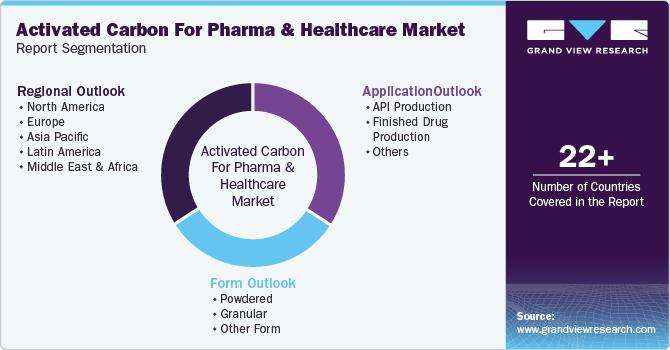
Global Activated Carbon For Pharma & Healthcare Market Report Segmentation
This report forecasts volume & revenue growth at the global, regional, and country levels and provides an analysis of the latest industry trends in each of the sub-segments from 2021 to 2033. For this study, Grand View Research has segmented the global activated carbon for pharma & healthcare market report based on form, application, and region:
 To learn more about this report, Download Free Sample Report
-
Form Outlook (Volume, Kilotons; Revenue, USD Million, 2021 - 2033)
-
Powdered
-
Granular
-
Other Form
-
-
Application Outlook (Volume, Kilotons; Revenue, USD Million, 2021 - 2033)
-
API Production
-
Finished Drug Production
-
Others
-
-
Regional Outlook (Volume, Kilotons; Revenue, USD Million, 2021 - 2033)
-
North America
-
U.S.
-
Canada
-
Mexico
-
-
Europe
-
Germany
-
UK
-
France
-
Italy
-
Spain
-
-
Asia Pacific
-
China
-
India
-
Japan
-
South Korea
-
Australia
-
-
Latin America
-
Brazil
-
Argentina
-
-
Middle East and Africa (MEA)
-
South Africa
-
Saudi Arabia
-
-
Research Methodology
The activated carbon for pharma & healthcare market figures in this report are based on a proven research process that combines executive interviews with secondary research from proprietary databases, company filings, and recognized regulatory and institutional sources. Market size is built through value-chain sizing - reconciling supply-side and demand-side estimates - and triangulated with bottom-up and top-down approaches. Every estimate passes multiple levels of expert validation before publication, with each activated carbon for pharma & healthcare segment quantified using the revenue-capture definitions in the table below.
Segment Definition
Segment - Form
Revenue capture definition
Powdered Activated Carbon (PAC)
Includes revenue generated from pharmaceutical-grade powdered activated carbon utilized for API purification, decolorization, impurity removal, solvent purification, and pharmaceutical intermediate processing.
Granular Activated Carbon (GAC)
Represents revenue from granular activated carbon employed in pharmaceutical water purification systems, process water treatment, solvent recovery, and healthcare facility filtration applications.
Extruded & Pelletized Activated Carbon
Covers sales of pelletized activated carbon used in pharmaceutical air purification, cleanroom filtration, gas purification, respiratory protection, and specialized healthcare applications.
Other Activated Carbon Grades
Includes activated carbon cloth, impregnated carbons, and specialty activated carbon products developed for medical devices, hemoperfusion, respiratory care, and niche pharmaceutical applications.
Segment - Application
Revenue capture definition
Pharmaceutical Manufacturing
Includes activated carbon consumed during API production, intermediate purification, decolorization, crystallization, solvent purification, and formulation manufacturing.
Biopharmaceuticals
Covers activated carbon utilized in biologics manufacturing, vaccine production, fermentation processing, downstream purification, and biotechnology applications.
Medical & Healthcare
Represents activated carbon used in hemoperfusion cartridges, poisoning treatment, dialysis support systems, respiratory filtration, wound care products, and medical devices.
Laboratory & Research
Includes activated carbon utilized in analytical laboratories, pharmaceutical R&D, quality control testing, and research institutions.
Other Healthcare Applications
Covers usage across nutraceuticals, diagnostic products, specialty healthcare products, and other pharmaceutical support applications.
Estimation Model
Layer Name
Key Question
Description
Raw Material & Manufacturing Layer
What forms the supply base?
Evaluate pharmaceutical-grade activated carbon production based on feedstocks such as coconut shell, wood, coal, and synthetic precursors, manufacturing technologies, activation processes, quality certifications, and production capacities.
Application Adoption Layer
Where is activated carbon utilized?
Estimate adoption across pharmaceutical manufacturing, biologics production, medical treatment, laboratory purification, and healthcare filtration based on application requirements and regulatory standards.
Consumption Intensity Layer
How much activated carbon is consumed?
Assess activated carbon usage based on API production volumes, pharmaceutical manufacturing output, biologics capacity, healthcare infrastructure, purification cycles, and replacement frequency across end-use industries.
Revenue Layer
How is market revenue generated?
Market revenue is generated through the sale of pharmaceutical-grade powdered, granular, pelletized, and specialty activated carbon supplied to pharmaceutical manufacturers, biopharmaceutical companies, healthcare facilities, laboratories, and medical device manufacturers worldwide.
Delivered Customizations
This report has been delivered with the following In-depth customizations
Client Request
Customization Delivered
Value Adds
Cross-Segmentation Analysis
Detailed cross-segmentation assessment evaluating the relationship between activated carbon product types (PAC, GAC, pelletized, specialty grades) and end-use sectors including pharmaceutical manufacturing, biopharmaceuticals, medical & healthcare, laboratories, and other healthcare applications. The analysis identifies adsorption requirements, purity specifications, replacement frequency, and revenue contribution across key product-end-use combinations.
Supports product portfolio optimization by identifying the highest-value product and application combinations. Enables prioritization of investment, commercialization, and customer targeting strategies across pharmaceutical and healthcare applications.
Competitive Benchmarking
Comparative evaluation of leading pharmaceutical-grade activated carbon manufacturers based on product portfolio, manufacturing capacity, purification performance, regulatory certifications, geographic footprint, raw material sourcing, healthcare customer base, distribution capabilities, and strategic developments.
Provides deeper visibility into supplier capabilities, competitive positioning, product differentiation, and manufacturing strengths, supporting supplier selection, partnership evaluation, and competitive intelligence.
Opportunity Assessment
Comprehensive assessment of emerging opportunities associated with biologics manufacturing, vaccine production, high-potency APIs, pharmaceutical water purification, hemoperfusion therapies, respiratory filtration, and expanding CDMO activities. The analysis evaluates application attractiveness, regulatory trends, and future demand potential across key healthcare segments.
Helps identify high-growth application areas, prioritize product development initiatives, and support long-term expansion strategies aligned with evolving pharmaceutical and healthcare requirements.
Frequently Asked Questions About This Report
The global activated carbon for pharma & healthcare market size was valued at USD 479.7 million in 2025 and is estimated at USD 511.4 million for 2026.
The global activated carbon for pharma & healthcare market is expected to grow at a CAGR of 5.5% from 2026 to 2033, reaching USD 741.9 million by 2033.
API Production segment accounted for the largest revenue share of 60.2% in 2025. The segment's dominance is driven by the widespread use of activated carbon in API purification, decolorization, and impurity removal processes to ensure high product quality and regulatory compliance.
Asia Pacific accounted for 48.6% of the activated carbon for pharma & healthcare market revenue in 2025, making it the largest regional market. The region's dominance is driven by expanding pharmaceutical manufacturing capacities, increasing API production, favorable government initiatives, and the growing adoption of advanced purification technologies across major economies such as China and India.
Granular is the fastest growing form segment with a CAGR of 6.0% in the forecast period. Its rapid growth is driven by increasing adoption in fixed-bed filtration systems, solvent recovery, and water purification processes within pharmaceutical manufacturing, owing to its durability, reusability, and superior adsorption capacity.
API production is the fastest growing application segment with a CAGR of 5.7% in the forecast period. The segment's rapid growth is fueled by rising pharmaceutical manufacturing activities and increasing demand for high-purity activated carbon in API purification, decolorization, and impurity removal to meet stringent quality standards.
Powdered segment dominated the form segment at a revenue share of 56.0% in 2025. The segment's leadership is supported by its extensive use in pharmaceutical purification, active ingredient processing, and medical-grade filtration applications, where high adsorption efficiency and rapid contaminant removal are critical.
Some of the key players in the activated carbon for pharma & healthcare market are Jacobi Group; Chemviron (a Kuraray Company); Haycarb PLC; Boyce Carbon; Southern Carbon Pvt. Ltd. and others.
The activated carbon for pharma & healthcare market is driven by the increasing demand for high-purity pharmaceutical products, stringent regulatory requirements for quality control, and the growing use of activated carbon in drug purification and medical filtration processes. Rising pharmaceutical manufacturing, expanding healthcare infrastructure, and increasing production of APIs and biopharmaceuticals are further supporting market growth.
About the Author(s)
Renewable Energy Research Team
Energy & Power · Renewable EnergyThis report was authored by the renewable energy research team at Grand View Research - comprising two research analysts, one senior research analyst, and one industry expert - with specialized expertise in the renewable energy segment of the energy & power industry. All findings are based on proprietary energy & power databases, executive interviews, and regulatory analysis, subject to internal peer review prior to publication.
Last Updated:
Speak to Analyst

Customize this report to your needs - add regions, segments, or data points, with 20% free customization.
Or view our licence options:


ISO 9001:2015 & 27001:2022 Certified
We are GDPR and CCPA compliant! Your transaction & personal information is safe and secure. For more details, please read our privacy policy.


