
- Home
- »
- Communications Infrastructure
- »
-
Advanced Metering Infrastructure Market Size, Growth Report, 2026-2033GVR Report cover

Advanced Metering Infrastructure Market (2026 - 2033)
Size, Share & Trends Analysis Report By Component (Hardware, Software, Services), By Application (Electricity, Water, Gas), By End-user (Residential, Commercial, Industrial), By Region, And Segment Forecasts
Market Size, 2025
$25.4BMarket Estimate, 2026
$27.8BMarket Forecast, 2033
$56.9BCAGR, 2026–2033
10.8%Advanced Metering Infrastructure Market Summary
The global advanced metering infrastructure market size was valued at USD 25.4 billion in 2025 and is projected to grow from USD 27.8 billion in 2026 to USD 56.9 billion by 2033, at a CAGR of 10.8% from 2026 to 2033. The market in North America dominated with the largest revenue share in 2025. The global advanced metering infrastructure (AMI) market is expected to grow significantly over the forecast period.
Key Market Trends & Insights
- By component: The hardware segment dominated the market in 2025.
- By application: The electricity application segment held the largest revenue share in 2025.
- By end user: The residential segment accounted for the highest market share in 2025.
Regional Insights
- Largest regional market: North America (2025)
- Fastest-growing regional market: Asia Pacific (highest CAGR, 2026-2033)
Market Size & Forecast
- Market size in 2025: USD 25.4 Billion
- Estimated market size in 2026: USD 27.8 Billion
- Projected market size by 2033: USD 56.9 Billion
- CAGR (2026-2033): 10.8%
Three ways to get this report
Buy it, customize it, or ask a question.Ask an Analyst
Analyst response in 1 business day
- AccessReport author, directly
- Reply timeWithin 1 working day
- No sales callDirect answer only
- FormatEmail reply
- CostFree, no cost
Get the Full Report
What the study covers
- FormatsPDF · Excel · Dashboard
- Timeline2026–2033 annual, 2025 base
- Coverage20+ countries, 5 regions
- Companies10+ key players profiled
Customize the Report
20% free customization
- IncludeCountries, segments, points
- TailorTo your product definition
- ExtendDeeper competitor detail
- OrA fully bespoke study
- Turnaround5–10 working days
There have been significant advancements in smart grid optimization, with the integration of AMI technologies into the existing system. Grid modernization initiatives, the urge for energy conservation, and the implementation of regulatory mandates are some of the factors expected to drive the market growth. The AMI market is experiencing steady growth due to the increasing adoption of smart metering solutions as a replacement for traditional metering systems by utilities. AMI enables two-way communication between utilities and end users, facilitating real-time monitoring of electricity, water, and gas consumption. The growth of the AMI market is largely driven by the increasing need to improve grid reliability, enhance billing accuracy, reduce operational losses, and achieve broader energy efficiency and sustainability objectives.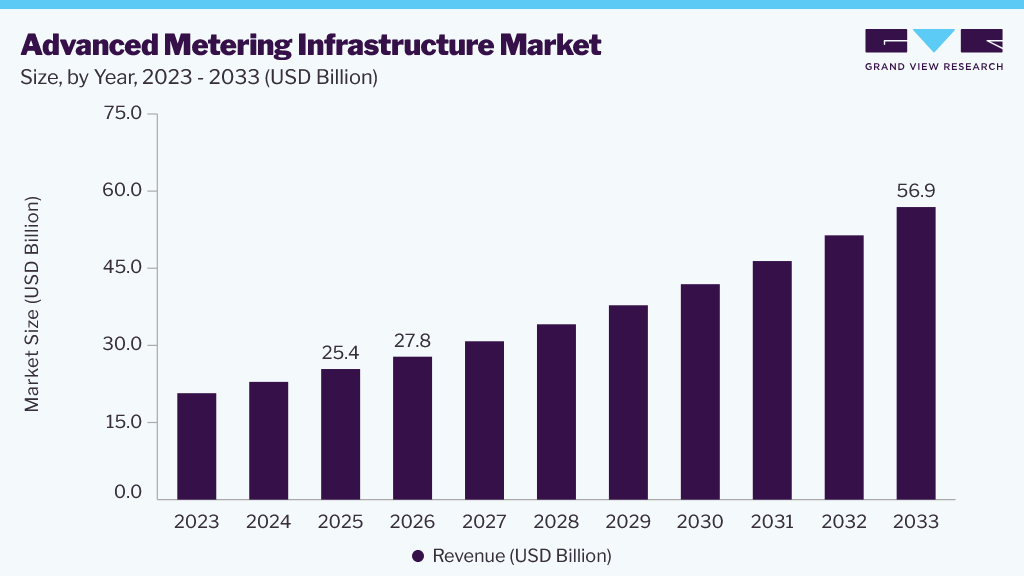 Source: Grand View Research, IR Documents, Primary Interviews, Paid DatabasesTo learn more about this report,
 Download Free Sample Report
The rising focus on the deployment of smart meters is one of the important factors contributing to market growth since it is an essential part of AMI technology. Smart meters help collect information automatically and perform remote meter reading. Increasing investments in utilities, communication, and digital technology infrastructure to enable smooth data transfer are driving the importance of AMI as a foundation for smart grids.
However, the growing complexity and volume of energy consumption data are driving demand for advanced software and analytics solutions. Utilities are increasingly adopting data management and analytics platforms to process meter data, identify consumption patterns, and detect anomalies. These capabilities support improved demand forecasting, outage management, operational efficiency, and the integration of renewable energy sources into existing grid systems.
The AMI market is gradually evolving into an intelligent, automated system through the implementation of digital technologies and grid modernization initiatives. Increasing investments by governments and utilities in smart infrastructure, along with greater attention paid to energy conservation and sustainability, are set to fuel market growth over the coming years.
Analyst Perspective
The Advanced Metering Infrastructure (AMI) market is expected to witness steady growth over the coming years, driven by the increasing transition of utilities toward digital, connected, and intelligent energy management systems. Rising demand for real-time consumption monitoring, accurate billing, and the reduction of transmission and distribution losses is projected to accelerate the deployment of smart meters across the electricity, water, and gas sectors. AMI enables two-way communication between utilities and end users, enhancing operational efficiency, improving grid reliability, and supporting informed energy management. Furthermore, increasing investments in smart grid modernization and a growing emphasis on energy efficiency, decarbonization, and sustainability are expected to favor market expansion over the coming years.
Component Insights
The hardware segment accounted for the largest share of the market in 2025, owing to the large-scale deployment of smart meters and supporting communication infrastructure across utility networks. Hardware forms the foundation of advanced metering infrastructure (AMI) systems, encompassing smart electricity, water, and gas meters, communication modules, data concentrators, and related networking equipment. Increasing investments in smart grid modernization, grid digitalization, and nationwide smart metering programs continue to drive demand for AMI hardware solutions. For instance, in January 2025, the National Smart Grid Mission (NSGM) under India's Ministry of Power reported that over 20 million smart consumer meters had been deployed across the country, reflecting the accelerating adoption of AMI infrastructure and reinforcing the dominant position of the hardware segment.
The software segment is anticipated to witness the fastest CAGR over the forecast period, owing to increasing utility investments in data analytics, meter data management, and grid intelligence platforms. With the increasing deployment of smart meters, there is a need for software solutions that will help in the analysis and management of consumption data. Software platform enables demand forecasting, outage management, theft detection, and integration of distributed energy resources. For instance, in June 2025, Oracle announced AI-powered enhancements to the Oracle Utilities Customer Platform to improve meter data management, enable anomaly detection, and enhance operational efficiency for utilities. According to Oracle, the upgraded system delivers up to 70% faster meter data processing and significantly improves billing accuracy by reducing exceptions. These advancements highlight the increasing role of intelligent software platforms in managing the growing volume and complexity of data generated through advanced metering infrastructure (AMI) deployments.
Application Insights
The electricity subsegment led the application segment with the largest revenue share in 2025 and is also estimated to grow at the fastest CAGR over the forecast period, owing to extensive smart grid modernization initiatives and large-scale smart electricity meter deployments worldwide. Electricity providers have been the pioneers of smart meters because of their efforts to increase the reliability of power supply networks, minimize energy losses during transmission, ensure accurate billing, and integrate renewable energy into the system. Also, the growing investments in digital technologies and demand-side management are promoting the rapid deployment of smart meters for electricity. For instance, in March 2025, Itron and CHINT Global launched the world's first smart meter that uses the DLMS Generic Companion Profile (GCP) standard. This has enhanced the interoperability capabilities and also facilitated the development of future-generation electricity metering infrastructure.
The water segment is anticipated to record notable growth over the forecast period, driven by rising concerns about water scarcity, non-revenue water losses, and aging utility infrastructure. Water utilities have been using advanced metering infrastructure solutions to improve leak detection, streamline billing, and enable real-time consumption measurement. Governments and utility companies have also been developing smart water management systems to help them conserve resources. For instance, in August 2025, Itron announced its partnership with the Water Authority of Fiji to implement Fiji's first-ever large-scale smart water metering solution, thereby providing enhanced network visibility and operational efficiency and helping manage water resources through metering.
End-user Insights
The residential segment accounted for the largest share of the advanced metering infrastructure market in 2025. The extensive deployment of smart meters across households under utility modernization and smart grid programs is contributing to the growth of the residential end-use segment. The segment continues to benefit from large-scale smart meter deployment programs undertaken by utilities to ensure accurate billing, enhance customer engagement, and enable real-time monitoring of energy usage.
Residential consumers represent the largest utility customer base globally, making households a primary focus of grid modernization initiatives. Furthermore, increasing adoption and demand response initiatives are leading to the increased installation of smart meters.
The commercial segment is expected to register the fastest growth over the forecast period, with businesses increasingly investing in digital energy management solutions to improve operational efficiency and achieve sustainability objectives. The commercial sector is embracing advanced metering infrastructure to gain greater insight into energy consumption, implement demand management strategies, and improve building efficiency.
Growing regulatory pressure the reduce energy use and carbon emissions is also driving adoption in offices, healthcare facilities, educational institutions, and retail spaces. For instance, in February 2025, Schneider Electric introduced and rolled out its product called the SpaceLogic Touchscreen Room Controller, an edge-AI-enabled room control solution designed to enhance energy management and operational efficiency in commercial buildings. The device integrates advanced automation capabilities for HVAC, lighting, and shading systems, enabling real-time optimization of occupant comfort and energy consumption.
Regional Insights
North America AMI market held the largest revenue share in 2025, owing to large-scale deployment of smart meters, strong regulatory support, and ongoing utility modernization programs. The region is witnessing extensive deployment of AMI technologies in residential, commercial, and industrial areas to facilitate real-time energy monitoring, outage detection, and demand-side management. More emphasis is being placed by utilities on deploying modern digital grid technology that can improve efficiency, integrate renewable energy resources, and increase grid resilience.
Initiatives undertaken by governments for energy efficiency and decarbonization are increasing the rate at which smart meters are being installed. For instance, the United States Department of Energy (DOE), under the Grid Modernization Initiative, is driving efforts to modernize the electric grid through the development and deployment of advanced digital technologies that enhance grid resilience, reliability, and operational efficiency. The initiative supports technologies such as smart grid systems, advanced sensing, and data analytics that enable improved monitoring, analysis, and control of energy networks.
Asia Pacific Advanced Metering Infrastructure Market Trends
Asia Pacific Advanced Metering Infrastructure (AMI) market is expected to record the fastest CAGR over the forecast period, driven by the growth in urbanization, increasing demand for electricity, and smart grid projects by governments. Countries like China, India, Japan, and South Korea have made huge investments in smart metering systems to minimize transmission and distribution losses, increase billing accuracy, and increase the capability of monitoring energy usage. The region is also experiencing rapid digitization of utilities along with the adoption of renewable energy sources, which are further contributing to the adoption of AMI solutions.
Key Advanced Metering Infrastructure Company Insights
In the advanced metering infrastructure market, companies are focusing on innovations in smart meters, grid analytics, and digital utilities. Leading companies are growing through utility partnerships, IoT connectivity, and large-scale implementation. There is increasing competition among companies due to increased focus on interoperability, cybersecurity, and cloud technologies for the development of smart grids.
Key Advanced Metering Infrastructure Companies
The following key companies have been profiled for this study on the advanced metering infrastructure market.
-
Itron Inc.
-
Landis+Gyr Group AG
-
Siemens AG
-
Schneider Electric SE
-
Honeywell International Inc.
-
Sensus (Xylem Inc.)
-
Aclara Technologies LLC
-
Kamstrup A/S
-
Iskraemeco Group
-
EDMI Limited
-
Sagemcom
-
Linyang Energy
Recent Developments
-
In April 2026, Landis+Gyr Group AG, a global energy technology leader driving intelligent innovation across the grid, completed the divestiture of its Europe, Middle East, and Africa (EMEA) business to AURELIUS, reflecting ongoing portfolio optimization and strategic focus on core markets. This development underscores the company’s efforts to streamline operations and enhance long-term competitiveness in the global smart metering landscape.
-
In October 2025, Itron, Inc. announced that they signed a definitive agreement for the acquisition of Urbint, Inc., an AI-based operational resilience software provider, for approximately USD 325 million. The acquisition strengthens Itron’s software and analytics capabilities, enabling improved risk prediction, grid reliability, and data-driven decision-making for utility customers.
-
In May 2025, Helen Sähköverkko strengthened its long-term collaboration with Landis+Gyr through the deployment of approximately 230,000 smart meters across its network. The agreement includes the implementation of advanced metering infrastructure supported by IoT-based communication technologies and remote reading services.
-
In March 2025, Honeywell Inc. and Verizon Business announced a collaboration aimed at advancing utility and energy grid management through enhanced connectivity solutions leveraging 5G technology. The initiative focuses on improving communication capabilities and enabling more efficient monitoring and management of energy infrastructure, supporting broader digital transformation across utility networks.
Advanced Metering Infrastructure Market Report Scope
Report Attribute
Details
Market size in 2025
USD 25.4 billion
Estimated market size in 2026
USD 27.8 billion
Projected market size by 2033
USD 56.9 billion
Growth rate
CAGR of 10.8% from 2026 to 2033
Base year for estimation
2025
Actual data
2021 - 2024
Forecast period
2026 - 2033
Quantitative units
Revenue in USD billion, and CAGR from 2026 to 2033
Report coverage
Revenue forecast, company ranking, competitive landscape, growth factors, and trends
Segments Covered
Component, application, end user, region
Regional Scope
North America; Europe; Asia Pacific; Latin America; MEA
Country Scope
U.S.; Canada; Mexico; UK; Germany; France; Italy; Spain; Japan; China; India: Australia; South Korea; Brazil; Argentina; South Africa; Saudi Arabia; UAE
Key companies profiled
Itron Inc.; Landis+Gyr Group AG; Siemens AG; Schneider Electric SE; Honeywell International Inc.; Sensus (Xylem Inc.); Aclara Technologies LLC; Kamstrup A/S; Iskraemeco Group; EDMI Limited; Sagemcom; Linyang Energy
Customization scope
Free report customization (equivalent to up to 8 analysts working days) with purchase. Addition or alteration to country, regional & segment scope.
Pricing and purchase options
Avail of customized purchase options to meet your exact research needs. Explore purchase options
Global Advanced Metering Infrastructure Market Report Segmentation
This report forecasts revenue growth at global, regional, and country levels and provides an analysis of the latest industry trends and opportunities in each of the sub-segments from 2021 to 2033. For the purpose of this study, Grand View Research has segmented the global advanced metering infrastructure market report based on component, application, end user, and region:
-
Component Outlook (Revenue, USD Million, 2021 - 2033)
-
Hardware
-
Software
-
Services
-
-
Application Outlook (Revenue, USD Million, 2021 - 2033)
-
Electricity
-
Water
-
Gas
-
Others
-
-
End-user Outlook (Revenue, USD Million, 2021 - 2033)
-
Residential
-
Commercial
-
Industrial
-
-
Regional Outlook (Revenue, USD Million, 2021 - 2033)
-
North America
-
U.S.
-
Canada
-
Mexico
-
-
Europe
-
UK
-
Germany
-
France
-
Italy
-
Spain
-
-
Asia Pacific
-
Japan
-
China
-
India
-
Australia
-
South Korea
-
-
Latin America
-
Brazil
-
Argentina
-
-
MEA
-
South Africa
-
Saudi Arabia
-
UAE
-
-
Frequently Asked Questions About This Report
The global advanced metering infrastructure market size was valued at USD 25.4 billion in 2025 and is estimated at USD 27.8 billion for 2026.
The global advanced metering infrastructure market is expected to grow at a CAGR of 10.8% from 2026 to 2033, reaching USD 56.9 billion.
North America dominated with the largest revenue share in 2025.
The hardware segment accounted for the largest revenue share in 2025.
Key players in the market include Itron Inc., Landis+Gyr Group AG, Siemens AG, Schneider Electric SE, Honeywell International Inc., Sensus (Xylem Inc.), Aclara Technologies LLC, Kamstrup A/S, Iskraemeco Group, EDMI Limited, Sagemcom, Linyang Energy, and others.
About the Author(s)
Communications Infrastructure Research Team
Technology · Communications InfrastructureThis report was authored by the communications infrastructure research team at Grand View Research - comprising two research analysts, one senior research analyst, and one industry expert - with specialized expertise in the communications infrastructure segment of the technology industry. All findings are based on proprietary technology databases, executive interviews, and regulatory analysis, subject to internal peer review prior to publication.
Last Updated:
Speak to Analyst

Customize this report to your needs - add regions, segments, or data points, with 20% free customization.
Or view our licence options:


ISO 9001:2015 & 27001:2022 Certified
We are GDPR and CCPA compliant! Your transaction & personal information is safe and secure. For more details, please read our privacy policy.


