
- Home
- »
- Advanced Interior Materials
- »
-
Aerospace & Defense C-Class Parts Market Report, 2033GVR Report cover

Aerospace & Defense C-Class Parts Market (2026 - 2033)
Size, Share & Trends Analysis Report By Product (Bearings, Electrical Components, Machined Components), By Application (Engine, Aerostructure, Interiors, Avionics), By End Use, By Region, And Segment Forecasts
Market Size, 2025
$19.5BMarket Estimate, 2026
$20.5BMarket Forecast, 2033
$31.2BCAGR, 2026–2033
6.2%Aerospace & Defense C-Class Parts Market Summary
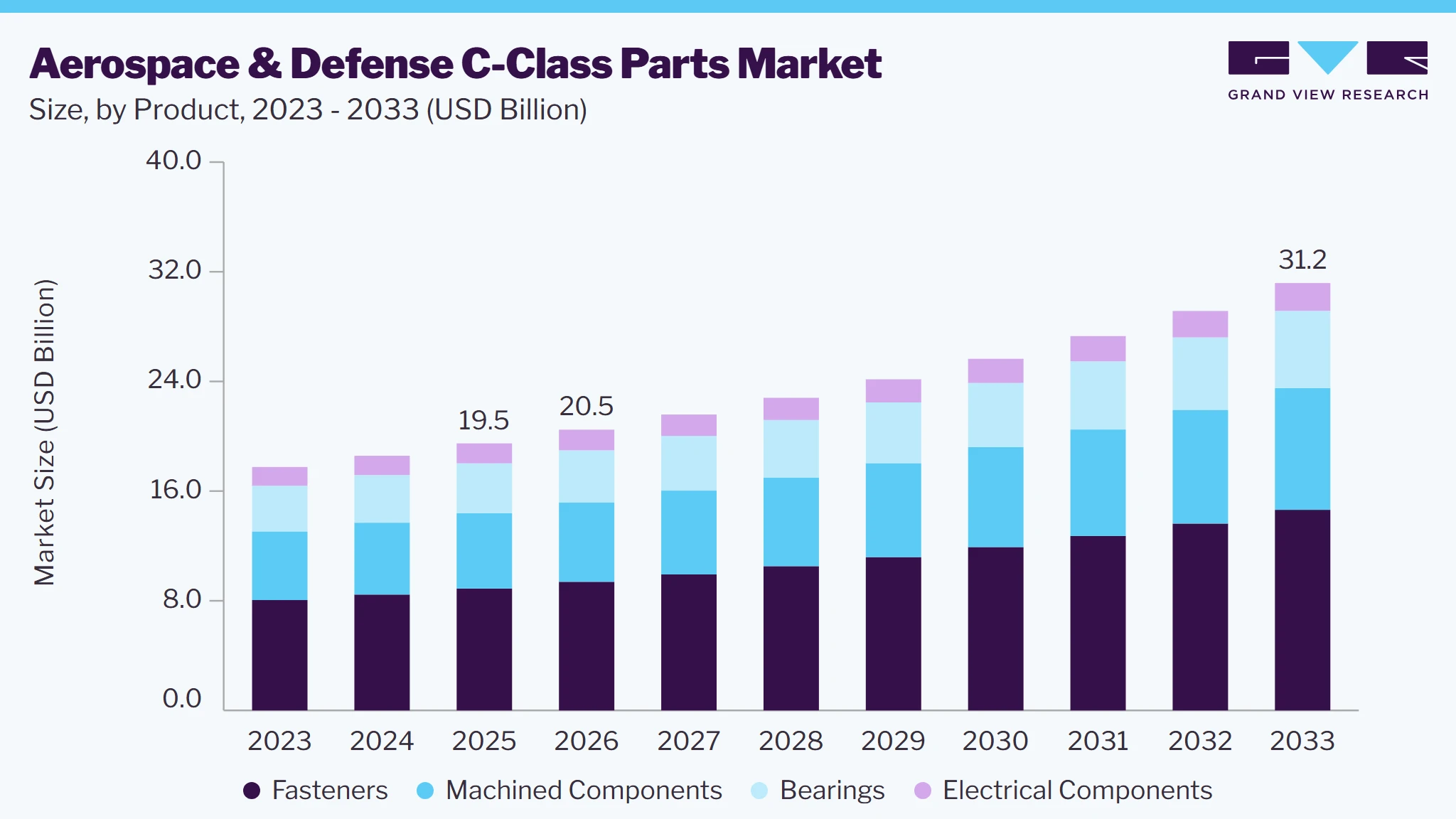
The global aerospace & defense C-class parts market size was valued at USD 19.5 billion in 2025 and is projected to grow from USD 20.5 billion in 2026 to USD 31.2 billion by 2033, at a CAGR of 6.2% from 2026 to 2033. North America dominated the market, accounting for a revenue share of 37.0% in 2025. A primary factor influencing this market is the substantial increase in defense budgets among nations worldwide.
 Source: Grand View Research, IR Documents, Primary Interviews, Paid DatabasesTo learn more about this report,
 Download Free Sample Report
Key Market Trends & Insights
- By product: Fasteners segment led the market with the largest revenue share of 45.7% in 2025.
- By application: Aerostructure segment led the market with the largest revenue share of 48.1% in 2025.
- By end use: Commercial segment led the market with the largest revenue share of 61.0% in 2025
Regional Highlights
- Largest regional market: North America (37.0% revenue share, 2025)
- By country: The U.S. held the largest market share in 2025.
Market Size & Forecast
- Market size in 2025: USD 19.5 Billion
- Estimated market size in 2026: USD 20.5 Billion
- Projected market size by 2033: USD 31.2 Billion
- CAGR (2026-2033): 6.2%
Prism AI by Grand View Research Free to tryAsk a question about the aerospace & defense C-Class parts marketTry asking✓Every figure cited from GVR research Prefer the report? Download free sample →
In response to escalating geopolitical tensions, governments are prioritizing military modernization, which necessitates the procurement of essential components, including C-Class parts. These parts play a critical role in the assembly and maintenance of various military platforms such as aircraft and naval vessels, driving the demand for advanced components that enhance operational effectiveness.In parallel with the military sector’s expansion, the commercial aviation industry is witnessing remarkable growth, fueled by rising passenger traffic and aggressive fleet expansion initiatives from airlines. This demand surge directly correlates with higher production rates for both commercial and military aircraft, leading to an increased requirement for C-Class parts such as fasteners, connectors, and bearings. Moreover, the ongoing trend of fleet modernization is compelling airlines to replace outdated components with innovative C-Class parts, ensuring compliance with stringent aviation standards and enhancing overall performance.
 To learn more about this report, Download Free Sample Report
Furthermore, advancements in manufacturing technologies are playing a transformative role within the Aerospace & Defense C-Class Parts Market. The emergence of Industry 4.0 technologies, such as IoT, automation, and data analytics, is revolutionizing traditional manufacturing practices. By integrating these cutting-edge solutions, manufacturers can significantly improve production efficiency, quality control, and supply chain resilience. The ability to produce high-quality parts that meet rigorous specifications positions companies to cater effectively to the rising demand within the market.
Regional dynamics are also influential in shaping the trajectory of the C-Class parts market. Rapid growth in aerospace sectors, particularly in the Asia-Pacific region, is being driven by increased defense budgets and initiatives aimed at local manufacturing capabilities. Countries such as China and India are developing indigenous aircraft programs that substantially elevate the demand for C-Class parts. In addition, investments in airport infrastructure across various regions are facilitating increased air traffic
Market Dynamics
The aerospace & defense C-class parts market is primarily driven by sustained growth in commercial aircraft production, increasing defense procurement, and the continuous demand for standardized, high-volume components essential to aircraft assembly and maintenance. Rising aircraft fleet expansion and elevated maintenance, repair, and overhaul (MRO) activities are reinforcing the need for efficient procurement and inventory management of C-class parts. The market is witnessing a growing shift toward integrated supply chain solutions, including vendor-managed inventory (VMI), digital procurement platforms, and automated inventory control to enhance operational efficiency and reduce total ownership costs. However, stringent aerospace quality standards, complex supplier qualification processes, and fluctuations in raw material prices continue to challenge procurement stability and margin optimization.
The aerospace & defense C-class parts market is primarily driven by increasing commercial aircraft production, sustained defense procurement, and expanding global aircraft fleets. Continuous demand for standardized, high-volume components across airframe assembly, system integration, and maintenance activities is strengthening procurement volumes.
Additionally, growing maintenance, repair, and overhaul (MRO) requirements for aging aircraft fleets are reinforcing the need for reliable component availability, while long-term production backlogs and defense modernization programs continue to support stable demand across OEM and aftermarket channels.
The aerospace & defense c-class parts market is restrained by the stringent qualification, certification, and regulatory approval processes required for even low-cost, high-volume components such as fasteners, bearings, seals, connectors, clamps, and other hardware. Aerospace and defense manufacturers must comply with rigorous quality standards, traceability requirements, and certification protocols established by aviation authorities and defense agencies. The qualification process for new suppliers or alternative components can take several months or even years, involving extensive testing, documentation, and audits. These lengthy approval cycles increase compliance costs, limit supplier flexibility, delay product introductions, and create barriers for new market entrants, thereby restraining overall market growth.
The increasing implementation of digital procurement platforms, vendor-managed inventory (VMI), predictive demand planning, and automated inventory management systems is creating significant opportunities to improve supply chain efficiency and reduce total procurement costs.
Simultaneously, the expansion of aerospace manufacturing capacity, supplier localization initiatives, and government investments in emerging aerospace hubs are strengthening regional supply networks and creating new growth opportunities for C-class parts manufacturers, distributors, and integrated supply partners.
Analyst Perspective
The aerospace & defense C-class parts market is supported by the steady growth in commercial aircraft production, defense modernization programs, and increasing demand for high-performance aerospace components. Although C-class parts such as fasteners, bearings, seals, springs, and fittings represent a relatively small proportion of an aircraft's total cost, they are critical to manufacturing efficiency, supply chain continuity, and operational reliability. Manufacturers are increasingly focusing on lightweight materials, corrosion-resistant alloys, and digital inventory management solutions to improve performance while reducing procurement complexity. In addition, rising MRO activities, expanding global aircraft fleets, and growing investments in next-generation military platforms are expected to sustain long-term demand for aerospace and defense C-class parts across OEM and aftermarket supply chains.
Product Insights
Based on product, the fasteners segment led the market with the largest revenue share of 45.7% in 2025 due to their essential function in aircraft assembly. Manufacturers are increasingly prioritizing lightweight and corrosion-resistant fasteners, fostering enhanced aircraft safety and performance, and consequently driving consumption across a diverse range of applications within the industry.
Machined components are expected to grow rapidly over the forecast period, stemming from their critical importance in precision engineering and custom applications. Their capacity to fulfill stringent specifications and performance standards makes them indispensable for both military and commercial aerospace projects, thereby ensuring maximum reliability and safety in operations.
Application Insights
Based on application, the aerostructure segment led the market with the largest revenue share of 48.1% in 2025 as it includes the main structural elements of an aircraft, such as wings and fuselage. Rising production rates in both commercial aviation and military modernization programs create a pressing need for robust aerostructure supplies.
The engine segment is expected to register significant growth over the forecast period. As manufacturers strive to improve fuel efficiency and minimize emissions, there is a significant uptick in the demand for advanced engine components, including C-Class parts, across both commercial and military sectors.
End Use Insights
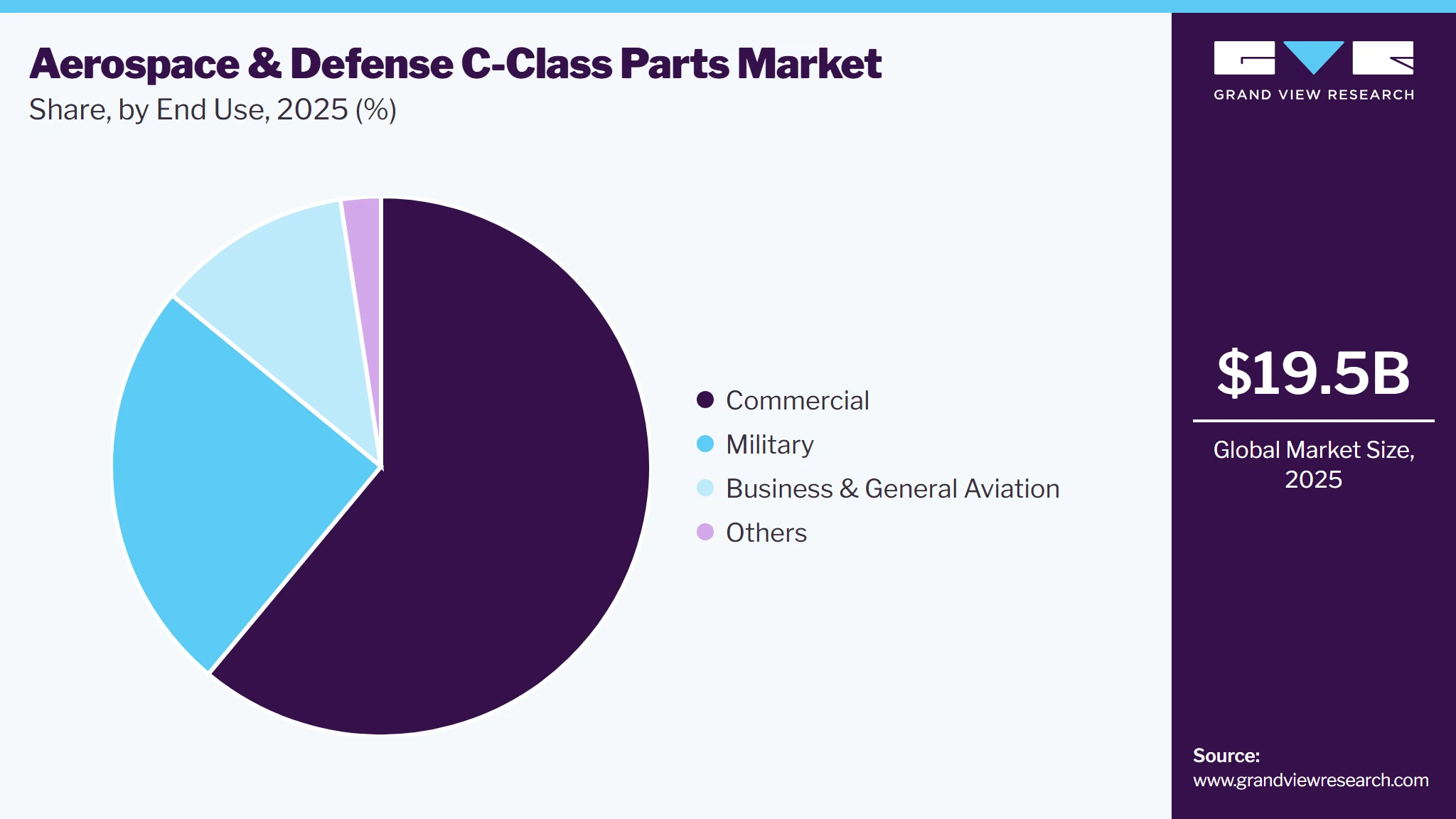
Based on end use, the commercial segment led the market with the largest revenue share of 61.0% in 2025. Airlines are making substantial investments in new aircraft to meet the increasing number of passengers, thereby amplifying the necessity for various C-Class parts essential for both assembly and maintenance functions.
 To learn more about this report, Download Free Sample Report
The military segment is projected to grow lucratively over the forecast period, propelled by increased defense budgets and modernization initiatives. Governments are channeling resources into advanced military aircraft and systems, necessitating a continuous supply of C-Class parts to maintain operational readiness and foster technological advancements within the defense sector.
Regional Insights
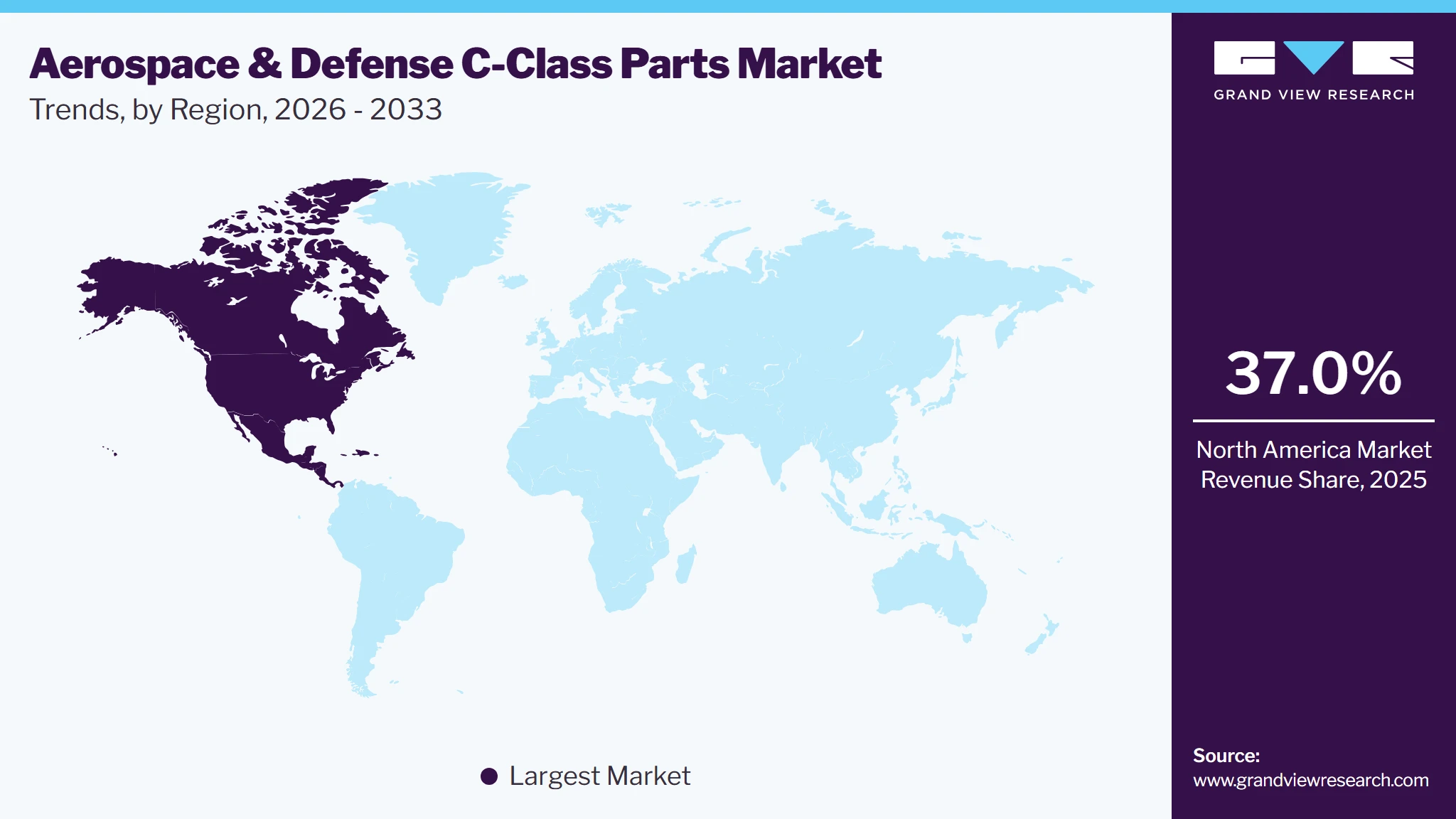
North America dominated the aerospace & defense C-class parts market with the largest revenue share of 37.0% in 2025, driven by its well-established aerospace manufacturing ecosystem, substantial defense spending, and robust supply chain. Major aircraft manufacturers and MRO facilities in the region ensure a consistent demand for C-Class parts catering to both commercial and military applications.
 To learn more about this report, Download Free Sample Report
U.S. Aerospace & Defense C-Class Parts Market Trends
The aerospace & defense C-class parts market in the U.S. held the largest share in the North America region in 2025, fueled by its leadership in aerospace manufacturing, significant defense budgets, and advanced technological capabilities. The presence of prominent OEMs and a comprehensive network of suppliers enhances market growth potential, promoting innovation and efficiency in production processes.
Europe Aerospace & Defense C-Class Parts Market Trends
Europe aerospace & defense C-class parts market held substantial market share in 2024. Increasing investments in defense modernization and a growing commercial aviation sector are driving market growth in the region. The region’s emphasis on sustainability and innovation in aircraft design drives demand for C-Class parts, as manufacturers seek lightweight and efficient components to meet regulatory standards.
The aerospace & defense C-class parts market in the UK is expected to grow in the forecast period, driven by its strong aerospace industry and commitment to advanced manufacturing techniques. Strategic investments in defense capabilities and collaborations with international partners enhance the UK’s market position, driving demand for high-quality C-Class parts essential for aircraft performance.
Asia Pacific Aerospace & Defense C-Class Parts Market Trends
Asia Pacific aerospace & defense C-class parts market is expected to register the fastest CAGR of 7.7% in the forecast period. Countries in this region are investing heavily in indigenous aircraft production and expanding their defense capabilities, significantly boosting the need for various C-Class parts across multiple applications.
The aerospace & defense C-class parts market in China is expected to register the fastest CAGR of 9.9% over the forecast period in the Asia Pacific market. The country has seen substantial investments in military aircraft development and modernization initiatives. The country’s growing defense budget and focus on self-sufficiency in aerospace manufacturing drive demand for C-Class parts.
Key Aerospace & Defense C-Class Parts Company Insights
Some key companies operating in the market include Stanley Black & Decker, Inc.; Amphenol Corporation; LiSi Group; among others. Key industry players drive innovation and quality through strategic initiatives, including investments in research and development, partnerships in advanced manufacturing technologies, and a focus on lightweight materials.
-
Amphenol Corporation specializes in high-performance interconnect systems and components tailored for the aerospace and defense sectors. Their connectors and cable assemblies are essential for dependable communication and power distribution across various aircraft and defense applications, supporting commercial and military operations efficiently.
-
LiSi Group is dedicated to manufacturing high-quality aerospace components, particularly fasteners and machined parts. They meet the needs of both commercial and military aerospace industries by providing innovative solutions that enhance aircraft performance, safety, and reliability, while utilizing lightweight materials
Key Aerospace & Defense C-Class Parts Companies:
The following key companies have been profiled for this study on the aerospace & defense C-class parts market.
- Stanley Black & Decker, Inc.
- Amphenol Corporation
- LiSi Group
- Precision Castparts Corp.
- Safran SA
- Arconic
- Triumph Group
- Eaton
Competitive Benchmarking
Category
Operating Strategies
Competitive Edge
Weakness
Established Players (e.g., LISI Aerospace; Howmet Aerospace; Amphenol Corporation; Stanley Black & Decker, Inc.; Eaton Corporation plc; PCC Fasteners.)
- Strengthen strategic partnerships and long-term supply agreements with aircraft OEMs, Tier suppliers, and MRO providers.
- Invest in manufacturing automation, advanced quality systems, and digital supply chain integration to enhance operational efficiency and traceability.
- Expand global production capacity and value-added inventory management solutions to support lifecycle demand and supply chain continuity.
- Extensive aerospace-qualified product portfolios supported by strong engineering and manufacturing capabilities.
- Well-established customer relationships, diversified global operations, and comprehensive distribution networks.
- High regulatory compliance expertise, proven product reliability, and strong financial resources supporting continuous innovation.
- Exposure to cyclical fluctuations in commercial aerospace production and government defense spending.
- Lengthy product qualification cycles and stringent regulatory requirements increase operational complexity and time-to-market.
- Large-scale manufacturing operations may limit responsiveness to low-volume or highly customized customer requirements.
Emerging & Regional Players (e.g., PennEngineering (PEM); B&B Specialties, Inc.; National Aerospace Fasteners Corporation (NAFCO); SPIROL International Corporation)
- Focus on specialized product portfolios targeting niche aerospace fastening and precision hardware applications.
- Expand regional manufacturing capabilities and strengthen partnerships with distributors, integrators, and aftermarket service providers.
- Differentiate through engineering customization, responsive customer support, and flexible production capabilities.
- Strong specialization in precision-engineered C-class components with high manufacturing flexibility.
- Faster product customization and shorter lead times for application-specific requirements.
- Ability to serve niche market segments through technical expertise and customer-centric solutions.
- Limited international footprint and comparatively lower manufacturing scale than global competitors.
- Lower investment capacity for advanced manufacturing technologies, digital transformation, and global expansion initiatives.
- Greater reliance on regional demand and indirect sales channels, limiting market penetration across large aerospace programs.
Aerospace & Defense C-Class Parts Market Report Scope
Report Attribute
Details
Market size in 2025
USD 19.5 billion
Estimated market size in 2026
USD 20.5 billion
Projected market size by 2033
USD 31.2 billion
Growth rate
CAGR of 6.2% from 2026 to 2033
Base year for estimation
2025
Historical data
2021 - 2024
Forecast period
2026 - 2033
Quantitative units
Revenue in USD billion and CAGR from 2026 to 2033
Report coverage
Revenue forecast, company ranking, competitive landscape, growth factors, and trends
Segments covered
Product, application, end use, region
Regional scope
North America; Europe; Asia Pacific; Latin America; Middle East & Africa
Country scope
U.S., Canada, Mexico, UK, Germany, France, Italy, Spain, China, Japan, India, Brazil
Key companies profiled
LISI Aerospace; Howmet Aerospace; Amphenol Corporation; Stanley Black & Decker, Inc.; Eaton Corporation plc; PCC Fasteners; PennEngineering (PEM); B&B Specialties, Inc.; National Aerospace Fasteners Corporation (NAFCO); SPIROL International Corporation.
Customization scope
Free report customization (equivalent up to 8 analysts' working days) with purchase. Addition or alteration to country, regional & segment scope.
Pricing and purchase options
Avail customized purchase options to meet your exact research needs. Explore purchase options
Global Aerospace & Defense C-Class Parts Market Report Segmentation
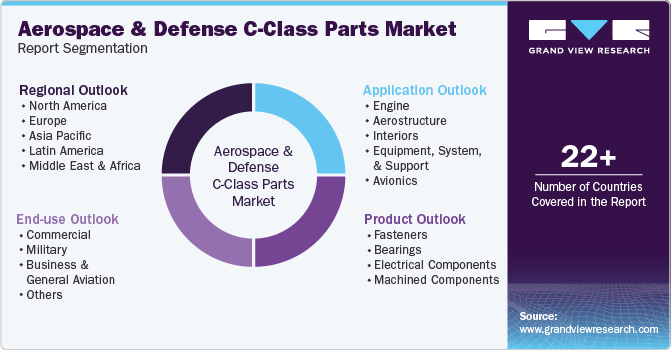
This report forecasts revenue growth at global, regional, and country levels and provides an analysis of the latest industry trends in each of the sub-segments from 2021 to 2033. For this study, Grand View Research has segmented the global aerospace & defense C-class parts market report based on product, application, end use, and region:
 To learn more about this report, Download Free Sample Report
-
Product Outlook (Revenue, USD Million, 2021 - 2033)
-
Fasteners
-
Bearings
-
Electrical Components
-
Machined Components
-
-
Application Outlook (Revenue, USD Million, 2021 - 2033)
-
Engine
-
Aerostructure
-
Interiors
-
Equipment, System, and Support
-
Avionics
-
-
End Use Outlook (Revenue, USD Million, 2021 - 2033)
-
Commercial
-
Military
-
Business & General Aviation
-
Others
-
-
Regional Outlook (Revenue, USD Million, 2021 - 2033)
-
North America
-
U.S.
-
Canada
-
Mexico
-
-
Europe
-
UK
-
Germany
-
France
-
Italy
-
Spain
-
-
Asia Pacific
-
Japan
-
China
-
India
-
-
Latin America
-
Brazil
-
-
Middle East & Africa
-
Research Methodology
The Aerospace & Defense C-Class Parts market figures in this report are based on a proven research process that combines executive interviews with secondary research from proprietary databases, company filings, and recognized regulatory and institutional sources. Market size is built through value-chain sizing - reconciling supply-side and demand-side estimates - and triangulated with bottom-up and top-down approaches. Every estimate passes multiple levels of expert validation before publication, with each Aerospace & Defense C-Class Parts segment quantified using the revenue-capture definitions in the table below.
Segment Definition
Segment - Product
Revenue Capture Definition
Fasteners
Revenue is generated from the sale of standardized aerospace fasteners, including bolts, nuts, screws, rivets, pins, washers, inserts, clips, and other mechanical fastening components used in aircraft assembly, maintenance, and repair.
Bearings
Revenue is generated from the sale of aerospace-grade bearings, bushings, sleeves, and related motion-control components designed to support rotational and linear movement in aircraft systems.
Electrical Components
Revenue is generated from the sale of standardized electrical C-class parts, including connectors, terminals, cable assemblies, clamps, backshells, wiring accessories, and other electrical hardware used in aerospace and defense platforms.
Machined Components
Revenue generated from the sale of precision-machined, standardized C-class components such as spacers, sleeves, shims, brackets, fittings, retainers, and other small hardware manufactured to aerospace specifications.
Segment - Application
Revenue Capture Definition
Engine
Revenue generated from the sale of aerospace C-class parts utilized in aircraft engine systems, including fastening, bearing, electrical, and precision hardware components required for engine assembly, maintenance, and overhaul.
Aerostructure
Revenue generated from the sale of C-class parts incorporated into aircraft structural assemblies, including fuselage, wings, empennage, nacelles, and related structural sections.
Interiors
Revenue is generated from the sale of standardized C-class components used in aircraft cabin interiors, including seating systems, overhead bins, flooring, galleys, lavatories, sidewalls, and interior fixtures.
Equipment, System, and Support
Revenue is generated from the sale of C-class parts used across aircraft mechanical systems, hydraulic and pneumatic equipment, landing gear, environmental control systems, fuel systems, and other support equipment.
Avionics
Revenue is generated from the sale of standardized C-class components integrated into avionics and electronic systems, including connectors, cable management products, mounting hardware, fasteners, and electrical accessories.
Segment - End Use
Revenue Capture Definition
Commercial
Revenue generated from the sale of aerospace & defense C-class parts supplied for commercial passenger and cargo aircraft manufacturing, maintenance, repair, overhaul (MRO), and fleet support activities.
Military
Revenue is generated from the sale of C-class parts supplied for military aircraft, helicopters, unmanned aerial systems (UAS), and defense aviation platforms used in production, modernization, sustainment, and maintenance programs.
Business & General Aviation
Revenue is generated from the sale of C-class parts used in business jets, turboprop aircraft, piston aircraft, helicopters, and other general aviation platforms for both OEM production and aftermarket maintenance.
Others
Revenue is generated from the sale of aerospace C-class parts supplied for specialized aviation applications, including space platforms, research aircraft, firefighting aircraft, training aircraft, and other niche aerospace and defense programs.
Estimation Model
Layer Name
Key Question
Description
Aerospace & Defense Manufacturing Demand Layer
Where are C-class parts required?
Analyze demand across commercial aerospace, military aviation, space, and defense manufacturing. Assess aircraft production, MRO activities, defense procurement, spacecraft manufacturing, and subsystem assembly to establish the addressable demand for C-class parts including fasteners, bearings, seals, springs, fittings, electrical hardware, and other standardized components.
Aircraft Production & Defense Investment Layer
Where is new demand being created?
Evaluate investments in commercial aircraft manufacturing, defense modernization programs, military aircraft procurement, spacecraft production, and aerospace supply chain expansion.
Product Adoption Layer
Which C-class parts are being deployed?
Segment demand by product type, platform (commercial aircraft, military aircraft, helicopters, spacecraft, and defense systems), application, and end user. Apply adoption rates based on aircraft type, production volume, certification requirements, material specifications, and platform complexity.
Revenue Conversion Layer
How much market revenue is generated?
Estimate annual demand for aerospace and defense C-class parts by product type, platform, application, and region. Quantify revenues generated exclusively from the sale of new C-class parts supplied to aerospace OEMs, Tier 1 suppliers, defense contractors, and MRO providers.
Delivered Customizations
This report has been delivered with the following In-depth customizations
Client Request
Customization Delivered
Value Adds
Competitive Benchmarking
Benchmarked leading aerospace & defense C-class parts manufacturers based on product portfolio, manufacturing capabilities, financial strength, geographic presence, end-use focus, and strategic initiatives.
Enabled the client to assess competitive positioning, identify key differentiators, and evaluate strategic growth opportunities across the competitive landscape.
Regional Segmentation
Refined regional analysis by evaluating aircraft production, MRO activity, defense expenditure, aerospace manufacturing base, and supply chain maturity across North America, Europe, Asia Pacific, Latin America, and the Middle East & Africa.
Supported identification of high-growth regional markets, investment priorities, and expansion opportunities based on aerospace manufacturing and defense demand.
Opportunity assessment
Assessed emerging growth opportunities across commercial aviation, military modernization, aftermarket (MRO), digital supply chain solutions, and localized aerospace manufacturing ecosystems.
Helped prioritize high-potential revenue opportunities by identifying rapidly growing application areas and evolving procurement trends across the aerospace value chain.
Frequently Asked Questions About This Report
The global aerospace & defense C-class parts market size was estimated at USD 19.5 billion in 2025 and is expected to be USD 20.5 billion in 2026.
The global aerospace & defense C-class parts market, in terms of revenue, is expected to grow at a compound annual growth rate of 6.2% from 2026 to 2033 to reach USD 31.2 billion by 2033.
Some of the key players operating in the aerospace & defense c-class parts market include Stanley Black & Decker Inc., Amphenol Corporation, Lisi Aerospace, Precision Castparts Corporation, Safran SA, Arconic Inc., Triumph Group, Eaton Corporation, LMI Aerospace Inc., RCB Bearings Incorporated, Trimas Corporation, National Aerospace Fasteners Corporation. Satcom Direct, NTN Corporation, and SKF.
Asia Pacific is anticipated to be one of the fastest-growing regional markets over the forecast period, driven by increasing aircraft deliveries, expanding aerospace manufacturing capabilities, rising defense procurement, and growing investments in indigenous aerospace programs.
The fasteners segment led the market with the largest revenue share of 45.7% in 2025.
The aerostructure segment accounted for the largest revenue share of 48.1% in 2025.
The commercial segment led the market with the largest revenue share of 61.0% in 2025.
North America dominated the aerospace & defense C-class parts market with the largest revenue share of 37.0% in 2025.
Key factors include increasing commercial aircraft production, rising defense spending, growing aircraft fleet expansion, increasing MRO activities, and rising demand for lightweight, high-performance, and corrosion-resistant aerospace components.
About the Author(s)
Advanced Interior Materials Research Team
Advanced Materials · Advanced Interior MaterialsThis report was authored by the advanced interior materials research team at Grand View Research - comprising two research analysts, one senior research analyst, and one industry expert - with specialized expertise in the advanced interior materials segment of the advanced materials industry. All findings are based on proprietary advanced materials databases, executive interviews, and regulatory analysis, subject to internal peer review prior to publication.
Last Updated:
Speak to Analyst

Customize this report to your needs - add regions, segments, or data points, with 20% free customization.
Or view our licence options:


ISO 9001:2015 & 27001:2022 Certified
We are GDPR and CCPA compliant! Your transaction & personal information is safe and secure. For more details, please read our privacy policy.


