
- Home
- »
- Advanced Interior Materials
- »
-
Aerospace Fasteners Market Size, Share Report, 2025-2033GVR Report cover
![Aerospace Fasteners Market (2025 - 2033)Report]()
Aerospace Fasteners Market (2025 - 2033)
Size, Share & Trends Analysis Report By Aircraft Type (Commercial, Business & General Aviation, Military), By Product (Bolts, Nuts, Screws, Rivets), By Region, And Segment Forecasts
Market Size, 2024
$7.3BMarket Estimate, 2026
$8.4BMarket Forecast, 2033
$13.6BCAGR, 2025–2033
7.2%Aerospace Fasteners Market Summary
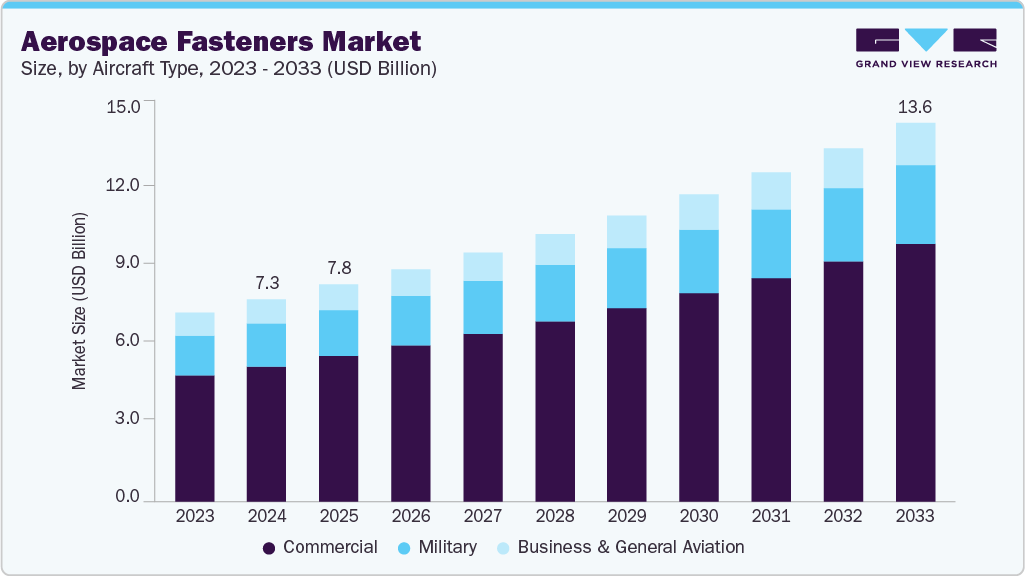
The global aerospace fasteners market size was valued at USD 7.3 billion in 2024 and is projected to grow from USD 8.4 billion in 2026 to USD 13.6 billion by 2033, at a CAGR of 7.2% from 2025 to 2033. North America dominated the market, accounting for a revenue share of 40.7% in 2024. The market is witnessing significant growth due to the steady rise in commercial air travel, defense modernization programs, and the expansion of space exploration initiatives.

Key Market Trends & Insights
- By aircraft type, the commercial segment is expected to grow at the fastest CAGR of 7.4% over the forecast period.
- By product, the rivets segment is expected to grow at the fastest CAGR of 7.7% over the forecast period.
Market Size & Forecast
- 2024 Market Size: USD 7.3 Billion
- 2033 Projected Market Size: USD 13.6 Billion
- CAGR (2025-2033): 7.2%
- North America: Largest market in 2024
- Asia Pacific: Fastest growing market
Three ways to get this report
Buy it, customize it, or ask a question.Ask an Analyst
A direct answer, usually in 1 working day
- AccessReport author, directly
- Reply timeWithin 1 working day
- No sales callDirect answer only
- FormatEmail reply
- CostFree, no cost
Get the Full Report
What the study covers
- FormatsPDF · Excel · Dashboard
- Timeline2025–2033 annual, 2024 base
- Coverage20+ countries, 5 regions
- Companies10+ key players profiled
Customize the Report
20% free customization
- IncludeCountries, segments, points
- TailorTo your product definition
- ExtendDeeper competitor detail
- OrA fully bespoke study
- Turnaround5–10 working days
With increasing global passenger traffic and cargo movement, aircraft manufacturers are ramping up production to meet rising demand. This, in turn, is fueling the need for advanced, reliable, and lightweight fasteners that can withstand extreme environmental and mechanical stress in both commercial and military aircraft.Key drivers of the market include a surge in aircraft fleet expansion, heightened demand for fuel-efficient aircraft, and the increasing use of composite materials in airframes and interiors. Fasteners are crucial for joining components in lightweight composite structures, which are replacing traditional metal counterparts to reduce overall aircraft weight and enhance fuel efficiency. Moreover, the growing demand for maintenance, repair, and overhaul (MRO) services globally is also boosting fastener replacement cycles, further driving market growth.
Innovations and trends shaping the aerospace fasteners market include the adoption of titanium and other advanced alloy fasteners for weight reduction and corrosion resistance, as well as the development of smart fasteners with embedded sensors for structural health monitoring. Additive manufacturing (3D printing) is also gaining traction for prototyping and low-volume production of customized fasteners. Additionally, automation in assembly lines, environmental regulations pushing for sustainable manufacturing practices, and the increasing use of digital supply chain systems are transforming the production and application of aerospace fasteners.
Market Dynamics
The increasing production of commercial and military aircraft is one of the major growth drivers for the aerospace fasteners market. Rising global air passenger traffic, expansion of low-cost carriers, and growing demand for fuel-efficient aircraft are encouraging airlines to expand their fleets. Aircraft manufacturers are continuously increasing production rates to meet the backlog of aircraft orders, which directly boosts the demand for aerospace fasteners used in airframes, wings, engines, interiors, and landing gear systems.
Additionally, defense modernization programs across countries are increasing procurement of fighter jets, helicopters, transport aircraft, and uncrewed aerial vehicles. Every aircraft contains a large volume of bolts, rivets, screws, nuts, and specialty fastening systems, making fasteners an essential component in aircraft assembly. The growing adoption of lightweight composite aircraft structures is also driving demand for advanced, corrosion-resistant titanium fasteners for high-performance aerospace applications.
The aerospace fasteners market faces a major challenge due to strict aviation certification requirements and high production costs associated with aerospace-grade materials. Fasteners used in aircraft applications must comply with rigorous quality, safety, traceability, and performance standards established by aviation regulatory authorities. The certification and testing process is highly time-consuming and expensive, particularly for manufacturers developing advanced fastening solutions for next-generation aircraft platforms.
Market Concentration & Characteristics
The aerospace fasteners market exhibits a moderately concentrated structure, with a few key global players dominating due to their technological capabilities, long-term contracts with aircraft manufacturers, and adherence to stringent aerospace quality standards. Major companies such as Howmet Aerospace, LISI Aerospace, Precision Castparts Corp., and Stanley Black & Decker hold significant market shares. These players benefit from high entry barriers, including certification requirements, capital-intensive manufacturing processes, and established supplier relationships with OEMs such as Boeing and Airbus. However, regional manufacturers and specialized suppliers are gaining ground by focusing on niche applications, rapid lead times, and customized solutions.
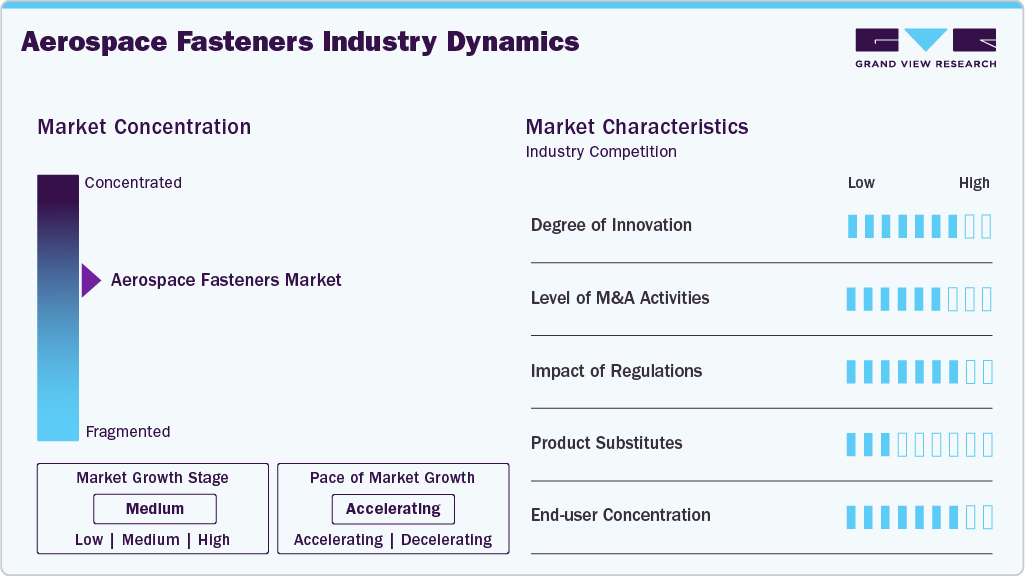
Aircraft Type substitutes for aerospace fasteners are limited due to the critical safety and performance requirements in aircraft assembly. However, innovations in adhesive bonding technologies and composite joining techniques are emerging as partial substitutes, especially in non-structural components. While adhesives can reduce weight and streamline production, they lack the mechanical reliability and inspectability of traditional fasteners in high-stress areas. In specific applications, welding and riveting techniques may also serve as alternatives, but they often come with design limitations and are less favored in modular aerospace designs. As a result, mechanical fasteners continue to remain the preferred solution for most aerospace applications.
Aircraft Type Insights
Commercial segment held the largest market share of 67.0% in 2024. This dominance is primarily driven by the high production volumes of commercial aircraft from manufacturers like Boeing and Airbus, coupled with the growing global air travel demand and the need for fleet expansion and modernization. Each commercial aircraft requires millions of fasteners for both structural and interior components, making this segment a significant consumer. Moreover, the robust aftermarket for maintenance, repair, and overhaul (MRO) in the commercial sector further contributes to consistent fastener demand, especially for replacement and upgrade purposes.
Military segment is expected to grow at a significant CAGR of 6.9% over the forecast period, fueled by increased global defense spending, modernization of air fleets, and the development of advanced fighter jets and transport aircraft. Military aircraft often require high-performance, corrosion-resistant fasteners made from specialized alloys, which command premium pricing. Additionally, rising geopolitical tensions and renewed investments in defense capabilities across major economies are accelerating the procurement of new aircraft and upgrades to existing ones, driving rapid growth in the military fasteners segment. While it contributes a smaller share compared to commercial aviation, its growth trajectory is outpacing other segments.
Product Insights
Bolts segment held the largest revenue market share of 29.9% in 2024. This growth is fueled by the increasing use of high-performance materials, demand for detachable joints in modern aircraft designs, and a shift toward modular assembly practices. Bolts, such as engines, landing gear, and interior components, are preferred in areas where maintenance access and reassembly are required. Innovations in bolt materials and coatings for enhanced strength, corrosion resistance, and weight reduction further accelerate their adoption, especially in next-generation aircraft platforms.
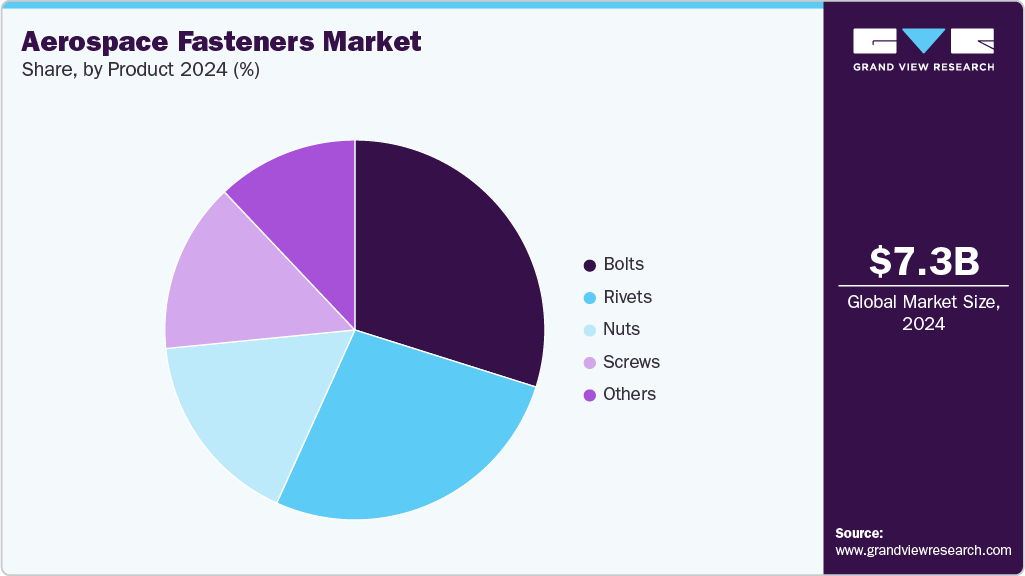
Rivets segment is expected to grow at the fastest CAGR of 7.7% over the forecast period, primarily due to their extensive use in aircraft assembly, particularly in joining sheet metal components in fuselage, wings, and control surfaces. Rivets create lightweight, permanent joints that resist vibration, ensuring structural integrity for both commercial and military aircraft. Their widespread application in both original equipment manufacturing (OEM) and maintenance, repair, and overhaul (MRO) activities ensures steady demand and high-volume consumption, making them the leading revenue contributor among all fastener types.
Regional Insights
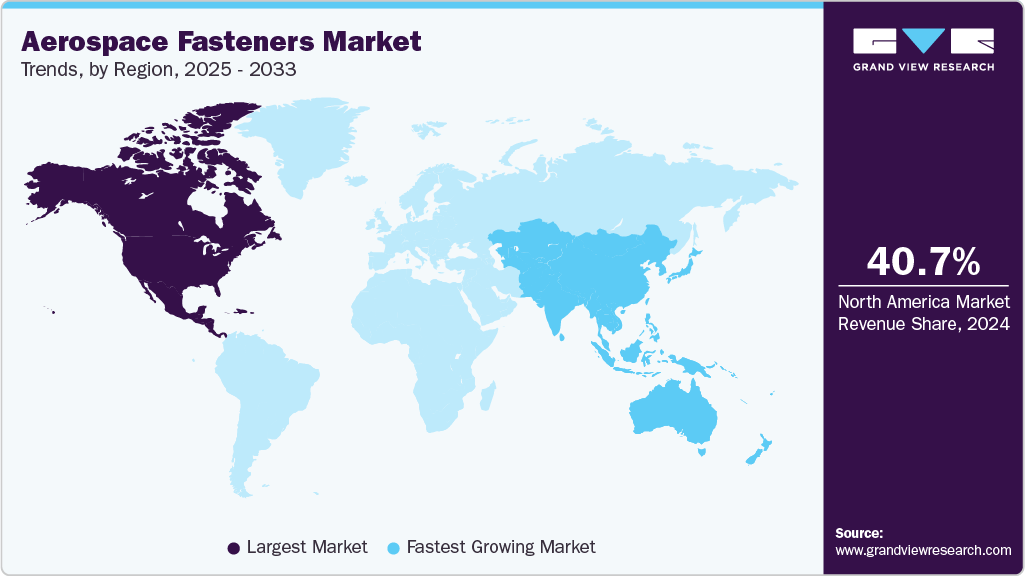
North America aerospace fasteners market dominated the market and accounted for the largest revenue share of about 40.7% in 2024. It benefits from the presence of leading OEMs such as Boeing, Lockheed Martin, and Bombardier, along with a highly advanced manufacturing and R&D ecosystem. The region has robust demand from both commercial and military aviation, including modernization programs and new aircraft deliveries. Strong government support, advanced technology integration, and strict regulatory compliance standards shape the market’s quality and innovation. Additionally, the U.S. aerospace and defense export capabilities ensure a steady global demand. North America’s position is reinforced by a mature supply chain and strategic partnerships across the aerospace sector.
U.S. Aerospace Fasteners Market Trends
The U.S. aerospace fasteners market is a global leader, driven by continuous aircraft production, defense projects, and MRO activities. The presence of major OEMs and defense contractors ensures high and stable demand for fasteners across all aircraft classes. Innovations in lightweight materials, additive manufacturing, and digital supply chains are being actively adopted in fastener production. The U.S. government’s support for reshoring critical manufacturing and enhancing aerospace competitiveness further strengthens the sector. Regulatory bodies like the FAA ensure product standardization and safety, promoting trusted, certified suppliers. The U.S. also serves as a major exporter, supplying aerospace fasteners to key regions around the world.
Asia Pacific Aerospace Fasteners Market Trends
Asia Pacific is expected to grow at the fastest CAGR of 7.5% in the forecast period, due to rapid growth in commercial aviation, increasing defense budgets, and expanding manufacturing capabilities. Countries such as China, India, and Japan are investing heavily in both domestic aircraft production and aerospace infrastructure. The rise of low-cost carriers, regional connectivity schemes, and rising air passenger traffic further fuel demand for aircraft and related components. The region also benefits from a strong supply chain for raw materials and cost-effective labor, attracting global OEMs and Tier 1 suppliers. Government initiatives to boost aerospace exports are adding to the region’s momentum. As a result, Asia Pacific continues to be the most dynamic and revenue-attractive region in the global market.
China aerospace fasteners market is growing rapidly alongside its expanding civil and military aviation sectors. The country's indigenous aircraft programs, like COMAC’s C919 and ARJ21, are increasing domestic demand for high-quality fasteners. China is also heavily investing in aerospace R&D, quality control systems, and certifications to meet international standards. Local manufacturers are scaling up production and forming joint ventures with global suppliers to gain technological expertise. Moreover, government backing through policies and subsidies is boosting the domestic aerospace supply chain. China's strategic aim to become a self-reliant aerospace hub is significantly shaping the fasteners market landscape.
Europe Aerospace Fasteners Market Trends
Aerospace fasteners market in Europe is marked by high regulatory standards, a well-established MRO network, and strong industrial capabilities. Countries like France, Germany, and the UK play a central role due to Airbus’ operations and a dense network of aerospace suppliers. The region emphasizes precision engineering and innovation in materials and coatings used in fasteners. Environmental regulations and sustainability goals are encouraging the use of eco-friendly production techniques. Moreover, collaboration between governments, industry associations, and R&D institutions supports continual development. Europe's market is stable and diversified, catering to both commercial and defense aviation across various subregions.
Germany aerospace fasteners market stands out as a leading aerospace hub in Europe, with a strong focus on engineering excellence and innovation. Its aerospace fasteners market benefits from advanced manufacturing infrastructure, skilled labor, and a strategic location within the EU. German companies are investing in smart manufacturing and sustainability-focused production, including recyclable materials and energy-efficient processes. The country is also home to several Tier 1 and Tier 2 suppliers that serve global aircraft manufacturers. Government support for aerospace research and digitization initiatives further boosts the industry. M&A activities and partnerships with international firms are helping German companies expand their technological capabilities in fastener production.
Central & South America Aerospace Fasteners Market Trends
Central & South America’s aerospace fasteners market is emerging steadily, supported by growing aircraft manufacturing and MRO operations in countries like Mexico and Brazil. Mexico, in particular, has become a regional aerospace manufacturing hub due to favorable trade agreements and skilled labor availability. While commercial aviation drives most of the demand, increasing defense investments are also contributing. Regional airlines are expanding their fleets, creating demand for both OEM and aftermarket fasteners. Governments are encouraging foreign direct investment and partnerships with international aerospace firms. Though still developing compared to other regions, Central & South America holds significant long-term growth potential in this sector.
Middle East & Africa Aerospace Fasteners Market Trends
The Middle East & Africa region is witnessing moderate growth in the aerospace fasteners market, primarily fueled by rising investments in aviation infrastructure and defense procurement. The UAE, Saudi Arabia, and South Africa are key contributors, with growing airline fleets and regional MRO facilities. Fastener demand is also supported by ambitious aviation expansion projects like airport developments and national carrier upgrades. The defense sector is seeing increased procurement of advanced aircraft, driving demand for specialized fasteners. Although the manufacturing base is limited, strategic partnerships with global aerospace firms are helping build local capabilities. The region's long-term outlook is positive as it invests more in aerospace and defense autonomy.
Key Aerospace Fasteners Company Insights
Some of the key players operating in the market include SFS Group, Boeing
-
SFS Group is a key global supplier of high-performance fastening systems, serving both civil and military aerospace sectors. The company focuses on precision-engineered fasteners and lightweight solutions tailored to meet stringent aerospace standards.
-
Boeing offers a wide range of aerospace fasteners used in its commercial and defense aircraft through its distribution services division. It supports global supply chains by providing certified fastener components and MRO solutions.
-
Precision Castparts Corp. and Howmet Aerospace are some of the emerging market participants in the aerospace fasteners market.
-
PCC is a leading manufacturer of complex metal components and high-strength aerospace fasteners. Known for its vertically integrated operations, the company supplies critical fastener systems for jet engines, airframes, and defense applications.
-
Howmet Aerospace is a major producer of engineered fastening solutions, supplying titanium and nickel-alloy fasteners for commercial and military aircraft. The company focuses on innovation adopting advanced materials, coatings, and automated production to meet rising demand and evolving aerospace standards.
Key Aerospace Fasteners Companies:
The following are the leading companies in the aerospace fasteners market. These companies collectively hold the largest market share and dictate industry trends.
- SFS Group
- LISI Aerospace
- Precision Castparts Corp.
- Howmet Aerospace
- MinebeaMitsumi Aerospace
- 3V Fasteners
- Boeing
- TriMas Corporation
- National Aerospace Fasteners Corporation (NAFCO)
- B&B Specialties Inc.
Competitive Benchmarking
Operating Strategies
Competitive Edge
Weaknesses
Mature Players: Howmet Aerospace; Precision Castparts Corp.; LISI Aerospace; Boeing, TriMas Corporation; SFS Group
- Focus on long-term supply agreements with major aircraft OEMs and defense contractors to ensure recurring revenue streams.
- Invest heavily in advanced manufacturing technologies, automation, and precision engineering for high-performance aerospace fasteners.
- Expand global production and distribution networks to strengthen aftermarket and MRO support capabilities.
- Strong brand recognition and certified product portfolios with compliance to stringent aerospace standards.
- Extensive relationships with leading aircraft manufacturers such as Boeing and Airbus create high entry barriers for competitors.
- Broad product diversification across bolts, rivets, screws, lockbolts, and specialty fastening systems supports market leadership.
- High dependence on aerospace production cycles and airline industry demand fluctuations affects revenue stability.
- Significant operational costs due to expensive raw materials, certification requirements, and precision manufacturing processes.
Emerging Players: MinebeaMitsumi; 3V Fasteners; National Aerospace Fasteners Corporation; B&B Specialties Inc.
- Focus on niche aerospace fastening applications and customized engineering solutions for regional and specialty aircraft programs.
- Strengthen market presence through partnerships, distributor networks, and targeted expansion into defense and MRO sectors.
- Emphasize cost-competitive manufacturing and flexible production capabilities to attract mid-sized aerospace customers.
- Higher operational flexibility allows faster response to customized fastening requirements and smaller production batches.
- Specialized expertise in titanium fasteners, precision machining, or defense-focused applications supports differentiation.
- Ability to adopt innovative production methods and emerging materials with comparatively lower organizational complexity.
- Limited global presence and smaller production capacities compared to established aerospace fastener manufacturers.
- Lower bargaining power with OEMs and raw material suppliers can impact profitability and contract opportunities.
Recent Developments
-
In February 2025, TriMas completed the acquisition of GMT Aerospace, expanding its aerospace fastener platform and enhancing its portfolio across multiple fastener categories
-
In October 2024, Bossard Group acquired Germany's Ferdinand Gross Group a leading fastening technology distributor with locations in Germany, Hungary, and Poland bolstering its aerospace segment in Europe.
-
In May 2024, AFC Industries acquired Meg Technologies Inc., a Southern California-based distributor of military-standard aerospace fasteners, enhancing its distributor portfolio and customer base.
Aerospace Fasteners Market Report Scope
Report Attribute
Details
Market size in 2024
USD 7.3 billion
Estimated market size in 2026
USD 8.4 billion
Projected market size by 2033
USD 13.6 billion
Growth rate
CAGR of 7.2% from 2025 to 2033
Base year for estimation
2024
Actual estimates/Historical data
2021 - 2024
Forecast period
2025 - 2033
Quantitative units
Revenue in USD million/billion and CAGR from 2025 to 2033
Report coverage
Revenue forecast, company ranking, competitive landscape, growth factors, and trends
Segments covered
Aircraft type, product, region
Regional scope
Global
Country scope
U.S.; Canada; Mexico; Germany; UK; France; Spain; Italy; China; Japan; India; South Korea
Key companies profiled
SFS Group; LISI Aerospace; Precision Castparts Corp.; Howmet Aerospace; MinebeaMitsumi Aerospace; 3V Fasteners; Boeing; TriMas Corporation; National Aerospace Fasteners Corporation (NAFCO); B&B Specialties Inc.
Customization scope
Free report customization (equivalent up to 8 analysts working days) with purchase. Addition or alteration to country, regional & segment scope.
Pricing and purchase options
Avail customized purchase options to meet your exact research needs. Explore purchase options
Global Aerospace Fasteners Market Report Segmentation
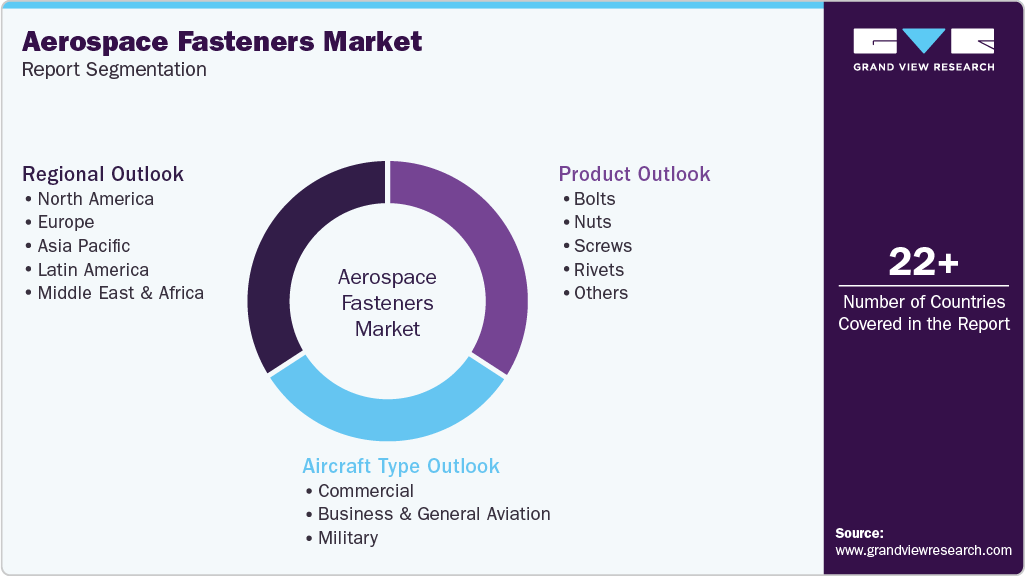
This report forecasts revenue growth at regional & country levels and provides an analysis on the industry trends in each of the sub-segments from 2021 to 2033. For this study, Grand View Research has segmented the aerospace fasteners market on the basis of aircraft type, product, and region:
-
Aircraft Type Outlook (Revenue, USD Million, 2021 - 2033)
-
Commercial
-
Business & General Aviation
-
Military
-
-
Product Outlook (Revenue, USD Million, 2021 - 2033)
-
Bolts
-
Nuts
-
Screws
-
Rivets
-
Others
-
-
Regional Outlook (Revenue, USD Million, 2021 - 2033)
-
North America
-
U.S.
-
Canada
-
Mexico
-
-
Europe
-
UK
-
Germany
-
France
-
Spain
-
Italy
-
-
Asia Pacific
-
China
-
Japan
-
India
-
South Korea
-
-
Central & South America
-
Middle East & Africa
-
Delivered Customizations
This report has been delivered with the following In-depth customizations
Client Request
Customization Delivered
Value Adds
Regional segmentation
A detailed regional analysis was delivered covering North America, Europe, Asia-Pacific, the Middle East & Africa, and Latin America, with country-level demand assessments for aerospace fasteners. The study included regional aircraft production trends, defense spending analysis, and MRO activity evaluation to identify high-growth markets and investment opportunities.
Helped identify region-specific growth pockets, supply chain expansion opportunities, and emerging aerospace manufacturing hubs. Enabled clients to prioritize strategic expansion and regional partnership development effectively.
Opportunity assessment
A comprehensive opportunity assessment was conducted by evaluating high-growth aircraft segments, aftermarket demand, lightweight fastening technologies, and defense aviation investments. The customization also analyzed future demand potential across commercial aviation, military modernization programs, and next-generation aircraft platforms.
Assisted clients in identifying revenue-generating segments, technology investment areas, and long-term business opportunities. Supported strategic planning for product development and market entry initiatives.
Competitive benchmarking
Detailed benchmarking of major aerospace fastener manufacturers was delivered, covering product portfolio, geographic presence, production capabilities, strategic partnerships, innovation focus, and aerospace certifications. The analysis compared mature and emerging players to evaluate competitive positioning and market strengths.
Enabled clients to understand competitor strategies, identify capability gaps, and assess market positioning. Supported decision-making related to partnerships, acquisitions, product differentiation, and competitive strategy development.
Frequently Asked Questions About This Report
The global aerospace fasteners market size was valued at USD 7.3 billion in 2024 and is estimated at USD 8.4 billion for 2026.
The global aerospace fasteners market is expected to grow at a CAGR of 7.2% from 2025 to 2033, reaching USD 13.6 billion by 2033.
The commercial segment of the market accounted for the largest revenue share of 67.0% in 2024, driven by the high production volumes of commercial aircraft from manufacturers like Boeing, coupled with the growing global air travel demand and the need for fleet expansion and modernization.
Some of the key players operating in the aerospace fasteners market include SFS Group, LISI Aerospace, Precision Castparts Corp., Howmet Aerospace, MinebeaMitsumi Aerospace, 3V Fasteners, Boeing, TriMas Corporation, National Aerospace Fasteners Corporation (NAFCO), and B&B Specialties Inc.
Key factors driving the aerospace fasteners market include rising aircraft production, growing MRO demand, lightweight material adoption, and increased defense spending.
About the Author(s)
Advanced Interior Materials Research Team
Advanced Materials · Advanced Interior MaterialsThis report was authored by the advanced interior materials research team at Grand View Research - comprising two research analysts, one senior research analyst, and one industry expert - with specialized expertise in the advanced interior materials segment of the advanced materials industry. All findings are based on proprietary advanced materials databases, executive interviews, and regulatory analysis, subject to internal peer review prior to publication.
Last Updated:
Speak to Analyst


Customize this report to your needs - add regions, segments, or data points, with 20% free customization.
Or view our licence options:


ISO 9001:2015 & 27001:2022 Certified
We are GDPR and CCPA compliant! Your transaction & personal information is safe and secure. For more details, please read our privacy policy.


