
- Home
- »
- Next Generation Technologies
- »
-
Agentic AI Development Platform Market Size Report, 2033GVR Report cover

Agentic AI Development Platform Market (2026 - 2033)
Size, Share & Trends Analysis Report By Component (Software, Services), By Deployment Mode (Cloud, On-premises, Hybrid), By End-use (BFSI, IT & Telecom, Retail & E-commerce, Manufacturing), By Region, And Segment Forecasts
Market Size, 2025
$5.6BMarket Estimate, 2026
$7.4BMarket Forecast, 2033
$52.3BCAGR, 2026–2033
32.3%Agentic AI Development Platform Market Summary
The global agentic AI development platform market size was valued at USD 5.6 billion in 2025 and is projected to grow from USD 7.4 billion in 2026 to USD 52.3 billion by 2033, at a CAGR of 32.3% from 2026 to 2033. North America dominated the market, accounting for the largest revenue share of 38.5% in 2025. The market is growing as enterprises adopt AI agents to automate workflows and coordinate tasks across applications.
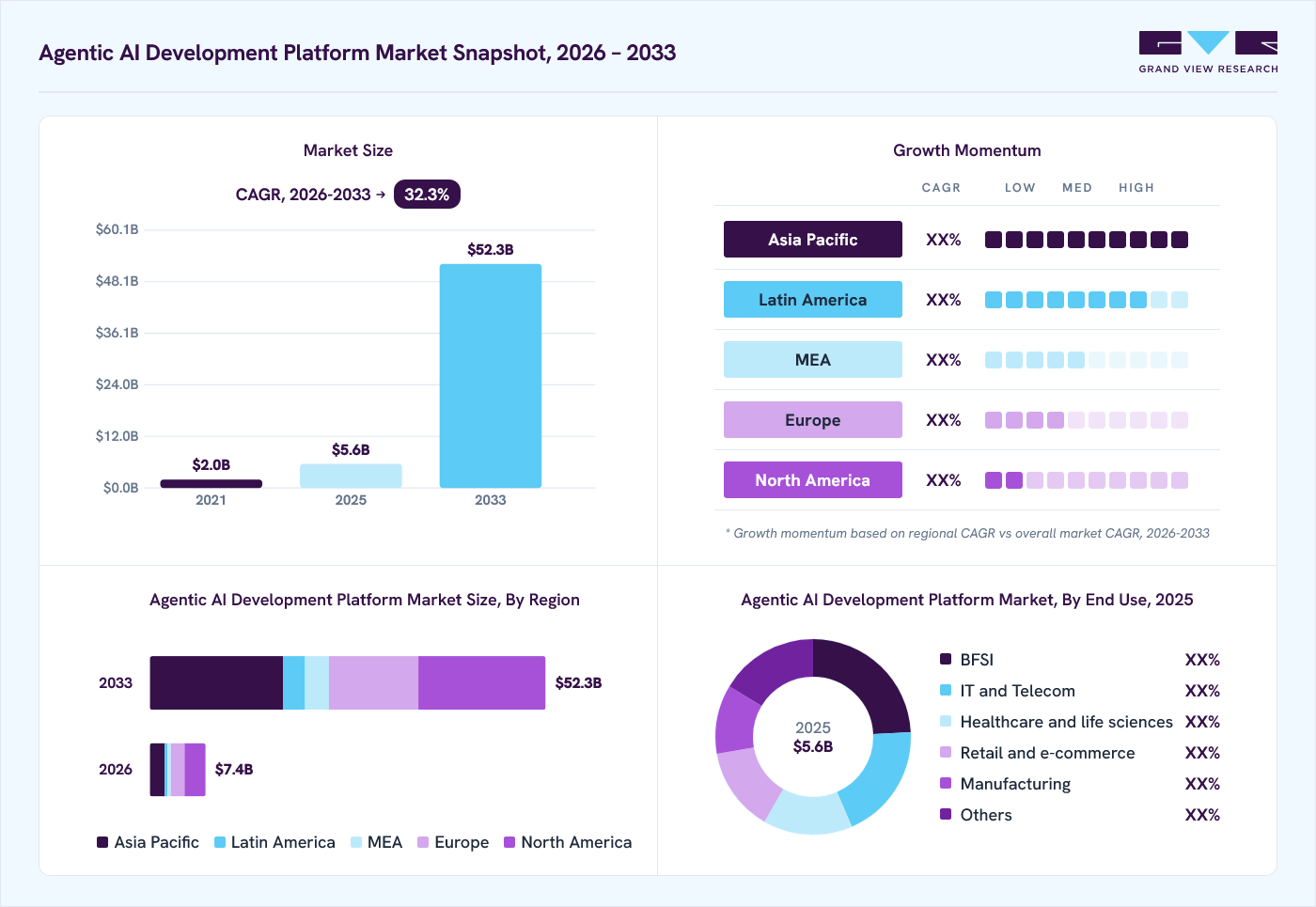 Source: Grand View Research, IR Documents, Primary Interviews, Paid DatabasesTo learn more about this report,
 Download Free Sample Report
Key Market Trends & Insights
- By component: Software segment held the largest market share of around 69.6% in 2025.
- By deployment mode: Cloud segment held the largest market revenue share in 2025.
- By end-use: BFSI segment led the market with the largest revenue share in 2025.
Regional Highlights
- Largest regional market: North America (38.5% revenue share, 2025)
- Fastest-growing regional market: Asia Pacific (highest CAGR, 2026-2033)
- Leading country: The U.S. held the largest share in 2025
Market Size & Forecasts
- Market size in 2025: USD 5.6 Billion
- Estimated market size in 2026: USD 7.4 Billion
- Projected market size by 2033: USD 52.3 Billion
- CAGR (2026-2033): 32.3%
Three ways to get this report
Buy it, customize it, or ask a question.Ask an Analyst
Analyst response in 1 business day
- AccessReport author, directly
- Reply timeWithin 1 working day
- No sales callDirect answer only
- FormatEmail reply
- CostFree, no cost
Get the Full Report
What the study covers
- FormatsPDF · Excel · Dashboard
- Timeline2026–2033 annual, 2025 base
- Coverage20+ countries, 5 regions
- Companies10+ key players profiled
Customize the Report
20% free customization
- IncludeCountries, segments, points
- TailorTo your product definition
- ExtendDeeper competitor detail
- OrA fully bespoke study
- Turnaround5–10 working days
Demand is increasing for platforms that simplify agent development, deployment, and monitoring. Growing adoption of multi-agent systems and enterprise application integration is further supporting market growth. The market is growing as businesses increasingly adopt managed agent runtimes, visual agent builders, and open interoperability standards to simplify AI agent development and deployment. Demand for integrated platforms that combine workflow design, tool and data connectivity, agent evaluation, and production monitoring is rising as enterprises scale autonomous AI applications. This trend is encouraging vendors to develop unified platforms that reduce development complexity and accelerate the transition from prototypes to production. For instance, in October 2025, OpenAI launched AgentKit, a toolkit that includes Agent Builder, a visual canvas for designing multi-agent workflows, a Connector Registry for managing data and tool connections, ChatKit for embeddable agent interfaces, and expanded evaluation tools. The launch reflects the shift toward unified agent development platforms that cover design, deployment, and ongoing optimization.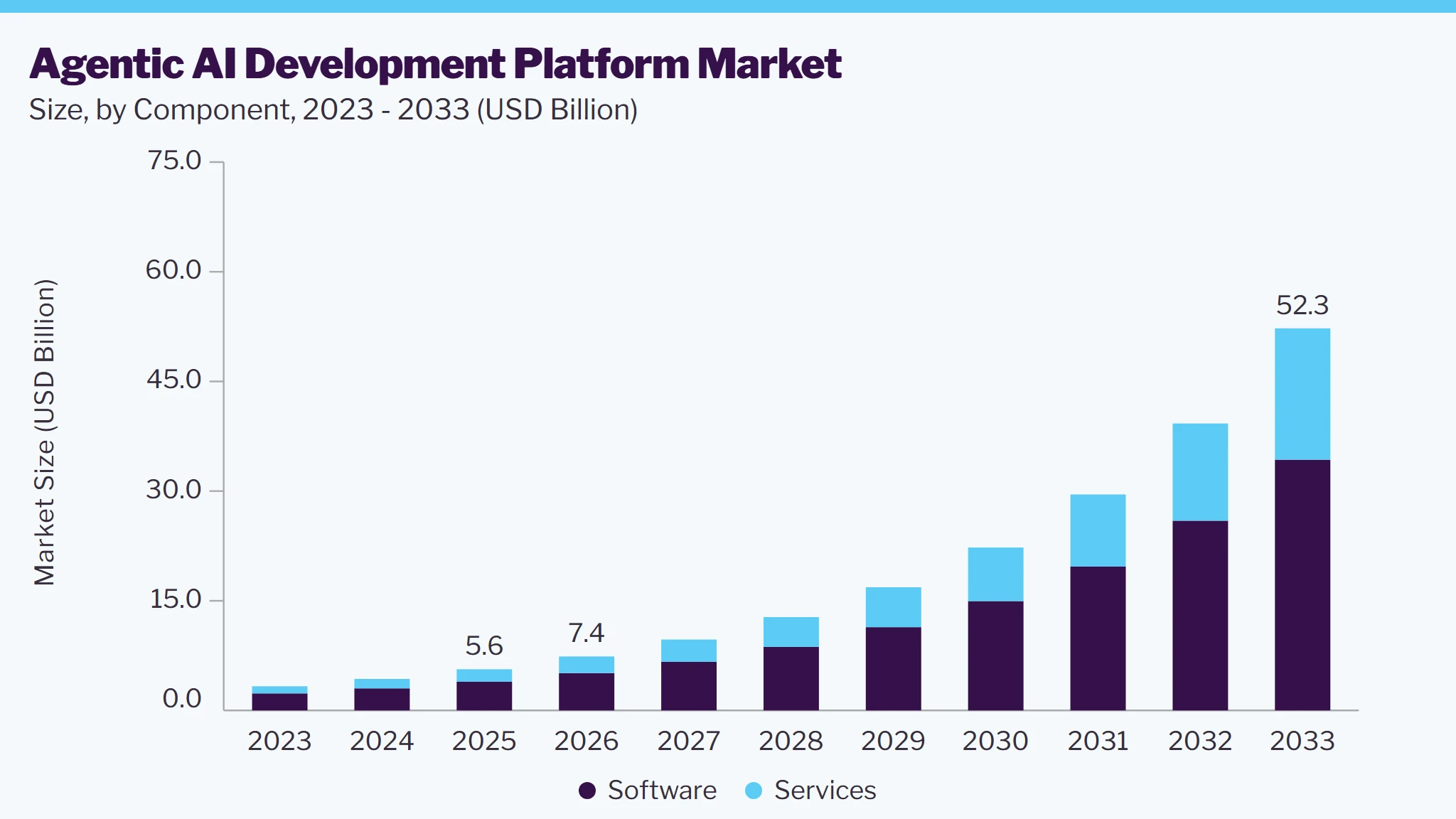 To learn more about this report, Download Free Sample Report
The growing adoption of multi-agent systems is driving the market as organizations seek to coordinate agents built on different frameworks and models. This is increasing demand for platforms that enable seamless agent communication, tool access, and interoperability across vendors, supporting the development of integrated multi-agent workflows. For instance, in May 2025, Google LLC announced updates to its Agent Development Kit, Vertex AI Agent Engine, and the Agent2Agent (A2A) protocol, including a production-ready Python ADK and an updated A2A specification. Microsoft announced support for the protocol in Azure AI Foundry and the ability to invoke A2A agents from Microsoft Copilot Studio. These developments support more portable agent architectures and reduce integration effort for enterprise buyers.
The need to move AI agents from pilot projects to production is driving the market. Enterprises are seeking platforms that support reliable deployment and scalable operations. This is increasing demand for testing, evaluation, and monitoring capabilities. Version control and trace-level debugging help developers identify issues and improve agent performance. Automated evaluation enables organizations to assess agent accuracy and consistency before deployment. Runtime monitoring helps track agent behavior and operational costs. Integration with existing enterprise data sources and identity systems further supports adoption. These capabilities help organizations manage complex agent workflows and improve deployment reliability. The growing need for scalable, reliable, and auditable AI agent operations is creating new growth opportunities in the market.
Market Dynamics
The market is growing as organizations integrate autonomous agents into customer service, software engineering, IT operations, finance, and other business processes. Rising pressure to automate multi-step workflows and improve productivity is encouraging investment in platforms that simplify agent creation and management. Technological advancements, expanding model choice, and wider enterprise adoption are creating new opportunities for market participants. However, production reliability, cost predictability, and skills gaps may influence market growth.
Organizations are increasingly looking beyond conversational assistants toward agents that can plan, use tools, and complete tasks with limited human intervention. This is creating demand for platforms that provide the building blocks for these systems, including orchestration, memory and knowledge access, tool integration, model routing, and human-in-the-loop controls. Businesses are investing in development platforms to shorten build cycles, standardize how agents are created, and reuse components across teams. Enterprises also value platforms that let them switch between models and connect to internal systems without rebuilding workflows.
As agents are embedded into more business processes, organizations need consistent ways to test, deploy, and monitor them. Platforms that combine development and lifecycle management reduce the operational effort needed to run many agents at once. The growing availability of low-code and no-code builders is also widening participation, allowing business teams to contribute to agent design alongside professional developers. This expanding user base and the push to automate complex workflows are supporting market expansion.
Many organizations find it difficult to move agents from prototypes to dependable production systems. Agents can behave unpredictably across long, multi-step tasks, and failures can be hard to detect and diagnose. Usage-based pricing tied to model tokens, tool calls, and hosted runtimes can also make costs difficult to forecast as agent volumes grow. These challenges can slow purchasing decisions and extend evaluation periods.
Building and operating agents require skills that remain scarce, including prompt and workflow design, evaluation methods, and agent observability. Fragmentation across frameworks, models, and protocols can complicate platform selection and increase the risk of vendor lock-in. Concerns about security, data access, and accountability may also lead enterprises to limit agent autonomy until stronger controls are in place. Consequently, reliability, cost, and skills barriers may limit the pace of adoption.
The growing number of agents in production is creating opportunities for tooling that measures and improves agent quality. Evaluation, tracing, and monitoring capabilities help teams identify failures, compare model and prompt changes, and control cost and latency. Vendors that integrate these capabilities with development and deployment workflows can address a key obstacle to scaling agent programs.
Small and medium-sized enterprises represent another opportunity, as low-code builders, pre-built connectors, and usage-based pricing lower the barrier to entry. Platforms that offer templates for common workflows and straightforward deployment can reach teams without dedicated AI engineering resources. Growth in regulated industries is also creating demand for hybrid and on-premises options that keep sensitive data within controlled environments. These trends support further growth across segments and regions.
Market Concentration & Characteristics
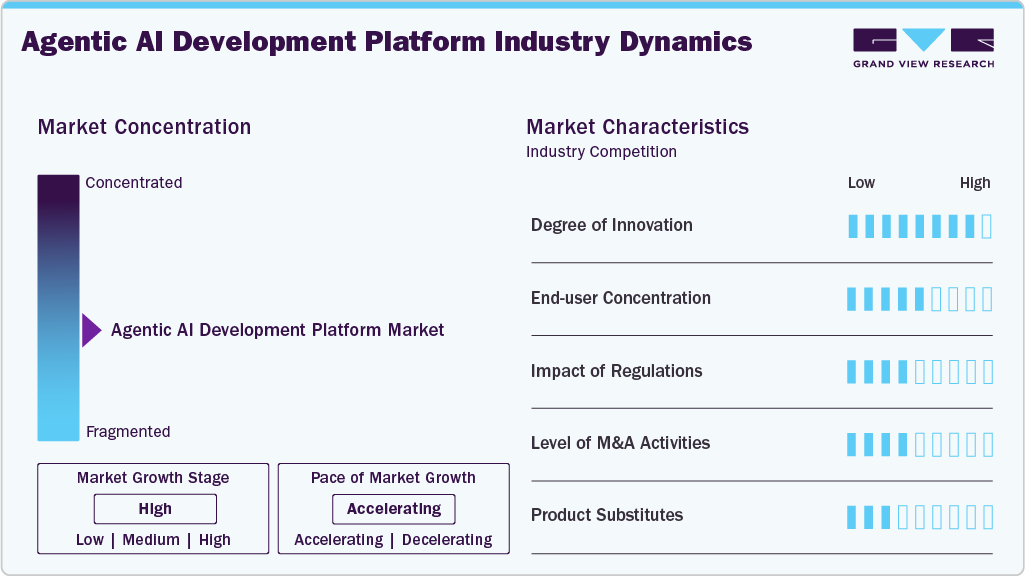
The global agentic AI development platform industry is moderately fragmented, with hyperscale cloud providers, enterprise software vendors, foundation model developers, open-source framework maintainers, and specialized start-ups competing across the agent development lifecycle. Large technology companies leverage existing cloud, data, and application ecosystems to bundle agent development capabilities. Meanwhile, specialized providers compete through open-source frameworks, orchestration depth, evaluation and observability tooling, and ease of use. The diversity of offerings creates competition across multiple capability layers.
 To learn more about this report, Download Free Sample Report
Market fragmentation is also influenced by the rapid pace of change in models, frameworks, and interoperability standards. Organizations have varying requirements for deployment control, model choice, security, and integration, which creates opportunities for both large providers and focused specialists. Strategic partnerships, product launches, and acquisitions may help companies expand their market presence. Established vendors may benefit from existing customer relationships and integrated enterprise offerings. However, specialized providers can remain competitive by offering targeted capabilities and adapting quickly to emerging requirements.
Analyst Perspective
The market is evolving as organizations move from experimenting with generative AI to deploying autonomous agents in production. Rising demand for orchestration, evaluation, and lifecycle management is driving investment in development platforms. Companies are releasing integrated builders, managed runtimes, and open frameworks to simplify agent creation and operation. Growing enterprise adoption and expanding low-code access are creating new market opportunities. The market is expected to expand as businesses prioritize reliable, scalable, and governed agent deployment.
Component Insights
The software segment dominated the market in 2025, accounting for a 69.6% revenue share. This dominance is driven by the increasing adoption of agent frameworks, orchestration layers, visual builders, and evaluation and monitoring tools. These platforms let organizations design agent workflows, connect them to tools and data, test behavior, and run agents in production. The need for repeatable, reusable development environments is further supporting software adoption. As enterprise deployment of agents expands, demand for scalable and automated development software is expected to increase.
The services segment is also gaining traction as organizations require professional support to implement and operate agent platforms. Businesses often need assistance with use-case selection, platform configuration, system integration, and ongoing optimization. Service providers help align platform capabilities with operational requirements and existing infrastructure. The complexity of production deployments is increasing demand for implementation, managed platform operations, training, and support. Consequently, growing deployment needs and expanding enterprise adoption are expected to support the services segment.
Deployment Mode Insights
The cloud-based segment dominated the market in 2025, due to its scalability, flexibility, and ease of deployment. Cloud-based platforms give teams access to managed runtimes, a wide choice of models, and built-in integrations without extensive infrastructure investment. Regular updates and elastic capacity allow organizations to scale agent workloads as usage grows. Their ability to integrate with cloud applications and data services further supports adoption. These advantages continue to support demand for cloud-based agent development platforms.
The hybrid segment is growing as organizations seek to balance cloud scalability with greater control over sensitive data and critical operations. Hybrid deployment allows businesses to build agents in the cloud while keeping data, models, or runtimes within private environments. This approach is particularly useful for organizations with strict data security, residency, and regulatory requirements. It also supports integration with legacy infrastructure. As enterprises adopt agents across diverse IT environments, demand for flexible deployment models is increasing. Hybrid solutions are gaining traction among organizations seeking operational flexibility and greater control over their data.
End-use Insights
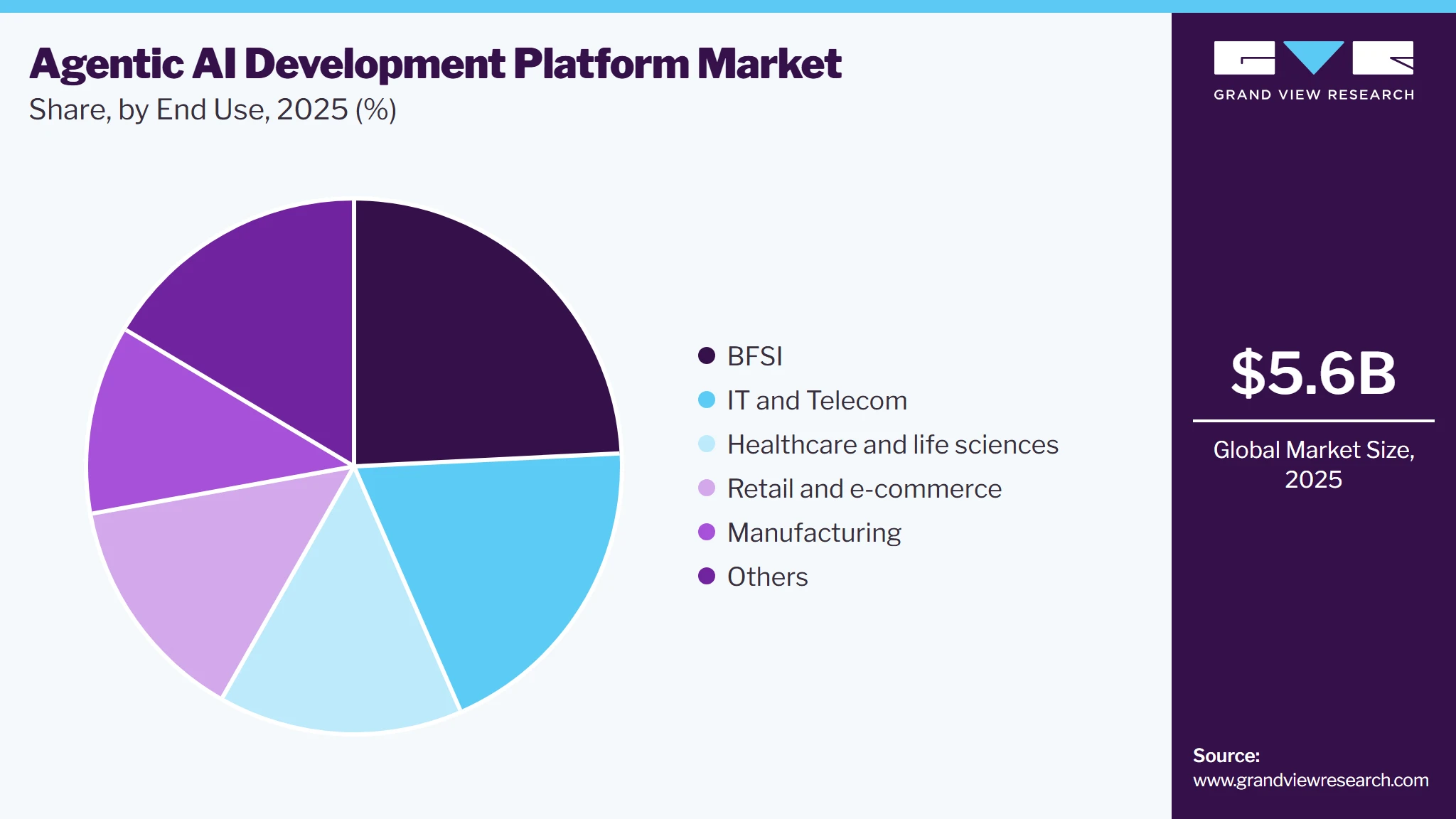
The BFSI segment dominated the market in 2025, due to the extensive use of AI across banking, financial services, and insurance operations. Financial institutions are building agents for customer service, fraud investigation, underwriting support, reconciliation, and compliance workflows. These cases require reliable orchestration, thorough testing, and strong oversight. The scale of financial operations and the value of automating complex, document-heavy processes further strengthen demand. These requirements support the adoption of agent development platforms across the BFSI sector.
 To learn more about this report, Download Free Sample Report
The healthcare and life sciences segment is growing as healthcare providers, pharmaceutical companies, and research institutions increasingly adopt AI agents. These agents can support administrative tasks, clinical documentation, revenue cycle workflows, research activities, and data management. Their use requires careful testing, controlled data access, and clear deployment controls, which increases demand for platforms with strong evaluation and hybrid deployment options. The increasing use of AI in clinical research and healthcare operations is creating additional demand for development tooling. As adoption expands, the need for dependable agent development and deployment is expected to support segment growth.
Regional Insights
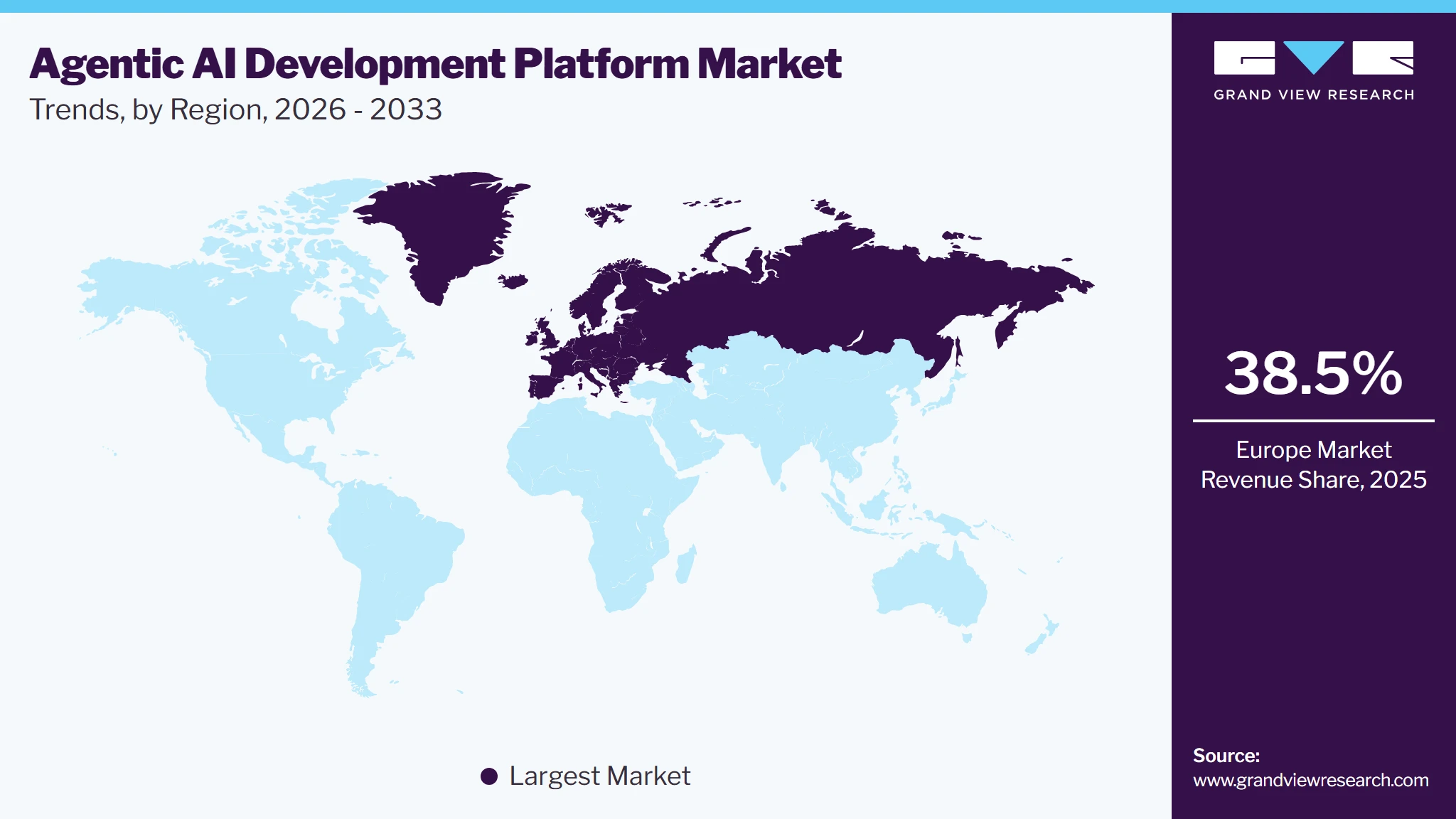
North America held the largest share of the agentic AI development platform market in 2025, accounting for 38.5% of revenue. The region benefits from widespread enterprise AI adoption, a large developer community, and the presence of leading cloud providers and AI developers. Strong venture investment in agent start-ups and early enterprise deployments further supports the regional market. Increasing investment in enterprise AI infrastructure and agent programs is expected to support continued market growth.
U.S. Agentic AI Development Platform Market Trends
The agentic AI development platform market in the U.S. is the largest in North America, supported by widespread enterprise AI adoption and a strong technology ecosystem. Organizations are increasingly building agents for software development, customer operations, and business process automation, creating demand for platforms that cover the full agent lifecycle. The country is home to major cloud providers, foundation model developers, and a large base of agent-focused start-ups. Businesses are integrating agent platforms with existing data and security frameworks.
Europe Agentic AI Development Platform Market Trends
The agentic AI development platform market in Europe is experiencing growing demand for agentic AI development platforms as enterprises expand their use of autonomous AI systems. Organizations in the region are prioritizing data protection, regulatory compliance, and data residency, which increases interest in hybrid and sovereign deployment options. Strong industrial, financial services, and public sector demand supports adoption across the UK, Germany, and France. The market is expected to grow as AI adoption increases and platforms adapt to regional requirements.
 To learn more about this report, Download Free Sample Report
Asia Pacific Agentic AI Development Platform Market Trends
The agentic AI development platform market in the Asia Pacific is expected to be the fastest-growing region, registering a CAGR of 36.6% from 2026 to 2033. Enterprises across the region are increasingly adopting AI applications across business functions, driving demand for agentic AI development platforms. Large developer communities in India and China are supporting the development and deployment of AI solutions. The expansion of cloud infrastructure is enabling enterprises to scale AI applications more efficiently. National AI strategies are further encouraging AI innovation and enterprise adoption. These developments are supporting market growth across the region.
Key Agentic AI Development Platform Company Insights
Key players operating in the market include Amazon Web Services, Inc., Databricks, Inc., Google LLC, IBM Corporation, Microsoft, Oracle Corporation, Salesforce, Inc., SAP SE, ServiceNow, Inc., and UiPath, Inc.
-
Amazon Web Services, Inc. has developed cloud-based capabilities to support the development, orchestration, and deployment of agentic AI applications. Its ecosystem enables enterprises to connect AI agents with business tools and data sources while supporting secure execution, monitoring, and scalable operations. These capabilities help organizations integrate autonomous agents into existing workflows and manage them in production.
-
Databricks is advancing agentic AI development through capabilities that connect AI agents with enterprise data, models, and business applications. Its platform supports agent development, deployment, performance evaluation, tracing, and governance, helping organizations build reliable AI agents grounded in their business data. These capabilities support the development of scalable, data-driven agentic AI applications across enterprise environments.
Key Agentic AI Development Platform Companies
The following key companies have been profiled for this study on the agentic AI development platform market.
-
Amazon Web Services, Inc.
-
CrewAI
-
Databricks, Inc.
-
Google LLC
-
IBM Corporation
-
LangChain
-
Microsoft
-
Oracle Corporation
-
ServiceNow, Inc.
-
UiPath, Inc.
Competitive Benchmarking
Operating Strategies
Competitive Edge
Weaknesses
Mature Players: Amazon Web Services, Inc., Google LLC, IBM Corporation, Microsoft
- Expand agent platforms through managed runtimes, open frameworks, partnerships, and integration with existing cloud, data, and application stacks.
- Established customer relationships, broad technology portfolios, global distribution, and enterprise-grade security and compliance.
- Complex product portfolios, potential lock-in concerns, and the challenge of keeping platforms aligned with fast-changing agent standards.
Emerging Players: CrewAI, LangChain
- Focus on specialized AI agent frameworks, multi-agent orchestration, open-source development tools, and integrations with enterprise applications and data sources.
- Flexible development environments, rapid innovation, developer-friendly tools, and support for building and coordinating AI agents across different models and frameworks.
- Flexible development environments, rapid innovation, developer-friendly tools, and support for building and coordinating AI agents across different models and frameworks.
Recent Developments
-
In February 2026, OpenAI and Amazon Web Services, Inc. announced a multi-year strategic partnership to develop a stateful runtime environment through Amazon Bedrock and expand enterprise access to OpenAI Frontier for building, deploying, and managing AI agents. The partnership also includes the use of AWS Trainium computing capacity and the joint development of customized AI models for Amazon’s customer-facing applications.
-
In July 2025, Amazon Web Services, Inc. introduced Amazon Bedrock AgentCore in preview, a suite of services designed to securely deploy, manage, and scale AI agents. The platform provides identity management, runtime security, monitoring, and access controls to help enterprises operate AI agents securely and efficiently.
-
In May 2025, CrewAI introduced CrewAI Studio v2, an AI-powered visual builder that enables users to create agentic workflows through a drag-and-drop interface. The company also introduced an agent repository to support centralized agent management, reuse, and deployment.
Agentic AI Development Platform Market Report Scope
Report Attribute
Details
Market size in 2025
USD 5.6 billion
Estimated market size in 2026
USD 7.4 billion
Projected market size by 2033
USD 52.3 billion
Growth rate
CAGR of 32.3% from 2026 to 2033
Actual data
2021 - 2025
Forecast period
2026 - 2033
Quantitative units
Revenue in USD billion and CAGR from 2026 to 2033
Report coverage
Revenue forecast, company share, competitive landscape, growth factors, and trends
Segments covered
Component, deployment mode, end-use, region
Regional scope
North America; Europe; Asia Pacific; Latin America; MEA
Country scope
U.S.; Canada; Mexico; UK; Germany; France; China; Japan; India; South Korea; Australia; Brazil; UAE; KSA; South Africa
Key companies profiled
Amazon Web Services, Inc.; CrewAI; Databricks, Inc.; Google LLC; IBM Corporation; LangChain; Microsoft; Oracle Corporation; ServiceNow, Inc.; UiPath, Inc.
Customization scope
Free report customization (equivalent to up to 8 analyst working days) with purchase. Addition or alteration to country, regional & segment scope.
Pricing and purchase options
Avail customized purchase options to meet your exact research needs. Explore purchase options
Global Agentic AI Development Platform Market Report Segmentation
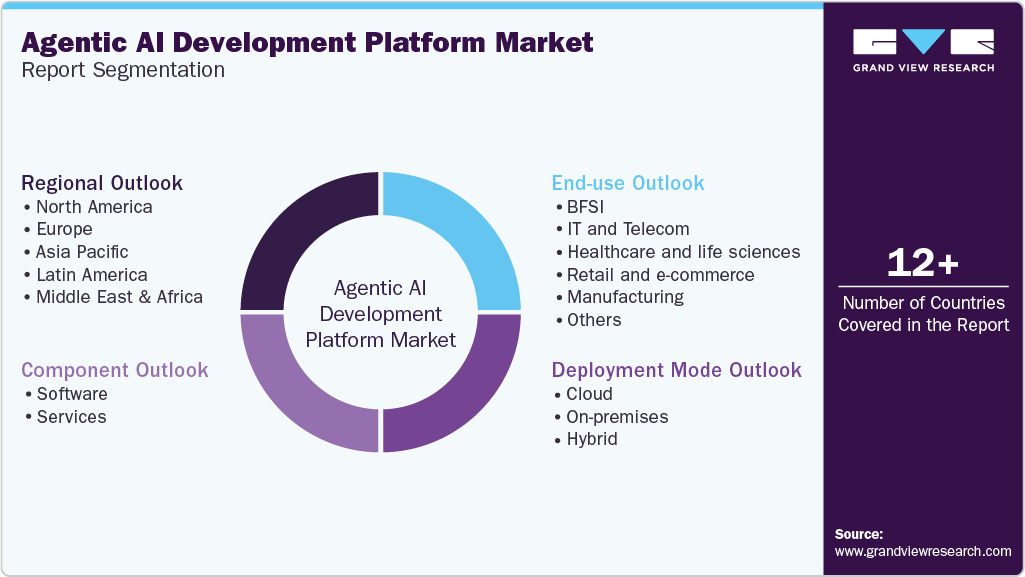
This report forecasts revenue growth at global, regional, and country levels and provides an analysis of the latest industry trends in each of the sub-segments from 2021 to 2033. For this study, Grand View Research has segmented the global agentic AI development platform market report based on component, deployment mode, end-use, and region:
 To learn more about this report, Download Free Sample Report
-
Component Outlook (Revenue, USD Billion, 2021 - 2033)
-
Software
-
Services
-
-
Deployment Mode Outlook (Revenue, USD Billion, 2021 - 2033)
-
Cloud
-
On-premises
-
Hybrid
-
-
End-use Outlook (Revenue, USD Billion, 2021 - 2033)
-
BFSI
-
IT and Telecom
-
Healthcare and life sciences
-
Retail and e-commerce
-
Manufacturing
-
Others
-
-
Regional Outlook (Revenue, USD Billion, 2021 - 2033)
-
North America
-
U.S.
-
Canada
-
Mexico
-
-
Europe
-
UK
-
Germany
-
France
-
-
Asia Pacific
-
China
-
Japan
-
India
-
South Korea
-
Australia
-
-
Latin America
-
Brazil
-
-
Middle East and Africa
-
UAE
-
KSA
-
South Africa
-
-
Research Methodology
The agentic AI development platform market figures in this report are based on a proven research process that combines executive interviews with secondary research from proprietary databases, company filings, and recognized regulatory and institutional sources. Market size is built through value-chain sizing—reconciling supply-side and demand-side estimates—and triangulated with bottom-up and top-down approaches. Every estimate passes multiple levels of expert validation before publication, with each agentic AI development platform segment quantified using the revenue-capture definitions in the table below.
Segment Definition
Component
Revenue Capture Definition
Software
Includes revenue from software licenses, subscriptions, and usage-based fees for platform capabilities covering agent development, orchestration, testing, deployment, evaluation, monitoring, and lifecycle management.
Services
Covers income from platform-attributable services, including implementation, system integration, managed platform operations, training, and support. General consulting and unrelated IT services are excluded.
Deployment Mode
Revenue Capture Definition
Cloud-based
Measures revenue from agent development platforms hosted on cloud infrastructure and delivered through subscription-based or usage-based service models.
On-premises
Covers licensing and related income from platforms installed and operated within an organization’s internal infrastructure or data centers.
Hybrid
Encompasses earnings from platforms that combine cloud and on-premises environments, allowing agents to be built, deployed, and run across distributed infrastructures.
End Use
Revenue Capture Definition
BFSI
Reflects revenue from banks, financial institutions, and insurers using agent development platforms for customer service, fraud, underwriting, reconciliation, and compliance workflows.
IT and Telecommunications
Includes spending by technology companies and telecom operators on platforms used to build agents for software development, IT operations, network management, and customer support.
Healthcare and Life Sciences
Accounts for revenue from healthcare providers, pharmaceutical companies, biotechnology firms, and research institutions building agents for clinical, administrative, and research workflows.
Government and Public Sector
Covers income from platforms procured by public agencies to build agents for citizen services, case management, and internal operations.
Manufacturing
Represents investment by industrial companies in platforms used to build agents for production planning, maintenance, quality, and supply chain operations.
Retail and E-commerce
Captures revenue from retailers and online merchants building agents for customer service, recommendations, pricing, inventory, and order management.
Estimation Model
Layer No.
Layer Name
Key Question
Description
01
End-user Industry Layer
Which industries generate demand for agentic AI development platforms?
Identifies the organizations creating market demand across BFSI, IT and telecommunications, healthcare and life sciences, government and public sector, manufacturing, retail and e-commerce, energy and utilities, and other industries building AI agents.
02
Adoption / Usage Layer
Which organizations are building and operating AI agents?
Evaluates the addressable market based on enterprise AI agent adoption, the number of agents moving into production, integration with business applications, and the share of agent programs built on commercial platforms.
03
Technology and Infrastructure Layer
Which technologies enable the development and operation of AI agents?
Assesses platform capabilities for agent development, orchestration, testing, deployment, evaluation, monitoring, and lifecycle management, along with supporting protocols and runtimes.
04
Revenue Capture Layer
How is revenue generated across the agent development platform ecosystem?
Measures revenue from software licenses, subscriptions, and usage-based platform fees across cloud-based, on-premises, and hybrid deployments, and from platform-attributable services such as implementation and managed operations.
Delivered Customizations
This report has been delivered with the following in-depth customizations
Client Request
Customization Delivered
Value Adds
Technology & Capability Assessment
Agent development, orchestration, evaluation, and monitoring capability assessment; deployment model and partner ecosystem analysis.
Identified technology gaps and opportunities; supported build, buy, and partnership decisions.
Product Positioning & Competitive Intelligence
Product and vendor capability benchmarking; pricing, deployment, and differentiation analysis.
Improved product positioning; supported pricing and competitive strategy.
Market Entry & Growth Assessment
Regional sizing, forecasting, and segmentation; adoption trends, regulations, and competitive analysis.
Identified growth opportunities; supported market entry and expansion planning.
About the Author(s)
Next Generation Technologies Research Team
Technology · Next Generation TechnologiesThis report was authored by the next generation technologies research team at Grand View Research - comprising two research analysts, one senior research analyst, and one industry expert - with specialized expertise in the next generation technologies segment of the technology industry. All findings are based on proprietary technology databases, executive interviews, and regulatory analysis, subject to internal peer review prior to publication.
Last Updated:
Speak to Analyst

Customize this report to your needs - add regions, segments, or data points, with 20% free customization.
Or view our licence options:


ISO 9001:2015 & 27001:2022 Certified
We are GDPR and CCPA compliant! Your transaction & personal information is safe and secure. For more details, please read our privacy policy.


