
- Home
- »
- Next Generation Technologies
- »
-
AI Agents Market Size, Share And Trends Report, 2026-2033GVR Report cover
![AI Agents Market Size, Share & Trends Report]()
AI Agents Market (2026 - 2033) Size, Share & Trends Analysis Report By Technology (Deep Learning, Computer Vision), By Agent System (Single Agent, Multi-Agent), By Type, By Application, By End Use, By Region, And Segment Forecasts
Market Size, 2025
$7.6BMarket Estimate, 2026
$10.9BMarket Forecast, 2033
$182.9BCAGR, 2026–2033
49.6%AI Agents Market Summary
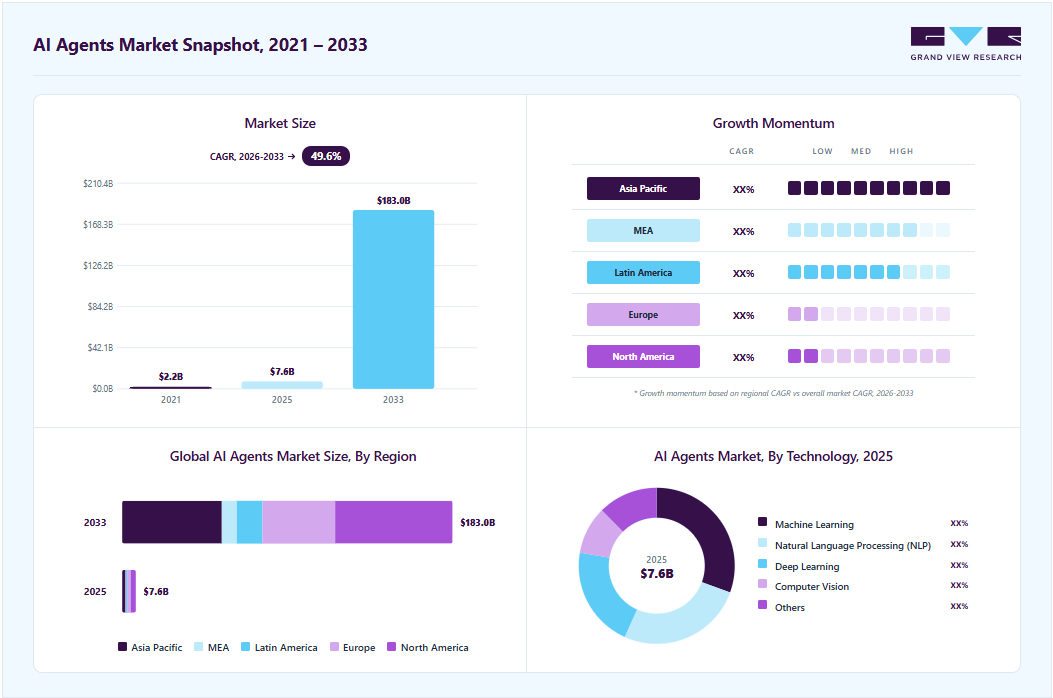
The global AI agents market size was valued at USD 7.6 billion in 2025 and is projected to grow from USD 10.9 billion in 2026 to USD 182.9 billion by 2033, at a CAGR of 49.6% from 2026 to 2033. The North America held the largest share of 39.6% of the global market in 2025. Increased demand for automation, advancements in natural language processing (NLP), and rising demand for personalized customer experience are primarily driving market growth.
Key Market Trends & Insights
- By technology: Machine learning segment held the largest market share of 30.5% in 2025.
- By agent system: Single-agent systems segment held the largest market share of 59.2% in 2025.
- By type: Ready-to-deploy agents segment accounted for the largest revenue share in 2025.
- By application: Customer service and virtual assistants segment accounted for the largest revenue share in 2025.
- By end use: Enterprise segment accounted for the largest revenue share in 2025.
Regional Highlights
- Largest regional market: North America (39.6% revenue share, 2025)
- Fastest-growing regional market: Asia Pacific (highest CAGR, 2026-2033)
- By country: The U.S. held the largest market share in 2025.
Market Size & Forecast
- Market size in 2025: USD 7.6 Billion
- Estimated market size in 2026: USD 10.9 Billion
- Projected market size by 2033: USD 182.9 Billion
- CAGR (2026-2033): 49.6%
Moreover, the widespread adoption of cloud computing has made it easier and cost-effective for businesses to deploy AI agents. Consumers expect more personalized interactions, and AI agents enable businesses to deliver customized solutions by using data to provide targeted recommendations, customer support, and marketing outreach, increasing customer satisfaction and loyalty. AI agents enhance customer engagement in e-commerce by offering real-time product recommendations, assisting with transactions, and improving the online shopping experience.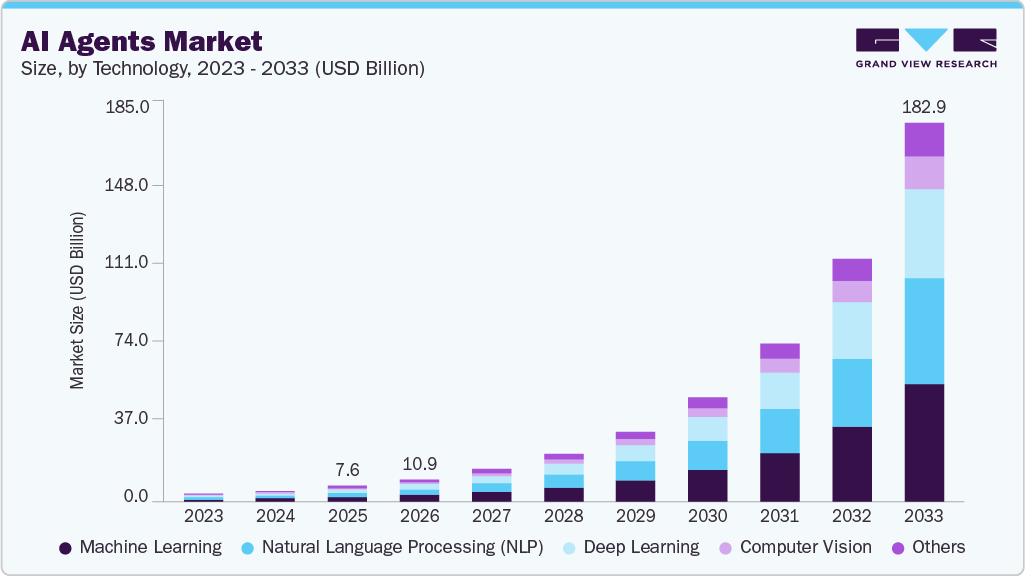
Moreover, the rise of online retail has been a significant growth driver as AI agents are used in telemedicine, patient management, and diagnostics, which are crucial in streamlining healthcare operations. Their ability to handle patient queries, assist in appointment scheduling, and offer health guidance contributes significantly to the growth of the AI agent industry in healthcare.
AI agents are integrated with security systems to monitor, analyze, and respond to security threats in real time. Their capabilities in detecting anomalies, predictive analysis, and automating security procedures drive market demand in both public and private sectors. Moreover, ongoing research and development in AI technologies, particularly in machine learning, deep learning, and NLP, are improving AI agents' functionality and performance. As AI agents become more advanced, industries are adopting them for increasingly complex tasks.
Market Dynamics
Organizations across industries are increasingly adopting AI agents to automate repetitive and time-intensive business processes, enabling faster execution and improved operational efficiency. Enterprises are integrating AI agents into functions such as customer support, IT operations, finance, human resources, and supply chain management to reduce manual intervention and optimize resource utilization. The growing need to handle large volumes of enterprise data and workflows in real time is accelerating demand for intelligent systems capable of independently managing tasks and generating actionable insights. AI agents also help businesses minimize operational errors, improve response times, and maintain consistent service delivery across departments.
In addition, enterprises are focusing on autonomous decision-making capabilities to enhance productivity and support data-driven business operations. AI agents equipped with machine learning, natural language processing, and predictive analytics can analyze complex datasets, identify patterns, and recommend or execute decisions with minimal human supervision. The increasing adoption of cloud computing and enterprise AI platforms is further supporting the deployment of scalable AI agent solutions across organizations. Companies are also using AI agents to improve agility in dynamic business environments, enabling faster adaptation to changing customer demands and market conditions.
AI agents often process large volumes of sensitive customer, operational, and financial data, creating risks related to unauthorized access, data leakage, and cyberattacks. Organizations operating in highly regulated industries such as healthcare, banking, and government remain cautious about deploying autonomous AI systems due to strict compliance requirements related to data handling and transparency. Variations in global data protection regulations, including regional privacy laws and cross-border data transfer restrictions, further complicate large-scale deployment strategies. These concerns slow purchasing decisions and extend enterprise evaluation cycles, particularly among large organizations managing critical infrastructure and confidential information.
In addition, the autonomous nature of AI agents creates challenges in monitoring, auditing, and controlling decision-making processes within enterprise systems. Many organizations struggle to ensure that AI agents operate within predefined governance frameworks while maintaining accountability and ethical compliance. Concerns about bias, unauthorized actions, and a lack of visibility into AI-generated outputs continue to erode trust among enterprise users. Companies are therefore increasing investments in secure AI infrastructure, explainable AI models, and governance frameworks before expanding deployment across business functions.
Enterprises are deploying AI agents to manage high volumes of customer interactions, provide real-time responses, and deliver consistent support across digital platforms. The integration of generative AI, NLP, and contextual learning capabilities enables these agents to understand customer intent more accurately and improve interaction quality. Businesses are also using AI agents to reduce operational costs, shorten response times, and maintain 24/7 customer support. As customer expectations shift toward faster, more seamless communication experiences, demand for intelligent virtual assistance solutions is expanding across both large enterprises and small businesses.
The opportunity is further increasing as industries, including retail, banking, healthcare, telecommunications, and travel, integrate AI agents into their customer engagement strategies. AI-powered virtual assistants are being adopted not only for handling routine queries but also for supporting sales recommendations, appointment scheduling, technical troubleshooting, and multilingual communication services. Advancements in multimodal AI and conversational intelligence are enabling AI agents to manage more complex interactions with higher accuracy and human-like engagement.
Market Concentration & Characteristics
The AI agents market demonstrates a high degree of innovation due to continuous advancements in generative AI, LLM, autonomous decision-making, and multimodal AI capabilities. Companies are actively developing intelligent agents capable of performing complex enterprise tasks, improving workflow automation, and enabling human-like interactions. Rapid innovation cycles and increasing investments in AI research are accelerating product differentiation and competitive intensity across the market. The growing integration of AI agents with enterprise software, cloud platforms, and IoT ecosystems is further expanding application capabilities across industries. In addition, continuous improvements in contextual reasoning, memory capabilities, and real-time analytics are enhancing the operational efficiency and scalability of AI agent solutions.
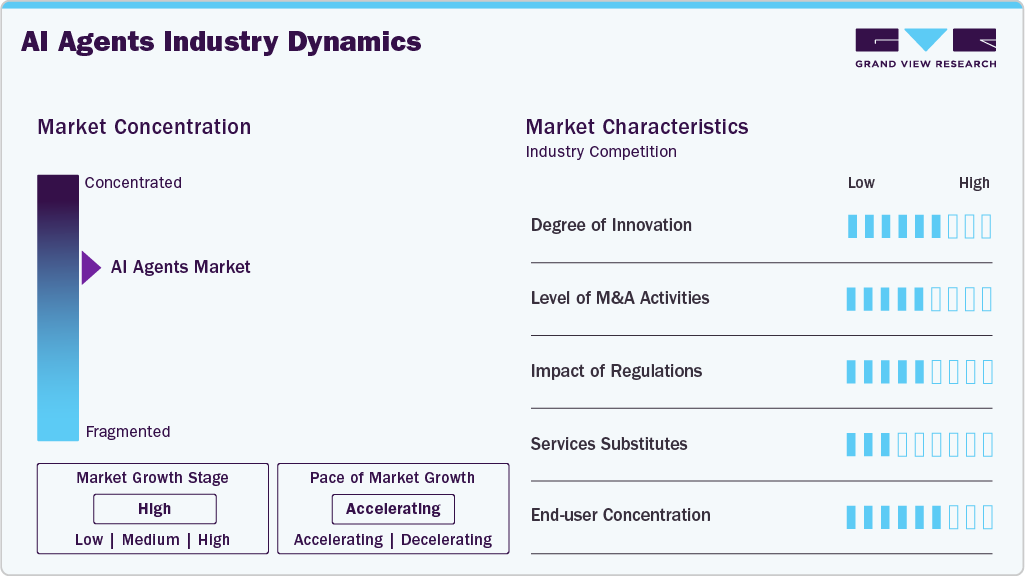
End-user concentration in the AI agents market is moderately high, with significant adoption across large enterprises in BFSI, healthcare, retail, manufacturing, and IT sectors. Enterprises with strong digital transformation initiatives are major contributors to market demand due to higher investments in AI-driven automation and customer engagement solutions. Meanwhile, increasing accessibility of cloud-based AI platforms is expanding adoption among SMEs. The rising demand for personalized customer experiences and operational efficiency is further accelerating AI agent deployment across diverse end-user industries. In addition, increasing cloud adoption and subscription-based AI service models are enabling wider enterprise integration and scalable implementation of AI agents globally.
Technology Insights
The machine learning technology segment led the market and accounted for 30.56% of the global revenue in 2025. Machine learning algorithms enable AI agents to analyze vast amounts of data and make informed decisions quickly. This capability enhances automation and improves overall operational efficiency across various industries. For instance, in May 2025, NTT DATA announced the Smart AI Agent Ecosystem, which incorporates machine learning through large language models (LLMs) and small language models (SLMs) in its platform for agentic AI solutions across industries, including healthcare, automotive manufacturing, finance, supply chain, and marketing.
The deep learning technology segment is predicted to experience significant growth in the forecast period. Enhanced performance and accuracy, big data availability, and advancements in computational power & real-time processing are factors primarily driving the segment's growth. For instance, in December 2025, Snowflake partnered with Anthropic to integrate Claude models, which employ deep learning transformer architectures, into the Snowflake platform, enabling AI agents to perform multi-step analysis on structured and unstructured data with over 90% accuracy on text-to-SQL tasks via Snowflake Cortex AI and Intelligence.
Agent System Insights
The single-agent systems segment accounted for the largest market revenue share in 2025. Single-agent systems are easier and faster to implement compared to multi-agent systems. Businesses can deploy these solutions quickly without extensive customization, making them suitable for companies looking to enhance efficiency rapidly. Moreover, the development and deployment costs associated with single-agent systems are generally lower. Organizations can achieve automation and AI capabilities without the significant investment required for multi-agent systems.
The multi-agent systems segment is predicted to foresee significant growth in the forecast period. The market is driven by multi-agent systems, enabling better communication and collaboration among agents, leading to improved coordination and teamwork. For instance, in December 2025, Fujitsu Limited announced new technology that lets AI agents from different companies and vendors work together securely in supply chains. This technology offers global best control even when information is incomplete and uses a secure gateway to keep data safe during operations.
Type Insights
The ready-to-deploy agents segment accounted for the largest market revenue share in 2025. Businesses can implement ready-to-deploy agents with minimal setup time, allowing them to start benefiting from AI technologies immediately. For instance, in June 2025, Salesforce announced Agentforce 3, which provides observability through the command center and interoperability via Model context protocol support. The platform includes an updated Atlas architecture with reduced latency and expanded language support across multiple regions.
The build-your-own agents segment is predicted to experience significant growth in the forecast period. Build-your-own agents can be designed to integrate with various enterprise systems, facilitating smoother workflows seamlessly. For instance, in October 2025, KPMG Velocity launched Global Business Services, enabled by the ServiceNow AI Platform to streamline workflows across finance, procurement, human resources, and IT functions. The solution provides a digital platform for orchestrating AI agents, for building and managing autonomous agents and workflows.
Application Insights
The customer service and virtual assistants segment accounted for the largest market revenue share in 2025. The market is driven by advanced AI algorithms that allow virtual assistants to analyze customer data and interactions, providing personalized responses and recommendations that enhance the customer experience. For instance, in August 2024, Interactions launched Task Orchestration, an AI-powered agent assist solution that extends its intelligent virtual assistants framework for contact centers. It integrates with existing robotic process automation solutions and supports multichannel self-service without escalations to live agents.
The healthcare segment is predicted to experience significant growth in the forecast period. The market is driven by various factors, such as improved patient engagement, efficiency in operations, enhanced diagnosis and decision support, and integration with wearable devices, which are primarily driving the growth of the healthcare segment. For instance, in April 2025, Tulu Health launched its AI-agent platform integrated with WhatsApp and hospital websites, offering modular AI agents for both providers and patients for the full healthcare journey from consultation to post-hospitalization.
End Use Insights
The enterprise segment accounted for the largest market revenue share in 2025. AI agents provide 24/7 customer support, personalized interactions, and quick responses, improving overall customer satisfaction and loyalty, which is crucial for businesses in competitive markets. For instance, in October 2025, PALO ALTO launched the Rubrik Agent Cloud, a new enterprise platform designed to enable organisations to deploy AI agents at scale, while maintaining oversight and control as it delivers security, accuracy, and operational efficiency during AI-driven transformation.

The industrial segment is projected to grow significantly over the forecast period. The demand is due to the increasing automation to enhance operational efficiency and reduce labor costs. AI agents can automate repetitive tasks, monitor processes, and make real-time decisions. For instance, in May 2025, Siemens announced the rollout of advanced AI agents designed to integrate with its existing Industrial Copilot ecosystem. These agents mark a shift from traditional query-based AI assistants to autonomous systems capable of managing entire industrial workflows without human oversight.
Regional Insights
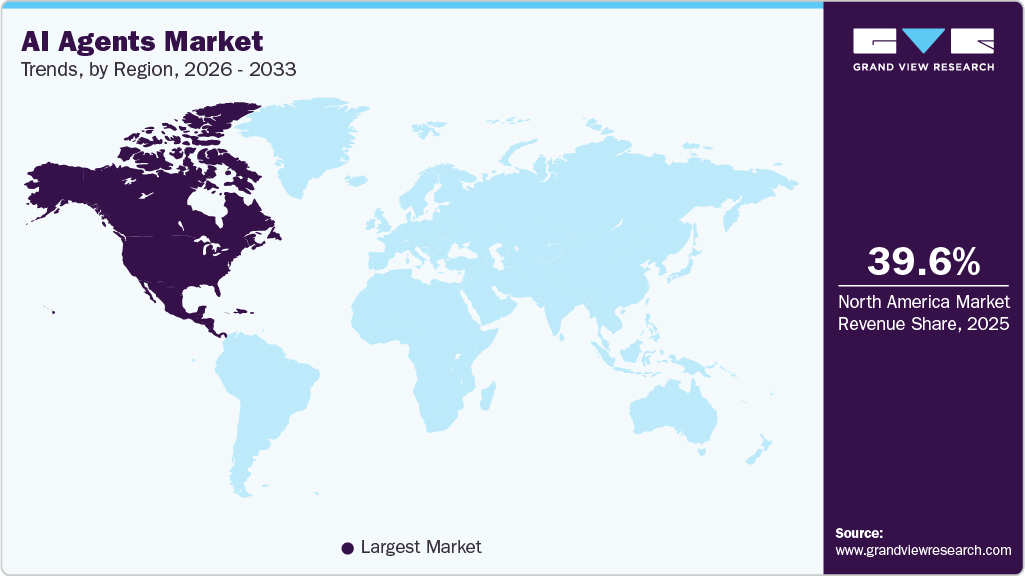
North America dominated the market by 39.63% revenue share in 2025, due to the advanced technological infrastructure, a high concentration of leading technological companies, and substantial investments in research and development in the region. Furthermore, the early adoption of AI technologies across various sectors, including defense, healthcare, finance, and retail, contributes significantly to the growth of the AI agent industry.
U.S. AI Agents Market Trends
The AI agents market in the U.S. is driven by the presence of tech giants, which are establishing advancements in AI agent technology. A booming startup ecosystem focused on AI innovation and automation further accelerates development across diverse sectors, including finance, education, and customer service. Government initiatives, such as the U.S. National AI Initiative, are also important in raising AI research, development, and deployment, setting the U.S. market position.
Europe AI Agents Market Trends
The AI agents market in Europe is driven by government support through regulations and initiatives such as the European Union's AI strategy. This strategic framework encourages research, innovation, and the responsible deployment of AI agents across diverse industries such as manufacturing, healthcare, and energy. Furthermore, increasing investments in AI research and development, with a growing awareness of the benefits of AI agents in improving efficiency and productivity, are fueling market expansion in Europe.
Asia Pacific AI Agents Market Trends
The AI agents market in the Asia Pacific is anticipated to register the highest CAGR over the forecast period, fueled by rapid digital transformation across industries, leading to increased adoption of AI technologies. Businesses are increasingly using AI to optimize operations, enhance customer engagement, and drive innovation. Factors such as expanding internet penetration, rising disposable income, and supportive government policies further contribute to the market's growth potential in this region.
Key AI Agents Company Insights
Some key companies in the industry are Baidu, Alibaba Group Holding Limited,Google, and Microsoft.
-
Baidu operates as an AI-focused company with an internet foundation, providing search services, AI cloud solutions, autonomous driving technology via its Apollo platform, and digital assistants like DuerOS. Its offerings include online marketing, video streaming through iQIYI, maps, and mobile ecosystem products serving a broad user base across search, advertising, and enterprise applications. The company maintains a full AI stack encompassing deep learning frameworks, models, and applications integrated into its diversified portfolio.
-
Microsoft Corporation develops, licenses, and supports software, services, devices, and solutions worldwide, with operations spanning productivity tools, intelligent cloud platforms, and personal computing. The company provides operating systems such as Windows, productivity applications including Office and Teams, cloud services through Azure, and hardware like Surface devices and Xbox consoles. It also delivers enterprise solutions such as SQL Server, Dynamics 365, and developer tools like Visual Studio.
Key AI Agents Companies:
The following key companies have been profiled for this study on the ai agents market.
- Alibaba Group Holding Limited
- Amazon Web Services, Inc.
- Apple Inc.
- Baidu
- IBM Corporation
- Meta
- Microsoft
- NVIDIA Corporation
- Salesforce, Inc.
Competitive Benchmarking
Operating Strategies
Competitive Edge
Weaknesses
Mature Players: Amazon Web Services, Inc.; Google; Microsoft; IBM Corporation
- Focus on expanding AI ecosystems through cloud platforms, proprietary AI models, and enterprise partnerships.
- Invest heavily in R&D, AI infrastructure, and generative AI integration across business applications.
- Strong cloud infrastructure, advanced AI capabilities, and an established enterprise customer base support large-scale deployment.
- Financial strength, proprietary datasets, and integrated AI portfolios provide long-term competitive advantage.
- Large organizational structures can slow innovation and reduce operational flexibility.
- High AI development costs and increasing regulatory analysis create operational challenges.
Emerging Players: Alibaba Group Holding Limited; Baidu
- Focus on localized AI agent deployment and industry-specific AI applications.
- Expand through cloud AI services, strategic partnerships, and regional ecosystem development.
- Strong regional presence and localized AI capabilities support faster market adoption.
- Active business structures enable quicker innovation and cost-efficient AI deployment.
- Limited global enterprise reach and lower international brand recognition affect expansion.
- Smaller R&D budgets and infrastructure limitations restrict competition with global leaders.
Recent Developments
-
In December 2025, Google released Google Workspace Studio, enabling business users to build and deploy AI-powered agents across Gmail, Drive, Chat, and other Google Workspace applications using the new Gemini 3 model. This launch transforms traditional rule-based automation toward flexible, context-aware workflows that enable non-technical employees to automate routine and complex tasks without writing code.
-
In November 2025, Baidu announced its new foundation model ERNIE 5.0, described as a natively omni-modal system capable of processing and generating across text, images, audio, and video. Alongside ERNIE 5.0, Baidu introduced a suite of AI offerings, including upgraded digital-human technology, a no-code application builder Miaoda, a general-AI agent GenFlow, a self-evolving agent Famou, and an integrated AI workspace Oreate for international deployment via its cloud and enterprise channels.
-
In March 2025, NVIDIA introduced the open “Llama Nemotron” family of reasoning-capable models for developers and enterprises, providing a production-ready foundation for building agentic AI platforms. The models is available in Nano, Super, and Ultra variants that support a range of deployment scenarios from edge devices to multi-GPU data-center servers.
AI Agents Market Report Scope
Report Attribute
Details
Market size in 2025
USD 7.6 billion
Estimated market size in 2026
USD 10.9 billion
Projected market size by 2033
USD 182.9 billion
Growth rate
CAGR of 49.6% from 2026 to 2033
Actual data
2021 - 2025
Forecast period
2026 - 2033
Quantitative units
Revenue in USD million/billion and CAGR from 2026 to 2033
Report coverage
Revenue forecast, company ranking, competitive landscape, growth factors, and trends
Segments covered
Technology, agent system, type, application, end use, region
Regional scope
North America; Europe; Asia Pacific; Latin America; MEA
Country scope
U.S.; Canada; Mexico; UK; Germany; France; China; Japan; India; South Korea; Australia; Brazil; KSA; UAE; South Africa
Key companies profiled
Alibaba Group Holding Limited; Amazon Web Services, Inc.; Apple Inc.; Baidu; Google; IBM Corporation; Meta; Microsoft; NVIDIA Corporation; Salesforce, Inc.
Customization scope
Free report customization (equivalent up to 8 analysts working days) with purchase. Addition or alteration to country, regional & segment scope.
Pricing and purchase options
Avail customized purchase options to meet your exact research needs. Explore purchase options
Global AI Agents Market Report Segmentation
This report forecasts revenue growth at global, regional, and country levels and provides an analysis of the latest industry trends in each of the sub-segments from 2021 to 2033. For this study, Grand View Research has segmented the global AI agents market report based on technology, agent system, type, application, end use, and region:
-
Technology Outlook (Revenue, USD Billion, 2021 - 2033)
-
Machine Learning
-
Natural Language Processing (NLP)
-
Deep Learning
-
Computer Vision
-
Others
-
-
Agent System Outlook (Revenue, USD Billion, 2021 - 2033)
-
Single Agent Systems
-
Multi-Agent Systems
-
-
Type Outlook (Revenue, USD Billion, 2021 - 2033)
-
Ready-to-Deploy Agents
-
Build-Your-Own Agents
-
-
Application Outlook (Revenue, USD Billion, 2021 - 2033)
-
Customer Service and Virtual Assistants
-
Robotics and Automation
-
Healthcare
-
Financial Services
-
Security and Surveillance
-
Gaming and Entertainment
-
Marketing and sales
-
Human Resources
-
Legal and compliance
-
Others
-
-
End Use Outlook (Revenue, USD Billion, 2021 - 2033)
-
Consumer
-
Enterprise
-
Industrial
-
-
Regional Outlook (Revenue, USD Billion, 2021 - 2033)
-
North America
-
U.S.
-
Canada
-
Mexico
-
-
Europe
-
UK
-
Germany
-
France
-
-
Asia Pacific
-
China
-
Japan
-
India
-
South Korea
-
Australia
-
-
Latin America
-
Brazil
-
-
Middle East and Africa (MEA)
-
KSA
-
UAE
-
South Africa
-
-
Delivered Customizations
This report has been delivered with the following In-depth customizations
Client Objective
Custom Research Modules Delivered
Strategic Value / Business Impact
Market Entry & Expansion Assessment
- Regional demand sizing and forecasting
- Customer segmentation and buying behavior analysis
- Competitive landscape benchmarking
- Regulatory and distribution channel assessment
- Identified high-growth market opportunities. Supported go-to-market strategy development
- Highlighted investment priorities and risks
- Enabled data-driven expansion planning
Product Positioning & Competitive Intelligence
- Product benchmarking and feature comparison
- Pricing and value proposition analysis
- Brand perception and customer preference study
- Competitor strategy evaluation
- Improved product differentiation strategy
- Supported pricing optimization
- Identified unmet customer needs
- Enhanced competitive positioning
Customer & End-User Insights Study
- Consumer awareness and adoption analysis
- Purchase decision journey mapping
- Satisfaction and loyalty assessment
- Usage pattern and pain-point evaluation
- Revealed key adoption drivers and barriers
- Supported customer-centric product development
- Improved targeting and engagement strategy
- Identified opportunities for retention and upselling
Technology & Innovation Assessment
- Emerging technology trend analysis
- Innovation pipeline
- Technology adoption readiness assessment
- Ecosystem and partnership mapping
- Identified future growth areas
- Supported innovation roadmap planning
- Evaluated commercialization potential
- Strengthened strategic partnership decisions
Investment Feasibility & Opportunity Analysis
- Market attractiveness evaluation
- Revenue and profitability modeling
- SWOT and risk assessment
- Industry trend and scenario analysis
- Supported investment decision-making, identified high-potential segments
- Reduced market uncertainty
- Enabled strategic business planning
Frequently Asked Questions About This Report
The machine learning segment led with a 30.5% revenue share in 2025.
The single-agent systems segment held the largest revenue share in 2025.
The ready-to-deploy agents segment accounted for the largest revenue share in 2025.
The customer service and virtual assistants segment accounted for the largest revenue share in 2025.
North America dominated the market with a 39.6% revenue share in 2025.
Asia Pacific is the fastest-growing region over the forecast period.
The global AI agents market size was valued at USD 7.6 billion in 2025 and is estimated at USD 10.9 billion for 2026.
The global AI agents market is expected to grow at a CAGR of 49.6% from 2026 to 2033, reaching USD 182.9 billion by 2033.
Some key players operating in the AI agents market include Alibaba Group Holding Limited; Amazon Web Services, Inc.; Apple Inc.; Baidu; Google; IBM Corporation; Meta; Microsoft; NVIDIA Corporation; Salesforce, inc.
Increased demand for automation, advancements in Natural Language Processing (NLP), and rising demand for personalized customer experiences are primarily driving the growth of the AI agents market. Moreover, the widespread adoption of cloud computing has made it easier and cost-effective for businesses to deploy AI agents.
About the Author(s)
Next Generation Technologies Research Team
Technology · Next Generation TechnologiesThis report was authored by the next generation technologies research team at Grand View Research - comprising two research analysts, one senior research analyst, and one industry expert - with specialized expertise in the next generation technologies segment of the technology industry. All findings are based on proprietary technology databases, executive interviews, and regulatory analysis, subject to internal peer review prior to publication.
Last Updated:
Speak to Analyst

Need a Tailored Report?
Customize this report to your needs — add regions, segments, or data points, with 20% free customization.
Or view our licence options:


ISO 9001:2015 & 27001:2022 Certified
We are GDPR and CCPA compliant! Your transaction & personal information is safe and secure. For more details, please read our privacy policy.












