
- Home
- »
- Advanced Interior Materials
- »
-
Aggregate Base Course Market Size Report, 2026-2033GVR Report cover
![Aggregate Base Course Market (2026 - 2033)Report]()
Aggregate Base Course Market (2026 - 2033)
Size, Share & Trends Analysis Report By End Use (Road Construction, Railways), By Region (North America, Asia Pacific, Europe, Central & South America, MEA), And Segment Forecasts
Market Size, 2025
$238.0BMarket Estimate, 2026
$259.5BMarket Forecast, 2033
$480.5BCAGR, 2026–2033
9.2%Aggregate Base Course Market Summary
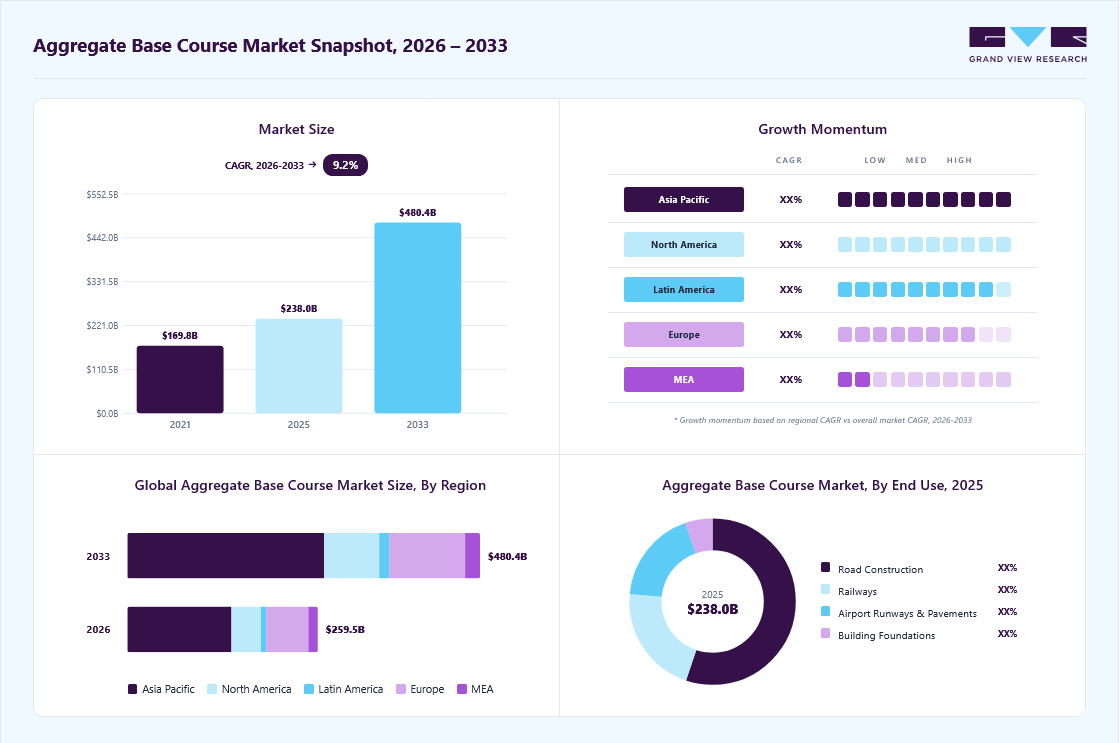
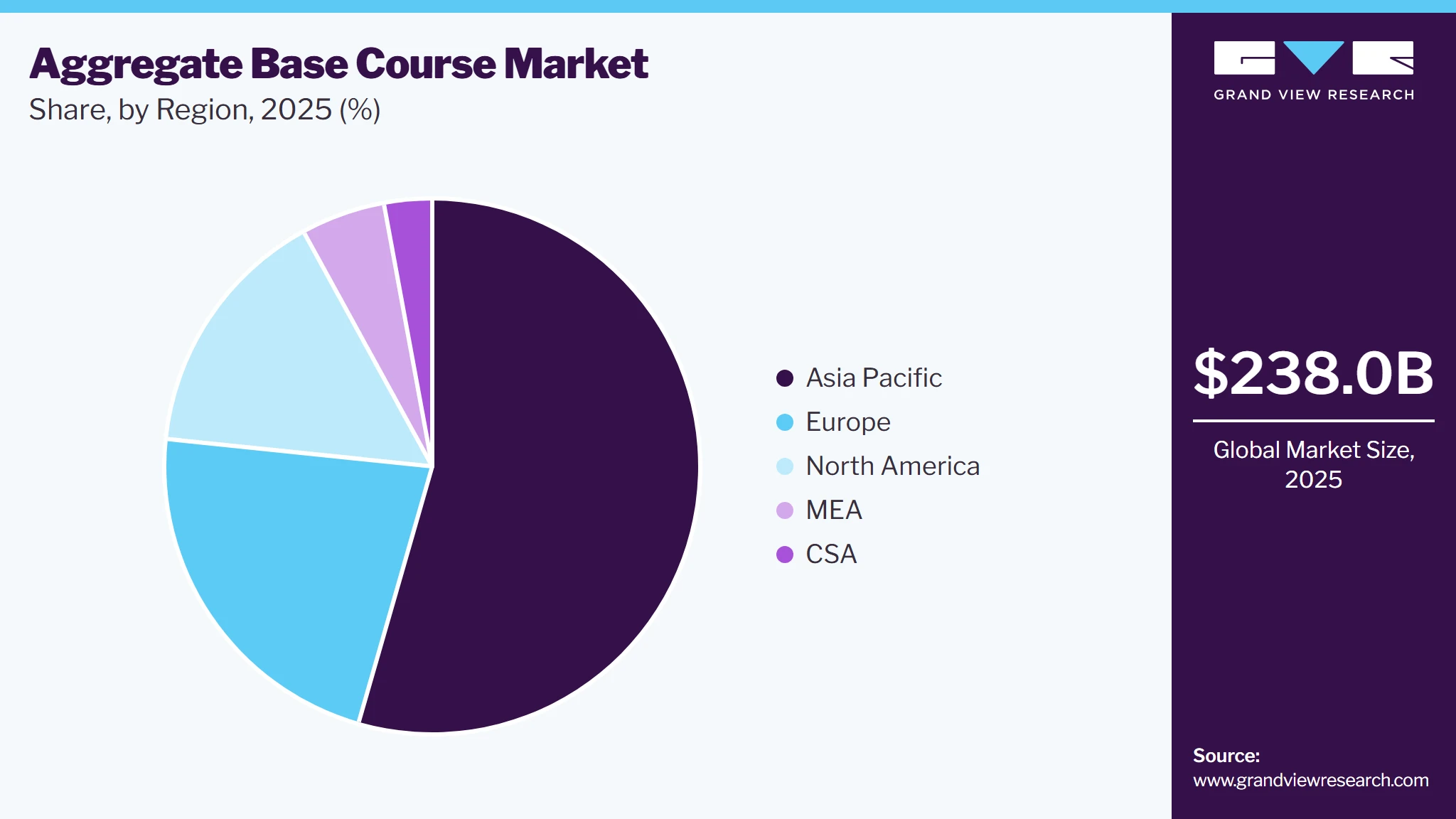
The global aggregate base course market size was estimated at USD 238.0 billion in 2025 and is projected to grow from USD 259.5 billion in 2026 to USD 480.5 billion by 2033, growing at a CAGR of 9.2% from 2026 to 2033, driven by the rapid expansion of infrastructure development projects worldwide. Asia Pacific dominated the aggregate base course market with the largest revenue share of 54.5% in 2025. Governments and private sector investments in road construction, highways, railways, and airport runways are significantly increasing the demand for aggregate base materials.
Key Market Trends & Insights
- By end use: Road construction segment led the market with the largest revenue share of 55.1% in 2025. is expected to grow at a CAGR of 9.4% over the forecast period.
- By end use: Road construction segment is expected to grow significantly at CAGR of 9.4% over the forecast period.
Regional Highlights
- Largest regional market: Asia Pacific (54.5% revenue share, 2025)
- By country: China held the largest market share in 2025.
Market Size & Forecast
- Market size in 2025: USD 238.0 Billion
- Estimated market size in 2026: USD 259.5 Billion
- Projected market size by 2033: USD 480.5 Billion
- CAGR (2026-2033): 9.2%
Urbanization and population growth are further necessitating the expansion and maintenance of transportation networks, which rely on high-quality aggregates for durability and structural stability. Additionally, advancements in construction technologies and the development of sustainable aggregates made from recycled materials are fueling market growth by reducing environmental impact while maintaining structural performance. The rising investments in smart city projects and large-scale urban planning initiatives are significantly driving the global aggregate base course industry. Many developing economies are prioritizing the construction of modern road networks, bridges, and high-speed rail systems to enhance connectivity and economic growth. This surge in infrastructure development is increasing the demand for high-quality aggregate base materials that offer durability and load-bearing capacity. Additionally, the growing need for improved rural road networks to facilitate transportation in remote areas is further fueling market demand, as governments allocate substantial budgets to road expansion and rehabilitation projects.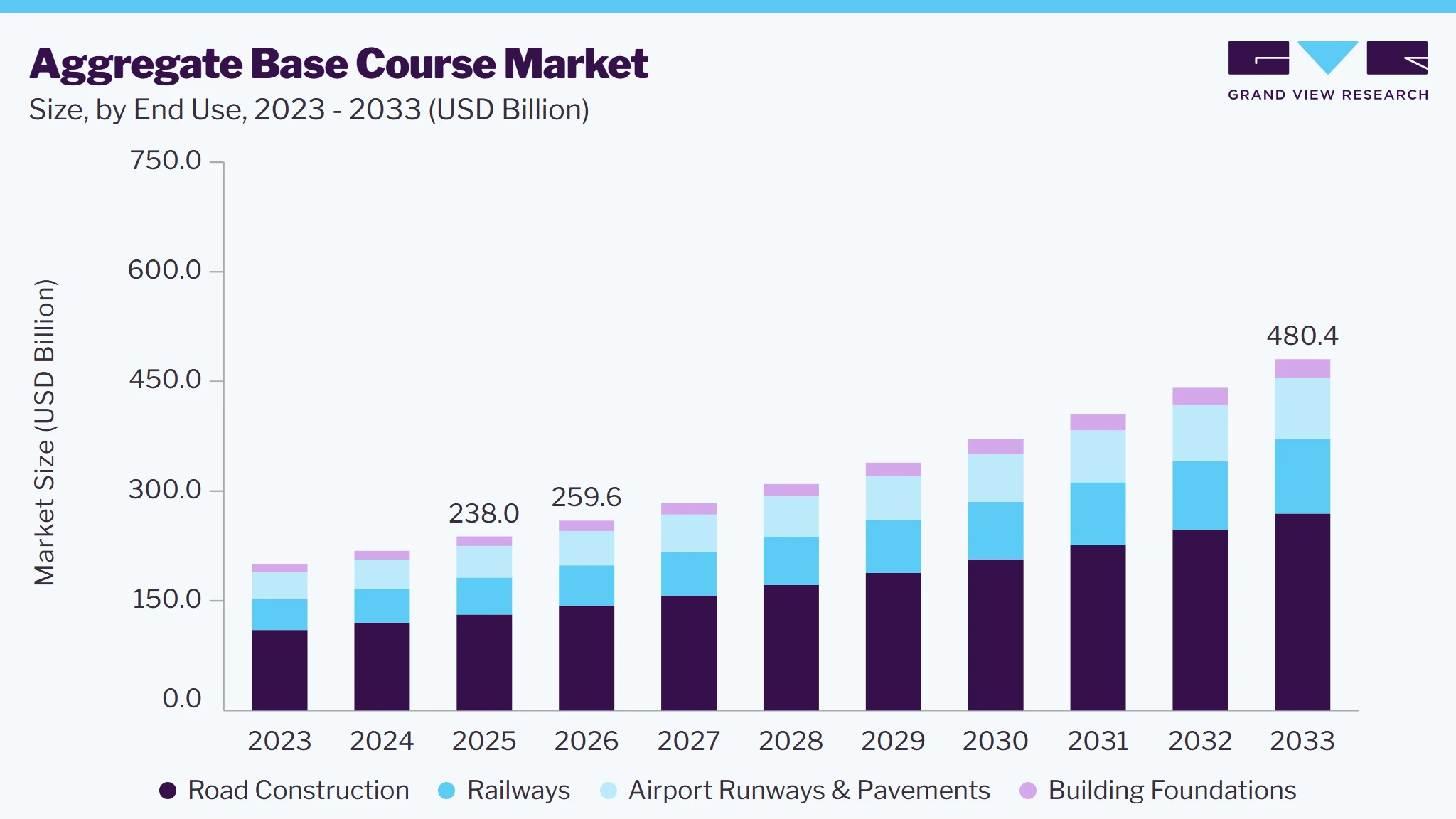
The growth of the market is also influenced by the expansion of the construction sector, particularly in commercial and industrial development. The rapid rise in warehouse construction, logistics hubs, and manufacturing facilities necessitates robust road and pavement structures, driving the demand for aggregate base materials. Furthermore, the increasing adoption of advanced geotechnical engineering techniques, such as soil stabilization and reinforced aggregate bases, is enhancing the market by improving road longevity and performance. As extreme weather conditions and climate change concerns escalate, there is also a growing demand for high-strength aggregates that can withstand temperature fluctuations, heavy rainfall, and seismic activities.
Market Dynamics
The aggregate base course market is experiencing steady growth due to increasing investments in transportation infrastructure, road construction, highway expansion, airport development, and urbanization projects worldwide. The aggregate base course serves as a critical foundation layer in pavements, roads, and other civil engineering structures, providing load distribution, structural stability, drainage support, and long-term durability. Rising government expenditure on infrastructure modernization, growing demand for resilient transportation networks, and increasing rehabilitation of aging road infrastructure are further supporting market growth. Additionally, advancements in aggregate processing technologies, quality control systems, and sustainable construction practices are contributing to wider adoption across infrastructure development projects.
The increasing investment in transportation infrastructure and road construction projects is a major factor driving the aggregate base course market. Governments across developed and emerging economies are allocating substantial budgets toward highways, expressways, bridges, airports, rail networks, and urban transportation systems to support economic growth and improve connectivity. Aggregate base course is extensively used as a foundational material in these projects due to its ability to provide structural support, improve load-bearing capacity, and enhance pavement performance. The expansion of smart city initiatives and large-scale public infrastructure programs continues to stimulate demand for high-quality aggregate base materials.
Furthermore, rapid urbanization and population growth are increasing the need for new residential, commercial, and industrial developments that require supporting transportation infrastructure. Public-private partnerships and infrastructure stimulus packages are further accelerating construction activities globally. As governments continue prioritizing infrastructure expansion and modernization, demand for aggregate base course is expected to remain strong, supporting long-term market growth.
The aggregate base course market faces challenges due to increasing environmental concerns associated with quarrying and aggregate extraction activities. Regulatory authorities in many regions are implementing stricter policies governing land use, mining permits, dust emissions, noise pollution, and environmental restoration requirements. Compliance with these regulations can increase operational costs and limit the availability of aggregate resources for producers.
The increasing focus on sustainable infrastructure development is creating significant growth opportunities for the aggregate base course market. Governments and construction companies are increasingly incorporating recycled aggregates, reclaimed asphalt pavement (RAP), and other environmentally friendly materials into road and infrastructure projects to reduce environmental impact and conserve natural resources. Aggregate base course applications are benefiting from the growing adoption of circular economy practices and green construction standards.
Market Concentration & Characteristics
The global aggregate base course industry exhibits a moderate to high level of market concentration, with a mix of large multinational corporations and regional suppliers competing for market share. Innovation in this market is primarily focused on the development of sustainable and high-performance materials, including the use of recycled aggregates and advanced binding agents to enhance durability and reduce environmental impact. The market has witnessed steady levels of mergers and acquisitions, as key players seek to expand their geographical reach and strengthen supply chain efficiency. Companies are increasingly investing in advanced production techniques and automation to improve quality control and cost efficiency, driving further consolidation within the industry.
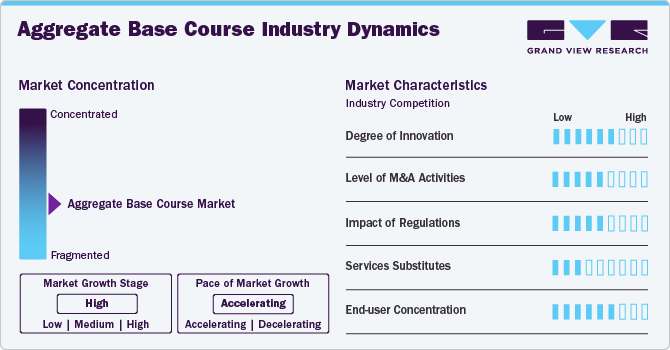
Regulatory frameworks play a crucial role in shaping the market, with stringent environmental laws governing quarrying operations, material sourcing, and transportation emissions. Governments across various regions are promoting the use of recycled aggregates and sustainable construction materials, influencing market dynamics. While direct service substitutes for aggregate base courses are limited, alternative construction techniques, such as soil stabilization and geosynthetic reinforcements, are gaining traction in specific applications. The end-use concentration of the market remains high, with infrastructure development, road construction, and commercial projects being the primary consumers, ensuring steady demand despite economic fluctuations.
Analyst Perspective
The aggregate base course market is evolving from a conventional construction material segment toward a strategically important component of modern infrastructure development, with the strongest growth opportunities emerging from highway expansion projects, airport modernization programs, railway network development, urban infrastructure upgrades, and sustainable construction initiatives. The key differentiator for companies will not be aggregate production capacity alone, but their ability to ensure consistent material quality, maintain reliable quarry reserves, optimize logistics and distribution networks, and meet increasingly stringent engineering, environmental, and sustainability standards across infrastructure projects. Players with vertically integrated operations, extensive quarry assets, strong contractor and government relationships, advanced processing capabilities, and broad geographic coverage are likely to capture premium contracts and long-term growth opportunities, while smaller and less diversified suppliers may remain vulnerable to regulatory constraints, transportation cost fluctuations, resource depletion challenges, and intensifying competition from alternative and recycled construction materials.
End Use Insights
Based on end use, the road construction segment led the market with the largest revenue share of 55.1% in 2025 and is expected to grow at a CAGR of 9.4% over the forecast period. Technological advancements in construction equipment and material processing have improved the efficiency and precision of base course application. Modern machinery enables better compaction and layering of aggregates, leading to stronger and more resilient road structures. Sustainability and environmental considerations are also influencing the market, with increased focus on using recycled aggregates and eco-friendly construction practices. The road construction industry is progressively adopting reclaimed asphalt pavement (RAP), crushed concrete, and other recycled materials in base courses to minimize environmental impact without compromising on performance.
Railways segment is expected to grow significantly at CAGR of 9.3% over the forecast period, driven by increasing demand for durable and stable foundational materials in railway infrastructure. Aggregate base courses provide essential structural support and load distribution for railway tracks, ensuring track stability, longevity, and safety. With the expansion of high-speed rail networks, urban transit systems, and freight corridors across developing and developed nations, the requirement for high-quality base materials that can withstand dynamic loads and harsh environmental conditions is steadily rising.
Regional Insights
Asia Pacific Aggregate Base Course Market Trends
Asia Pacific dominated the aggregate base course market with the largest revenue share of 54.5% in 2025, driven by rapid urbanization, large-scale infrastructure projects, and expanding road networks. Countries such as India, Indonesia, and Vietnam are heavily investing in transportation infrastructure, including highways, bridges, and railways, creating a strong demand for high-quality aggregate base materials. Government initiatives promoting smart cities and sustainable construction practices further contribute to market growth. Additionally, the increasing adoption of recycled aggregates to reduce environmental impact and comply with regulatory standards is influencing market dynamics.
China Aggregate Base Course Market Trends
The aggregate base course market in China held the largest share in the Asia Pacific region in 2025. China's aggregate base course market is primarily driven by its vast infrastructure development initiatives, including the Belt and Road Initiative (BRI), which fuels demand for road and highway construction. The country’s expanding urban population and increasing industrialization have led to a surge in construction activities, requiring a steady supply of aggregate materials. Additionally, stringent environmental regulations have encouraged the adoption of sustainable and eco-friendly aggregates, further shaping the market. The presence of numerous domestic manufacturers ensures competitive pricing and high production capacity to meet growing demand.
North America Aggregate Base Course Market Trends
In North America, the aggregate base course market is supported by government infrastructure investments and the ongoing maintenance of aging roads and highways. The U.S. and Canada have significant infrastructure rehabilitation programs aimed at improving transportation networks, driving demand for high-performance aggregate materials. The rise in sustainable construction practices, including the use of recycled aggregates and advanced stabilization techniques, is further influencing the market. Additionally, technological advancements in material processing and quality control are enhancing efficiency and durability in construction projects.
U.S. Aggregate Base Course Market Trends
The U.S. aggregate base course market is largely driven by federal and state-level investments in infrastructure modernization, including the rebuilding of highways, bridges, and urban transportation systems. The Bipartisan Infrastructure Law has allocated significant funding for road construction, boosting the demand for high-quality aggregate base materials. Additionally, growing concerns over sustainability and resource conservation are prompting the increased use of recycled aggregates and alternative materials. The market is also witnessing the integration of digital solutions, such as automated material testing and quality assurance technologies, to enhance efficiency and compliance with regulatory standards.
Europe Aggregate Base Course Market Trends
The European aggregate base course market is influenced by stringent environmental regulations and sustainability initiatives aimed at reducing carbon footprints in construction. The region’s focus on green infrastructure and circular economy principles has led to the increased use of recycled aggregates and alternative construction materials. Additionally, large-scale infrastructure development projects, particularly in transportation and energy sectors, are driving steady demand. Technological advancements in aggregate processing and improved quality control measures are further shaping the market landscape.
Germany Aggregate Base Course Market Trends
Germany's aggregate base course market benefits from its strong emphasis on high-quality infrastructure and precision engineering in construction. The country’s investment in smart transportation systems, high-speed rail projects, and durable road networks contributes significantly to market demand. Additionally, Germany's stringent environmental policies encourage the use of sustainable materials, driving innovation in recycled aggregates and energy-efficient production processes. The presence of leading construction material manufacturers and research-driven advancements in aggregate performance further bolster market growth.
Latin America Aggregate Base Course Market Trends
In Latin America, the aggregate base course market is fueled by growing investments in road infrastructure and urban expansion projects. Countries such as Brazil, Mexico, and Argentina are prioritizing transportation network improvements to support economic development, driving demand for aggregate materials. However, regulatory challenges, supply chain constraints, and economic fluctuations impact market stability. The increasing adoption of public-private partnerships (PPPs) in infrastructure projects is expected to enhance market opportunities, while efforts to promote sustainable construction practices are gradually gaining traction.
Middle East & Africa Aggregate Base Course Market Trends
The Middle East & Africa aggregate base course market is primarily driven by large-scale infrastructure projects, including smart cities, transportation networks, and industrial developments. In the Middle East, countries such as Saudi Arabia and the UAE are heavily investing in megaprojects like NEOM and Expo-related infrastructure, boosting demand for high-performance aggregates. In Africa, improving road connectivity and urbanization efforts are supporting market expansion, though challenges related to raw material availability and high transportation costs remain. Sustainability initiatives are also emerging, with some governments encouraging the use of alternative and recycled aggregates in construction.
Key Aggregate Base Course Company Insights
Some of the key players operating in market include CRH, CEMEX S.A.B. de C.V
-
CRH plc is a leading global building materials company headquartered in Ireland, with a strong presence in the market. The company specializes in producing and supplying a wide range of construction materials, including aggregates, cement, asphalt, and ready-mix concrete. CRH offers high-performance aggregate base course solutions tailored for road construction, infrastructure development, and commercial projects.
-
CEMEX S.A.B. de C.V., a multinational building materials company based in Mexico, is a key player in the market. The company provides high-quality aggregates for road bases, sub-bases, and infrastructure projects, ensuring durability and long-term performance. CEMEX’s product portfolio includes crushed stone, sand, and gravel, which are widely used in construction applications.
Martin Marietta Materials, Inc., Vulcan Materials Company are some of the emerging market participants in aggregate base course industry.
-
Martin Marietta Materials, Inc. is a leading U.S.-based supplier of aggregates and heavy building materials, catering to the market. The company offers a comprehensive range of crushed stone, gravel, and sand, which are essential for road construction, highways, and foundation stabilization.
-
Vulcan Materials Company, headquartered in the United States, is a dominant player in the market, supplying essential construction aggregates to various industries. The company specializes in producing high-quality crushed stone, sand, and gravel for road construction, airport runways, and industrial applications.
Key Aggregate Base Course Companies:
The following key companies have been profiled for this study on the aggregate base course market.
-
CRH
-
CEMEX S.A.B. de C.V.
-
Martin Marietta Materials, Inc.
-
Vulcan Materials Company
-
Heidelberg Materials
-
Buzzi Unicem S.p.A.
-
Summit Materials, Inc.
-
Eurocement Group
-
Breedon Group plc
Competitive Benchmarking
Category
Operating Strategies
Competitive Edge
Weakness
Established Players (CRH, CEMEX S.A.B. de C.V., Martin Marietta Materials, Inc., Vulcan Materials Company, Heidelberg Materials)
- Operate vertically integrated quarrying, processing, and distribution networks.
- Pursue acquisitions and capacity expansions to strengthen regional presence.
- Secure long-term supply contracts for large infrastructure and transportation projects.
- Extensive aggregate reserves and large production capacities.
- Strong logistics infrastructure and broad geographic coverage.
- Established relationships with government agencies, contractors, and developers.
- High capital expenditure and operational costs.
- Greater exposure to environmental and regulatory compliance requirements.
- Slower decision-making due to large organizational structures.
Emerging Players (Summit Materials, Inc., Eurocement Group, Breedon Group plc)
- Focus on regional markets and localized supply networks.
- Expand through targeted quarry development and strategic partnerships.
- Compete through flexible pricing and customized customer service.
- Faster response to local demand fluctuations and project requirements.
- Lower operational complexity and greater business agility.
- Strong understanding of regional regulations and customer preferences.
- Limited financial resources and production scale.
- Higher dependence on regional construction activity and infrastructure spending.
- Restricted bargaining power compared to large multinational suppliers.
Aggregate Base Course Market Report Scope
Report Attribute
Details
Market size in 2025
USD 238.0 billion
Estimated market size in 2026
USD 259.5 billion
Projected market size by 2033
USD 480.5 billion
Growth rate
CAGR of 9.2% from 2026 to 2033
Base year for estimation
2025
Historical data
2021 - 2024
Forecast period
2026 - 2033
Quantitative units
Volume in million metric tons and Revenue in USD million/billion and CAGR from 2026 to 2033
Report coverage
Revenue forecast, company ranking, competitive landscape, growth factors, and trends
Segments covered
End use, region
Regional scope
North America; Europe; Asia Pacific; Latin America; MEA
Country scope
U.S.; Canada; Mexico; UK; Germany; France; Italy; Spain; China; India; Japan; South Korea
Key companies profiled
CRH; CEMEX S.A.B. de C.V.; Martin Marietta Materials, Inc.; Vulcan Materials Company; Heidelberg Materials; Buzzi Unicem S.p.A.; Summit Materials, Inc.; Eurocement Group; Breedon Group plc
Customization scope
Free report customization (equivalent up to 8 analysts' working days) with purchase. Addition or alteration to country, regional & segment scope.
Pricing and purchase options
Avail customized purchase options to meet your exact research needs. Explore purchase options
Global Aggregate Base Course Market Report Segmentation
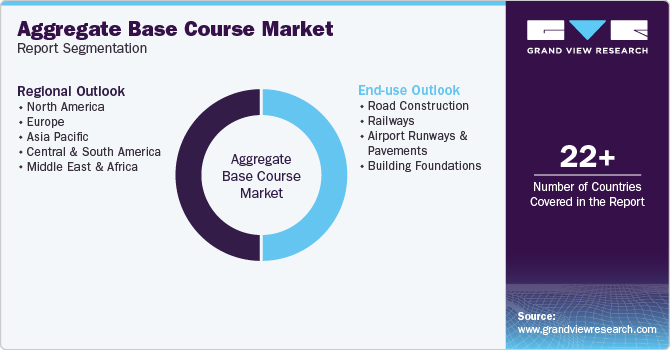
This report forecasts revenue growth at global, regional, and country levels and provides an analysis of the latest industry trends in each of the sub-segments from 2021 to 2033. For this study, Grand View Research has segmented the global aggregate base course market report based on end use and region:
-
End Use Outlook (Revenue, USD Million; Volume, Million Metric Ton; 2021 - 2033)
-
Road Construction
-
Railways
-
Airport Runways & Pavements
-
Building Foundations
-
-
Regional Outlook (Revenue, USD Million; Volume, Million Metric Ton; 2021 - 2033)
-
North America
-
U.S.
-
Canada
-
Mexico
-
-
Europe
-
Germany
-
UK
-
France
-
Italy
-
Spain
-
-
Asia Pacific
-
China
-
Japan
-
India
-
South Korea
-
-
Central & South America
-
Middle East & Africa
-
Research Methodology
The aggregate base course market figures in this report are based on a proven research process that combines executive interviews with secondary research from proprietary databases, company filings, and recognized regulatory and institutional sources. Market size is built through value-chain sizing - reconciling supply-side and demand-side estimates - and triangulated with bottom-up and top-down approaches. Every estimate passes multiple levels of expert validation before publication, with each aggregate base course segment quantified using the revenue-capture definitions in the table below.
Segment Definition
Segment - End Use
Revenue capture definition
Road Construction
Revenue generated from the sale of aggregate base course used in the construction of roads, highways, expressways, streets, and transportation corridors. This segment captures revenues from aggregate base materials utilized as foundational layers that provide load-bearing capacity, structural stability, drainage support, and pavement durability for public and private road infrastructure projects.
Railways
Revenue generated from the sale of aggregate base course used in railway infrastructure development, including track beds, ballast support layers, freight corridors, and passenger rail networks. This segment captures revenues from aggregate materials supplied for railway foundations requiring strength, stability, drainage performance, and long-term resistance to heavy dynamic loads and environmental conditions.
Airport Runways & Pavements
Revenue generated from the sale of aggregate base course used in the construction and maintenance of airport runways, taxiways, aprons, and aviation pavements. This segment captures revenues from aggregate materials supplied to aviation infrastructure projects requiring high load-bearing capacity, surface stability, effective drainage, and durability to withstand repeated aircraft operations and heavy traffic conditions.
Building Foundations
Revenue generated from the sale of aggregate base course used in building foundations for residential, commercial, industrial, and institutional construction projects. This segment captures revenues from aggregate materials utilized to create stable foundation bases, improve ground support, enhance drainage, and ensure long-term structural integrity for buildings and other civil engineering structures.
Estimation Model
Layer Name
Key Question
Description
Infrastructure Construction Activity
What is the total volume of infrastructure projects requiring aggregate base course?
Estimates total construction activity across road networks, highways, railways, airport infrastructure, residential developments, commercial buildings, industrial facilities, and public infrastructure projects where aggregate base course is utilized as a foundational material.
Base Course Material Requirement
How much aggregate base course is consumed per construction project or infrastructure type?
Evaluates aggregate base course consumption intensity based on project specifications, pavement design standards, foundation requirements, layer thickness, load-bearing needs, and engineering guidelines across different end-use applications.
Aggregate Base Course Demand by End Use
What proportion of infrastructure construction utilizes aggregate base course?
Quantifies demand generated from key end-use sectors including road construction, railways, airport runways & pavements, building foundations, and other civil engineering applications. This layer captures adoption rates and material usage patterns across each application segment.
Market Revenue Estimation
What revenue is generated from aggregate base course sales?
Calculates market value by multiplying aggregate base course volume demand by average selling prices across regions and application segments. This layer incorporates factors such as aggregate type, transportation costs, regional pricing variations, project scale, and supplier margins to estimate total market revenue.
Delivered Customizations
This report has been delivered with the following In-depth customizations
Client Request
Customization Delivered
Value Adds
Sustainable Construction Materials Opportunity Assessment
Evaluated adoption trends of recycled aggregates, reclaimed asphalt pavement (RAP), and other sustainable base course materials across road construction, airports, railways, and building foundation applications.
Supports investment decisions by identifying sustainability-driven growth opportunities, regulatory compliance trends, and emerging demand centers for environmentally responsible construction materials.
Competitive Landscape Assessment
Benchmarked leading aggregate producers on production capacity, quarry reserves, geographic presence, pricing strategies, and infrastructure project participation.
Provides actionable insights for competitive positioning, market entry strategies, and partnership opportunities.
Regulatory and Environmental Impact Assessment
Evaluated mining regulations, quarry permitting requirements, environmental compliance standards, and sustainability policies affecting aggregate production.
Helps companies anticipate regulatory risks, improve compliance planning, and support long-term operational sustainability.
Frequently Asked Questions About This Report
Asia Pacific is the fastest-growing region over the forecast period.
Asia Pacific dominated the market with the largest revenue share of 54.5% in 2025.
Road construction is expected to be the fastest-growing end use over the forecast period.
The global aggregate base course market size was estimated at USD 238.0 billion in 2025 and is expected to reach USD 259.6 billion in 2026.
The key factors driving the aggregate base course market include growing infrastructure development, expanding transportation networks, and increasing demand for durable foundational materials in road and railway construction.
The aggregate base course market is expected to grow at a compound annual growth rate of 9.2% from 2026 to 2033 to reach USD 480.5 billion by 2033.
RH, CEMEX S.A.B. de C.V., Martin Marietta Materials, Inc., Vulcan Materials Company, Heidelberg Materials, Buzzi Unicem S.p.A., Summit Materials, Inc., Eurocement Group, and Breedon Group plc. are prominent companies in the aggregate base course market.
About the Author(s)
Advanced Interior Materials Research Team
Advanced Materials · Advanced Interior MaterialsThis report was authored by the advanced interior materials research team at Grand View Research - comprising two research analysts, one senior research analyst, and one industry expert - with specialized expertise in the advanced interior materials segment of the advanced materials industry. All findings are based on proprietary advanced materials databases, executive interviews, and regulatory analysis, subject to internal peer review prior to publication.
Last Updated:
Speak to Analyst


Customize this report to your needs — add regions, segments, or data points, with 20% free customization.
Or view our licence options:


ISO 9001:2015 & 27001:2022 Certified
We are GDPR and CCPA compliant! Your transaction & personal information is safe and secure. For more details, please read our privacy policy.


