
- Home
- »
- Homecare & Decor
- »
-
Agritourism Market Size & Share Report, 2026-2033GVR Report cover

Agritourism Market (2026 - 2033)
Size, Share & Trends Analysis Report By Activity (On-farm Sales, Outdoor Recreation, Entertainment, Educational Tourism, Accommodations), By Booking Mode, By Region, And Segment Forecasts
Market Size, 2025
$9.0BMarket Estimate, 2026
$10.0BMarket Forecast, 2033
$22.6BCAGR, 2026–2033
12.3%Agritourism Market Summary
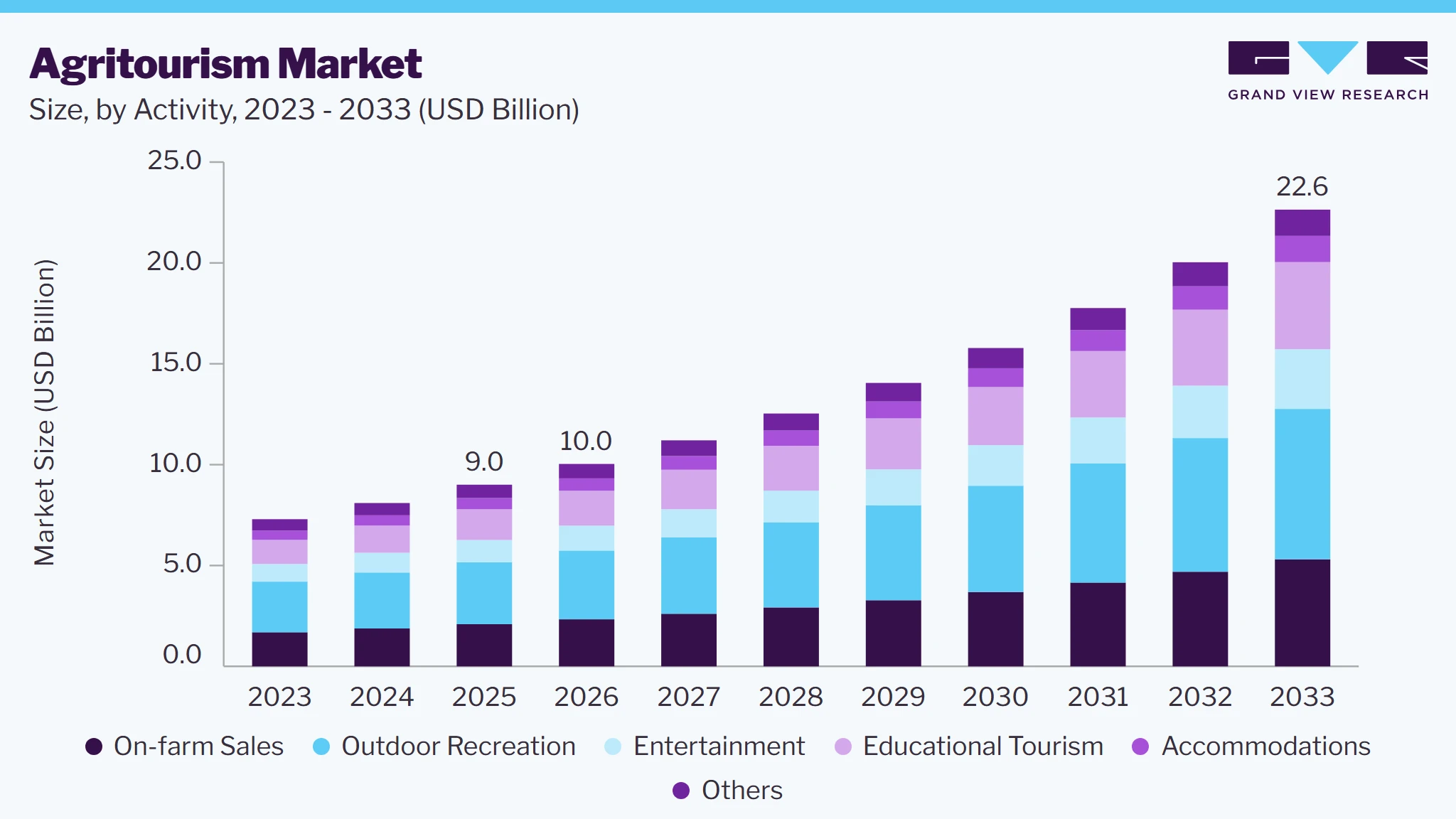
The global agritourism market size was valued at USD 9.0 billion in 2025 and is projected to grow from USD 10.0 billion in 2026 to USD 22.6 billion by 2033, at a CAGR of 12.3% from 2026 to 2033. North America dominated the market, accounting for a revenue share of 46.1% in 2025. Agritourism has experienced significant growth in recent years, driven by a convergence of factors that appeal to both domestic and international travelers seeking authentic rural experiences.
 Source: Grand View Research, IR Documents, Primary Interviews, Paid DatabasesTo learn more about this report,
 Download Free Sample Report
Key Market Trends & Insights
- By activity: Outdoor Recreation segment led the market with the largest revenue share of 34.1% in 2025.
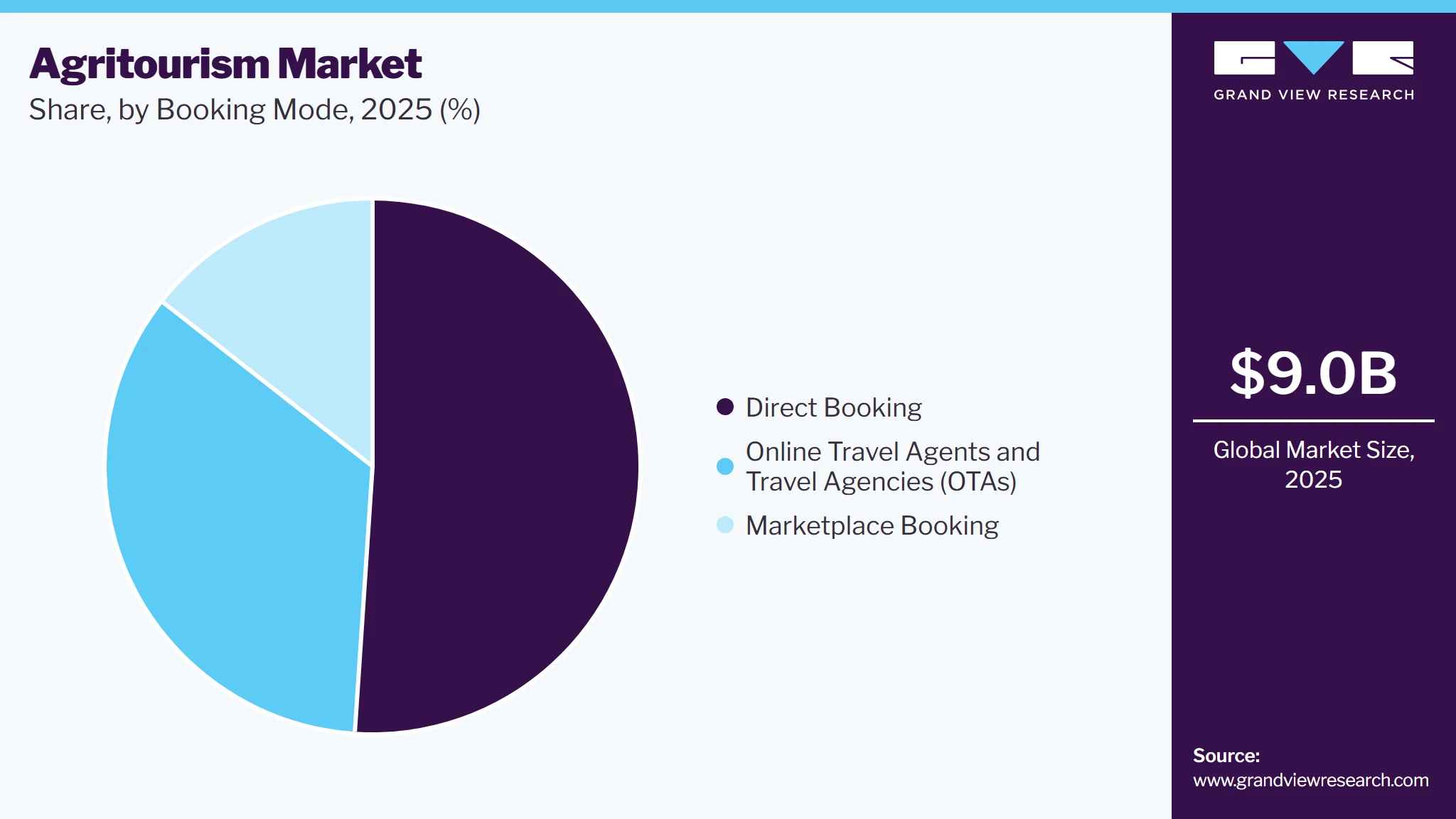
- By booking mode: Direct Booking segment led the market with the largest revenue share of 51.1% in 2025.
Regional Highlights
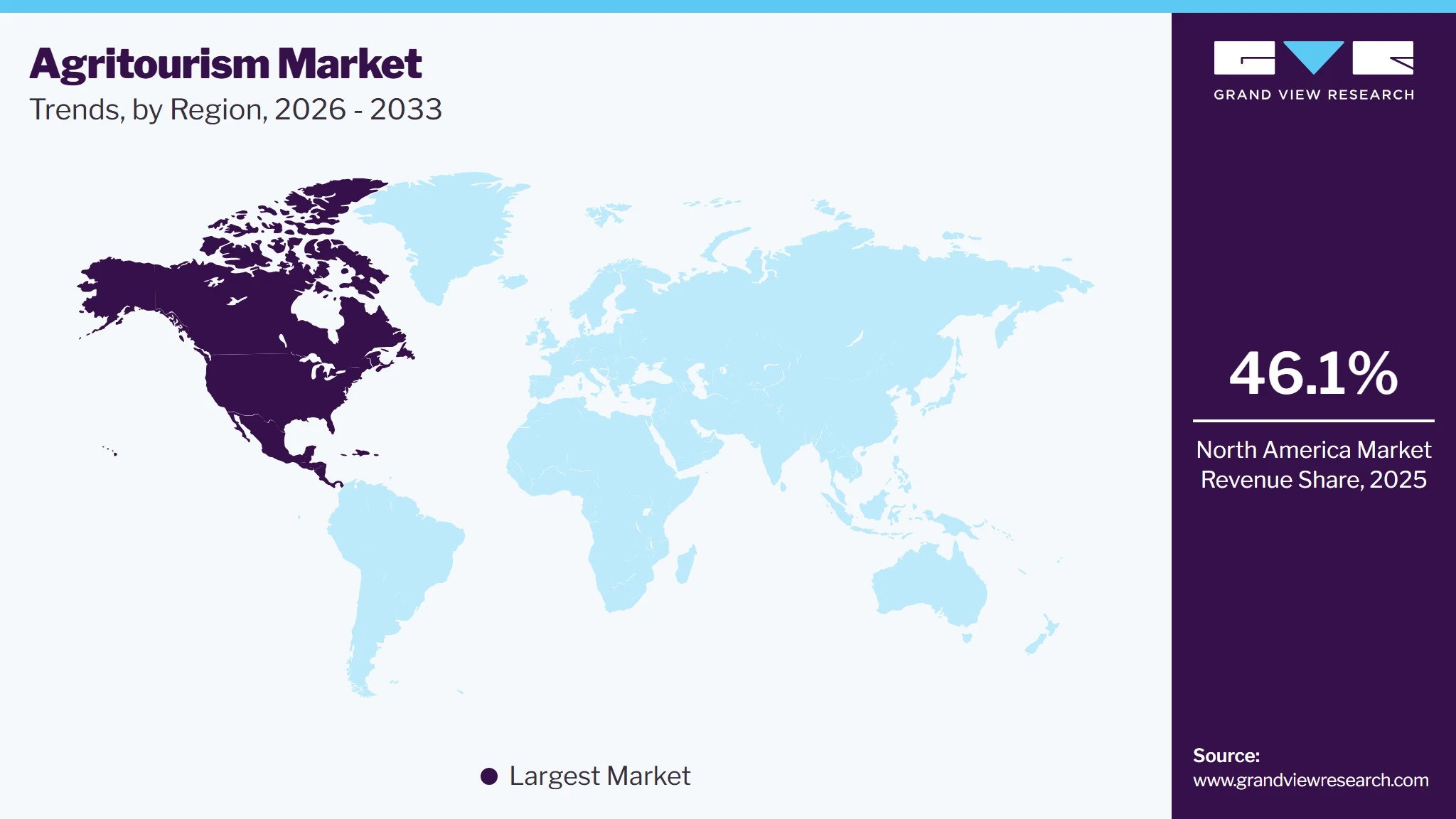
- Largest regional market: North America (46.1% revenue share, 2025)
- By country: The U.S. held the largest market share in 2025.
Market Size & Forecast
- Market size in 2025: USD 9.0 Billion
- Estimated market size in 2026: USD 10.0 Billion
- Projected market size by 2033: USD 22.6 Billion
- CAGR (2026-2033): 12.3%
Three ways to get this report
Buy it, customize it, or ask a question.Ask an Analyst
Analyst response in 1 business day
- AccessReport author, directly
- Reply timeWithin 1 working day
- No sales callDirect answer only
- FormatEmail reply
- CostFree, no cost
Get the Full Report
What the study covers
- FormatsPDF · Excel · Dashboard
- Timeline2026–2033 annual, 2025 base
- Coverage20+ countries, 5 regions
- Companies10+ key players profiled
Customize the Report
20% free customization
- IncludeCountries, segments, points
- TailorTo your product definition
- ExtendDeeper competitor detail
- OrA fully bespoke study
- Turnaround5–10 working days
This market expansion is underpinned by rising consumer interest in sustainable and immersive travel experiences that connect them with agricultural activities and rural lifestyles. Moreover, heightened awareness and appreciation for local food systems have spurred demand for farm-to-table experiences, where visitors can directly engage in activities such as harvesting produce, participating in cooking classes with farm-fresh ingredients and learning about traditional farming practices from local experts.
 To learn more about this report, Download Free Sample Report
The agritourism sector has benefited from strategic collaborations between farms, local governments, and tourism organizations aiming to promote rural development and economic diversification. These partnerships often involve initiatives to enhance infrastructure, promote agritourism routes, and provide tailored marketing efforts that highlight the cultural and environmental richness of rural areas. In June 2024, the Ohio Ecological Food and Farm Association (OEFFA), along with its partners, hosted its annual Farm Tour and Workshop Series. The program featured 24 events, including tours of organic and ecological farms in Ohio and Michigan, and educational workshops. Participants had the opportunity to explore farm fields, gardens, and pastures during 10 OEFFA-led farm tours. Additionally, 14 workshops covered topics such as organic certification, farmland access, and farm employment law, offering valuable insights into sustainable agriculture and local food systems. Additionally, advancements in digital platforms and social media have amplified the visibility of agritourism destinations, allowing farms to reach a broader audience of travelers seeking unique and memorable experiences off the beaten path.
The growth trajectory of agritourism also reflects evolving consumer preferences towards experiential travel, where tourists seek meaningful connections with local communities and environments. This trend has prompted farms worldwide to innovate by offering a range of activities beyond traditional farm tours, including vineyard stays, agricultural festivals, and wildlife safaris integrated with agricultural landscapes. Moreover, the appeal of agritourism extends beyond leisure travelers to include educational institutions and corporate groups seeking team-building activities and sustainable tourism practices.
According to data released by the U.S. Census of Agriculture in 2022, a total of 28,617 farms provided agritourism and recreational services. This substantial number highlights the growing integration of tourism within the agricultural sector, contributing to the overall expansion of the agritourism market. As more farms diversify their operations to include visitor services, the sector is poised for continued growth, driven by increased consumer demand for experiential travel and sustainable tourism offerings. This trend not only enhances farm revenue streams but also strengthens rural economies by attracting both domestic and international tourists seeking authentic agricultural experiences.
In the coming years, the travel industry will witness a sustained shift toward experiential tourism, with travelers increasingly seeking authentic, immersive experiences. Agritourism offers a distinctive platform for visitors to engage with local communities and experience their way of life firsthand. Farm stays, which allow guests to reside on active farms and participate in daily agricultural activities, are gaining significant popularity. Additionally, the rise of culinary tourism, centered on experiencing regional food and beverages, is becoming a key driver within the agritourism sector. Farmers markets, food festivals, and farm-to-table dining experiences offer travelers a unique opportunity to engage deeply with local food culture while supporting sustainable, farm-based economies.
The market is experiencing rapid expansion, supported by strong initiatives from tourism ministries in various countries, which are expected to further fuel market growth. Key drivers such as digital innovation, evolving consumer spending patterns, and increasing urbanization are collectively propelling the demand for agritourism experiences. Farm tourism, offering visitors the chance to immerse themselves in the tranquil rural environment, engage in farm activities, and experience a lifestyle distinct from urban areas, is poised for significant growth. As individuals increasingly seek innovative forms of entertainment and relaxation, the demand for alternative travel experiences in village settings is accelerating, further contributing to the expansion of the farm tourism industry.
For the farming community, agritourism presents a vital opportunity for supplementary income while enhancing global sustainability efforts. This sector holds immense potential for providing profitable business ventures to farmers, alongside creating affordable, family-friendly recreational experiences. As a result, the growing integration of tourism within agricultural practices is driving significant market growth. However, the agritourism industry does face challenges, particularly in the form of unpredictable climate changes and environmental degradation, which present potential risks to its future sustainability.
Market Dynamics
The agritourism market is expanding as farms increasingly diversify beyond agricultural production to generate supplementary income through tourism-based experiences. Growing consumer interest in authentic rural lifestyles, farm-to-table food systems, sustainable travel, and experiential tourism has transformed agricultural properties into destinations offering farm stays, harvest participation, educational workshops, vineyard tours, livestock interactions, and local culinary experiences. Rising government support for rural development, digital booking platforms, and increasing demand for eco-conscious travel are further accelerating market growth. As travelers seek meaningful, nature-based experiences away from urban environments, agritourism is emerging as an important contributor to rural economic development and agricultural sustainability.
The growing preference for experiential travel is a primary driver of the agritourism market. Travelers are increasingly seeking immersive experiences that allow them to participate in farming activities, learn traditional agricultural practices, interact with local communities, and consume locally produced food. Unlike conventional leisure tourism, agritourism offers authentic cultural engagement while promoting environmental awareness and sustainable consumption.
The expansion of farm-to-table movements, organic agriculture, wine tourism, and culinary tourism has further strengthened visitor interest in agricultural destinations. Families, educational institutions, and urban consumers are increasingly choosing farm visits for recreation, wellness, and educational purposes. At the same time, governments in many countries are encouraging farm diversification through financial incentives, rural tourism initiatives, and infrastructure development, enabling farmers to generate additional revenue streams while preserving agricultural heritage.
Seasonality and limited rural infrastructure remain significant challenges for the agritourism market. Many agritourism activities are directly linked to crop harvesting cycles, livestock management, flowering seasons, and favorable weather conditions, resulting in uneven visitor flows throughout the year. This seasonal dependence often limits revenue generation and reduces asset utilization during off-peak periods.
In addition, many rural destinations continue to face inadequate transportation connectivity, limited accommodation capacity, insufficient digital connectivity, and underdeveloped tourism infrastructure. Smaller family-owned farms may also lack hospitality expertise, marketing capabilities, insurance coverage, and compliance with health and safety regulations required for welcoming visitors. These operational constraints can restrict visitor satisfaction, limit repeat tourism, and slow the commercialization of agritourism offerings, particularly in developing regions.
The rapid adoption of digital tourism platforms and the diversification of on-farm experiences present substantial growth opportunities for the agritourism market. Farmers are increasingly utilizing online booking platforms, social media marketing, and destination management applications to promote farm stays, vineyard experiences, harvest festivals, educational tours, wellness retreats, and seasonal events directly to domestic and international travelers. Digital visibility is helping small and medium-sized farms reach broader customer bases while reducing dependence on traditional travel intermediaries.
Simultaneously, farms are expanding beyond sightseeing by offering premium accommodations, glamping, culinary workshops, artisan food production, wine tasting, beekeeping demonstrations, agrarian festivals, and wellness-focused experiences such as yoga retreats and nature therapy. The integration of local culture, regional cuisine, and sustainable farming practices into tourism offerings is increasing visitor spending, extending average lengths of stay, and creating higher-value revenue streams. As consumer demand for authentic, environmentally responsible, and experience-driven travel continues to rise, diversified agritourism models are expected to become a key driver of long-term market growth.
Analyst Perspective
The agritourism market is evolving from a supplementary farm income model into a diversified rural enterprise driven by experiential travel and direct-to-consumer engagement. Farms are increasingly investing in premium accommodations, farm-to-table dining, seasonal festivals, and educational experiences to generate year-round revenue beyond agricultural production. Digital booking platforms and social media have significantly expanded the visibility of independent farms, reducing reliance on traditional tourism channels. Markets with strong government support for rural development and farm diversification are witnessing faster commercialization. Additionally, consumer preference for authentic, sustainable, and locally sourced experiences is encouraging operators to integrate wellness, organic farming, and cultural heritage into agritourism offerings, creating higher-value visitor experiences and stronger repeat visitation.
Activity Insights
Based on activity, the Outdoor Recreation segment led the market with the largest revenue share of 34.1% in 2025 and is expected to grow at the fastest CAGR over the forecast period. Outdoor recreation remains the cornerstone of agritourism as travelers increasingly seek immersive, nature-based experiences that combine leisure, wellness, and education. Activities such as farm tours, hiking trails, horseback riding, fishing, camping, wildlife observation, corn mazes, orchard walks, and seasonal harvest experiences allow visitors to engage directly with rural landscapes while escaping urban lifestyles. The growing popularity of experiential travel, eco-tourism, and family-oriented outdoor vacations has further strengthened demand for these offerings. Additionally, farms are expanding their recreational infrastructure by introducing adventure activities, picnic areas, educational trails, and nature-based events to increase visitor engagement and extend average spending per visit. The rising preference for sustainable tourism, combined with increasing government support for rural tourism development and farm diversification, continues to reinforce the dominance of the outdoor recreation segment in the agritourism market.
Booking Mode Insights
Based on booking mode, the Direct Booking segment led the market with the largest revenue share of 51.1% in 2025, as many agritourism operators are family-owned farms and independent rural businesses that rely on direct customer relationships to maximize profitability and provide personalized experiences. Travelers increasingly book through farm websites, social media platforms, telephone reservations, and on-site inquiries to access exclusive packages, customized activities, flexible scheduling, and lower booking fees compared with third-party platforms.
 To learn more about this report, Download Free Sample Report
Direct communication also enables visitors to obtain detailed information regarding seasonal events, accommodation availability, farm experiences, and local produce offerings before making reservations. Furthermore, the widespread adoption of digital payment systems, user-friendly booking websites, and social media marketing has enabled agritourism operators to attract visitors without depending heavily on online travel agencies. The growing emphasis on authentic rural experiences and personalized customer service continues to support the leading position of the direct booking segment.
Regional Insights
North America dominated the Agritourism market with the largest revenue share of 46.1% in 2025. The region's leadership is supported by a well-established agricultural sector, strong domestic tourism, and growing consumer interest in experiential and nature-based travel. Farmers across the U.S. and Canada have increasingly diversified their income streams by offering farm stays, pick-your-own produce experiences, vineyard tours, livestock interactions, educational workshops, harvest festivals, and outdoor recreational activities. Rising demand for sustainable tourism, local food experiences, and weekend rural getaways has further strengthened visitor numbers. In addition, supportive government initiatives promoting rural development, robust transportation infrastructure, widespread digital marketing adoption, and high consumer spending on leisure travel continue to reinforce North America's dominant position in the agritourism market.
 To learn more about this report, Download Free Sample Report
U.S. Agritourism Market Trends
The Agritourism market in the U.S. held the largest share of about 87.5% in the North America region in 2025. The U.S. benefits from a vast and diverse agricultural landscape encompassing vineyards, orchards, ranches, dairy farms, organic farms, and specialty crop producers that offer year-round tourism experiences. Consumers are increasingly seeking authentic farm-to-table experiences, educational agricultural tours, seasonal festivals, pumpkin patches, corn mazes, wine tourism, and outdoor recreation as alternatives to conventional vacations. The growing popularity of local food movements, experiential travel, and wellness tourism has encouraged farms to invest in visitor accommodations, event hosting, recreational facilities, and direct-to-consumer sales. Furthermore, the increasing use of online booking platforms, social media promotion, and partnerships with local tourism organizations has significantly improved the visibility and accessibility of agritourism destinations, supporting the continued dominance of the U.S. market.
Asia Pacific Agritourism Market Trends
Asia Pacific accounted for a revenue share of around 20.15% in 2024. The agritourism market in Asia Pacific is rapidly evolving, with countries like Japan, India, and Australia leading the way. Japan's growing interest in rural revitalization has made farm-based tourism a key part of its tourism strategy, with initiatives like the Japanese Agriculture Ministry's support for "green tourism" driving growth. In India, agritourism is emerging as a significant sector, particularly in Maharashtra and Kerala, where farm stays and spice plantation tours are gaining popularity among both domestic and international travelers. Meanwhile, Australia’s diverse landscapes, from vineyard tours in South Australia to sheep shearing experiences in New South Wales, are increasingly attracting tourists looking for authentic farm-based experiences. Governments in the region are recognizing the potential of agritourism to boost rural economies and are implementing policies to support its expansion across Asia Pacific.
Europe Agritourism Market Trends
The Europe agritourism market is projected to grow at a CAGR of 12.2% from 2025 to 2030. In Europe, agritourism has long been a popular segment, particularly in countries such as Italy, France, and Spain, where centuries-old agricultural traditions are intertwined with rich cultural heritage. Tuscany’s farm stays and vineyard tours, Provence’s lavender fields, and Spain’s olive farms have become iconic destinations for agritourism enthusiasts. The European Union’s Common Agricultural Policy (CAP) supports agritourism by funding rural development programs, which encourage farmers to diversify into tourism. Additionally, European agritourism benefits from government regulations that promote sustainable tourism practices and protect rural landscapes. These policies, coupled with strong demand for farm-based activities and culinary tourism, are driving significant growth in the region.
Key Agritourism Company Insights
The competitive landscape of the agritourism market is characterized by a diverse mix of small-scale local farms, mid-sized agribusinesses, and large-scale operators, all competing to attract a growing base of experiential travelers. Many smaller, family-owned farms differentiate themselves through personalized and authentic experiences, such as organic farm tours, sustainable farming workshops, and unique accommodations like farm stays or glamping options. These operators often rely on direct marketing through websites and social media to engage with niche customer segments, offering tailored packages that cater to eco-conscious consumers and those seeking intimate, hands-on interactions with agricultural life.
In contrast, mid-sized and larger players, including agricultural cooperatives and corporate-backed operations, leverage their scale to offer a wider range of services, including culinary tourism, adventure-based farm activities, and large event hosting, such as weddings and corporate retreats.
Key Agritourism Companies:
The following key companies have been profiled for this study on the agritourism market.
-
Farm to Farm Tours
-
Bay Farm Tours
-
Tourism Prince George
-
Star Destinations
-
Expedia, Inc.
-
Greenmount Travel
-
Blackberry Farm, LLC
-
Ruppier Tours
-
Hermitage Farm
-
Select Holidays
Competitive Benchmarking
Category
Operating Strategies
Competitive Edge
Weakness
Established Players (Expedia, Inc.; Blackberry Farm, LLC; Select Holidays; Star Destinations; Greenmount Travel)
- Expand agritourism offerings through strategic partnerships with farms, vineyards, ranches, and rural tourism boards while integrating farm experiences into broader leisure travel packages.
- Invest in digital booking platforms, curated experiential travel, premium farm stays, culinary tourism, and sustainable tourism initiatives to attract domestic and international travelers.
- Strong brand recognition, extensive customer networks, and established distribution channels through online travel platforms and travel agencies.
- Ability to bundle agritourism experiences with accommodation, transportation, and destination services, supported by robust marketing capabilities and global customer reach.
- High dependence on seasonal travel demand, economic conditions, and discretionary consumer spending.
- Greater operational complexity due to coordination with multiple local tourism operators, agricultural businesses, and regional regulations, limiting flexibility in niche rural markets.
Emerging & Regional Players (Farm to Farm Tours; Bay Farm Tours; Tourism Prince George; Ruppier Tours; Hermitage Farm)
- Focus on authentic farm-based experiences, educational tours, local food experiences, vineyard visits, and community-led rural tourism tailored to regional attractions.
- Leverage partnerships with local farmers, artisan producers, and regional tourism organizations while utilizing digital marketing, social media engagement, and customized travel itineraries to attract experiential travelers.
- Strong local market knowledge and the ability to deliver authentic, personalized, and immersive agritourism experiences that differentiate them from large travel operators.
- Greater flexibility in designing niche tourism offerings around local culture, agriculture, sustainability, and seasonal farm activities, enabling rapid adaptation to changing traveler preferences.
- Limited financial resources, marketing reach, and geographic presence compared to global travel companies.
- Higher exposure to weather conditions, seasonal agricultural cycles, and dependence on regional tourism demand, making business performance more volatile throughout the year.
Recent Developments
-
In June 2024, Tourism Prince George launched a new self-guided outing titled Farm Tour, aimed at enthusiasts of local growers and sustainable food practices. The tour spans 15 distinct locations, featuring six farms situated within a one-hour radius of the city, in addition to markets, restaurants, and local establishments that prioritize sourcing from regional growers.
-
In September 2024, the Great Canadian Farm Tour reemerges for its fourth season, uniquely positioned in the fall to highlight the diverse aspects of Canadian agriculture during this distinct season. From October through December, Agriculture in the Classroom Canada (AITC-C) and its ten provincial affiliates invite students nationwide to engage with the harvest experience and gain insights into fall operations within the agricultural and food sectors.
Agritourism Market Report Scope
Report Attribute
Details
Market size in 2025
USD 9.0 billion
Estimated market size in 2026
USD 10.0 billion
Projected market size by 2033
USD 22.6 billion
Growth rate
CAGR of 12.3% from 2026 to 2033
Base year for estimation
2025
Historical data
2021 - 2024
Forecast period
2026 - 2033
Quantitative units
Revenue in USD million/billion and CAGR from 2026 to 2033
Report coverage
Revenue forecast, company ranking, competitive landscape, growth factors, and trends
Segments covered
Activity, booking mode, region
Regional scope
North America; Europe; Asia Pacific; Central & South America; Middle East & Africa
Country scope
U.S.; Canada; Mexico; UK; Germany; France; Italy; Spain; China; India; Japan; Australia & New Zealand; South Korea; Brazil; South Africa
Key companies profiled
Farm to Farm Tours; Bay Farm Tours; Tourism Prince George; Star Destinations; Expedia, Inc.; Greenmount Travel; Blackberry Farm, LLC; Ruppier Tours; Hermitage Farm; Select Holidays
Customization scope
Free report customization (equivalent up to 8 analysts' working days) with purchase. Addition or alteration to country, regional & segment scope.
Pricing and purchase options
Avail customized purchase options to meet your exact research needs. Explore purchase options
Global Agritourism Market Report Segmentation
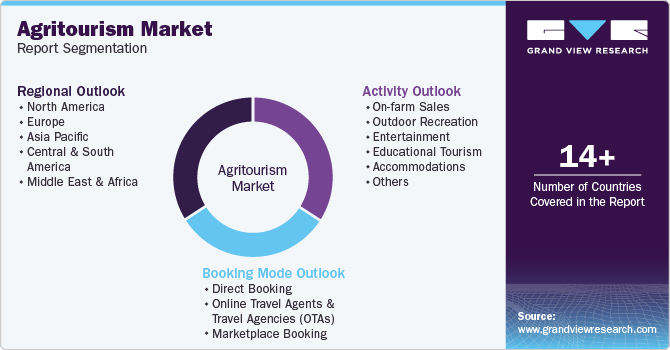
This report forecasts revenue growth at global, regional & country levels and provides an analysis of the latest trends and opportunities in each of the sub-segments from 2021 to 2033. For this study, Grand View Research has segmented the agritourism market report based on activity, booking mode, and region:
 To learn more about this report, Download Free Sample Report
-
Activity Outlook (Revenue, USD Billion, 2021 - 2033)
-
On-farm Sales
-
Outdoor Recreation
-
Entertainment
-
Educational Tourism
-
Accommodations
-
Others
-
-
Booking Mode Outlook (Revenue, USD Billion, 2021 - 2033)
-
Direct Booking
-
Online Travel Agents and Travel Agencies (OTAs)
-
Marketplace Booking
-
-
Regional Outlook (Revenue, USD Billion, 2021 - 2033)
-
North America
-
U.S.
-
Canada
-
Mexico
-
-
Europe
-
UK
-
Germany
-
France
-
Italy
-
Spain
-
-
Asia Pacific
-
China
-
India
-
Japan
-
Australia & New Zealand
-
South Korea
-
-
Central & South America
-
Brazil
-
-
Middle East & Africa (MEA)
-
South Africa
-
-
Research Methodology
The agritourism market figures in this report are based on a proven research process that combines executive interviews with secondary research from proprietary databases, company filings, and recognized regulatory and institutional sources. Market size is built through value-chain sizing - reconciling supply-side and demand-side estimates - and triangulated with bottom-up and top-down approaches. Every estimate passes multiple levels of expert validation before publication, with each agritourism segment quantified using the revenue-capture definitions in the table below.
Segment Definition
Segment - Activity
Revenue capture definition
On-farm Sales
Covers agritourism activities where visitors purchase products directly from farms, including fresh fruits and vegetables, dairy products, honey, flowers, herbs, organic produce, processed food items, beverages, handicrafts, and farm-branded merchandise. Also includes pick-your-own experiences, farmers' markets operated on farms, seasonal produce sales, and farm retail stores integrated into tourism offerings.
Outdoor Recreation
Covers recreational experiences conducted in agricultural landscapes, including farm trails, hiking, cycling, horseback riding, fishing, camping, wildlife observation, birdwatching, corn mazes, orchards, vineyards, nature walks, and adventure activities hosted on farms. Also includes guided outdoor excursions and seasonal recreational programs linked with agricultural properties.
Entertainment
Covers leisure and amusement activities organized at farms, including harvest festivals, music events, cultural performances, petting zoos, hayrides, pumpkin patches, corn maze attractions, food festivals, family entertainment events, seasonal celebrations, and farm-themed recreational programs. Also includes event-based attractions conducted within agricultural destinations.
Educational Tourism
Covers farm-based learning experiences, including guided farm tours, agricultural workshops, crop cultivation demonstrations, livestock management sessions, sustainable farming education, organic farming programs, beekeeping demonstrations, vineyard education, food production experiences, school excursions, and skill-based agricultural training conducted for visitors.
Accommodations
Covers overnight stay facilities offered within agricultural properties, including farm stays, guesthouses, cottages, ranch accommodations, vineyard lodges, eco-lodges, cabins, glamping sites, homestays, and rural resorts located on working farms. Also includes accommodation packages integrated with agricultural experiences and local hospitality services.
Others
Covers additional agritourism activities not categorized elsewhere, including wellness retreats, farm-to-table dining, culinary experiences, wine and cider tastings, photography tours, artisan workshops, volunteer farming programs, agri-events, corporate retreats, private celebrations, and customized rural tourism experiences conducted on agricultural properties.
Segment - Booking Mode
Revenue capture definition
Direct Booking
Covers reservations made directly through farm operators using official websites, telephone bookings, email inquiries, social media pages, mobile applications, or walk-in reservations. Also includes direct package bookings for accommodations, farm tours, recreational activities, educational programs, seasonal events, and bundled agritourism experiences without third-party intermediaries.
Online Travel Agents and Travel Agencies (OTAs)
Covers agritourism bookings facilitated through online travel agencies and traditional travel agencies offering farm stays, rural accommodations, agricultural tours, activity packages, and vacation itineraries. Includes digital travel platforms, tour operators, destination management companies, and agency-managed reservation services for agritourism experiences.
Marketplace Booking
Covers bookings completed through digital marketplace platforms connecting travelers with agritourism providers, including farm experience marketplaces, vacation rental platforms, local experience marketplaces, and rural tourism aggregators. Also includes peer-to-peer booking platforms offering accommodations, farm activities, educational tours, seasonal events, and customized agritourism packages.
Estimation Model
Agricultural Asset Base Layer
Tourism-Ready Farm Layer
Visitor Participation Layer
Monetisation Layer
Which farms have the potential to offer tourism experiences?
Which farms actively participate in tourism?
Who actively books agritourism experiences?
How much revenue is generated?
Begin with the global agricultural land base and the number of operational farms. Filter for commercial farms, vineyards, orchards, ranches, plantations, dairy farms, and specialty farms with the infrastructure, accessibility, and visitor appeal necessary for agritourism activities. This establishes the potential supply base.
Apply factors such as tourism infrastructure, rural accessibility, government agritourism initiatives, farm diversification programs, accommodation availability, and regulatory approvals to estimate farms capable of hosting visitors. This derives the addressable agritourism supply network.
Estimate annual visitor demand by applying domestic and international rural tourism participation rates, farm visit frequency, educational tours, outdoor recreation, farm stays, seasonal events, and direct farm sales. Incorporate booking channels including direct bookings and online travel platforms to estimate annual agritourism visits.
Multiply annual visitor volume by average spending per visitor across accommodations, farm activities, educational programs, outdoor recreation, food & beverages, direct farm sales, and merchandise. Include ancillary revenues from festivals, workshops, weddings, and corporate events to estimate total market revenue.
Delivered Customizations
This report has been delivered with the following In-depth customizations
CLIENT REQUEST
CUSTOMIZATION DELIVERED
VALUE ADDS
Experience Portfolio & Regional Demand Mapping Across Agritourism Activities
Comprehensive cross-segmentation analysis of the agritourism market across activities (on-farm sales, outdoor recreation, entertainment, educational tourism, accommodations, and others), booking modes (direct booking, OTAs/travel agencies, marketplace platforms), and regional markets. The study evaluates how different agritourism offerings perform across mature and emerging destinations, considering farm size, agricultural specialization, seasonality, visitor demographics, and rural tourism infrastructure.
Identifies which agritourism experiences generate the highest visitor engagement and revenue across regions. Highlights where outdoor recreation and farm stays dominate, where educational tourism is gaining momentum, and how regional agricultural strengths (vineyards, dairy farms, orchards, tea estates, livestock farms, etc.) influence tourism demand. This enables destination operators to optimize their experience mix and investment priorities.
Agritourism Operator & Destination Benchmarking
Benchmarking of leading agritourism operators, farm-stay providers, destination management organizations, online travel platforms, and rural hospitality providers. The assessment compares business models, experience portfolios, pricing strategies, accommodation offerings, sustainability initiatives, partnerships with local communities, digital presence, and customer engagement strategies across major agritourism destinations.
Enables stakeholders to distinguish premium experiential operators from volume-focused rural tourism providers. Identifies successful models integrating farm experiences with wellness tourism, culinary tourism, local food ecosystems, and educational programs. The benchmarking also reveals partnership opportunities with travel agencies, hospitality operators, and regional tourism boards to improve destination competitiveness.
Visitor Behavior, Booking Channel & Revenue Opportunity Assessment
Detailed analysis of traveler behavior across direct bookings, online travel agencies (OTAs), and marketplace platforms, including booking preferences, trip purpose (leisure, family, education, corporate, wellness), seasonal demand, visitor spending patterns, length of stay, and ancillary revenue streams such as farm product sales, workshops, dining experiences, and recreational activities.
Identifies where direct bookings maximize operator profitability while OTAs expand market reach and international visibility. Highlights high-value revenue opportunities beyond accommodation, including farm-to-table dining, agricultural workshops, harvest festivals, local product retail, and corporate retreats. The analysis supports pricing optimization, visitor retention strategies, and diversification of farm income through multiple tourism offerings.
Frequently Asked Questions About This Report
The global agritourism market size was valued at USD 8.1 billion in 2024 and is estimated at USD 10.0 billion for 2026.
The global agritourism market is expected to grow at a CAGR of 11.9% from 2025 to 2030, reaching USD 15.8 billion by 2030.
North America dominated with a 46.3% revenue share in 2024.
Some of the key players operating in the agritourism market include Farm to Farm Tours, Bay Farm Tours, Tourism Prince George, Star Destinations, Expedia, Inc., Greenmount Travel, Blackberry Farm, LLC, Ruppier Tours, Hermitage Farm, and Select Holidays.
The growth of the global agritourism market is majorly driven by rising consumer interest in sustainable and immersive travel experiences that connect them with agricultural activities and rural lifestyles and heightened awareness and appreciation for local food systems.
About the Author(s)
Homecare & Decor Research Team
Consumer Goods · Homecare & DecorThis report was authored by the homecare & decor research team at Grand View Research - comprising two research analysts, one senior research analyst, and one industry expert - with specialized expertise in the homecare & decor segment of the consumer goods industry. All findings are based on proprietary consumer goods databases, executive interviews, and regulatory analysis, subject to internal peer review prior to publication.
Last Updated:
Speak to Analyst

Customize this report to your needs - add regions, segments, or data points, with 20% free customization.
Or view our licence options:


ISO 9001:2015 & 27001:2022 Certified
We are GDPR and CCPA compliant! Your transaction & personal information is safe and secure. For more details, please read our privacy policy.


