
- Home
- »
- Next Generation Technologies
- »
-
AI For Customer Service Market Size, Industry Report, 2033GVR Report cover

AI For Customer Service Market (2025 - 2033) Size, Share & Trends Analysis Report By Technology (Machine Learning & Deep Learning, Natural Language Processing), By Application, By End Use, By Region, And Segment Forecasts
Market Size, 2024
$13,012.4MMarket Estimate, 2026
$15,784.6MMarket Forecast, 2033
$83,854.9MCAGR, 2025–2033
23.2%AI For Customer Service Market Summary
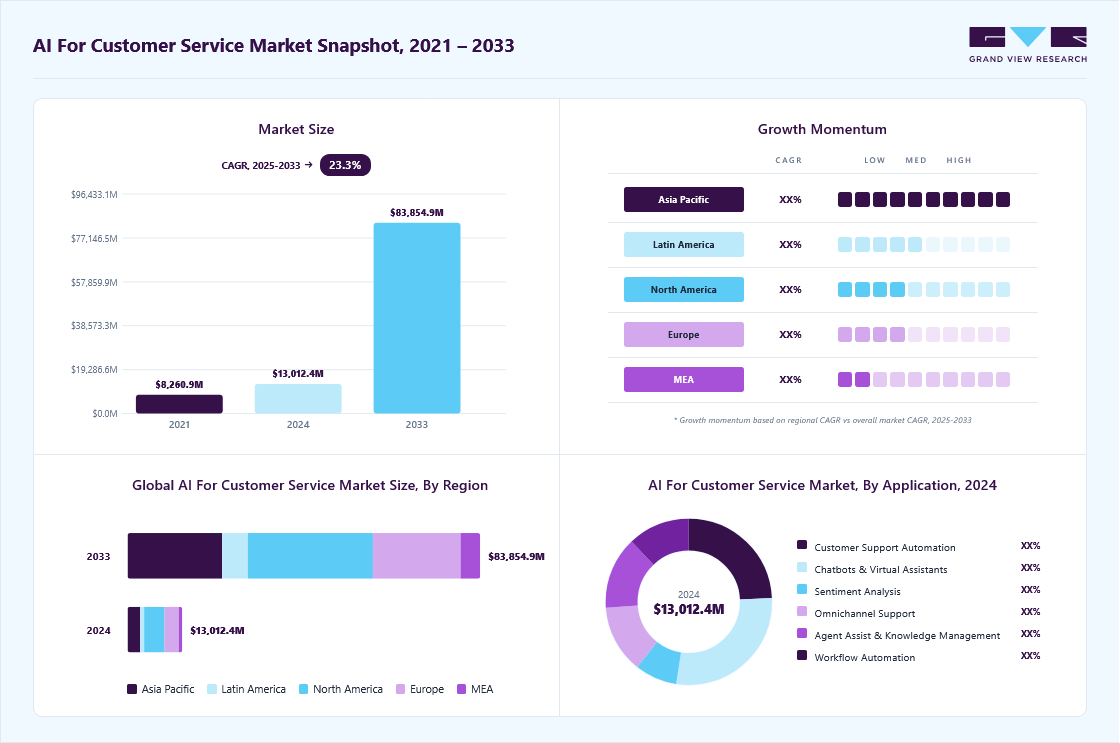
The global AI for customer service market size was valued at USD 13,012.4 million in 2024 and is projected to reach USD 83,854.9 million by 2033, growing at a CAGR of 23.2% from 2025 to 2033. The rise of autonomous AI agents is transforming customer service by simplifying complex, multi-step interactions without human support.
 Source: Grand View Research, IR Documents, Primary Interviews, Paid DatabasesTo learn more about this report,
 Download Free Sample Report
 Key Market Trends & Insights
- North America dominated the AI for customer service market with the largest revenue share of 37.2% in 2024.
- The AI for customer service market in the U.S. accounted for the largest market revenue share in North America in 2024.
- By technology, the machine learning & deep learning segment led the market with the largest revenue share of 43.5% in 2024.
- By application, the chatbots & virtual assistants segment led the market with the largest revenue share of 28.1% in 2024.
- By end use, the retail & e-commerce segment is expected to grow at the fastest CAGR of 26.0% from 2025 to 2033.
Market Size & Forecast
- 2024 Market Size: USD 13,012.4 Million
- 2033 Projected Market Size: USD 83,854.9 Million
- CAGR (2025-2033): 23.2%
- North America:Largest market in 2024
- Asia Pacific: Fastest growing market
Three ways to get this report
Buy it, customize it, or ask a question.Ask an Analyst
Analyst response in 1 business day
- AccessReport author, directly
- Reply timeWithin 1 working day
- No sales callDirect answer only
- FormatEmail reply
- CostFree, no cost
Get the Full Report
What the study covers
- FormatsPDF · Excel · Dashboard
- Timeline2025–2033 annual, 2024 base
- Coverage20+ countries, 5 regions
- Companies10+ key players profiled
Customize the Report
20% free customization
- IncludeCountries, segments, points
- TailorTo your product definition
- ExtendDeeper competitor detail
- OrA fully bespoke study
- Turnaround5–10 working days
This advancement enables quicker resolutions, reduces workload on support teams, and ensures consistent service quality. As organizations seek to simplify operations and enhance responsiveness, demand for such capabilities is driving growth in the AI for customer service industry. Organizations are increasingly focusing on AI solutions that align with local data residency and regulatory frameworks. This shift is driven by the need to ensure privacy, compliance, and operational control.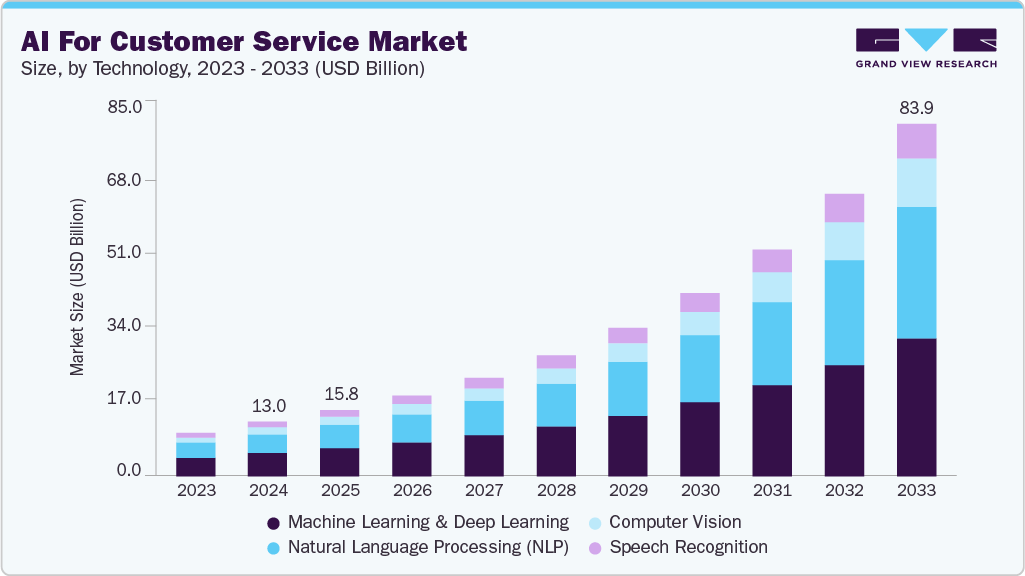 To learn more about this report, Download Free Sample Report
 Sovereign cloud infrastructure enables the secure deployment of AI-based customer service tools while ensuring data remains within national boundaries. This has led to growing demand for region-specific, compliant AI platforms customized to local requirements. This trend is changing the way companies adopt AI to meet business goals and follow safety and compliance rules. For instance, in February 2025, Accenture, a professional services company in Ireland, collaborated with Google Cloud to expand its Generative AI Center of Excellence to Saudi Arabia, to accelerate sovereign cloud and AI adoption across industries. This collaboration focuses on improving operational efficiency, enhancing customer experiences, and advancing local talent development through training, hands-on labs, and upskilling programs to support long-term digital innovation.
Products are increasingly integrating generative AI to support real-time, conversational interactions. Voice-enabled assistants are being used to simplify access to information and features. This enhances user convenience and makes technology more intuitive. The trend reflects a shift toward embedding AI directly into everyday tools and systems. As a result, businesses are using AI to deliver more responsive and personalized experiences. This approach is helping organizations strengthen user engagement and differentiate their offerings in competitive markets. For instance, in February 2025, Stellantis, a multinational automotive manufacturing company in the Netherlands, is expanding its partnership with Mistral AI to integrate generative AI across vehicle development, manufacturing, and customer experiences, including a voice-enabled in-car assistant for real-time support. This partnership explores AI-driven tools for component analysis, quality control, and employee assistance to boost efficiency and product quality.
Generative AI is changing the way customer service interactions take place. It helps systems understand the context of each conversation, making responses more accurate and relevant. These tools can access and analyze historical customer data to offer continuity across interactions. They also detect sentiment and emotional tone, allowing the system to respond empathetically and adaptively in real time. This allows for more personalized and engaging communication that feels natural and human-such as. The tone, language, and even pacing of responses can be adjusted based on the customer's mood and behavior. As a result, customers feel heard, respected, and understood, which strengthens their relationship with the brand. The interactions become smoother, more productive, and less frustrating for users. This improves overall customer satisfaction while reducing support resolution times. It supports stronger customer retention, loyalty, and lifetime value, positioning generative AI as a key driver of next-generation customer experience strategies.
Technology Insights
The machine learning & deep learning segment led the market with the largest revenue share of 43.5% in 2024. They help systems understand user behavior through data patterns. Machine learning & deep learning models improve over time with continuous feedback. Businesses rely on them for predictive support and automation. They are also key to personalizing customer interactions at scale. Their dominance shows their ability to handle both structured and unstructured data effectively. Many AI platforms now use these methods as the backbone of their service automation engines. This continued reliance highlights their role in driving efficiency and accuracy across customer service functions.
The computer vision segment is anticipated to grow at the fastest CAGR during the forecast period. It allows systems to process and interpret visual information from images or video. This is particularly useful for facial recognition and document validation. Industries such as retail and automotive are actively adopting it. Computer vision also supports visual troubleshooting in technical support. Its growth signals the rising importance of visual inputs in service interactions. As more customer touchpoints shift to visual formats, computer vision adoption is expected to accelerate. Its expanding use indicates a move toward more interactive and intuitive customer experiences.
Application Insights
The chatbots and virtual assistants segment accounted for the largest market revenue share in 2024. Chatbots and virtual assistants have become the most widely adopted AI tools in customer service. They handle routine inquiries efficiently, reducing the load on human agents. These tools are available 24/7, providing instant responses across channels. Businesses favor them for their cost-effectiveness and scalability. Their use improves response times and customer satisfaction. Widespread integration across platforms confirms their dominant position in the market. Their capabilities continue to expand with generative AI, enabling more natural and context-aware conversations. As customer expectations grow, companies are prioritizing these tools to maintain fast and consistent engagement.
The agent assist tools and knowledge management systems segment is anticipated to grow at the fastest CAGR during the forecast period. These tools support agents in real time by offering suggested responses and relevant content. They help reduce resolution times and improve accuracy during interactions. Companies are investing in these solutions to enhance agent productivity and service consistency. The growing demand for hybrid support models is accelerating their adoption. Their increasing use marks a clear move toward more intelligent, agent-empowering technologies. Enhanced knowledge sharing and automation are helping organizations manage complex queries more effectively. As support roles evolve, these systems are becoming central to delivering seamless customer service.
End Use Insights
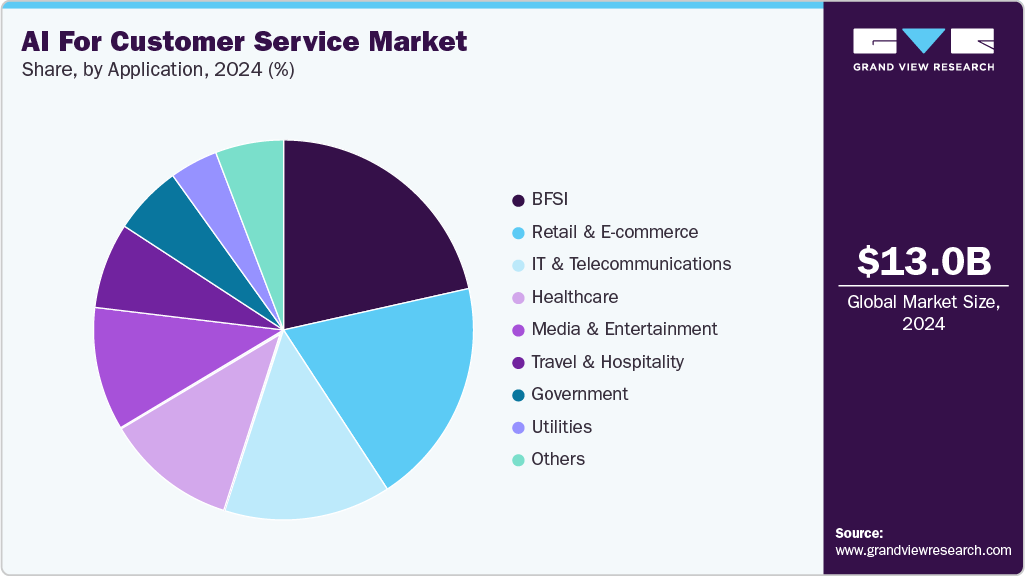
The BFSI segment accounted for the largest market revenue share in 2024. The BFSI sector has been at the forefront of adopting AI in customer service. Financial institutions use AI tools for fraud detection, personalized banking support, and 24/7 customer interaction. The complexity of financial queries makes AI-driven automation especially valuable. These systems improve operational efficiency while enhancing trust through faster, accurate responses. The need for compliance and data security further drives AI integration. Many firms are also integrating AI with legacy systems to ensure consistent service across digital and traditional channels. Growing customer demand for secure, on-demand financial assistance keeps AI investment strong in this sector.
 To learn more about this report, Download Free Sample Report
 The retail and e-commerce segment is rapidly expanding its use of AI to enhance customer engagement. AI helps deliver personalized shopping experiences, automate returns, and streamline order support. Chatbots and recommendation engines are widely used across platforms. Real-time inventory updates and sentiment analysis are also gaining traction. Businesses are investing in AI to meet evolving customer expectations and scale efficiently. Continued growth shows their focus on creating faster, more intuitive service journeys. Visual search, voice-based ordering, and AI-driven promotions are becoming common features. These innovations help retailers boost conversion rates and improve customer satisfaction.
Regional Insights
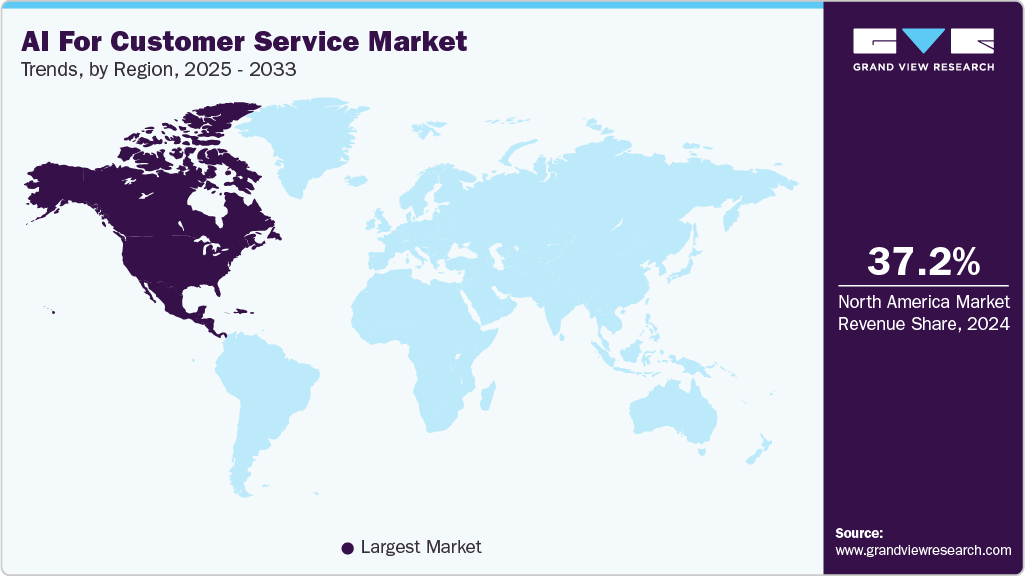
North America dominated the AI for customer service market with the largest revenue share of 37.2% in 2024. Strong digital infrastructure and early AI adoption contributed to this leadership. Enterprises in the region continue to invest in AI-driven customer support tools. Regulatory clarity and a focus on customer experience further support growth. The region remains a key hub for AI innovation and deployment. Major industries such as BFSI, retail, and telecom are actively integrating generative AI and automation.
 To learn more about this report, Download Free Sample Report
 U.S. AI For Customer Service Market Trends
The AI for customer service market in the U.S. accounted for the largest market revenue share in North America in 2024. Its dominance is driven by robust enterprise adoption, mature AI infrastructure, and significant R&D investment. Key industries such as finance, retail, and healthcare are aggressively integrating generative AI tools to enhance customer engagement and operational efficiency.
Europe AI For Customer Service Market Trends
The AI for customer service market in Europe is experiencing steady growth in AI for customer service adoption, supported by digital transformation across the public and private sectors. Regional initiatives focused on ethical AI and data protection, such as GDPR, are encouraging the use of secure, compliant AI tools. Enterprises in countries such as Germany, France, and the UK are deploying AI to simplify multilingual support and boost service efficiency. The region also benefits from government-backed AI development programs and a growing talent base.
Asia Pacific AI For Customer Service Market Trends
The AI for customer service market in Asia Pacific is anticipated to grow at the fastest CAGR during the forecast period. Rapid digitization, increasing smartphone penetration, and rising consumer expectations are key drivers. Countries such as China, Japan, South Korea, and India are actively adopting AI for chatbots, voice assistants, and predictive support. Local companies are investing in AI to differentiate customer experience and reduce service costs. Government support and a competitive tech landscape continue to fuel the region’s accelerated adoption.
Key AI For Customer Service Company Insights
Some of the key companies in the AI for customer service industry include Google LLC, IBM Corporation, Microsoft, Mistral AI, Salesforce, Inc., and others. Organizations are focusing on increasing their customer base to gain a competitive edge in the industry. Therefore, key players are taking several strategic initiatives, such as mergers and acquisitions, and partnerships with other major companies.
-
IBM Corporation has advanced AI for customer service through its Watson Assistant, which uses natural language processing to automate responses, guide customers, and assist human agents. It enables omnichannel support, intent recognition, and integrates with CRM systems to streamline issue resolution and enhance customer engagement. IBM Corporation is also focusing on secure and scalable deployments customized for industries with strict compliance needs.
-
Microsoft integrates AI into Dynamics 365 Customer Service using Azure AI and Copilot, offering features such as real-time response suggestions, sentiment analysis, and knowledge article generation. It focuses on improving agent efficiency, automating routine queries, and delivering personalized, AI-driven service experiences across channels. Microsoft continues to enhance AI-powered collaboration between agents and virtual assistants to accelerate issue resolution.
Key AI For Customer Service Companies:
The following are the leading companies in the AI for customer service market. These companies collectively hold the largest market share and dictate industry trends.
- Ada
- Amazon Web Services, Inc.
- Freshworks Inc.
- Google LLC
- IBM Corporation
- Microsoft
- Mistral AI
- Salesforce, Inc.
- ServiceNow
- Zendesk
Recent Developments
-
In March 2025, Oracle, a computer software company, collaborated with NVIDIA Corporation to accelerate enterprise adoption of agentic AI by integrating NVIDIA’s inference software and GPUs with Oracle Cloud Infrastructure (OCI), enabling fast, scalable deployment of generative AI applications. This collaboration offers over 160 AI tools, NIM microservices, and no-code blueprints for real-time inference, AI vector search, and enterprise use cases such as customer service, healthcare, and media.
-
In March 2025, Anthropic PBC, a U.S.-based artificial intelligence company, has upgraded its developer platform to support team collaboration and advanced reasoning for its Claude AI assistant, enabling cross-functional teams to develop, manage, and refine AI prompts jointly. This update addresses key enterprise challenges such as version control and collaboration gaps, making AI integration more efficient across both technical and non-technical roles.
-
In September 2024, Oracle partnered with Amazon Web Services, Inc. to launch Oracle Database AWS, allowing enterprises to access Oracle Autonomous Database and Exadata services directly within AWS for simplified migration, improved performance, and integrated AI/ML capabilities. This partnership supports seamless connectivity, unified support, and flexible deployment, enabling businesses across industries to modernize their IT infrastructure while enhancing agility and security.
AI For Customer Service Market Report Scope
Report Attribute
Details
Market size value in 2025
USD 15,784.6 million
Revenue forecast in 2033
USD 83,854.9 million
Growth rate
CAGR of 23.2% from 2025 to 2033
Base year for estimation
2024
Historical data
2021 - 2023
Forecast period
2025 - 2033
Quantitative units
Revenue in USD million/billion and CAGR from 2025 to 2033
Report coverage
Revenue forecast, company ranking, competitive sector, growth factors, and trends
Segment scope
Technology, application, end use, region
Region scope
North America; Europe; Asia Pacific; Latin America; Middle East & Africa
Country scope
U.S.; Canada; Mexico; Germany; UK; France; China; Japan; India; Australia, South Korea, Brazil, KSA, UAE, South Africa
Key companies profiled
Ada; Amazon Web Services, Inc.; Freshworks Inc.; Google LLC; IBM Corporation; Microsoft; Mistral AI; Salesforce, Inc.; ServiceNow; Zendesk
Customization scope
Free report customization (equivalent up to 8 analysts’ working days) with purchase. Addition or alteration to country, regional & segment scope
Pricing and purchase options
Avail customized purchase options to meet your exact research needs. Explore purchase options
Global AI For Customer Service Market Report Segmentation
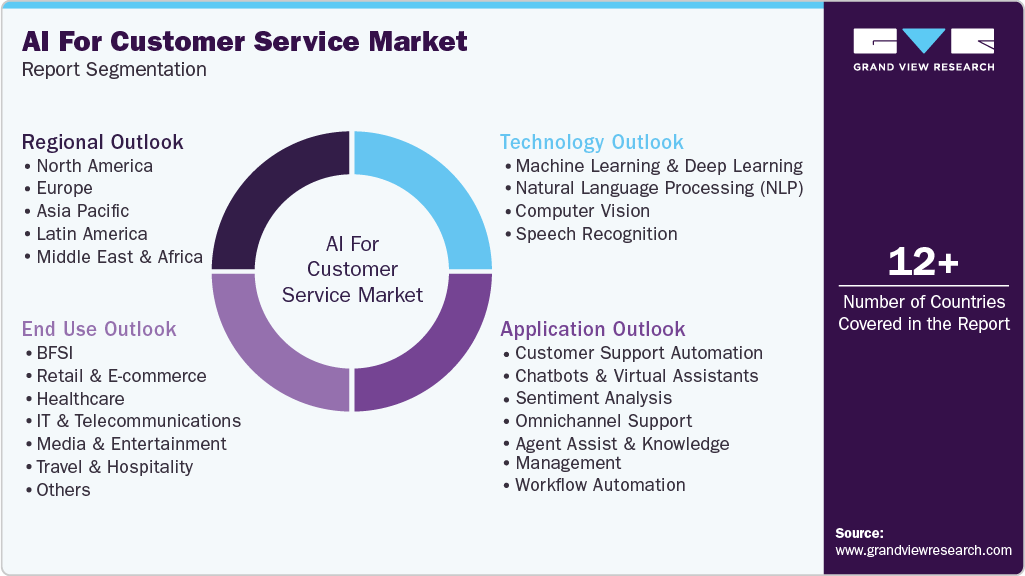
This report forecasts revenue growth at global, regional, and country levels and provides an analysis of the latest industry trends and opportunities in each of the sub-segments from 2021 to 2033. For this study, Grand View Research has segmented the global AI for customer service market based on the technology, application, end use, and region.
 To learn more about this report, Download Free Sample Report
 -
Technology Outlook (Revenue, USD Million, 2021 - 2033)
-
Machine Learning & Deep Learning
-
Natural Language Processing (NLP)
-
Computer Vision
-
Speech Recognition
-
-
Application Outlook (Revenue, USD Million, 2021 - 2033)
-
Customer Support Automation
-
Chatbots & Virtual Assistants
-
Sentiment Analysis
-
Omnichannel Support
-
Agent Assist & Knowledge Management
-
Workflow Automation
-
-
End Use Outlook (Revenue, USD Million, 2021 - 2033)
-
BFSI
-
Retail & E-commerce
-
Healthcare
-
IT & Telecommunications
-
Media & Entertainment
-
Travel & Hospitality
-
Government
-
Utilities
-
Others
-
-
Regional Outlook (Revenue, USD Million, 2021 - 2033)
-
North America
-
U.S.
-
Canada
-
Mexico
-
-
Europe
-
UK
-
Germany
-
France
-
-
Asia Pacific
-
China
-
Japan
-
India
-
Australia
-
South Korea
-
-
Latin America
-
Brazil
-
-
Middle East & Africa (MEA)
-
KSA
-
UAE
-
South Africa
-
-
Frequently Asked Questions About This Report
The global AI for customer service market size was estimated at USD 13,012.4 million in 2024 and is expected to reach USD 15,784.6 million in 2025.
The global AI for customer service market is expected to grow at a compound annual growth rate of 23.2% from 2025 to 2033 to reach USD 83,854.9 million by 2033.
North America dominated the AI for customer service market with a share of 37.2% in 2024. This is attributable to early technology adoption, strong digital infrastructure, and significant investments by major enterprises.
Some key players operating in the AI for customer service market include Ada, Amazon Web Services, Inc., Freshworks Inc., Google LLC, IBM Corporation, Microsoft, Mistral AI, Salesforce, Inc., ServiceNow, and Zendesk.
Key factors that are driving the market growth include rising demand for automated support, enhanced customer experience, advancements in NLP, and increased use of AI across communication channels.
About the Author(s)
Next Generation Technologies Research Team
Technology · Next Generation TechnologiesThis report was authored by the next generation technologies research team at Grand View Research - comprising two research analysts, one senior research analyst, and one industry expert - with specialized expertise in the next generation technologies segment of the technology industry. All findings are based on proprietary technology databases, executive interviews, and regulatory analysis, subject to internal peer review prior to publication.
Last Updated:
Speak to Analyst

Customize this report to your needs - add regions, segments, or data points, with 20% free customization.
Or view our licence options:


ISO 9001:2015 & 27001:2022 Certified
We are GDPR and CCPA compliant! Your transaction & personal information is safe and secure. For more details, please read our privacy policy.


