
- Home
- »
- Next Generation Technologies
- »
-
AI Integration Platform Market Size, Share Report, 2026-2033GVR Report cover

AI Integration Platform Market (2026 - 2033)
Size, Share & Trends Analysis Report By Component (Software, Services), By Application (Data Integration & Management, API & Workflow Automation), By End Use, By Region, And Segment Forecasts
Market Size, 2025
$8.3BMarket Estimate, 2026
$11.2BMarket Forecast, 2033
$88.3BCAGR, 2026–2033
34.4%AI Integration Platform Market Summary
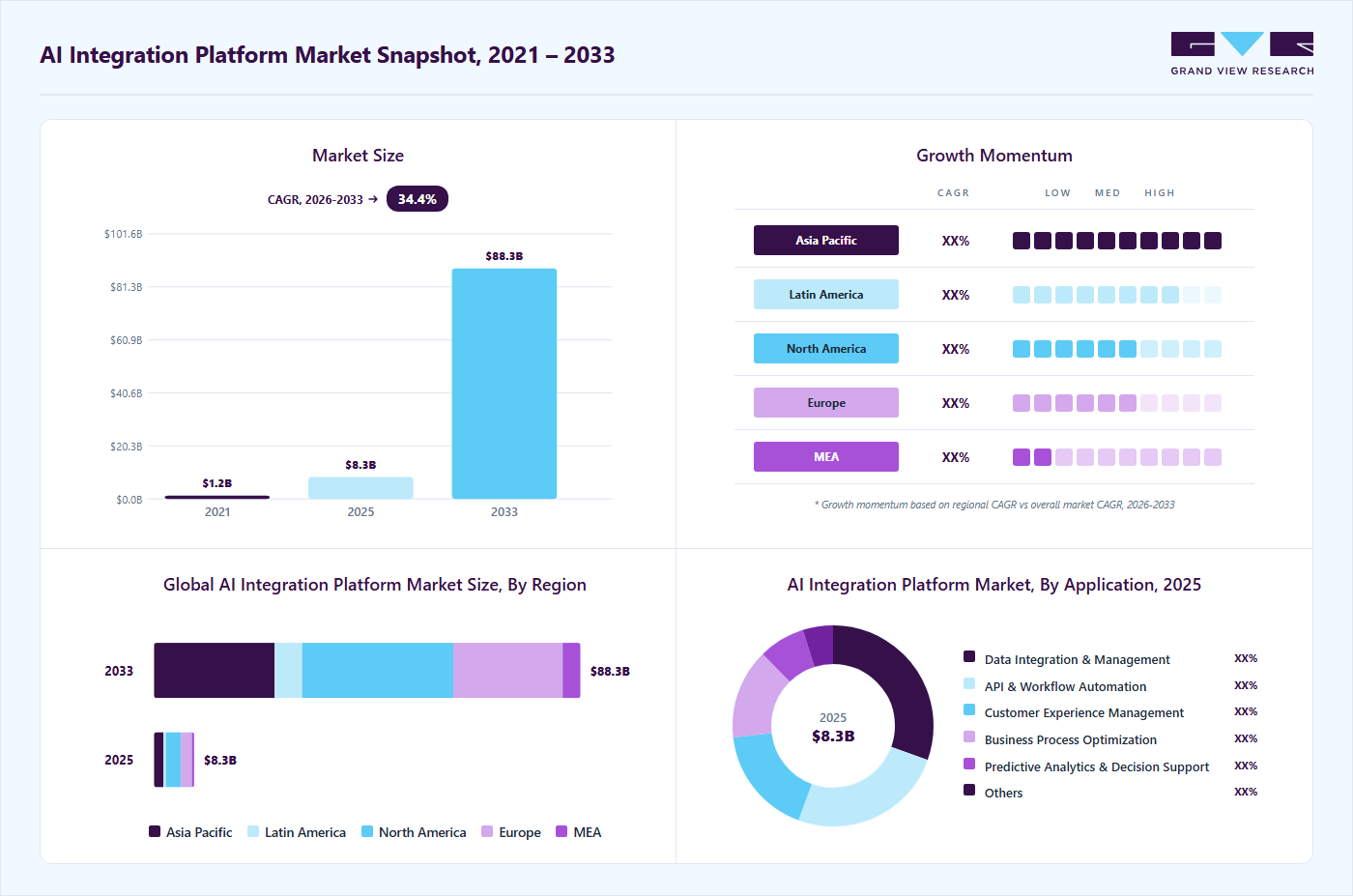
The global AI integration platform market size was valued at USD 8.3 billion in 2025 and is projected to grow from USD 11.2 billion in 2026 to USD 88.3 billion by 2033, at a CAGR of 34.4% from 2026 to 2033. The North America held the largest share of 37.4% of the global market in 2025. The global market is growing at a strong pace. This growth is driven by the increasing adoption of generative AI and rising demand for unified data environments.
 Source: Grand View Research, IR Documents, Primary Interviews, Paid DatabasesTo learn more about this report,
 Download Free Sample Report
 Key Market Trends & Insights
- By component: Software segment held the largest revenue share of 66.3% in 2025.
- By application: Data integration & management accounted for the largest share of 30.4% in 2025.
- By end use: Healthcare segment is expected to grow at the fastest CAGR of 36.9% from 2026 to 2033.
Regional Highlights
- Largest regional market: North America (37.4% revenue share, 2025)
- Fastest-growing regional market: Asia Pacific (highest CAGR, 2026-2033).
- By country: The U.S. led the North America market in 2025.
Market Size & Forecast
- Market size in 2025: USD 8.3 Billion
- Estimated market size in 2026: USD 11.2 Billion
- Projected market size by 2033: USD 88.3 Billion
- CAGR (2026-2033): 34.4%
Three ways to get this report
Buy it, customize it, or ask a question.Ask an Analyst
Analyst response in 1 business day
- AccessReport author, directly
- Reply timeWithin 1 working day
- No sales callDirect answer only
- FormatEmail reply
- CostFree, no cost
Get the Full Report
What the study covers
- FormatsPDF · Excel · Dashboard
- Timeline2026–2033 annual, 2025 base
- Coverage20+ countries, 5 regions
- Companies10+ key players profiled
Customize the Report
20% free customization
- IncludeCountries, segments, points
- TailorTo your product definition
- ExtendDeeper competitor detail
- OrA fully bespoke study
- Turnaround5–10 working days
The need to operationalize AI across enterprise workflows is further accelerating market expansion. A growing emphasis on governed AI deployment is influencing the AI integration platform industry. Enterprises are prioritizing structured frameworks to ensure AI systems operate within defined policies and compliance requirements. This approach addresses concerns related to data privacy, security, and regulatory standards. Organizations are integrating human oversight and embedded guardrails into AI workflows to maintain control over automated decisions. Governance-driven deployment also helps in reducing risks associated with bias, errors, and unintended outcomes. Companies are planning to adopt platforms that enable scalable and responsible AI implementation across enterprise environments. For instance, in March 2026, R Systems Inc., a U.S.-based product engineering and digital solutions provider, launched EXIQO, an AI Studio designed to help enterprises scale agentic AI by combining AI-native engineers, a unified platform (OptimaAI), and a governed delivery methodology. The platform addresses challenges such as integration complexity and governance, enabling organizations to enhance productivity, automate workflows, and expedite execution across their entire operations.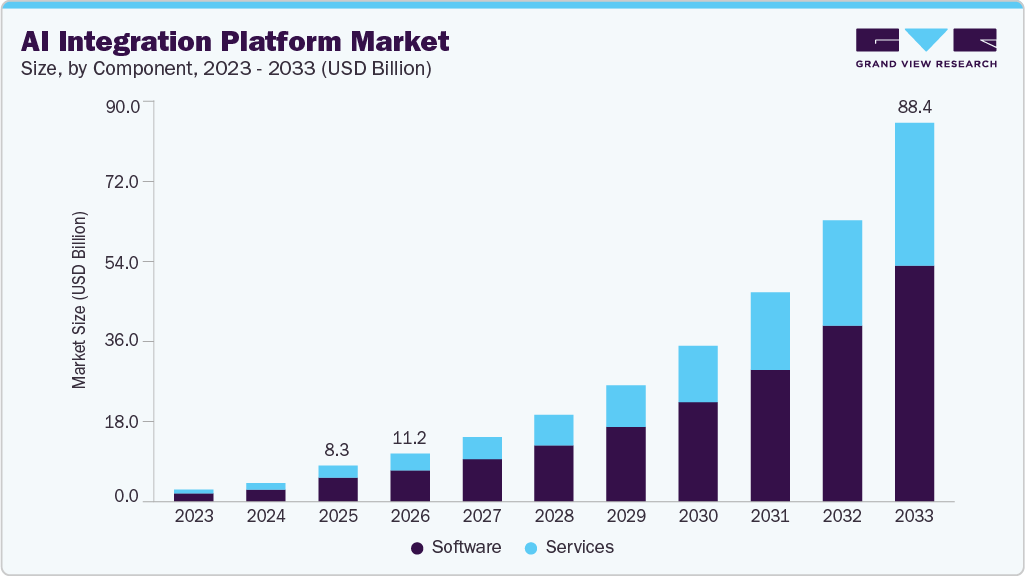 To learn more about this report, Download Free Sample Report
 The advancement of unified AI integration platforms with multimodal and agent-based capabilities is gaining strong momentum in the global market. Enterprises are increasingly adopting AI integration platforms that combine text, image, video, and voice-based AI within a single environment. This approach improves data interoperability, enhances decision-making efficiency, and supports real-time AI processing across enterprise systems. Agent-based AI capabilities are enabling autonomous workflow execution, reducing manual intervention and improving operational efficiency. Vendors are planning to strengthen AI orchestration, integration with legacy systems, and cross-platform deployment to support enterprise scalability. The demand for enterprise AI integration platforms is increasing, driven by the need for scalable, intelligent, and fully integrated AI solutions. For instance, in October 2025, Microsoft expanded its AI Integration Platform capabilities through Azure AI Foundry updates, adding advanced models, agent frameworks, and real-time AI processing features. These enhancements focused on enabling enterprise-scale AI orchestration, improved governance, and seamless integration of multimodal and agent-based workflows.
The growth in pre-built connectors and low-code integration tools is accelerating in the market. Enterprises are increasingly adopting solutions that simplify the integration of AI models with existing applications and data systems. Pre-built connectors enable faster connectivity with databases, cloud platforms, APIs, and enterprise software. This reduces the need for extensive custom development and lowers implementation time. Low-code tools are allowing business users and non-technical teams to participate in AI deployment. This is improving collaboration between technical and business functions within organizations. Vendors are planning to expand connector libraries to support a wider range of enterprise systems and use cases. The availability of drag-and-drop interfaces is further simplifying integration workflows. This approach is helping organizations reduce costs and improve operational efficiency.
Component Insights
The software segment dominated the market in 2025, accounting for a 66.3% share. The software segment dominated the market in 2025 due to the increasing demand for scalable and flexible integration solutions. Enterprises adopted software platforms to enable seamless connectivity between AI models, data systems, and business applications. These solutions supported real-time processing, automation, and efficient deployment of AI across workflows. Vendors enhanced software offerings with features such as low-code tools, pre-built connectors, and multi-cloud compatibility. As a result, the software segment accounted for the largest share, driven by its ability to support enterprise-wide AI integration.
The services segment is anticipated to grow over the forecast period, due to increasing demand for consulting, implementation, and support services. Enterprises are seeking specialized expertise to integrate AI solutions with existing IT infrastructure. This demand is driven by the complexity of AI deployment and the need for seamless system integration. Service providers are offering customized solutions to meet specific business requirements. Ongoing maintenance and optimization services are further supporting long-term AI performance. The services segment is expanding steadily across enterprise environments.
Application Insights
Data integration & management dominated the market in 2025. This growth is attributed to enterprises requiring seamless access to large volumes of structured and unstructured data. Organizations are focusing on unifying data from multiple sources to enable accurate AI model training and deployment. This capability supports real-time analytics and improves decision-making across business functions. The increasing adoption of cloud and hybrid environments is further driving the need for efficient data integration solutions. Vendors are enhancing platforms with advanced data pipelines, governance, and quality management features.
The adoption of predictive analytics and decision support is anticipated to witness growth over the forecast period. Organizations are integrating these capabilities to improve forecasting accuracy and business planning. AI integration platforms enable seamless connection of data sources to support real-time insights. This supports faster and more informed decision-making across functions. Demand is increasing across industries such as BFSI, healthcare, and retail. As a result, predictive analytics and decision support are strengthening the value proposition of AI integration platforms.
End Use Insights
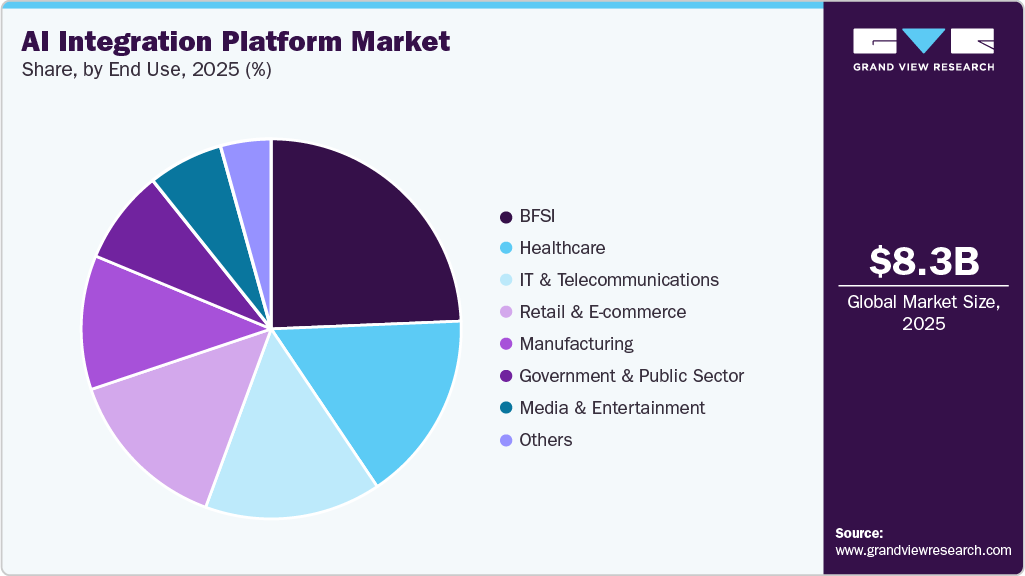
The BFSI sector dominated the market in 2025, due to the high demand for advanced data processing and real-time decision-making. Financial institutions are adopting AI integration platforms to enhance fraud detection, risk management, and customer experience. The need for seamless integration with legacy banking systems is further driving adoption. Regulatory requirements are also encouraging the use of governed and secure AI solutions. Vendors are offering specialized platforms to support complex financial workflows and compliance needs.
 To learn more about this report, Download Free Sample Report
 The healthcare sector is projected to grow over the forecast period due to increasing adoption of AI for diagnostics, patient management, and operational efficiency. Healthcare organizations are integrating AI with existing systems to enable real-time data analysis and improve clinical decision-making. The need for interoperability across electronic health records and medical systems is further driving adoption. Regulatory requirements are encouraging the use of secure and compliant AI integration solutions. Vendors are offering platforms that support data privacy, accuracy, and scalability in healthcare environments.
Regional Insights
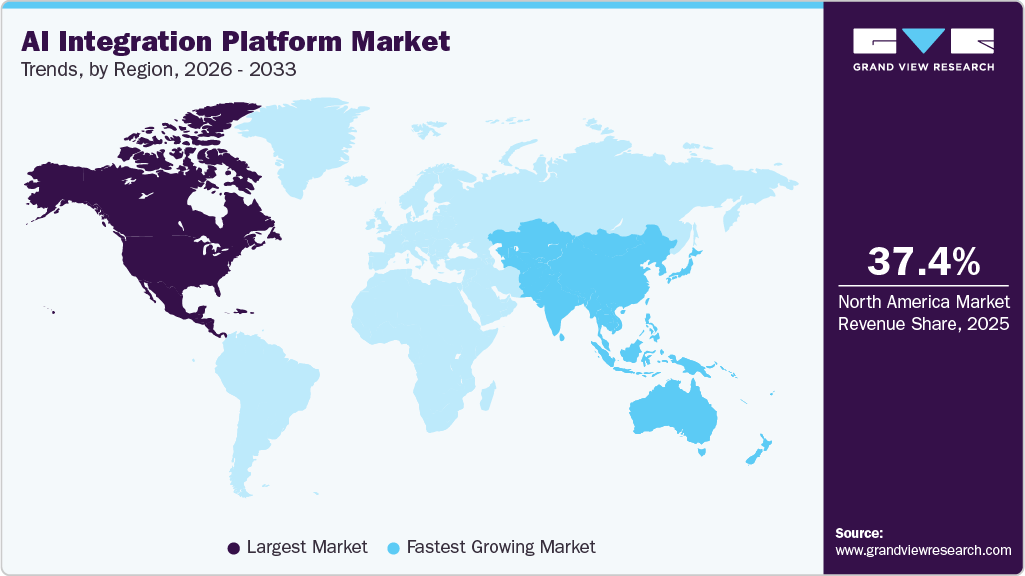
North America AI integration platform industry held the largest share at 37.4% in 2025, due to strong adoption of advanced AI technologies across enterprises. The presence of major technology companies and a well-established digital infrastructure is supporting market growth. Organizations in the region are investing heavily in AI integration to improve operational efficiency and innovation. The increasing demand for automation and real-time data processing is further driving adoption.
 To learn more about this report, Download Free Sample Report
 U.S. AI Integration Platform Market Trends
The U.S. AI integration platform industry is growing rapidly due to strong enterprise adoption of AI-driven solutions across industries. The presence of advanced digital infrastructure and major technology providers is supporting widespread deployment of AI integration platforms. High investment in AI, including data centers and cloud-based infrastructure, is accelerating platform development and adoption.
Europe AI Integration Platform Market Trends
The Europe AI integration platform industry is growing steadily due to increasing adoption of AI across industries such as manufacturing, healthcare, and financial services. Strong regulatory frameworks are encouraging the deployment of secure and compliant AI integration solutions. Enterprises are focusing on integrating AI with existing systems to improve efficiency and data utilization.
Asia Pacific AI Integration Platform Market Trends
The Asia Pacific AI integration platform industry is the anticipated to be the fastest growing market over the forecast period, due to rapid digital transformation across emerging economies. Increasing adoption of AI technologies in countries such as China, India, and Japan is driving market expansion. Enterprises are investing in AI integration to enhance operational efficiency and innovation. Government initiatives supporting AI development and smart technologies are further accelerating growth.
Key AI Integration Platform Company Insights
Some of the key companies in the AI integration platform industry include Amazon.com, Inc., Databricks, Google LLC, IBM Corporation, Jitterbit, Microsoft and others. Organizations are focusing on increasing customer base to gain a competitive edge in the industry. Therefore, key players are taking several strategic initiatives, such as mergers and acquisitions, and partnerships with other major companies.
-
Databricks provides a unified analytics platform that integrates AI and machine learning workflows directly with enterprise data. Its Lakehouse architecture allows seamless access to structured and unstructured data for AI model training. The platform supports end-to-end AI development, from data preparation to deployment, with built-in collaboration tools. Databricks also offers prebuilt AI integrations and APIs for faster adoption in enterprise applications. Continuous updates focus on improving model performance, scalability, and seamless integration with cloud ecosystems.
-
Google LLC offers AI integration through its cloud platform, enabling enterprises to embed AI capabilities into existing applications. Tools like Vertex AI allow development, training, and deployment of machine learning models in a managed environment. Google emphasizes prebuilt models, AutoML, and APIs to accelerate integration without heavy coding. Its platform supports real-time AI inference and large-scale data processing for enterprise needs. Google continuously expands integrations with other Google services and third-party applications to enhance AI accessibility.
Key AI Integration Platform Companies:
The following key companies have been profiled for this study on the AI integration platform market
- Amazon.com, Inc.
- Databricks
- Google LLC
- IBM Corporation
- Jitterbit
- Microsoft
- OpenAI
- Oracle
- Salesforce, Inc.
- Snowflake Inc.
Recent Developments
-
In February 2026, Snowflake Inc., a U.S. cloud-based data platform company, has partnered with OpenAI to integrate advanced AI models directly into its cloud data platform, enabling enterprises to analyze data, automate workflows, and generate insights in natural language across all major cloud providers. This partnership enables customers to deploy AI agents on proprietary data securely, enhancing research, analytics, and decision-making while competing with other AI-focused platforms.
-
In December 2025, IBM Corporation has partnered with Amazon Web Services, Inc. to integrate IBM watsonx Orchestrate with Amazon Bedrock AgentCore, enabling enterprises to design, deploy, and manage Agentic AI solutions. This partnership provides scalable, secure, and governed AI tools across industries, supporting enterprise-wide AI adoption and application modernization.
-
In October 2025, Oracle has collaborated with Amazon Web Services, Inc. to offer Oracle Database@AWS, enabling enterprises to run mission-critical workloads with advanced AI capabilities, zero-ETL integrations, and enhanced resiliency. This collaboration allows customers to access Oracle’s AI-powered databases through AWS and Oracle channel partners, simplifying cloud migration, accelerating innovation, and supporting AI and analytics initiatives across industries.
AI Integration Platform Market Report Scope
Report Attribute
Details
Market size in 2025
USD 8.3 billion
Estimated market size in 2026
USD 11.2 billion
Projected market size by 2033
USD 88.3 billion
Growth rate
CAGR of 34.4% from 2026 to 2033
Base year for estimation
2025
Historical data
2021 - 2024
Forecast period
2026 - 2033
Quantitative units
Revenue in USD billion and CAGR from 2026 to 2033
Report coverage
Revenue forecast, company ranking, competitive sector, growth factors, and trends
Segment scope
Component, application, end use, region
Region scope
North America; Europe; Asia Pacific; Latin America; Middle East & Africa
Country scope
U.S.; Canada; Mexico; Japan; UK; India; China; Japan; India; Australia, South Korea, Brazil, KSA, UAE, South Africa
Key companies profiled
Amazon.com, Inc.; Databricks; Google LLC; IBM Corporation; Jitterbit; Microsoft; OpenAI; Oracle; Salesforce, Inc.; Snowflake Inc.
Customization scope
Free report customization (equivalent up to 8 analysts’ working days) with purchase. Addition or alteration to country, regional & segment scope
Pricing and purchase options
Avail customized purchase options to meet your exact research needs. Explore purchase options
Global AI Integration Platform Market Report Segmentation
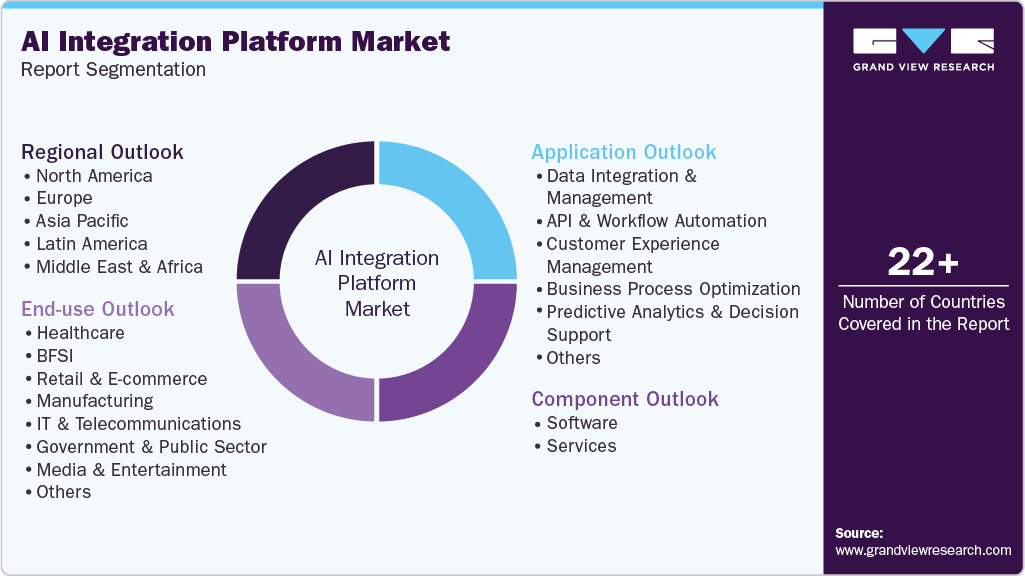
This report forecasts revenue growth at global, regional, and country levels and provides an analysis of the latest industry trends and opportunities in each of the sub-segments from 2021 to 2033. For this study, Grand View Research has segmented the global AI integration platform market report based on component, application, end use, and region.
 To learn more about this report, Download Free Sample Report
 -
Component Outlook (Revenue, USD Billion, 2021 - 2033)
-
Software
-
Services
-
-
Application Outlook (Revenue, USD Billion, 2021 - 2033)
-
Data Integration & Management
-
API & Workflow Automation
-
Customer Experience Management
-
Business Process Optimization
-
Predictive Analytics & Decision Support
-
Others
-
-
End Use Outlook (Revenue, USD Billion, 2021 - 2033)
-
Healthcare
-
BFSI
-
Retail & E-commerce
-
Manufacturing
-
IT & Telecommunications
-
Government & Public Sector
-
Media & Entertainment
-
Others
-
-
Regional Outlook (Revenue, USD Billion, 2021 - 2033)
-
North America
-
U.S.
-
Canada
-
Mexico
-
-
Europe
-
UK
-
Germany
-
France
-
-
Asia Pacific
-
China
-
Japan
-
India
-
Australia
-
South Korea
-
-
Latin America
-
Brazil
-
-
Middle East & Africa (MEA)
-
KSA
-
UAE
-
South Africa
-
-
Frequently Asked Questions About This Report
Asia Pacific is the fastest-growing region over the forecast period.
The software segment dominated the market and accounted for the largest revenue share of 66.3% in 2025.
The data integration & management segment led with a 30.4% revenue share in 2025.
The BFSI segment held the largest revenue share in 2025, while healthcare is the fastest-growing segment.
The global AI integration platform market size was valued at USD 8.3 billion in 2025 and is estimated at USD 11.2 billion for 2026.
The global AI integration platform market is expected to grow at a CAGR of 34.4% from 2026 to 2033, reaching USD 88.3 billion by 2033.
North America dominated the AI integration platform market with a share of 37.4% in 2025, driven by widespread adoption of AI technologies, advanced analytics, and automation across key industries.
Key players include Amazon.com, Inc.; Databricks; Google LLC; IBM Corporation; Jitterbit; Microsoft; OpenAI; Oracle; Salesforce, Inc.; Snowflake Inc.
Key factors driving market growth include increasing adoption of AI and machine learning technologies, rising demand for automation across industries, growing investment in smart manufacturing, and Industry 4.0 initiatives.
About the Author(s)
Next Generation Technologies Research Team
Technology · Next Generation TechnologiesThis report was authored by the next generation technologies research team at Grand View Research - comprising two research analysts, one senior research analyst, and one industry expert - with specialized expertise in the next generation technologies segment of the technology industry. All findings are based on proprietary technology databases, executive interviews, and regulatory analysis, subject to internal peer review prior to publication.
Last Updated:
Speak to Analyst

Customize this report to your needs - add regions, segments, or data points, with 20% free customization.
Or view our licence options:


ISO 9001:2015 & 27001:2022 Certified
We are GDPR and CCPA compliant! Your transaction & personal information is safe and secure. For more details, please read our privacy policy.


