
- Home
- »
- Next Generation Technologies
- »
-
AI In K-12 Education Market Size & Share Report, 2026-2033GVR Report cover

AI In K-12 Education Market (2026 - 2033)
Size, Share & Trends Analysis Report By Component, By Deployment, By Technology, By Application (Learning Platform & Virtual Facilitators, Smart Content), By Region, And Segment Forecasts
Market Size, 2025
$600.5MMarket Estimate, 2026
$901.3MMarket Forecast, 2033
$7,949.9MCAGR, 2026–2033
36.5%AI In K-12 Education Market Summary
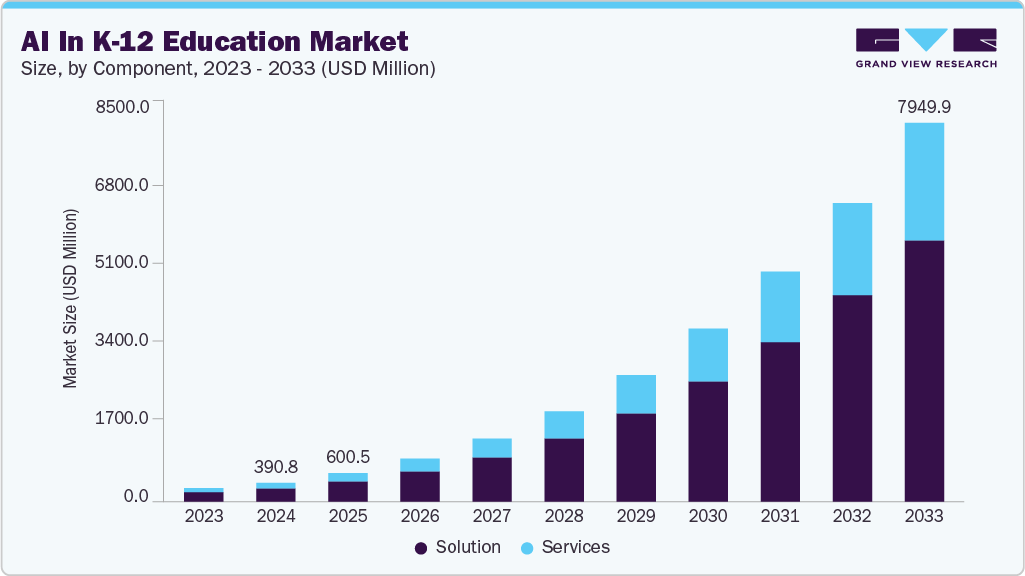
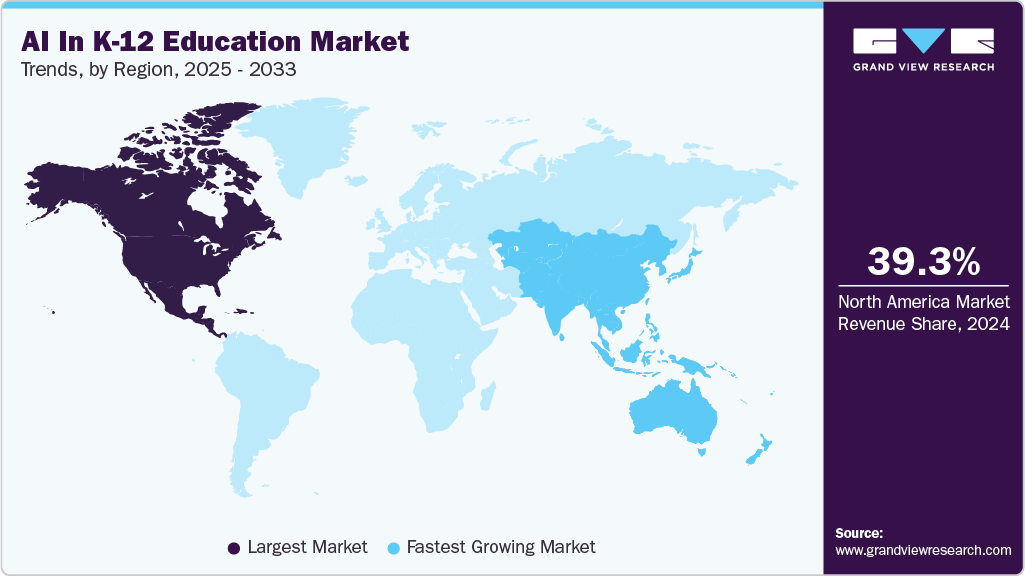
The global AI in K-12 education market size was valued at USD 600.5 million in 2025 and is projected to grow from USD 901.3 million in 2026 to USD 7,949.9 million by 2033, at a CAGR of 36.5% from 2026 to 2033. North America dominated the market, accounting for a revenue share of 35.0% in 2025. The growth is driven by the increasing adoption of personalized learning solutions and intelligent tutoring systems to enhance student engagement and academic outcomes.
 Source: Grand View Research, IR Documents, Primary Interviews, Paid DatabasesTo learn more about this report,
 Download Free Sample Report
 Key Market Trends & Insights
- By component: Solution segment led the market with a share of around 70.0% in 2025.
- By deployment: Cloud segment led the market with over 59.0% revenue share in 2025.
- By technology: Machine learning segment held the largest market share of over 60.0% in 2025.
- By application: The learning platform & virtual facilitators segment accounted for the largest revenue share of over 45.0% in 2025.
Regional Highlights
- Largest regional market: North America (35.0% revenue share, 2025)
- Fastest-growing regional market: Asia Pacific (highest CAGR, 2026-2033)
Market Size & Forecast
- Market size in 2025: USD 600.5 Million
- Estimated market size in 2026: USD 901.3 Million
- Projected market size by 2033: USD 7,949.9 Million
- CAGR (2026-2033): 36.5%
Three ways to get this report
Buy it, customize it, or ask a question.Ask an Analyst
Analyst response in 1 business day
- AccessReport author, directly
- Reply timeWithin 1 working day
- No sales callDirect answer only
- FormatEmail reply
- CostFree, no cost
Get the Full Report
What the study covers
- FormatsPDF · Excel · Dashboard
- Timeline2026–2033 annual, 2025 base
- Coverage20+ countries, 5 regions
- Companies10+ key players profiled
Customize the Report
20% free customization
- IncludeCountries, segments, points
- TailorTo your product definition
- ExtendDeeper competitor detail
- OrA fully bespoke study
- Turnaround5–10 working days
The AI in K-12 education industry’s growth is driven by the increasing adoption of digital learning platforms that enhance student engagement and personalize instruction. AI technologies support adaptive learning by tailoring content to individual student needs, improving knowledge retention, and academic performance. In addition, AI automates time-consuming administrative tasks such as grading and attendance, allowing educators to focus more on teaching. Integrating AI-driven analytics also provides deeper insights into student progress, enabling timely interventions supporting improved learning outcomes across diverse classroom settings.Moreover, the market growth is driven by ongoing technological advancements in AI that enhance the capabilities of personalized learning systems, making them more intuitive and accessible for students and educators alike. Expansion of hybrid and remote learning models continues as schools integrate AI-powered digital tools with traditional instruction, increasing learning flexibility and inclusivity. Further development of smart content generation and immersive technologies, such as AR, complements AI efforts, creating enriched educational experiences. Increasing awareness of the benefits of AI in supporting differentiated instruction and addressing learning gaps promotes wider adoption among academic institutions worldwide.
The growth of the AI in K-12 education market is driven by investments in teacher training and professional development focused on AI literacy to ensure effective implementation in classrooms. Data security and privacy protections evolve to address concerns around sensitive student information, building trust in AI applications. Governments and educational bodies emphasize STEM education and digital skills, encouraging the integration of AI tools that prepare students for future workforce demands. These combined elements contribute to steady expansion in the AI-powered K-12 education market as technology reshapes teaching and learning paradigms globally.
Innovation and new solution developments highlight the growth potential of this industry. For instance, in May 2026, Google launched first wave of 20+ sessions for the Google AI Educator Series, developed in with ISTE+ASCD, as a free AI literacy training, offered to nearly 6 million K-12 and higher education teachers in the U.S. Such developments are critical in further growth of this industry.
Analyst Perspective
The AI in K-12 education market is growing due to demand for personalized learning, better teaching support, administrative efficiency, and accessible digital tools. Adoption of AI tutoring, adaptive learning, automated assessment, analytics, and generative AI is increasing as schools aim to offer personalized experiences and reduce teachers' routine work. Challenges include student data privacy, AI content accuracy, access inequality, limited teacher training, and safety concerns. However, advancements in responsible AI, digital platforms, and teacher-support tech are creating new opportunities for more effective, inclusive learning. Companies developing secure, age-appropriate AI solutions and involving teachers in decisions will benefit long-term by improving outcomes, supporting educators, and making K-12 education more personalized and efficient.
Component Insights
The solution segment led the AI in K-12 education industry in 2025, accounting for over 70.0% of global revenue share as educational institutions invest heavily in AI-driven platforms, software, and applications designed to improve personalized learning and administrative efficiency. These solutions integrate adaptive learning, real-time analytics, and automated assessment capabilities that enhance teaching and learning experiences. Schools prioritize comprehensive AI packages that provide seamless content delivery, progress monitoring, and curriculum customization. The consolidated nature of solutions simplifies deployment and scalability, making them preferred over fragmented tools. Continuous innovation and integration with existing educational technologies maintain a steady demand for AI solutions across K-12 systems.
The services segment is predicted to experience the fastest CAGR during the forecast period. AI-related services such as consulting, integration, maintenance, and training expand rapidly as schools require expert support to implement and optimize AI technologies effectively. Customized service offerings assist educational institutions in adapting AI solutions to specific curricula, regulatory standards, and infrastructure. Professional development and ongoing support enable educators to leverage AI tools confidently and maximize impact on student outcomes. As AI deployments become more complex, demand for specialized service providers grows, facilitating smoother transitions and continuous improvement. Services also include data privacy compliance management, enhancing institutional trust, and improving adoption rates.
Deployment Insights
The cloud segment accounted for the largest revenue share of the AI in K-12 education market in 2025 due to its flexibility, ease of access, and scalability, which suit the dynamic needs of K-12 education systems. Cloud-based AI platforms allow educators and students to access learning resources anytime and anywhere, supporting hybrid and remote learning models. Real-time data processing and analytics capabilities enable personalized instruction and effective student tracking on a global scale. Institutions benefit from lower upfront costs and simplified infrastructure management with cloud services. Enhanced security measures and frequent updates ensure compliance with data privacy standards and improve system reliability.
The on-premises segment is expected to grow at a significant CAGR during the forecast period. On-premises AI infrastructure gains traction among institutions with stringent data privacy policies or limited broadband connectivity. Local deployments provide schools full control over sensitive student data and facilitate compliance with regional regulatory requirements. Customizable AI systems address specific operational needs and integrate with legacy platforms, engaging districts that prioritize stability and performance. Schools with larger budgets often prefer on-premises solutions to mitigate network latency and ensure uninterrupted service.
Technology Insights
The machine learning segment accounted for the largest market revenue share in 2025, driven by AI adoption, which enabled adaptive learning environments tailored to individual student progress and abilities. ML algorithms analyze vast educational data to recommend personalized content, predict learning gaps, and provide instant feedback. This technology enhances intelligent tutoring systems, automated grading, and predictive analytics for student performance. Education providers favor ML for its ability to continuously improve models based on real-time data, increasing instructional effectiveness.
The Natural Language Processing (NLP) segment is expected to grow significantly during the forecast period, driven by increasing use of AI for language-based applications such as automated grading, essay evaluation, chatbots, and multilingual support. These tools improve communication between students and educators, facilitate language learning, and offer personalized feedback on written assignments. As content diversification expands, NLP enables accessibility features such as text-to-speech and translation services. Advances in understanding natural human language in educational contexts enhance interactivity and engagement. The growing need for spoken and written language support in diverse classrooms drives increased NLP adoption.
Application Insights
The learning platform & virtual facilitators segment accounted for the largest revenue share of the AI in K-12 education industry in 2025. Learning platforms integrated with AI virtual facilitators provide comprehensive ecosystems that support personalized learning, student engagement, and teacher assistance. These platforms aggregate content, assignments, assessments, and collaboration tools into centralized hubs accessible across devices. Virtual facilitators guide learners through custom pathways, answer queries, and provide real-time interventions, improving retention and motivation. In addition, schools emphasize these solutions to accommodate diverse learning styles and enable scalable individualized instruction.
The smart content segment is anticipated to grow at the fastest CAGR during the forecast period. Smart content, which includes AI-generated interactive textbooks, simulations, and adaptive assessments, drives accelerated growth by enriching traditional materials with immersive and personalized features. This dynamic content adapts in real time to student responses and progress, fostering deeper understanding and engagement. Incorporating multimedia, gamification, and scenario-based learning supports competency-based education frameworks. AI-enabled content updates streamline curriculum alignment to evolving standards and educational research. The increasing demand for engaging, flexible, and effective learning materials fuels smart content adoption.
Regional Insights
North America AI in K-12 education market dominatedthe global market with a revenue share of over 35.0% in 2025, due to advanced digital infrastructure, extensive EdTech investment, and early government support for AI integration in K-12 education. The region benefits from a vibrant ecosystem of technology providers, research institutions, and innovative school districts implementing AI-powered learning environments. High awareness about AI’s role in addressing educational disparities encourages adoption across the public and private sectors.
 To learn more about this report, Download Free Sample Report
 U.S. AI In K-12 Education Market Trends
The U.S. AI in K-12 education industry is expected to grow significantly in 2025, driven by federal and state investments targeting the modernization of education through AI technologies that enhance learning outcomes and operational efficiency. The increasing integration of AI in standardized testing, student performance analytics, and personalized learning platforms supports broad adoption. Initiatives addressing digital equity and remote learning infrastructure expansion prioritize AI solutions to reach underserved communities.
Europe AI In K-12 Education Market Trends
The AI in K-12 education industry in Europe is expected to grow significantly over the forecast period, driven by regulatory focus on ethical AI use, data protection, and inclusive education policies that encourage responsible AI adoption in schools. Multilingual content delivery and accessibility features address the continent’s linguistic and cultural diversity. Investments in digital skills training and AI literacy support educator readiness and student engagement across varied learning environments. Collaborative transnational initiatives stimulate innovation in AI tools aligned with educational priorities such as lifelong learning and equity.
Asia Pacific AI In K-12 Education Market Trends
The AI in K-12 education industry in Asia Pacific is anticipated to grow at the fastest CAGR from 2026 to 2033, driven by increasing government focus on digital education infrastructure, widespread smartphone penetration, and a large school-age population embracing technology in learning. Market growth is supported by investments in AI-powered tutoring, language learning, and interactive content tailored for diverse educational systems. The region’s emphasis on STEM education and skill development accelerates AI integration to prepare students for competitive global environments. Public and private sector collaboration and the adoption of cloud-based AI services enable scalable, cost-effective deployment across urban and rural schools.
Key AI In K-12 Education Market Company Insights
Some key companies in the AI in K-12 education industry are Amazon Web Services, Inc.; IBM Corporation; Google LLC; and Pearson Plc.
-
Amazon Web Services, Inc. offers cloud-based AI solutions for K-12 education, enabling personalized learning and efficient school administration. Its platform supports data analytics, secure storage, and scalable resources, helping educators deliver tailored lessons and improve student outcomes. Amazon Web Services, Inc., collaborates with edtech providers to integrate AI tools that enhance teaching and learning experiences while maintaining privacy protections.
-
IBM Corporation delivers AI-driven solutions for K-12 education that assist in personalized learning, administrative efficiency, and student success tracking. Utilizing AI, data analytics, and cloud computing expertise, IBM Corporation develops platforms that enable customized educational content and adaptive assessments to meet diverse learner needs. IBM Corporation’s solutions emphasize integration with existing school systems and leverage AI to support educators with actionable insights, automate routine tasks, and facilitate virtual collaboration.
Key AI In K-12 Education Companies
The following key companies have been profiled for this study on the AI in K-12 education market.
-
Amazon Web Services, Inc.
-
Cengage Learning, Inc.
-
Cognizant
-
Google LLC
-
Graham Holdings Company
-
HMH
-
IBM Corporation
-
McGraw Hill
-
Microsoft (Nuance)
-
Pearson Plc
Recent Developments
-
In June 2026, Google announced new AI capabilities across Google Classroom and Gemini to provide more personalized learning support for K-12 students. The company introduced Study Notebooks, Guided Learning, and other connected AI experiences that allow students to create study guides, test their knowledge, and develop deeper understanding of subjects. Google also stated that these experiences are designed with education and safety considerations and can be grounded in students’ course materials.
-
In June 2026, Microsoft announced new AI-powered teaching and learning tools alongside its third annual AI in Education Report. The company highlighted the increasing adoption of AI in education and introduced tools intended to support learning outcomes, student engagement, critical thinking, and educator confidence.
-
In May 2026, Google launched the Google AI Educator Series in the United States to provide free AI literacy training to K-12 and higher education educators. The initial program included more than 20 short training sessions developed with ISTE+ASCD, allowing teachers to learn AI skills in manageable modules that can fit into their existing schedules.
-
In November 2025, OpenAI introduced ChatGPT for Teachers, a secure AI workspace specifically designed for verified U.S. K-12 educators and made it free through June 2027. The platform provides teachers with tools to adapt classroom materials, support lesson preparation, collaborate, and use AI within an environment that includes education-focused privacy, security, and administrative controls.
-
In July 2025, OpenAI announced a strategic partnership with the American Federation of Teachers to launch the National Academy for AI Instruction, an initiative to integrate artificial intelligence into K-12 education. As the inaugural contributor, OpenAI committed USD 10 million over five years, comprising USD 8 million in direct funding and USD 2 million in in-kind support, which includes engineering expertise, computing resources, and technical guidance. The program also receives backing from the United Federation of Teachers, Microsoft, and Anthropic PBC.
-
In June 2025, Pearson Plc announced a multi-year strategic partnership with Google LLC to develop AI-driven educational products targeted at the K-12 sector. The collaboration aims to create tools that personalize learning experiences, provide educators with actionable insights, and enhance schools' ability to efficiently access and scale digital learning resources. This partnership highlights both companies' commitment to advancing educational technology and improving student outcomes through innovative AI applications.
-
In June 2025, Michigan Virtual University and the AI Education Project (aiEDU) partnered to advance AI literacy and readiness within Michigan Virtual University's K-12 education system. This collaboration seeks to accelerate the integration of artificial intelligence by enhancing support for educators and utilizing the state’s extensive network of instructional and educational technology coaches. The initiative positions Michigan Virtual University to capitalize on emerging opportunities for innovation in AI-driven education, ultimately adapting improved teaching and learning outcomes across the state.
AI In K-12 Education Market Report Scope
Report Attribute
Details
Market size in 2025
USD 600.5 million
Estimated market size in 2026
USD 901.3 million
Projected market size by 2033
USD 7,949.9 million
Growth rate
CAGR of 36.5% from 2026 to 2033
Base year for estimation
2025
Historical data
2021 - 2024
Forecast period
2026 - 2033
Quantitative units
Revenue in USD million, and CAGR from 2026 to 2033
Report coverage
Revenue forecast, company ranking, competitive landscape, growth factors, and trends
Segments covered
Application, technology, component, deployment, region
Regional scope
North America; Europe; Asia Pacific; Latin America; MEA
Country scope
U.S.; Canada; Mexico; Germany; UK; France; China; India; Japan; Australia; South Korea; Brazil; UAE; South Africa; KSA
Key companies profiled
Amazon Web Services, Inc.; IBM Corporation; Google LLC; Pearson Plc; Cognizant; Graham Holdings Company; McGraw Hill; Cengage Learning, Inc.; Microsoft (Nuance); HMH
Customization scope
Free report customization (equivalent up to 8 analysts working days) with purchase. Addition or alteration to country, regional & segment scope.
Pricing and purchase options
Avail of customized purchase options to meet your exact research needs. Explore purchase options
Global AI In K-12 Education Market Report Segmentation
This report forecasts revenue growth at global, regional, and country levels and provides an analysis of the latest industry trends in each of the sub-segments from 2021 to 2033. For this study, Grand View Research has segmented the global AI in K-12 education market report on the basis of component, deployment, technology, application, and region:
- Component Outlook (Revenue, USD Million, 2021 - 2033)
- Solution
- Services
- Deployment Outlook (Revenue, USD Million, 2021 - 2033)
- Cloud
- On-premises
- Technology Outlook (Revenue, USD Million, 2021 - 2033)
- Natural Language Processing (NLP)
- Machine Learning
- Application Outlook (Revenue, USD Million, 2021 - 2033)
- Learning Platform & Virtual Facilitators
- Intelligent Tutoring System (ITS)
- Smart Content
- Fraud and Risk Management
- Others
- Regional Outlook (Revenue, USD Million, 2021 - 2033)
- North America
- U.S.
- Canada
- Mexico
- Europe
- Germany
- UK
- France
- Asia Pacific
- China
- Japan
- India
- South Korea
- Australia
- Latin America
- Brazil
- Middle East and Africa (MEA)
- UAE
- KSA
- South Africa
- North America
Frequently Asked Questions About This Report
The global AI in k-12 education market size was valued at USD 600.5 million in 2025 and is estimated at USD 901.3 million for 2026.
North America dominated with an over 35.0% revenue share in 2025.
The global AI in k-12 education market is expected to grow at a CAGR of 36.5% from 2026 to 2033, reaching USD 7,949.9 million.
Key players in the market include Amazon Web Services, Inc., IBM Corporation, Google LLC, Pearson Plc, Cognizant, Graham Holdings Company, McGraw Hill, Cengage Learning, Inc., Microsoft (Nuance), HMH, and others
The solution segment led the market with the largest revenue share of around 70.0% in 2025.
About the Author(s)
Next Generation Technologies Research Team
Technology · Next Generation TechnologiesThis report was authored by the next generation technologies research team at Grand View Research - comprising two research analysts, one senior research analyst, and one industry expert - with specialized expertise in the next generation technologies segment of the technology industry. All findings are based on proprietary technology databases, executive interviews, and regulatory analysis, subject to internal peer review prior to publication.
Last Updated:
Speak to Analyst

Customize this report to your needs - add regions, segments, or data points, with 20% free customization.
Or view our licence options:


ISO 9001:2015 & 27001:2022 Certified
We are GDPR and CCPA compliant! Your transaction & personal information is safe and secure. For more details, please read our privacy policy.


