
- Home
- »
- Next Generation Technologies
- »
-
AI In Software Development Market Size Report, 2025-2033GVR Report cover

AI In Software Development Market (2025 - 2033)
Size, Share & Trends Analysis Report By Application (Code Generation & Auto-completion, Automated Testing), By Technology, By Deployment (Cloud, On-premises, Hybrid), By End User, By Region, And Segment Forecasts
Market Size, 2024
$674.3MMarket Estimate, 2026
$1,298.9MMarket Forecast, 2033
$15,704.8MCAGR, 2025–2033
42.3%AI In Software Development Market Summary
The global AI in software development market size was valued at USD 674.3 million in 2024 and is projected to grow from USD 1,298.9 million in 2026 to USD 15,704.8 million by 2033, at a CAGR of 42.3% from 2025 to 2033. North America dominated the market, accounting for a revenue share of 42.1% in 2024. As AI becomes more deeply embedded in every stage of the software product development life cycle, companies are starting to see a real shift in how teams operate.
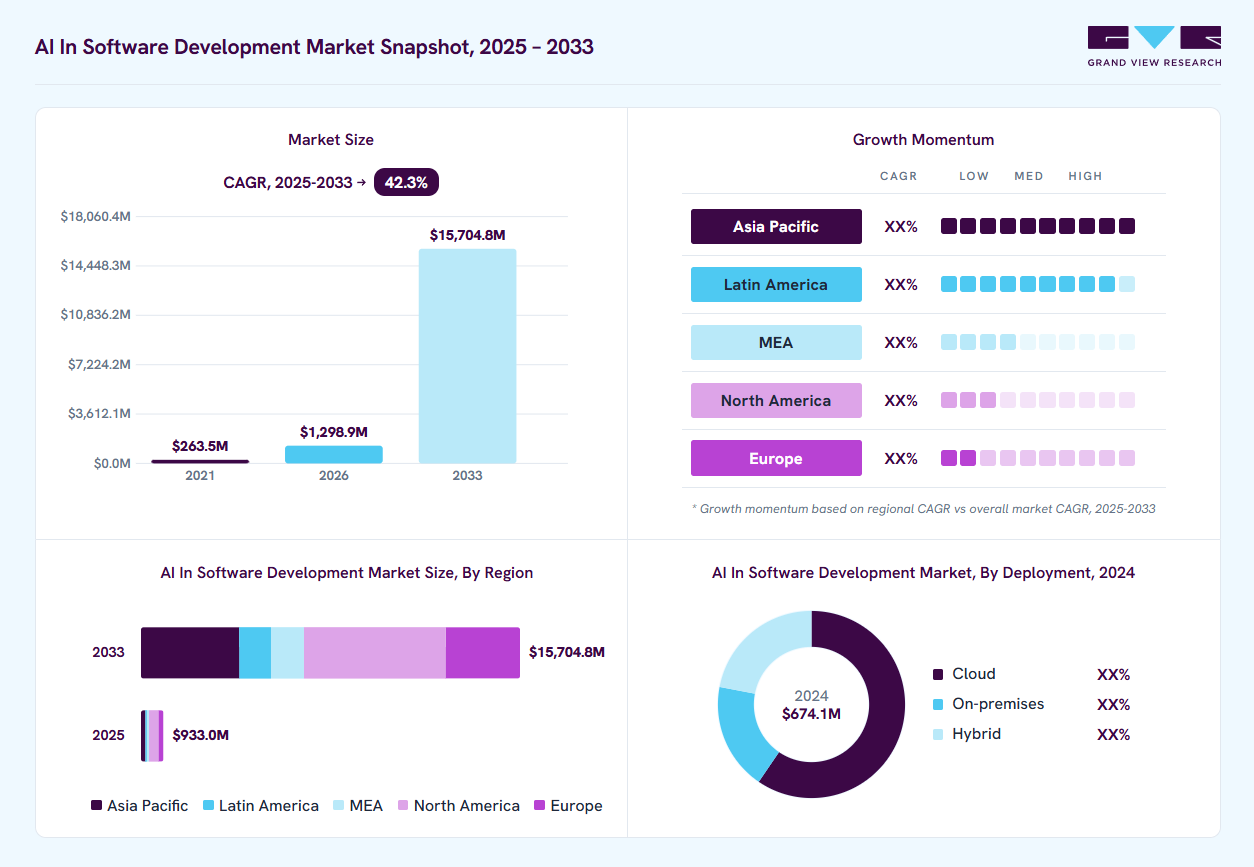 Source: Grand View Research, IR Documents, Primary Interviews, Paid DatabasesTo learn more about this report,
 Download Free Sample Report
 Key Market Trends & Insights
- The AI in software development market in the U.S. led North America with the largest revenue share in 2024.
- By code generation and auto-completion, the deployment segment led the market, holding the largest revenue share of 31.9% in 2024.
- By technology, the machine learning segment held the dominant position in the market and accounted for the leading revenue share of 36.7% in 2024.
- By end user, the healthcare segment is expected to grow at the fastest CAGR of 52.7% from 2025 to 2033.
Market Size & Forecast
- 2024 Market Size: USD 674.3 Million
- 2033 Projected Market Size: USD 15,704.8 Million
- CAGR (2025-2033): 42.3%
- North America: Largest market in 2024
- Asia Pacific: Fastest growing market
Three ways to get this report
Buy it, customize it, or ask a question.Ask an Analyst
A direct answer, usually in 1 working day
- AccessReport author, directly
- Reply timeWithin 1 working day
- No sales callDirect answer only
- FormatEmail reply
- CostFree, no cost
Get the Full Report
What the study covers
- FormatsPDF · Excel · Dashboard
- Timeline2025–2033 annual, 2024 base
- Coverage20+ countries, 5 regions
- Companies10+ key players profiled
Customize the Report
20% free customization
- IncludeCountries, segments, points
- TailorTo your product definition
- ExtendDeeper competitor detail
- OrA fully bespoke study
- Turnaround5–10 working days
By automating routine and repetitive tasks, AI allows product managers, engineers, and developers to focus more on high-impact work, driving innovation, improving decision-making, and delivering better customer outcomes.This shift is also enabling teams to incorporate broader and more diverse data inputs into their development processes, leading to faster iteration cycles and more user-centered solutions. The outcome is not only improved product quality but also stronger customer adoption and satisfaction. As organizations continue to redesign their development frameworks with AI at the core, they're creating a foundation for faster delivery, better performance, and long-term competitive advantage.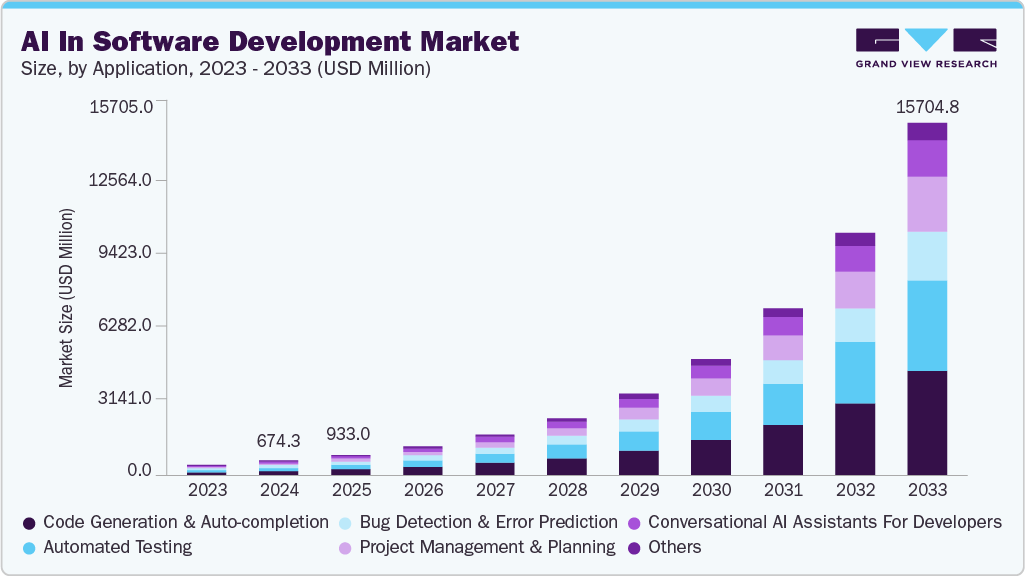 To learn more about this report, Download Free Sample Report
 Leading organizations are beginning to realize the broader potential of AI beyond software engineering, recognizing its capacity to transform the entire product management and development lifecycle. The most significant gains are emerging from AI’s ability to compress the timeline between initial strategic planning and large-scale product deployment. By streamlining traditionally manual, time-intensive activities such as project coordination, market research, performance validation, and the synthesis of customer feedback, AI enables product managers, engineers, and designers to reallocate their time toward higher-value initiatives. These include defining product vision, shaping strategic roadmaps, refining concepts, and prioritizing feature areas where human insight and creativity are critical. This shift not only accelerates delivery but also enhances team productivity and overall product quality.
Application Insights
The code generation and auto-completion segment led the AI in software development industry in 2024, accounting for over 31.9% of global revenue. AI is fundamentally reshaping software development by automating code generation, bug detection, testing, and even documentation. Major initiatives by key players are propelling the market growth. For instance, in March 2025, Microsoft announces the latest evolution of Visual Studio IntelliCode, delivering advanced AI-powered code completion and automation directly within your development workflow. IntelliCode now offers whole-line autocompletions, context-aware recommendations, and intelligent refactoring, helping developers code with greater accuracy and efficiency.
The project management and planning segment is expected to grow at the highest CAGR during the forecast period. AI is redefining project management functions, offering measurable gains in operational efficiency and strategic oversight. Advanced analytics empower teams to detect potential delays, budget variances, and delivery risks early by leveraging insights from historical project performance. Automation capabilities are streamlining core administrative functions such as scheduling, status reporting, and stakeholder communication, thereby reducing overhead and freeing up valuable management capacity. Additionally, AI-driven dashboards and proactive risk notifications enhance visibility, enabling timely, informed interventions. Scenario modeling tools also support stronger forecasting and contingency planning.
Technology Insights
The machine learning (ML) segment accounted for the largest revenue share of the AI in software development market in 2024, due to the field of artificial intelligence (AI), fundamentally transforming software development. Initially a niche technology, ML now underpins many advanced applications, due to the significant growth of cloud-based platforms and pre-trained models that have democratized access for developers. This evolution allows software teams to quickly integrate ML capabilities into their solutions, making it critical for analyzing large datasets, extracting actionable insights, and delivering personalized, context-aware experiences to users.
The computer vision segment is expected to grow at the fastest CAGR over the forecast period, driven by its ability to automate the analysis of visual data, enabling accurate object detection, image recognition, and real-time scene interpretation. Innovations such as foundation models and Vision Transformers (ViTs) boost both precision and scalability, while edge AI supports fast, on-device processing, enhancing privacy and responsiveness. The integration of multimodal AI integrates visual, language, and audio inputs further, deepens contextual understanding, speeding up development and expanding potential use cases. Rising demand for greater automation, reduced errors, and smarter decision-making across industries continues to fuel rapid growth and innovation in this field.
Deployment Insights
The cloud segment led the market with revenue share in 2024 due to its increased automation and efficiency. AI streamlines tasks such as code generation, testing, and resource management, freeing developers to concentrate on more strategic work. Scalability is also a significant advantage, with AI enabling dynamic resource allocation to maintain performance and reduce costs. Enhanced security is another benefit, with AI-powered systems providing real-time threat detection and response to safeguard cloud environments. Additionally, AI-driven predictive analytics and personalized experiences make cloud services more intelligent and responsive to evolving business requirements.
The on-premises segment is expected to grow at the highest CAGR over the forecast period. The growth is driven due to the superior data security and privacy, as organizations maintain complete control over sensitive information within their own infrastructure, ensuring compliance with strict regulatory standards. This approach also allows for highly customizable and scalable infrastructure focused on specific operational needs, delivering optimized performance and minimal latency for real-time applications. Furthermore, on-premises deployment offers predictable long-term costs by eliminating fluctuating cloud fees and enables internal fine-tuning of open-source AI models without exposing data externally. These advantages make it a preferred choice for industries with rigorous data governance and high-performance demands.
End User Insights
The IT and software services segment accounted for the largest revenue share of the AI in software development industry in 2024, driven by the AI’s capability to automate routine tasks such as coding, debugging, and testing, greatly enhancing developer efficiency and shortening development cycles. AI-driven tools provide real-time data analysis and predictive insights, enabling more informed and faster decision-making in the software development process. Moreover, AI enhances user experience through hyper-personalization, allowing applications to adapt to individual user preferences. The ability to cut costs through intelligent automation and scale effectively to meet increasing workloads also contributes to the growing adoption of AI in this segment.
 To learn more about this report, Download Free Sample Report
 The healthcare segment is anticipated to grow at the fastest CAGR during the forecast period. The healthcare end user segment is driven by AI’s potential to improve diagnostic precision and focused treatments through advanced machine learning and predictive analytics, leading to better patient outcomes and cost savings. AI-driven automation simplifies administrative processes, minimizing errors and freeing up time, while digital health assistants offer round-the-clock support, enhancing accessibility and patient satisfaction. Furthermore, AI enables early detection and prevention of diseases, supporting proactive care and more effective management of chronic conditions. Together, these factors enhance efficiency, accuracy, and patient-focused innovation in healthcare software development.
Regional Insights
North America dominated the AI in software development industry with a revenue share of over 42.1% in 2024, driven by the digital transformation across industries such as healthcare, finance, and retail. The region is home to major tech leaders like Microsoft, Google, and IBM, as well as a dynamic startup ecosystem backed by significant venture capital and government R&D support. Key growth factors include the integration of AI and machine learning into development tools, the expansion of cloud-native and low-code/no-code platforms, and the increasing use of AI for automation, cybersecurity, and personalized software solutions. Additionally, favorable government policies and strong investment in AI research continue to drive innovation and reinforce North America’s leadership in software development.
 To learn more about this report, Download Free Sample Report
 U.S. AI In Software Development Market Trends
The U.S. AI in software development industry is expected to grow significantly in 2024, driven by the strong business capital landscape that supports startups and widespread enterprise adoption, with tech giants like Microsoft, Meta, and Amazon expanding AI capabilities to automate workflows and enhance predictive intelligence. The popularity of generative AI models such as OpenAI’s ChatGPT and Anthropic’s Claude has sparked significant innovation and positioned U.S. developers in AI advancement. Continued progress in large language models, cost-effective cloud GPU infrastructure, and increasing demand for AI-powered automation in sectors like healthcare, finance, and retail further drive the integration of AI into software development. A strong focus on regulatory compliance, data security, and ethical AI practices also ensures sustainable and responsible growth across various industries.
Europe AI In Software Development Market Trends
The Europe AI in software development industry is witnessing steady growth over the forecast period,driven by regulatory initiatives like the EU AI Act, which promote transparency, safety, and accountability, building trust and encouraging ethical innovation. Major investments in digital infrastructure, including 5G, edge computing, and cloud-native technologies, enable the development of scalable, efficient AI-driven software solutions. The growing use of AI for automation and cybersecurity-first strategies is further driving software advancements across sectors. Additionally, Europe’s focus on sustainability and emerging technologies like quantum computing is shaping the future of AI-powered software development. Government initiatives such as the Digital Decade Programme support this progress by advancing digital transformation and reinforcing technological sovereignty.
Asia Pacific AI In Software Development Market Trends
The AI in software development industry in Asia Pacific is anticipated to register the highest CAGR over the forecast period due to its rise as a global innovation hub, harnessing AI, deep tech, and climate tech to transform industries and promote sustainable growth. Thriving innovation ecosystems encourage collaboration between governments, startups, and financial institutions, accelerating AI adoption across various sectors. The region’s rapidly growing data center and cloud infrastructure, particularly in cities like Singapore, Tokyo, and Mumbai, meet the increasing computational needs of AI applications. Additionally, the smooth uptake of generative AI and supportive, mission-oriented policies strengthens businesses to scale AI solutions quickly, boosting productivity and driving the creation of new markets.
Key AI In Software Development Company Insights
Some key companies in the AI in software development industry are OpenAI, Microsoft, IBM, and Alphabet.
-
OpenAI is an AI research and deployment company dedicated to creating safe and beneficial artificial general intelligence (AGI) that surpasses human performance in most economically valuable tasks. Known for its work on large language models like GPT-4.5 and Codex, OpenAI powers AI tools and applications in software development. OpenAI’s innovations, including ChatGPT and AI coding assistants, have greatly accelerated the adoption of AI in software development, revolutionizing how developers create and deploy intelligent solutions.
-
Microsoft operates in AI-powered software development, providing strong platforms like GitHub Copilot and Azure AI Foundry that enable developers to efficiently build, test, and deploy AI-driven applications. The company’s innovations emphasize autonomous AI agents, intelligent automation, and seamless AI integration across cloud, edge, and Windows environments, revolutionizing traditional development workflows.
Key AI In Software Development Companies:
The following are the leading companies in the AI in software development market. These companies collectively hold the largest market share and dictate industry trends.
- IBM
- OpenAI
- NVIDIA Corporation
- Accenture
- Microsoft
- DataRobot, Inc.
- InData Labs
- Alphabet
- DataToBiz
- Neoteric
Recent Developments
-
In May 2025, NVIDIA launched its AI-focused DGX Spark and DGX Station personal computing systems. These AI supercomputers offer exceptional performance and energy efficiency in a compact desktop format, empowering developers, researchers, and enterprises to efficiently prototype and scale advanced AI models. Focused on the evolving needs of agentic AI systems, DGX Spark delivers up to 1 petaflop of AI computing power. At the same time, DGX Station reaches up to 20 petaflops, featuring high-speed connectivity and multi-user support.
-
In May 2024, Alphabet introduced a range of AI innovations aimed at increasing productivity and creativity across its platforms. The company showcased progress in generative AI, featuring enhanced language models and AI-driven coding assistants. Emphasizing responsible AI integration, Alphabet highlighted its focus on transparency and giving users greater control.
-
In January 2024, Microsoft introduced the AI Odyssey initiative to train 100,000 developers in India on AI technologies and tools through an intensive, month-long program. The initiative is structured in two stages: the first is building and deploying AI solutions using Azure AI services, while the second involves an online assessment to earn Microsoft Applied Skills credentials. This program is designed to equip India’s tech workforce with the skills needed to create impactful AI solutions, supporting economic growth and digital advancement.
AI In Software Development Market Report Scope
Report Attribute
Details
Market size in 2024
USD 674.3 million
Estimated market size in 2026
USD 1,298.9 million
Projected market size by 2033
USD 15,704.8 million
Growth rate
CAGR of 42.3% from 2025 to 2033
Base year for estimation
2024
Actual data
2021 - 2023
Forecast period
2025 - 2033
Quantitative units
Market revenue in USD million & CAGR from 2025 to 2033
Report coverage
Revenue forecast, company ranking, competitive landscape, growth factors, and trends
Segments covered
Technology, deployment, application, end user estimates, region
Regional scope
North America; Europe; Asia Pacific; Latin America; MEA
Country scope
U.S.; Canada; UK; Germany; France; China; India; Japan; South Korea; Australia; Brazil; Mexico; KSA; UAE; South Africa
Key companies profiled
IBM; OpenAI; NVIDIA Corporation; Accenture; Microsoft; DataRobot, Inc.; InData Labs; Alphabet; DataToBiz; Neoteric
Customization scope
Free report customization (equivalent up to 8 analysts working days) with purchase. Addition or alteration to the country, regional, and segment scope.
Pricing and purchase options
Avail customized purchase options to meet your exact research needs. Explore purchase options
Global AI In Software Development Market Report Segmentation
This report forecasts revenue growth on global, regional, and country levels and provides an analysis of the industry trends in each of the sub-segments from 2021 to 2033. For this study, Grand View Research has segmented the global AI in software development market report based on the technology, deployment, application, end user, and region:
-
Technology Outlook (Revenue, USD Million, 2021 - 2033)
-
Machine Learning
-
NLP
-
Deep Learning
-
Computer Vision
-
Others
-
-
Deployment Outlook (Revenue, USD Million, 2021 - 2033)
-
Cloud
-
On-premises
-
Hybrid
-
-
Application Outlook (Revenue, USD Million, 2021 - 2033)
-
Code Generation and Auto-completion
-
Bug Detection and Error Prediction
-
Automated Testing
-
Project Management and Planning
-
Conversational AI Assistants for Developers
-
Others
-
-
End User Estimates Outlook (Revenue, USD Million, 2021 - 2033)
-
Retail & E-commerce
-
IT and Software Services
-
BFSI
-
Telecommunications
-
Healthcare
-
Automotive
-
Others
-
-
Market Regional Outlook (Revenue, USD Million, 2021 - 2033)
-
North America
-
U.S.
-
Canada
-
Mexico
-
-
Europe
-
UK
-
Germany
-
France
-
-
Asia Pacific
-
China
-
India
-
Japan
-
South Korea
-
Australia
-
-
Latin America
-
Brazil
-
-
Middle East and Africa
-
KSA
-
UAE
-
South Africa
-
-
Frequently Asked Questions About This Report
North America dominated the AI in software development market with a share of 42.1% in 2024. Driven by the digital transformation across industries such as healthcare, finance, and retail. The region is home to major tech leaders like Microsoft, Google, and IBM, as well as a dynamic startup ecosystem backed by significant venture capital and government R&D support
Some key players operating in the AI in software development market include IBM; OpenAI; NVIDIA Corporation; Accenture; Microsoft; DataRobot, Inc.; InData Labs; Alphabet; DataToBiz; Neoteric.
Key factors that are driving the market growth include leading organizations in beginning to realize the broader potential of AI beyond software engineering, recognizing its capacity to transform the entire product management and development lifecycle.
The global AI in software development market size was valued at USD 674.3 million in 2024 and is estimated at USD 1,298.9 million for 2026.
The global AI in software development market is expected to grow at a CAGR of 42.3% from 2025 to 2033, reaching USD 15,704.8 million by 2033.
About the Author(s)
Next Generation Technologies Research Team
Technology · Next Generation TechnologiesThis report was authored by the next generation technologies research team at Grand View Research - comprising two research analysts, one senior research analyst, and one industry expert - with specialized expertise in the next generation technologies segment of the technology industry. All findings are based on proprietary technology databases, executive interviews, and regulatory analysis, subject to internal peer review prior to publication.
Last Updated:
Speak to Analyst

Customize this report to your needs - add regions, segments, or data points, with 20% free customization.
Or view our licence options:


ISO 9001:2015 & 27001:2022 Certified
We are GDPR and CCPA compliant! Your transaction & personal information is safe and secure. For more details, please read our privacy policy.


