
- Home
- »
- Next Generation Technologies
- »
-
AI In Warehousing Market Size & Share Report, 2026-2033GVR Report cover

AI In Warehousing Market (2026 - 2033)
Size, Share & Trends Analysis Report By Component (Hardware, Software, Services), By Application, By Deployment, By Organization Size, By Industry, By Region, And Segment Forecasts
Market Size, 2025
$14.1BMarket Estimate, 2026
$17.8BMarket Forecast, 2033
$93.6BCAGR, 2026–2033
26.7%AI In Warehousing Market Summary
The global AI in warehousing market size was valued at USD 14.1 billion in 2025 and is projected to grow from USD 17.8 billion in 2026 to USD 93.6 billion by 2033, at a CAGR of 26.7% from 2026 to 2033. North America dominated the market, accounting for a revenue share of 33.0% in 2025. This can be attributed to the surge in e-commerce, which demands faster and more accurate order fulfillment.
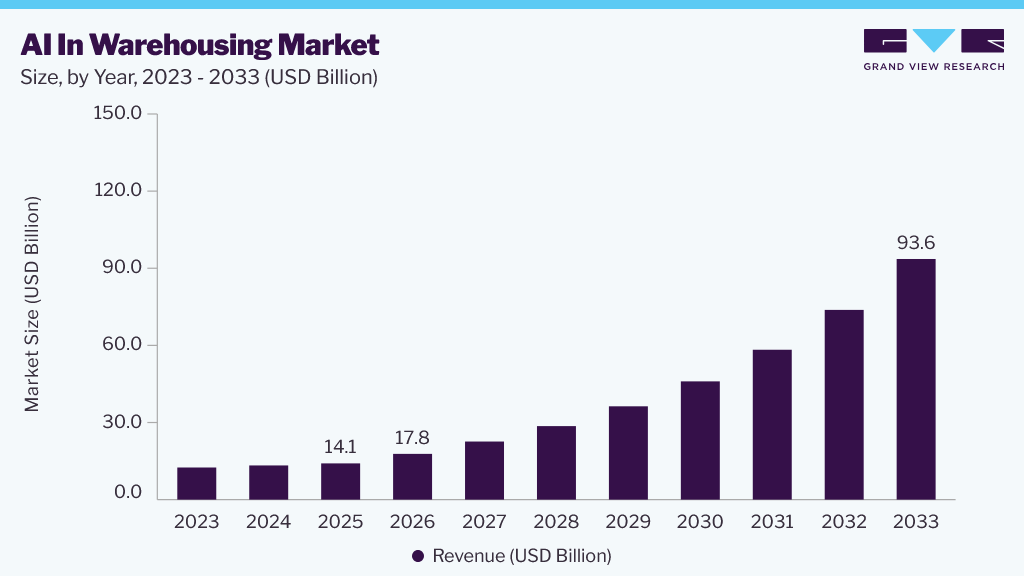 Source: Grand View Research, IR Documents, Primary Interviews, Paid DatabasesTo learn more about this report,
 Download Free Sample Report
 Key Market Trends & Insights
- By component: Hardware held the largest market share of around 55.0% in 2025.
- By application: Inventory management segment held the largest market share of around 30.0% in 2025.
- By deployment: Cloud segment held the largest market share of around 53.0% in 2025.
- By organization size: Large enterprises led the market with a share of around 60.0% in 2025.
Regional Highlights
- Largest regional market: North America (33.0% revenue share, 2025)
- Fastest-growing regional market: Asia Pacific (highest CAGR, 2026-2033)
Market Size & Forecast
- Market size in 2025: USD 14.1 Billion
- Estimated market size in 2026: USD 17.8 Billion
- Projected market size by 2033: USD 93.6 Billion
- CAGR (2026-2033): 26.7%
GVR research-powered AIAsk Prism AI about the AI in warehousing marketGet cited answers from GVR research on market growth, segments, regulations and forecasts.Start with✓ Source-linked answers ✓ Market-specific context ✓ Traceable figuresExplore Prism AI ↗Warehouses are under pressure to handle larger volumes and more complex inventories, leading to the adoption of AI-driven automation, robotics, and advanced analytics. These technologies streamline workflows, reduce manual errors, and improve inventory management, while also addressing labor shortages and rising operational costs. The integration of AI enables real-time decision-making and enhances productivity, making warehouses more efficient and competitive. For instance, Ocado operates highly advanced AI-driven warehouses where robotic systems, coordinated by artificial intelligence (AI), manage automated storage, retrieval, and packing with remarkable efficiency and precision.
Ongoing advancements in robotics, machine learning, and big data analytics are making AI solutions increasingly accessible and scalable for warehouses of all sizes. The integration of AI with IoT devices allows for real-time tracking and management of inventory and assets, improving visibility and decision-making across the supply chain. Companies are also investing in research and development to introduce innovative solutions that optimize warehouse workflows, automate routine tasks, and support predictive maintenance. AI-powered computer vision and robotic systems further enhance operational accuracy by automatically identifying misplaced or damaged goods, reducing human error, and streamlining inventory processes.
Furthermore, sustainability and the need for cost-effective operations are also influencing the adoption of AI in warehousing, which optimize energy use, reduce waste, and improve resource allocation, aligning with corporate sustainability goals. As businesses seek to enhance performance metrics and meet evolving customer expectations, the use of AI in warehousing continues to expand, transforming traditional logistics into data-driven, efficient, and agile operations.
Analyst Perspective
The global AI in warehousing market is expected to grow steadily due to the increasing demand for automation, improved inventory management, and higher operational efficiency in warehouse and logistics activities. Businesses are adopting AI technologies such as machine learning, computer vision, predictive analytics, and robotics to enhance demand forecasting, inventory tracking, order processing, and warehouse operations. The growing use of AI-powered warehouse management systems, autonomous robots, and smart supply chain solutions is creating new opportunities to improve productivity and performance. However, factors such as high implementation costs, challenges in integrating AI with existing warehouse systems, and data security concerns may affect market growth.
Component Insights
The hardware segment held the largest market share of around 55.0% in 2025, driven by the widespread adoption of AI-enabled hardware such as cameras, sensors, and robotics that automate key warehouse functions and enhance operational efficiency. Hardware solutions are critical for real-time data collection, automated material handling, and monitoring, making them essential for modern warehouses. Companies are investing in advanced hardware to meet the growing demand for automation and to support seamless integration with AI-driven software. For instance, in October 2025, Amazon introduced Blue Jay, a multi-arm robotic system designed to coordinate multiple robotic arms for handling items in its fulfillment centers, alongside Project Eluna, an agentic AI system designed to support logistics decision-making.
The services segment is anticipated to grow at the fastest CAGR during the forecast period, due to adoption of AI enabled services to ensure smooth operation and integration. Service providers assist organizations optimize AI deployment, manage system upgrades, and provide ongoing technical support, which is crucial for maximizing return on investment. This trend is driven by the complexity of AI systems and the need for specialized expertise to maintain and scale these solutions.
Application Insights
The inventory management segment held the largest market share of around 30.0% in 2025. AI-powered systems enable real-time tracking, demand forecasting, and automated stock replenishment, resulting in improved inventory accuracy and reduced stockouts or overstocking. These solutions assist warehouses maintain optimal inventory levels and respond quickly to market changes, which is vital for efficient supply chain management. The integration of AI in inventory management directly addresses the challenges of manual tracking and human error. For instance, in May 2026, Amazon launched Amazon Supply Chain Services, providing businesses of all sizes with access to AI forecasting models and supply chain data to optimize inventory placement, improve inventory accuracy, and position products closer to demand.
The warehouse optimization segment is anticipated to grow at the fastest CAGR during the forecast period. AI technologies are increasingly being used to optimize warehouse layouts, streamline picking and packing processes, and allocate resources efficiently. By analyzing large volumes of operational data, AI identifies bottlenecks and suggests improvements, leading to higher throughput and reduced operational costs. This focus on continuous improvement and efficiency is driving the rapid adoption of AI for warehouse optimization.
Deployment Insights
The cloud segment led the market in 2025, reflecting a preference for cloud-based AI solutions in warehousing. Cloud platforms offer scalability, flexibility, and cost savings by eliminating the need for on-premises IT infrastructure. They enable real-time data access, seamless integration with other digital tools, and easier system updates, which are essential for dynamic warehouse environments. The ability to manage fluctuating product volumes and integrate with multiple technologies makes cloud solutions highly attractive for warehouse operators. For instance, in April 2026, NEURA Robotics and AWS entered a strategic collaboration under which AWS became NEURA's primary cloud provider for the Neuraverse platform, supporting physical AI training, real-time data processing, and shared intelligence across robotic fleets, with Amazon also exploring deployment of NEURA robots in select fulfillment centers.
The on-premises segment is expected to grow at a significant CAGR during the forecast period, as some organizations prioritize data security, regulatory compliance, and control over their IT infrastructure. Industries with sensitive data or strict operational requirements often choose on-premises solutions to maintain direct oversight of their systems. These deployments also allow for customization to meet specific operational needs, which is important for certain large-scale or specialized warehouses. As a result, on-premises AI solutions continue to see strong demand in select sectors.
Organization Size Insights
The large enterprises segment led the market in 2025, as their resources and scale enable the deployment and integration of advanced AI technologies. These organizations often manage complex, high-volume operations that benefit significantly from automation, predictive analytics, and real-time decision-making. Large enterprises are also more likely to invest in comprehensive AI strategies, integrating hardware, software, and services across multiple sites. Their focus on efficiency, cost reduction, and customer satisfaction drives substantial adoption of AI in warehousing.
The small & medium (SMEs) segment is expected to grow at the fastest CAGR during the forecast period, driven by the increasing accessibility and affordability of AI solutions that enable smaller businesses to strengthen their competitiveness against larger enterprises. Cloud-based platforms and modular AI tools lower the barriers to entry, enabling SMEs to automate processes, improve inventory management, and enhance operational efficiency. This democratization of AI technology supports rapid growth among smaller organizations in the sector.
Industry Insights
The logistics & transportation segment held the largest revenue share in 2025, reflecting the critical role of AI in optimizing supply chain operations. AI-driven solutions enhance route planning, shipment tracking, and fleet management, resulting in faster and more reliable deliveries. Logistics companies are adopting AI to improve resource utilization, reduce costs, and meet the demands of e-commerce and global trade. The integration of AI in logistics supports end-to-end visibility and efficiency across the supply chain.
The retail & e-commerce segment is estimated to grow at the fastest CAGR during the forecast period, driven by the surge in online shopping and changing consumer expectations. AI enables retailers and e-commerce companies to automate order fulfillment, personalize customer experiences, and manage inventory more effectively. As competition intensifies, these businesses are turning to AI to improve delivery speed, accuracy, and customer satisfaction. For instance, in June 2026, Amazon announced plans to launch more than 100 specialized Urban Fulfillment Centers in India, supported by AI-driven inventory planning, demand forecasting, and optimized operations infrastructure to expand product selection while maintaining rapid delivery.
Regional Insights
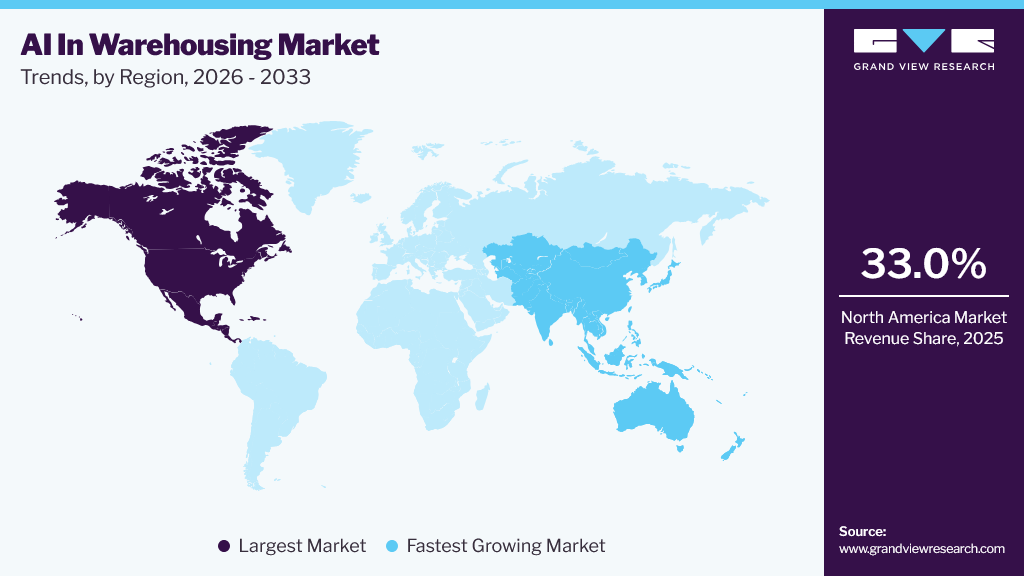
North America AI in warehousing marketdominated the global industry in 2025, accounting for a revenue share of approximately 33.0%. This can be attributed to early adoption of advanced technologies, a strong presence of leading AI vendors, and significant investments in automation. North American companies prioritize operational efficiency and customer service, driving widespread implementation of AI in warehousing. The mature logistics infrastructure and focus on innovation further strengthen the region’s market position.
 To learn more about this report, Download Free Sample Report
 U.S. AI In Warehousing Market Trends
The AI in warehousing industry in the U.S. is anticipated to exhibit a significant CAGR over the forecast period, supported by ongoing investments in digital transformation and automation. American companies are leveraging AI to address labor shortages, improve accuracy, and enhance supply chain resilience. The country's large-scale retail, e-commerce, and logistics sectors provide fertile ground for AI adoption. Regulatory support and a culture of innovation also contribute to the expansion of AI in U.S. warehousing.
Europe AI In Warehousing Market Trends
The Europe AI in warehousing industry is expected to witness significant growth over the forecast period, as companies in the region increasingly embrace digital transformation. European businesses are focusing on sustainability, efficiency, and compliance, prompting the adoption of AI-driven solutions for warehouse management. The presence of established logistics networks and a growing e-commerce market further supports AI integration. Collaboration between technology providers and logistics companies accelerates the deployment of AI across European warehouses.
Asia Pacific AI In Warehousing Market Trends
The Asia Pacific AI in warehousing industry is anticipated to register the highest from 2026 to 2033, driven by rapid industrialization, urbanization, and the expansion of e-commerce. Countries in the APAC are investing heavily in automation and digital infrastructure to meet rising consumer demand and improve supply chain efficiency. The adoption of AI in warehousing supports faster order processing, better inventory control, and enhanced operational agility. Government initiatives and increasing technology adoption among businesses fuel the market growth in Asia Pacific.
Key AI In Warehousing Company Insights
Some key companies in the AI in warehousing market are ABB, Google LLC, Honeywell International, Inc., and IBM Corporation.
- ABB specializes in electrification, automation, and robotics, with a focus on integrating AI into warehouse operations. The company’s AI-powered solutions enhance warehouse efficiency through intelligent robotics, automated material handling, and advanced process optimization. ABB leverages machine learning and data analytics to improve inventory management, optimize picking and sorting, and enable predictive maintenance, supporting seamless and scalable warehouse automation.
- Honeywell International Inc. offers advanced automation, robotics, and data-driven solutions tailored for modern distribution centers. Through its Honeywell Robotics center and collaborations with partners such as Google Cloud, Honeywell International Inc. develops AI and machine learning applications that streamline warehouse workflows, automate repetitive tasks, and provide real-time operational insights.
Key AI In Warehousing Companies:
The following key companies have been profiled for this study on the AI in warehousing market.
-
ABB
-
Amazon Web Services, Inc.
-
Google LLC
-
Honeywell International, Inc.
-
IBM Corporation
-
Microsoft
-
Oracle
-
SAP SE
-
Siemens AG
-
Zebra Technologies Corporation
Recent Developments
-
In July 2026, Sereact secured a strategic investment from Zalando, increasing its Series B funding to USD 116 million to scale its AI-powered warehouse robotics platform, Cortex 2.0, and expand internationally. Sereact reported that more than 200 systems were already operating across Europe and had completed over 1 billion production picks.
-
In June 2026, Amazon announced a planned investment of over USD 10 billion in European fulfillment operations. The AI-enabled robot can understand natural-language commands and autonomously transport heavy carts and containers across fulfillment centers, expanding the use of intelligent robotics for material handling and supporting employees with physically demanding warehouse tasks. Amazon plans to deploy the technology across European sites from 2027.
-
In March 2025, Powerfleet, a provider of AIoT technology and fleet telematics, launched its Unity in-warehouse solutions through a partnership with TELUS to enhance safety, workforce retention, and operational efficiency in Canada and the United States. This collaboration leverages TELUS’s extensive communications network and expertise in digital transformation to expand the reach and impact of Powerfleet’s AI-driven platform. Unity integrates advanced AI to unify operational data, providing actionable insights that address key challenges such as fragmented systems and safety risks in warehouse environments.
-
In January 2025, Gather AI launched its Partner Program to enable vetted supply chain optimization experts to deliver AI-powered inventory monitoring solutions. The program leverages advanced computer vision and autonomous drones to help partners increase revenue and enhance customer satisfaction by significantly reducing inventory errors by up to 70% and boosting clients’ return on investment by three to five times.
-
In January 2025, KION GROUP AG began collaborating with Accenture to optimize supply chains using NVIDIA’s advanced AI and simulation technologies. By leveraging NVIDIA’s Omniverse and Mega platforms, KION is able to create digital replicas of warehouse environments, enabling real-time testing and optimization of layouts, automation equipment, and workforce allocation without disrupting operations. The initiative aims to deliver more efficient, resilient, and adaptable supply chain solutions for global customers.
AI In Warehousing Market Report Scope
Report Attribute
Details
Market size in 2025
USD 14.1 billion
Estimated market size in 2026
USD 17.8 billion
Projected market size by 2033
USD 93.6 billion
Growth rate
CAGR of 26.7% from 2026 to 2033
Base year for estimation
2025
Historical data
2021 - 2024
Forecast period
2026 - 2033
Quantitative units
Revenue in USD billion, and CAGR from 2026 to 2033
Report coverage
Revenue forecast, company ranking, competitive landscape, growth factors, and trends
Segments covered
Component, application, deployment, organization size, industry, and region
Regional scope
North America; Europe; Asia Pacific; Latin America; Middle East & Africa
Country scope
U.S.; Canada; Mexico; Germany; UK; France; China; India; Japan; Australia; South Korea; Brazil; UAE; South Africa; KSA
Key companies profiled
ABB; Amazon Web Services, Inc.; Google LLC; Honeywell International, Inc.; IBM Corporation; Microsoft; Oracle; SAP SE; Siemens AG; Zebra Technologies Corporation
Customization scope
Free report customization (equivalent to 8 analyst working days) with purchase. Addition or alteration to country, regional & segment scope.
Pricing and purchase options
Avail of customized purchase options to meet your exact research needs. Explore purchase options
Global AI In Warehousing Market Report Segmentation
This report forecasts revenue growth at the global, regional, and country levels and provides an analysis of the latest industry trends and opportunities across each sub-segment from 2021 to 2033. For this study, Grand View Research has segmented the global AI in warehousing market report based on component, application, deployment, organization size, industry, and region:
- Component Outlook (Revenue, USD Billion, 2021 - 2033)
- Hardware
- Software
- Services
- Application Outlook (Revenue, USD Billion, 2021 - 2033)
- Inventory Management
- Order Picking & Sorting
- Warehouse Optimization
- Predictive Maintenance
- Supply Chain Visibility
- Deployment Outlook (Revenue, USD Billion, 2021 - 2033)
- Cloud
- On-premises
- Organization Size Outlook (Revenue, USD Billion, 2021 - 2033)
- Small & Medium Enterprises (SMEs)
- Large Enterprises
- Industry Outlook (Revenue, USD Billion, 2021 - 2033)
- Logistics & Transportation
- Retail & E-commerce
- Healthcare
- Manufacturing
- Food & Beverage
- Others
- Regional Outlook (Revenue, USD Billion, 2021 - 2033)
- North America
- U.S.
- Canada
- Mexico
- Europe
- UK
- Germany
- France
- Asia Pacific
- China
- India
- Japan
- Australia
- South Korea
- Latin America
- Brazil
- MEA
- UAE
- South Africa
- KSA
- North America
Frequently Asked Questions About This Report
North America dominated with an approximately 33.0% revenue share in 2025.
Key players in the market include ABB, Amazon Web Services, Inc., Google LLC, Honeywell International, Inc., IBM Corporation, Microsoft, Oracle, SAP SE, Siemens AG, Zebra Technologies Corporation, and others.
The inventory management segment held the largest market share of around 30.0% in 2025.
The global AI in warehousing market size was valued at USD 14.1 billion in 2025 and is estimated at USD 17.8 billion for 2026.
The global AI in warehousing market is expected to grow at a CAGR of 26.7% from 2026 to 2033, reaching USD 93.6 billion.
About the Author(s)
Next Generation Technologies Research Team
Technology · Next Generation TechnologiesThis report was authored by the next generation technologies research team at Grand View Research - comprising two research analysts, one senior research analyst, and one industry expert - with specialized expertise in the next generation technologies segment of the technology industry. All findings are based on proprietary technology databases, executive interviews, and regulatory analysis, subject to internal peer review prior to publication.
Last Updated:
Speak to Analyst

Customize this report to your needs - add regions, segments, or data points, with 20% free customization.
Or view our licence options:


ISO 9001:2015 & 27001:2022 Certified
We are GDPR and CCPA compliant! Your transaction & personal information is safe and secure. For more details, please read our privacy policy.


