
- Home
- »
- Advanced Interior Materials
- »
-
Aluminum Honeycomb Market Size, Share Report 2026-2033GVR Report cover

Aluminum Honeycomb Market (2026 - 2033)
Size, Share & Trend Analysis Report, By End Use (Aerospace & Defense, Transportation, Marine & Shipbuilding, Construction & Architecture, Others), By Product (Standard Core, Engineered / Processed Core), By Region, And Segment Forecasts
Market Size, 2025
$542.7MMarket Estimate, 2026
$586.1MMarket Forecast, 2033
$951.7MCAGR, 2026–2033
7.2%Aluminum Honeycomb Market Summary
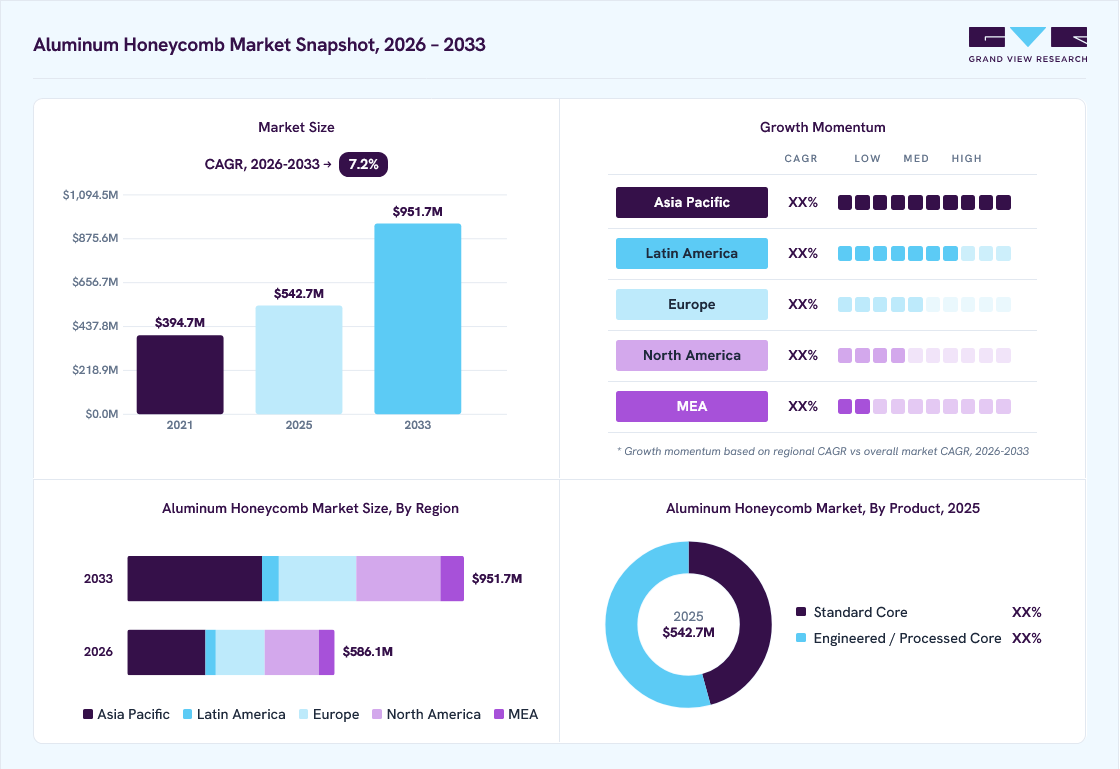
The global aluminum honeycomb market size was valued at USD 542.7 million in 2025 and is projected to grow from USD 586.1 million in 2026 to USD 951.7 million by 2033, at a CAGR of 7.2% from 2026 to 2033. Asia Pacific dominated the market, accounting for a revenue share of 37.3% in 2025. Rising demand for lightweight, high-strength materials in aerospace, transportation, marine, and construction applications is expected to drive growth, particularly in China, India, and Vietnam.
 Source: Grand View Research, IR Documents, Primary Interviews, Paid DatabasesTo learn more about this report,
 Download Free Sample Report
Key Market Trends & Insights
- By end use: Aerospace & defense accounted for the largest market revenue share of 37.1% in 2025.
- By product: Engineered / processed core segment is anticipated to register the fastest CAGR of 8.3% from 2026 to 2033.
Regional Highlights
- Largest regional market: Asia Pacific (37.3% revenue share, 2025)
- By country: China held the largest market share in 2025.
Market Size & Forecast
- Market Size in 2025: USD 542.7 million
- Estimated market size in 2026: USD 586.1 million
- Projected Market Size by 2033: USD 951.7 million
- CAGR (2026-2033): 7.2%
Three ways to get this report
Buy it, customize it, or ask a question.Ask an Analyst
Analyst response in 1 business day
- AccessReport author, directly
- Reply timeWithin 1 working day
- No sales callDirect answer only
- FormatEmail reply
- CostFree, no cost
Get the Full Report
What the study covers
- FormatsPDF · Excel · Dashboard
- Timeline2026–2033 annual, 2025 base
- Coverage20+ countries, 5 regions
- Companies10+ key players profiled
Customize the Report
20% free customization
- IncludeCountries, segments, points
- TailorTo your product definition
- ExtendDeeper competitor detail
- OrA fully bespoke study
- Turnaround5–10 working days
Manufacturers are increasingly focusing on material efficiency, recyclability, and lightweight structural solutions as end users seek to reduce overall component weight and resource consumption. Honeycomb cores provide high stiffness with low material usage, making them suitable for aircraft interiors, rail components, marine structures, and architectural panels. Greater emphasis on recycled aluminum and optimized core designs is also supporting sustainability objectives. These developments are encouraging suppliers to improve material utilization while maintaining mechanical performance and service life.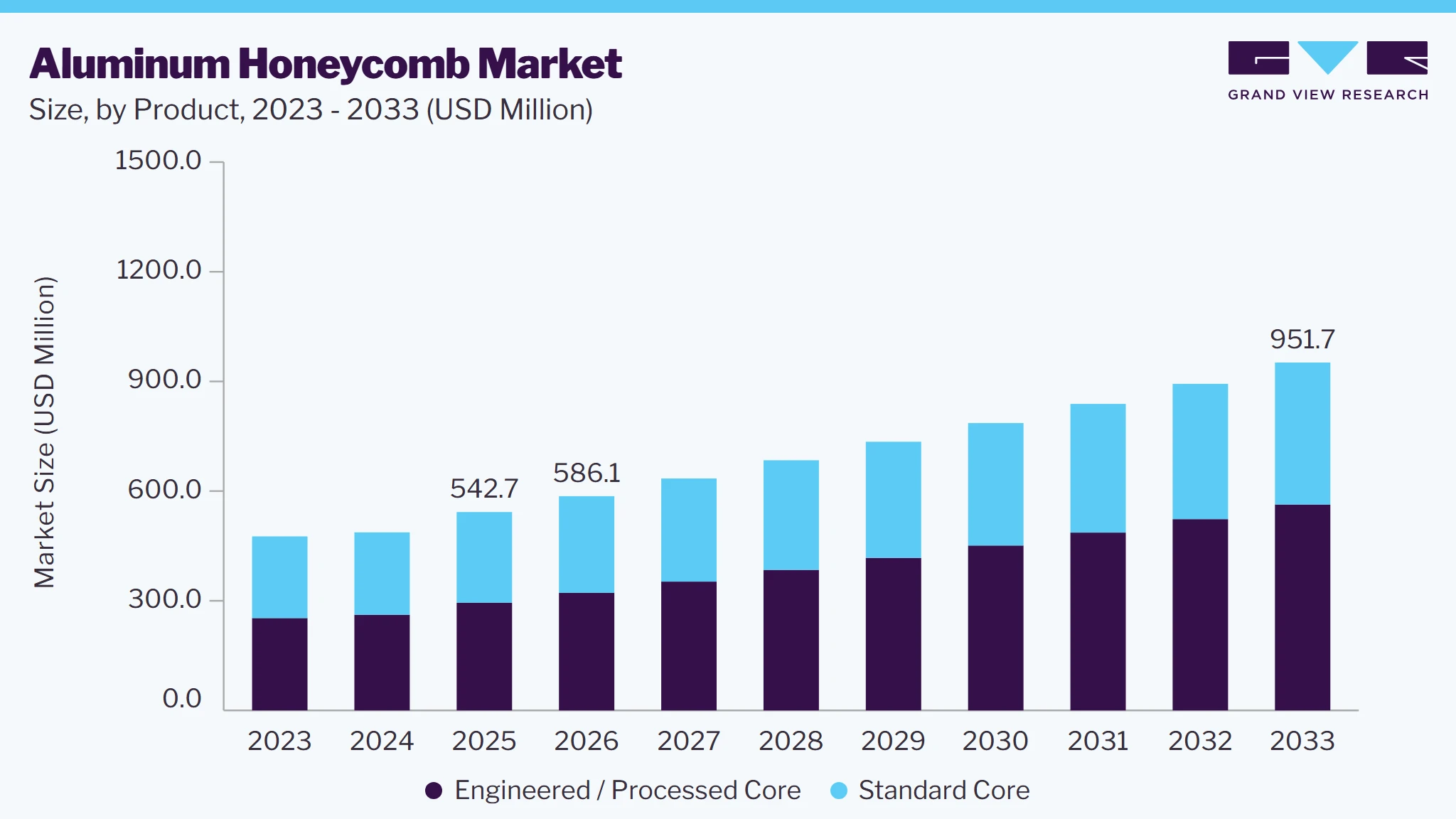 To learn more about this report, Download Free Sample Report
Technological advancement is shifting toward automated fabrication, precision cutting, improved bonding techniques, and application-specific cellular configurations. Variations in cell size, foil thickness, density, and alloy composition allow manufacturers to tailor stiffness, weight, vibration characteristics, and energy-absorption performance. Computer-aided engineering and simulation are increasingly used to optimize component designs before production, reducing material use and development time. Automation is also improving dimensional consistency and production efficiency for complex and high-volume components.
Market Dynamics
The increasing emphasis on weight reduction across aerospace, rail, marine, and other transportation sectors is strengthening demand for lightweight sandwich structures. Aluminum honeycomb cores provide high stiffness at low weight, helping manufacturers reduce the mass of floors, partitions, doors, interior panels, and other components. This can support improved fuel efficiency, lower energy consumption, and greater payload efficiency over the operating life of vehicles.
Aircraft fleet expansion, railway modernization, and the development of energy-efficient transportation systems are creating additional application opportunities. In rail and marine platforms, lightweight panels can help reduce overall structural weight while maintaining the rigidity required for interior and semi-structural applications. Growing production of commercial aircraft and increasing investment in advanced mobility infrastructure are therefore expected to provide a sustained demand base.
Manufacturing involves several precision-intensive stages, including aluminum foil preparation, adhesive application, core expansion, cutting, surface treatment, and panel assembly. Maintaining consistent cell dimensions, density, bond strength, and flatness across large components can increase production complexity and quality-control requirements. These factors can result in higher manufacturing costs compared with conventional sheet-based structures, particularly for customized or low-volume components.
Performance requirements can further restrict adoption in demanding applications. Aerospace and transportation components may require compliance with stringent standards related to fire and smoke behaviour, corrosion resistance, impact performance, structural integrity, and long-term durability. Improper machining, handling, or sealing can also increase the risk of localized damage or moisture penetration. Consequently, qualification requirements and higher upfront costs can limit penetration in cost-sensitive applications.
Increasing aircraft production, defense procurement, space programs, and aircraft interior modernization are creating opportunities for lightweight structural materials. Honeycomb-based panels can provide weight savings while maintaining the stiffness required for aircraft floors, partitions, doors, ceilings, and other interior applications. The growing focus on fuel efficiency and payload optimization further strengthens the suitability of these structures for next-generation aircraft and specialized aerospace platforms.
Architectural and commercial construction applications also offer scope for expansion through lightweight façades, ceilings, partitions, doors, and large-format interior panels. Demand for thin, rigid, dimensionally stable panels can encourage substitution of heavier conventional materials in selected applications. Manufacturers can strengthen their positioning by supplying machined components, finished sandwich panels, customized geometries, and application-specific assemblies, enabling higher-value opportunities beyond standard core products.
Analyst Perspective
The global aluminum honeycomb market is driven by demand across aerospace and defense, transportation, marine, construction and architecture, and industrial applications. The need for lightweight structures and high strength-to-weight ratios supports adoption across these sectors. Growing emphasis on fuel efficiency and structural performance further strengthens demand. Advancements in engineered core designs and customized panel solutions are expanding application opportunities. Infrastructure development and increasing aircraft production are expected to support consumption. Sustainability initiatives and material efficiency are also influencing product development.
End Use Insights
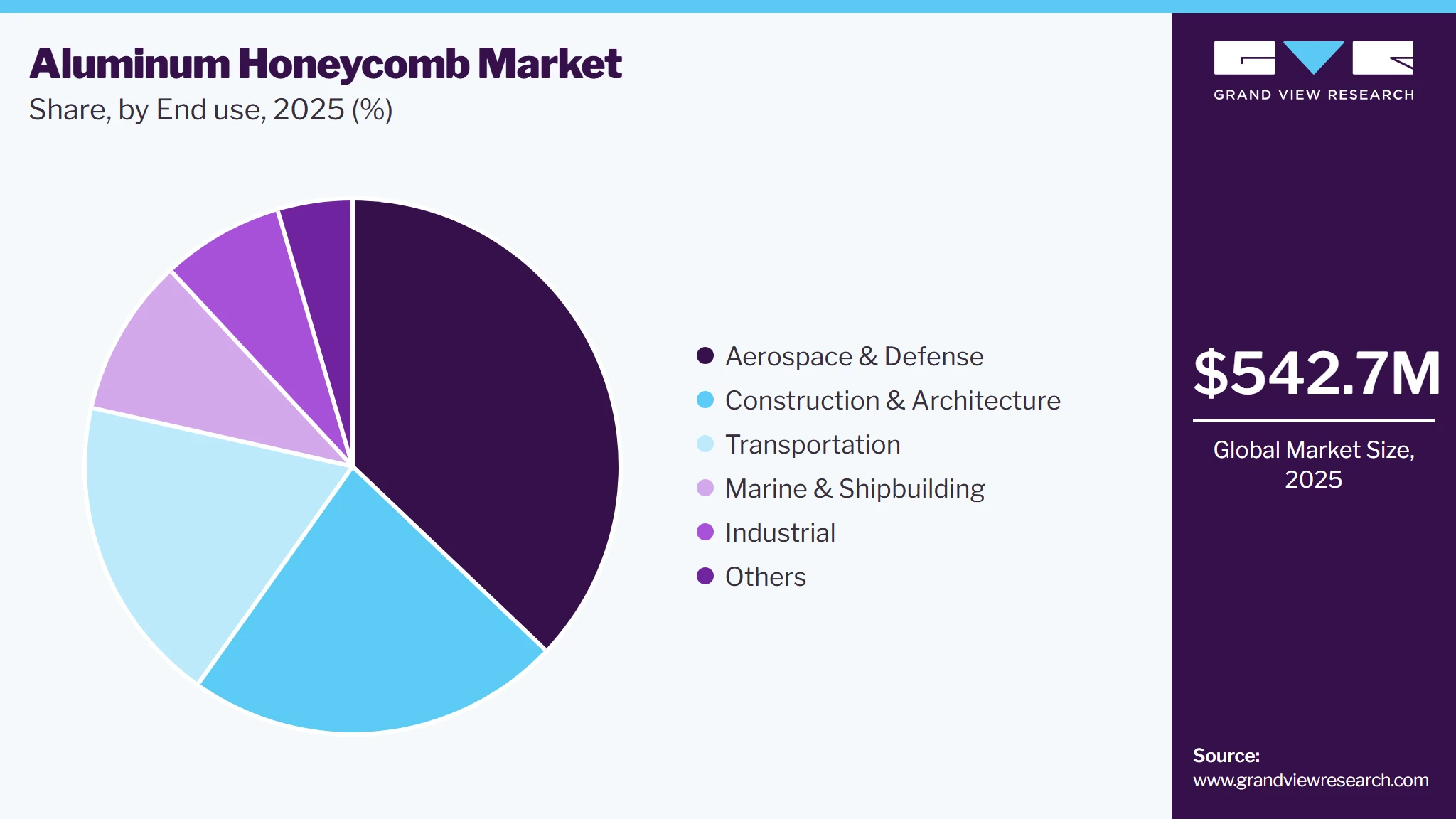
Aerospace & defense held the largest share of the global aluminum honeycomb market in 2025, accounting for 37.1% of revenue. Demand is supported using lightweight, high-strength panels in aircraft interiors, structural components, and defense applications. The material's high stiffness-to-weight ratio helps reduce aircraft weight and improve fuel efficiency. Continued aircraft production and modernization of defense equipment are expected to support segment demand.
 To learn more about this report, Download Free Sample Report
The industrial segment is projected to register the fastest CAGR of 8.8% over the forecast period. Increasing adoption of lightweight structural materials in industrial equipment, machinery, and specialized enclosures is expected to support segment growth. Aluminum honeycomb structures offer rigidity and durability while reducing overall component weight. Expanding automation and demand for efficient industrial designs are likely to create additional growth opportunities.
Product Insights
Engineered / processed core accounted for the largest share of the global aluminum honeycomb market in 2025, representing 54.3% of revenue. Demand is driven by applications requiring customized cell structures, precise specifications, and enhanced mechanical performance across aerospace, transportation, and industrial uses. These cores can be tailored to meet specific strength, thickness, and bonding requirements. Growing demand for application-specific lightweight components is expected to support adoption.
Standard core continues to serve applications requiring lightweight, rigid, and cost-effective honeycomb structures. Its use in general-purpose panels, architectural components, and transportation interiors is expected to support steady demand, particularly where standardized specifications and ease of integration are key purchasing considerations. Standard cores offer a practical solution for applications with less complex performance requirements. Their straightforward manufacturing and broad applicability support continued use across diverse industries.
Regional Insights
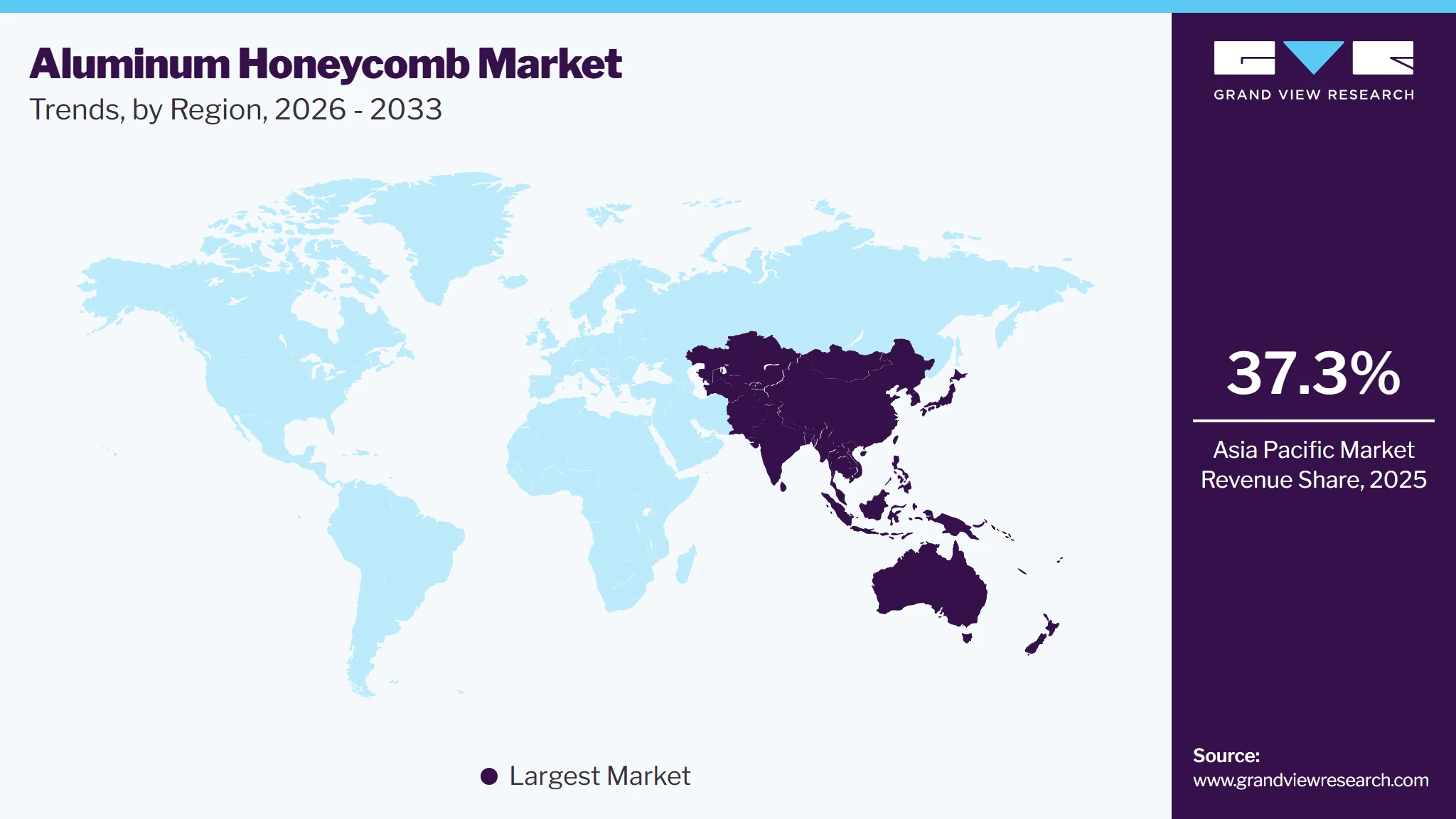
Asia Pacific dominated the aluminum honeycomb market with the largest market revenue share of 37.3% in 2025. Asia Pacific is supported by expanding aerospace production, infrastructure development, and industrialization. China, India, Japan, and South Korea contribute through investments in transportation, advanced manufacturing, and construction. Rising demand for lightweight components is encouraging adoption across multiple industries. Growing aircraft production and infrastructure modernization are expected to create further opportunities.
 To learn more about this report, Download Free Sample Report
China Aluminum Honeycomb Market Trends
The aluminum honeycomb industry in the China held the largest revenue share in 2025. China's demand is supported by expanding aerospace manufacturing, transportation infrastructure, and industrial production. Investments in aircraft development, high-speed rail, and modern construction are creating opportunities for lightweight panel applications. Domestic manufacturing capabilities and industrial expansion further support adoption. Continued infrastructure investment and technological development are expected to contribute to growth.
North America Aluminum Honeycomb Market Trends
North America benefits from established aerospace manufacturing, defense spending, and demand for lightweight structural materials. The region's aircraft manufacturers and composite panel suppliers support the adoption of aluminum honeycomb structures. Applications across transportation, marine, and construction further contribute to demand. Continued investment in aircraft production and infrastructure is expected to support regional growth.
U.S. Aluminum Honeycomb Market Trends
The U.S. is a key contributor, supported by its strong aerospace and defense industries. Aluminum honeycomb structures are used in aircraft interiors, structural components, and specialized transportation applications. Ongoing aircraft production, defense modernization, and demand for fuel-efficient designs are expected to support adoption. Established manufacturing capabilities and technological advancements further strengthen the country's position.
Europe Aluminum Honeycomb Market Trends
Europe benefits from a well-established aerospace industry, automotive manufacturing base, and focus on lightweight engineering materials. Demand is supported by aircraft production, rail transportation, marine applications, and architectural panels. Manufacturers are increasingly emphasizing weight reduction and material efficiency across industrial applications. Continued investment in advanced manufacturing and sustainable transportation is expected to support regional demand.
Latin America Aluminum Honeycomb Market Trends
Latin America benefits from aircraft maintenance activities, infrastructure development, and demand for lightweight transportation components. Brazil contributes through its aerospace manufacturing base and industrial applications. Commercial construction and modernization projects across the region also support the use of honeycomb panels. Further investment in transportation infrastructure and industrial facilities is expected to sustain demand.
Middle East & Africa Aluminum Honeycomb Market Trends
Demand across the Middle East & Africa is supported by infrastructure development, aviation expansion, and commercial construction projects. Saudi Arabia and the UAE contribute through airport development, large-scale infrastructure investments, and modern building projects. Increasing interest in lightweight, durable construction materials is creating additional opportunities. Continued investment in aviation and industrial infrastructure is expected to support regional adoption.
Key Aluminum Honeycomb Company Insights
Some of the key players operating in the market include Alucoil, Corex Honeycomb, and others.
-
Alucoil is headquartered in Miranda de Ebro, Spain. The company manufactures aluminum composite panels and lightweight structural solutions for architectural, transportation, and industrial applications. Its LARCORE product line uses an aluminum honeycomb core bonded between aluminum sheets to provide rigidity and a high strength-to-weight ratio. These panels are used in building facades, transportation, and specialized structural applications.
-
Corex Honeycomb is headquartered in the UK and specializes in honeycomb core materials for composite panel applications. The company supplies lightweight core solutions for transportation, aerospace, marine, and industrial uses. Its products are designed to provide structural strength, rigidity, and weight reduction in sandwich panel constructions. Application-specific solutions support manufacturers requiring lightweight and durable components.
-
EURO-COMPOSITES S.A. was established in 1984 and is headquartered in Echternach, Luxembourg. The company manufactures advanced composite materials, including aluminum honeycomb cores, sandwich panels, and engineered components. Its products serve aerospace, defense, transportation, and industrial applications where low weight, structural strength, and dimensional stability are important. The company also provides customized composite solutions to meet demanding technical and performance requirements.
Key Aluminum Honeycomb Companies
The following key companies have been profiled for this study on the aluminum honeycomb market:
-
Alucoil
-
Corex Honeycomb
-
EconCore N.V.
-
Encocam Ltd.
-
EURO-COMPOSITES S.A.
-
Hexcel Corporation
-
HONYLITE
-
Hunter Douglas
-
Pacific Panels Inc.
-
Plascore Inc.
Competitive Benchmarking
Category
Operating Strategies
Competitive Edge
Weakness
Established Global Players: (Alucoil, Corex Honeycomb, EconCore N.V., Encocam Ltd., EURO-COMPOSITES S.A., Hexcel Corporation, HONYLITE, Hunter Douglas, Pacific Panels Inc., Plascore, Inc.)
- Expand product portfolios across standard and engineered aluminum honeycomb cores and sandwich panels for aerospace, transportation, marine, construction, and industrial applications.
- Invest in advanced manufacturing, automated processing, and customized core designs to improve product quality and performance.
- Strengthen relationships with OEMs, panel fabricators, distributors, and industrial customers through technical support and application-specific solutions.
- Specialized expertise in honeycomb core manufacturing and lightweight sandwich-panel engineering.
- Diverse application exposure supports demand across aerospace, building facades, transportation interiors, marine structures, and industrial equipment.
- Established customer networks and technical capabilities support customized solutions requiring weight reduction, rigidity, and dimensional stability.
- Exposure to fluctuations in aluminum prices, energy costs, and manufacturing expenses can affect profitability.
- Qualification and testing requirements in aerospace and other demanding applications can lengthen product adoption cycles.
- Competition from polymer honeycomb, Nomex honeycomb, and foam cores can limit adoption in price-sensitive or specialized applications.
Regional & Specialized Players: (HONYLITE, Corex Honeycomb, Pacific Panels Inc.)
- Focus on specialized honeycomb cores and panel solutions for selected regional and industrial applications.
- Strengthen customer relationships through localized technical support, customization, and direct engagement with fabricators and end users.
- Develop application-specific products and expand distribution in selected end-use industries and geographic markets.
- Focused product expertise enables solutions tailored to specific customer and application requirements.
- Regional presence can support closer customer coordination and responsive technical service.
- Specialized offerings can address niche applications that require customized panel dimensions or performance characteristics.
- More limited geographic reach can restrict access to large multinational customers and projects.
- Smaller production scale, where applicable, may constrain capacity flexibility and cost competitiveness.
- Concentration in selected applications or regions can increase exposure to fluctuations in local demand.
Recent Development
-
In September 2026, Hexcel Corporation launched an enhanced Vented Flex-Core aluminum honeycomb product for aerospace and space-launch applications. The high-density core combines formability with integrated venting to simplify the manufacture of complex composite structures. The development expands specialized lightweight-core solutions for demanding aerospace applications.
-
In October 2026, Plascore received planning approval for a new manufacturing facility in Zeeland, Michigan, U.S. The proposed 83,500-square-foot facility is expected to create at least 70 jobs and support the company's continued expansion. Plascore manufactures honeycomb cores, panels, and composite structures for aerospace and commercial applications.
-
In February 2026, 3A Composites showcased new panel-material innovations at EuroShop 2026 in Düsseldorf, Germany. The company highlighted developments in its DIBOND aluminum composite panel range, including new surface finishes and design options for retail environments. Although focused on composite panels rather than aluminum honeycomb cores, the announcement reflects ongoing product innovation in lightweight aluminum-based panel solutions.
Aluminum Honeycomb Market Report Scope
Report Attribute
Details
Market definition
The scope includes apparent consumption of aluminum honeycomb across key end-use industries, including aerospace and defense, transportation, marine, construction and architecture, industrial applications, and others.
Market size in 2025
USD 542.7 million
Estimated market size in 2026
USD 586.1 million
Projected market size by 2033
USD 951.7 million
Growth rate
CAGR of 7.2% from 2026 to 2033
Base year for estimation
2025
Historical data
2021 - 2023
Forecast period
2026 - 2033
Quantitative units
Revenue in USD million/billion, volume in Tons, and CAGR from 2026 to 2033
Report coverage
Volume forecast, revenue forecast, competitive landscape, growth factors, and trends
Segments covered
Product, end use, region
Regional scope
North America; Europe; Asia Pacific; Latin America; Middle East & Africa
Country scope
U.S.; Canada; Mexico; Germany; France; Italy; UK; China; India; Japan; South Korea; Brazil; Saudi Arabia; UAE
Key companies profiled
Alucoil; Corex Honeycomb; EconCore N.V.; Encocam Ltd.; EURO-COMPOSITES S.A.; Hexcel Corporation; HONYLITE; Hunter Douglas; Pacific Panels Inc.; Plascore, Inc.
Customization scope
Free report customization (equivalent up to 8 analysts working days) with purchase. Addition or alteration to country, regional & segment scope.
Pricing and purchase options
Avail customized purchase options to meet your exact research needs. Explore purchase options
Global Aluminum Honeycomb Market Report Segmentation
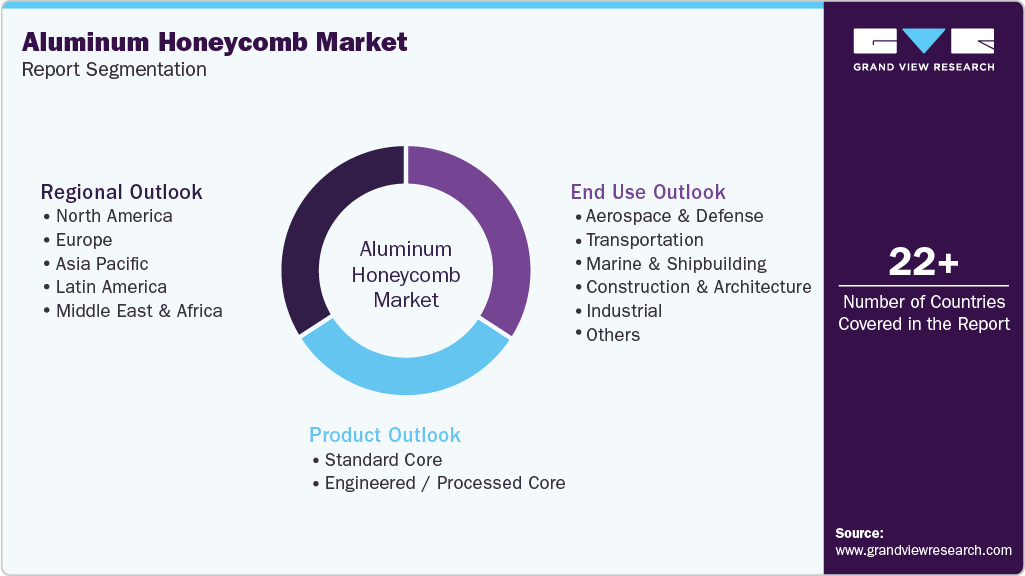
This report forecasts revenue and volume growth at global, regional, and country levels and provides an analysis of the latest industry trends in each of the sub-segments from 2021 to 2033. For this study, Grand View Research has segmented the global aluminum honeycomb market report on the basis of end use, product, and region.
 To learn more about this report, Download Free Sample Report
-
End Use Outlook (Volume, Tons; Revenue, USD Million, 2021-2033)
-
Aerospace & Defense
-
Transportation
-
Marine & Shipbuilding
-
Construction & Architecture
-
Industrial
-
Others
-
-
Product Outlook (Volume, Tons; Revenue, USD Million, 2021-2033)
-
Standard Core
-
Engineered / Processed Core
-
-
Regional Outlook (Volume, Tons; Revenue, USD Million, 2021-2033)
-
North America
-
U.S.
-
Canada
-
Mexico
-
-
Europe
-
Germany
-
UK
-
Italy
-
France
-
-
Asia Pacific
-
China
-
India
-
Japan
-
South Korea
-
-
Latin America
-
Brazil
-
-
Middle East & Africa
-
Saudi Arabia
-
UAE
-
-
Research Methodology
The aluminum honeycomb market figures in this report are based on a proven research process that combines executive interviews with secondary research from proprietary databases, company filings, and recognized regulatory and institutional sources. Market size is built through value-chain sizing—reconciling supply-side and demand-side estimates—and triangulated with bottom-up and top-down approaches. Every estimate passes multiple levels of expert validation before publication, with each aluminum honeycomb segment quantified using the revenue-capture definitions in the table below.
Segment Definition
End Use
Revenue Capture Definition
Aerospace & Defense
Revenue is captured from aluminum honeycomb cores and panels used in aircraft interiors, flooring, cargo systems, structural components, military aircraft, and defense equipment. Applications requiring lightweight construction, high stiffness, and structural performance are included.
Transportation
Revenue is captured from aluminum honeycomb products used in rail interiors, automotive components, commercial vehicles, and other transportation systems. Applications include lightweight flooring, partitions, interior panels, and structural assemblies designed to reduce weight and improve energy efficiency.
Marine & Shipbuilding
Revenue is captured from aluminum honeycomb cores and panels used in ship interiors, bulkheads, doors, ceilings, flooring, and lightweight marine structures. Applications requiring corrosion resistance, structural rigidity, and reduced vessel weight are included.
Construction & Architecture
Revenue is captured from aluminum honeycomb cores and panels used in building facades, wall cladding, ceilings, partitions, doors, roofing systems, and architectural installations. Demand for lightweight, rigid, and dimensionally stable building materials is included.
Industrial
Revenue is captured from aluminum honeycomb products used in industrial machinery, equipment enclosures, cleanroom panels, tooling fixtures, modular structures, and specialized industrial components. Applications requiring structural stability, lightweight construction, and precision engineering are included.
Others
Includes revenue from aluminum honeycomb consumption in applications not covered by the above categories, such as specialized furniture, display systems, recreational products, and other niche applications. Only products and panels incorporating aluminum honeycomb cores are included.
Product
Revenue Capture Definition
Standard Core
Revenue is captured from conventional aluminum honeycomb cores manufactured to standard specifications for cell size, foil thickness, density, and dimensions. These products are used in general-purpose sandwich panels and applications where standardized structural performance and cost efficiency are key requirements.
Engineered / Processed Core
Revenue is captured from customized, precision-processed, or application-specific aluminum honeycomb cores designed to meet performance and manufacturing requirements. This includes cores with specialized cell configurations, densities, thicknesses, shapes, perforations, or machining and processing, where these features provide tailored structural performance or facilitate integration into finished panels.
Estimation Model
Layer No.
Layer Name
Key Question
Description
01
Addressable Industrial Production Base Layer
What is the potential demand base for aluminum honeycomb?
Quantify the production and operating base of major aluminum honeycomb-consuming industries, including aerospace and defense, transportation, marine and shipbuilding, construction and architecture, and industrial applications. Assess production volumes, operating capacity, manufacturing activity, utilization rates, and new capacity additions to establish the addressable demand base.
02
Aluminum Honeycomb Consumption Intensity Layer
How much aluminum honeycomb is consumed per unit of industrial output?
Establish industry- and application-specific consumption coefficients, expressed in tons of aluminum honeycomb per relevant unit of output or installed capacity. Account for differences in product specifications, panel dimensions, core density, cell size, material thickness, design requirements, replacement cycles, and manufacturing processes.
03
Aluminum Honeycomb Demand Layer
What quantity of aluminum honeycomb is required?
Calculate annual aluminum honeycomb demand by applying the relevant consumption intensity to the corresponding industrial production base. Incorporate requirements from new manufacturing capacity, ongoing production, maintenance, replacement, and infrastructure development, where applicable. Quantify demand in tons and segment it by product type, end use, and region..
04
Pricing & Revenue Layer
What is the monetary value of aluminum honeycomb demand?
Estimate revenue by multiplying calculated consumption volumes by applicable average selling prices (ASP). Differentiate pricing by standard and engineered/processed cores, alloy grade, cell size, foil thickness, density, processing requirements, and application. Incorporate regional price variations, import/export unit values, aluminum input costs, and manufacturing expenses to derive representative revenue estimates.
Delivered Customizations
We have successfully delivered the following deep-dive customizations:
Client Request
Customization Delivered
Value Adds
Aluminum Honeycomb Pricing Benchmarking
Comparison of indicative pricing across standard and engineered/processed cores based on cell size, foil thickness, density, alloy grade, and application requirements, subject to data availability.
Identifies product-level price differences, cost drivers, and potential pricing strategies.
Raw Material Cost & Profitability Analysis
Assessment of aluminum foil costs, alloy availability, energy consumption, processing requirements, and other major manufacturing inputs.
Evaluates cost sensitivities, input-price risks, and opportunities to improve production economics.
Substitute Materials & Comparative Assessment
Comparison of aluminum honeycomb with Nomex honeycomb, polymer honeycomb, foam cores, and other sandwich-panel core materials across relevant applications.
Evaluates substitution risks, relative performance, cost considerations, and applications where aluminum honeycomb has competitive advantages.
Frequently Asked Questions About This Report
Asia Pacific dominated the aluminum honeycomb market with the largest market revenue share of 37.3% in 2025.
The growth of the global aluminum honeycomb market is primarily driven by increasing demand for lightweight, high-strength materials across aerospace and defense, transportation, construction, marine, and industrial applications.
Some of the key players of the global aluminum honeycomb market are Alucoil, Corex Honeycomb, EconCore N.V., Encocam Ltd., EURO-COMPOSITES S.A., Hexcel Corporation, HONYLITE, Hunter Douglas, Pacific Panels Inc., Plascore, Inc., and others.
The aluminum honeycomb market in China held the largest share in the Asia Pacific region in 2025.
Engineered / processed core accounted for the largest share of the global aluminum honeycomb market in 2025, representing 54.3% of revenue.
The global aluminum honeycomb market size was valued at USD 542.7 million in 2025 and is estimated to reach USD 586.1 million in 2026.
The global aluminum honeycomb market is expected to grow at a CAGR of 7.2% from 2026 to 2033, reaching USD 951.7 million by 2033.
Aerospace & defense accounted for the largest market revenue share of 37.1% in 2025 while industrial segment is the fastest-growing segment.
About the Author(s)
Advanced Interior Materials Research Team
Advanced Materials · Advanced Interior MaterialsThis report was authored by the advanced interior materials research team at Grand View Research - comprising two research analysts, one senior research analyst, and one industry expert - with specialized expertise in the advanced interior materials segment of the advanced materials industry. All findings are based on proprietary advanced materials databases, executive interviews, and regulatory analysis, subject to internal peer review prior to publication.
Last Updated:
Speak to Analyst

Customize this report to your needs - add regions, segments, or data points, with 20% free customization.
Or view our licence options:


ISO 9001:2015 & 27001:2022 Certified
We are GDPR and CCPA compliant! Your transaction & personal information is safe and secure. For more details, please read our privacy policy.


