
- Home
- »
- Clothing, Footwear & Accessories
- »
-
Anti-fatigue Mats Market Size & Share Report, 2026-2033GVR Report cover

Anti-fatigue Mats Market (2026 - 2033)
Size, Share & Trends Analysis Report By Application (Industrial, Commercial, Residential), By Distribution Channel (Offline, Online), By Region (Asia Pacific, North America, Europe), And Segment Forecasts
Market Size, 2025
$2.0BMarket Estimate, 2026
$2.1BMarket Forecast, 2033
$2.8BCAGR, 2026–2033
4.6%Anti-fatigue Mats Market Summary
The global anti-fatigue mats market size was valued at USD 2.0 billion in 2025 and is projected to grow from USD 2.1 billion in 2026 to USD 2.8 billion in 2033, at a CAGR of 4.6% from 2026 to 2033. North America dominated the global market, accounting for the largest revenue share of 40.0%% in 2025. Hectic work hours and changing diet patterns among working-class professionals at the international level have led to foot problems and lower limb issues among personnel who stand for long periods. As a result, anti-fatigue mats can absorb shock during walking and ease foot fatigue.
Key Market Trends & Insights
- By application: Industrial segment held the market share of over 50.0% in 2025.
- By distribution channel: Sales through the online channel are expected to grow at the fastest CAGR from 2026 to 2033.
Regional Highlights
- Largest regional market: North America (nearly 40.0% revenue share, 2025)
- Fastest-growing regional market: Asia Pacific (highest CAGR, 2026-2033)
Market Size & Forecast
- Market Size in 2025: USD 2.0 Billion
- Estimated Market Size in 2026: USD 2.1 Billion
- Projected Market Size by 2033: USD 2.8 Billion
- CAGR (2026-2033): 4.6%
Three ways to get this report
Buy it, customize it, or ask a question.Ask an Analyst
Analyst response in 1 business day
- AccessReport author, directly
- Reply timeWithin 1 working day
- No sales callDirect answer only
- FormatEmail reply
- CostFree, no cost
Get the Full Report
What the study covers
- FormatsPDF · Excel · Dashboard
- Timeline2026–2033 annual, 2025 base
- Coverage20+ countries, 5 regions
- Companies10+ key players profiled
Customize the Report
20% free customization
- IncludeCountries, segments, points
- TailorTo your product definition
- ExtendDeeper competitor detail
- OrA fully bespoke study
- Turnaround5–10 working days
The rise in popularity of sit-stand desks in developed countries, including the U.S., Germany, France, and the UK, is driving companies to install anti-fatigue mats.
Time spent sitting or standing is associated with negative health outcomes. To avoid this, several businesses are using active workstations and standing desks that allow employees to seamlessly switch from sitting to standing. With business expansion and changing industries, workplaces are evolving, and businesses are spending heavily on infrastructure development to provide safe working environments for their personnel. Globally, the manufacturing industry is growing. Long-term employment in the manufacturing industry causes a slew of health problems for workers and reduces quality and output. One of the market's driving forces is the need for ergonomic items such as anti-fatigue mats. Owing to the introduction of portable workstations worldwide, the need to reduce slip-and-fall incidents has grown.
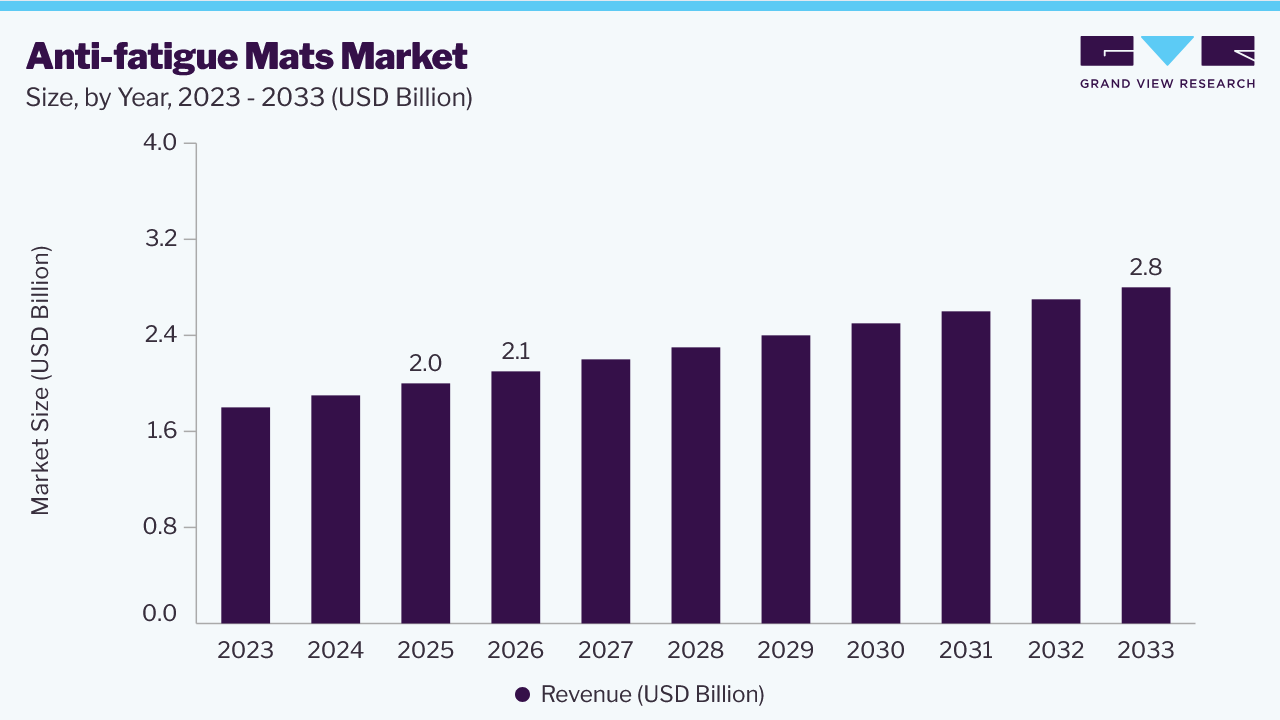 Source: Grand View Research, IR Documents, Primary Interviews, Paid DatabasesTo learn more about this report,
 Download Free Sample Report
People began visiting commercial establishments such as hotels, schools, universities, and sports facilities as vaccination programs continued and travel restrictions were lifted. Over the forecast period, the global market is likely to be driven by the growth of online retail worldwide, key player initiatives in product development and innovation, and the work-from-home culture, which is resulting in longer working hours. The new work-from-home culture is expected to create major opportunities for market participants to expand their presence in the residential sector globally.
Safety bodies, including the Occupational Safety and Health Administration (OSHA), have implemented policies to reduce the rising number of workstation accidents by deploying various types of office safety equipment. Additionally, the manufacturing units are installed to prevent falls and enhance employee safety, which will promote the use of anti-fatigue mats in the coming years. The anti-fatigue mats should be made from high-quality materials to provide a firm grip for the end user and reduce foot discomfort. Anti-fatigue mats that are too soft or of poor quality may cause slipping or falling, hindering the global market and limiting consumer adoption.
Physical issues caused by the prolonged pervasiveness of occupation-related diseases have been growing daily. Anti-fatigue mat demand is growing as the number of foot and lower limb illnesses among laborers who remain in one position for long periods increases. Furthermore, an anti-fatigue mat is used in restaurants and hotels where kitchen staff stand for longer periods during baking, dishwashing, and cooking. Moreover, anti-fatigue mats are used in laundry, bathrooms, home offices, and garages. The growing use of anti-fatigue mats in the above-mentioned spaces worldwide is likely to expand market reach over the forecast period.
Market Dynamics
The anti-fatigue mats market is growing as awareness of workplace comfort, safety, and employee well-being increases. Companies across industries such as manufacturing, healthcare, retail, and hospitality are adopting anti-fatigue mats to reduce discomfort and fatigue caused by prolonged standing. Product improvements, including anti-slip and antimicrobial features, are supporting demand. However, the availability of low-cost alternatives and the presence of price-sensitive customers may pose a challenge for companies. Furthermore, increasing investments in workplace safety and employee health are expected to create strong growth opportunities for the market over the forecast period.
The anti-fatigue mats market is driven by growing investments in workplace safety and ergonomic infrastructure across industrial, warehousing, healthcare, and commercial sectors. Employers are increasingly recognizing the impact of prolonged standing on employee health, productivity, and absenteeism. Anti-fatigue mats help reduce pressure on the feet, knees, and lower back by promoting subtle muscle movements and improving circulation. The expansion of manufacturing facilities, logistics hubs, and distribution centers worldwide has further increased demand for ergonomic flooring solutions. In addition, stricter occupational safety standards and corporate wellness initiatives are encouraging organizations to invest in products that improve employee comfort and reduce workplace injuries. Companies are introducing advanced matting solutions featuring anti-slip surfaces, drainage capabilities, and enhanced durability for demanding work environments. For instance, in August 2025, Groundwork Mats announced its nationwide expansion across the U.S., launching its performance flooring and anti-fatigue mat solutions into industrial, retail, gym, and workspace applications. Such developments highlight the role of comfort flooring in improving safety, productivity, and employee wellness, reflecting the growing adoption of ergonomic matting solutions across workplaces. Furthermore, organizations are seeking durable products with longer service life to reduce maintenance costs and support environmental goals.
A key challenge for the anti-fatigue mats market is the increasing availability of alternative ergonomic solutions, including ergonomic footwear, cushioned insoles, adjustable workstations, and advanced flooring systems. Many organizations evaluate these alternatives alongside anti-fatigue mats when allocating workplace wellness budgets. In addition, the upfront cost of premium anti-fatigue mats can discourage adoption among small businesses and cost-sensitive end users, particularly in developing markets. Budget constraints often lead to delayed replacement cycles or the selection of lower-cost flooring products that offer fewer ergonomic benefits. Furthermore, anti-fatigue mats require periodic maintenance and replacement due to wear and tear in high-traffic environments, adding to long-term ownership costs. These factors can hinder broader market penetration despite growing awareness of ergonomic workplace practices. The growing adoption of ergonomic seating and posture-support products illustrates the increasing competition for workplace wellness spending, which can divert investments away from anti-fatigue flooring products.
The increasing integration of workplace wellness initiatives into facility design presents a significant opportunity for the anti-fatigue mats market. Organizations are moving beyond basic safety requirements and incorporating employee comfort, productivity, and well-being into workplace planning. This trend is particularly evident in commercial buildings, healthcare facilities, educational institutions, retail spaces, and industrial plants where employees spend extended periods standing. Demand is also rising for sustainable, aesthetically appealing, and application-specific flooring solutions that combine ergonomic benefits with modern design requirements. As companies continue to renovate and upgrade workspaces, anti-fatigue mat manufacturers have opportunities to expand their product portfolios and penetrate new end-use sectors. For instance, in October 2025, Gerflor Group acquired Matter Surfaces, a leading U.S. provider of commercial flooring and entrance surface solutions. Such acquisition strengthens the company presence in commercial flooring markets. It reflects increasing investment in advanced workplace surface solutions, creating opportunities for ergonomic and anti-fatigue flooring products within broader commercial infrastructure projects.
Analyst Perspective
The anti-fatigue mats market is expected to grow steadily as awareness of workplace ergonomics, employee comfort, and occupational safety increases. Rising adoption across manufacturing, warehousing, healthcare, retail, and commercial sectors is supporting demand for these products. Employers are investing in anti-fatigue mats to reduce worker fatigue, improve productivity, and minimize the risk of musculoskeletal disorders caused by prolonged standing. Ongoing product innovations, such as anti-slip, antimicrobial, and durable mat designs, are enhancing market growth.
Application Insights
The industrial segment accounted for over 50.0% share of the global market in 2025. Long-standing working hours on shop floors in the manufacturing sector have increased the incidence of various problems, including foot problems, joint pain, and circulatory diseases. As a result, industrial units have installed anti-fatigue mats as a preventive measure to reduce the incidence of these diseases among employees. Manufacturing companies and other businesses have begun using anti-fatigue mats on their premises to create more pleasant workspaces and reduce worker fatigue. Anti-fatigue mats used in conjunction with sit-stand workstations provide significant relief for individuals who work at these desks for extended periods. Thus, the industrial segment is expected to witness exponential demand for anti-fatigue mats in the coming years.
The commercial segment is expected to grow significantly over the forecast period. Key players are also launching new products in this segment to surge their market share. For instance, in March 2025, Kite Packaging launched anti-fatigue mats designed for industrial and commercial workplaces. It provides cushioning and support and reduces strain on employees. Key players in the global market are heavily investing in product innovation and conducting research and development to deliver higher-quality, novel products that meet customer demand while competing with rivals’ offerings. Key companies have developed anti-fatigue mats in various forms and designs for use across sectors, such as rubber and PVC foamed mats for commercial applications, thereby driving market growth.
Distribution Channel Insights
Sales through the offline channel accounted for approximately 80.0% in 2025. Consumers choose to buy anti-fatigue mats from local shops and supermarkets, which offer physical verification of the product. Thus, a buyer can understand and experience the product features and comfort in these stores. In addition, these stores offer suitable discounts on bulk product buying from production units and corporate companies. Moreover, these stores also install anti-fatigue mats and offer after-sales support in case of any issues with their use.
The sales through the online channel are expected to grow at a significant CAGR over the forecast period from 2026 to 2033. E-commerce retailers offer various promotional offers to buyers, driving segment growth. Buyers are drawn to online channels by member benefits, discounts, and cashback offers. It has been observed that manufacturing units in advanced countries such as the U.S., the UK, and Germany prefer to make bulk purchases through online channels due to the ease of product selection. B2B online sellers such as Alibaba, eBay, Amazon, and IndiaMART are offering attractive discounts and money-back guarantees to consumers for bulk purchases. Furthermore, the increasing adoption of smartphones among millennials is expected to have a profound impact on the global market in the coming years.
Regional Insights
North America accounted for approximately 40.0% market share in 2025 and is anticipated to witness substantial growth over the forecast period. The development of the market is credited to the presence of a large number of corporate and manufacturing units, along with the strong enforcement of safety standards by the government and industry associations. Large healthcare spending in the U.S. is driving people to embrace healthy lifestyles at home and in the workplace to avoid massive treatment costs. Also, a growing number of employees experiencing limb issues and joint soreness due to hectic work hours in companies will increase demand for anti-fatigue mats over the forecast period.
 To learn more about this report, Download Free Sample Report
Asia Pacific Anti-fatigue Mats Market Trends
The Asia Pacific is expected to witness significant growth over the forecast period. The development of the manufacturing industry will lead to increased sales of anti-fatigue mats to enhance worker safety. Moreover, the growing disposable income of the young working population in emerging countries such as China, India, South Korea, and Bangladesh is likely to open up new market opportunities for companies to expand their product portfolios and consumer bases.
Europe Anti-fatigue Mats Market Trends
Europe is expected to see significant growth, driven by growing awareness of the health risks associated with extended hours spent standing on rough, hard surfaces. Anti-Fatigue mats are most popular in the UK and France. They are expected to become more popular as they are promoted as safe and productive accessories for the residential and commercial environment. During the forecast period, the regional industrial sector is likely to dominate the market, followed by the commercial sector.
Key Anti-fatigue Mats Company Insights
Several players operating in the market are working on new product launches to increase their market revenue. As most nations remain largely undiscovered, several leading anti-fatigue mat manufacturers are focusing their efforts on emerging regions. Furthermore, the growth of automation and the manufacturing industry is expected to offer companies major expansion opportunities.
-
In April 2025, Wearwell expanded its portfolio by introducing 8 new additions to its 24/Seven LockSafe product line, featuring ergonomic comfort and anti-slip technology options.
-
In June 2024, Wearwell LLC entered into a strategic partnership with Euzkola S.R.L. de C.V. to establish a joint venture, Euzkalgoma S.R.L. de C.V. The collaboration combines Wearwell’s anti-fatigue matting and ergonomic flooring portfolio with Euzkola’s rubber manufacturing expertise.
Key Anti-fatigue Mats Companies
The following key companies have been profiled for this study on the anti-fatigue mats market
-
NoTrax
-
3M
-
Wearwell LLC
-
WellnessMats
-
Durable Corporation
-
Cintas Corporation
-
Euronics Industries Pvt Ltd.
-
M+A Matting
-
SmartCells Cushioning Technology
-
UniFirst Corporation
Anti-fatigue Mats Market Report Scope
Report Attribute
Details
Market size in 2025
USD 2.0 billion
Estimated market size in 2026
USD 2.1 billion
Projected market size by 2033
USD 2.8 billion
Growth rate
CAGR of 4.6% from 2026 to 2033
Base year for estimation
2025
Historical data
2021 - 2024
Forecast period
2026 - 2033
Quantitative units
Revenue in USD billion, and CAGR from 2026 to 2033
Report coverage
Revenue forecast, company ranking, competitive landscape, growth factors, and trends
Segments covered
Application, distribution channel, region
Regional scope
North America; Europe; Asia Pacific; Central & South America; Middle East & Africa
Country scope
U.S.; Canada; Mexico; UK; Germany; France; Italy; Spain; China; India; Japan; South Korea; Australia; South Africa; Brazil
Key companies profiled
NoTrax; 3M; Wearwell LLC; WellnessMats; Durable Corporation; Cintas Corporation; Euronics Industries Pvt Ltd.; M+A Matting; SmartCells Cushioning Technology; UniFirst Corporation
Customization scope
Free report customization (equivalent up to 8 analysts working days) with purchase. Addition or alteration to country, regional & segment scope.
Pricing and purchase options
Avail of customized purchase options to meet your exact research needs. Explore purchase options
Global Anti-fatigue Mats Market Segmentation
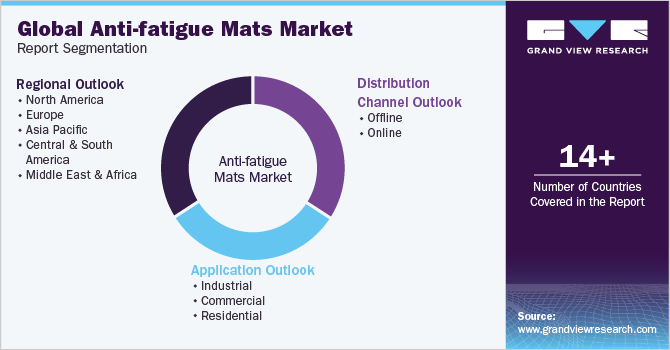
This report forecasts revenue growth at global, regional & country levels and provides an analysis of the latest trends and opportunities in each of the sub-segment from 2021 to 2033. For this study, Grand View Research has segmented the global anti-fatigue mats market on the basis of application, distribution channel, and region.
 To learn more about this report, Download Free Sample Report
-
Application Outlook (Revenue, USD Billion, 2021 - 2033)
-
Industrial
-
Commercial
-
Residential
-
-
Distribution Channel Outlook (Revenue, USD Billion, 2021 - 2033)
-
Offline
-
Online
-
-
Regional Outlook (Revenue, USD Billion, 2021 - 2033)
-
North America
-
U.S.
-
Canada
-
Mexico
-
-
Europe
-
U.K.
-
Germany
-
France
-
Italy
-
Spain
-
-
Asia Pacific
-
China
-
India
-
Japan
-
Australia
-
South Korea
-
-
Central & South America
-
Brazil
-
-
Middle East & Africa
-
South Africa
-
-
Frequently Asked Questions About This Report
The global anti-fatigue mats market size was valued at USD 2.0 billion in 2025 and is estimated to grow from USD 2.1 billion in 2026.
The global anti-fatigue mats market is expected to grow at a CAGR of 4.6% from 2026 to 2033, reaching USD 2.8 billion by 2033.
North America dominated with a revenue share of 40.0% in 2025.
Some key players operating in the anti-fatigue mats market include NoTrax; 3M; Unifirst; Wearwell, LLC; Smart Step Flooring; COBA Europe Ltd.; Mountville Mills, Inc.; Euronics Industries Pvt Ltd.; M+A Matting; and SmartCells USA.
Sales through the online channel are expected to grow at the fastest CAGR from 2026 to 2033.
About the Author(s)
Clothing, Footwear & Accessories Research Team
Consumer Goods · Clothing, Footwear & AccessoriesThis report was authored by the clothing, footwear & accessories research team at Grand View Research - comprising two research analysts, one senior research analyst, and one industry expert - with specialized expertise in the clothing, footwear & accessories segment of the consumer goods industry. All findings are based on proprietary consumer goods databases, executive interviews, and regulatory analysis, subject to internal peer review prior to publication.
Last Updated:
Speak to Analyst

Customize this report to your needs - add regions, segments, or data points, with 20% free customization.
Or view our licence options:


ISO 9001:2015 & 27001:2022 Certified
We are GDPR and CCPA compliant! Your transaction & personal information is safe and secure. For more details, please read our privacy policy.


