
- Home
- »
- Clothing, Footwear & Accessories
- »
-
Apparel Market Size, Share & Trends Report, 2026-2033GVR Report cover

Apparel Market (2026 - 2033)
Size, Share & Trends Analysis Report By Category (Mass, Premium, Luxury), By End-use (Men, Women, Children), By Distribution Channel (Offline, Online), By Region, And Segment Forecasts
Market Size, 2025
$1.8TMarket Estimate, 2026
$1.9TMarket Forecast, 2033
$2.5TCAGR, 2026–2033
4.1%Apparel Market Summary
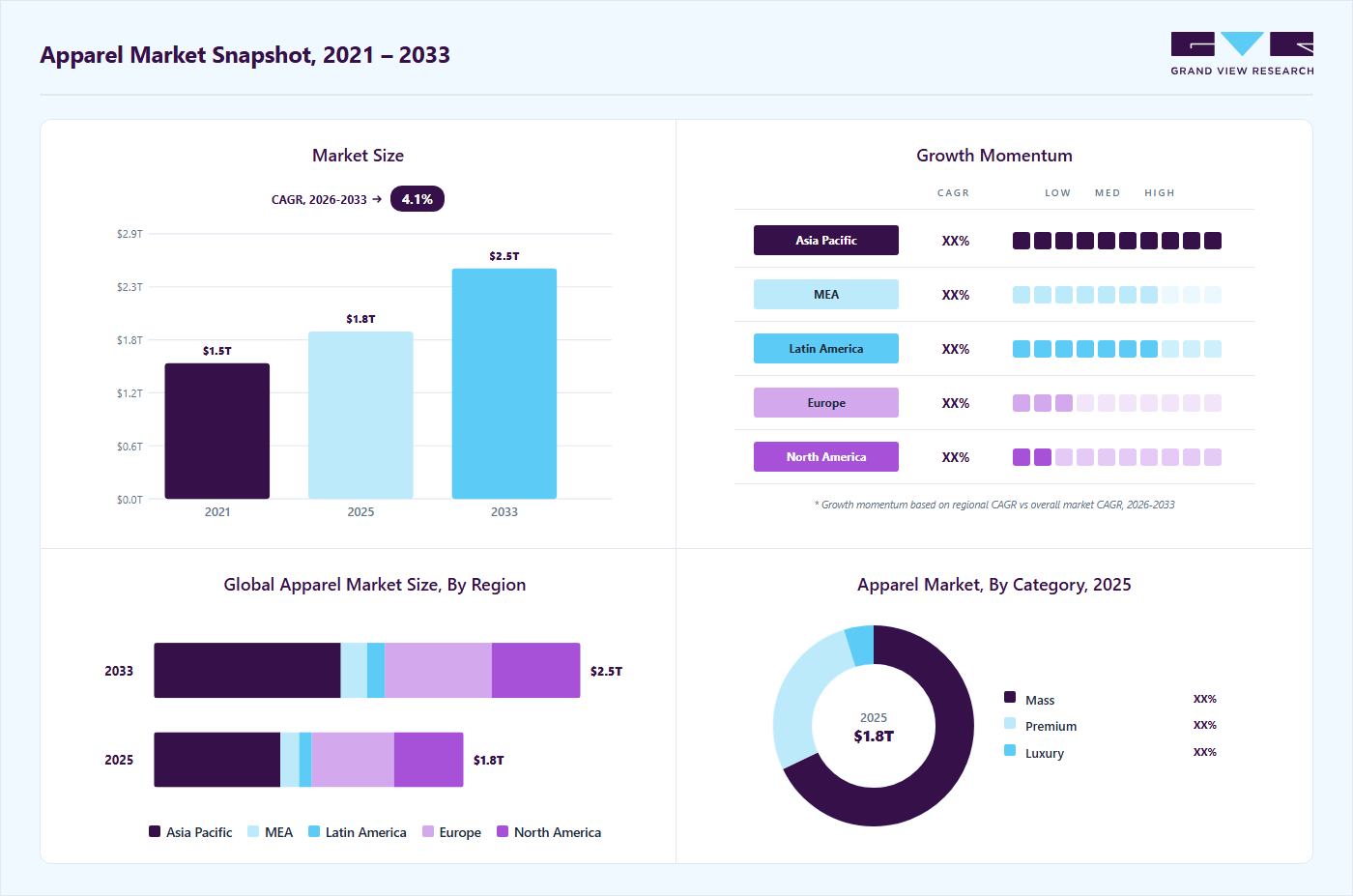
The global apparel market size was valued at USD 1.8 trillion in 2025 and is projected to grow from USD 1.9 trillion in 2026 to USD 2.5 trillion by 2033, at a CAGR of 4.1% from 2026 to 2033. Asia Pacific dominated the market with the largest revenue share of 40.8% the global market in 2025. The increasing expenditure on apparel by customers worldwide is a key factor driving the market growth.
 Source: Grand View Research, IR Documents, Primary Interviews, Paid DatabasesTo learn more about this report,
 Download Free Sample Report
 Key Market Trends & Insights
- By category: The mass apparel segment held the largest market share of 67.8% in 2025.
- By end use: The women segment held the largest market share of 51.4% in 2025.
- By distribution channel: The offline segment held the largest market share of around 78.3% in 2025.
Regional Highlights
- Largest regional market: Asia Pacific (40.8% revenue share, 2025)
- Fastest-growing regional market: Asia Pacific (highest CAGR, 2026-2033)
- By country: China held the largest market share in 2025.
Market Size & Forecast
- Market size in 2025: USD 1.8 Trillion
- Estimated market size in 2026: USD 1.9 Trillion
- Projected market size by 2033: USD 2.5 Trillion
- CAGR (2026-2033): 4.1%
Three ways to get this report
Buy it, customize it, or ask a question.Ask an Analyst
Analyst response in 1 business day
- AccessReport author, directly
- Reply timeWithin 1 working day
- No sales callDirect answer only
- FormatEmail reply
- CostFree, no cost
Get the Full Report
What the study covers
- FormatsPDF · Excel · Dashboard
- Timeline2026–2033 annual, 2025 base
- Coverage20+ countries, 5 regions
- Companies10+ key players profiled
Customize the Report
20% free customization
- IncludeCountries, segments, points
- TailorTo your product definition
- ExtendDeeper competitor detail
- OrA fully bespoke study
- Turnaround5–10 working days
According to the U.S. Bureau of Labor Statistics, in 2023, the average annual per household expenditure for women’s apparel was approximately USD 655, and USD 406 for men’s apparel, reflecting steady demand across the men’s clothing market and broader men’s wear market. Availability of products through online distribution, increasing market penetration of e-commerce websites, and a large number of collections launched by key market players are anticipated to drive further growth over the forecast period, particularly within the online apparel market and online clothing market.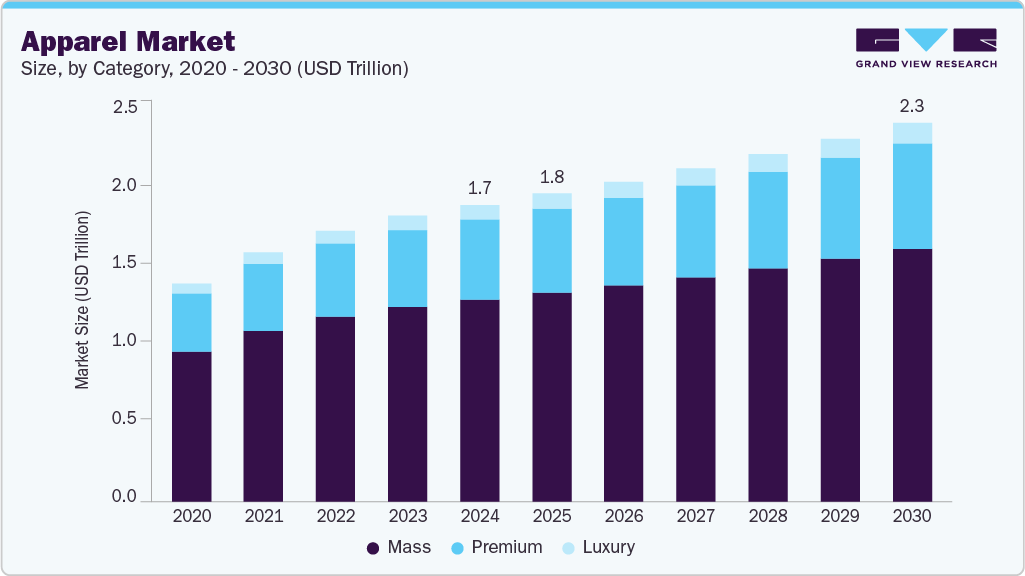 To learn more about this report, Download Free Sample Report
 In addition, the increasing disposable income among consumers in emerging economies is significantly driving the global clothing market. Emerging economies such as China, India, Brazil, and others are experiencing rapid urbanization, industrialization, and economic growth, enabling the middle class with higher purchasing power. This demographic shift is fueling a surge in demand for clothing and accessories as consumers seek to upgrade their wardrobes, follow fashion trends, and improve their lifestyles, strengthening the global apparel retail market.
Growing consumer demand for sustainable and environmentally friendly products, including apparel, is likely to develop growth trends for this market. According to the YouGov PLC data published in November 2024, about 14% of U.S. Gen Z consumers consider sustainable clothing and production practices as a purchasing factor. Consumers have become conscious of the environmental impact of consumption patterns and materials used in manufacturing, influencing purchase behavior across the garments market. As a result, they are actively seeking out clothing that is sustainably and ethically produced, utilizing eco-friendly materials such as organic cotton, recycled fabrics, and other innovative alternatives. Consumers are urging brands to adopt transparent supply chains, minimize waste, and enforce fair labor practices to meet this demand.
Over the past decade, the apparel industry has witnessed a significant trend related to the emergence of Direct-to-Consumer (D2C) brands. These brands sell their products directly to consumers, eliminating traditional intermediaries, including wholesalers, retailers, or distributors. With the increasing digitalization and prevalence of e-commerce, D2C brands have found favorable conditions to thrive and reshape the online clothing market. Offering competitive pricing, enhanced customer experiences, and customized products and services tailored to individual preferences, D2C brands have garnered significant attention and consumer loyalty within the apparel retail market.
The apparel accessories market, apparel retail market, fashion ecommerce industry, and intimate apparel market are being driven by digital-first consumer behavior, rising fashion consciousness, premiumization, social media influence, and rapid omnichannel expansion, while key trends include personalization, sustainable materials, direct-to-consumer models, fast fashion cycles, and increasing demand for comfort-led and inclusive intimate apparel designs.
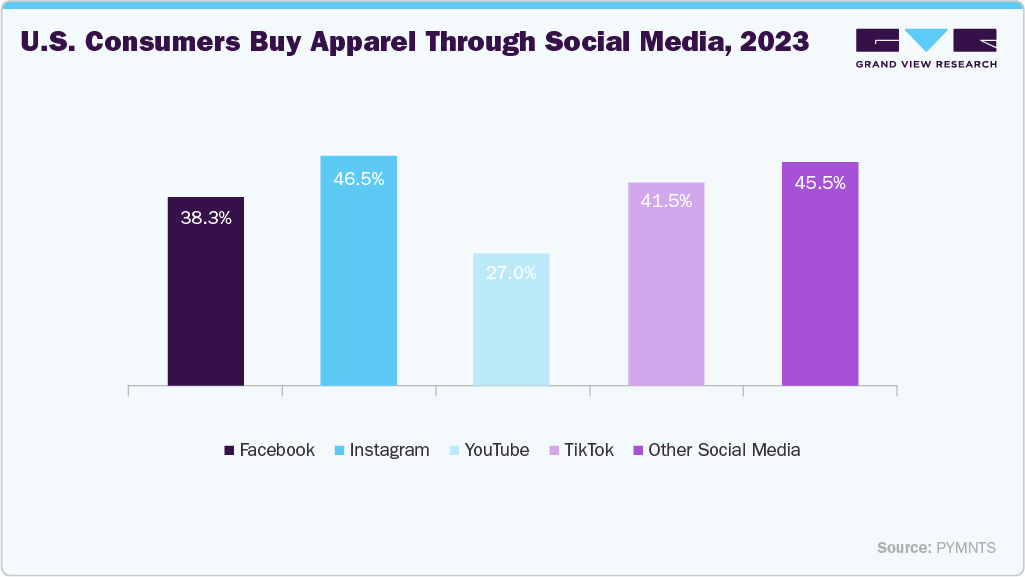
Social media has greatly influenced fashion preferences, shaping consumer choices and shopping preferences. According to data published in November 2023, approximately 40% of consumers use social media feeds to find products, reinforcing the role of digital discovery in the online apparel market. Through platforms such as Instagram and Facebook, consumers across the globe have easy access to a wide range of fashion content posted by influencers, bloggers, and celebrities. This enhanced accessibility has sparked a growing interest in exploring various styles and experimenting with new looks among consumers, influencing trends across both women’s apparel and the men’s clothing market.
 To learn more about this report, Download Free Sample Report
 Moreover, innovations in various processes, including manufacturing, designing, display, and distribution, are projected to influence the growth of this market. In recent years, technology advancements have enabled key players to adopt practices that ensure improved brand visibility, enhanced customer engagement, and increased customer interactions. For instance, in June 2023, Google launched virtual try-ons powered by a new AI shopping feature for various women’s apparel brands. Such advancements are expected to facilitate growth in customer engagement across the global apparel retail market over the forecast period.
Market Dynamics
The apparel market is being strongly supported by the expansion of private labels and retailer-owned fashion collections across mass, premium, and value-oriented segments. Large retailers, department stores, fashion chains, and online marketplaces are increasingly launching in-house apparel brands to improve margins, control pricing, and reduce dependency on third-party brands. These collections allow retailers to respond faster to shifting consumer preferences across casual wear, activewear, basics, ethnic wear, children’s clothing, and seasonal fashion. By using store-level sales data, online browsing behavior, loyalty programs, and regional demand insights, retailers can design apparel assortments that are more closely aligned with consumer needs. Private labels also offer differentiated products at competitive prices, which strengthens customer retention and supports higher purchase frequency in the apparel market.
A major restraint for the apparel market is the rising volume of product returns, particularly across online apparel sales. Apparel purchases are highly dependent on fit, size accuracy, fabric feel, color perception, styling, and body-shape compatibility, which are difficult to evaluate through digital channels alone. As consumers increasingly shop online, a mismatch between product expectations and actual delivery often leads to frequent returns, exchanges, refund claims, and reverse logistics costs. This directly affects retailer margins, inventory planning, and warehouse efficiency, especially for fast-moving seasonal collections. Returned apparel may also require repackaging, discounting, quality checks, or liquidation, increasing operational complexity. The issue is further intensified by consumer expectations for free returns and quick refunds, making online growth less profitable for many apparel retailers.
Brand Share Analysis
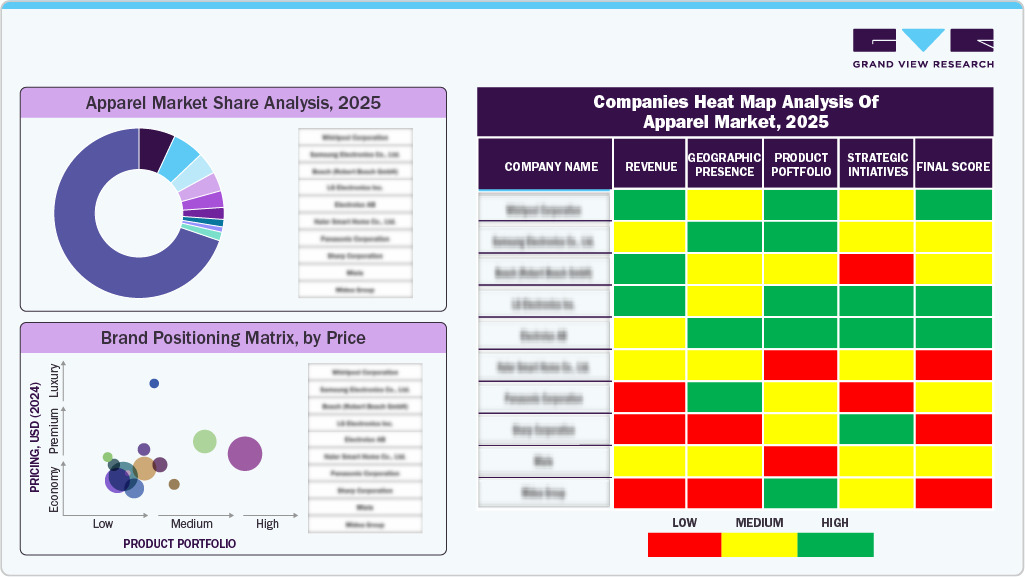
The global apparel industry is characterized by a mix of long-established heritage brands, premium and luxury fashion houses, mass-market leaders, and fast-growing regional and digital-native players competing across a wide range of consumer segments and price points.
 To learn more about this report, Download Free Sample Report
 Established players such as Nike, Adidas, Levi’s, Zara (Inditex), H&M, and Ralph Lauren dominate key segments of the global apparel market through strong brand equity, extensive product portfolios, and expansive global retail and supply-chain networks. These brands benefit from high brand recognition, consistent product innovation, effective marketing, and a strong presence across major apparel markets in North America, Europe, and East Asia.
Mid-premium and branded mass-market players, including Uniqlo (Fast Retailing), Gap, American Eagle, and Marks & Spencer, command significant market share by offering affordable quality, trend-responsive designs, and broad distribution across physical stores and e-commerce platforms. Their emphasis on value-for-money, frequent collection refreshes, and omnichannel accessibility resonates strongly with young professionals and family-oriented consumers.
Consumer Insights for Apparel Market
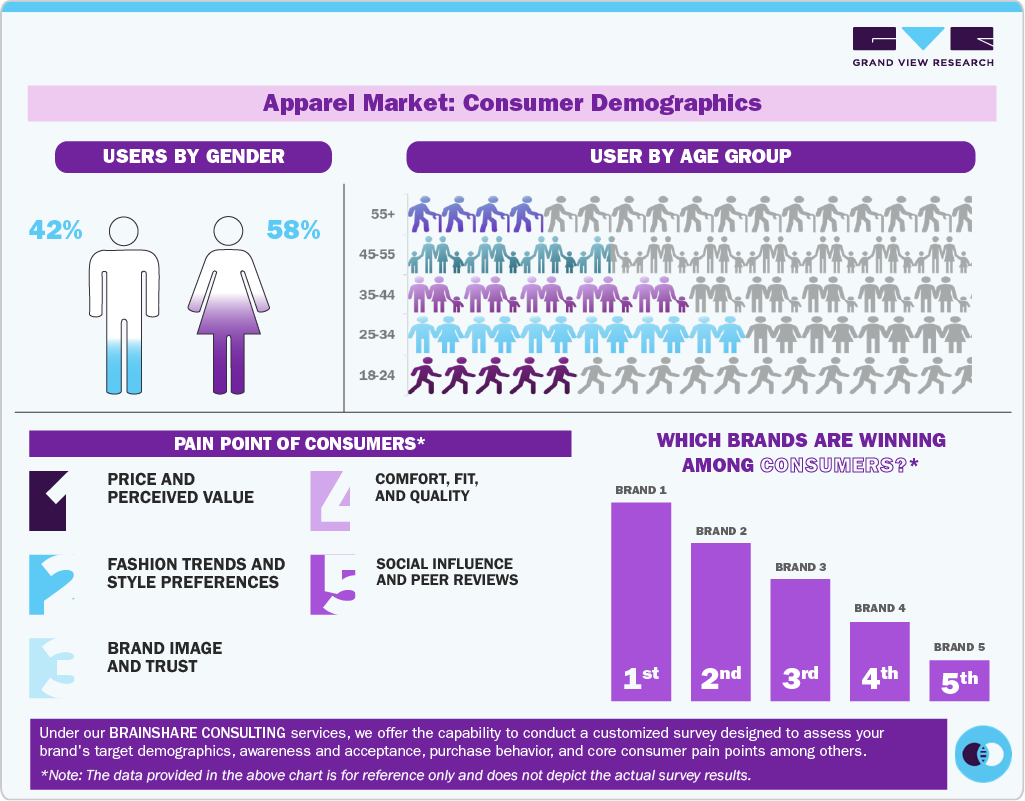
Consumers in the apparel market are increasingly prioritizing a balance of style, comfort, and value, with higher expectations around fabric quality, fit consistency, and durability even at mid-price points. Demand is being shaped by fast-changing fashion trends amplified by social media, alongside a growing preference for casual and athleisure wear driven by hybrid work and lifestyle shifts. At the same time, shoppers are becoming more price-sensitive, comparing options across brands and channels, actively using discounts, and favoring retailers that offer strong value-for-money and easy returns.
Category Insights
 To learn more about this report, Download Free Sample Report
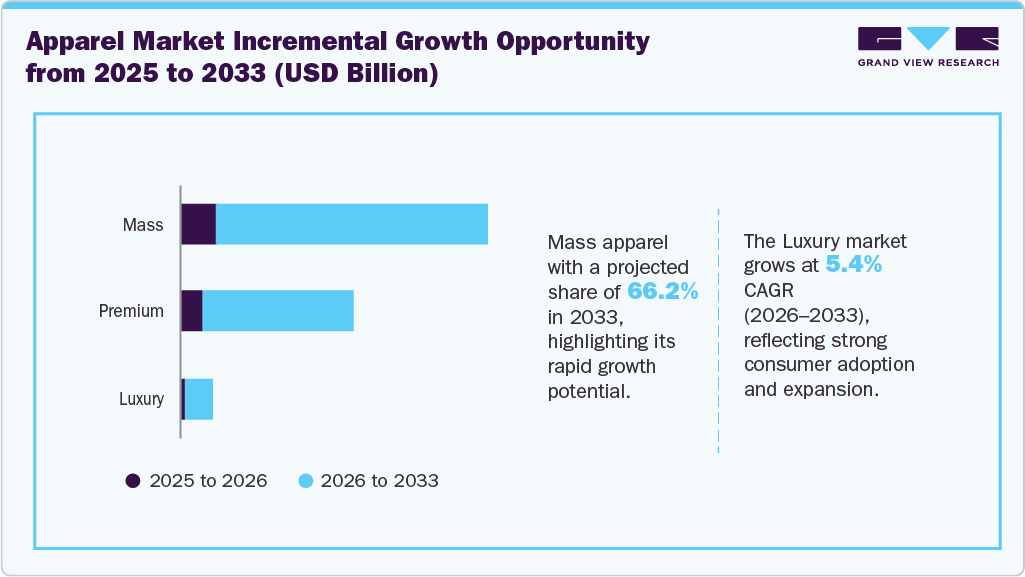
 Mass apparel accounted for the largest share of 67.8% of the global revenue in 2025. Mass apparel is constantly produced with the inclusion of new designs and patterns that appeal to customers, leading to increased engagement. Rather than restocking inventory, retailers swap items with the latest arrivals. Fast fashion ensures that shoppers can access desired clothing items promptly and conveniently. Moreover, it has made fashionable clothing more accessible, offering innovative, imaginative, and stylish options. Mass apparel is affordable and provides easy access to trendy clothing, making a large variety of garments accessible to a broader range of customers.
 To learn more about this report, Download Free Sample Report
 The luxury apparel market is projected to grow at the fastest CAGR of 5.4% from 2026 to 2033. This market is primarily driven by the increasing adoption by high-net-worth individuals, the growing availability of luxury apparel through online portals, and the focus of multiple luxury apparel brands to enhance the market reach across various regions. Increased sales of fashionable luxury apparel and rising interaction between consumers and industry players through social media platforms and online retail channels are pivotal factors driving market expansion. The increasing popularity of luxury apparel among millennials presents a significant opportunity for industry growth. In addition, advancements in digital marketing strategies and the rising prevalence of social media as a marketing platform in emerging markets have opened numerous new business prospects for industry participants.
End User Insights
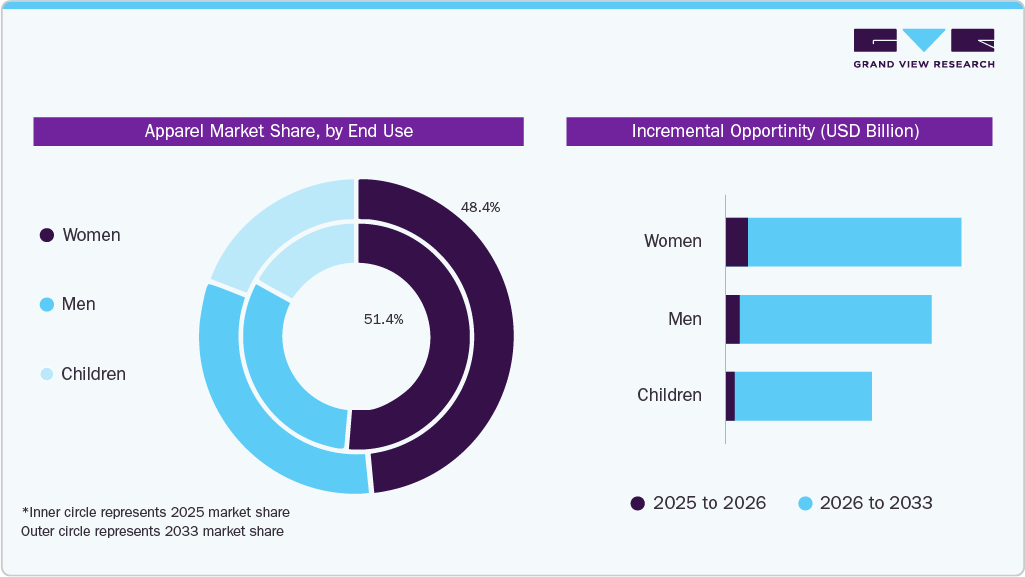
The women’s segment accounted for the largest share of 51.45% in 2025. The female fashion industry is experiencing a surge in demand for new trends and diverse options. Women's fashion represents a higher demand than men's due to the wide variety available, including dresses, skirts, blouses, and accessories. This increased demand prompts designers and retailers to prioritize female fashion, catering to consumers' evolving preferences. As a significant consumer market segment, women contribute substantially to global fashion industry trends through their spending habits. Their tendency to invest more in clothing and accessories makes women's fashion a lucrative business sector. According to the data published in December 2025, women spend approximately 40% more on clothing compared to men.
 To learn more about this report, Download Free Sample Report
 The children’s segment is projected to grow at the fastest CAGR of 5.8% from 2026 to 2033. In the children's apparel industry, fashion-ability is emphasized as the primary consideration. In addition, many industry players commonly offer multi-pack options, providing added convenience for shoppers. Larger retailers are also increasingly incorporating sustainable options, such as organic cotton, into their children's clothing collections at prices comparable to their core offerings, thereby stimulating market growth. Moreover, the premium kids wear segment capitalizes on several long-term trends, including a shift towards more thoughtful purchasing decisions and the increasing age of new parents. According to the data published in December 2025, new parents spend 3 times more on children’s apparel compared to parents of teenagers.
Distribution Channel Insights
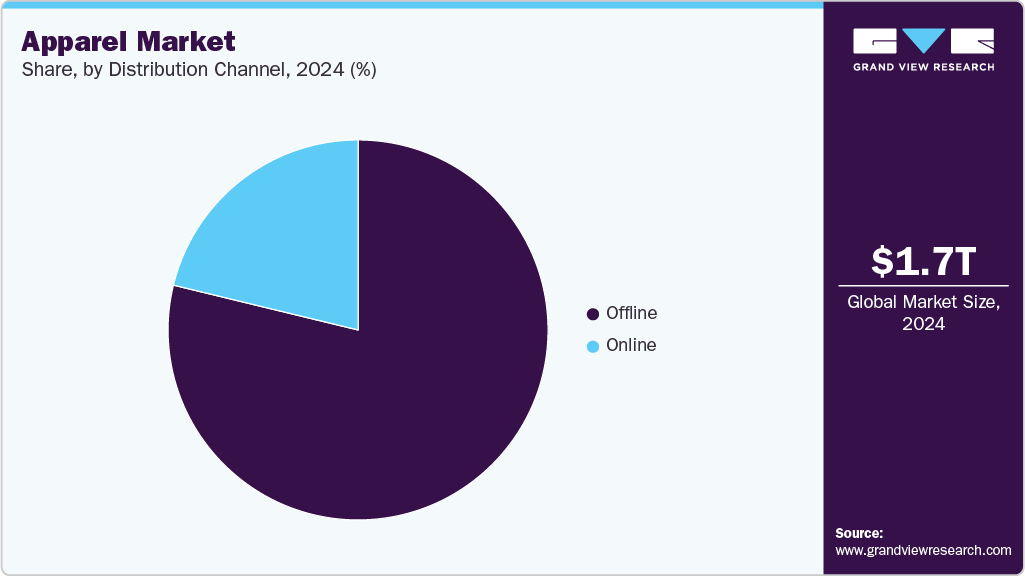
The apparel sales through offline channels accounted for the largest share of around 78.3% of the global revenue in 2025. Offline shopping provides customers with a personalized experience, enabling them to examine various product features, such as the quality of fabric, designs, and materials incorporated into the product. Store associates can provide tailored assistance, offer styling advice, suggest complementary items, and address any concerns or questions customers may have. This personalized attention enhances the overall shopping experience and fosters a sense of loyalty and trust between the customer and the brand. In addition, the ability to physically see, touch, and try on products in offline stores instills confidence in their quality and fit. Customers can inspect the fabric, examine the craftsmanship, and assess how the garment looks and feels on their body.
 To learn more about this report, Download Free Sample Report
 The apparel sales through online channels are projected to grow at the fastest CAGR of 6.2% from 2026 to 2033. Online shopping provides customers with convenience, enabling them to effortlessly browse, compare, and purchase products or services from the comfort of their homes at any time of the day. Moreover, online channels provide competitive prices, coupons, and discounts, owing to which their adoption is increasing among consumers, thus driving the segment’s growth. Online sales channels grant easy access to global brands, eliminating geographical constraints and expanding consumer choices.
Regional Insights
North America apparel market accounted for a share of 22.5% in 2025. This market is mainly influenced by factors such as the increasing market penetration accomplished by the e-commerce industry, the growing focus of multiple fashion and apparel brands on enhancing their digital footprint, and the rising inclination among young consumers to purchase products equipped with the latest fashion trends and novel designs.
U.S. Apparel Market Trends
The apparel market in the U.S. led the North American region in 2025, holding the largest share of 86.2% owing to the presence of multiple key companies, growing disposable income levels of young customers, increasing new entrants in the industry, and technological enhancements that enable manufacturers with improved capacities in terms of production, design, and distribution. The rising popularity of e-commerce websites such as Amazon and the increasing market penetration accomplished by online retail platforms are also generating multiple growth opportunities.
Europe Apparel Market Trends
The apparel market in Europe accounted for a share of 26.55% of the global revenue in 2025. The European market is driven by shifting fashion trends, a focus on sustainability within the industry, the expansion of e-commerce, and ongoing innovation in design and manufacturing techniques. The presence of multiple brands in the region and the launch of brick-and-mortar stores by numerous apparel brands in key cities such as Paris, London, Berlin, Milan, and Munich also contribute to the growth of this market. For instance, in February 2025, Lululemon Athletica, one of the major market participants in the athleisure market, opened its largest store in the EMEA region in London, spanning nearly 8,923 sq ft.
The UK apparel market is influenced by high consumer spending on clothing, rapid trend adoption, and the presence of a wide range of international and domestic apparel brands catering to mass, mid-range, and premium segments. The UK’s role as a major fashion and retail hub encourages frequent product launches and fast inventory turnover, while strong e-commerce penetration and omnichannel retail models enhance accessibility and convenience for consumers. In addition, demand is reinforced by a large urban population, strong influence of global fashion trends, and consistent import flows that ensure product variety and competitive pricing.
Asia Pacific Apparel Market Trends
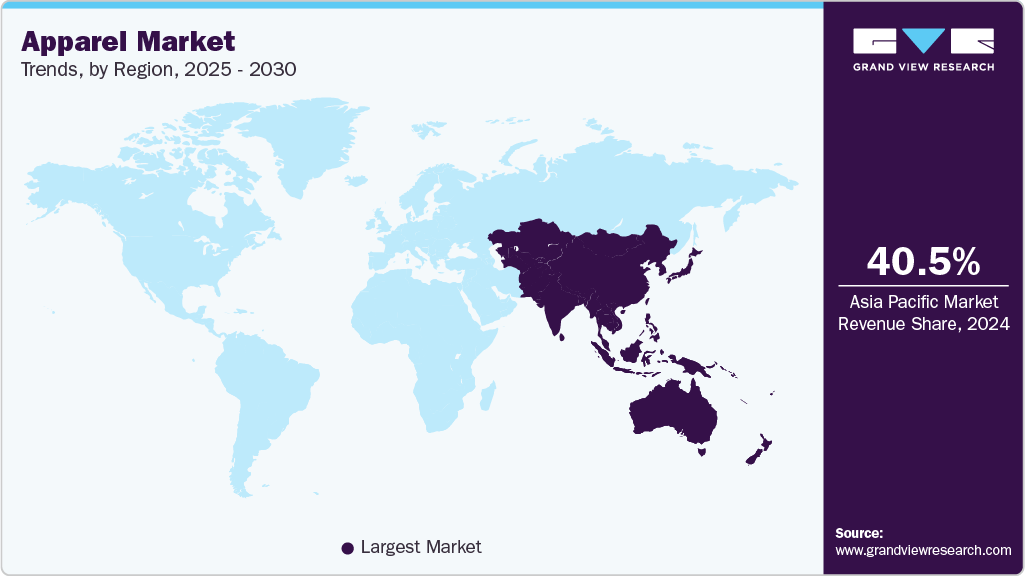
The apparel market in Asia Pacific accounted for the largest market share of 40.8% in 2025. Growth of this market is mainly driven by the significant growth in demand from highly populated countries such as China and India, increasing focus of multiple global brands on expansion in Asia Pacific, and rising disposable income levels of customers living in countries such as India and Australia.
 To learn more about this report, Download Free Sample Report
 China apparel market is primarily influenced by factors such as a large number of manufacturing facilities in China, easy availability of various materials, and growing demand from the domestic market. Multiple brands that offer a large range of products in numerous apparel categories have manufacturing facilities in China. Mass-manufactured apparel exported from China contributes to the growth experienced by this market.
The apparel industry in India is influenced by strong domestic consumption driven by a large and young population, rising urbanization, and increasing disposable income, along with a broad manufacturing base spanning cotton textiles, knitwear, and ready-made garments. Government initiatives and investments in integrated manufacturing and export infrastructure are supporting capacity expansion and competitiveness. In addition, India’s role as a key apparel exporter-supported by a large workforce and expanding sourcing interest from global brands-continues to contribute to market growth.
Japan apparel industry is shaped by mature and relatively stable demand, with consumer preference skewing toward high-quality, functional, and premium products. Demographic shifts-particularly an ageing population-are influencing product design and demand toward comfort, practicality, and adaptive apparel, while retailers increasingly rely on e-commerce and personalized experiences to address changing shopping behavior. Additionally, Japan remains highly import-reliant for apparel supply, with imports (largely from Asia) playing a significant role in meeting domestic demand and shaping market dynamics.
Central & South America Apparel Market Trends
The apparel market in Central & South America is expected to grow at a CAGR of 4.2% from 2026 to 2033. The Central & South America apparel market is supported by rising demand for affordable and mid-priced apparel across urban populations, where fashion adoption is increasingly influenced by social media and global style trends. Seasonal demand linked to festivals, climate variation, and lifestyle wear continues to support consistent apparel purchases. In addition, the expansion of local manufacturing bases, increased import activity, and the growing role of digital commerce are improving product availability and choice.
Middle East & Africa Apparel Market Trends
The apparel market in the Middle East & Africa is expected to grow at a CAGR of 4.3% from 2026 to 2033. The Middle East & African industry is driven by rising participation of younger consumers in fashion-led spending, increasing acceptance of ready-made garments over tailored clothing, and gradual shifts toward Western-style and casual apparel. Expansion of shopping malls, outlet formats, and cross-border retail is improving brand reach, while better logistics and sourcing networks are enabling faster product availability.
Key Apparel Companies:
The following key companies have been profiled for this study on the apparel market.
- Lululemon Athletica
- Burberry Group plc
- Puma SE
- Adidas AG
- Nike Inc.
- H & M Hennes & Mauritz AB
- LVMH
- Kering Group
- PVH Corp.
- Inditex
Recent Developments
-
In December 2025, entrepreneur and actor Rishaab Chauhaan announced the launch of GRABORA, a new premium fashion brand entering India’s rapidly expanding apparel market with a focus on high-quality fabrics, thoughtful design, and contemporary styles for both men and women. With ambitions to set fresh benchmarks in comfort, aesthetics, and global standard craftsmanship, GRABORA aims to cater to evolving consumer tastes driven by rising incomes and a youthful demographic.
-
In December 2025, H&M announced a renewed partnership with renowned designer and sustainability leader Stella McCartney, marking nearly 20 years since their first collaboration and setting the stage for a Spring 2026 collection that blends McCartney’s signature style with responsible design. The upcoming line will showcase certified and recycled materials as alternatives to conventional fabrics, highlighting iconic silhouettes and design codes from McCartney’s brand while reinforcing eco-conscious values.
-
In March 2025, NIKE, Inc. partnered with TOGETHXR Inc. to launch the Everyone Watches Women’s Sports apparel collection. The collection features T-shirts, hoodies, and caps and reinforces NIKE's commitment to encouraging women's sports through innovation, investment, improved visibility, and inspiration.
Apparel Market Report Scope
Report Attribute
Details
Market size in 2025
USD 1.8 trillion
Estimated Market size in 2026
USD 1.9 trillion
Projected Market size by 2033
USD 2.5 trillion
Growth rate (revenue)
CAGR of 4.1% from 2026 to 2033
Actuals
2021 - 2025
Forecast period
2026 - 2033
Quantitative units
Revenue in USD million/billion, and CAGR from 2026 to 2033
Report coverage
Revenue forecast, company ranking, competitive landscape, growth factors, and trends
Segments covered
Category, end use, distribution channel, region
Regional scope
North America; Europe; Asia-Pacific; Central & South America; Middle East & Africa
Country scope
U.S.; Canada; Mexico; Germany; UK; France; Italy; Spain; China; India; Japan; Australia & New Zealand; South Korea; Brazil; South Africa
Key companies profiled
Lululemon Athletica; Burberry Group plc; Puma SE; Adidas AG; NIKE Inc.; H & M Hennes & Mauritz AB; LVMH; KERING; PVH Corp.; INDITEX
Customization scope
Free report customization (equivalent up to 8 analysts’ working days) with purchase. Addition or alteration to country, regional & segment scope.
Pricing and purchase options
Avail customized purchase options to meet your exact research needs. Explore purchase options Global Apparel Market Report Segmentation
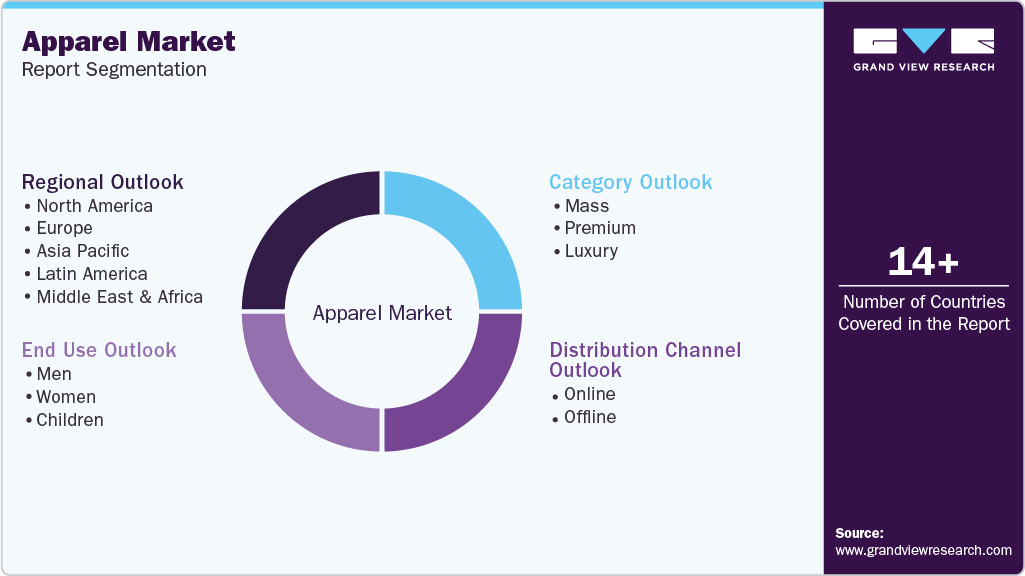
This report forecasts revenue growth at the global, regional and country levels and provides an analysis of the latest industry trends and opportunities in each of the sub-segments from 2021 to 2033. For this study, Grand View Research has segmented the global apparel market report on the basis of category, end use, distribution channel, and region:
 To learn more about this report, Download Free Sample Report
 -
Category Outlook (Revenue, USD Billion, 2021 - 2033)
-
Mass
-
Premium
-
Luxury
-
-
End Use Outlook (Revenue, USD Billion, 2021 - 2033)
-
Women
-
Casual Wear
-
Formal Wear
-
Sportswear
-
Night Wear
-
Inner Wear
-
Ethnic Wear
-
Others
-
-
Men
-
Casual Wear
-
Formal Wear
-
Sportswear
-
Night Wear
-
Inner Wear
-
Ethnic Wear
-
Others
-
-
Children
-
Casual Wear
-
Formal Wear
-
Sportswear
-
Night Wear
-
Inner Wear
-
Ethnic Wear
-
Others
-
-
-
Distribution Channel Outlook (Revenue, USD Billion, 2021 - 2033)
-
Offline
-
Supermarkets & Hypermarkets
-
Clothing Stores
-
Others
-
-
Online
-
-
Regional Outlook (Revenue, USD Billion, 2021 - 2033)
-
North America
-
U.S.
-
Canada
-
Mexico
-
-
Europe
-
Germany
-
UK
-
France
-
Italy
-
Spain
-
-
Asia Pacific
-
China
-
India
-
Japan
-
South Korea
-
Australia & New Zealand
-
-
Central & South America
-
Brazil
-
-
Middle East & Africa
-
South Africa
-
-
Delivered Customizations
This report has been delivered with the following In-depth customizations
Client Request
Customization Delivered
Value Adds
End User and Apparel Type Cross Segmentation Analysis
Developed a detailed cross-segmentation analysis of the apparel market by mapping end-user categories, including men, women, and children, across key apparel types such as casual wear, formal wear, sportswear, night wear, inner wear, ethnic wear, and others. The analysis evaluated revenue contribution, demand variation, category-wise adoption patterns, and segment-level consumption behavior across each end user–apparel type combination.
Enables stakeholders to identify high-growth and high-value apparel intersections such as women’s casual wear, children’s sportswear, or men’s formal wear. Supports product portfolio planning, assortment optimization, targeted merchandising, and demand prioritization across consumer groups and apparel categories.
Supplier Mapping for Leading Apparel Companies
Delivered a customized supplier intelligence assessment covering the list of top suppliers associated with leading apparel companies. The analysis focused on supplier relationships, sourcing networks, manufacturing linkages, and the role of key vendors in supporting apparel production, procurement, and supply chain continuity.
Helps clients understand supplier concentration, sourcing dependencies, and vendor ecosystem structures across major apparel companies. Supports procurement benchmarking, supply chain risk assessment, supplier diversification, and strategic sourcing decisions.
Category and Channel-Level Market Opportunity Assessment
Conducted a structured segmentation assessment of the apparel market by category, including mass, premium, and luxury, and by distribution channel, including online and offline. The analysis evaluated segment-level market contribution, pricing positioning, channel penetration, consumer accessibility, and demand differences across value tiers and retail formats.
Provides actionable insights into pricing-tier performance and channel-led growth opportunities. Supports go-to-market planning, retail strategy, premiumization assessment, online expansion evaluation, and identification of commercially attractive segments across mass, premium, and luxury apparel categories.
Frequently Asked Questions About This Report
The global apparel market size was valued at USD 1.8 trillion in 2025 and is expected to reach USD 1.9 trillion in 2026.
The mass segment held the market with the largest revenue share of 67.8% in 2025, while luxury is the fastest-growing segment.
Asia Pacific is the fastest-growing region over the forecast period.
Some prominent players in the apparel market include VF Corporation; Burberry Group plc; Puma SE; Adidas AG; NIKE Inc.; H & M Hennes & Mauritz AB; LVMH; KERING; PVH Corp.; INDITEX
The apparel market is driven by rising disposable incomes, rapid fashion cycles, and increasing influence of social media and celebrity endorsements on consumer purchasing behavior. Growth in e-commerce, demand for athleisure and sustainable clothing, and frequent product launches are further accelerating market expansion.
Asia Pacific dominated the market with the largest revenue share of 40.8% in 2025.
The global apparel market is expected to grow at a CAGR of 4.1% from 2026 to 2033, reaching USD 2.5 trillion by 2033.
The women segment held the market with the largest revenue share of 51.4% in 2025, while children is the fastest-growing segment.
The offline segment held the market with the largest revenue share of 78.3% in 2025, while online is the fastest-growing segment.
About the Author(s)
Clothing, Footwear & Accessories Research Team
Consumer Goods · Clothing, Footwear & AccessoriesThis report was authored by the clothing, footwear & accessories research team at Grand View Research - comprising two research analysts, one senior research analyst, and one industry expert - with specialized expertise in the clothing, footwear & accessories segment of the consumer goods industry. All findings are based on proprietary consumer goods databases, executive interviews, and regulatory analysis, subject to internal peer review prior to publication.
Last Updated:
Speak to Analyst

Customize this report to your needs - add regions, segments, or data points, with 20% free customization.
Or view our licence options:


ISO 9001:2015 & 27001:2022 Certified
We are GDPR and CCPA compliant! Your transaction & personal information is safe and secure. For more details, please read our privacy policy.


