
- Home
- »
- Communications Infrastructure
- »
-
API Management Market Size, Share & Trends Report, 2033GVR Report cover

API Management Market (2026 - 2033)
Size, Share & Trends Analysis Report By Component (Solutions, Services), By Deployment (Cloud, On-premises), By Enterprise Size, By End-use (IT & Telecom, BFSI, Retail & E-commerce, Healthcare & Life Sciences), By Region, And Segment Forecasts
Market Size, 2025
$8.6BMarket Estimate, 2026
$9.9BMarket Forecast, 2033
$36.3BCAGR, 2026–2033
20.3%API Management Market Summary
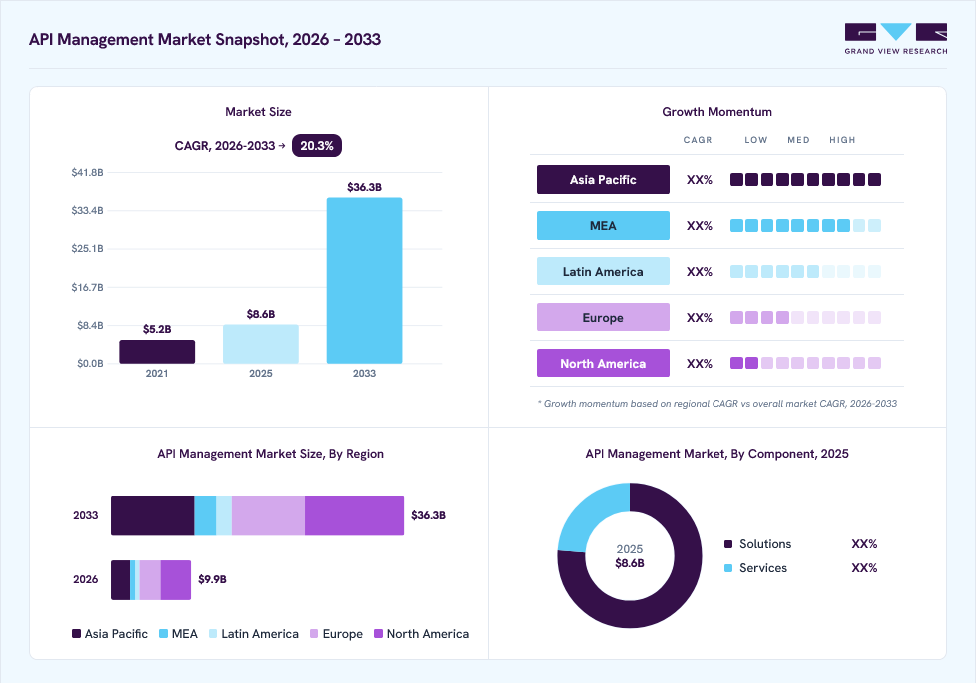
The global application programing interface (API) management market size was valued at USD 8.6 billion in 2025 and is projected to grow from USD 9.9 billion in 2026 to USD 36.3 billion by 2033, at a CAGR of 20.3% from 2026 to 2033. North America dominated the market, accounting for the largest revenue share of 39.0% in 2025. Rising adoption of microservices architecture is driving market growth.
 Source: Grand View Research, IR Documents, Primary Interviews, Paid DatabasesTo learn more about this report,
 Download Free Sample Report
 Key Market Trends & Insights
- By component: Solutions segment dominated the market, with a revenue share of 76.1% in 2025.
- By deployment: Cloud segment dominated the market, with a revenue share of 73.5% in 2025.
- By enterprise size: Large enterprises segment dominated the market, with a revenue share of 65.1% in 2025.
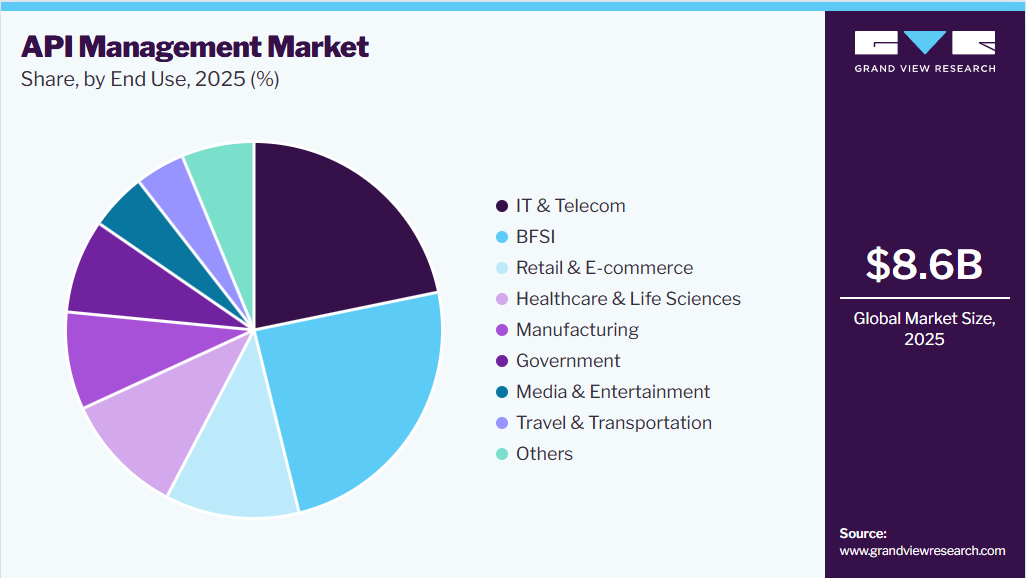
- By end use: IT & telecom segment held the largest revenue share in 2025.
Regional Highlights
- Largest regional market: North America (39.0% revenue share, 2025)
- Fastest-growing regional market: Asia Pacific (highest CAGR, 2026-2033)
- By country: The U.S. held the largest market share in 2025
Market Size & Forecast
- Market size in 2025: USD 8.6 Billion
- Estimated market size in 2026: USD 9.9 Billion
- Projected market size by 2033: USD 36.3 Billion
- CAGR (2026-2033): 20.3%
Three ways to get this report
Buy it, customize it, or ask a question.Ask an Analyst
A direct answer, usually in 1 working day
- AccessReport author, directly
- Reply timeWithin 1 working day
- No sales callDirect answer only
- FormatEmail reply
- CostFree, no cost
Get the Full Report
What the study covers
- FormatsPDF · Excel · Dashboard
- Timeline2026–2033 annual, 2025 base
- Coverage20+ countries, 5 regions
- Companies10+ key players profiled
Customize the Report
20% free customization
- IncludeCountries, segments, points
- TailorTo your product definition
- ExtendDeeper competitor detail
- OrA fully bespoke study
- Turnaround5–10 working days
The increasing use of GraphQL APIs is driving market growth by introducing new governance and monitoring requirements alongside conventional REST-based interfaces. GraphQL allows applications to request specific data structures through flexible queries, which can improve application development efficiency while introducing different approaches to traffic monitoring and security. Enterprises using GraphQL alongside REST APIs require visibility across multiple API styles within the same technology environment. API management platforms can provide centralized policy enforcement, authentication, analytics, and lifecycle controls across these interfaces. This increases the value of application programing interface (API) management in heterogeneous application environments. The growing adoption of GraphQL-based architectures is therefore contributing to market growth.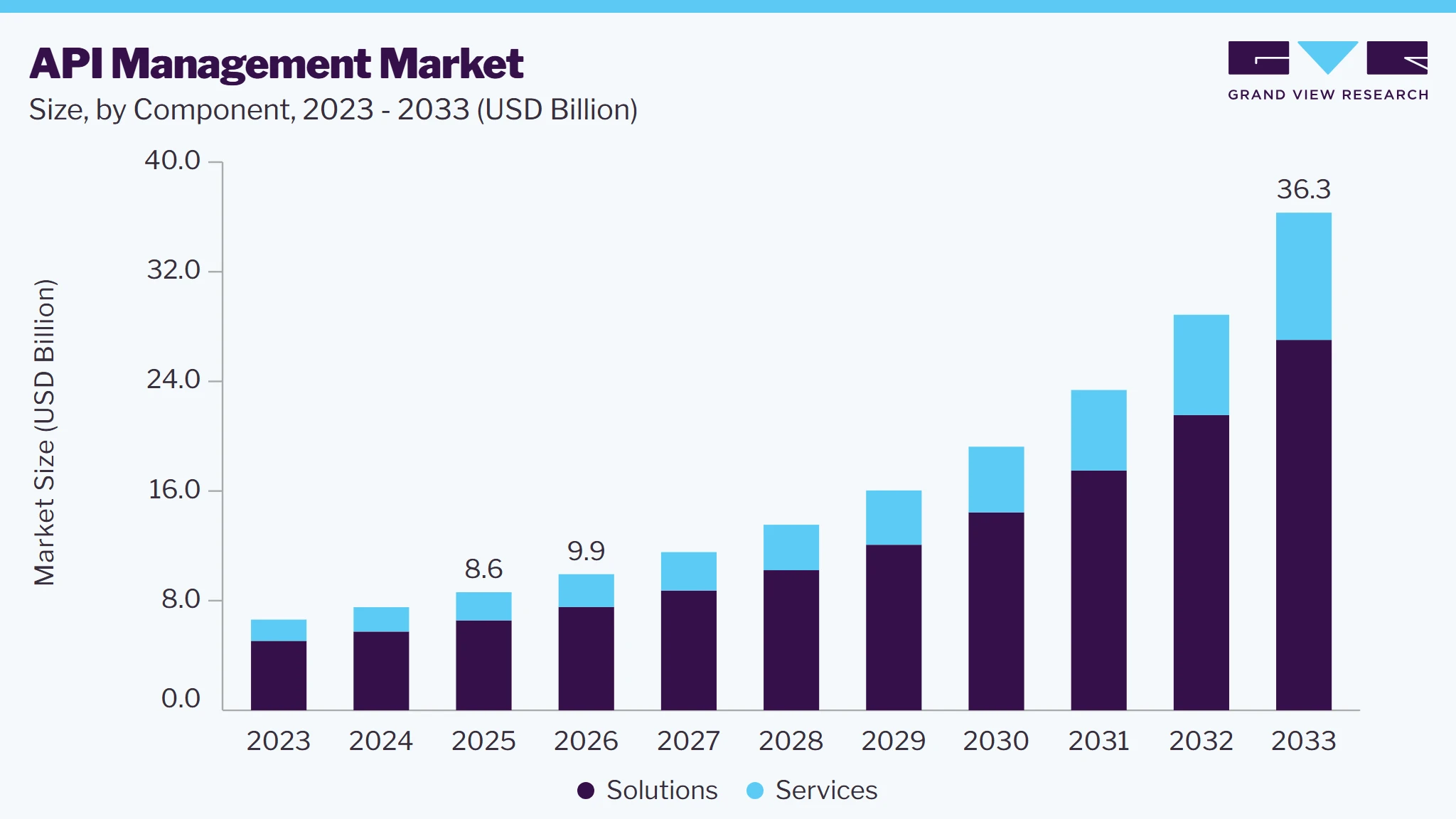 To learn more about this report, Download Free Sample Report
 The increasing adoption of smart cities and urban infrastructure initiatives is driving market growth within the API management market. Municipal governments, transportation agencies, utilities, urban planners, and infrastructure developers are deploying geographic analytics to manage transportation networks, public safety systems, utility infrastructure, environmental monitoring, emergency response planning, and urban development programs. API management platforms support spatial modeling, traffic optimization, infrastructure planning, service distribution analysis, and geographic resource management across complex urban environments. Public authorities increasingly require integrated geospatial intelligence platforms that simultaneously support long-term urban planning and real-time operational management. The continued expansion of smart infrastructure and digital urban development is propelling demand for API management technologies across public-sector applications.
The expansion of zero-trust security architectures is driving market growth as organizations move toward continuous verification of users, applications, devices, and service interactions. APIs frequently connect internal applications, cloud services, external partners, and automated processes across different trust boundaries. This creates a need for identity-aware access policies that can be applied consistently across distributed API environments. API management platforms can enforce authentication and authorization rules at the interface layer while providing visibility into traffic and access patterns. This makes API gateways increasingly relevant to broader enterprise security architecture. The adoption of zero-trust principles is therefore propelling demand for advanced API management capabilities.
The growth of embedded digital services is driving market expansion as companies increasingly integrate external functionality into their applications and customer experiences. Payments, identity verification, maps, communications, analytics, logistics, credit assessment, and other capabilities can be accessed through third-party APIs. Enterprises need mechanisms to monitor these external dependencies and maintain consistent security and performance standards. API management platforms can provide visibility into external API usage and help organizations control how third-party services interact with internal applications. This creates a growing requirement for API governance across interconnected digital ecosystems. The increasing adoption of embedded services is consequently propelling demand for application programing interface (API) management software.
The expansion of open banking and API-based financial services is driving market growth as financial institutions increasingly connect their banking infrastructure to fintech companies, payment platforms, personal finance applications, and other digital services. These ecosystems require strong controls around authentication, authorization, consent, transaction security, and usage monitoring. API management platforms provide centralized mechanisms for managing access to financial interfaces while maintaining operational visibility. The growing number of connected financial applications also increases the need for version control and standardized API documentation. As financial services become increasingly API-driven, API management is increasingly integrated with digital banking infrastructure. The expansion of API-based financial ecosystems is therefore propelling market adoption.
Market Dynamics
The API management market is experiencing strong growth as enterprises increasingly depend on APIs to connect applications, cloud services, databases, microservices, partner platforms, and customer-facing digital products. The expansion of hybrid and multi-cloud architectures is increasing the number of APIs that organizations must create, publish, secure, monitor, version, and govern throughout their technology environments. API management platforms provide centralized capabilities for API gateways, lifecycle management, access control, traffic monitoring, analytics, developer portals, and policy enforcement, allowing enterprises to manage increasingly complex API ecosystems. The rise of digital products and API-driven business models is further encouraging organizations to treat APIs as strategic assets rather than purely technical integration components. In addition, growing requirements for API security, performance optimization, and governance are accelerating the adoption of specialized API management platforms across industries.
The rising use of GPS and mobile location data is driving market growth in the API management market as businesses increasingly rely on precise geographic information to understand customer behavior, movement patterns, and operational performance across physical environments. Smartphones, navigation applications, connected vehicles, wearable devices, and mobile applications continuously generate location coordinates that can be analyzed to identify visitation trends, travel routes, dwell times, regional demand variations, and consumer mobility behavior. application programing interface (API) management platforms transform these large-scale geographic datasets into actionable business intelligence that supports retail planning, transportation optimization, infrastructure development, marketing strategy, and service delivery improvement. Organizations increasingly seek analytical systems capable of processing millions of location records while generating meaningful spatial insights across urban, suburban, and rural environments. The continued expansion of GPS-enabled digital ecosystems is propelling demand for advanced API management platforms across commercial and public-sector applications.
Data privacy and location-tracking concerns are constraining growth in the API management market, as organizations face increasing public sensitivity about how geographic information is collected, stored, analyzed, and shared. Consumers are becoming more aware that smartphones, mobile applications, connected vehicles, wearable devices, and digital services continuously generate detailed location histories that can reveal personal routines, travel patterns, workplace locations, residential areas, and behavioral characteristics. Businesses using API management platforms must implement strict consent management, anonymization techniques, encryption standards, access controls, and data governance policies before location information can be processed for commercial purposes. Many organizations hesitate to expand location-based analytics initiatives when customer trust and privacy protection become central strategic priorities across digital operations. The growing emphasis on personal data protection continues limiting broader deployment of API management solutions across consumer-facing industries.
The growing adoption of edge-based geospatial analytics is creating substantial opportunities in the API management market by enabling geographic data processing directly at the point of data generation. Connected sensors, mobile devices, autonomous vehicles, industrial equipment, drones, surveillance systems, and IoT infrastructure increasingly produce continuous streams of location data that can be analyzed locally without relying exclusively on centralized cloud platforms. Edge-based geospatial analytics allows organizations to process spatial information with lower latency, faster decision-making, and greater operational responsiveness across transportation, logistics, manufacturing, utilities, public safety, and smart infrastructure environments. API management providers can develop distributed analytics platforms that support real-time geographic intelligence across highly dynamic operational networks. The continued expansion of edge computing infrastructure is opening opportunities for next-generation API management architectures that operate across decentralized digital ecosystems.
Market Concentration & Characteristics
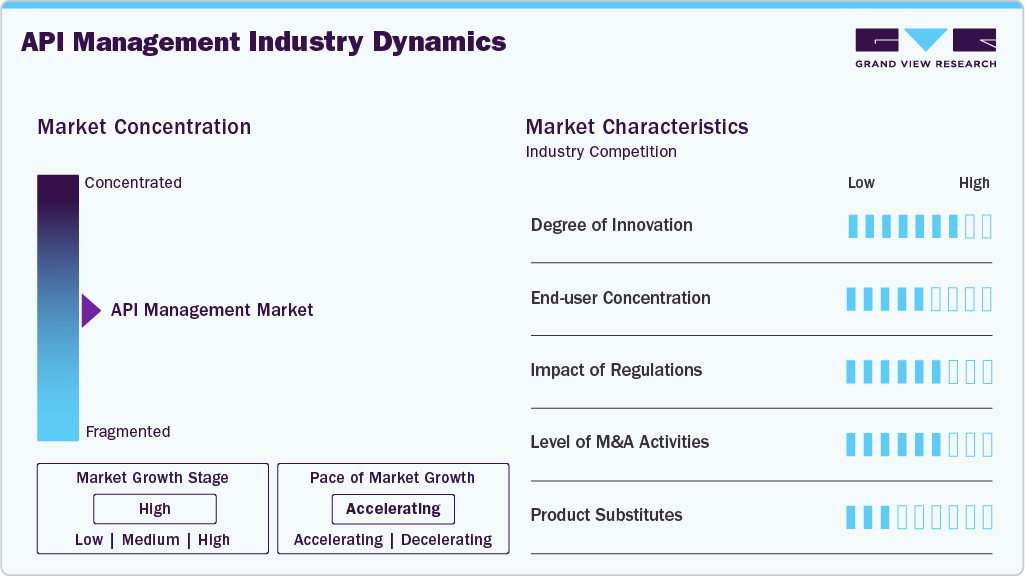
The API management market is highly competitive and moderately concentrated, with large cloud providers, enterprise integration companies, and specialized API platform vendors competing across enterprise, hybrid, and multi-cloud environments. Market leadership is shaped less by standalone API gateway capabilities and more by the ability to provide a complete API lifecycle covering discovery, security, governance, developer portals, analytics, versioning, and runtime management. Entry barriers are moderate to high, as successful platforms require deep integration with enterprise architectures, strong security capabilities, protocol support, and the ability to manage large, distributed API estates.
 To learn more about this report, Download Free Sample Report
 The market is experiencing a strong expansion phase as enterprises shift toward microservices, cloud-native architectures, digital ecosystems, and API-first integration models. APIs increasingly serve as reusable business assets that connect internal applications, partners, customers, and external services, making API governance and lifecycle visibility increasingly important as API portfolios expand. The rapid development of AI applications is also creating a new layer of demand for managing AI model endpoints, agents, and emerging protocols alongside conventional APIs.
Analyst Perspective
The API management market is shifting from basic API gateway deployment toward comprehensive platforms that govern the full lifecycle of APIs across increasingly distributed enterprise architectures. Competitive differentiation is moving toward capabilities such as API security, automated lifecycle governance, real-time analytics, developer experience, AI-assisted API development, and seamless management across cloud, on-premise, and hybrid environments. Enterprises are increasingly evaluating API management platforms based on their ability to create a controlled layer between rapidly expanding application ecosystems and the business services exposed through APIs. As organizations adopt microservices, composable applications, event-driven architectures, and API-first development strategies, the value of application programing interface (API) management is increasingly tied to governance, reuse, security, and monetization of digital services. The market is therefore expected to evolve toward intelligent API management environments that provide centralized visibility and policy control while enabling developers and business teams to scale API-driven digital operations.
Component Insights
The solutions segment accounted for the largest market share of 76.1% in 2025 in the API management market. The increasing complexity of enterprise application environments is driving demand for API management solutions that provide centralized control over API gateways, security, analytics, lifecycle management, and developer access. As organizations connect cloud applications, legacy systems, mobile applications, partner platforms, and microservices, managing APIs individually becomes increasingly difficult. A dedicated solution layer enables enterprises to standardize API policies, monitor traffic, manage authentication, and maintain consistent performance across large API estates. The expansion of API-first development is further increasing the number of interfaces that organizations need to publish, govern, and secure throughout their lifecycle. This growing requirement for centralized API control is driving market growth for application programing interface (API) management solutions.
The services segment is anticipated to grow significantly during the forecast period. The growing need for specialized expertise during API architecture design, integration, migration, implementation, and ongoing optimization is driving demand for API management services. Many organizations have established application environments that include legacy systems, cloud workloads, third-party applications, and internally developed APIs, all of which require complex integration. Service providers help enterprises design API strategies, configure governance frameworks, migrate existing interfaces, and establish monitoring and security practices without requiring extensive internal expertise. The increasing adoption of API management platforms among organizations with limited specialized API engineering resources is also expanding opportunities for consulting, implementation, support, and training services. This need for external technical expertise is driving the services segment as API environments become broader and more sophisticated.
Deployment Insights
The cloud segment accounted for the largest market share of 73.5% in 2025. The migration of enterprise applications toward cloud-native architectures is driving the adoption of cloud-based API management platforms. Organizations increasingly require APIs that can connect distributed applications, microservices, containers, serverless workloads, and SaaS platforms without maintaining extensive internal management infrastructure. Cloud deployment also enables API management capabilities to scale with traffic volumes and application requirements, which is particularly valuable for organizations experiencing rapidly changing digital workloads. Continuous software updates and easier integration with cloud development environments further reduce operational complexity compared with maintaining dedicated API infrastructure. The expansion of cloud-native application development is therefore driving strong demand for cloud API management deployment.
The on-premise segment is expected to register a significant CAGR from 2026 to 2033. The requirement for direct control over sensitive data, infrastructure, and API traffic is driving continued adoption of on-premises API management platforms. Financial institutions, government organizations, and enterprises operating under strict internal security policies may prefer keeping API management infrastructure within their controlled environments. On-premises deployment also allows organizations to customize network configurations, access policies, authentication mechanisms, and integration architectures according to internal requirements. Enterprises with substantial legacy infrastructure may find on-premises deployment more practical when replacing or gradually restructuring existing systems, rather than moving all workloads to the cloud. These infrastructure-control and data-governance requirements continue generating demand for on-premises API management.
Enterprise Size Insights
The large enterprises segment accounted for the largest market share of 65.1% in 2025 in the API management market. The expansion of complex digital ecosystems within large enterprises is driving API management adoption among organizations with extensive application portfolios. Large companies typically operate numerous internal systems, business applications, partner connections, customer-facing platforms, and geographically distributed technology environments that generate high volumes of API interactions. Centralized API governance allows these organizations to establish common security policies, authentication standards, traffic controls, monitoring mechanisms, and lifecycle processes across different business units. The increasing modernization of legacy applications through microservices and modular architectures is creating additional API dependencies that require systematic management. Consequently, the scale and complexity of enterprise application environments are driving sustained API management investment among large enterprises.
The small and medium enterprises (SMEs) segment is anticipated to register the fastest CAGR during the forecast period. The growing availability of subscription-based and scalable API management platforms is driving adoption among SMEs by reducing the infrastructure and upfront investment required to implement API governance. Smaller businesses increasingly use SaaS applications, payment platforms, cloud databases, e-commerce systems, customer applications, and third-party digital services that need reliable API connectivity. API management enables these organizations to connect such services without having to develop every integration capability internally. Pay-as-you-grow pricing models and simplified deployment options also make advanced API capabilities more accessible to organizations with smaller technology teams. The increasing digitalization of SMEs is therefore expanding the addressable customer base for API management platforms beyond large enterprises.
End-use Insights
The BFSI segment accounted for the largest market share of 24.4% in 2025 in the API management market. The expansion of digital banking and embedded financial services is driving the adoption of application programing interface (API) management across the BFSI sector. Banks, insurers, fintech companies, and payment providers increasingly expose APIs for account services, payments, identity verification, lending, investment services, and connections with third-party applications. These interfaces require strong authentication, authorization, traffic management, monitoring, and governance because financial transactions involve highly sensitive information and strict operational requirements. The development of open banking and interconnected financial ecosystems is further increasing the number of external and internal APIs that financial institutions must manage. The growing complexity of digital financial ecosystems is consequently driving demand for secure, centrally governed API management platforms in the BFSI sector.
 To learn more about this report, Download Free Sample Report
 The healthcare & life sciences segment is anticipated to register fastest CAGR during the forecast period, driven by the rapid digitization of healthcare ecosystems and the increasing need to securely connect electronic health records (EHRs), telehealth platforms, wearable devices, laboratory systems, pharmacy networks, and healthcare applications. API management platforms enable healthcare organizations to securely expose, integrate, monitor, and govern APIs while supporting interoperability, real-time data exchange, and compliance with stringent data privacy and security requirements. The growing adoption of cloud-based healthcare solutions, patient-centric digital services, remote patient monitoring, and AI-enabled healthcare applications further increases API traffic and integration complexity, thereby driving demand for scalable API management solutions and services.
Regional Insights
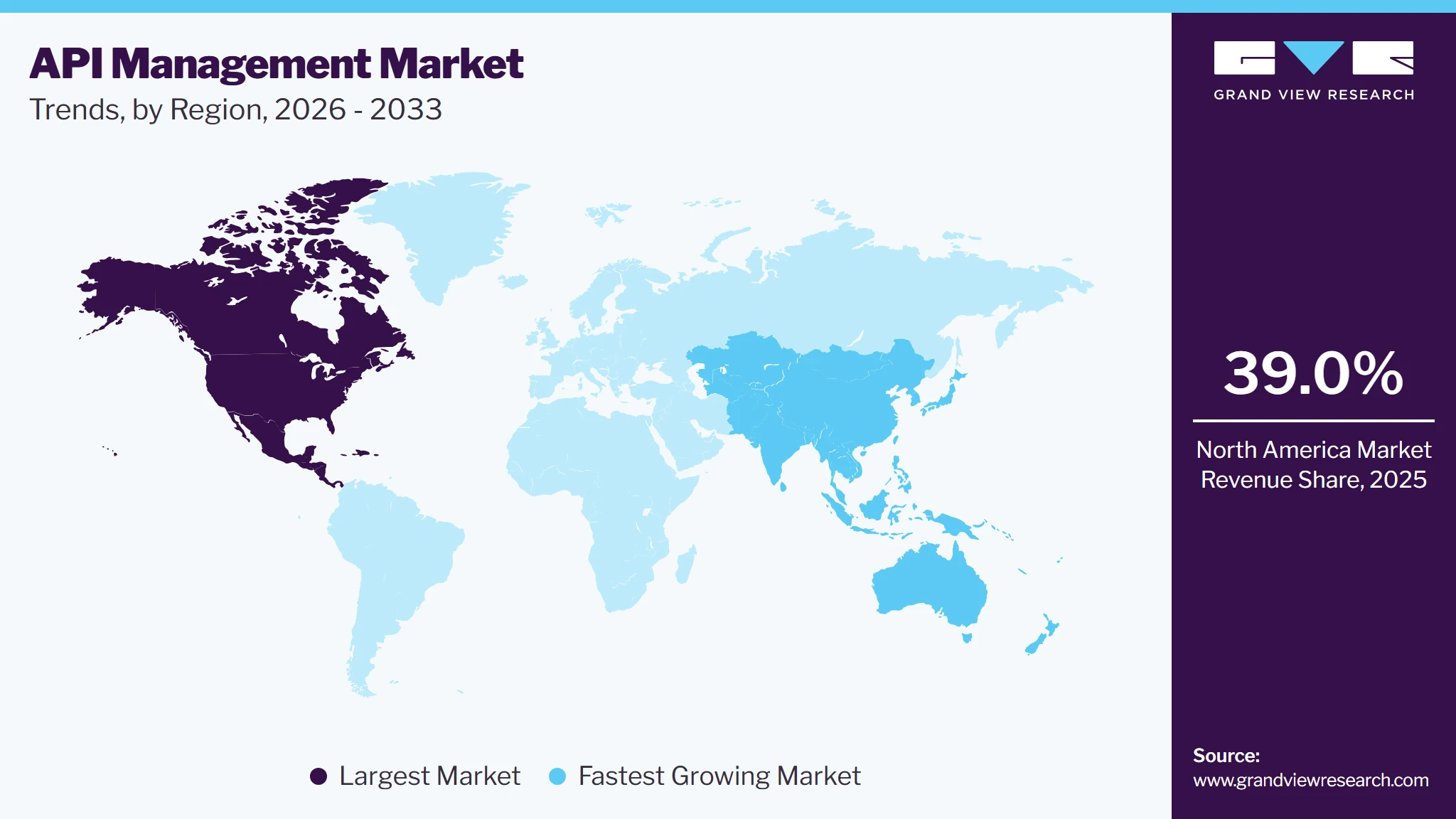
North America dominated the API management market, accounting for 39.0% of revenue in 2025. The high concentration of digitally mature enterprises and technology-intensive businesses is driving API management adoption across North America. Organizations in the region have extensive use of cloud platforms, SaaS applications, microservices, mobile applications, fintech ecosystems, and digitally delivered services that depend heavily on API connectivity. The presence of sophisticated developer ecosystems also encourages businesses to adopt structured API lifecycle management rather than relying on isolated integration tools. Increasing cybersecurity requirements are simultaneously encouraging enterprises to establish stronger controls over API access, authentication, monitoring, and traffic. These characteristics are driving North America to remain a major application programing interface (API) management market, with the region accounting for a leading share of global demand.
 To learn more about this report, Download Free Sample Report
 U.S. API Management Market Trends
The API management market in the U.S. is projected to grow significantly during the forecast period. The rapid expansion of API-first digital business models is driving demand for API management in the U.S. Technology companies, fintech platforms, retailers, healthcare organizations, and enterprises increasingly use APIs as the primary connection layer between applications, services, customers, and external partners. The country's mature cloud ecosystem also enables widespread deployment of microservices, SaaS applications, AI services, and distributed architectures that generate substantial API traffic. Financial technology development and digitally enabled marketplaces further increase the need for controlled and scalable API connectivity. The continued development of API-centric software ecosystems is therefore driving strong adoption of API management across the U.S.
Asia Pacific API Management Market Trends
The API management market in Asia Pacific is expected to grow at the fastest CAGR from 2026 to 2033. The rapid expansion of digital services and connected application ecosystems is driving API management growth across the Asia Pacific. Businesses across the region are accelerating digital payments, mobile commerce, cloud adoption, telecommunications services, digital banking, and platform-based business models that require large numbers of API connections. The expansion of 5G infrastructure is also creating additional opportunities for connected applications and real-time digital services that depend on reliable API communication. Countries with large technology user bases are increasingly developing interconnected digital ecosystems that require centralized API security, analytics, governance, and lifecycle management. This broad digital transformation is driving Asia Pacific toward a faster API management growth trajectory than more mature markets.
The API management industry in China is projected to grow significantly during the forecast period. The expansion of large-scale digital platforms is driving demand for API management in China as enterprises increasingly connect e-commerce, fintech, manufacturing, logistics, cloud, and artificial intelligence applications. Major businesses operate highly distributed application environments in which APIs facilitate communication among internal platforms, external partners, customers, and digital services. The country's manufacturing modernization is also driving greater integration among operational technology, enterprise software, cloud platforms, and industrial applications. Growth in digital payments and platform-based commerce further increases the requirement for reliable API connectivity across high-volume transactions. The increasing scale of China's interconnected digital economy is consequently driving demand for API governance, security, monitoring, and lifecycle management.
The API management industry in India is projected to grow significantly during the forecast period. The expansion of digital public infrastructure and API-enabled services is driving API management adoption in India. Digital payment ecosystems, fintech applications, e-commerce platforms, SaaS businesses, and government-linked digital services increasingly depend on APIs to exchange information and connect multiple applications. India's rapidly expanding startup ecosystem is also encouraging API-first application development, as young technology companies often build products by combining cloud services, payment systems, identity platforms, analytics tools, and other third-party capabilities. Increasing cloud adoption is further enabling Indian enterprises to develop distributed application environments that require centralized API governance. The continued expansion of interconnected digital services is therefore driving strong demand for API management across India.
Europe API Management Market Trends
The API management industry in Europe is anticipated to grow steadily from 2026 to 2033. The strengthening emphasis on data governance, interoperability, and secure digital integration is driving API management adoption across Europe. Enterprises increasingly need to connect applications and exchange data across countries, business partners, cloud platforms, and public digital services while maintaining structured access controls. Data protection requirements are encouraging organizations to establish stronger governance around how APIs expose, transmit, and manage information. European industries are also modernizing manufacturing, financial services, logistics, healthcare, and public-sector systems, increasing the need for standardized interfaces between legacy and modern applications. These requirements are driving demand for API management platforms capable of combining interoperability with security and governance.
The API management industry in the UK is expected to grow significantly during the forecast period. The development of open banking and API-enabled financial services is driving API management adoption in the UK Financial institutions and fintech companies increasingly use APIs to connect banking services with third-party applications, payment platforms, financial management tools, and digital customer interfaces. This ecosystem requires reliable API availability, authentication, authorization, monitoring, and lifecycle governance because numerous external participants interact with the financial infrastructure. The country's mature fintech environment is also encouraging the development of new digital financial products that rely on reusable, scalable API connections. The expansion of API-driven financial ecosystems is consequently increasing demand for API management technologies across the UK.
The API management industry in Germany is expected to grow significantly during the forecast period. he advancement of Industry 4.0 and industrial digitalization is driving the adoption of API management in Germany. Manufacturers increasingly connect factory systems, enterprise applications, industrial equipment, cloud platforms, digital twins, supply-chain systems, and analytics applications to create integrated production environments. APIs provide the communication layer required to exchange information between these heterogeneous systems while maintaining structured access and governance. The coexistence of legacy industrial infrastructure with newer cloud-native applications creates additional requirements for controlled API integration and lifecycle management. Germany's continued industrial modernization is therefore driving demand for API management as manufacturers build increasingly interconnected digital production ecosystems.
Key API Management Company Insights
Some prominent players in the API management market include IBM Corporation and Microsoft Corporation, among others.
-
IBM Corporation is a global technology and consulting company with a broad portfolio covering hybrid cloud, artificial intelligence, enterprise software, data management, cybersecurity, automation, and IT infrastructure. IBM provides API management capabilities through IBM API Connect, an enterprise platform designed to support the complete API lifecycle from creation and testing through deployment, security, consumption, analytics, and retirement. The platform supports API-led integration, enabling organizations to expose data and application functionality to internal teams, partners, developers, and customers.
-
Microsoft Corporation is a global technology company with a portfolio spanning cloud computing, enterprise software, artificial intelligence, operating systems, productivity applications, cybersecurity, developer tools, and digital services. Microsoft provides Azure API Management, a cloud-based and hybrid API management platform that enables organizations to publish, secure, govern, monitor, and analyze APIs. Azure API Management includes capabilities for API gateways, developer portals, API policies, authentication and authorization, rate limiting, traffic management, API versioning, analytics, and lifecycle management.
Key API Management Companies
The following key companies have been profiled for this study on the API management market.
-
IBM Corporation
-
Microsoft Corporation
-
Google LLC
-
KRAKEND S.L.U.
-
Tyk Technologies
-
MuleSoft
-
Boomi, LP.
-
SnapLogic Inc.
-
Postman, Inc.
-
Torry Harris Business Solutions Pvt. Ltd.
Competitive Benchmarking
Operating Strategies
Competitive Edge
Weakness
Mature Players: Google; Microsoft; IBM; Amazon Web Services; Broadcom
- Established players focus on managing the complete API lifecycle, including design, security, publishing, monitoring, traffic control, and developer access.
- They integrate API management with cloud platforms, integration tools, identity systems, and application development environments to support large-scale digital ecosystems.
- Their broad cloud and enterprise technology portfolios allow organizations to manage APIs alongside existing infrastructure and development workflows.
- Large developer ecosystems, mature security capabilities, and extensive integration options strengthen their ability to serve complex enterprise environments.
- Extensive platform capabilities can increase configuration complexity and require specialized technical skills.
- Organizations may also face higher costs and migration challenges when API management becomes deeply tied to a broader vendor ecosystem.
Emerging Players: Kong; Gravitee; Tyk; WSO2; Solo.io
- Emerging players focus on cloud-native, API-first, and Kubernetes-oriented management approaches designed for microservices and distributed application architectures.
- They emphasize lightweight gateways, open-source models, developer-friendly tooling, and flexible deployment across multi-cloud and hybrid environments.
- Their modular architectures provide greater deployment flexibility and enable organizations to adapt API infrastructure to modern application environments.
- Open-source offerings and strong developer communities can also accelerate experimentation and reduce barriers to initial adoption.
- Smaller enterprise sales networks and support ecosystems can limit adoption among highly complex organizations.
- Maintaining feature parity with large cloud vendors while supporting rapidly changing cloud-native architectures can also place pressure on development resources.
Recent Developments
-
In June 2026, MuleSoft and Akamai have expanded their partnership to help enterprises strengthen API security and governance across hybrid, multi-cloud, and AI-driven environments. As businesses increasingly deploy AI-powered applications and agentic workflows, APIs are becoming critical connectors between applications, data, AI models, agents, and enterprise services. This rapid expansion is creating greater security and governance complexities, particularly as APIs, MCP servers, and associated assets can remain undocumented, unmanaged, or inconsistently protected across complex IT environments.
-
In April 2026, Postman collaborated with Microsoft to expand AI model options within Postman’s Agent Mode. As part of the collaboration, Agent Mode now supports OpenAI models via Microsoft Foundry, giving development teams greater flexibility to select models that align with their workflows, security requirements, and organizational preferences. This integration enables teams to access expanded model choices in Foundry without leaving the platform.
API Management Market Report Scope
Report Attribute
Details
Market size in 2025
USD 8.6 billion
Estimated market size in 2026
USD 9.9 billion
Projected market size by 2033
USD 36.3 billion
Growth rate
CAGR of 20.3% from 2026 to 2033
Actual data
2021 - 2025
Forecast period
2026 - 2033
Quantitative units
Revenue in USD billion, and CAGR from 2026 to 2033
Report coverage
Revenue forecast, company share, competitive landscape, growth factors, and trends
Segments covered
Component, deployment, enterprise size, end-use, region
Regional scope
North America; Europe; Asia Pacific; Latin America; MEA
Country scope
U.S.; Canada; Mexico UK; Germany; France; China; India; Japan; Australia; South Korea; Brazil; UAE; Saudi Arabia; South Africa
Key companies profiled
IBM Corporation; Microsoft Corporation; Google LLC; KRAKEND S.L.U.; Tyk Technologies; MuleSoft; Boomi, LP.; SnapLogic Inc.; Postman, Inc.; Torry Harris Business Solutions Pvt. Ltd.
Customization scope
Free report customization (equivalent to 8 analysts working days) with purchase. Addition or alteration to country, regional & segment scope.
Pricing and purchase options
Avail customized purchase options to meet your exact research needs. Explore purchase options
Global API Management Market Report Segmentation
This report forecasts revenue growth at global, regional, and country levels and provides an analysis of the latest industry trends in each of the sub-segments from 2021 to 2033. For this study, Grand View Research has segmented the global API management market report based on component, deployment, enterprise size, end-use, and region.
-
Component Outlook (Revenue, USD Million, 2021 - 2033)
-
Solutions
-
API Gateway
-
API Security
-
API Analytics & Monitoring
-
API Lifecycle Management
-
Developer Portal
-
API Monetization
-
Others
-
-
Services
-
Consulting & Advisory
-
Integration & Implementation
-
Training & Education
-
Support & Maintenance
-
-
-
Deployment Outlook (Revenue, USD Million, 2021 - 2033)
-
Cloud
-
On-premise
-
-
Enterprise Size Outlook (Revenue, USD Million, 2021 - 2033)
-
Large Enterprises
-
Small and Medium Enterprises (SMEs)
-
-
End-use Outlook (Revenue, USD Million, 2021 - 2033)
-
IT & Telecom
-
BFSI
-
Retail & E-commerce
-
Healthcare & Life Sciences
-
Manufacturing
-
Government
-
Media & Entertainment
-
Travel & Transportation
-
Others
-
-
Regional Outlook (Revenue, USD Million, 2021 - 2033)
-
North America
-
U.S.
-
Canada
-
Mexico
-
-
Europe
-
Germany
-
UK
-
France
-
-
Asia Pacific
-
China
-
India
-
Japan
-
South Korea
-
Australia
-
-
Latin America
-
Brazil
-
-
Middle East & Africa
-
UAE
-
Saudi Arabia
-
South Africa
-
-
Research Methodology
The API management market figures in this report are based on a proven research process that combines executive interviews with secondary research from proprietary databases, company filings, and recognized regulatory and institutional sources. Market size is built through value-chain sizing-reconciling supply-side and demand-side estimates-and triangulated with bottom-up and top-down approaches. Every estimate passes multiple levels of expert validation before publication, with each API management segment quantified using the revenue-capture definitions in the table below.
Segment Definition
Component
Revenue capture definition
Solutions
The largest component segment, capturing value through API gateways, API lifecycle management platforms, developer portals, API analytics, security controls, traffic management, and integration capabilities. Enterprises invest in these solutions to expose, manage, secure, and monitor APIs connecting applications, cloud services, data platforms, and digital products.
Services
Market value is captured through API consulting, implementation, integration, migration, customization, managed API operations, training, and technical support. Service providers help organizations modernize legacy interfaces, establish API governance frameworks, and integrate APIs across increasingly complex hybrid and multi-cloud environments.
Deployment
Revenue capture definition
Cloud
The largest component segment, capturing value through API gateways, API lifecycle management platforms, developer portals, API analytics, security controls, traffic management, and integration capabilities. Enterprises invest in these solutions to expose, manage, secure, and monitor APIs connecting applications, cloud services, data platforms, and digital products.
On-Premise
Market value is captured through API consulting, implementation, integration, migration, customization, managed API operations, training, and technical support. Service providers help organizations modernize legacy interfaces, establish API governance frameworks, and integrate APIs across increasingly complex hybrid and multi-cloud environments.
Enterprise Size
Revenue capture definition
Large Enterprises
The Large enterprises segment, with respect to the number of employees, typically comprises organizations employing more than 1,000 employees for multinational corporations.
Small and Medium Enterprises (SMEs)
The SMEs segment, with respect to the number of employees, generally includes organizations employing between 10 and 999 employees.
End Use
Revenue capture definition
IT & Telecom
The segment is supported by extensive use of APIs for cloud services, telecommunications networks, software platforms, digital applications, and partner ecosystems. Technology providers require robust API management to handle high transaction volumes, developer access, service monetization, and secure integration across distributed architectures.
BFSI
Banks, insurers, and financial technology providers use API management to securely connect core banking systems, payment platforms, mobile applications, open banking interfaces, and external financial services. Strong authentication, access control, monitoring, and regulatory governance increase the value of API management within this sector.
Retail & E-commerce
Market activity is driven by APIs connecting e-commerce platforms, payment systems, inventory databases, logistics providers, marketplaces, customer applications, and personalization engines. Retailers rely on API governance to maintain seamless omnichannel experiences while managing integrations with numerous external partners.
Healthcare & Life Sciences
Healthcare organizations deploy API management to connect electronic health records, patient applications, medical devices, laboratories, insurance systems, and healthcare platforms. Secure API exchange helps organizations improve interoperability while maintaining control over sensitive health information and access permissions.
Manufacturing
Manufacturers utilize API management to connect enterprise resource planning systems, industrial IoT platforms, production applications, supply chain systems, and connected machinery. APIs enable information to move between operational technology and IT environments, supporting more connected and data-driven manufacturing processes.
Government
Government agencies adopt API management to modernize public digital services, connect departmental systems, facilitate secure data exchange, and provide controlled access to government APIs. API-based architectures help agencies improve interoperability while maintaining governance over sensitive public-sector information.
Media & Entertainment
Streaming providers, broadcasters, publishers, and entertainment platforms rely on APIs to connect content management, advertising, subscriber, recommendation, payment, and distribution systems. High-volume digital consumption increases the need for reliable API performance, analytics, access management, and monetization capabilities.
Travel & Transportation
Airlines, airports, rail operators, logistics companies, and travel platforms use APIs to connect booking systems, schedules, payment services, tracking platforms, customer applications, and third-party travel ecosystems. API management enables real-time information exchange and supports seamless digital services across highly interconnected transportation networks.
Others
This segment includes education, energy and utilities, automotive, real estate, professional services, and other industries adopting API-driven architectures. Increasing digital transformation and integration of third-party applications are expanding API management requirements across organizations outside the major technology-intensive verticals.
Estimation Model
Layer
Question
Analysis
API Lifecycle Layer
What stages of an API require management?
Identify the complete API lifecycle, from design and development to testing, deployment, versioning, monitoring, retirement, and decommissioning. This layer defines market demand around the need to govern APIs consistently as enterprises expand the number of internal, and public-facing interfaces connecting applications, data sources, and digital services.
API Exposure & Consumption Layer
Who consumes APIs and how are APIs exposed?
Assess the different API consumption models across internal developers, business partners, third-party developers, mobile applications, IoT devices, and customer-facing digital platforms. API management platforms regulate access through authentication, authorization, rate limiting, quotas, developer portals, and API keys, enabling organizations to expose digital capabilities while controlling how external and internal users consume them.
API Traffic & Governance Layer
How are API interactions controlled and optimized?
Analyze the management of API traffic through gateways, routing, throttling, load balancing, caching, policy enforcement, analytics, and real-time monitoring. Organizations use these capabilities to maintain API availability, detect abnormal usage, enforce governance policies, monitor performance, and prevent excessive or unauthorized consumption as API traffic scales across distributed and multi-cloud environments.
API Economy & Monetization Layer
How is commercial value generated from APIs?
Evaluate revenue generation through API management software subscriptions, API gateway licensing, cloud-based management services, implementation projects, integration services, and technical support. Beyond software revenue, APIs create economic value by enabling organizations to expose data, applications, and digital capabilities as reusable services, while API monetization models such as usage-based pricing, subscription access, and partner consumption create recurring digital revenue streams.
Delivered Customizations
This report has been delivered with the following In-depth customizations
CLIENT REQUEST
CUSTOMIZATION DELIVERED
VALUE ADDS
API Lifecycle Management & Developer Ecosystem Trends
Conducted a focused analysis of API management adoption across enterprises, SaaS providers, financial institutions, telecom operators, and digital platforms, covering API creation, publishing, versioning, documentation, developer portals, and lifecycle governance.
Helps stakeholders identify high-value API management use cases, evaluate API-led business models, and assess opportunities around scalable digital service delivery.
API Monetization & Partner Integration Adoption Trends
Evaluated demand for API monetization, usage-based pricing, partner onboarding, API marketplaces, access plans, and developer engagement tools, with emphasis on organizations using APIs to expose internal capabilities to customers and external partners.
Provides insights into revenue-generating API models, partner ecosystem expansion, and commercially attractive capabilities for turning APIs into reusable digital products.
API Security, Traffic Governance & Integration Infrastructure Opportunity Assessment
Assessed requirements for API gateways, authentication, rate limiting, threat detection, traffic analytics, policy enforcement, and integration across microservices, hybrid cloud, and multi-cloud environments, including challenges related to API sprawl, legacy modernization, and security governance.
Supports investment and expansion strategies by identifying infrastructure gaps, prioritizing API governance capabilities, and strengthening long-term opportunities in secure and scalable API ecosystems.
Frequently Asked Questions About This Report
The global application programing interface (API) management market size was valued at USD 8.6 billion in 2025 and is estimated at USD 9.9 billion in 2026.
The global application programing interface (API) management market is expected to grow at a compound annual growth rate of 20.3% from 2026 to 2033, to reach USD 36.2 billion by 2033.
The solutions segment led with an 74.2% revenue share in 2025, while services is the fastest-growing segment.
The cloud segment led with an 73.5% revenue share in 2025 and is the fastest-growing segment.
The large enterprises segment held the largest share (over 65%), while small & medium enterprises is the fastest-growing segment.
Key players operating in the API management market include IBM Corporation, Microsoft Corpoation, Google LLC, KRAKEND S.L.U., Tyk Technologies, MuleSoft, Boomi, LP., SnapLogic Inc., Postman, Inc., Torry Harris Business Solutions Pvt. Ltd.
Asia Pacific is the fastest-growing region over the forecast period.
Key factors include rising adoption of microservices architecture, and the increasing use of GraphQL APIs.
North America dominated the market with 39.0% revenue share in 2025.
About the Author(s)
Communications Infrastructure Research Team
Technology · Communications InfrastructureThis report was authored by the communications infrastructure research team at Grand View Research - comprising two research analysts, one senior research analyst, and one industry expert - with specialized expertise in the communications infrastructure segment of the technology industry. All findings are based on proprietary technology databases, executive interviews, and regulatory analysis, subject to internal peer review prior to publication.
Last Updated:
Speak to Analyst

Customize this report to your needs - add regions, segments, or data points, with 20% free customization.
Or view our licence options:


ISO 9001:2015 & 27001:2022 Certified
We are GDPR and CCPA compliant! Your transaction & personal information is safe and secure. For more details, please read our privacy policy.


