
- Home
- »
- Pharmaceuticals
- »
-
Artemisinic Acid Market Size & Share Report, 2026-2033GVR Report cover

Artemisinic Acid Market (2026 - 2033)
Size, Share & Trends Analysis Report By Type (Antimalarial Injections, Antimalarial Tablets), By Region (Asia Pacific, North America, Europe, Central & South America, Middle East & Africa), And Segment Forecasts
Market Size, 2022
$790.0MMarket Estimate, 2026
$821.6MMarket Forecast, 2033
$1,079.0MCAGR, 2023–2033
4.0%Artemisinic Acid Market Summary
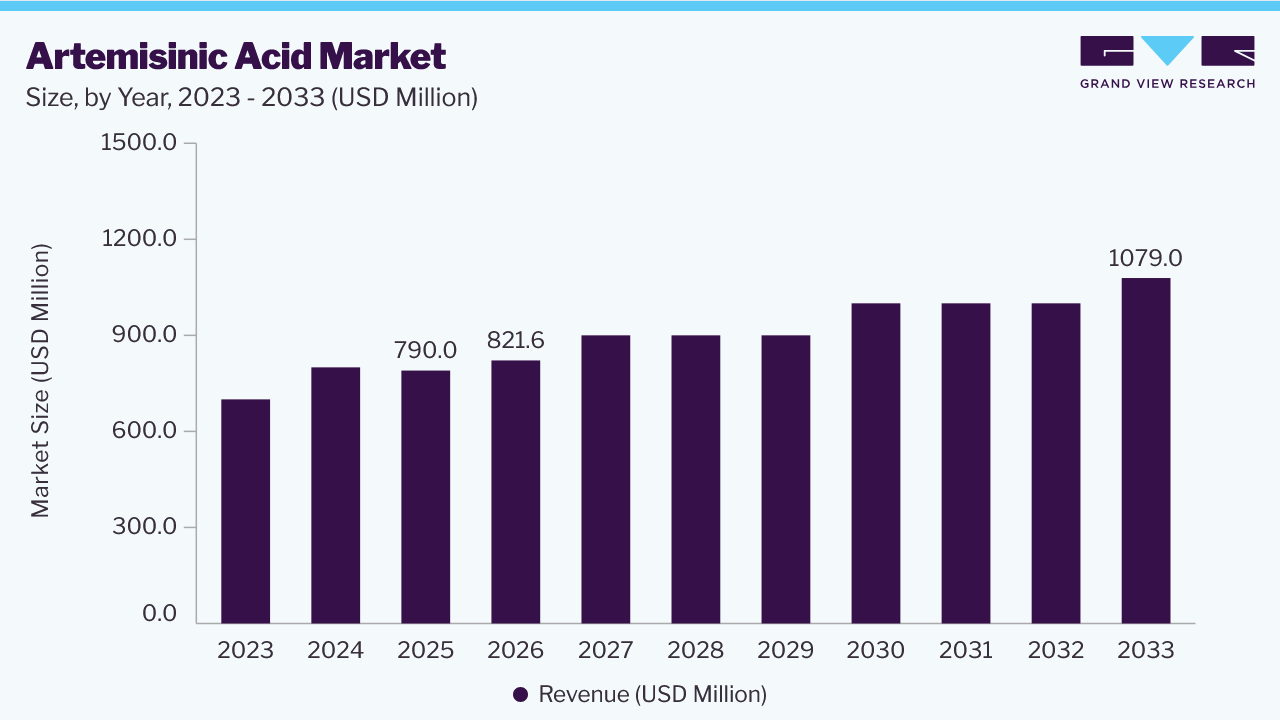
The global artemisinic acid market size was valued at USD 790.0 million in 2025 and is projected to grow from USD 821.6 million in 2026 to USD 1,079.0 million in 2033, at a CAGR of 4.0% from 2026 to 2033. Middle East & Africa dominated the global market, accounting for the largest revenue share of 57.0%% in 2025. This growth can be attributed to the high incidence of malaria, especially in developing and underdeveloped economies; initiatives by public organizations to raise awareness of malaria treatment; and increased research into malaria treatment, which are expected to drive the market over the forecast period.
Key Market Trends & Insights
- By type: The antimalarial tablets segment held the largest market share of over 80.0% in 2025.
Regional Highlights
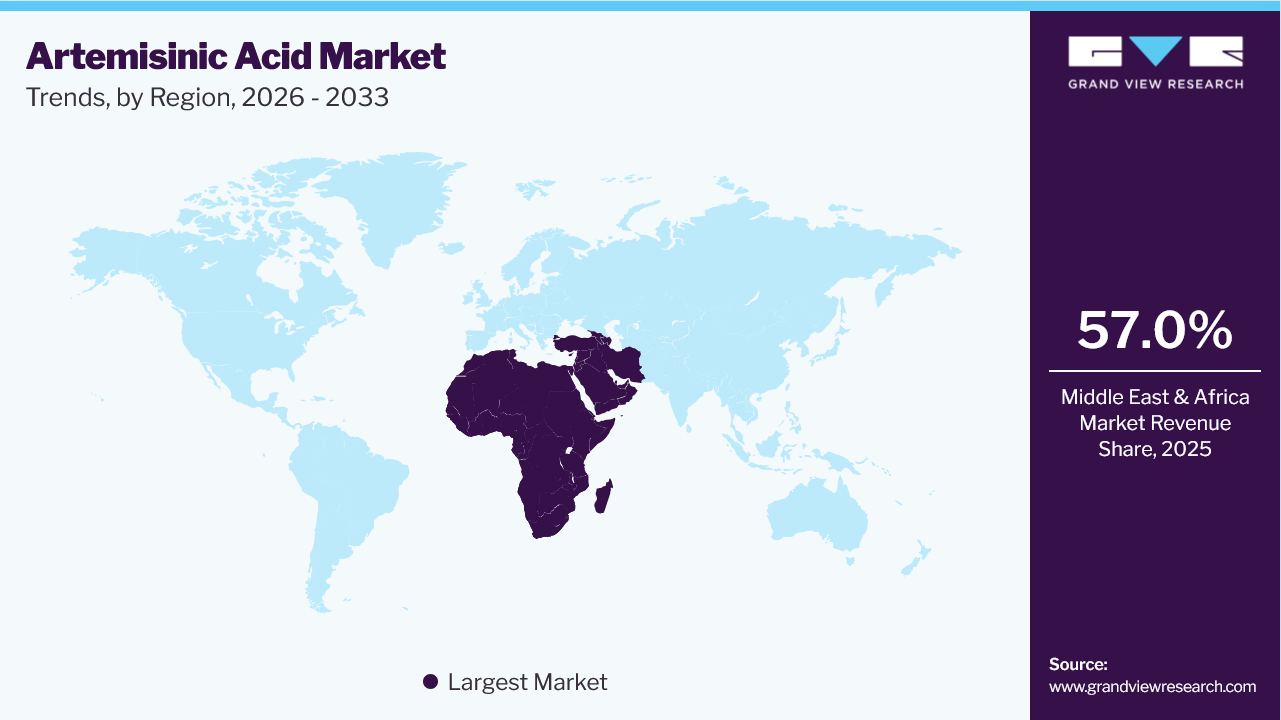
- Largest regional market: Middle East (57.0% revenue share, 2025)
Market Size & Forecast
- Market size in 2025: USD 790.0 Million
- Estimated market size in 2026: USD 821.6 Million
- Projected market size by 2033: USD 1,079.0 Million
- CAGR (2026-2033): 4.0%
Three ways to get this report
Buy it, customize it, or ask a question.Ask an Analyst
Analyst response in 1 business day
- AccessReport author, directly
- Reply timeWithin 1 working day
- No sales callDirect answer only
- FormatEmail reply
- CostFree, no cost
Get the Full Report
What the study covers
- FormatsPDF · Excel · Dashboard
- Timeline2023–2033 annual, 2022 base
- Coverage20+ countries, 5 regions
- Companies10+ key players profiled
Customize the Report
20% free customization
- IncludeCountries, segments, points
- TailorTo your product definition
- ExtendDeeper competitor detail
- OrA fully bespoke study
- Turnaround5–10 working days
Malaria is a life-threatening disease. According to the World Health Organization (WHO), there were approximately 282 million cases and 610 000 malaria fatalities worldwide in 2024. This high disease burden is expected to increase demand for new treatment options and create opportunities for artemisinin-based therapies.
 Source: Grand View Research, IR Documents, Primary Interviews, Paid DatabasesTo learn more about this report,
 Download Free Sample Report
 Public organizations across the globe have taken initiatives to improve access to effective malaria treatment and reduce deaths associated with the disease. For instance, in December 2024, the World Health Organization (WHO) published the World Malaria Report 2024, highlighting the need to expand access to malaria prevention, diagnosis, and treatment services to accelerate progress toward global malaria reduction targets, particularly in high-burden countries. Such initiatives by public organizations to provide treatment at low cost are expected to increase demand for treatments such as artemisinin acid, thereby supporting market growth.
In endemic countries around the globe, artemisinin-based combination therapies (ACT) are currently used as the first line of malaria treatment. Artemisinin is made by synthesizing artemisinic acid. The high use of Artemisinin and the cost-effectiveness of Artemisinin prepared from artemisinic acid are expected to drive demand for artemisinic acid production for treating malaria. This is also expected to improve its adoption, especially in endemic countries, thereby supporting market growth.
Market Dynamics
The industry is expanding steadily, driven by rising global demand for artemisinin-based combination therapies (ACTs) and the growing emphasis on plant-derived pharmaceutical intermediates. Increasing incidences of malaria in endemic regions, combined with sustained efforts by international health organizations and national governments to expand access to ACTs, are reinforcing demand for artemisinic acid as a critical biosynthetic precursor. The growing adoption of synthetic biology and microbial fermentation technologies is further transforming production scalability and cost efficiency, strengthening the market's long-term supply outlook.
The escalating burden of malaria across sub-Saharan Africa, South Asia, and Southeast Asia is a primary driver of the artemisinin acid market. The World Health Organization (WHO) reported approximately 282 million malaria cases and approximately 610,000 deaths globally in 2024, underscoring the sustained pharmaceutical demand for artemisinin-derived treatments. Artemisinic acid serves as a key precursor in the biosynthesis of artemisinin, making it central to the manufacturing of WHO-recommended ACTs. Government procurement programs and international funding mechanisms, including those supported by the U.S. President's Malaria Initiative (PMI) and the Global Fund, continue to drive large-scale ACT production, directly stimulating upstream demand for artemisinic acid across pharmaceutical supply chains.Advancements in semi-synthetic artemisinin production technologies are driving growth in the global artemisinic acid market. Pharmaceutical manufacturers are increasingly adopting microbial fermentation and synthetic biology-based production methods to reduce dependence on seasonal Artemisia annua cultivation and improve supply stability. These technologies enable more consistent yields, greater cost efficiency, and enhanced scalability, thereby strengthening the availability of artemisinin-based therapies and increasing demand for artemisinic acid as a critical intermediate in the production process.
Dependence on artemisia annua cultivation as the primary natural source of artemisinic acid exposes the market to significant supply-side vulnerabilities. Crop yields are highly sensitive to climatic conditions, soil quality, and regional agricultural capacity, leading to price volatility and periodic supply shortfalls. The U.S. Department of Agriculture (USDA) has highlighted the susceptibility of specialty botanical crops to seasonal disruptions, which directly impacts the consistency of artemisinic acid availability for pharmaceutical manufacturers. In addition, the absence of harmonized international quality and purity standards for botanical-derived pharmaceutical intermediates increases regulatory compliance complexity and raises production costs across global markets.
The increasing adoption of semi-synthetic methods for artemisinin production poses a challenge to traditional artemisinic acid supply chains. Advances in synthetic biology and microbial fermentation technologies enable pharmaceutical companies to produce artemisinin more efficiently and with reduced reliance on agricultural feedstock. As these alternative production pathways become more commercially viable, demand for naturally sourced artemisinic acid may face pressure, potentially limiting market growth opportunities for conventional producers.
The advancement of synthetic biology and microbial fermentation technologies presents a significant growth opportunity for the artemisinic acid market. Pharmaceutical companies and research organizations are increasingly investing in fermentation-based production methods that utilize engineered microorganisms to produce artemisinic acid more efficiently and consistently than traditional agricultural cultivation. These technologies help reduce dependence on Artemisia annua crop yields, improve supply chain stability, and enable scalable production to meet the growing global demand for artemisinin-based antimalarial therapies. As manufacturers seek to enhance production efficiency and mitigate risks in raw material supply, the adoption of semi-synthetic production pathways is expected to create substantial opportunities for market expansion.
Beyond malaria, emerging research into the anti-cancer, antiviral, and anti-inflammatory properties of artemisinin derivatives is broadening the pharmaceutical application pipeline for artemisinic acid. The U.S. National Institutes of Health (NIH) National Cancer Institute has investigational studies on artemisinins as potential adjunct oncology agents, reflecting growing institutional interest in expanding the therapeutic utility of artemisinin-derived compounds. Government health agencies across Asia-Pacific, particularly in China and India, the two largest producers of Artemisia annua, are actively supporting botanical pharmaceutical manufacturing through policy incentives and export promotion frameworks, creating a favorable environment for market expansion throughout the forecast period.
Analyst Perspective
The artemisinin market is witnessing stable growth, driven by the continued global burden of malaria and rising demand for artemisinin-based combination therapies (ACTs). Increasing investments in malaria control programs and advancements in semi-synthetic production technologies are improving supply reliability and market growth. Despite challenges such as raw material dependence and regulatory requirements, sustained efforts to eliminate malaria are expected to support long-term market expansion, particularly in endemic regions.
Type Insights
Based on type, the antimalarial tablets segment led the market with the largest revenue share of over 80.0% in 2025and is also expected to grow at the fastest CAGR over the forecast period. Tablets are an oral way of drug administration. Tablets are self-administering and do not require a trained physician for drug administration, which is one of the major reasons for the high acceptance of tablet formulations. Moreover, tablet formulations offer high patient compliance, accurate dosing, control of drug release, and stability. This further improves the demand for antimalarial tablet formulations in the market. In addition, the widespread use of artemisinin-based combination therapies (ACTs) in tablet form as the standard treatment for uncomplicated malaria is further supporting segment growth.
The antimalarial injection segment is expected to witness a considerable growth rate over the forecast period. Antimalarial injections are used for severe malaria cases, especially during the time of emergencies. The high bioavailability of injectable formulations, which leads to immediate onset of action, is the primary factor driving demand in the market. The high number of hospitalizations due to malaria worldwide is expected to further boost the segment's market growth. In addition, increasing government efforts to improve access to lifesaving malaria treatments in hospitals and emergency care settings are supporting the adoption of injectable antimalarial therapies.
Regional Insights
Middle East & Africa artemisinic acid market held the largest share of around 57.0% in 2025 and is also expected to grow at the fastest CAGR of over 4.0% over the forecast period. Africa is one of the major countries which suffers significantly from malaria. For instance, UNICEF reports that every minute a child under 5 years dies from malaria in Africa. In MEA, public organizations are keen to provide treatment to reduce the number of deaths associated with the disease.
 To learn more about this report, Download Free Sample Report
 According to the WHO's World Malaria Report 2024, the WHO African Region accounted for approximately 94% of global malaria cases and 95% of malaria-related deaths in 2023. The continued concentration of the disease burden across African countries has prompted governments, international health agencies, and donor organizations to strengthen malaria prevention, diagnosis, and treatment programs. The high prevalence of malaria and sustained investments in antimalarial interventions are supporting the growth of the regional market.
Asia Pacific Artemisinic Acid Market Trends
The artemisinic acid market in Asia Pacific accounted for the second-largest share in 2025. Countries such as India, Pakistan, Indonesia, and others suffer from a high burden of malaria cases in the region. India is known for the world's third-highest malaria burden. The initiatives taken by public organizations in APAC countries to reduce the burden of malaria and ensure proper treatment are expected to boost the market in the Asia Pacific. For instance, in 2024, the Government of India launched the National Strategic Plan for Malaria Elimination (2023-2027), which focuses on enhanced surveillance, universal access to diagnosis and treatment, and a Test, Treat, and Track approach, aiming to achieve zero indigenous malaria cases by 2027.
Key Artemisinic Acid Company Insights
Market players are undertaking various strategic initiatives, such as launching new products, entering into partnerships, and pursuing mergers and acquisitions, to strengthen their product portfolios and gain a competitive advantage. For instance, dōTERRA announced four new wellness innovations during its Global Convention, including RevitaZen+ Advanced Organ Detoxification Complex. The launch expanded the company's portfolio of botanical and essential oil-based wellness products and reinforced its focus on product innovation in the natural wellness space.
Key Aromatherapy Carrier Oil Companies
Some of the key players operating in the artemisinic acid market are:
-
Sanofi
-
KPC Pharmaceuticals, Inc
-
Shanghai Fosun Pharmaceutical (Group) Co., Ltd.
-
Calyx Chemicals and Pharmaceuticals Ltd.
-
Novartis AG
-
Ipca Laboratories Ltd.
-
Cipla.
-
SHINPOONG.CO,.LTD
-
Hostinger
-
AdvaCare Pharma
Recent Developments
-
In May 2025, a paper published by the National Library of Medicine outlines the integration of supercritical CO₂ extraction from the Artemisia annua plant. This is expected to enhance microbial fermentation, thereby improving overall production efficiency and purity.
-
In April 2025, a paper from the National Library of Medicine identified and engineered dihydroartemisinic acid dehydrogenase (AaDHAADH) enzyme. This enzyme enables direct, bidirectional conversion between artemisinic acid and dihydroartemisinic acid. This will help boost yields in engineered yeast.
Artemisinic Acid Market Report Scope
Report Attribute
Details
Market size in 2025
USD 790.0 million
Estimated market size in 2026
USD 821.6 million
Projected market size by 2033
USD 1,079.0 million
Growth rate
CAGR of 4.0% from 2026 to 2033
Base year for estimation
2025
Actual data
2021 - 2024
Forecast period
2026 - 2033
Quantitative units
Revenue in USD million/billion, and CAGR from 2026 to 2033
Report coverage
Revenue forecast, company ranking, competitive landscape, growth factors, and trends
Segments covered
Type, region
Regional scope
North America; Europe; Asia Pacific; Central & South America; Middle East & Africa
Country scope
U.S.; Canada; UK; Germany; France; Italy; Spain; Denmark; Sweden; Norway; China; India; Japan; South Korea; Thailand; Australia; Pakistan; Indonesia; Vietnam; Colombia; Brazil; Mexico; Argentina; South Africa; UAE; Saudi Arabia; Nigeria; Democratic Republic of Congo; Mali; Uganda; Kenya; Kuwait
Key companies profiled
Sanofi; KPC Pharmaceuticals, Inc.; Shanghai Fosun Pharmaceutical (Group) Co., Ltd.; Calyx Chemicals and Pharmaceuticals Ltd.; Novartis AG; Ipca Laboratories Ltd.; Cipla Inc.; ShinPoong Pharm Co., Ltd.; Hostinger; AdvacarePharma
Customization scope
Free report customization (equivalent up to 8 analysts working days) with purchase. Addition or alteration to country, regional & segment scope.
Pricing and purchase options
Avail of customized purchase options to meet your exact research needs. Explore purchase options
Global Artemisinic Acid Market Report Segmentation
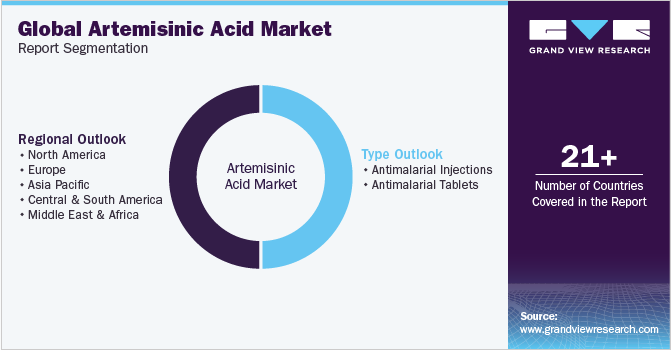
This report forecasts revenue growth at the global, regional, and country levels and provides an analysis on the latest industry trends and opportunities in each of the sub-segments from 2021 to 2033. For this study, Grand View Research has segmented the global artemisinic acid market report on the basis of type and region
 To learn more about this report, Download Free Sample Report
 -
Type Outlook (Revenue, USD Million, 2021 - 2033)
-
Antimalarial Injections
-
Antimalarial Tablets
-
-
Regional Outlook (Revenue, USD Million, 2021 - 2033)
-
North America
-
U.S.
-
Canada
-
-
Europe
-
U.K.
-
Germany
-
France
-
Italy
-
Spain
-
Denmark
-
Sweden
-
Norway
-
-
Asia Pacific
-
China
-
India
-
Japan
-
South Korea
-
Thailand
-
Australia
-
Pakistan
-
Indonesia
-
Vietnam
-
-
Central & South America
-
Mexico
-
Argentina
-
Colombia
-
Brazil
-
-
Middle East & Africa
-
South Africa
-
Saudi Arabia
-
UAE
-
Kuwait
-
Nigeria
-
Democratic Republic of Congo
-
Mali
-
Uganda
-
Kenya
-
-
Frequently Asked Questions About This Report
The global artemisinic acid market size was valued at USD 790.0 million in 2025 and is estimated at USD 821.6 million in 2026.
The global artemisinic acid market is expected to grow at a CAGR of 4.0% from 2023 to 2030, reaching USD 1,079.0 million.
Middle East and Africa dominated the artemisinic acid market with a share of 57.0% in 2025.
Some key players operating in the artemisinic acid market include Sanofi, KPC Pharmaceuticals, Inc, Guilin Pharmaceutical Co., Ltd., Calyx Chemicals and Pharmaceuticals Ltd., Novartis AG, Ipca Laboratories Ltd., and Cipla, Inc.
Antimalarial tablets segment dominated the container security market with a share of 80.0% in 2025, while antimalarial injection is the fastest-growing segment.
About the Author(s)
Pharmaceuticals Research Team
Healthcare · PharmaceuticalsThis report was authored by the pharmaceuticals research team at Grand View Research - comprising two research analysts, one senior research analyst, and one industry expert - with specialized expertise in the pharmaceuticals segment of the healthcare industry. All findings are based on proprietary healthcare databases, executive interviews, and regulatory analysis, subject to internal peer review prior to publication.
Last Updated:
Speak to Analyst

Customize this report to your needs - add regions, segments, or data points, with 20% free customization.
Or view our licence options:


ISO 9001:2015 & 27001:2022 Certified
We are GDPR and CCPA compliant! Your transaction & personal information is safe and secure. For more details, please read our privacy policy.


