
- Home
- »
- Medical Devices
- »
-
Arthroscopy Market Size, Share & Trends Report, 2026-2033GVR Report cover

Arthroscopy Market (2026 - 2033)
Size, Share & Trends Analysis Report By Product (Visualization Systems, Fluid Management Systems, Ablation Systems, Powered Shaver Systems, Arthroscopes), By Application (Hip, Knee, Shoulder, Elbow), By Region, And Segment Forecasts
Market Size, 2025
$6.6BMarket Estimate, 2026
$6.8BMarket Forecast, 2033
$8.5BCAGR, 2026–2033
3.4%Arthroscopy Market Summary
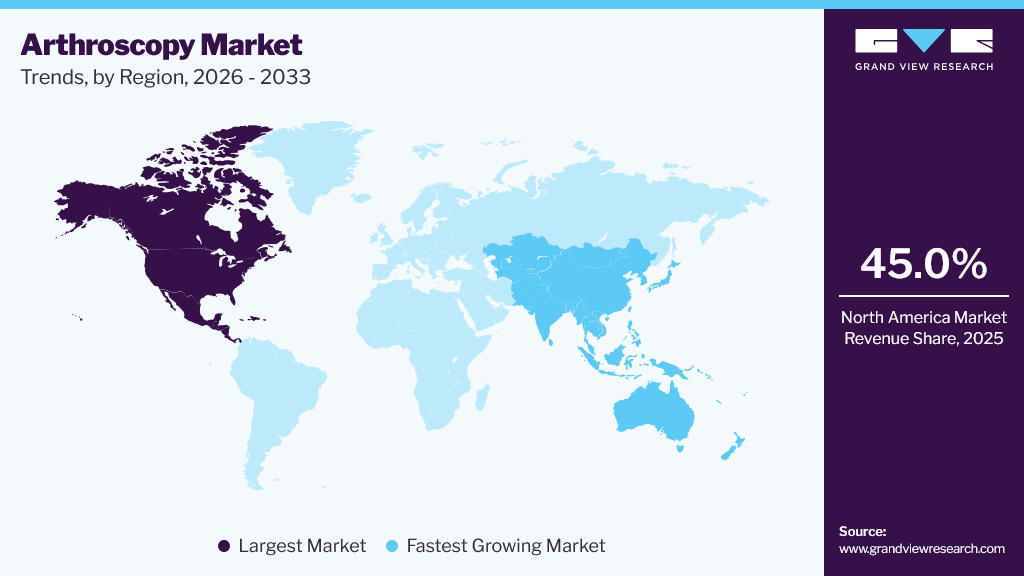
The global arthroscopy market size was valued at USD 6.6 billion in 2025 and is projected to grow from USD 6.8 billion in 2026 to USD 8.5 billion by 2033, growing at a CAGR of 3.4% from 2026 to 2033. North America dominated the market, accounting for a revenue share of 45.0% in 2025. The rising geriatric population is a key driver, as this age group is more prone to injuries requiring arthroscopic procedures. According to a March 2025 report in The Journal of Arthroscopic & Related Surgery, a large population-based study (over 300,000 patients aged >50 years) found that knee arthroscopy is frequently performed in older patients.
Key Market Trends & Insights
- By product: The arthroscope implants segment accounted for over 45.0% market share in 2025.
- By application: The knee segment held the largest market share in 2025.
Regional Highlights
- Largest regional market: North America (45.0% revenue share, 2025)
- Fastest-growing regional market: Asia Pacific (highest CAGR, 2026-2033)
Market Size & Forecast
- Market size in 2025: USD 6.6 Billion
- Estimated market size in 2026: USD 6.8 Billion
- Projected market size by 2033: USD 8.5 Billion
- CAGR (2026-2033): 3.4%
Three ways to get this report
Buy it, customize it, or ask a question.Ask an Analyst
Analyst response in 1 business day
- AccessReport author, directly
- Reply timeWithin 1 working day
- No sales callDirect answer only
- FormatEmail reply
- CostFree, no cost
Get the Full Report
What the study covers
- FormatsPDF · Excel · Dashboard
- Timeline2026–2033 annual, 2025 base
- Coverage20+ countries, 5 regions
- Companies10+ key players profiled
Customize the Report
20% free customization
- IncludeCountries, segments, points
- TailorTo your product definition
- ExtendDeeper competitor detail
- OrA fully bespoke study
- Turnaround5–10 working days
Sportspersons and athletes frequently suffer from sports-related injuries such as torn ligaments, meniscus tears, and cartilage tears; arthroscopy effectively treats them accurately and allows athletes to return to their sports quickly. Meniscus tear is the most common sports injury. One of the most common arthroscopic procedures is meniscus arthroscopy. A soft, C-shaped piece of cartilage called the meniscus acts as a cushion between the shinbone and the thighbone. Many basic actions, such as walking and stair climbing, depend on the proper function of the meniscus.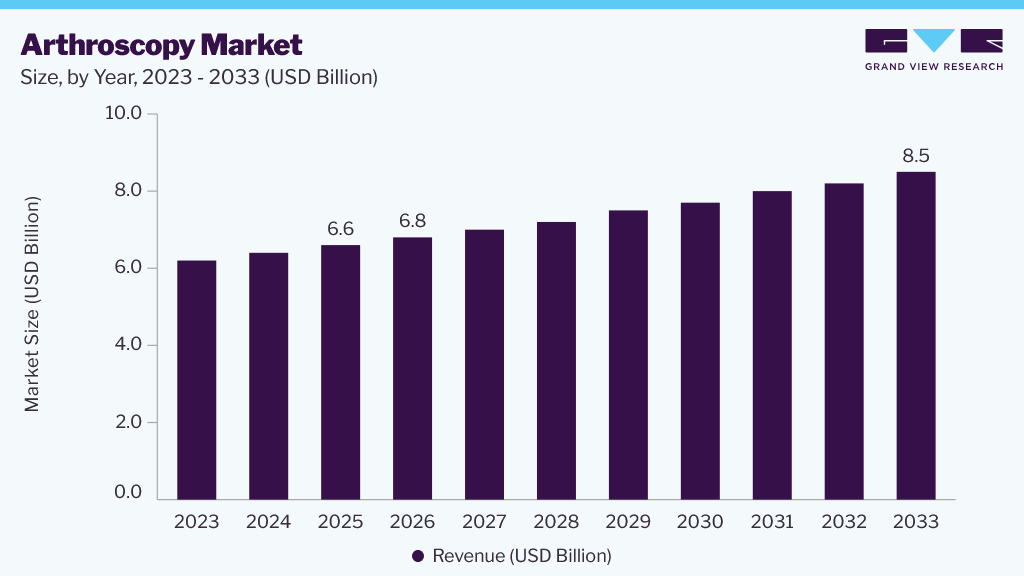 Source: Grand View Research, IR Documents, Primary Interviews, Paid DatabasesTo learn more about this report,
 Download Free Sample Report
 Osteoarthritis, a degenerative condition affecting one or more joints, affects approximately 30 million Americans. Around a million people have rheumatoid arthritis (RA), and around 750,000 of the over two million arthroscopic procedures in the U.S. each year include knee surgery.
Visualization systems are used to identify the injury at the joint site. The images can be displayed in 3D format with technological innovations at the forefront. Furthermore, the rise in the use of fluid management systems to optimize the visualization process will spur demand.
Market Dynamics
The market is driven by the increasing prevalence of musculoskeletal disorders, rising sports-related injuries, and the growing aging population. The demand for minimally invasive procedures is increasing due to benefits such as greater surgical precision, faster recovery, and shorter hospital stays. In addition, technological advancements in arthroscopic imaging and surgical instruments are further supporting market growth. However, the market is restrained by the high cost of arthroscopic equipment and procedures.
The increasing prevalence of musculoskeletal disorders is a major market driver. Conditions such as ligament tears, meniscal injuries, cartilage damage, rotator cuff tears, shoulder instability, and osteoarthritis are becoming more common due to greater participation in sports and physical activities, sedentary lifestyles, obesity, and the growing elderly population. Arthroscopy has emerged as a preferred treatment option because it is a minimally invasive procedure that enables surgeons to diagnose and treat joint disorders with greater precision through small incisions. These advantages have increased patient preference for arthroscopic interventions and encouraged healthcare providers to adopt advanced arthroscopic technologies. The procedure is widely used for knee, shoulder, hip, ankle, elbow, and wrist disorders, further expanding its application across orthopedic care settings.
The growing burden of musculoskeletal diseases worldwide is driving an increase in orthopedic consultations and surgical interventions. According to an article published in October 2024 by PLoS One, it is found that over half of older Indian adults (> 60 years) have musculoskeletal disorders, highlighting the substantial disease burden in the country.
The high cost of arthroscopic equipment and procedures is a major market restraint. Arthroscopy requires a wide range of advanced and specialized instruments, including high-definition imaging systems, light sources, camera units, surgical hand tools, shavers, and radiofrequency devices. The initial capital investment required to establish an arthroscopy setup is very high, often making it unaffordable for small and medium-sized hospitals, particularly in developing and low-income regions. As a result, the adoption of arthroscopic procedures remains concentrated in large hospitals and well-equipped healthcare centers. In addition to the high equipment cost, the overall procedure cost is also significant.
Arthroscopic surgeries often involve expensive disposable instruments, implants, and accessories, along with high maintenance costs for delicate and sophisticated equipment. These recurring expenses increase the total cost burden on healthcare providers, potentially limiting the frequency of procedures and reducing profitability for medical facilities. Another important factor contributing to this restraint is the limited or partial reimbursement coverage in many healthcare systems. In several countries, insurance providers do not fully cover arthroscopic procedures or related implants, thereby increasing patients' out-of-pocket expenses.
Analyst Perspective
The market is growing due to the increasing prevalence of joint disorders, sports injuries, and age-related musculoskeletal conditions. Arthroscopy is widely preferred because it is a minimally invasive procedure that enables faster recovery, reduced pain, and shorter hospital stays compared to traditional surgical methods. The growing number of knee, shoulder, and hip procedures, along with rising demand for advanced orthopedic treatments, is supporting market growth. In addition, technological advancements in arthroscopic instruments, visualization systems, and robotic-assisted surgery are improving surgical accuracy and patient outcomes.
Application Insights
The knee segment led the market, accounting for over 40.0% of revenue in 2025. This large share is attributed to the growing geriatric population and increasing incidence rate of injuries such as ligament tears, meniscal damage, and osteoarthritis. According to the Panorama Orthopedic & Spine report, ACL (anterior cruciate ligament) injuries represent a major contributor to knee arthroscopy demand, with approximately 400,000 ACL injuries occurring annually in the U.S. The high burden of ACL injuries significantly contributes to procedural volumes, as arthroscopy remains the preferred surgical approach for ligament reconstruction and soft tissue repair due to its minimally invasive nature.
The elbow segment is expected to witness the fastest CAGR during the forecast period, owing to the increasing number of Rheumatoid arthritis cases in developed economies such as the U.S. and other developing economies such as India and China. According to the Liv Hospital report, 1.3 million Americans are affected by Rheumatoid arthritis. Furthermore, the growing clinical preference for minimally invasive techniques, coupled with advancements in small-joint arthroscopic instruments specifically designed for elbow procedures, is expanding the applicability of arthroscopy for complex inflammatory joint conditions. Increasing awareness of early intervention in rheumatoid arthritis, along with improved access to orthopedic care in developing regions, is further expected to accelerate procedure volumes.
Product Insights
The market is segmented into visualization systems, ablation systems, powered shaver systems, arthroscopes, fluid management systems, arthroscopy implants, accessories, and disposables. The arthroscope implants segment dominated the market in terms of revenue, with over 45.0% share in 2025. Arthroscopic implants are used in arthroscopy surgeries to reconstruct ruptured joints. These implants are very well-designed and do not require any additional bending. Their increasing adoption is driven by the growing preference for minimally invasive surgeries, which offer benefits such as reduced blood loss, faster recovery, and lower risk of infection compared to open surgical procedures.
The visualization system segment is expected to grow at the fastest CAGR over the forecast period. This is attributed to increased surgeries, as visualization systems are used to assess injury extent. Hence, irrespective of the type of surgery, visualization systems are required, which drives the market for visualization systems. For instance, Zimmer Biomet’s ZEOS Arthroscopy Tower provides a 4K HDR visualization system with enhanced color and contrast, as well as real-time image processing, specifically designed for arthroscopic and endoscopic surgeries.
Regional Insights
North America dominated the market, accounting for over 45.0% in 2025. The U.S. dominated the region in 2025 owing to advanced healthcare infrastructure, rising healthcare expenditure, and the presence of key players. The market is further supported by a high volume of orthopedic procedures and widespread adoption of minimally invasive surgical techniques. The presence of skilled orthopedic surgeons, continuous technological advancements in arthroscopy equipment, and strong investments in healthcare innovation further support market growth across North America.
 To learn more about this report, Download Free Sample Report
 Asia Pacific Arthroscopy Market Trends
The arthroscopy market in the Asia Pacific is expected to grow at the fastest CAGR over the forecast period, driven by an aging population in Japan, China, and India. According to China's 2025 population survey released in May 2026, the population aged 60 years and above reached 321.2 million, accounting for 22.9% of the total population, highlighting the country's accelerating demographic aging trend. This demographic shift is expected to boost demand for arthroscopic procedures, as older adults are more susceptible to age-related musculoskeletal disorders such as osteoarthritis, degenerative joint diseases, cartilage deterioration, and meniscal injuries.
Key Arthroscopy Company Insights
The key players in the market are undertaking strategies such as new product launches, mergers, collaborations, partnerships, and acquisitions to improve their market position.
Key Arthroscopy Companies
The following key companies have been profiled for this study on the arthroscopy market.
-
CONMED Corporation
-
Zimmer Biomet
-
Henke Sass Wolf GmbH
-
Johnson & Johnson
-
KARL STORZ SE & Co. KG
-
Arthrex, Inc.
-
Richard Wolf GmbH
-
Smith + Nephew
-
Medtronic
-
Stryker
Recent Developments
-
In December 2025, the Articulator Arthroscopic Bur was designed for arthroscopic procedures and received FDA 510(k) clearance as an arthroscopic surgical instrument.
-
In March 2023, Zimmer Biomet announced plans to unveil ZBEdge, an integrated software of digital and robotic technologies to improve efficiency and patient outcomes.
-
In March 2023, Smith + Nephew unveiled “precise in motion” in the arthroscopy sector, which uses AI technology to personalize surgery, advance efficiency, and optimize performance.
-
In January 2023, Arthrex, Inc. received FDA clearance for its product Tightrope, the only device cleared for pediatric ACL surgery. Such developments are likely to drive market growth.
Arthroscopy Market Report Scope
Report Attribute
Details
Market size in 2025
USD 6.6 billion
Estimated market size in 2026
USD 6.8 billion
Projected market size by 2033
USD 8.5 billion
Growth rate
CAGR of 3.4 % from 2026 to 2033
Historical data
2021 - 2025
Forecast period
2026 - 2033
Quantitative units
Revenue in USD billion, and CAGR from 2026 to 2033
Report coverage
Revenue forecast, company ranking, competitive landscape, growth factors, and trends
Segments covered
Product, application, region
Regional Scope
North America; Europe; Asia Pacific; Latin America; MEA
Country scope
U.S.; Canada; UK; Germany; France; Italy; Spain; Denmark; Sweden; Norway; Japan; China; India; Australia; South Korea; Thailand; Brazil; Mexico; Argentina; Saudi Arabia; South Africa; UAE; Kuwait
Key companies profiled
CONMED Corporation; Zimmer Biomet; Henke Sass Wolf GmbH; Johnson & Johnson; KARL STORZ SE & Co. KG; Arthrex, Inc.; Richard Wolf GmbH; Smith + Nephew; Medtronic; Stryker
Customization scope
Free report customization (equivalent to up to 8 analysts working days) with purchase. Addition or alteration to country, regional & segment scope.
Pricing and purchase options
Avail of customized purchase options to meet your exact research needs. Explore purchase options
Global Arthroscopy Market Report Segmentation
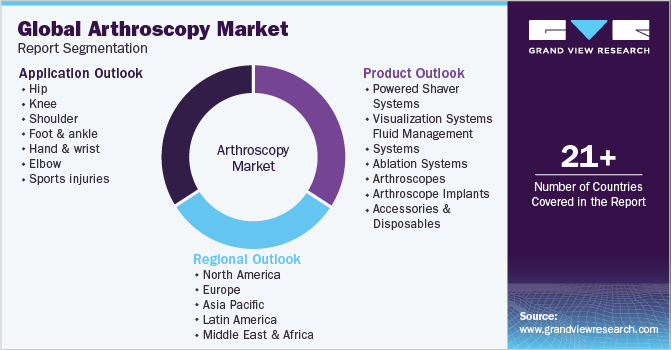
This report forecasts revenue growth at the regional and country levels and provides an analysis of the latest industry trends and opportunities in each of the sub-segments from 2021 to 2033. For this study, Grand View Research has segmented the global arthroscopy market report based on product, application, and region:
 To learn more about this report, Download Free Sample Report
 -
Product Outlook (Revenue in USD Billion, 2021 - 2033)
-
Powered Shaver Systems
-
Visualization Systems
-
Fluid Management Systems
-
Ablation Systems
-
Arthroscopes
-
Arthroscope Implants
-
Accessories And Disposables
-
-
Application Outlook (Revenue in USD Billion, 2021 - 2033)
-
Hip
-
Knee
-
Shoulder
-
Foot & ankle
-
Hand & wrist
-
Elbow
-
Sports injuries
-
-
Region Outlook (Revenue in USD Billion, 2021 - 2033)
-
North America
-
U.S.
-
Canada
-
-
Europe
-
UK
-
Germany
-
France
-
Italy
-
Spain
-
Denmark
-
Sweden
-
Norway
-
-
Asia Pacific
-
Japan
-
China
-
India
-
Australia
-
Thailand
-
South Korea
-
-
Latin America
-
Brazil
-
Mexico
-
Argentina
-
-
Middle East and Africa
-
South Africa
-
Saudi Arabia
-
UAE
-
Kuwait
-
-
Frequently Asked Questions About This Report
The global arthroscopy market size was valued at USD 6.6 billion in 2025 and is estimated at USD 6.8 billion for 2026.
The global arthroscopy market is expected to grow at a CAGR of 3.4% from 2026 to 2033, reaching USD 8.5 billion.
Key players include CONMED Corporation; Zimmer Biomet; Henke Sass Wolf GmbH; Johnson & Johnson; KARL STORZ SE & Co. KG; Arthrex, Inc.; Richard Wolf GmbH; Smith + Nephew; Medtronic; Stryker
North America dominated with a 45.0% revenue share in 2025.
Arthroscope implants dominated the arthroscopy market with a share of 45.0% in 2025.
About the Author(s)
Medical Devices Research Team
Healthcare · Medical DevicesThis report was authored by the medical devices research team at Grand View Research - comprising two research analysts, one senior research analyst, and one industry expert - with specialized expertise in the medical devices segment of the healthcare industry. All findings are based on proprietary healthcare databases, executive interviews, and regulatory analysis, subject to internal peer review prior to publication.
Last Updated:
Speak to Analyst

Customize this report to your needs - add regions, segments, or data points, with 20% free customization.
Or view our licence options:


ISO 9001:2015 & 27001:2022 Certified
We are GDPR and CCPA compliant! Your transaction & personal information is safe and secure. For more details, please read our privacy policy.


