
- Home
- »
- Next Generation Technologies
- »
-
AI Video Market Size, Share & Trends Report, 2026-2033GVR Report cover

AI Video Market (2026 - 2033)
Size, Share & Trends Analysis Report By Device (Desktop Computers, Mobile Devices, Cloud-Based Platforms), By Users (B2B, B2C), By Offering Type (Video Analysis AI, Creative AI Video Generators, Video Editing AI), By Region, And Segment Forecasts
Market Size, 2025
$4.6BMarket Estimate, 2026
$5.5BMarket Forecast, 2033
$42.3BCAGR, 2026–2033
33.7%AI Video Market Summary
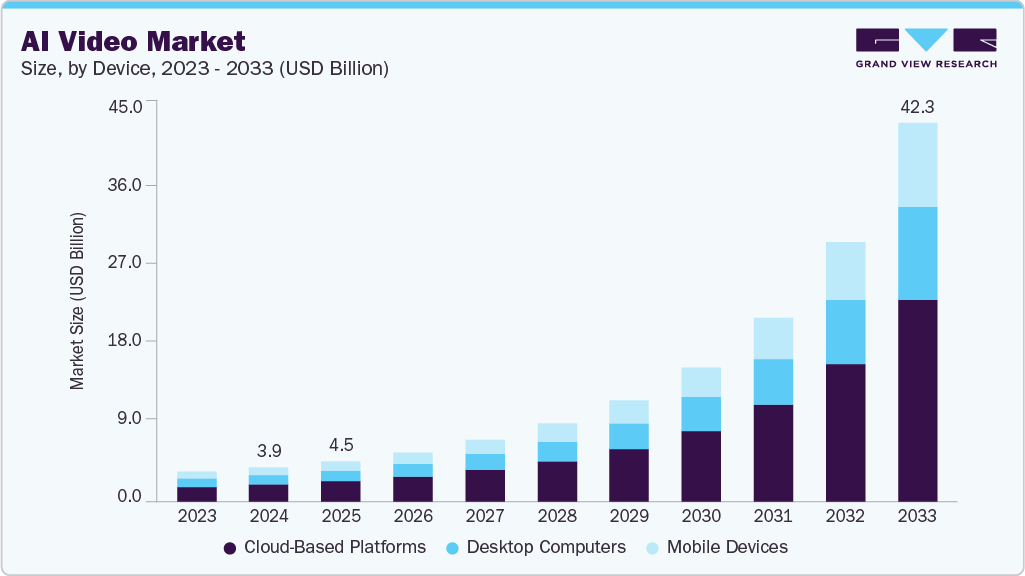
The global AI video market size was valued at USD 4.6 billion in 2025 and is projected to grow from USD 5.5 billion in 2026 to USD 42.3 billion by 2033, at a CAGR of 33.7% from 2026 to 2033. North America dominated the AI video market with the largest revenue share of 34.6% in 2025. The AI video market is witnessing significant expansion as businesses increasingly integrate generative AI into their content development processes.
 Source: Grand View Research, IR Documents, Primary Interviews, Paid DatabasesTo learn more about this report,
 Download Free Sample Report
 Key Market Trends & Insights
- By device: Cloud-based platforms segment held a significant 51.2% revenue share in 2025.
- By users: B2B (Enterprise) segment held the largest revenue share in 2025.
- By Offering Type: Video analysis AI segment held a significant 40.4% revenue share in 2025.
Regional Highlights
- Largest regional market: North America (34.6% revenue share, 2025)
- Fastest growing regional market: Asia Pacific (highest CAGR, 2026-2033)
- By country: The U.S. held the largest market share in 2025.
Market Size & Forecast
- Market size in 2025: USD 4.6 Billion
- Estimated market size in 2026: USD 5.5 Billion
- Projected market size by 2033: USD 42.3 Billion
- CAGR (2026-2033): 33.7%
Three ways to get this report
Buy it, customize it, or ask a question.Ask an Analyst
A direct answer, usually in 1 working day
- AccessReport author, directly
- Reply timeWithin 1 working day
- No sales callDirect answer only
- FormatEmail reply
- CostFree, no cost
Get the Full Report
What the study covers
- FormatsPDF · Excel · Dashboard
- Timeline2026–2033 annual, 2025 base
- Coverage20+ countries, 5 regions
- Companies10+ key players profiled
Customize the Report
20% free customization
- IncludeCountries, segments, points
- TailorTo your product definition
- ExtendDeeper competitor detail
- OrA fully bespoke study
- Turnaround5–10 working days
AI-driven video solutions are helping organizations create content more efficiently while lowering production time and costs. Rising demand for scalable and personalized video experiences is further accelerating market growth. As businesses increasingly seek innovative ways to engage audiences, AI-powered video tools are becoming indispensable. This growth is evident in various sectors, including marketing, entertainment, and education, where personalized and automated video content is enhancing user experiences. The rise of AI-driven video editing platforms allows for simplified content creation, reducing the need for extensive manual input and accelerating production timelines. Moreover, AI's capabilities in video analytics are providing deeper insights into viewer behavior and content effectiveness. Companies are utilizing these insights to refine their strategies and improve ROI. The overall market is projected to continue its upward trajectory as AI technologies evolve, and new applications emerge.Consumer demand for high-quality, engaging video content is a major factor propelling the growth of the AI video market. With the proliferation of digital platforms and social media, users expect increasingly polished and personalized video experiences. AI technologies are meeting these expectations by providing tools that automate video production, enhance content relevance, and improve viewer engagement. The ability to generate and manipulate video content with AI saves time and allows for more creative and targeted approaches. As content creators and marketers strive to stand out in a crowded digital space, AI solutions offer significant competitive advantages. This demand is also being fueled by the growing use of video in e-commerce, remote work, and virtual events. The increasing reliance on video across various domains shows the importance of AI in shaping the future of digital content.
 To learn more about this report, Download Free Sample Report
 AI’s role in video security and content moderation is becoming increasingly crucial as the volume of video content continues to grow. With the rise of user-generated content and live streaming, ensuring the safety and appropriateness of videos is a significant challenge. AI-powered systems are being employed to detect and filter out harmful content, including hate speech, misinformation, and explicit material. These systems use advanced algorithms to analyze video footage and flag inappropriate content with high accuracy. By improving the effectiveness of content moderation, AI is helping platforms maintain a safe environment for users. Moreover, AI-driven security measures protect against unauthorized access and piracy. The enhancement of video security through AI is essential for maintaining trust and compliance in the digital video ecosystem, ensuring that platforms can scale their operations while upholding community standards.
The AI video market is experiencing significant innovation, with advancements in content creation, such as automated editing and special effects. Deepfake technology and synthetic media are pushing the boundaries of realism in video production. AI-driven personalization enhances user experience by customizing recommendations and content to individual preferences. Real-time video processing enables features like virtual backgrounds and live enhancements, revolutionizing streaming and virtual interactions. Moreover, AI's capabilities in automated video analysis improve tasks like security monitoring and content moderation, driving efficiency and new applications.
Market Dynamics
The AI video market is experiencing strong growth due to increasing adoption of generative AI technologies for content creation, marketing, training, and entertainment applications. Organizations are using AI-powered video platforms to reduce production time, lower costs, and deliver personalized content at scale. Growing demand for multilingual and customized video experiences is creating new opportunities across industries. At the same time, concerns related to deepfakes, copyright issues, data privacy, and content authenticity remain key challenges for broader adoption. Continuous advancements in text-to-video generation, AI avatars, and video editing capabilities are supporting the ongoing expansion of the AI Video market worldwide.
The demand for personalized video content is increasing across marketing, advertising, and customer engagement activities. Organizations are using AI video platforms to create content tailored to individual customer preferences and behaviors. Personalized videos help improve audience engagement and communication effectiveness. AI-powered tools enable faster content customization without significantly increasing production costs. This trend is encouraging broader adoption of AI video solutions across industries.
The need for multilingual video content is growing as organizations expand their presence across international markets. Businesses are seeking efficient ways to deliver content in multiple languages while maintaining message consistency. AI video platforms support automated translation, voice synthesis, and content localization. These capabilities help reduce the time and resources required for multilingual content production. Demand for AI-driven video localization solutions continues to increase.
The increasing use of AI-generated videos has raised concerns about deepfakes and content authenticity. AI tools can create highly realistic videos that may be used to spread misinformation or manipulate public opinion. This has created challenges for organizations seeking to maintain trust and credibility. Governments and regulatory bodies are introducing measures to address the misuse of synthetic media. These concerns may slow down the adoption of AI video technologies in certain applications.
Copyright and data privacy concerns continue to affect the AI Video market. Questions regarding the use of copyrighted content for AI model training and content generation have led to legal and regulatory scrutiny. Organizations must also ensure that personal and sensitive data is handled securely when using AI-powered video platforms. Compliance with evolving data protection regulations can increase operational complexity. These challenges may limit adoption among organizations with strict legal and compliance requirements.
The increasing adoption of digital learning platforms is creating significant opportunities for AI video solutions in the education sector. Educational institutions, training providers, and enterprises are using AI-generated videos to develop engaging learning materials and instructional content. AI-powered tools help automate video creation, reducing the time and resources required for content development. These capabilities enable organizations to scale educational content efficiently across different subjects and audiences. As online and hybrid learning models continue to expand, demand for AI video solutions is expected to increase.
AI video technologies also support personalized and multilingual learning experiences, improving accessibility for diverse learner groups. Features such as automated translation, voice synthesis, and AI avatars help deliver content in multiple languages and formats. Organizations can use these tools to create customized training programs that address specific learning needs. Enhanced learner engagement and improved content accessibility are encouraging broader adoption of AI-generated educational videos. This trend is creating new growth opportunities for AI video platform providers in the education and e-learning market.
Market Concentration & Characteristics
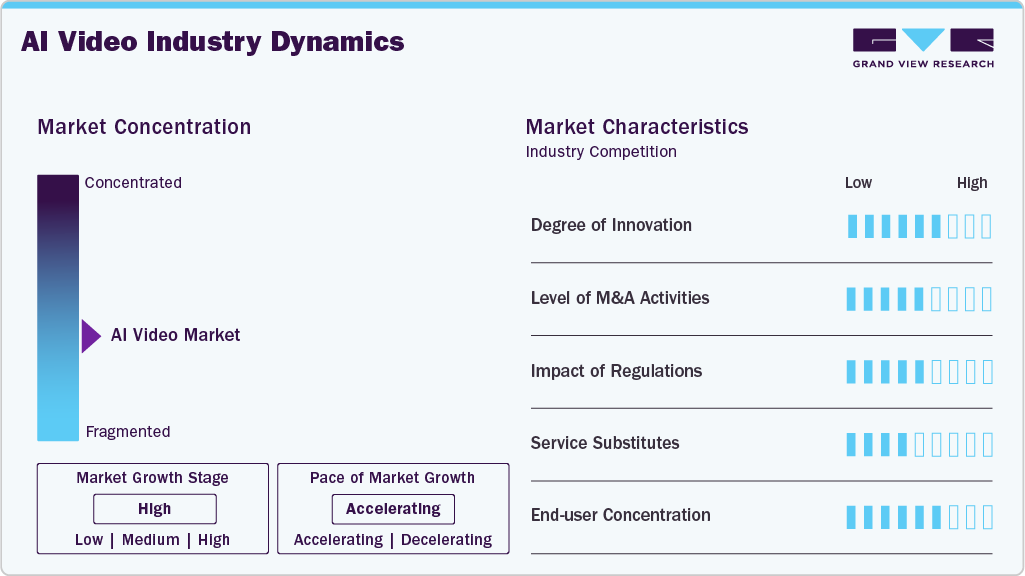
The AI Video market is moderately fragmented, with many technology providers competing across text-to-video generation, AI avatars, video editing, and content localization. While a few companies have established strong market positions, no single vendor dominates the market across all application areas. The presence of numerous startups and specialized solution providers contributes to a highly competitive environment. The market is currently in a high-growth stage, supported by increasing adoption of generative AI technologies across industries. Growth is accelerating as organizations expand the use of AI-powered video solutions for content creation, marketing, training, and customer engagement.
 To learn more about this report, Download Free Sample Report
 The AI Video market is characterized by a high degree of innovation driven by continuous advancements in generative AI models, AI avatars, and video generation capabilities. Industry competition remains high due to the presence of established technology firms, emerging startups, and niche solution providers. Merger and acquisition activity is currently moderate, as companies seek to strengthen technology capabilities and expand market reach. Regulations have a moderate to high impact on the market because of concerns related to deepfakes, copyright compliance, data privacy, and content authenticity. Service substitutes and end-user concentration remain relatively low, as AI video solutions address diverse use cases across multiple industries and customer groups.
Analyst Perspective
The AI Video market is gaining momentum as organizations increasingly use generative AI to create video content faster and more efficiently. Businesses across marketing, education, media, and enterprise communications are adopting AI video tools to improve productivity and reduce content production costs. Ongoing improvements in text-to-video generation, AI avatars, and video editing capabilities are making these solutions more accessible and practical for a wider range of users. Demand for personalized and multilingual video content continues to create new growth opportunities across industries. Despite concerns related to content authenticity, copyright, and data privacy, the market is expected to maintain strong growth as AI video technologies continue to evolve.
Device Insights
Based on device, the Cloud-Based platforms segment led the market with the significant revenue share of 51.2% in 2025. Cloud-based platforms are rapidly growing in the AI video market due to their scalability, cost efficiency, and advanced AI services. These platforms enable businesses to handle large volumes of video data and processing tasks without heavy upfront investments, utilizing pay-as-you-go models to manage costs. They offer integrated AI tools for tasks like automated editing and content analysis, simplify collaboration across distributed teams, and continuously update with the latest innovations. This growth shows the cloud's ability to provide flexible, advanced solutions that meet the dynamic needs of video content creators and enterprises.
The mobile devices segment is projected to grow significantly over the forecast period. Mobile devices are significantly expanding their role in the AI video market due to advancements in processing power and camera technology. AI-driven applications on these devices enable real-time video editing, enhanced image recognition, and sophisticated augmented reality experiences. The proliferation of high-resolution displays and powerful GPUs in mobile devices supports more immersive and interactive video content. Moreover, the accessibility and portability of these devices make advanced AI video tools more available to a broader audience. As AI technology continues to evolve, mobile devices are expected to drive further innovation and growth in the video market.
Users Insights
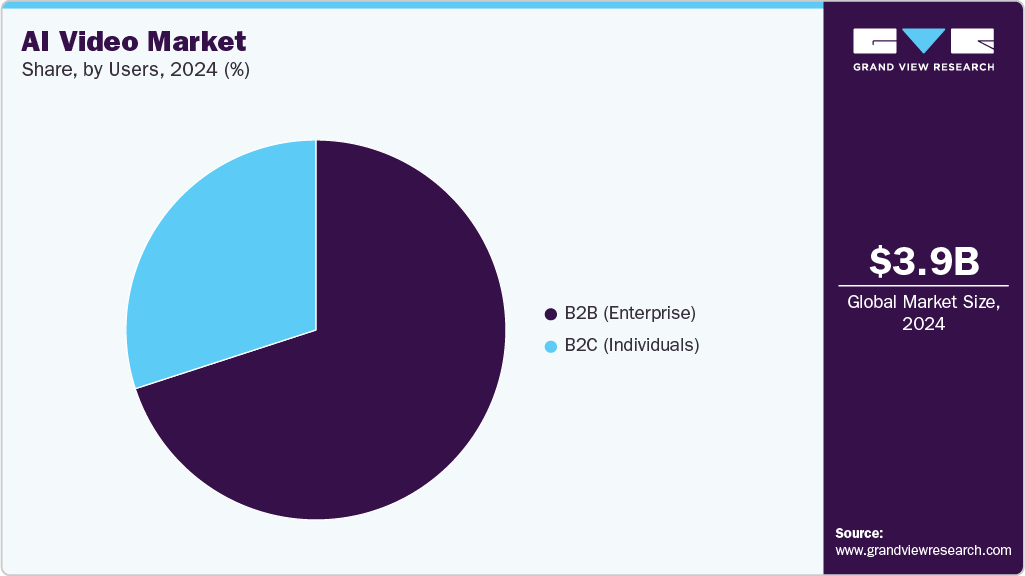
Based on users, the B2B (Enterprise) segment led the market with the largest revenue share of 69.4% in 2025. The B2B sector dominates the AI video market due to its substantial need for advanced video analytics and automation solutions to enhance operational efficiency. Enterprises utilize AI video technologies for tasks such as surveillance, quality control, and customer engagement, where high accuracy and scalability are crucial. The integration of AI into enterprise video solutions facilitates advanced data insights, real-time decision-making, and improved security protocols. B2B clients often have larger budgets and more complex requirements, driving demand for sophisticated, customizable AI video solutions. Moreover, enterprise adoption of AI video technology can lead to significant competitive advantages, further accelerating its dominance in the market.
 To learn more about this report, Download Free Sample Report
 The B2C (individual) segment is predicted to witness significant growth in the forecast period. The B2C sector is growing in the AI video market due to the increasing availability and affordability of AI-powered video apps and tools for personal use. Individuals are increasingly using AI-driven video applications for activities like enhanced photo and video editing, personalized content creation, and real-time video filters. The rise of social media platforms and content-sharing apps has driven demand for intuitive and advanced AI video features that can enhance user-generated content. As mobile devices become more powerful and accessible, they enable individuals to leverage sophisticated AI video technology directly from their smartphones and tablets. This democratization of AI tools is expanding their reach and popularity among everyday users.
Offering Type Insights
Based on offering type, the Video analysis AI segment led the market with a significant revenue share of 40.4% in 2025. Video analysis AI dominates the market due to its ability to deliver highly accurate and actionable insights from video data. By utilizing machine learning algorithms and computer vision, it can automatically identify and track objects, detect anomalies, and extract meaningful patterns from vast amounts of footage. This technology is crucial for applications such as surveillance, security, and customer behavior analysis, where real-time processing and analysis are essential. The growing demand for data-driven decision-making and enhanced operational efficiency across various industries has further propelled its adoption. Moreover, advancements in AI technology and decreasing costs are making video analysis solutions more accessible and appealing to a broader range of businesses and organizations.
The creative AI video generators segment is projected to grow significantly over the forecast period. Creative AI video generators are experiencing rapid growth in the market due to their ability to streamline content creation and inspire innovation. These tools use advanced algorithms to automate video production tasks, such as scriptwriting, scene generation, and visual effects, making high-quality video creation more accessible.
They cater to a broad audience, including marketers, content creators, and individuals, by providing easy-to-use platforms for generating engaging and personalized content. The increasing demand for visually appealing and diverse media content across digital channels is driving further adoption of these technologies. Moreover, as AI algorithms continue to improve, creative AI video generators are offering increasingly sophisticated and customized results, fueling their market expansion.
Regional Insights
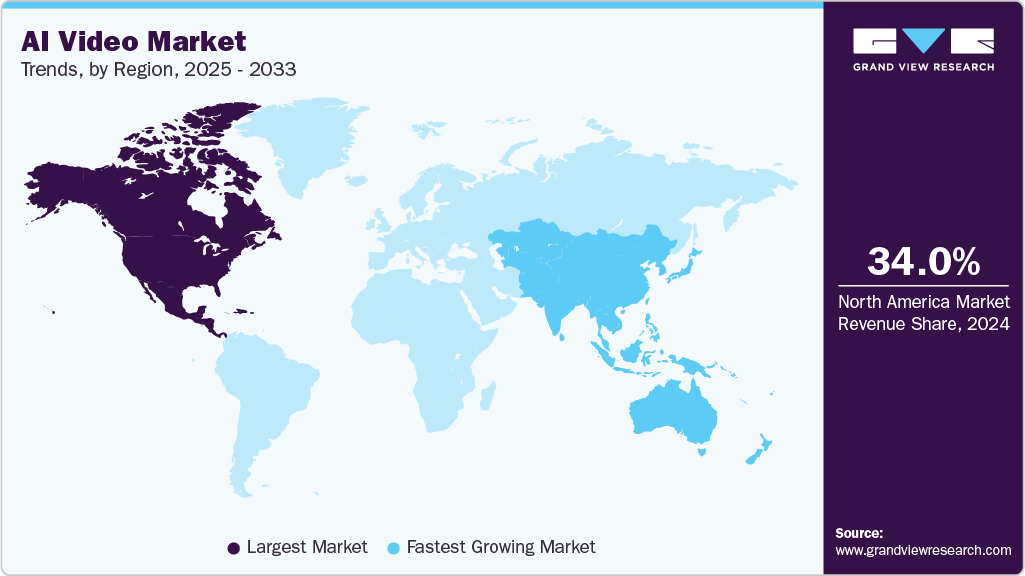
North America dominated the AI video market with the largest revenue share of 34.6% in 2025. North America's technological infrastructure is characterized by high-speed internet, extensive data centers, and cutting-edge computing resources, all of which are crucial for developing and deploying AI video solutions. The region's well-established network of technology hubs and innovation centers fosters collaboration and rapid advancements in AI technology. Moreover, North America benefits from a strong ecosystem of cloud computing services and hardware providers that enhance the capabilities of AI video applications. This advanced infrastructure enables seamless integration, scalability, and performance of sophisticated AI video solutions.
 To learn more about this report, Download Free Sample Report
 U.S. AI Video Market Trends
The AI video market in the U.S. held the largest share in the North America region in 2025. AI technologies are transforming the U.S. media and entertainment industry by automating tasks such as video editing and content creation. This integration speeds up production and reduces costs, while AI-driven recommendations enhance audience engagement. Overall, AI tools streamline workflows and improve content quality efficiently.
Europe AI Video Market Trends
The Europe AI-powered video market is gaining traction in smart surveillance, significantly enhancing public safety and security. Advanced features such as real-time threat detection and facial recognition are being widely adopted to improve monitoring and response capabilities. The growing use of these technologies is driven by the need for more effective and proactive security measures. As AI continues to advance, its role in surveillance is expected to expand, providing increasingly sophisticated solutions.
Asia Pacific AI Video Market Trends
Asia Pacific AI video market is anticipated to register the fastest CAGR over the forecast period, driven by rapid technological advancements and increasing adoption of AI video solutions across various industries. The region’s burgeoning digital economy and significant investments in infrastructure and innovation support this growth. Expanding consumer markets and rising demand for advanced video analytics and content creation tools also contribute to the acceleration. As businesses and governments in Asia Pacific embrace AI technologies, the market is poised for substantial expansion.
Key AI Video Company Insights
Some key companies in the AI video industry are Adobe, Designs.ai, Lumen5, and Microsoft.
-
Adobe is a prominent player in the AI video generation market, primarily through its Firefly platform, which enables text-to-video and image-to-video content creation. The company integrates these AI tools into its flagship products, such as Premiere Pro, Photoshop, and Express, targeting creative professionals and marketers. Adobe differentiates itself by training Firefly on licensed and public domain content, ensuring outputs are safe for commercial use.
-
Designs.ai offers an all‑in‑one generative, creative platform that includes Video Maker, an AI-powered text-to-video tool that transforms scripts into polished videos with templates, voiceovers, music, and animations. The Video Maker targets both novices and professionals, featuring an intuitive drag‑and‑drop interface and pre-made templates for various use cases like promos, tutorials, and social media content. As part of the wider Pixlr Group of AI design tools, Designs.ai emphasizes speed and accessibility, enabling users to produce high-quality videos “in less than 2 minutes” and scale creative workflows efficiently. With flexible pricing, including free, Basic, Pro, and Enterprise plans, it caters to individuals, agencies, and business teams.
Key AI Video Companies
The following key companies have been profiled for this study on the AI video market.
-
Adobe
-
Designs.ai
-
Google LLC
-
International Business Machines Corporation
-
Lumen5
-
Microsoft
-
Midjourney
-
Muse.ai
-
NVIDIA Corporation
-
OpenAI
Competitive Benchmarking
Operating Strategies
Competitive Edge
Weaknesses
Mature Players: Adobe, Microsoft, Google LLC, International Business Machines Corporation (IBM)
- Focus on integrating AI video into existing ecosystems, targeting enterprises with scalable, secure, and compliant solutions. They invest heavily in R&D and offer bundled services across cloud, creative, and AI platforms.
- Strong brand recognition, extensive customer base, advanced AI infrastructure, large R&D budgets, and seamless integration with existing enterprise and creative software ecosystems.
- Higher implementation costs, slower product development cycles, complex organizational structures, and greater dependence on existing product ecosystems.
Emerging Players: Designs.ai, Lumen5, Midjourney, Muse.ai, OpenAI
- Focus on rapid innovation in generative video tools, targeting creators and SMEs with simple, subscription-based platforms. They compete through fast feature rollout, user experience, and niche specialization.
- Faster innovation cycles, specialized AI video capabilities, user-friendly platforms, flexible pricing models, and the ability to quickly address evolving creator and business requirements.
- Limited financial resources, smaller customer base, lower brand recognition, and challenges in scaling operations and competing with large technology companies.
Recent Developments
-
In June 2025, Electric Sheep launched an AI-powered platform that allows creators to iterate, edit, and produce professional-grade video content in a single unified workspace. Drawing from over a decade of experience in Hollywood’s production pipeline, the platform merges AI tools and filmed media to streamline video creation without the typical budget or technical constraints. Designed to maintain the fundamentals of storytelling while leveraging GenAI advancements, Electric Sheep aims to democratize high-end video production, offering creators tools previously only accessible to industry professionals.
-
In June 2025, Pictory launched the MCP Server, a lightweight integration layer that allows developers, AI assistants, and automation platforms to create intelligent video workflows using natural language. Fully compliant with the Model Context Protocol (MCP), it enables easy discovery and orchestration of video creation tasks such as storyboarding and rendering without the need for complex coding.
-
In June 2024, NVIDIA Corporation and Hewlett Packard Enterprise launched NVIDIA AI Computing by HPE, a portfolio of AI solutions to accelerate generative AI adoption, featuring the HPE Private Cloud AI. This collaboration offers enterprises a flexible and efficient path for AI development, supported by global integrators like Deloitte and Infosys.
-
In May 2024, Google LLC introduced Project Astra, an AI agent, during its annual developer conference. It showcased its real-time capabilities across video, audio, and text. This initiative aims to solidify the company's position at the forefront of AI by introducing AI-driven features across its products.
-
In April 2024, Bakstage.AI, a U.S.-based company specializing in AI-enhanced video customer communications, has partnered with IBM to integrate Watsonx.AI into its platform. This collaboration aims to enhance digital customer experiences through personalized insights and AI-driven interactions.
AI Video Market Report Scope
Report Attribute
Details
Market size value in 2025
USD 4.6 billion
Market size value in 2026
USD 5.5 billion
Revenue forecast in 2033
USD 42.3 billion
Growth rate
CAGR of 33.7% from 2026 to 2033
Base year for estimation
2025
Historical data
2021 - 2024
Forecast period
2026 - 2033
Quantitative units
Revenue in USD million/Million and CAGR from 2026 to 2033
Report coverage
Revenue forecast, company ranking, competitive landscape, growth factors, and trends
Segments covered
Device, users, offering type, region
Regional scope
North America; Europe; Asia Pacific; Latin America; MEA
Country scope
U.S.; Canada; Mexico; Germany; UK; France; China; Japan; India; Australia; South Korea; Brazil; KSA; UAE; South Africa
Key companies profiled
Adobe; Designs.ai; Google LLC; International Business Machines Corporation; Lumen5; Microsoft; Midjourney; Muse.ai; NVIDIA Corporation; OpenAI
Customization scope
Free report customization (equivalent up to 8 analysts' working days) with purchase. Addition or alteration to country, regional & segment scope.
Pricing and purchase options
Avail customized purchase options to meet your exact research needs. Explore purchase options
Global AI Video Market Report Segmentation
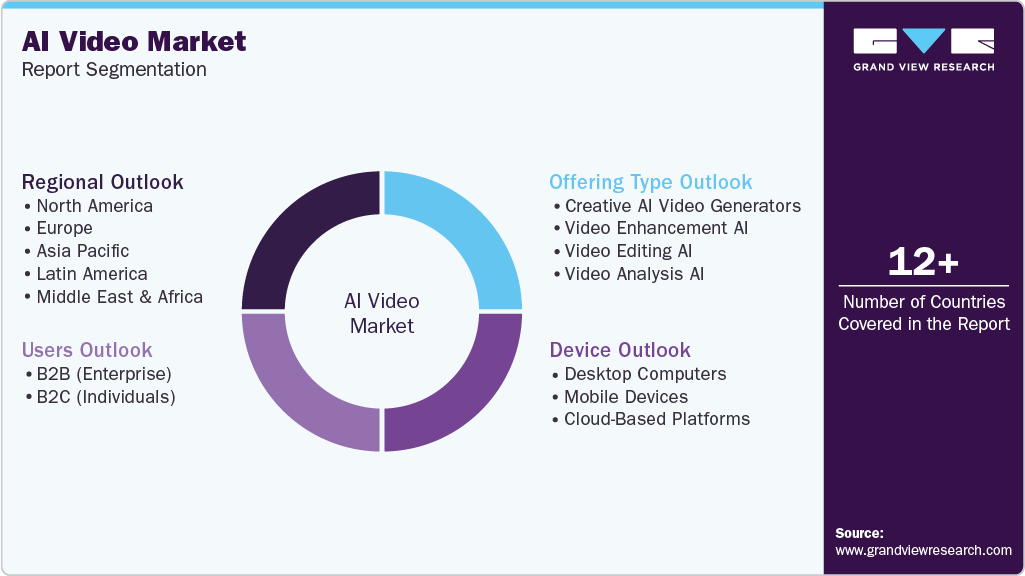
This report forecasts revenue growth at the global, regional, and country levels and provides an analysis of the latest industry trends in each of the sub-segments from 2021 to 2033. For this study, Grand View Research has segmented the global AI video market report based on device, users, offering type, and region.
 To learn more about this report, Download Free Sample Report
 -
Device Outlook (Revenue, USD Million, 2021 - 2033)
-
Desktop Computers
-
Mobile Devices
-
Cloud-Based Platforms
-
-
Users Outlook (Revenue, USD Million, 2021 - 2033)
-
B2B (Enterprise)
-
B2C (Individuals)
-
-
Offering Type Outlook (Revenue, USD Million, 2021 - 2033)
-
Creative AI Video Generators
-
Video Enhancement AI
-
Video Editing AI
-
Video Analysis AI
-
-
Regional Outlook (Revenue, USD Million, 2021 - 2033)
-
North America
-
U.S.
-
Canada
-
Mexico
-
-
Europe
-
UK
-
Germany
-
France
-
-
Asia Pacific
-
China
-
Japan
-
India
-
South Korea
-
Australia
-
-
Latin America
-
Brazil
-
-
Middle East and Africa (MEA)
-
KSA
-
UAE
-
South Africa
-
-
Research Methodology
The AI video market figures in this report are based on a proven research process that combines executive interviews with secondary research from proprietary databases, company filings, and recognized regulatory and institutional sources. Market size is built through value-chain sizing - reconciling supply-side and demand-side estimates - and triangulated with bottom-up and top-down approaches. Every estimate passes multiple levels of expert validation before publication, with each AI video segment quantified using the revenue-capture definitions in the table below.
Segment Definition
Segment - Device
Revenue Capture Definition
Desktop Computers
AI video creation and editing on high-performance PCs/workstations using licensed software and GPU-based tools
Mobile Devices
AI video apps used on smartphones/tablets for creation, editing, and social media content monetization
Cloud-Based Platforms
AI video generation delivered via cloud using SaaS, APIs, and pay-per-use or subscription models
Segment - Users
Revenue Capture Definition
B2B (Enterprise)
Revenue generated from businesses using AI video tools for marketing, training, internal communication, advertising, and customer engagement through enterprise licenses, SaaS subscriptions, and API usage
B2C (Individuals)
Revenue generated from individual users creating or consuming AI-generated videos via mobile apps or web platforms, primarily through subscriptions, freemium upgrades, and in-app purchases
Segment - Offering Type
Revenue Capture Definition
Creative AI Video Generators
Revenue from tools that generate videos from text, images, or prompts, including AI avatars, storytelling videos, and marketing content creation platforms
Video Enhancement AI
Revenue from AI tools used to improve existing videos through editing, upscaling, translation, captioning, and quality enhancement
Video Editing AI
Revenue generated from AI-powered video editing tools that automate tasks such as trimming, scene selection, captioning, effects generation, background removal, audio enhancement, and post-production workflows through subscriptions, licensing, and usage-based fees.
Video Analysis AI
Revenue from AI systems that analyze video content for insights such as object detection, audience behavior, security monitoring, and content tagging
Estimation Model
Layer Name
Key Question
Description
AI Video End-User Layer
Who creates demand for AI video solutions?
Identifies the total base of organizations and individuals using or requiring AI video solutions, including enterprises, media companies, educational institutions, marketing agencies, and individual creators.
Adoption / Usage Layer
Who actively uses AI video platforms?
Filters the total user base based on AI adoption readiness, digital transformation levels, content creation needs, marketing intensity, and usage of generative AI tools for video production and editing.
Application / Platform Layer
What AI video solutions are deployed?
Estimates adoption across text-to-video generators, AI avatars, video editing tools, video enhancement systems, localization tools, and video analytics platforms across industries.
Revenue Capture Layer
How is revenue generated in the AI Video ecosystem?
Calculates revenue from SaaS subscriptions, API usage, enterprise licensing, pay-per-use video generation, mobile app monetization, advertising, and value-added services such as customization and enterprise integration.
Delivered Customizations
This report has been delivered with the following In-depth customizations
Client Objective
Custom Research Modules Delivered
Strategic Value / Business Impact
Market Entry & Expansion Assessment
Regional demand sizing and forecasting
End-user and industry adoption analysis
Competitive landscape benchmarking
Regulatory assessment for AI-generated content
Identified high-growth opportunities across industries and regions
Supported market entry and expansion strategies
Highlighted adoption barriers and investment risks
Enabled data-driven business planning
Product Positioning & Competitive Intelligence
AI video platform benchmarking and feature comparison
Pricing and subscription model analysis
User preference and adoption study
Competitor strategy evaluation
Improved product differentiation
Supported pricing and packaging decisions
Identified feature gaps and user requirements
Enhanced competitive positioning
Technology & Innovation Assessment
Text-to-video and AI avatar technology analysis
Innovation pipeline assessment
Technology adoption readiness evaluation
Partnership and ecosystem mapping
Identified emerging growth areas
Supported product roadmap development
Evaluated commercialization opportunities
Strengthened technology and partnership strategies
Frequently Asked Questions About This Report
Asia Pacific is the fastest-growing region over the forecast period.
The Cloud-Based Platforms segment led with a 51.2% revenue share in 2025 and is also the fastest-growing segment.
The B2B (Enterprise) segment led with a 69.4% revenue share in 2025, while B2C (Individuals) is the fastest-growing segment.
The Video Analysis AI segment led with a 40.4% revenue share in 2025, while Creative AI Video Generators is the fastest-growing segment.
North America dominated the AI video market with a share of 34.6% in 2025. This is attributable to the region's advanced technology infrastructure, significant investment in AI innovation, and broad application of AI video solutions across diverse sectors.
The global AI video market size was valued at USD 4.6 billion in 2025 and is estimated at USD 5.5 billion in 2026.
Some key players operating in the AI video market include Adobe Inc., Alludo (Corel Corporation), Designs.ai, Google LLC, International Business Machines Corporation (IBM), inVideo, Lumen5, Microsoft, Midjourney, Muse.ai, NVIDIA Corporation, OpenAI, PearlMountain Limited (FlexClip), Pictory.AI, and RAWSHORTS, INC
Key factors that are driving the market growth include advancements in AI, increasing demand for video content, cost efficiency, enhanced personalization, improved accessibility, and seamless integration with other technologies.
The global AI video market is expected to grow at a CAGR of 33.7% from 2026 to 2033, reaching USD 42.3 billion by 2033.
About the Author(s)
Next Generation Technologies Research Team
Technology · Next Generation TechnologiesThis report was authored by the next generation technologies research team at Grand View Research - comprising two research analysts, one senior research analyst, and one industry expert - with specialized expertise in the next generation technologies segment of the technology industry. All findings are based on proprietary technology databases, executive interviews, and regulatory analysis, subject to internal peer review prior to publication.
Last Updated:
Speak to Analyst

Customize this report to your needs - add regions, segments, or data points, with 20% free customization.
Or view our licence options:


ISO 9001:2015 & 27001:2022 Certified
We are GDPR and CCPA compliant! Your transaction & personal information is safe and secure. For more details, please read our privacy policy.


