
- Home
- »
- Healthcare IT
- »
-
Artificial Intelligence In Remote Patient Monitoring Market Report 2030GVR Report cover

Artificial Intelligence In Remote Patient Monitoring Market (2025 - 2030) Size, Share & Trends Analysis Report By Component (AI-enabled Devices), By Clinical Application (Cardiovascular Monitoring), By End Use, By Region, And Segment Forecasts
Artificial Intelligence In Remote Patient Monitoring Market Summary
The global artificial intelligence in remote patient monitoring market was valued at USD 1.99 billion in 2024 and is projected to reach USD 8.51 billion by 2030, growing at a CAGR of 27.98% from 2025 to 2030. Growing trend towards personalized healthcare, increasing focus on cost reduction in healthcare, and technological advancements are factors contributing to market growth.
Key Market Trends & Insights
- North America accounted for the largest revenue share of 50.66% in 2024.
- U.S. held the largest market share in 2024.
- Based on component, AI-enabled devices segment held the largest revenue share of over 42% in 2024.
- Based on clinical application, the diabetes management segment held the largest revenue share of over 19% in 2024.
- Based on end use, the hospitals & health systems segment held the largest revenue share of over 29% in 2024.
Market Size & Forecast
- 2024 Market Size: USD 1.99 Billion
- 2030 Projected Market Size: USD 8.51 Billion
- CAGR (2025-2030): 27.98%
- North America: Largest market in 2024
Three ways to get this report
Buy it, customize it, or ask a question.Ask an Analyst
Analyst response in 1 business day
- AccessReport author, directly
- Reply timeWithin 1 working day
- No sales callDirect answer only
- FormatEmail reply
- CostFree, no cost
Get the Full Report
What the study covers
- FormatsPDF · Excel · Dashboard
- Timeline2025–2030 annual, 2024 base
- Coverage20+ countries, 5 regions
- Companies10+ key players profiled
Customize the Report
20% free customization
- IncludeCountries, segments, points
- TailorTo your product definition
- ExtendDeeper competitor detail
- OrA fully bespoke study
- Turnaround5–10 working days
In addition, the rising adoption of sophisticated healthcare platforms, devices, and solutions to reduce burden on hospital resources further fuel market growth. The increasing incidence of chronic conditions such as diabetes, cardiovascular and neurological diseases, and respiratory disorders drives demand for effective monitoring solutions. Artificial intelligence (AI) enhances remote patient monitoring (RPM) systems by analyzing vast amounts of data from wearable devices such as smartwatches, fitness trackers, continuous glucose monitors, wearable ECG monitors, and other sources to identify trends and alert healthcare providers before patient health condition worsens. Source: Grand View Research, IR Documents, Primary Interviews, Paid DatabasesTo learn more about this report,
 Download Free Sample Report
 Moreover, these devices contribute to significant cost savings for both healthcare providers and patients. By enabling early detection and intervention, AI-enabled remote patient monitoring systems reduce the need for emergency visits and hospital admissions, leading to lower healthcare expenditures. In addition, AI automates routine tasks such as data analysis and alert generation, allowing healthcare professionals to focus on patient care. This operational efficiency optimizes resource utilization and enhances the overall quality of healthcare services.
Key Features of Artifical Intelligence in Remote Patient Monitoring
The AI-enabled RPM devices facilitate early detection of health risks through predictive analytics, allowing healthcare providers to identify complications rapidly. For instance, Dozee by Turtle Shell Technologies Pvt Ltd is an AI-based ballistocardiography technology with contactless sensors that capture vibrations produced in every heartbeat and respiratory cycle, where the data is sent to the cloud-based platform. This data is converted into biomarkers, enabling clinicians to access and analyze it on the SecureRPM application. Similarly, by leveraging advanced computer vision and machine learning algorithms, RPM systems analyze visual data to identify subtle changes in a patient's condition that are likely to be missed by human observers.
 To learn more about this report, Download Free Sample Report
 For instance, Chooch's Vision AI system monitors patient's movements to detect behaviors indicating a potential fall, such as sitting on the edge of the bed. This approach facilitates timely interventions, reducing the risk of adverse events and improving patient outcomes. Moreover, the market observes the robust launch of such technologies supporting the development of personalized care plans tailored to individual patient needs, reducing emergency visits, and empowering patients to make informed health choices.
Strategic Initiatives Related To Disease/ Indication
 To learn more about this report, Download Free Sample Report
 Furthermore, the increasing shift toward home-based and outpatient care demands real-time, intelligent health monitoring solutions. Companies are increasingly investing in developing advanced monitoring tools powered by AI, thereby benefiting patients from enhanced quality care and encouraging providers to adopt these technologies. For instance, in September 2022, Align Technology launched Invisalign Virtual Care AI remote monitoring solution. This platform helps clinicians to monitor Invisalign treatment progress.
Key Funding’s/Investments in AI-enabled RPM Market
Company
Year
Months
Investment Value (USD Million)
Investment Description
Octagos Health
2024
July
43
Octagos Health raised over USD 43 million in Series B funding to enhance its AI-driven cardiac device monitoring solutions. This funding is expected to accelerate the company's AI-driven platform that offers continuous monitoring and data analysis for patients with cardiac devices
Callyope
2023
November
2.5
Callyope secured USD 2.5 million in equity funding to advance its AI-driven tool for treating mental health conditions. The company is developing a speech-based RPM platform for people living with schizophrenia, major depression, and bipolar disorders.
Care.ai
2022
November
27
Care.ai raised USD 27 million in funding, led by Crescent Cove Advisors, to enhance its AI-enabled patient monitoring platform.
Blue Spark Technologies
2022
April
40
Blue Spark Technologies secured USD 40 million in growth funding. This investment is anticipated to support the advancement of their AI-based RPM solutions, thereby expediting the company’s growth and global adoption of continuous wearable RPM solutions
Aevice Health
2021
June
2.1
Aevice Health secured USD 2.1 million in funding to develop an AI-powered wearable stethoscope to enhance remote respiratory health monitoring
Market Concentration & Characteristics
The chart below illustrates the relationship between market concentration, industry characteristics, and industry participants. The x-axis represents the level of industry concentration, ranging from low to high. The y-axis represents various industry characteristics, including industry competition, impact of regulations, level of partnerships & collaborations activities, degree of innovation, and regional expansion. For instance, the artificial intelligence in remote patient monitoring industry is fragmented, with many platform and device providers entering the market. The degree of innovation is high, the level of partnerships & collaborations activities, the impact of regulations on the industry, and the regional expansion is high.
The artificial intelligence in remote patient monitoring experiences a high degree of innovation driven by technological advancements. The increasing adoption of healthcare IT solutions in care management to reduce hospital burden drives demand for advanced AI-enabled monitoring platforms and devices, thus lowering the costs associated with in-person visits. For instance, in March 2025, Validic launched new Health IoT and remote patient management solutions powered by generative AI in the AWS Marketplace. These solutions focus on improving health monitoring and management to deliver better health outcomes and streamline healthcare processes for patients and providers.
 To learn more about this report, Download Free Sample Report
 The industry is experiencing a high level of partnership and collaboration activities undertaken by several key players. This is due to the desire to gain a competitive advantage in the industry, enhance technological capabilities, and consolidate in a rapidly growing market. For instance, in March 2023, Zephyr AI and KangarooHealth partnered to leverage remote patient monitoring and artificial intelligence. This partnership aims to utilize artificial intelligence for the predictive analysis of remote patient monitoring data, addressing gaps in precision healthcare, and enhancing the efficiency of healthcare delivery systems.
Regulations, such as the HIPAA in the U.S. and the GDPR in Europe, establish standards for safeguarding patient data privacy and security. Compliance with these regulations is crucial for AI applications in healthcare to ensure the safe and secure handling of patient information, reducing the risk of data breaches and unauthorized access.
Companies within the AI-enabled RPM sector seek geographic expansion strategies to maintain their foothold in emerging markets and attract customers from these regions. With the growing adoption of digital healthcare solutions, the market is expected to grow significantly in the coming years, especially in developing countries. For instance, in October 2024, Philips and Siloam Hospitals Group signed a MoU to enhance AI capabilities in Indonesia's healthcare sector. This partnership aims to support the Indonesian government's strategy for healthcare transformation using artificial intelligence. In support of this strategy, the hospital is anticipated to integrate AI-powered remote patient monitoring systems to connect patients in rural areas, improve patient outcomes, and optimize hospital operations.
Component Insights
Based on component, AI-enabled devices segment held the largest revenue share of over 42% in 2024. AI-enabled devices such as continuous glucose monitors (CGMs), wearable ECG monitors, blood pressure cuffs, and pulse oximeters are widely used in chronic conditions. These devices capture real-time physiological data and enable intelligent, automated health assessments. Moreover, they are increasingly interoperable with EHRs, mobile apps, cloud platforms, and RPM dashboards. For instance, in October 2022, Dozee launched an AI-enabled ECG patch device to detect arrhythmias and other early signs of cardiac deterioration.
The services segment is expected to grow at the fastest CAGR for the AI-enabled RPM market forecast period, driven by increasing demand for real-time data interpretation, device integration, and continuous patient support. AI-powered analytics services help clinicians detect early signs of deterioration, enabling timely interventions. The growing adoption of home healthcare and chronic disease management accelerated the need for managed services, including teleconsultations, cloud-based monitoring, and maintenance. For instance, in November 2024, Biofourmis assisted in expanding remote patient monitoring and launching home-based hospital care services at Lee Health. It enables hospital-level care to be delivered in patients’ homes, coordinated and supported by AI-driven monitoring and logistics-expanding the scope and value of remote care services.
Clinical Application Insights
The diabetes management segment held the largest revenue share of over 19% in 2024, driven by the global rise in diabetes prevalence and the need for continuous glucose monitoring. AI-powered RPM platforms provide real-time insights, predict glucose fluctuations, and personalize care plans, enhancing patient outcomes and reducing complications. In addition, strategic partnerships such as Glooko acquired xbird, a company specializing in AI-powered diabetes management solutions in January 2022. This strengthens Glooko’s ability to remotely monitor and manage diabetic patients, improving adherence and outcomes in clinical and home settings.
The mental health & behavioral monitoring is anticipated to grow at the fastest CAGR from 2025 to 2030. Rising global mental health concerns and the demand for continuous, stigma-free support drive the segment's growth. AI algorithms analyze data from wearables, smartphones, and patient-reported outcomes to detect mood shifts, stress patterns, and early signs of anxiety or depression. This enables timely intervention and personalized care plans. For instance, companies such as Mindstrong use AI-powered platforms for real-time behavioral tracking and remote therapy support. The scalability, cost-effectiveness, and accessibility of these solutions fuel rapid adoption across healthcare systems and employers.
End Use Insights
The Hospitals & Health Systems segment held the largest revenue share of over 29% in 2024, driven by the rising prevalence of chronic diseases, the need for continuous patient data analysis, and the demand for efficient healthcare delivery. Hospitals leveraged AI-powered RPM to detect health deterioration early, improve patient engagement, and integrate with electronic health records, enabling proactive care and reducing costs.
 To learn more about this report, Download Free Sample Report
 Home Healthcare Provider is the fastest-growing CAGR for the forecast period in the AI-enabled remote patient monitoring market, driven by rising chronic disease prevalence, increasing demand for personalized and cost-effective care, and advancements in wearable and telehealth technologies. AI-powered RPM enables continuous, real-time health monitoring and early detection of complications, reducing hospitalizations and improving outcomes for patients at home. For instance, in November 2023, AI-powered home healthcare provider Cera Care plans to help the UK government and hospitals save Euro 100 million this winter by delivering five million care visits.
Regional Insights
North America artificial intelligence in remote patient monitoring market accounted for the largest revenue share of 50.66% in 2024. This is attributed to advancements in healthcare IT infrastructure, growing care expenditures, and widespread adoption of AI/ML technologies. In addition, factors, such as growing geriatric population, changing lifestyles, increasing prevalence of chronic disorders, and growing demand for value-based care are other factors propelling market growth in North America.
 To learn more about this report, Download Free Sample Report
 U.S. Artificial Intelligence in RPM Market Trends
Artificial intelligence in remote patient monitoring market in the U.S. held the largest market share in 2024 due to the advancements in medical technology, lucrative funding options, and the presence of several key players. Moreover, increasing demand for efficient and personalized healthcare solutions, coupled with regulatory initiatives and supportive government policies further fuel market growth. For instance, in April 2025, Smart Meter and Kura Care partnered to enhance blood pressure management for U.S. citizens by launching a 12-week program. This program utilizes Smart Meter’s cellular iBloodPressure monitors along with Kura Care’s AI system, which analyzes data and provides personalized coaching and reminders via texts, emails, and reports.
Europe Artificial Intelligence in Remote Patient Monitoring Market Trends
Europe artificial intelligence in remote patient monitoring market is anticipated to witness significant growth during the forecast period. This is attributed to the widespread adoption of AI technologies and increasing investments in by government and private organizations.
Artificial intelligence in remote patient monitoring market in the UK is expected to grow over the forecast period, owing to the robust healthcare infrastructure and increasing investments in AI technologies to enhance patient care, optimize operations, and tackle various healthcare challenges. For instance, according to Gov.UK, private firms invested around USD 250 million investments in AI from July 2024 to January 2025. Similarly, in January 2025, the government introduced the AI Opportunities Action Plan, which includes the creation of AI Growth Zones and an investment of USD 9 billion in the coming five years.
The Germany artificial intelligence in remote patient monitoring market held the largest market share in 2024 in the European market, attributed to the increasing investments in healthcare technology and robust healthcare infrastructure. In addition, favorable government initiatives propel market growth further.
Asia Pacific Artificial Intelligence in RPM Market Trends
Asia Pacific artificial intelligence in remote patient monitoring market is projected to experience significant growth in the coming years. Increasing investments from private investors, venture capitalists, and non-profit organizations aimed at enhancing clinical outcomes, improving data analysis and security, and reducing healthcare costs are driving adoption rates in the region. In addition, favorable government initiatives that support and promote the adoption of AI-based technologies by healthcare organizations and providers are anticipated to boost market growth. Moreover, rising healthcare expenditure and technological advancements in healthcare IT contribute to market growth.
Japan artificial intelligence in remote patient monitoring market is expected to grow significantly over the forecast period. Increasing demand for personalized healthcare solutions and the growing adoption of artificial intelligence in healthcare contribute to market growth. In addition, technological advancements and growing government support and initiatives further fuel market growth.
Artificial intelligence in remote patient monitoring market in India is experiences lucrative growth, owing to the increasing healthcare expenditure and rapid adoption of healthcare IT solutions. Hospitals in the country are adopting AI-powered technologies to enhance patient care and improve treatment outcomes. For instance, in December 2024, Dozee partnered with Maharashtra-based Sahyadri Hospitals to launch an AI-powered command center, enabling real-time monitoring, proactive interventions, and improved clinical outcomes. In November 2024, Sancheti Advanced Orthocare Hospital launched a "Smart Ward" that features Dozee's AI-based Remote Monitoring System (RMS) and Early Warning System (EWS).
Latin America Artificial Intelligence in Remote Patient Monitoring Market Trends
Latin America artificial intelligence in remote patient monitoring market is anticipated to grow at a significant CAGR over the forecast period, this growth is attributed to the growing awareness about AI technologies, increasing government spending, and collaboration activities.
Middle East and Africa Artificial Intelligence in Remote Patient Monitoring Market Trends
Middle East and Africa artificial intelligence in remote patient monitoring market is expected to grow at a significant CAGR over the forecast period. The market is characterized by a dynamic landscape driven by the growing adoption of healthcare IT solutions, increasing healthcare expenditures and supportive government policies.
Key Artificial Intelligence In Remote Patient Monitoring Company Insights
Key players operating in artificial intelligence in remote patient monitoring industry are undertaking various initiatives to strengthen their market presence and increase the reach of their products and services. Strategies such as new product launches and partnerships are playing a key role in propelling market growth.
Key Artificial Intelligence In Remote Patient Monitoring Companies:
The following are the leading companies in the artificial intelligence in remote patient monitoring market. These companies collectively hold the largest market share and dictate industry trends.
- BioIntelliSense
- Jorie Healthcare Partners
- HealthSnap, Inc.
- Roche
- Dexcom
- CompuGroup Medical
- Abbott
- Kakao Healthcare Corp.
- Powerful Medical
- Idoven
- Viatom Technology Co., Ltd.
- Lepu Medical (Carewell China)
- AliveCor, Inc.
- 100Plus.
- Datos
- Credo Health AI
- Center Health
Recent Developments
-
In February 2025, BioIntelliSense and care.ai partnered to combine continuous biometric data with ambient intelligent monitoring, aiming to enhance the quality and delivery of patient care. This integration will enable healthcare professionals to monitor high-frequency vital sign trends and environmental data in a single comprehensive solution, leading to actionable insights for improved care prioritization and efficient resource allocation for patients both in the hospital and at home.
-
In June 2024, Knownwell acquired Alfie Health to incorporate AI into its primary care and obesity treatment services. Knownwell aims to offer a comprehensive and rigorous metabolic care approach that includes anti-obesity medications, nutrition, movement, behavioral health, and remote patient monitoring.
-
In March 2024, a major California healthcare organization is investing significantly in San Francisco and artificial intelligence by launching a new ‘innovation center.’
-
In February 2024, care.ai partnered with Virtua Health to enhance hybrid care services by expanding their virtual care capabilities. This collaboration focuses on improving the patient and care team experience, aiming for safer, more efficient, and empathically connected healthcare.
-
In January 2024, Apollo Hospital Seshadripuram partnered with LifeSigns, a provider of AI-powered health-monitoring technology. This initiative aims to enhance patient care by implementing an advanced monitoring system that tracks vital signs, including ECG, blood pressure, and SpO2.
Future Trends/Emerging Technologies
Sr.No.
Company
Initiatives
Remarks
1. NVIDIA Corporation
In November 2024, NVIDIA introduced GluFormer, an AI-driven solution offering insights to aid in diabetes prevention.
Providing predictive insights for diabetes prevention sets a precedent for proactive, data-driven care. This innovation is expected to grow the integration of AI into chronic disease management and reshape preventive healthcare strategies globally.
2. F. Hoffmann-La Roche Ltd
In July 2024, Roche obtained CE Mark approval for its AI-powered continuous glucose monitoring system, which provides essential predictive insights for individuals managing diabetes.
Roche’s CE Mark approval for its AI-enabled continuous glucose monitoring solution highlights a significant step forward in predictive diabetes care. This advancement strengthened Roche’s position in the AI-driven RPM space and supports the growing trend toward real-time, personalized disease management across Europe’s regulated healthcare landscape.
Artificial Intelligence In Remote Patient Monitoring Market Report Scope
Report Attribute
Details
Market size value in 2025
USD 2.48 billion
Revenue forecast in 2030
USD 8.51 billion
Growth rate
CAGR of 27.98% from 2025 to 2030
Actual data
2018 - 2023
Forecast period
2025 - 2030
Quantitative units
Revenue in USD million and CAGR from 2025 to 2030
Report coverage
Revenue forecast, company ranking, competitive landscape, growth factors, and trends
Segments covered
Component, clinical application, end use, region
Regional scope
North America; Europe; Asia Pacific; Latin America; MEA
Country scope
U.S.; Canada; Mexico; Germany; UK; France; Italy; Spain; Denmark; Sweden; Norway; China; Japan; India; South Korea; Australia; Thailand; Brazil; Argentina; South Africa; Saudi Arabia; UAE; Kuwait
Key companies profiled
BioIntelliSense; Jorie Healthcare Partners; HealthSnap, Inc.; Roche; Dexcom; CompuGroup Medical; Abbott; Kakao Healthcare Corp.; Powerful Medical; Idoven; Viatom Technology Co., Ltd.; Lepu Medical (Carewell China); AliveCor, Inc.; 100Plus.; Datos; Credo Health AI; Center Health
Customization scope
Free report customization (equivalent up to 8 analysts working days) with purchase. Addition or alteration to country, regional & segment scope.
Pricing and purchase options
Avail customized purchase options to meet your exact research needs. Explore purchase options
Global Artificial Intelligence In Remote Patient Monitoring Market Report Segmentation
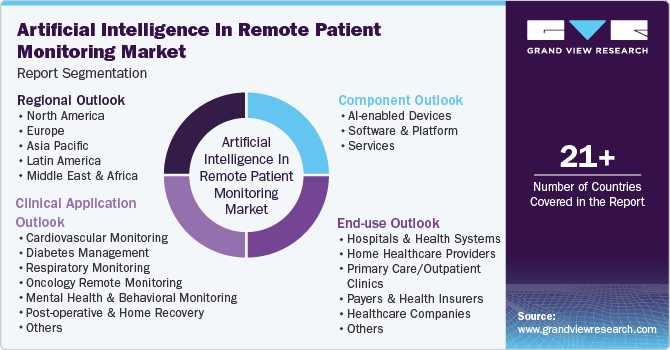
This report forecasts revenue growth at global, regional, and country levels and provides an analysis of the latest industry trends in each of the sub-segments from 2018 to 2030. For this study, Grand View Research has segmented the global artificial intelligence in remote patient monitoring market report based on component, clinical application, end use, and region:
 To learn more about this report, Download Free Sample Report
 -
Component Outlook (Revenue, USD Million; 2018 - 2030)
-
AI-enabled Devices
-
Continuous Glucose Monitor
-
Blood Pressure Monitors
-
Pulse Oximeters
-
Wearable ECG Monitor
-
Temperature Monitor
-
Respiratory Monitor
-
Fetal Heart Monitor
-
Others
-
-
Software & Platform
-
Services
-
-
Clinical Application Outlook (Revenue, USD Million; 2018 - 2030)
-
Cardiovascular Monitoring
-
Diabetes Management
-
Respiratory Monitoring
-
Oncology Remote Monitoring
-
Mental Health & Behavioral Monitoring
-
Post-operative & Home Recovery
-
Elderly/Frail Patient Monitoring
-
Sleep Disorders & Neurological Monitoring
-
Others
-
-
End Use Outlook (Revenue, USD Million; 2018 - 2030)
-
Hospitals & Health Systems
-
Home Healthcare Providers
-
Primary Care/Outpatient Clinics
-
Payers & Health Insurers
-
Healthcare Companies
-
Others
-
-
Regional Outlook (Revenue, USD Million; 2018 - 2030)
-
North America
-
U.S.
-
Canada
-
Mexico
-
-
Europe
-
Germany
-
UK
-
France
-
Italy
-
Spain
-
Denmark
-
Sweden
-
Norway
-
-
Asia Pacific
-
China
-
Japan
-
India
-
South Korea
-
Australia
-
Thailand
-
-
Latin America
-
Brazil
-
Argentina
-
-
MEA
-
South Africa
-
Saudi Arabia
-
UAE
-
Kuwait
-
-
Frequently Asked Questions About This Report
The global artificial intelligence in remote patient monitoring market size was estimated at USD 1.99 billion in 2024 and is expected to reach USD 2.48 billion in 2025.
The global artificial intelligence in remote patient monitoring market is expected to grow at a compound annual growth rate of 27.98% from 2025 to 2030 to reach USD 8.51 billion by 2030.
North America dominated the artificial intelligence in remote patient monitoring market with the highest revenue share of 50.66% in 2025. This is attributed to advancements in healthcare IT infrastructure, growing care expenditures, and widespread adoption of AI/ML technologies.
Some key players operating in the artificial intelligence in remote patient monitoring market include BioIntelliSense; Jorie Healthcare Partners; HealthSnap, Inc.; Roche; Dexcom; CompuGroup Medical; Abbott; Kakao Healthcare Corp.; Powerful Medical; Idoven; Viatom Technology Co., Ltd.; Lepu Medical (Carewell China); AliveCor, Inc.; 100Plus.; Datos; Credo Health AI; Center Health.
Key factors driving the artificial intelligence in remote patient monitoring market growth include growing trend towards personalized healthcare, increasing focus on cost reduction in healthcare, and technological advancements are factors contributing to market growth. In addition, rising adoption of sophisticated healthcare platforms, devices, and solutions to reduce burden on hospital resources further fuel market growth.
About the Author(s)
Healthcare IT Research Team
Healthcare · Healthcare ITThis report was authored by the healthcare it research team at Grand View Research - comprising two research analysts, one senior research analyst, and one industry expert - with specialized expertise in the healthcare it segment of the healthcare industry. All findings are based on proprietary healthcare databases, executive interviews, and regulatory analysis, subject to internal peer review prior to publication.
Last Updated:
Speak to Analyst

Customize this report to your needs - add regions, segments, or data points, with 20% free customization.
Or view our licence options:


ISO 9001:2015 & 27001:2022 Certified
We are GDPR and CCPA compliant! Your transaction & personal information is safe and secure. For more details, please read our privacy policy.


