
- Home
- »
- Advanced Interior Materials
- »
-
Ash Handling System Market Size And Share Report, 2033GVR Report cover

Ash Handling System Market (2026 - 2033)
Size, Share & Trends Analysis Report By System Type (Mechanical, Pneumatic, Hydraulic), By Handling Method (Dry Ash Handling, Wet Ash Handling), By Application, By Region, And Segment Forecasts
Market Size, 2025
$4.0BMarket Estimate, 2026
$4.2BMarket Forecast, 2033
$6.1BCAGR, 2026–2033
5.3%Ash Handling System Market Summary
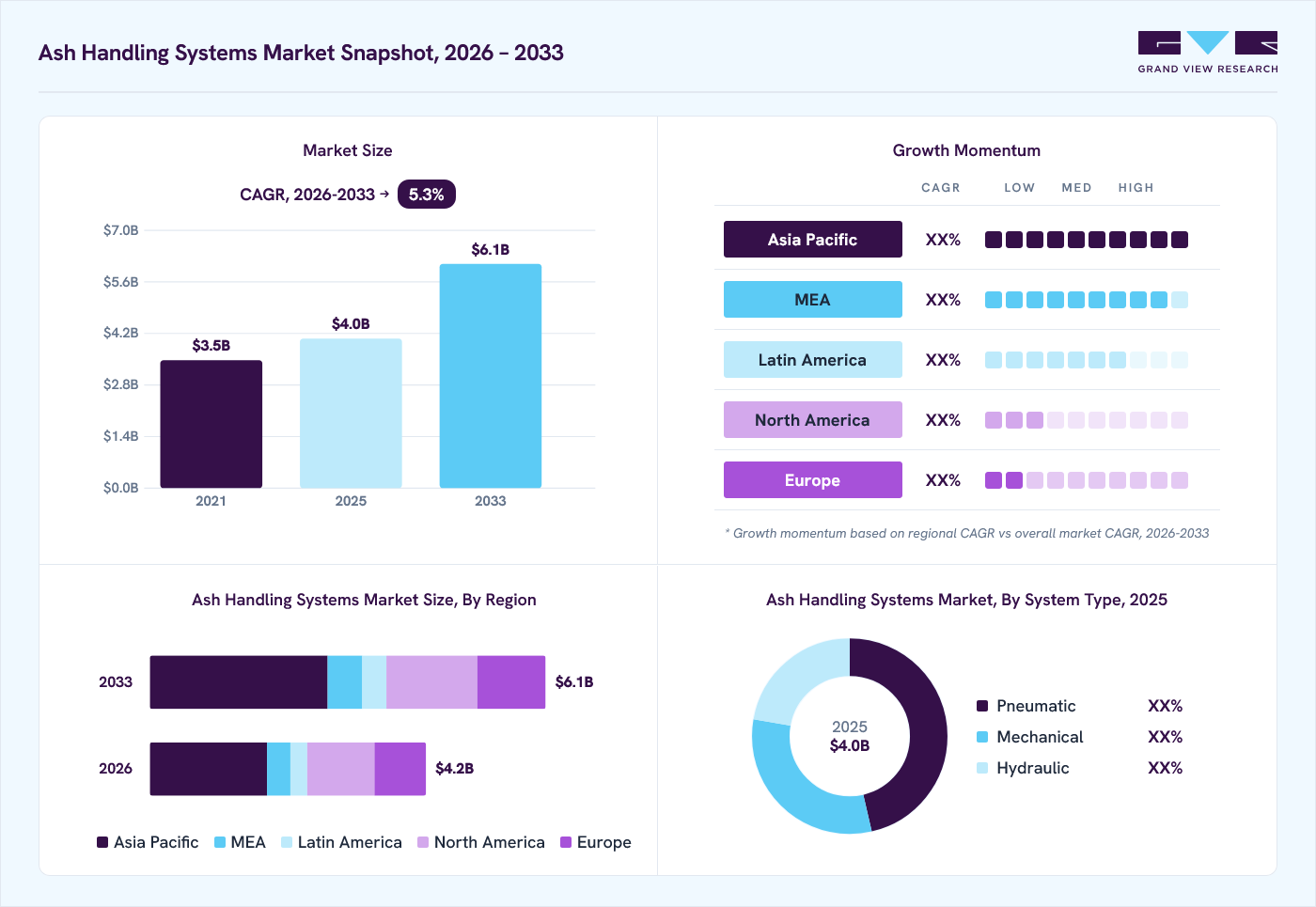
The global ash handling system market size was valued at USD 4.0 billion in 2025 and is projected to grow from USD 4.2 billion in 2026 to USD 6.1 billion by 2033, at a CAGR of 5.3% from 2026 to 2033. Asia Pacific dominated the market, accounting for a revenue share of 42.1% in 2025. The global industry is expected to grow as coal-fired power plants continue to generate substantial quantities of fly ash and bottom ash during electricity production. These residues require reliable collection, transportation, storage, and disposal systems to maintain continuous plant operations and reduce environmental risks. Increasing electricity demand in developing economies, particularly across Asia Pacific, is supporting the operation and modernization of coal-based power generation facilities.
 Source: Grand View Research, IR Documents, Primary Interviews, Paid DatabasesTo learn more about this report,
 Download Free Sample Report
Key Market Trends & Insights
- By system type: Pneumatic segment led the market with the largest revenue share of 46.3% in 2025.
- By handling method: Dry ash segment led the market with the largest revenue share of 56.7% in 2025.
- By application: Cement manufacturing segment is expected to grow at a 6.0% CAGR during the forecast period.
Regional Highlights
- Largest Regional Market: Asia Pacific (42.1% revenue share, 2025)
- By Country: China held the largest market share in 2025
Market Size & Forecast
- Market Size in 2025: USD 4.0 Billion
- Estimated Market Size in 2026: USD 4.2 Billion
- Projected Market Size by 2033: USD 6.1 Billion
- CAGR (2026-2033): 5.3%
Three ways to get this report
Buy it, customize it, or ask a question.Ask an Analyst
Analyst response in 1 business day
- AccessReport author, directly
- Reply timeWithin 1 working day
- No sales callDirect answer only
- FormatEmail reply
- CostFree, no cost
Get the Full Report
What the study covers
- FormatsPDF · Excel · Dashboard
- Timeline2026–2033 annual, 2025 base
- Coverage20+ countries, 5 regions
- Companies10+ key players profiled
Customize the Report
20% free customization
- IncludeCountries, segments, points
- TailorTo your product definition
- ExtendDeeper competitor detail
- OrA fully bespoke study
- Turnaround5–10 working days
Increasing regulatory emphasis on industrial waste management and the beneficial utilization of coal ash is another important driver of market growth. Governments are encouraging power plants to improve ash collection, containment, transportation, and disposal practices to minimize air pollution and land contamination.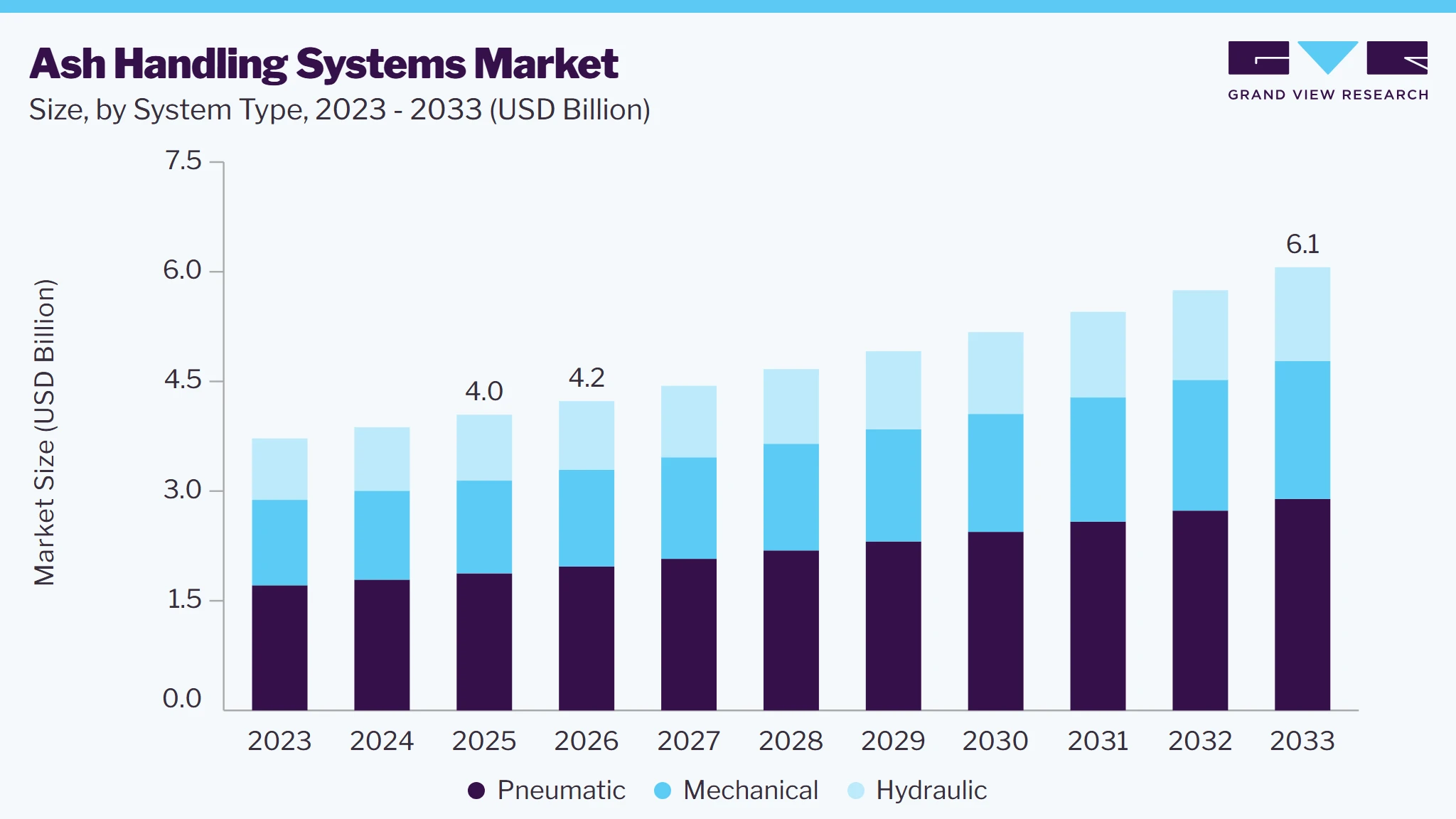 To learn more about this report, Download Free Sample Report
The use of fly ash in cement, concrete, bricks, and road construction also requires efficient systems for segregation, storage, and controlled transfer.
Market Dynamics
The industry is influenced by coal-fired power generation, industrial waste management requirements, equipment modernization, and demand for reliable material transportation. Market participants are focusing on improving system performance, reducing maintenance requirements, and offering solutions tailored to plant capacity and ash characteristics. Pneumatic, hydraulic, and mechanical technologies serve different operational needs, while purchasing decisions depend on installation costs, energy consumption, reliability, and lifecycle expenses. Competition among established suppliers and specialized engineering companies continues to shape product development, project execution, and aftermarket service strategies.
The modernization of aging thermal power plants is supporting demand for ash handling systems. Existing facilities require equipment upgrades to improve operational reliability, accommodate changing plant capacities, and replace outdated conveying infrastructure. Retrofitting existing systems with improved pumps, conveyors, valves, and control equipment can reduce breakdowns and improve ash removal efficiency. Plant operators also seek solutions that integrate with existing boilers and material handling infrastructure while minimizing operational disruptions.
High installation and maintenance costs can restrict the adoption of advanced ash handling systems, particularly among smaller power plants and industrial facilities operating under tight capital budgets. Pneumatic and hydraulic systems may require specialized pipelines, pumps, compressors, storage silos, and control equipment, increasing initial investment requirements. Abrasive ash can also cause wear in pipelines, valves, and conveying components, resulting in recurring maintenance expenses and replacement costs. These financial considerations can delay modernization projects and encourage operators to extend the use of existing equipment.
Industrial automation presents an opportunity for ash handling system manufacturers to develop digitally integrated solutions that improve operational visibility and equipment management. Sensors, programmable logic controllers, and remote monitoring platforms can track conveying pressure, material flow, equipment temperature, and system performance. These capabilities help operators identify abnormalities, schedule maintenance, and reduce unplanned interruptions. Integrating ash handling equipment with plant-wide control systems can also improve coordination between collection, transportation, and storage operations. Suppliers offering scalable automation packages can address the needs of both new installations and existing facilities.
Variations in ash composition, particle size, moisture content, abrasiveness, and temperature create technical challenges for ash handling system manufacturers. Fly ash generally requires different conveying arrangements from heavier bottom ash, while moisture variations can affect material flow and increase the risk of blockages. Equipment must therefore be designed according to plant-specific operating conditions, ash volumes, and transportation distances. Selecting unsuitable components can increase wear, reduce conveying efficiency, and cause operational interruptions. Manufacturers must balance system durability, energy consumption, throughput, and maintenance requirements while ensuring consistent performance under changing conditions.
Market Concentration & Characteristics
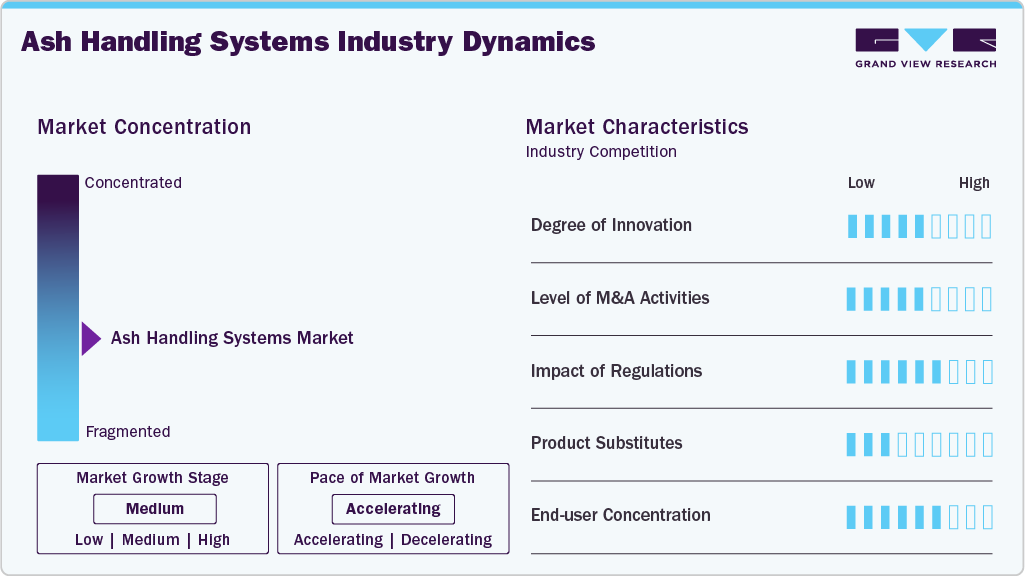
The industry is fragmented, with numerous global and regional manufacturers competing across pneumatic, hydraulic, and mechanical handling technologies. Market participants range from established industrial equipment suppliers offering integrated ash management solutions to specialized engineering companies serving specific applications and plant requirements. Competition is influenced by system efficiency, reliability, customization, installation capabilities, maintenance support, and compliance with environmental regulations. Regional expertise and project-specific requirements further contribute to the diverse competitive landscape.
Manufacturers are developing advanced pneumatic conveying systems, energy-efficient hydraulic solutions, automated ash collection, and real-time monitoring technologies. Improvements in dust suppression, wear-resistant components, and predictive maintenance are helping reduce downtime and operating costs. Digital controls and system integration are also improving ash transportation reliability and supporting compliance with environmental requirements.
 To learn more about this report, Download Free Sample Report
Environmental regulations are shaping the industry by increasing requirements for controlled ash collection, transportation, storage, and disposal. Regulations targeting particulate emissions and industrial waste management encourage power plant operators to adopt enclosed conveying systems, dust suppression technologies, and improved ash containment infrastructure. Policies promoting the beneficial utilization of fly ash in cement, concrete, and construction materials further increase the need for efficient handling and transfer equipment.
Analyst Perspective
The industry is influenced by the need for reliable collection, transportation, cooling, and disposal of fly ash and bottom ash generated by coal-fired power plants and other industrial facilities. Demand is supported by modernization of existing thermal power infrastructure, growing emphasis on dust control and environmental compliance, and increasing utilization of fly ash in cement and construction applications. System selection is shaped by ash characteristics, plant configuration, water availability, operating costs, and automation requirements.
System Type Insights
The pneumatic segment led the market in 2025 due to its ability to transport fine fly ash efficiently through enclosed pipelines, minimizing dust emissions and material spillage. These systems are widely used in thermal power plants for transferring ash from boilers, electrostatic precipitators, and storage silos. Their flexibility in handling long-distance transportation, limited floor-space requirements, and suitability for automated operations support adoption across large-scale power generation facilities.
The mechanical segment is expected to grow at a 5.2% CAGR during the forecast period as industrial facilities seek reliable and cost-effective solutions for transporting heavier ash residues, particularly bottom ash. Equipment such as belt conveyors, screw conveyors, drag-chain conveyors, and bucket elevators supports continuous material movement across short and medium distances. Improvements in wear-resistant components, conveyor design, and automated controls are expected to enhance operational reliability, reduce maintenance requirements, and support adoption in thermal power plants.
Handling Method Insights
The dry ash handling segment dominated the market in 2025 due to its ability to collect, transport, and store ash without water consumption. These systems facilitate fly ash recovery for applications in cement, concrete, and construction materials. Reduced wastewater generation, improved material recovery, and lower water treatment requirements support adoption among power plant operators seeking efficient ash management and resource utilization.
The wet ash handling segment is expected to grow at a 5.0% CAGR during the forecast period due to its established use in transporting bottom ash and managing high-temperature residues from coal-fired power plants. Water-based systems facilitate ash cooling and hydraulic transportation, supporting continuous boiler operations. Demand is likely to persist at facilities with existing wet handling infrastructure, particularly where conversion to dry systems requires substantial capital investment and operational modifications.
Application Insights
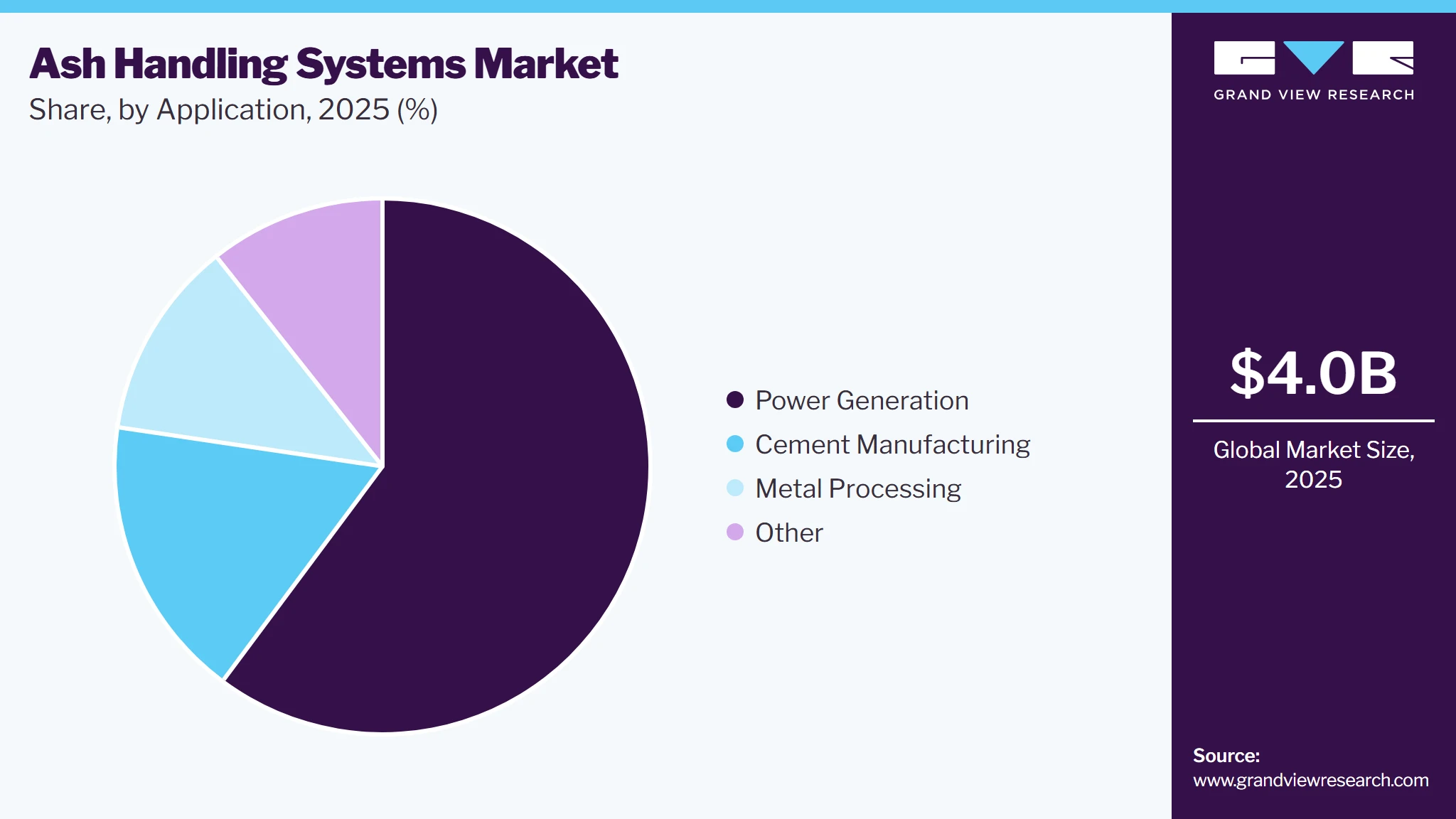
The power generation segment led the market in 2025, holding 60.2% market share due to the substantial volumes of fly ash and bottom ash produced by coal-fired power plants. Continuous electricity generation requires reliable systems for ash collection, cooling, transportation, and storage to maintain operational efficiency. Extensive thermal power infrastructure, equipment modernization, and ongoing ash management requirements sustain demand for pneumatic, mechanical, and hydraulic handling solutions.
 To learn more about this report, Download Free Sample Report
The cement manufacturing segment is expected to grow as cement producers utilize fly ash as a supplementary cementitious material to reduce clinker consumption and improve resource efficiency. This application requires reliable systems for ash unloading, storage, conveying, and controlled feeding into production processes. Expanding infrastructure development and demand for blended cement are expected to encourage investments in specialized ash handling equipment across cement manufacturing facilities.
Regional Insights
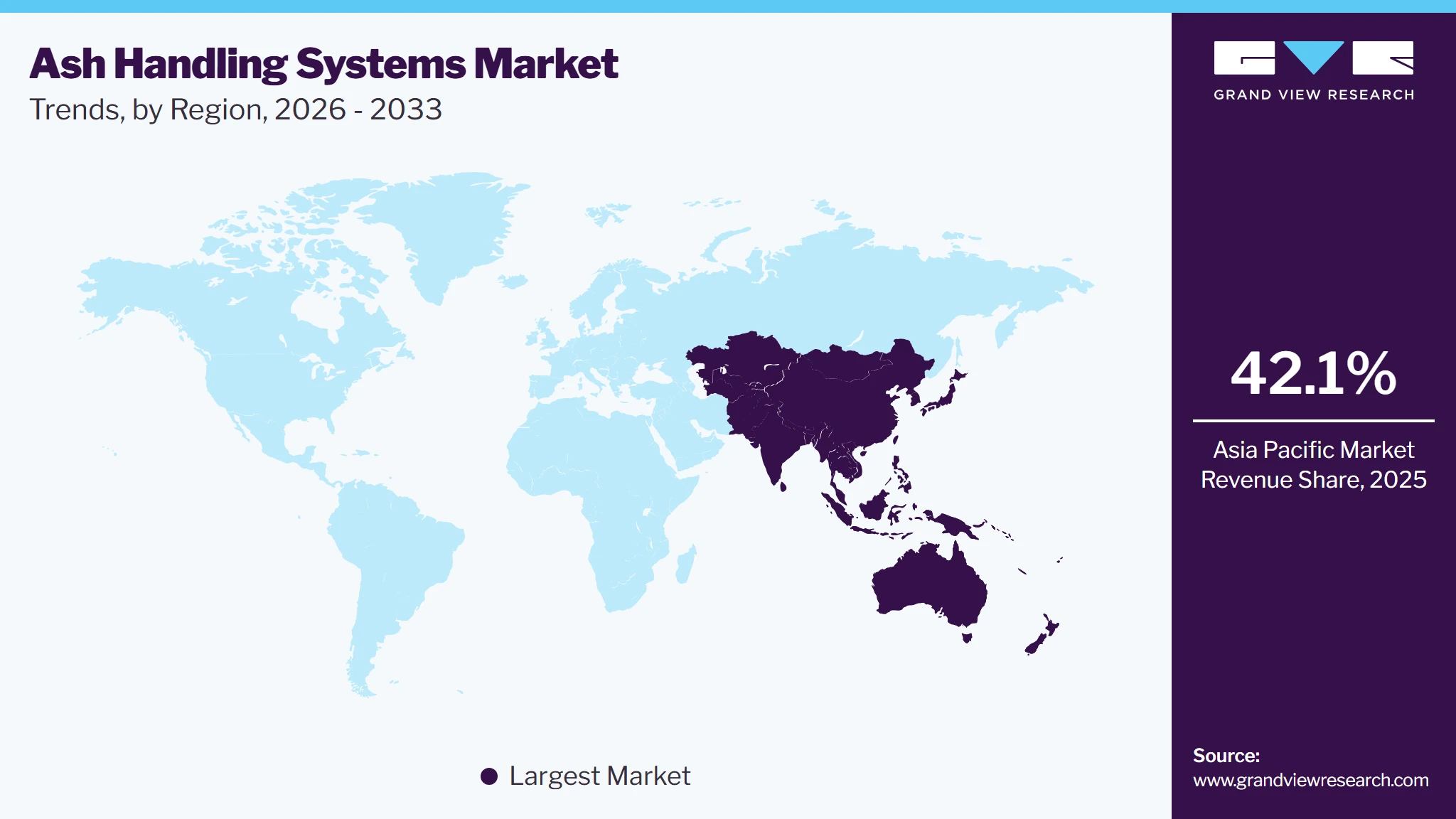
The Asia Pacific ash handling system market held the largest share of 42.1% in 2025 and is also expected to grow at the fastest CAGR from 2026 to 2033. The market is driven by its extensive thermal power infrastructure and continuing electricity demand. Coal-fired generation remains significant across several regional economies, creating substantial requirements for fly ash and bottom ash collection and transportation. New installations, plant expansions, and modernization projects support demand for pneumatic, mechanical, and hydraulic systems. The region's large manufacturing base also supports the availability of engineering services and equipment components.
 To learn more about this report, Download Free Sample Report
The ash handling system market in China is supported by its extensive coal-fired power generation capacity and ongoing improvements in thermal power plant efficiency. Large generating facilities require high-capacity systems capable of continuously removing substantial quantities of fly ash and bottom ash. Equipment upgrades can improve conveying reliability, reduce unplanned shutdowns, and accommodate changing operating conditions. China's development of high-efficiency coal power units also creates requirements for integrated ash collection and transportation infrastructure.
The India ash handling system market is driven by the substantial role of coal-based electricity generation in meeting the country's growing power requirements. Thermal power stations require dependable systems to manage large volumes of combustion residues while supporting uninterrupted electricity production. India's fly ash utilization framework also encourages power plants to improve ash collection, storage, and dispatch to cement manufacturers, brick producers, and infrastructure projects. This creates demand for conveying systems, silos, loading equipment, and related material transfer infrastructure.
North America Ash Handling System Market Trends
The ash handling system market in North America is supported by the modernization of existing thermal power infrastructure and increasing emphasis on industrial waste management. Operators are investing in equipment upgrades to improve material transportation reliability, reduce maintenance interruptions, and extend the operational life of existing facilities. Demand also arises from industrial boilers and biomass-based power generation, which require specialized systems for collecting and transporting combustion residues. Established engineering capabilities and the availability of aftermarket services support equipment refurbishment, replacement, and integration across the region's power generation and industrial sectors.
U.S. Ash Handling System Market Trends
The ash handling system market in the U.S. is expected to remain a major market due to continued operation and maintenance of coal-fired power plants, particularly in regions where coal remains part of the electricity supply mix. Existing facilities require reliable equipment to manage fly ash and bottom ash while complying with applicable waste storage and disposal requirements. The Environmental Protection Agency's Coal Combustion Residuals regulations influence how power plant operators manage ash storage and disposal infrastructure. These requirements support demand for suitable conveying, collection, and containment equipment, although coal plant retirements limit opportunities for new installations.
Europe Ash Handling System Market Trends
The ash handling system market in Europe is shaped by industrial decarbonization and the changing composition of solid-fuel power generation. As several countries reduce coal dependence, biomass combustion and waste-to-energy facilities are becoming relevant sources of combustion residues requiring specialized handling. These plants need systems designed for variations in ash composition, moisture, and temperature. Investments in waste-to-energy infrastructure and industrial energy recovery support demand for mechanical and pneumatic conveying technologies.
The Germany ash handling system market is growing due to its established waste-to-energy infrastructure and industrial use of thermal treatment technologies. Municipal waste incineration facilities generate bottom ash and fly ash that require separate collection, transportation, and treatment processes. These operations create demand for conveyors, enclosed transfer systems, and equipment designed to handle abrasive or chemically complex residues.
The ash handling system market in the UK is influenced by biomass-fired electricity generation and the management of combustion residues from renewable energy facilities. Biomass plants produce ash with characteristics that differ from conventional coal ash, requiring equipment suited to variations in particle size, moisture, and material composition. The country's transition toward lower-carbon electricity generation creates opportunities for suppliers serving biomass installations and industrial energy recovery projects.
Middle East & Africa Ash Handling System Market Trends
The ash handling system market in the Middle East and Africa is expected to grow at a 5.8% CAGR during the forecast period. The industry is supported by industrial expansion and the operation of thermal power and process heating facilities across selected countries. Cement production, metals processing, and other energy-intensive industries generate solid combustion residues that require controlled collection and transportation. Industrial operators are investing in more reliable material handling infrastructure to improve plant availability and reduce operational disruptions. Demand varies considerably across the region because electricity generation mixes and industrial development levels differ between countries.
The Saudi Arabia ash handling system market is driven by the development of cement manufacturing and other mineral-processing industries associated with infrastructure and industrial diversification. Where these facilities use solid fuels or generate combustion residues, operators require equipment for collecting, conveying, and storing ash. High-temperature operating conditions and abrasive materials increase the importance of durable conveyors, wear-resistant components, and dependable maintenance support. Investments in industrial production capacity can create project-specific opportunities for handling equipment suppliers.
Latin America Ash Handling System Market Trends
The ash handling system market in Latin America is expected to grow at a 5.3% CAGR during the forecast period, supported by industrial energy generation and the use of biomass residues as fuel, particularly in countries with substantial agricultural processing industries. Sugar processing, pulp and paper production, and other biomass-intensive operations provide potential applications for mechanical and pneumatic handling equipment in this region.
The Brazil ash handling system market is supported by its sugar and ethanol industry, where bagasse from sugarcane processing is commonly used as boiler fuel for heat and electricity generation. Combustion produces ash that must be removed from boilers, transferred to storage areas, and managed for disposal or potential reuse. This creates demand for conveyors, ash extraction equipment, and systems suited to biomass residues.
Key Ash Handling System Companies Insights
Some of the key players operating in the market include FLSmidth, BABCOCK & WILCOX, Macawber Beekay, Clyde Bergemann, among others.
-
FLSmidth is a Denmark-based engineering company that provides equipment, technologies, and services for the cement and mining industries. Its portfolio includes material handling solutions, conveying equipment, and systems used to manage industrial bulk materials. The company's engineering expertise and experience with high-capacity material transportation are relevant to applications involving combustion residues and industrial process materials.
-
Babcock & Wilcox is a U.S.-based energy and environmental technology company serving power generation and industrial markets. Its offerings include boiler systems, environmental equipment, and technologies for managing combustion byproducts. Through its ash handling solutions, the company supports the collection, transportation, and disposal of fly ash and bottom ash generated by thermal power plants. Its portfolio includes equipment for dry and wet ash handling applications, helping operators manage combustion residues and maintain plant reliability.
Key Ash Handling System Companies
Some prominent players in the ash handling system market include:
-
FLSmidth
-
BABCOCK & WILCOX
-
Macawber Beekay
-
Clyde Bergemann
-
Ducon Technologies
-
United Conveyor Corporation
-
Magaldi Power
-
KC Cottrell
-
Mitsubishi Heavy Industries
-
Sumitomo Heavy Industries
-
ANDRITZ
-
Bharat Engineering
-
ProcessBarron
-
Qingdao Sizhou Electric Power Equipment Co. Ltd.
-
Desein
Company Categorization
Operating Strategies
Competitive Edge
Weaknesses
Mature Players: FLSmidth, Babcock & Wilcox, Macawber Beekay, Clyde Bergemann, United Conveyor Corporation, Magaldi Power, Mitsubishi Heavy Industries, Sumitomo Heavy Industries, ANDRITZ, ProcessBarron
Focus on expanding global presence, developing efficient pneumatic, mechanical, and hydraulic ash handling systems, strengthening relationships with power plant operators, and improving automation.
They also emphasize customized engineering, equipment modernization, aftermarket services, and integrated fly ash and bottom ash management solutions.
- Established industry reputation, extensive engineering expertise, broad product portfolios, international service networks, and experience executing complex industrial projects.
- Their ability to provide customized ash collection, conveying, storage, and disposal solutions, alongside installation and maintenance services, supports competitiveness in large-scale projects.
- Higher operating costs, complex organizational structures, and potentially longer project execution timelines can reduce flexibility.
- Dependence on capital-intensive power generation projects and exposure to declining coal-fired generation in certain markets may also affect demand and future growth opportunities.
Emerging Players: Bharat Engineering, Qingdao Sizhou Electric Power Equipment Co. Ltd.
Focus on regional opportunities, competitive pricing, specialized equipment manufacturing, and customized engineering. They may prioritize pneumatic conveying equipment, mechanical conveyors, storage systems, and components suited to specific plant requirements.
Relationships with local power producers, engineering contractors, and industrial customers support market expansion.
- Flexible operations, competitive pricing, faster decision-making, and the ability to customize equipment for particular ash characteristics and plant configurations.
- Regional presence can facilitate customer relationships, localized technical support, and responsive installation and maintenance services, particularly for smaller power plants and industrial facilities.
- Limited international distribution networks, financial resources, brand recognition, and manufacturing capacity can restrict access to large-scale projects.
- Less extensive service infrastructure and limited experience with complex installations or advanced automation may also affect their ability to compete with established suppliers.
Recent Developments:
-
In September 2026, Refex Industries secured an ash-lifting contract in Madhya Pradesh, covering 1 million metric tons of pond ash and fly ash over 18 months. This large-volume contract can encourage power plants and service providers to invest in conveyors, loading systems, and ash transportation equipment, improving operational efficiency and supporting market growth.
-
In November 2025, ANDRITZ strengthened its boiler service business by acquiring Allen-Sherman-Hoff, a recognized provider of ash handling systems. The acquisition expanded ANDRITZ’s capabilities in ash collection, conveying, and disposal solutions for power plants.
Ash Handling System Market Report Scope
Report Attribute
Details
Market size in 2025
USD 4.0 billion
Estimated market size in 2026
USD 4.2 billion
Projected market size by 2033
USD 6.1 billion
Growth rate
CAGR of 5.3% from 2026 to 2033
Base year for estimation
2025
Historical data
2021 - 2024
Forecast period
2026 - 2033
Quantitative units
Revenue in USD billion and CAGR from 2026 to 2033
Report coverage
Revenue forecast, company market position analysis, competitive landscape, growth factors, and trends
Segments covered
System type, handling method, application, region
Regional scope
North America; Europe; Asia Pacific; Latin America; Middle East & Africa
Country Scope
U.S.; Canada; Mexico; Germany; UK; Italy; Spain; France; China; Japan; India; Australia; South Korea; Brazil; Argentina; Saudi Arabia; UAE; South Africa
Key companies profiled
FLSmidth; BABCOCK & WILCOX; Macawber Beekay; Clyde Bergemann; Ducon Technologies; United Conveyor Corporation; Magaldi Power; KC Cottrell; Mitsubishi Heavy Industries; Sumitomo Heavy Industries; ANDRITZ; Bharat Engineering; ProcessBarron; Qingdao Sizhou Electric Power Equipment Co. Ltd.; Desein
Customization scope
Free report customization (equivalent up to 8 analysts working days) with purchase. Addition or alteration to country, regional & segment scope.
Pricing and purchase options
Avail customized purchase options to meet your exact research needs. Explore purchase options
Global Ash Handling System Market Report Segmentation
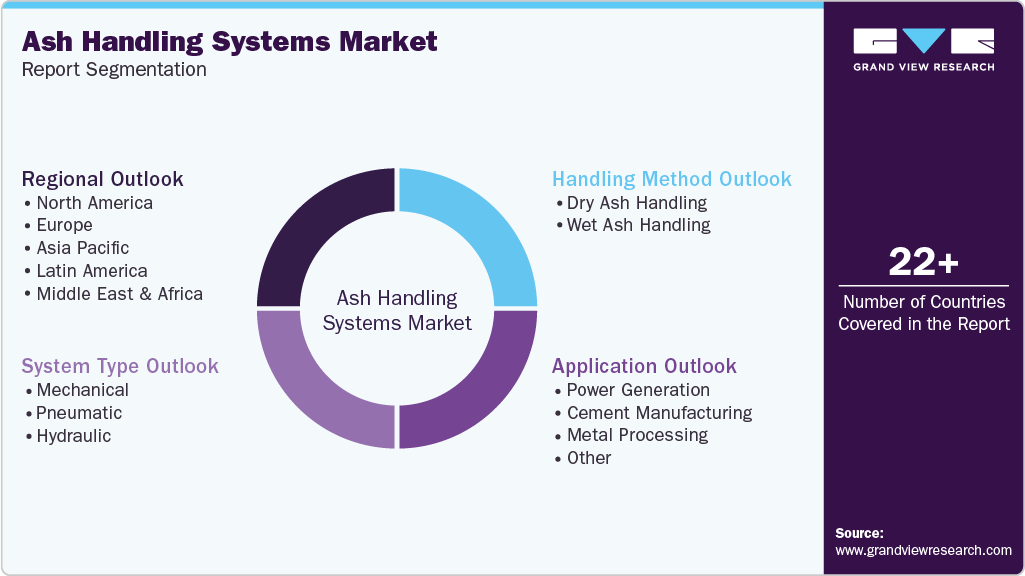
This report forecasts revenue growth at global, regional & country levels and provides an analysis of the industry trends in each of the sub-segments from 2021 to 2033. For this study, Grand View Research has segmented the global ash handling system market report based on system type, handling method, application, and region:
 To learn more about this report, Download Free Sample Report
-
System Type Outlook (Revenue, USD Billion, 2021 - 2033)
-
Mechanical
-
Pneumatic
-
Hydraulic
-
-
Handling Method Outlook (Revenue, USD Billion, 2021 - 2033)
-
Dry Ash Handling
-
Wet Ash Handling
-
-
Application Outlook (Revenue, USD Billion, 2021 - 2033)
-
Power Generation
-
Cement Manufacturing
-
Metal Processing
-
Other
-
-
Regional Outlook (Revenue, USD Billion, 2021 - 2033)
-
North America
-
U.S.
-
Canada
-
Mexico
-
-
Europe
-
Germany
-
France
-
UK
-
Spain
-
Italy
-
-
Asia Pacific
-
China
-
India
-
Japan
-
South Korea
-
Australia
-
-
Latin America
-
Brazil
-
Argentina
-
-
Middle East & Africa
-
Saudi Arabia
-
UAE
-
South Africa
-
-
Research Methodology
The ash handling system market figures in this report are based on a proven research process that combines executive interviews with secondary research from proprietary databases, company filings, and recognized regulatory and institutional sources. Market size is built through value-chain sizing—reconciling supply-side and demand-side estimates—and triangulated with bottom-up and top-down approaches. Every estimate passes multiple levels of expert validation before publication, with each ash handling system segment quantified using the revenue-capture definitions in the table below.
Segment Definition
Segment – System Type
Revenue Capture Definition
Mechanical
Revenue is generated from sales of mechanical ash handling systems installed in power plants and industrial facilities, including belt conveyors, screw conveyors, drag-chain conveyors, and bucket elevators used to transport fly ash, bottom ash, and other solid combustion residues.
Pneumatic
Revenue is derived from sales of pneumatic ash handling systems deployed across thermal power plants, cement manufacturing facilities, and industrial boiler installations, where pipelines, blow tanks, compressors, and conveying equipment transport fine ash to storage silos and disposal points.
Hydraulic
Revenue is captured from sales of hydraulic ash handling systems installed in power generation and industrial facilities, incorporating slurry pumps, pipelines, water circulation equipment, and associated components for transporting ash mixed with water to storage, settling, or disposal areas.
Segment –Handling Method
Revenue Capture Definition
Dry Ash Handling
Revenue is obtained from sales of dry ash handling systems installed across power plants and industrial facilities, including equipment for ash extraction, cooling, conveying, silo storage, and bulk loading that supports reduced water consumption and potential ash reuse in cement and construction applications.
Wet Ash Handling
Revenue is generated from sales of wet ash handling systems deployed at power plants and industrial facilities that use water-based collection, cooling, and transportation processes.
Segment –
Application
Revenue Capture Definition
Power Generation
Revenue is derived from sales of ash handling systems installed in coal-fired power plants and other thermal power generation facilities for collecting, cooling, conveying, storing, and transporting fly ash and bottom ash generated during combustion.
Cement Manufacturing
Revenue is captured from sales of ash handling systems deployed across cement plants, grinding units, and fly ash processing facilities for receiving, unloading, conveying, storing, and feeding fly ash into cement production processes and associated bulk material handling operations.
Metal Processing
Revenue is obtained from sales of ash handling systems installed across metal processing plants, foundries, smelting facilities, and industrial furnaces where combustion ash and other suitable solid residues require collection, cooling, transportation, and storage.
Other
Revenue is generated from sales of ash handling systems deployed across waste-to-energy facilities, pulp and paper mills, industrial boiler installations, and other ash-generating industrial operations requiring combustion residue collection, conveying, storage, and disposal.
Estimation Model
Layer No.
Layer Name
Key Question
Description
01
Industrial Ash Generation Layer
Which industries and operating conditions generate demand for ash handling systems?
The estimation begins by evaluating coal-fired power plants, industrial boilers, cement manufacturing facilities, metal processing plants, biomass-fired facilities, and waste-to-energy installations. Ash generation volumes, fuel consumption, plant capacity, operating hours, combustion technology, and fly ash and bottom ash characteristics determine the underlying demand for ash collection, transportation, cooling, storage, and disposal systems.
02
System Type & Handling Method Layer
Which equipment configurations and handling methods determine market demand?
This layer refines demand by assessing mechanical, pneumatic, and hydraulic ash handling systems across dry ash handling and wet ash handling methods. Ash particle size, moisture content, abrasiveness, conveying distance, handling capacity, water availability, plant layout, automation requirements, and environmental considerations influence equipment selection and system configuration.
03
Application & Deployment Layer
Where are ash handling systems installed, and what determines their utilization?
Market demand is estimated through deployment across power generation, cement manufacturing, metal processing, and other applications, including industrial boilers, biomass-fired facilities, and waste-to-energy plants. New plant construction, existing facility modernization, ash disposal requirements, fly ash utilization, operating conditions, equipment replacement cycles, and integration with existing material handling infrastructure influence installation and replacement demand.
04
Revenue Layer
How is total market revenue calculated?
Revenue is estimated by aggregating expenditure on ash handling systems across system types, handling methods, applications, and regional markets. New installations, system upgrades, and replacement demand are assessed using equipment volumes, average selling prices, handling capacity, system complexity, conveying distance, automation features, installation requirements, and associated engineering and commissioning services to validate the overall market size.
Delivered Customizations
We have successfully delivered the following deep-dive customizations:
Client Request
Customization Delivered
Value Adds
Regional Segmentation
Detailed regional analysis was conducted across North America, Europe, Asia Pacific, Latin America, and the Middle East & Africa, including country-level assessments of the U.S., Germany, China, India, Brazil, and Saudi Arabia. The study evaluated coal-based power generation, thermal power plant modernization, industrial boiler installations, cement manufacturing, fly ash utilization, environmental requirements, and infrastructure investments influencing ash handling system demand.
Helped identify regional differences in ash handling system adoption, country-specific demand patterns, thermal power infrastructure development, industrial applications, ash utilization practices, and modernization opportunities. The analysis supported the assessment of demand for pneumatic, mechanical, dry, and wet ash handling systems across major markets.
Competitive benchmarking
Benchmarking was conducted for major ash handling system market participants based on system portfolios, pneumatic and mechanical conveying capabilities, dry and wet handling technologies, fly ash and bottom ash applications, automation capabilities, plant integration, customization, engineering expertise, geographic presence, project execution, and installation and aftermarket services.
Assisted clients in understanding competitor positioning, technology differentiation, application coverage, project capabilities, service networks, and product development priorities. The analysis also supported comparisons of suppliers' capabilities in power generation, cement manufacturing, industrial boilers, and ash transportation and disposal applications.
Opportunity assessment
In-depth opportunity assessment was conducted across coal-fired power plants, industrial boilers, cement manufacturing, and other ash-generating facilities. The study evaluated opportunities related to pneumatic conveying systems, mechanical conveyors, dry ash handling, wet ash handling, plant modernization, automation, remote monitoring, ash silo and loading infrastructure, and systems supporting fly ash utilization.
Enabled clients to identify attractive application segments, evaluate opportunities across system types and handling methods, and assess demand arising from power plant upgrades, operational efficiency requirements, environmental compliance, and increased use of fly ash in cement and construction materials.
Frequently Asked Questions About This Report
The dry ash handling segment led the market and accounted for 56.7% market share in 2025.
Key factors include continued coal-fired power generation, rising electricity demand, thermal power plant modernization, stricter environmental regulations, increasing fly ash utilization in construction, and demand for efficient ash collection, transportation, and disposal systems.
The Asia Pacific region led the market and accounted for 42.1% of the global market revenue share in 2025.
The cement manufacturing segment is expected to grow at 6.0% CAGR during forecast period in ash handling system market.
The global ash handling system market size was estimated at USD 4.0 billion in 2025 and is expected to reach USD 4.2 billion in 2026.
The ash handling system market, in terms of revenue, is expected to grow at a compound annual growth rate of 5.3% from 2026 to 2033 to reach USD 6.1 billion by 2033.
The pneumatic segment led the market and accounted for 46.3% market revenue share in 2025.
Some of the key players operating in the ash handling system include FLSmidth, BABCOCK & WILCOX, Macawber Beekay, Clyde Bergemann, Ducon Technologies, United Conveyor Corporation, Magaldi Power, KC Cottrell, Mitsubishi Heavy Industries, Sumitomo Heavy Industries, ANDRITZ, Bharat Engineering, ProcessBarron, Qingdao Sizhou Electric Power Equipment Co. Ltd., Desein.
About the Author(s)
Advanced Interior Materials Research Team
Advanced Materials · Advanced Interior MaterialsThis report was authored by the advanced interior materials research team at Grand View Research - comprising two research analysts, one senior research analyst, and one industry expert - with specialized expertise in the advanced interior materials segment of the advanced materials industry. All findings are based on proprietary advanced materials databases, executive interviews, and regulatory analysis, subject to internal peer review prior to publication.
Last Updated:
Speak to Analyst

Customize this report to your needs - add regions, segments, or data points, with 20% free customization.
Or view our licence options:


ISO 9001:2015 & 27001:2022 Certified
We are GDPR and CCPA compliant! Your transaction & personal information is safe and secure. For more details, please read our privacy policy.


