
- Home
- »
- Organic Chemicals
- »
-
Asphalt Release Agents Market Size Report, 2026-2033GVR Report cover

Asphalt Release Agents Market (2026 - 2033)
Size, Share & Trends Analysis Report By Product (Bio-based, Petroleum-based), By Application (Truck Beds, Pavers, Rollers), By Region, And Segment Forecasts
Market Size, 2025
$383.8MMarket Estimate, 2026
$396.1MMarket Forecast, 2033
$535.3MCAGR, 2026–2033
4.4%Asphalt Release Agents Market Summary
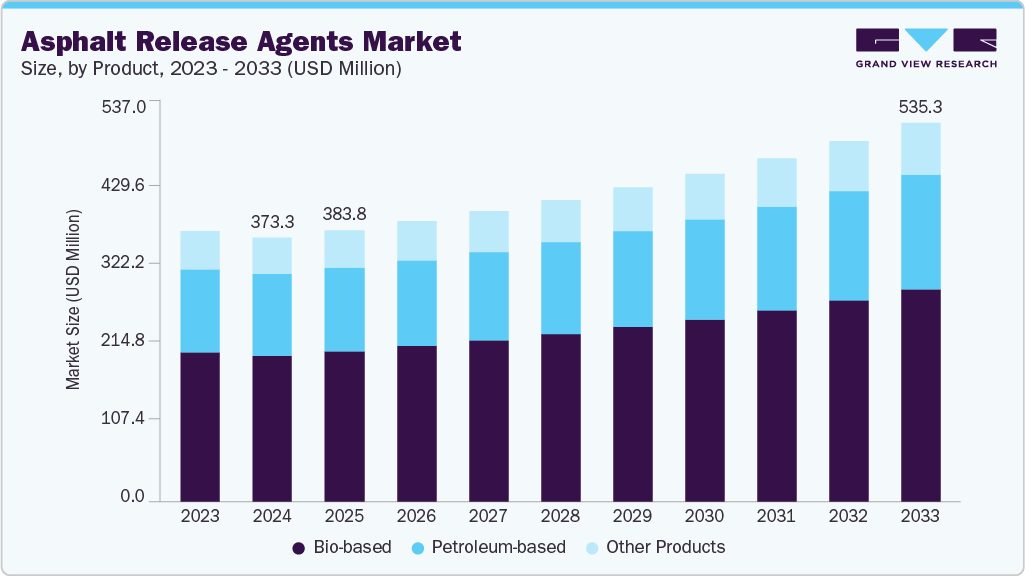
The global asphalt release agents market size was valued at USD 383.8 million in 2025 and is projected to grow from USD 396.1 million in 2026 to USD 535.3 million in 2033, at a CAGR of 4.4% from 2026 to 2033. Asia Pacific dominated the market, accounting for a revenue share of 35.0% in 2025. The market is primarily driven by strong growth in road construction and maintenance, supported by public infrastructure spending and urban expansion projects across emerging and developed economies.
 Source: Grand View Research, IR Documents, Primary Interviews, Paid DatabasesTo learn more about this report,
 Download Free Sample Report
 Key Market Trends & Insights
- By product: Bio-based segment held the largest revenue share of around 55.0% in 2025.
- By application: Truck beds segment held the largest revenue share of around 45.0% in 2025 in terms of value.
Regional Highlights
- Largest regional market: Asia Pacific (35.0% revenue share, 2025)
- Fastest-growing regional market: North America (highest CAGR, 2026-2033)
Market Size & Forecast
- Market size in 2025: USD 383.8 Million
- Estimated market size in 2026: USD 396.1 Million
- Projected market size by 2033: USD 535.3 Million
- CAGR (2026-2033): 4.4%
Three ways to get this report
Buy it, customize it, or ask a question.Ask an Analyst
Analyst response in 1 business day
- AccessReport author, directly
- Reply timeWithin 1 working day
- No sales callDirect answer only
- FormatEmail reply
- CostFree, no cost
Get the Full Report
What the study covers
- FormatsPDF · Excel · Dashboard
- Timeline2026–2033 annual, 2025 base
- Coverage20+ countries, 5 regions
- Companies10+ key players profiled
Customize the Report
20% free customization
- IncludeCountries, segments, points
- TailorTo your product definition
- ExtendDeeper competitor detail
- OrA fully bespoke study
- Turnaround5–10 working days
The rising emphasis on equipment efficiency and lifecycle cost reduction is prompting contractors and municipalities to adopt high-performance release agents that prevent asphalt build-up, reduce downtime, and lower maintenance costs. The stringent environmental and occupational safety regulations in North America and Europe are accelerating the shift from petroleum-based to biodegradable, water-based formulations, thereby boosting demand for eco-friendly solutions. Continuous innovation by manufacturers, such as the development of non-hazardous emulsions and bio-solvent blends, further supports market expansion.Significant market opportunities lie in the rapid adoption of bio-based and non-label formulations that align with the green procurement policies and sustainability targets of road agencies and contractors. Manufacturers offering customized, ready-to-use concentrates tailored to specific asphalt mixtures, temperature ranges, and equipment types are well-positioned to gain a competitive advantage. The infrastructure modernization programs in Asia Pacific, Latin America, and the Middle East, driven by national highway and smart-city initiatives, are expected to create strong long-term demand for asphalt release solutions. The integration of digital monitoring and automated spraying systems in paving equipment also opens avenues for premium, high-margin products tailored to next-generation construction technologies.
Despite growth prospects, the market is likely to face challenges related to raw material price volatility, particularly for petroleum derivatives and certain bio-solvents, which can affect product margins. The lack of standardized performance benchmarks for biodegradable formulations leads to variability in product efficacy, occasionally limiting end-user confidence. Furthermore, low awareness and cost sensitivity among small- and mid-sized contractors in developing regions often lead to the continued use of unregulated or locally blended agents, thereby constraining the penetration of compliant commercial formulations. Lastly, stringent chemical labeling and transportation regulations (such as REACH and EPA guidelines) add to compliance costs and complexity for international suppliers.
Market Concentration & Characteristics
The market is moderately consolidated, with leading players such as FUCHS, Zeller+Gmelin, ArrMaz, and Quaker holding a significant share, while regional specialists such as Zep, SoySolv, Rhomar Industries, Meyer Lab, and Miller-Stephenson cater to localized demand. The top companies collectively account for around half of global revenues, leveraging strong R&D, established distribution networks, and long-term supply partnerships with asphalt plant OEMs and road construction contractors. Product portfolios span petroleum-based, bio-based, and water-emulsion formulations, reflecting a strategic shift toward sustainable and compliant chemistries.
Competition centers on formulation performance, environmental compliance, and pricing efficiency. Vendors are increasingly focusing on low-VOC, biodegradable products, ready-to-use concentrates, and OEM-integrated solutions to differentiate in a price-sensitive market. However, smaller players face pressure from fluctuations in raw material costs, limited standardization, and high regulatory compliance costs. To strengthen competitiveness, leading manufacturers are investing in green chemistry innovation, regional expansion through partnerships, and digitalized application systems that enhance operational efficiency and customer retention.
Analyst Perspective
The market is expected to experience steady growth, driven by increased road construction and maintenance activities, rising infrastructure development projects, and the growing need for efficient asphalt-handling solutions. The increasing adoption of environmentally friendly, biodegradable, and non-petroleum-based release agents is supporting market expansion by improving operational efficiency while complying with evolving environmental regulations. Continuous investments in transportation infrastructure, advancements in asphalt paving technologies, and the replacement of conventional diesel-based release agents are creating new opportunities for manufacturers. However, fluctuations in raw material prices, stringent regulatory requirements for chemical formulations, and higher costs of bio-based alternatives may restrain market growth to some extent.
Product Insights
The bio-based segment dominated the market, with the largest revenue share of around 55.0% in 2025, primarily due to the rapid shift toward environmentally sustainable and non-toxic formulations in the road construction and maintenance industries. Growing regulatory emphasis on reducing volatile organic compound (VOC) emissions, combined with the increasing enforcement of EPA and REACH compliance standards, has accelerated the adoption of bio-based and water-emulsion agents. These formulations, derived from vegetable oils, soy derivatives, and biodegradable esters, offer performance comparable to petroleum-based counterparts while eliminating the environmental hazards associated with hydrocarbon residues. Major producers such as FUCHS, Zeller+Gmelin, and SoySolv have expanded their eco-friendly product portfolios, supporting large-scale procurement by municipalities and contractors prioritizing green certifications and worker safety. For instance, in February 2025, Cargill expanded its Anova bio-based asphalt solutions portfolio, strengthening sustainable road-construction technologies that complement environmentally friendly asphalt release-agent applications.
The other product category, including hybrid blends, silicone-based concentrates, and specialty emulsions, is expected to gain traction over the forecast period as manufacturers innovate to bridge the performance gap between traditional and bio-based solutions. This product diversification collectively reflects a structural market transition, with bio-based asphalt release agents positioned as the primary growth engine driving long-term market expansion.
Application Insights
The truck beds segment accounted for the largest revenue share of around 45.0% in 2025, driven by its critical role in preventing asphalt adhesion during the transportation of hot-mix materials. The continuous movement of asphalt between mixing plants and paving sites creates a strong need for effective release agents to ensure clean discharge, reduce material waste, and minimize equipment downtime. Contractors and fleet operators increasingly prefer ready-to-use, water-based bio formulations that provide superior release performance while complying with environmental and worker safety regulations. The segment’s dominance is further supported by the high volume of truck utilization in large-scale road construction and maintenance projects across North America, Europe, and the Asia Pacific, making it the most consistent and recurring point of consumption for asphalt release agents.
The pavers and rollers segment is expected to witness a notable growth over the forecast period, driven by demand for surface finishing and compaction operations that require the continuous application of release agents to prevent asphalt buildup on equipment surfaces. The pavers segment is experiencing notable growth owing to increased adoption of automated spray systems and temperature-resistant formulations that enhance operational efficiency. Meanwhile, other applications, including plant equipment, conveyor systems, and rubber-tired rollers, are seeing steady adoption as manufacturers develop multifunctional emulsions suited to diverse paving conditions. Overall, the market’s application landscape is evolving toward high-performance, environmentally compliant solutions that optimize both equipment longevity and asphalt quality across the paving value chain.
Regional Insights
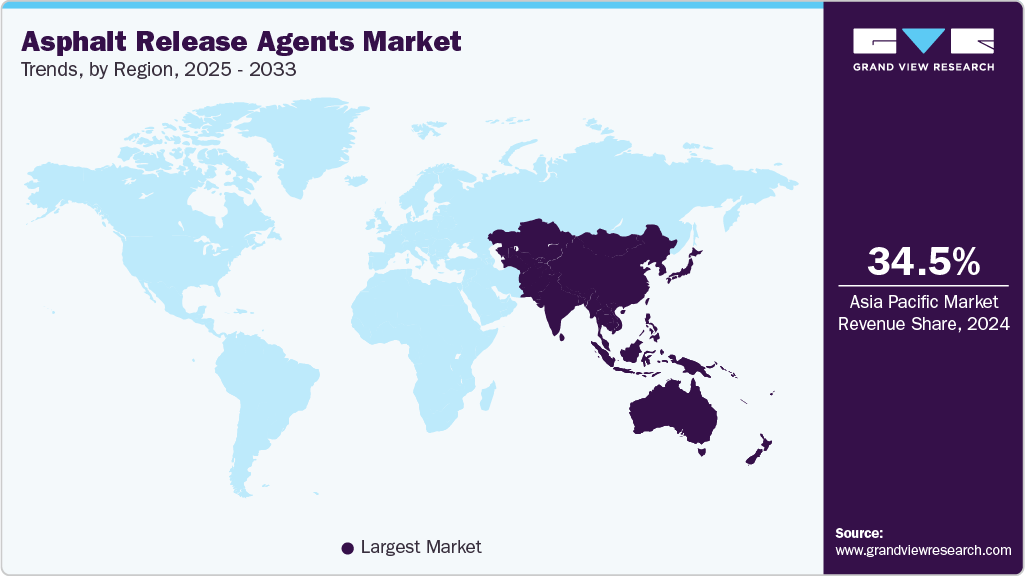
The asphalt release agents industry in Asia Pacific dominated the global market with around 35.0% revenue share in 2025, underpinned by massive investments in transportation and urban infrastructure across China, India, Japan, and Southeast Asia. Expanding highway construction programs, rising government spending on public works, and the adoption of mechanized paving technologies have significantly increased the use of release agents in the region. The transition toward bio-based and low-VOC formulations is accelerating, supported by emerging environmental regulations and local manufacturers offering cost-effective alternatives. With ongoing infrastructure modernization and large-scale public-private partnerships, the Asia Pacific is expected to remain the fastest-growing regional market during the forecast period.
 To learn more about this report, Download Free Sample Report
 The China asphalt release agents industry accounted for a significant share of the Asia Pacific market in 2025, driven by its extensive road-building agenda under the 14th Five-Year Plan and ongoing upgrades to expressways and municipal roads. The country's high asphalt consumption and rapidly expanding construction equipment fleet sustain robust demand for both petroleum-based and bio-based release agents. Local producers dominate the market through competitive pricing and product availability, while multinational firms are investing in localized production and distribution to capture the growing demand for environmentally compliant products. The government’s emphasis on green construction materials and VOC-reduction policies is expected to stimulate further the adoption of bio-based release agents in the coming years.
North America Asphalt Release Agents Market Trends
The asphalt release agents industry in North America held a notable market share in 2025, supported by strong demand from road maintenance and resurfacing projects across the United States and Canada. Stringent environmental standards, advanced paving technologies, and the widespread use of ready-to-use biodegradable formulations drive the region’s market growth. Federal and state-level infrastructure funding through initiatives such as the Infrastructure Investment and Jobs Act (IIJA) has further accelerated product consumption. The region also benefits from the presence of leading global players such as FUCHS, Zep, and Rhomar Industries, which emphasize product innovation and regulatory compliance, positioning North America as one of the most mature and innovation-driven markets worldwide.
U.S. Asphalt Release Agents Market Trends
The asphalt release agents industry in the U.S. accounted for a significant share of North America in 2025, reflecting its extensive road network and high volume of asphalt paving activity. Federal and state investments in highway rehabilitation, urban development, and maintenance programs continue to drive consistent demand for release agents. The U.S. market is characterized by strong adoption of bio-based and non-hazardous formulations, propelled by EPA regulations and contractor preference for eco-certified solutions. Major domestic and international suppliers have established extensive distribution networks and offer application-specific concentrates tailored to diverse climatic and operational conditions, reinforcing the country’s position as a key revenue generator in the global market.
Key Asphalt Release Agents Company Insights
The market for asphalt release agents is characterized by global, regional, and niche solution providers competing through technological innovation, strategic partnerships, acquisitions, and product portfolio expansion.
Key Asphalt Release Agents Companies
The following key companies have been profiled for this study on the asphalt release agents market:
-
FUCHS
-
Zeller+Gmelin
-
BG Chemical
-
Meyer Lab
-
Zep
-
SoySolv
-
Rhomar Industries Inc.
-
Industrial Chemical Solutions
-
McGee Industries, Inc.
-
Miller-Stephenson Chemical Company, Inc.
Recent Developments
- In October 2025, Tarmac launched its CEVO Asphalts range in the UK, combining advanced binder technology, warm-mix asphalt technologies, and higher levels of recycled asphalt to reduce the carbon footprint of road construction. The company stated that the solutions can reduce emissions from asphalt materials by up to 45% compared with conventional hot-mix asphalt. The launch highlighted the increasing adoption of lower-temperature production and recycled-material technologies as the asphalt industry seeks to improve sustainability and reduce energy consumption.
Global Asphalt Release Agents Market Report Scope
Report Attribute
Details
Market size in 2025
USD 383.8 million
Estimated market size in 2026
USD 396.1 million
Projected market size by 2033
USD 535.3 million
Growth rate
CAGR of 4.4% from 2026 to 2033
Base year for estimation
2025
Historical data
2021 - 2025
Forecast period
2026 - 2033
Quantitative units
Revenue in USD million and CAGR from 2026 to 2033
Report coverage
Revenue forecast, company ranking, competitive landscape, growth factors, and trends
Segments covered
Product, application, region
Regional Scope
North America; Europe; Asia Pacific; MEA; Latin America
Country Scope
U.S.; Canada; Mexico; Germany; UK; France; Italy; Spain; China; India; Japan; South Korea; Brazil; Argentina; South Africa; Saudi Arabia
Key companies profiled
FUCHS; Zeller+Gmelin; BG Chemical; Meyer Lab; Zep; SoySolv; Rhomar Industries Inc.; Industrial Chemical Solutions; McGee Industries, Inc.; Miller-Stephenson Chemical Company, Inc.
Customization scope
Free report customization (equivalent to 8 analyst working days) with purchase. Addition or alteration to country, regional & segment scope.
Pricing and purchase options
Avail of customized purchase options to meet your exact research needs. Explore purchase options
Asphalt Release Agents Market Report Segmentation
This report forecasts revenue growth at the global, regional, and country levels and provides an analysis of the latest industry trends and opportunities across each sub-segment from 2021 to 2033. For this study, Grand View Research has segmented the global asphalt release agents market report based on product, application, and region:
- Product Outlook (Volume, Kilotons; Revenue, USD Million, 2021 - 2033)
- Bio-based
- Petroleum-based
- Other Products
- Application Outlook (Volume, Kilotons; Revenue, USD Million, 2021 - 2033)
- Truck Beds
- Pavers
- Rollers
- Other Applications
- Regional Outlook (Volume, Kilotons; Revenue, USD Million, 2021 - 2033)
- North America
- U.S.
- Canada
- Mexico
- Europe
- Germany
- UK
- France
- Italy
- Spain
- Asia Pacific
- China
- India
- Japan
- South Korea
- Middle East & Africa
- Saudi Arabia
- South Africa
- Latin America
- Brazil
- Argentina
- North America
Frequently Asked Questions About This Report
The global asphalt release agents market size was valued at USD 383.8 million in 2025 and is estimated at USD 396.1 million in 2026.
The global asphalt release agents market is expected to grow at a CAGR of 4.4% from 2026 to 2033, reaching USD 535.3 million.
The Asia Pacific region dominated the global asphalt release agents market, accounting for approximately 35.0% of revenue in 2025.
Key players in the market include FUCHS, Zeller+Gmelin, BG Chemical, Meyer Lab, Zep, SoySolv, Rhomar Industries Inc., Industrial Chemical Solutions, McGee Industries, Inc., and Miller-Stephenson Chemical Company, Inc., among others.
The bio-based segment accounted for the largest revenue share in 2025, at around 55.0%.
About the Author(s)
Organic Chemicals Research Team
Bulk Chemicals · Organic ChemicalsThis report was authored by the organic chemicals research team at Grand View Research - comprising two research analysts, one senior research analyst, and one industry expert - with specialized expertise in the organic chemicals segment of the bulk chemicals industry. All findings are based on proprietary bulk chemicals databases, executive interviews, and regulatory analysis, subject to internal peer review prior to publication.
Last Updated:
Speak to Analyst

Customize this report to your needs - add regions, segments, or data points, with 20% free customization.
Or view our licence options:


ISO 9001:2015 & 27001:2022 Certified
We are GDPR and CCPA compliant! Your transaction & personal information is safe and secure. For more details, please read our privacy policy.


