
- Home
- »
- Next Generation Technologies
- »
-
Assistive Learning Technologies Market Size Report, 2033GVR Report cover
![Assistive Learning Technologies Market (2026 - 2033)Report]()
Assistive Learning Technologies Market (2026 - 2033)
Size, Share, & Trends Analysis Report By Product Type (Software Solutions, Hardware Devices), By Application (Writing Assistance, Communication Support, Mathematics Assistance), By End Use, By Region, And Segment Forecasts
Market Size, 2025
$6.6BMarket Estimate, 2026
$7.3BMarket Forecast, 2033
$16.3BCAGR, 2026–2033
12.2%Assistive Learning Technologies Market Summary
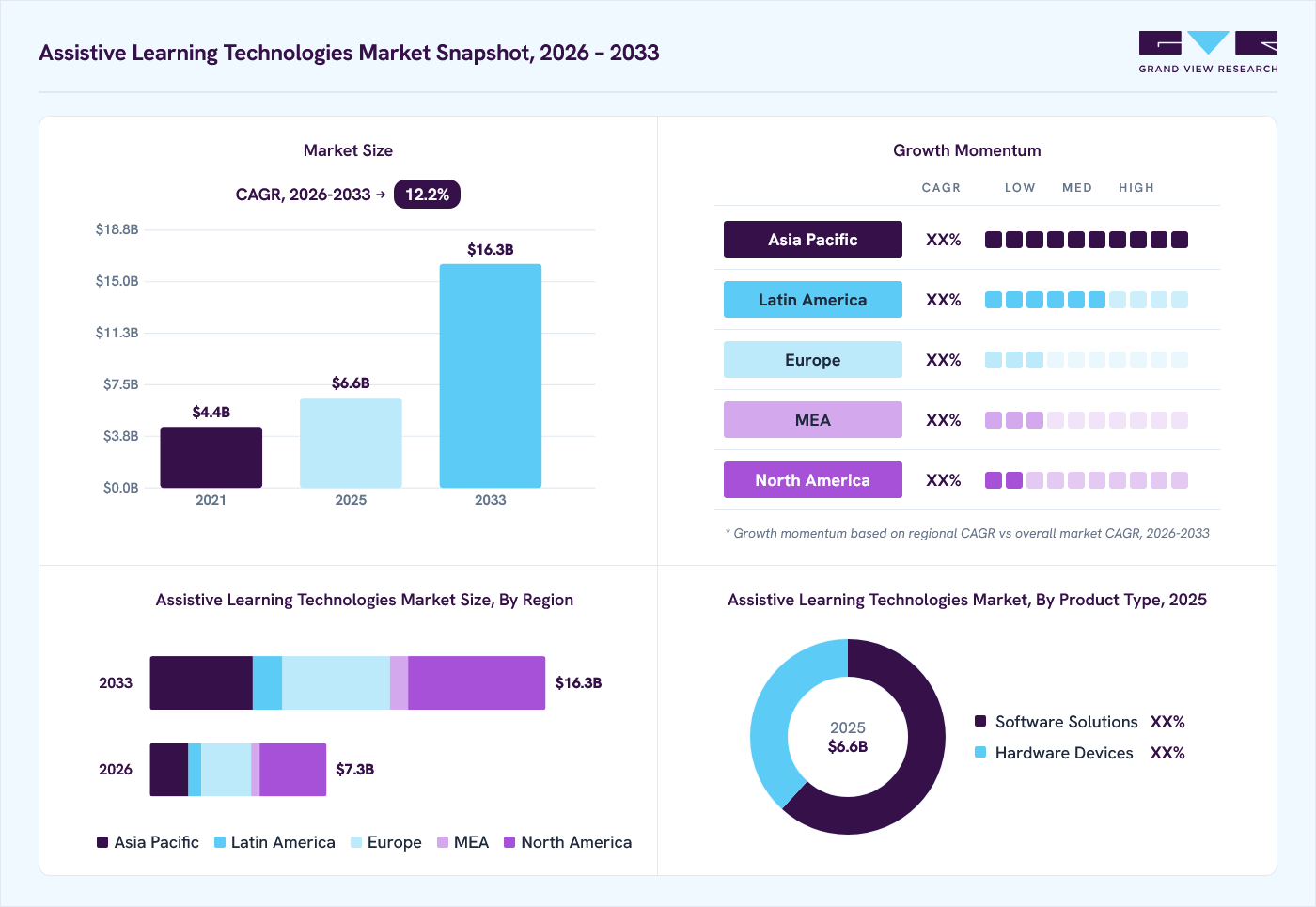
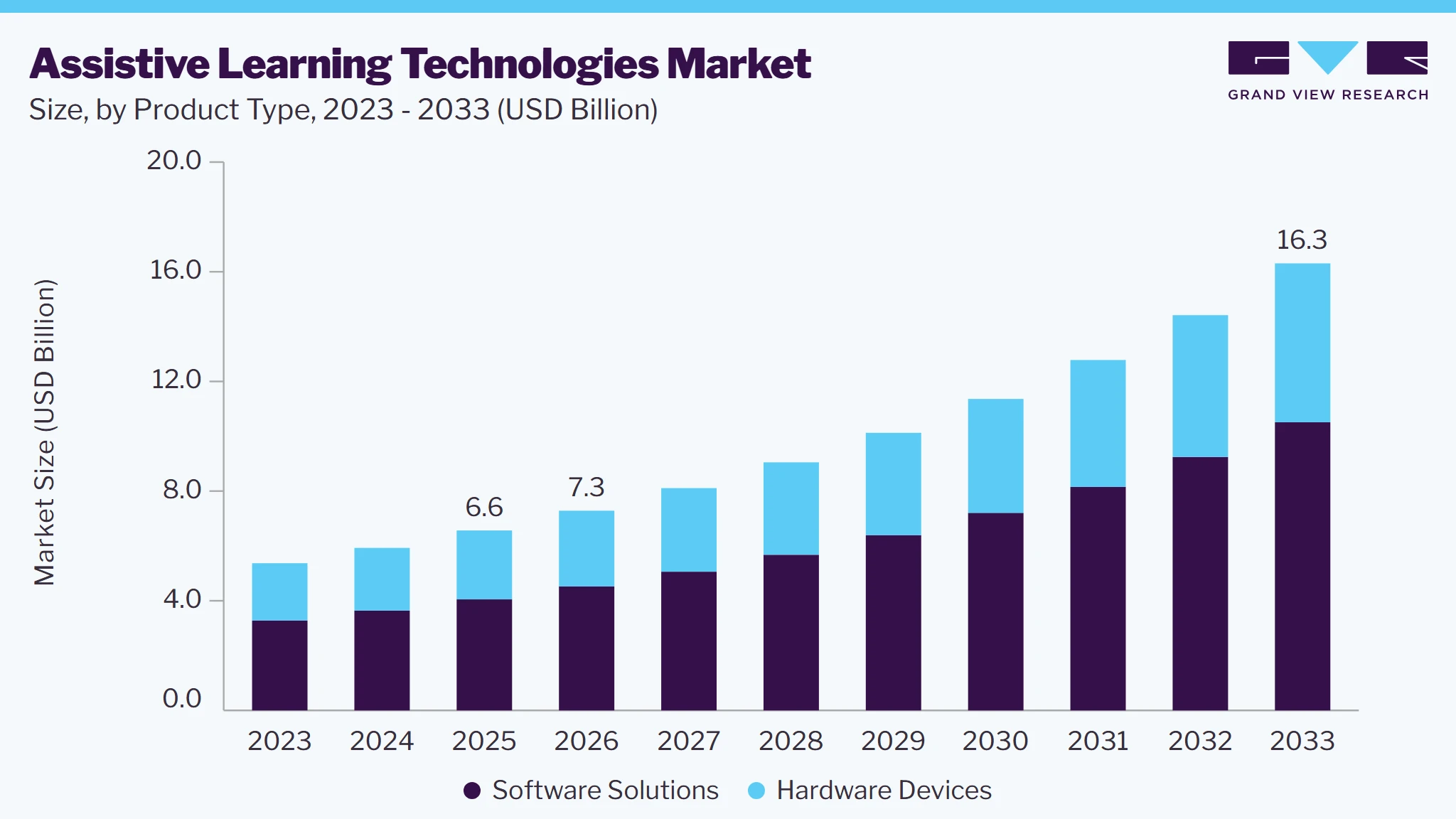
The global assistive learning technologies market size was valued at USD 6.6 billion in 2025 and is projected to grow from USD 7.3 billion in 2026 to USD 16.3 billion by 2033, at a CAGR of 12.2% from 2026 to 2033. North America dominated the market, accounting for the largest revenue share of 38.3% in 2025. The global assistive learning technologies market is growing as demand for inclusive education increases.
Key Market Trends & Insights
- By product type: Software solutions segment held the largest market share of around 61.7% in 2025.
- By application: Reading & literacy support segment held the largest market revenue share in 2025.
- By end use: Schools & educational institutions (K–12) segment led the market with the largest revenue share in 2025.
Regional Highlights
- Largest regional market: North America (38.3% revenue share, 2025)
- Fastest-growing regional market: Asia Pacific (highest CAGR, 2026-2033)
- Leading country: The U.S. held the largest share in 2025
Market Size & Forecasts
- Market size in 2025: USD 6.6 Billion
- Estimated market size in 2026: USD 7.3 Billion
- Projected market size by 2033: USD 16.3 Billion
- CAGR (2026-2033): 12.2%
Three ways to get this report
Buy it, customize it, or ask a question.Ask an Analyst
A direct answer, usually in 1 working day
- AccessReport author, directly
- Reply timeWithin 1 working day
- No sales callDirect answer only
- FormatEmail reply
- CostFree, no cost
Get the Full Report
What the study covers
- FormatsPDF · Excel · Dashboard
- Timeline2026–2033 annual, 2025 base
- Coverage20+ countries, 5 regions
- Companies10+ key players profiled
Customize the Report
20% free customization
- IncludeCountries, segments, points
- TailorTo your product definition
- ExtendDeeper competitor detail
- OrA fully bespoke study
- Turnaround5–10 working days
This is driving the adoption of AI-enabled and adaptive learning solutions that provide personalized support for diverse learning needs. Increasing focus on accessible education is further supporting market expansion. Increasing adoption of AI-powered personalized learning is shaping the assistive learning technologies market. AI enables learning platforms to adapt content to students’ individual needs, learning pace, and performance. This supports more personalized learning experiences for students with diverse learning requirements and helps address individual learning gaps. Educational institutions are increasingly exploring AI to improve learning outcomes and provide targeted support across different learning needs. The integration of AI into educational platforms is also enabling real-time feedback and more adaptive learning experiences, supporting the broader adoption of assistive learning technologies. For instance, in June 2025, Pearson, an education and learning company entered a multi-year partnership with Google Cloud to develop AI-powered personalized learning tools for primary and secondary school students. The tools are designed to adapt to students’ individual learning needs while helping teachers track performance and tailor lessons.
Increasing adoption of AI-powered speech recognition is emerging as an important trend in the Assistive Learning Technologies market. Speech recognition enables learning platforms to understand students’ spoken responses and provide real-time feedback on pronunciation, reading, and communication skills. This can support students with speech, language, and reading difficulties by enabling more interactive and accessible learning experiences. Educational institutions are increasingly incorporating voice-enabled technologies to support reading assessment, conversational learning, and personalized instruction. The integration of speech recognition with AI is also expanding the capabilities of assistive learning platforms beyond traditional text-based solutions. For instance, in June 2025, Amplify Education, Inc., a U.S. education technology company, announced the development of a custom Automatic Speech Recognition (ASR) system to power voice-enabled education products. The technology is designed to support reading assessment, conversational tutoring, digital activity input, and classroom monitoring while providing feedback on pronunciation and reading fluency.
Increasing focus on accessibility and inclusive digital learning is driving demand in the assistive learning technologies market. Education providers are increasingly adopting technologies that improve access to digital learning content. These solutions support students with diverse learning and physical needs. They enable easier content navigation, reading, communication, and interaction. This is increasing demand for accessibility-focused learning technologies across educational settings. Technology providers are also integrating accessibility features directly into digital learning platforms. The growing emphasis on inclusive education is encouraging institutions to adopt scalable solutions for diverse learner populations. As accessibility becomes an integral part of digital education, demand for assistive learning technologies is expected to increase.
Market Dynamics
The assistive learning technologies market is evolving with increasing focus on accessibility, personalization, and inclusive learning. Education providers are adopting advanced technologies to support students with diverse learning and physical needs. The rising demand for accessible and personalized learning experiences is encouraging continuous innovation across digital learning platforms. Market players are enhancing their solutions to improve content accessibility, learning engagement, and support for individual learning requirements. These developments are expected to drive sustained growth of the assistive learning technologies market.
The growing demand for inclusive education is driving the adoption of assistive learning technologies. Educational institutions are increasingly focusing on providing equal learning opportunities for students with diverse learning needs. This is increasing the use of technologies that support reading, communication, navigation, and classroom participation. Schools and educators are adopting accessible digital tools to provide more personalized and flexible learning experiences. The continued emphasis on inclusive education is expected to support demand for assistive learning technologies.
The expansion of inclusive education programs is encouraging institutions to improve accessibility across learning environments. Assistive technologies can help address different learning requirements while enabling students to participate more effectively in educational activities. Growing awareness among educators and parents is also supporting the adoption of specialized learning solutions. Technology providers are developing platforms with accessibility features to address a broader range of learner requirements. These developments are creating new opportunities for assistive learning technology providers across education settings.
The high cost of assistive learning technologies can limit their adoption, particularly among schools and educational institutions with constrained budgets. Advanced solutions such as specialized communication devices, adaptive learning platforms, and accessibility-focused hardware often require significant upfront expenditure. This can make it difficult for institutions to deploy these technologies across a larger number of students. In addition, maintenance, software subscriptions, training, and technical support can increase the overall cost of ownership. These factors may restrict adoption in price-sensitive markets and smaller educational institutions.
The cost barrier is particularly relevant in regions where funding for special education and assistive technologies remains limited. Schools may prioritize essential educational infrastructure over specialized learning technologies when budgets are constrained. Limited awareness of available funding programs can further delay technology adoption. Technology providers, therefore, face the challenge of offering affordable and scalable solutions without compromising functionality. Addressing these cost-related barriers could support broader access to assistive learning technologies.
The integration of generative AI presents opportunities to enhance the capabilities of assistive learning technologies. Generative AI can help create personalized learning content based on students’ individual needs, learning levels, and progress. It can also support real-time explanations, interactive exercises, text simplification, and adaptive feedback. These capabilities can make learning platforms more flexible and responsive to students with diverse learning requirements. As AI technologies mature, their integration can expand the functionality of existing assistive learning solutions.
Education technology providers are increasingly exploring AI to develop more adaptive and interactive learning experiences. Generative AI can support teachers by helping create customized materials and provide additional learning assistance. Its integration with speech, text, and accessibility technologies can further expand applications across different learning needs. This creates opportunities for providers to develop AI-enabled solutions that address a wider range of educational requirements. The increasing use of generative AI in education could therefore create new avenues for innovation in the assistive learning technologies market.
Market Concentration & Characteristics
The assistive learning technologies market is moderately fragmented, with competition spread across specialized assistive technology providers and diversified education technology companies. Market participants offer solutions across areas such as adaptive learning, communication support, reading and writing assistance, accessibility software, and assistive hardware. This broad range of applications allows companies with different technological capabilities and product portfolios to participate in the market. Specialized providers often focus on specific learning needs, while larger technology companies integrate accessibility features into broader education and digital platforms. This creates a competitive environment with varying levels of specialization across different product categories.
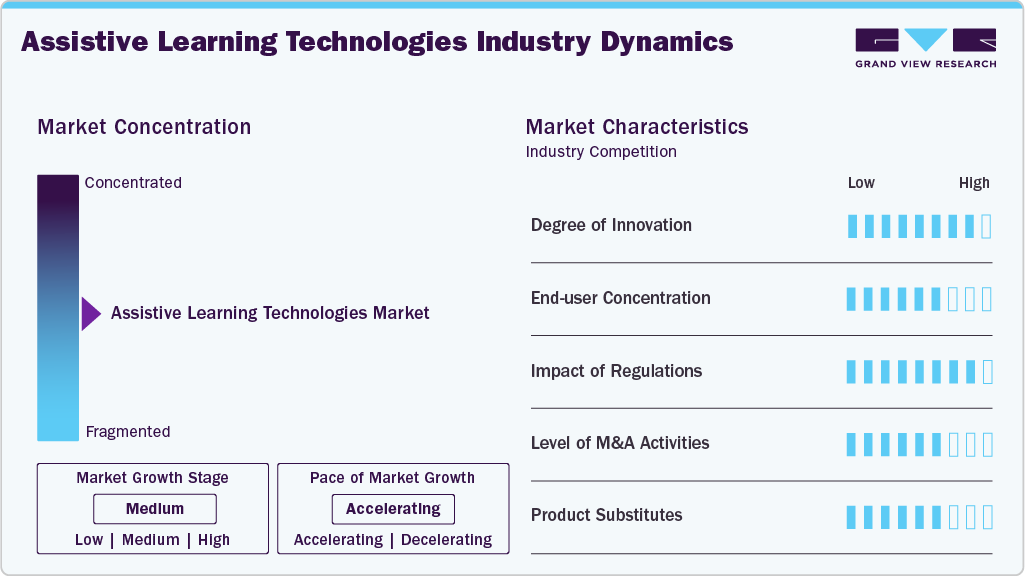
The market also includes established providers with strong positions in specific product segments, while smaller companies address niche learning requirements and specific user groups. Large technology companies are expanding their accessibility, cloud, AI, and digital learning capabilities, further increasing competition across the market. Product innovation, partnerships with educational institutions, and integration of AI are influencing competitive strategies among market participants. However, the presence of multiple specialized vendors and the diverse nature of assistive learning applications limit overall market concentration. As demand for inclusive and personalized education increases, competition is expected to remain distributed across several technology and application areas.
Analyst Perspective
The assistive learning technologies market is entering a growth phase as educational institutions increasingly adopt technologies that support inclusive, accessible, and personalized learning experiences. Advancements in artificial intelligence, adaptive learning, speech recognition, natural language processing, and accessibility technologies are improving the ability of learning platforms to address diverse student requirements. K–12 education, higher education, special education, and online learning are expected to remain key areas of adoption as institutions expand their digital learning initiatives. The market is expected to move toward AI-enabled, adaptive, and increasingly personalized assistive learning solutions as demand for accessible education and individualized learning support continues to increase.
Product Type Insights
The software solutions segment led the market and accounted for 61.7% of the global revenue in 2025. Software solutions offer flexible and scalable support for diverse learning requirements. These solutions include adaptive learning platforms, accessibility tools, communication applications, and learning support software. Increasing integration of AI and personalization features is further enhancing their functionality. Growing adoption of digital learning platforms is expected to support continued demand for software-based assistive learning solutions. The ability to update and customize software solutions also supports their adoption across different educational settings.
The hardware devices segment represents an important component of the assistive learning technologies market. These devices provide direct support for students with visual, hearing, physical, communication, and other learning needs. They include communication devices, Braille displays, alternative input devices, reading devices, and specialized learning equipment. Advances in sensor technologies, voice interfaces, and connected devices are improving the functionality of assistive hardware. Integration with software and AI-enabled platforms is further expanding the applications of these devices across educational settings. Increasing demand for accessible and interactive learning environments continues to support the use of assistive hardware devices.
Application Insights
The reading & literacy support segment dominated the assistive learning technologies market in 2025. Demand is supported by the widespread need for tools that assist students with reading, writing, comprehension, and literacy development. Assistive solutions such as text-to-speech, speech-to-text, digital reading tools, and literacy software are increasingly used across educational settings. These technologies help students access learning content and improve their engagement with educational materials. Integration of AI and adaptive learning capabilities is further enhancing reading and literacy support solutions.
The communication support segment is growing as demand increases for technologies that help students with speech, language, and communication difficulties. Assistive solutions such as speech-generating devices, communication applications, and voice-enabled tools support interaction in classrooms and learning environments. Advances in speech recognition and natural language processing are improving the functionality of these solutions. AI integration is also enabling more responsive and personalized communication support. Increasing emphasis on inclusive education is expected to further support the adoption of communication-focused assistive technologies.
End Use Insights
The schools & educational institutions (K–12) segment dominated the assistive learning technologies market in 2025. K–12 institutions are increasingly adopting assistive technologies to support students with diverse learning and accessibility needs. These solutions help improve reading, communication, classroom participation, and access to digital learning content. The growing emphasis on inclusive education and accessibility in schools is driving the adoption of assistive learning technologies. The increasing integration of digital learning tools across K–12 education is further supporting segment demand.
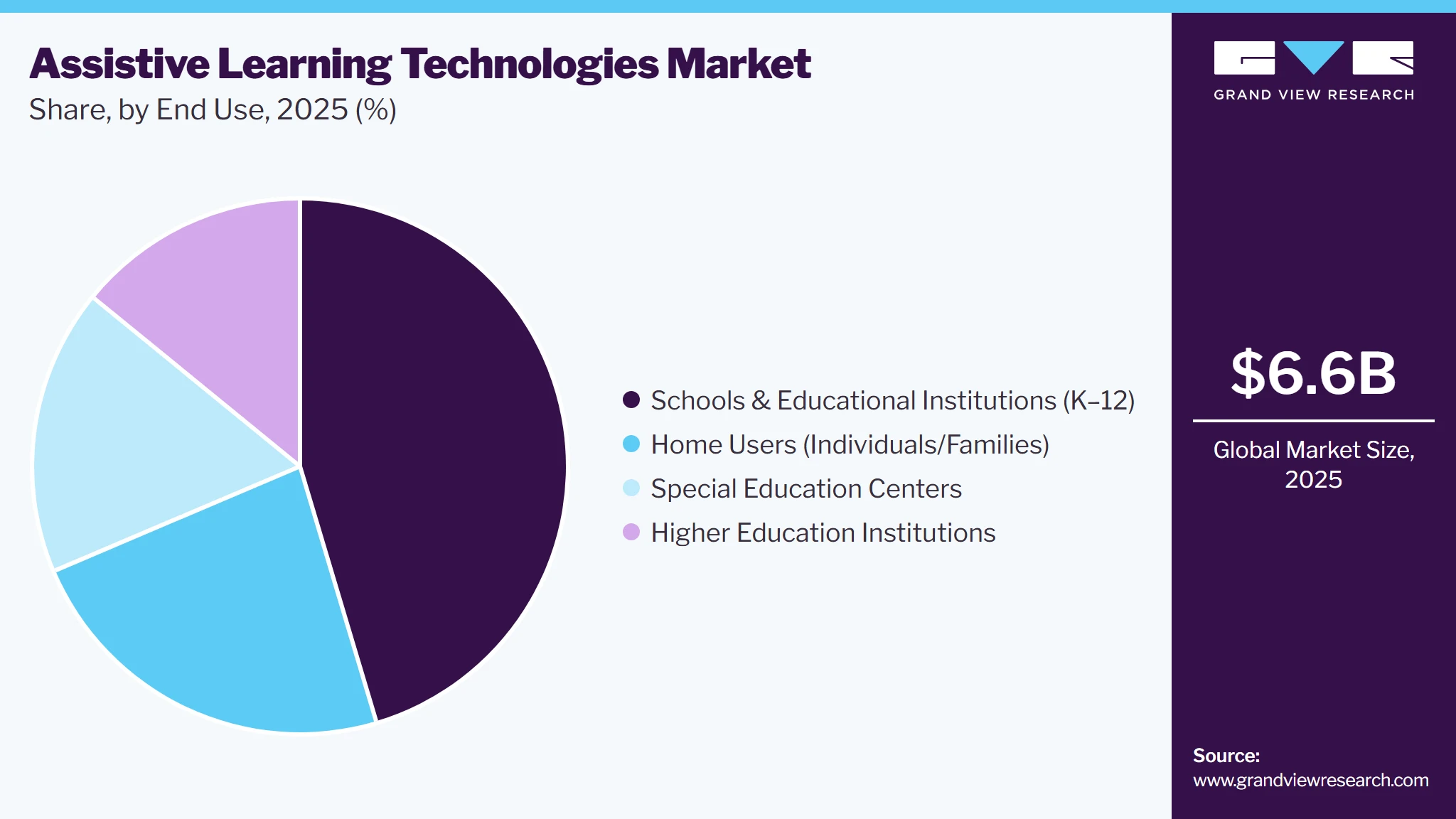
The higher education institutions segment is growing as universities and colleges increasingly adopt technologies to support accessible and personalized learning. Assistive solutions are being used to improve access to digital content, communication, note-taking, and academic resources for students with diverse needs. The expansion of online and hybrid learning is further increasing the need for accessible digital education tools. Institutions are also integrating AI-enabled and adaptive technologies to provide more flexible learning support. These developments are supporting the adoption of assistive learning technologies across higher education environments.
Regional Insights
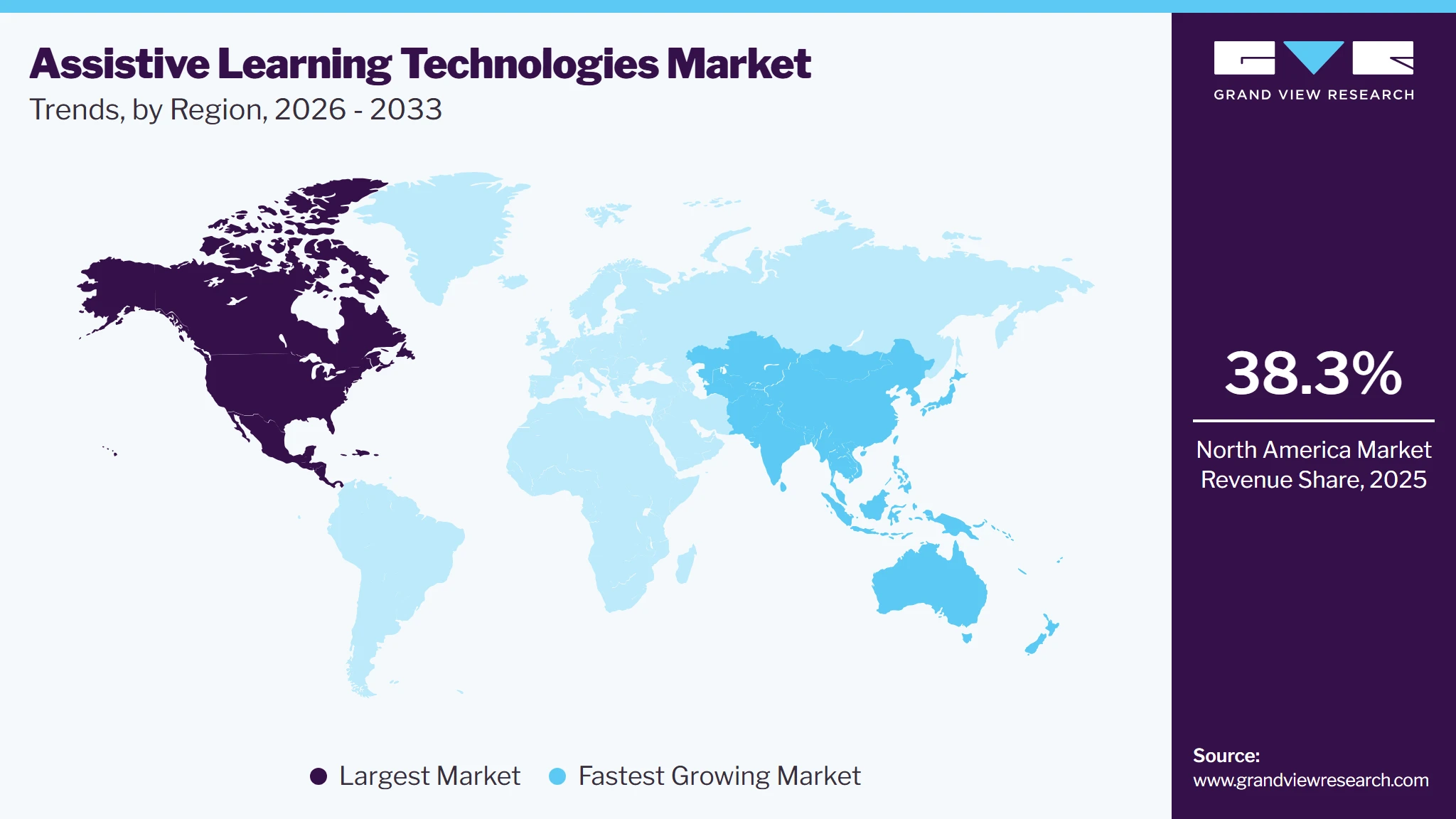
North America dominated the assistive learning technologies market, accounting for 38.3% of global revenue in 2025. The region’s strong position is supported by established digital education infrastructure and high adoption of assistive technologies. Increasing focus on inclusive education and accessible learning is further supporting market demand. Growing integration of AI and adaptive learning solutions is also contributing to regional growth. Continued innovation in assistive learning technologies is expected to support the region’s market development.
U.S. Assistive Learning Technologies Market Trends
The U.S. accounted for a significant share of the assistive learning technologies market in 2025, supported by advanced digital education infrastructure and strong adoption of assistive technologies. Educational institutions are increasingly adopting solutions that support students with diverse learning, communication, and accessibility needs. Growing emphasis on inclusive education and personalized learning is further supporting demand. Integration of AI, speech recognition, and adaptive learning capabilities is expanding the applications of assistive learning technologies.
Europe Assistive Learning Technologies Market Trends
Europe represented a significant market for assistive learning technologies in 2025, supported by increasing focus on accessible and inclusive education. Educational institutions are adopting digital tools to improve access to learning and support students with diverse needs. Growing awareness of assistive technologies and increasing adoption of digital learning platforms are contributing to regional demand. The integration of AI and accessibility features into educational solutions is further expanding their applications.
Asia Pacific Assistive Learning Technologies Market Trends
Asia Pacific is expected to be the fastest-growing region in the assistive learning technologies market, supported by expanding digital education infrastructure and rising awareness of inclusive learning. Educational institutions are increasingly adopting assistive and personalized learning solutions to address diverse student requirements. The growing penetration of online education and AI-enabled learning platforms is further supporting regional demand. Increasing government focus on digital education and accessibility is encouraging technology adoption across educational settings. These factors are expected to drive strong growth in the regional market.
Key Assistive Learning Technologies Company Insights
Key players operating in the Assistive Learning Technologies market include Alphabet Inc.; Amazon.com, Inc.; Apple Inc.; BenQ; Cisco Systems, Inc.; Intel Corporation; Microsoft; Pearson; Sony Group; and Tobii Dynavox.
-
Amazon.com, Inc has expanded accessibility capabilities across its devices and services to support users with diverse learning and accessibility needs. Its Alexa ecosystem provides hands-free interaction and voice-based assistance, supporting users with mobility and communication challenges. Amazon has also introduced features such as Tap to Alexa and text-to-speech capabilities on selected devices to improve accessibility. These developments strengthen the use of voice-enabled and accessible technologies within learning and educational environments.
-
Alphabet Inc. has expanded AI-powered learning and accessibility capabilities through its Google for Education ecosystem. In 2025, Google integrated LearnLM capabilities into Gemini 2.5 to provide more personalized and learning-focused AI interactions. Google has also enhanced Chromebooks and Workspace for Education with accessibility features such as screen readers, voice typing, and Face Control. These developments are expanding the application of AI and accessibility technologies across inclusive learning environments.
Key Assistive Learning Technologies Companies
The following key companies have been profiled for this study on the assistive learning technologies market.
-
Alphabet Inc.
-
Amazon.com, Inc.
-
Apple Inc.
-
BenQ
-
Cisco Systems, Inc.
-
Intel Corporation
-
Microsoft
-
Pearson
-
Sony Group
-
Tobii Dynavox
Competitive Benchmarking
Operating Strategies
Competitive Edge
Weaknesses
Mature Players: Alphabet Inc., Amazon.com, Inc., Apple Inc.
- Focus on expanding assistive learning product portfolios, integrating AI and accessibility features, strengthening partnerships with educational institutions, and developing personalized learning solutions.
- Strong technology capabilities, established education relationships, specialized accessibility expertise, diversified product offerings, and broad market presence.
- High product development and support costs, complex technology requirements, and comparatively slower adaptation to highly specialized learning needs.
Emerging Players: BenQ, Cisco Systems, Inc., Intel Corporation
- Focus on developing specialized assistive learning and communication solutions, enhancing product capabilities, integrating AI and accessibility technologies, and expanding partnerships.
- Specialized expertise, focused product portfolios, flexible solutions, and the ability to respond quickly to specific learning and accessibility requirements.
- Limited geographic presence, smaller customer base, lower financial resources, and greater dependence on specialized market segments and partnerships.
Recent Developments
-
In March 2025, Tobii Dynavox collaborated with Microsoft to integrate Microsoft Neural Voice into its assistive communication solutions. The technology provides personalized AI-generated voice options for users of eye-gaze-based communication devices and supports more than 50 languages.
-
In February 2025, Amazon Web Services, Inc. and Pearson expanded their long-standing collaboration to advance AI-powered personalized learning and enhance accessibility across Pearson’s education products. The collaboration includes increased use of AWS cloud infrastructure and Amazon Bedrock to support personalized learning, real-time insights, AI-powered content generation, and improved learning experiences.
-
In February 2025, Amazon.com, Inc. introduced Explore with Alexa within Alexa+ and Amazon Kids+, enabling children to engage in interactive, age-appropriate learning conversations. The feature provides educational questions, trivia, facts, and interactive activities through voice-based interaction.
Assistive Learning Technologies Market Report Scope
Report Attribute
Details
Market size in 2025
USD 6.6 billion
Estimated market size in 2026
USD 7.3 billion
Projected market size by 2033
USD 16.3 billion
Growth rate
CAGR of 12.2% from 2026 to 2033
Actual data
2021 - 2025
Forecast period
2026 - 2033
Quantitative units
Revenue in USD Million and CAGR from 2026 to 2033
Report coverage
Revenue forecast, company share, competitive landscape, growth factors, and trends
Segments covered
Product type, application, end use, region
Regional scope
North America; Europe; Asia Pacific; Latin America; Middle East and Africa
Country scope
U.S.; Canada; Mexico; UK; Germany; France; China; Japan; India; South Korea; Australia; Brazil; UAE; KSA; South Africa
Key companies profiled
Alphabet Inc.; Amazon.com, Inc.; Apple Inc.; BenQ; Cisco Systems, Inc.; Intel Corporation; Microsoft; Pearson; Sony Group; Tobii Dynavox
Customization scope
Free report customization (equivalent to up to 8 analyst working days) with purchase. Addition or alteration to country, regional & segment scope.
Pricing and purchase options
Avail customized purchase options to meet your exact research needs.
Global Assistive Learning Technologies Market Report Segmentation
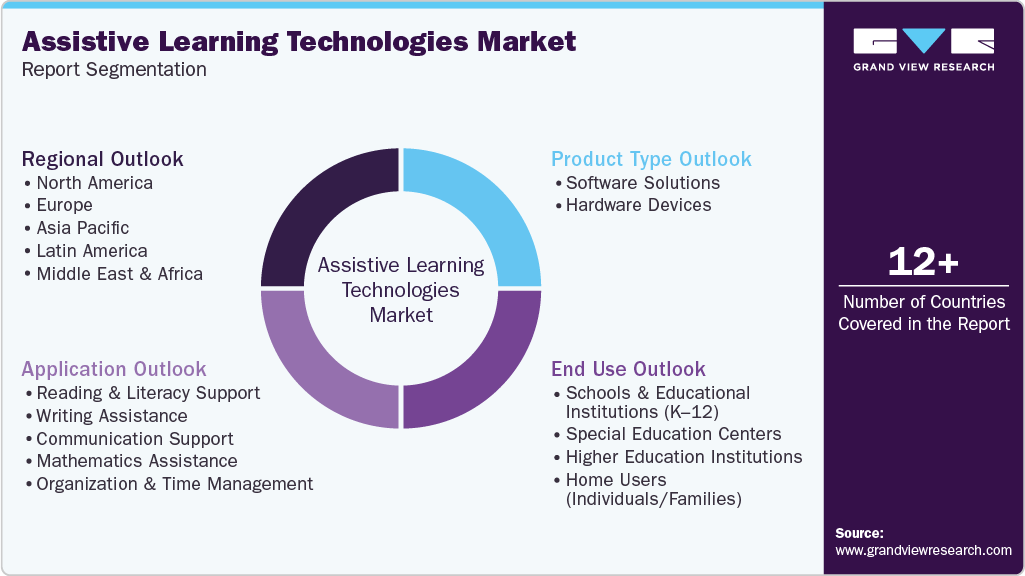
This report forecasts revenue growth at global, regional, and country levels and provides an analysis of the latest industry trends in each of the sub-segments from 2021 to 2033. For this study, Grand View Research has segmented the global assistive learning technologies market report based on product type, application, end use, and region.
-
Product Type Outlook (Revenue, USD Million, 2021 - 2033)
-
Software Solutions
-
Hardware Devices
-
-
Application Outlook (Revenue, USD Million, 2021 - 2033)
-
Reading & Literacy Support
-
Writing Assistance
-
Communication Support
-
Mathematics Assistance
-
Organization & Time Management
-
-
End Use Outlook (Revenue, USD Million, 2021 - 2033)
-
Schools & Educational Institutions (K–12)
-
Special Education Centers
-
Higher Education Institutions
-
Home Users (individuals/families)
-
-
Regional Outlook (Revenue, USD Million, 2021 - 2033)
-
North America
-
U.S.
-
Canada
-
Mexico
-
-
Europe
-
UK
-
Germany
-
France
-
-
Asia Pacific
-
China
-
Japan
-
India
-
South Korea
-
Australia
-
-
Latin America
-
Brazil
-
-
Middle East and Africa
-
UAE
-
KSA
-
South Africa
-
-
Research Methodology
The assistive learning technologies market figures in this report are based on a proven research process that combines executive interviews with secondary research from proprietary databases, company filings, and recognized regulatory and institutional sources. Market size is built through value-chain sizing-reconciling supply-side and demand-side estimates-and triangulated with bottom-up and top-down approaches. Every estimate passes multiple levels of expert validation before publication, with each assistive learning technologies segment quantified using the revenue-capture definitions in the table below.
Segment Definition
Product Type
Revenue Capture Definition
Software Solutions
Revenue generated from assistive learning software, including adaptive learning platforms, accessibility applications, text-to-speech and speech-to-text tools, literacy software, communication applications, and subscription- or license-based solutions designed to support learners with diverse needs.
Hardware Devices
Revenue generated from physical assistive learning devices, including speech-generating devices, Braille displays, alternative input devices, specialized reading devices, communication devices, and other dedicated hardware used to support accessible learning.
Application
Revenue Capture Definition
Reading & Literacy Support
Revenue generated from technologies that support reading, comprehension, vocabulary, literacy development, and access to written educational content, including text-to-speech, reading assistance, and digital literacy tools.
Writing Assistance
Revenue generated from technologies that assist learners with writing, spelling, grammar, sentence construction, and written expression, including speech-to-text, word prediction, spelling support, and writing-assistance software.
Communication Support
Revenue generated from technologies that support verbal and non-verbal communication, including speech-generating devices, augmentative and alternative communication (AAC) applications, voice-enabled tools, and communication software.
Mathematics Assistance
Revenue generated from technologies that assist learners with mathematical concepts, calculations, problem-solving, numerical representation, and access to mathematics-related educational content.
Organization & Time Management
Revenue generated from technologies that support planning, task organization, scheduling, reminders, time management, and classroom activity management for learners requiring additional organizational support.
End Use
Revenue Capture Definition
Schools & Educational Institutions (K–12)
Revenue generated from assistive learning technologies purchased, licensed, or subscribed to by primary and secondary schools, school districts, and other K–12 educational institutions for student learning and accessibility support.
Special Education Centers
Revenue generated from assistive learning technologies purchased or licensed by special education schools, centers, intervention programs, and specialized educational facilities to support students with learning, communication, cognitive, sensory, or physical needs.
Higher Education Institutions
Revenue generated from assistive learning technologies purchased, licensed, or subscribed to by universities, colleges, and other post-secondary institutions to support accessible learning and academic participation.
Home Users (individuals/families)
Revenue generated from assistive learning technologies purchased or subscribed to directly by individuals, parents, caregivers, or families for use by learners in home-based or independent learning environments.
Estimation Model
Layer Name
Key Question
Description
End-user Industry Layer
Who creates demand for Assistive Learning Technologies?
Identifies the total base of end users generating demand for assistive learning technologies across schools and educational institutions, special education centers, higher education institutions, and home users that require accessible, personalized, and supportive learning solutions.
Adoption / Usage Layer
Who actively adopts Assistive Learning Technologies?
Filters the addressable market based on the adoption of digital learning platforms, inclusive education initiatives, special education programs, personalized learning requirements, accessibility policies, online and hybrid learning, and increasing awareness of assistive technologies among educators, institutions, parents, and learners.
Technology & Infrastructure Layer
Which technologies are deployed?
Estimates adoption across technologies including adaptive learning, artificial intelligence, speech recognition, text-to-speech, speech-to-text, natural language processing, communication technologies, accessibility software, specialized learning devices, assistive hardware, and cloud-based and on-device solutions.
Revenue Capture Layer
How is revenue generated in the Assistive Learning Technologies ecosystem?
Calculates revenue generated from assistive learning software, adaptive learning platforms, accessibility applications, communication software, reading and writing assistance tools, speech and language technologies, specialized hardware devices, communication devices, Braille displays, alternative input devices, software licenses, subscriptions, hardware sales, implementation, customization, technical support, maintenance, and related services.
Delivered Customizations
This report has been delivered with the following In-depth customizations
Client Objective
Custom Research Modules Delivered
Strategic Value / Business Impact
Technology & Accessibility Capability Assessment
Assistive learning technology trend analysis
AI, adaptive learning, speech recognition, NLP, text-to-speech, and accessibility technology assessment
Assistive software and hardware innovation pipeline assessment
Technology ecosystem and education technology partner mapping
Identified emerging assistive learning technology opportunities
Supported technology adoption planning
Evaluated technology adoption readiness
Strengthened technology partnership decisions
Product Positioning & Competitive Intelligence
Assistive learning software and hardware benchmarking
Accessibility features, learning support capabilities, and product functionality comparison
Pricing and value proposition analysis
Improved product differentiation strategy
Supported pricing optimization
Identified customer requirements and capability gaps
Enhanced competitive positioning
Market Entry & Growth Assessment
Regional market sizing and forecasting
End-use, application, and product type segmentation analysis
Learning need and accessibility requirement assessment
Competitive landscape and regulatory environment assessment
Identified high-growth regional and application opportunities
Supported go-to-market strategy development
Highlighted market opportunities and adoption barriers
Enabled data-driven expansion planning
About the Author(s)
Next Generation Technologies Research Team
Technology · Next Generation TechnologiesThis report was authored by the next generation technologies research team at Grand View Research - comprising two research analysts, one senior research analyst, and one industry expert - with specialized expertise in the next generation technologies segment of the technology industry. All findings are based on proprietary technology databases, executive interviews, and regulatory analysis, subject to internal peer review prior to publication.
Last Updated:
Speak to Analyst


Customize this report to your needs - add regions, segments, or data points, with 20% free customization.
Or view our licence options:


ISO 9001:2015 & 27001:2022 Certified
We are GDPR and CCPA compliant! Your transaction & personal information is safe and secure. For more details, please read our privacy policy.


