
- Home
- »
- Medical Devices
- »
-
Automated Microscopy Market Size, Growth Report, 2026-2035GVR Report cover
![Automated Microscopy Market (2026 - 2035)Report]()
Automated Microscopy Market (2026 - 2035)
Size, Share & Trends Analysis Report By Product (Optical Microscopes, Electron Microscopes, Scanning Probe Microscopes, Digital Microscopes), By End Use, By Region, And Segment Forecasts
Market Size, 2025
$8.5BMarket Estimate, 2026
$9.1BMarket Forecast, 2035
$16.1BCAGR, 2026–2035
6.6%Automated Microscopy Market Summary
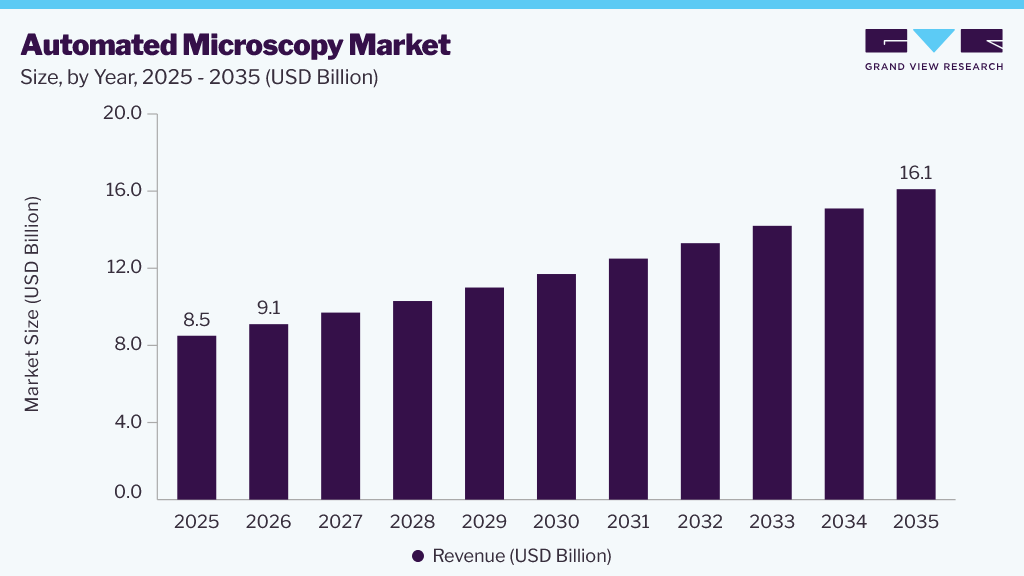
The global automated microscopy market size was valued at USD 8.5 billion in 2025 and is projected to grow from USD 9.1 billion in 2026 to USD 16.1 billion in 2035, at a CAGR of 6.6% from 2026 to 2035. North America dominated the market, accounting for the largest revenue share in 2025. The automated microscopy market is witnessing steady growth, driven by increasing demand for high-throughput imaging, advances in artificial intelligence (AI)-powered image analysis, and growing investments in life sciences, pharmaceutical research, and semiconductor inspection. Rising adoption of automated imaging systems for drug discovery, disease diagnosis, materials research, and quality control is further supporting market expansion.
Key Market Trends & Insights
- By product: The optical microscopes segment held the largest market share in 2025.
- By end use: The pharmaceutical & biotechnology companies segment held the largest market share in 2025.
Regional Highlights
- Largest regional market: North America (2025)
- Fastest-growing regional market: Asia Pacific (highest CAGR, 2026-2035)
Market Size & Forecast
- Market size in 2025: USD 8.5 Billion
- Estimated market size in 2026: USD 9.1 Billion
- Projected market size by 2035: USD 16.1 Billion
- CAGR (2026-2035): 6.6%
The automated microscopy market is experiencing strong growth as research laboratories, healthcare organizations, and industrial manufacturers increasingly rely on advanced imaging technologies to improve accuracy, efficiency, and productivity. Automated microscopy systems enable high-throughput imaging, reduce manual intervention, and deliver consistent results, making them valuable in applications such as drug discovery, pathology, cell biology, semiconductor inspection, and materials science. Continuous technological advancements in digital microscopy, robotics, and automated workflows are improving imaging accuracy, minimizing manual intervention, and accelerating research and industrial inspection processes.
The growing adoption of artificial intelligence (AI), machine learning, and digital image analysis is further enhancing the capabilities of automated microscopy by enabling faster image processing and more precise data interpretation. Despite its promising outlook, the market faces challenges related to the high cost of advanced microscopy systems and the complexity of integrating automated platforms into existing laboratory workflows. Small research institutions and diagnostic laboratories may find it difficult to invest in sophisticated imaging equipment due to budget constraints. In addition, operating advanced microscopy systems often requires skilled professionals, while managing and analyzing large imaging datasets can create additional technical and infrastructure challenges.
The market offers significant opportunities as precision medicine, biotechnology research, and semiconductor manufacturing continue to expand worldwide. Increasing investments in life sciences research, automation in clinical diagnostics, and the development of smart laboratories are expected to accelerate demand for automated microscopy solutions. Furthermore, ongoing innovations in cloud-based image management, robotic sample handling, and AI-assisted image analysis are making automated microscopy more efficient and accessible. As industries continue to prioritize speed, accuracy, and data-driven decision-making, automated microscopy is expected to become an essential tool across research, healthcare, and industrial applications.
Analyst Perspective
The automated microscopy market is gaining momentum as laboratories and industrial organizations increasingly adopt intelligent imaging solutions to enhance accuracy, speed, and workflow efficiency. From an analyst perspective, the integration of artificial intelligence (AI), machine learning, and automated image analysis is emerging as a key market driver, enabling faster data interpretation while reducing manual intervention. Rising investments in pharmaceutical research, clinical diagnostics, semiconductor manufacturing, and materials science are further supporting demand for advanced automated microscopy systems. Continued technological innovation, expanding precision medicine applications, and the development of digital laboratories are expected to create significant growth opportunities. These trends are positioning automated microscopy as an increasingly important technology across modern research, healthcare, and industrial inspection applications.
Product Insights
The optical microscopes segment held the largest market share in 2025. The segment's dominance is attributed to its widespread adoption across life sciences, clinical diagnostics, pharmaceutical research, and academic laboratories. Optical microscopes offer high-resolution imaging, ease of operation, and compatibility with automated imaging and digital analysis platforms, making them suitable for routine biological and industrial applications. Continuous advancements in fluorescence imaging, confocal microscopy, and AI-enabled image processing have further enhanced the efficiency and accuracy of automated optical microscopy systems. Growing investments in biomedical research and laboratory automation continue to support the segment's leading position.
The digital microscopes segment is expected to register a notable growth over the forecast period. The increasing demand for real-time imaging, remote collaboration, and automated image analysis is accelerating the adoption of digital microscopy solutions. These systems enable high-quality image capture, cloud-based data sharing, and seamless integration with artificial intelligence and machine learning software for automated analysis. Rising use of digital microscopes in semiconductor inspection, industrial quality control, pathology, and research laboratories is further driving market growth. As laboratories and manufacturers continue to adopt digital workflows and smart imaging technologies, demand for automated digital microscopy systems is expected to increase significantly.
In September 2024, Nikon Corporation launched Version 1.3 of its ECLIPSE Ui Digital Imaging Microscope, introducing automated image capture, faster autofocus, and enhanced digital viewing capabilities to streamline pathological observation workflows. The update highlights the growing adoption of automated digital microscopy solutions for improving efficiency and diagnostic accuracy in clinical laboratories.
End Use Insights
The pharmaceutical & biotechnology companies segment held the largest market share in 2025. The segment's dominance is driven by the growing use of automated microscopy in drug discovery, cell biology research, high-content screening, and preclinical studies. Pharmaceutical and biotechnology companies increasingly rely on automated imaging systems to accelerate research workflows, improve data accuracy, and support large-scale analysis of biological samples. The integration of artificial intelligence (AI), robotic sample handling, and automated image analysis has further enhanced productivity by enabling rapid identification of cellular responses and reducing manual intervention. Rising investments in biologics, precision medicine, and advanced therapeutics continue to strengthen demand for automated microscopy solutions across the pharmaceutical and biotechnology sector.
The semiconductor & electronics industry segment is expected to register significant growth over the forecast period. Increasing demand for advanced semiconductor devices, miniaturized electronic components, and high-precision quality inspection is driving the adoption of automated microscopy systems in manufacturing facilities. Automated microscopes enable rapid defect detection, wafer inspection, failure analysis, and dimensional measurement while ensuring consistent quality control throughout production processes. Furthermore, the growing adoption of AI-powered image analysis, automated metrology, and smart manufacturing technologies is improving inspection efficiency and reducing production errors. As semiconductor manufacturers continue investing in advanced fabrication technologies, demand for automated microscopy solutions is expected to grow significantly.
Regional Insights
The North American region held the largest market share in 2025. The region's dominance is driven by the strong presence of leading pharmaceutical and biotechnology companies, advanced healthcare infrastructure, and significant investments in life sciences research. The widespread adoption of automated laboratory technologies, increasing use of digital pathology, and growing demand for AI-powered imaging solutions are further supporting market growth. In addition, the presence of major microscopy manufacturers, well-established research institutions, and continuous funding for biomedical and semiconductor research further strengthens the region's leadership in the automated microscopy market.
Asia Pacific Automated Microscopy Market Trends
The Asia Pacific region is expected to register the fastest growth over the forecast period. Rapid expansion of the pharmaceutical, biotechnology, and semiconductor industries in countries such as China, Japan, South Korea, and India is driving demand for automated microscopy solutions. Increasing government support for research and development, rising investments in advanced manufacturing facilities, and growing adoption of laboratory automation technologies are further contributing to market growth. Moreover, the expansion of semiconductor fabrication plants, academic research activities, and precision healthcare initiatives is expected to accelerate the adoption of automated microscopy systems across the region.
In August 2025, Leica Biosystems unveiled the Aperio GT 180 digital pathology scanner at the Asia Pacific Imaging Summit 2025. The compact, high-throughput scanner features automated slide processing and workflow-enhancing capabilities designed to streamline pathology workflows and support research and cancer diagnostics, reflecting the growing adoption of advanced automated imaging technologies in the Asia Pacific region.
Key Automated Microscopy Company Insights
The automated microscopy market is characterized by the presence of global and regional manufacturers competing through technological innovation, product launches, strategic collaborations, and portfolio expansion. Leading companies are increasingly investing in artificial intelligence (AI)-powered image analysis, digital pathology, laboratory automation, robotic imaging systems, and cloud-based data management solutions to strengthen their market positions and address the growing demand for high-throughput, precision imaging across life sciences, healthcare, semiconductor, and industrial applications.
Key Automated Microscopy Companies
The following key companies have been profiled for this study on the automated microscopy market:
-
Zeiss Group
-
Evident
-
Nikon Corporation
-
Leica Microsystems
-
Thermo Fisher Scientific Inc.
-
Bruker
-
Hitachi High-Tech Corporation
-
KEYENCE CORPORATION
-
JEOL Ltd.
-
Hamamatsu Photonics K.K.
Recent Developments
- In May 2026, Nikon Corporation launched the ECLIPSE LV100AMS, a one-click automated microscope for industrial inspection and quality control. The system integrates fully automated inspection workflows with AI-powered image analysis to improve inspection speed, consistency, and accuracy, highlighting the growing adoption of intelligent automation in industrial microscopy.
- In October 2025, Yokogawa Electric Corporation's subsidiary, Yokogawa China, signed a Memorandum of Cooperation (MoC) with Sinopec Engineering (Group) Co., Ltd. to collaborate on engineering, procurement, and construction (EPC) projects. The partnership aims to enhance plant engineering capabilities while expanding the deployment of advanced automation, process control, and instrumentation solutions across oil and gas facilities worldwide.
Automated Microscopy Market Report Scope
Report Attribute
Details
Market size in 2025
USD 8.5 billion
Estimated market size in 2026
USD 9.1 billion
Projected market size by 2035
USD 16.1 billion
Growth rate
CAGR of 6.6% from 2026 to 2035
Base year for estimation
2025
Actual data
2021 – 2024
Forecast period
2026 – 2035
Quantitative units
Revenue in USD billion, and CAGR from 2026 to 2035
Report coverage
Revenue forecast, company ranking, competitive landscape, growth factors, and trends
Segments covered
Product, end use, and region
Regional scope
North America; Europe; Asia Pacific; Latin America; Middle East & Africa
Country scope
U.S.; Canada; Mexico; UK; Germany; France; Italy; Spain; China; Japan; India; Australia; South Korea; Brazil; Argentina; South Africa; Saudi Arabia; UAE
Key companies profiled
Zeiss Group; Evident; Nikon Corporation; Leica Microsystems; Thermo Fisher Scientific Inc.; Bruker; Hitachi High-Tech Corporation; KEYENCE CORPORATION; JEOL Ltd.; Hamamatsu Photonics K.K.
Customization scope
Free report customization (equivalent to 8 analyst working days) with purchase. Addition or alteration to country, regional & segment scope.
Pricing and purchase options
Avail of customized purchase options to meet your exact research needs. Explore purchase options
Global Automated Microscopy Market Report Segmentation
This report forecasts revenue growth at the global, regional, and country levels and provides an analysis of the latest industry trends and opportunities across each sub-segment from 2021 to 2035. For this study, Grand View Research has segmented the global automated microscopy market report based on product, end use, and region:
-
Product Outlook (Revenue, USD Billion, 2021 - 2035)
-
Optical Microscopes
-
Electron Microscopes
-
Scanning Probe Microscopes
-
Digital Microscopes
-
-
End Use Outlook (Revenue, USD Billion, 2021 - 2035)
-
Pharmaceutical & Biotechnology Companies
-
Academic & Research Institutes
-
Hospitals & Diagnostic Laboratories
-
Semiconductor & Electronics Industry
-
Industrial Manufacturing
-
Others
-
-
Regional Outlook (Revenue, USD Billion, 2021 - 2035)
-
North America
-
U.S.
-
Canada
-
Mexico
-
-
Europe
-
UK
-
Germany
-
France
-
Italy
-
Spain
-
-
Asia Pacific
-
China
-
Japan
-
India
-
Australia
-
South Korea
-
-
Latin America
-
Brazil
-
Argentina
-
-
Middle East and Africa (MEA)
-
South Africa
-
Saudi Arabia
-
UAE
-
-
Frequently Asked Questions About This Report
The global automated microscopy market size was valued at USD 8.5 billion in 2025 and is estimated at USD 9.1 billion for 2026.
The global automated microscopy market is expected to grow at a CAGR of 6.6% from 2026 to 2035, reaching USD 16.1 billion.
The optical microscopes segment accounted for the largest revenue share in 2025.
North America dominated with the largest revenue share in 2025.
Key players in the market include Zeiss Group, Evident, Nikon Corporation, Leica Microsystems, Thermo Fisher Scientific Inc., Bruker, Hitachi High-Tech Corporation, KEYENCE CORPORATION, JEOL Ltd., and Hamamatsu Photonics K.K.
About the Author(s)
Medical Devices Research Team
Healthcare · Medical DevicesThis report was authored by the medical devices research team at Grand View Research - comprising two research analysts, one senior research analyst, and one industry expert - with specialized expertise in the medical devices segment of the healthcare industry. All findings are based on proprietary healthcare databases, executive interviews, and regulatory analysis, subject to internal peer review prior to publication.
Last Updated:
Speak to Analyst


Customize this report to your needs — add regions, segments, or data points, with 20% free customization.
Or view our licence options:


ISO 9001:2015 & 27001:2022 Certified
We are GDPR and CCPA compliant! Your transaction & personal information is safe and secure. For more details, please read our privacy policy.


