
- Home
- »
- Automotive & Transportation
- »
-
Automotive Active Purge Pump Market Size Report, 2033GVR Report cover

Automotive Active Purge Pump Market (2026 - 2033)
Size, Share & Trends Analysis Report By Component, By Material Type (Metal, Non-Meta), By Vehicle Type, By Sales Channel (OEM, Aftermarket), By Region, And Segment Forecasts
Market Size, 2025
$105.6MMarket Estimate, 2026
$115.4MMarket Forecast, 2033
$231.3MCAGR, 2026–2033
10.4%Automotive Active Purge Pump Market Summary
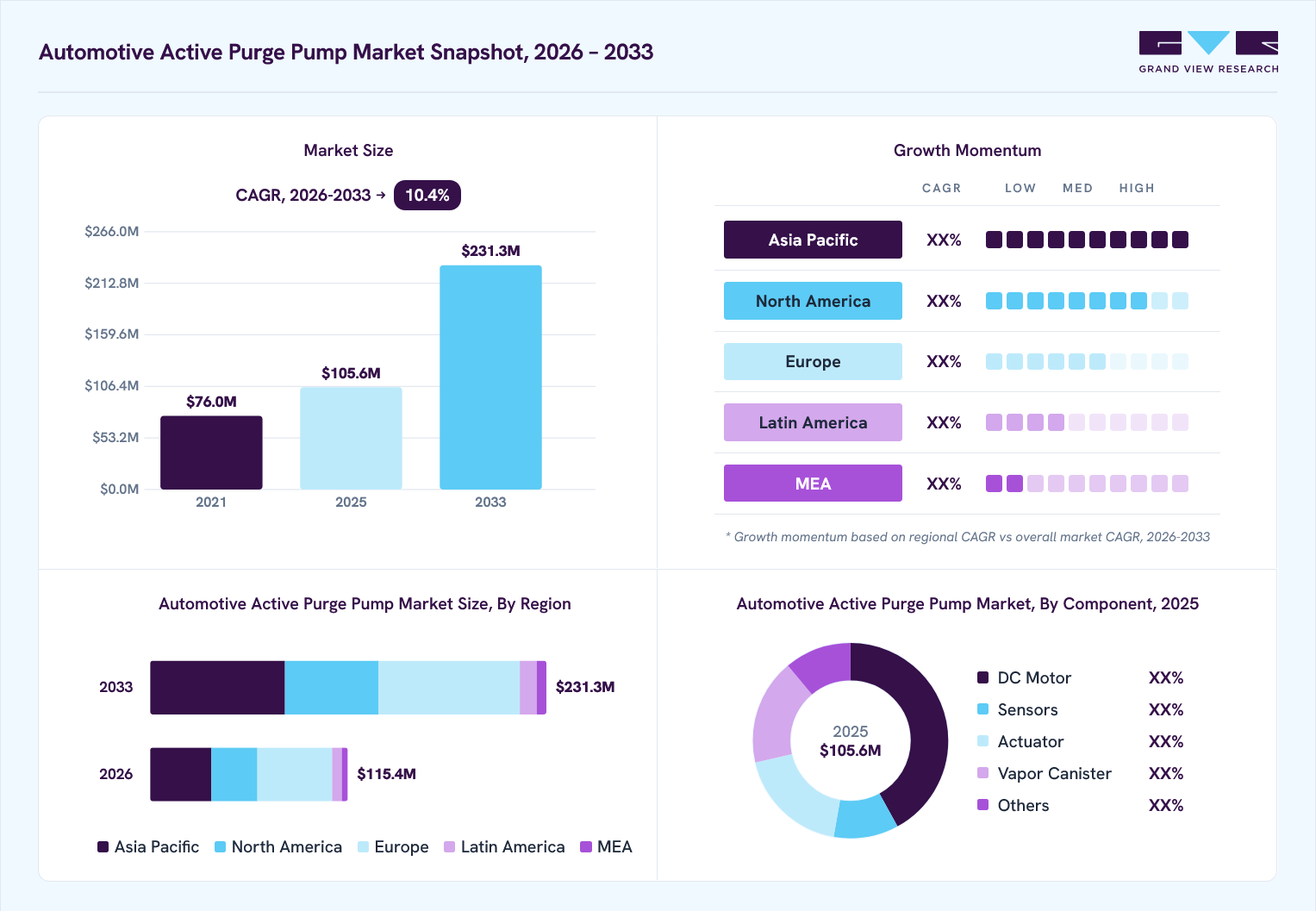
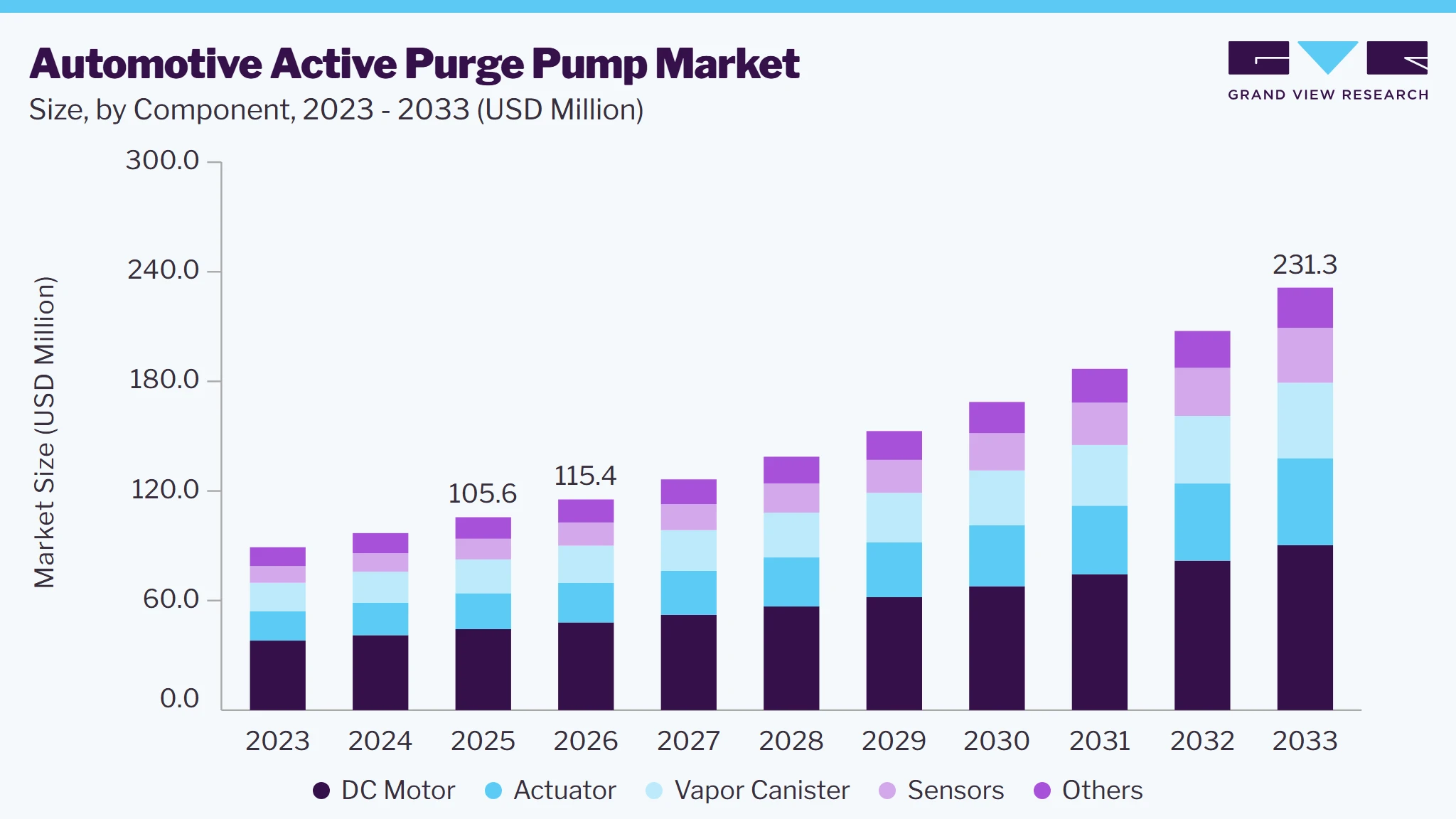
The global automotive active purge pump market size was valued at USD 105.6 million in 2025, and is projected to grow from USD 115.4 million in 2026 to USD 231.3 million by 2033, at a CAGR of 10.4% from 2026 to 2033. Europe dominated the market, accounting for a revenue share of 38.1% in 2025. The growing adoption of electronically controlled fuel-vapor management systems is increasing demand for active purge pumps that provide precise and consistent vapor flow control.
 Source: Grand View Research, IR Documents, Primary Interviews, Paid DatabasesTo learn more about this report,
 Download Free Sample Report
Key Market Trends & Insights
- By component: DC Motor segment led the market and accounted for 42.0% of the global revenue in 2025.
- By material type: Non-metal segment led the market and accounted for 64.2% of the global revenue in 2025.
- By vehicle type: Passenger Vehicle segment led the market and accounted for 67.3% of the global revenue in 2025.
- By sales channel: OEM segment accounted for the largest share of the global revenue in 2025.
Regional Highlights
- Largest regional market: Europe (38.1% revenue share, 2025)
- By country: Germany held the largest market share in 2025.
Market Size & Forecast
- Market size in 2025: USD 105.6 Million
- Estimated market size in 2026: USD 115.4 Million
- Projected market size by 2033: USD 231.3 Million
- CAGR (2026-2033): 10.4%
Prism AI by Grand View Research Free to tryAsk a question about the automotive active purge pump marketTry asking✓Every figure cited from GVR research Prefer the report? Download free sample →
The rapid global adoption of battery electric vehicles (BEVs) and plug-in hybrids is reshaping vehicle layouts, axle loads, and suspension tuning, thereby propelling the market growth for specialized ball joints. Heavier battery packs positioned low in the chassis alter weight distribution and increase stress on suspension sub-assemblies, pushing OEMs to adopt ball joints with enhanced Vehicle Type strength, sealing, and fatigue resistance to ensure ride stability and durability. According to the U.S. Environmental Protection Agency (EPA), the accelerating penetration of EVs into the new-vehicle fleet underscores the need for reengineered suspension components, thereby boosting market demand for advanced ball joint solutions.The growing adoption of hybrid and advanced gasoline vehicles is creating demand for automotive active purge pumps. These vehicles require effective management of fuel vapors under a wider range of engine operating conditions, particularly when engine operation is intermittent or limited. Active purge systems can provide controlled vapor movement and support more consistent evaporative emission management. This is encouraging automakers to incorporate electronically controlled purge solutions into newer vehicle platforms.
 To learn more about this report, Download Free Sample Report
The integration of pumps with increasingly sophisticated vehicle emission management systems is a trend in the automotive active purge pump market. Automakers are adopting electronically controlled components that can provide more precise purge-flow management across different vehicle operating conditions. This trend is also supported by vehicle electrification and hybridization, which create operating conditions in which conventional engine-driven purge strategies may be limited. As a result, suppliers are focusing on compact, electronically controlled, and energy-efficient pump solutions.
High cost pressure across the automotive industry can restrain the adoption of active purge pump systems, particularly in price-sensitive vehicle segments. Automakers continuously seek to reduce component costs while maintaining required emission performance, which can limit the use of higher-cost electronic purge solutions. Additional expenses associated with system integration, electronic controls, and validation can further increase the overall cost of the emission-control system. This may encourage manufacturers to prioritize cost-efficient alternatives or limit adoption on lower-priced vehicle platforms.
Market Dynamics
The automotive active purge pump market is being shaped by increasing requirements for effective evaporative emission control, tighter vehicle emission standards, and greater use of electronically controlled fuel-vapor management systems. Active purge pumps enable hydrocarbon vapor movement independently of engine intake vacuum, supporting more controlled canister regeneration across different operating conditions. The market is also benefiting from increasing integration of pumps, motors, sensors, and electronic controls into compact emission-management assemblies.
Automotive manufacturers are facing increasing requirements to control fuel vapors generated within vehicle fuel systems. Conventional evaporative emission systems rely on controlled vapor movement through the engine intake system, which can limit purge performance under certain operating conditions. As emission-control requirements become more demanding, manufacturers need systems that can manage hydrocarbon vapors more precisely across varying engine loads, temperatures, and driving conditions. This creates demand for active purge pump technologies that provide greater control over vapor flow and canister regeneration.
Automotive active purge pumps address this requirement by moving hydrocarbon vapors from the carbon canister to the engine intake, reducing reliance on available manifold vacuum. The technology can support controlled purge operations while enabling onboard diagnostic monitoring and evaporative leak detection. Active pumping also enables the emissions system to operate more consistently across different vehicle conditions, thereby increasing its relevance for modern gasoline-powered vehicles. Consequently, increasing emphasis on evaporative emission control is supporting the adoption of active purge pump systems.
A key constraint is the complexity of integrating active purge pumps into the vehicle's existing evaporative emissions architecture. The pump must operate reliably under varying temperatures, fuel-vapor conditions, pressure requirements, and electrical loads while maintaining compatibility with the canister, hoses, sensors, control unit, and engine-management system. Automotive suppliers and manufacturers also need to conduct extensive validation to ensure that the system maintains consistent performance throughout the vehicle's operating life. These requirements increase development complexity and can raise the cost of adopting active purge pump technology compared with simpler passive purge arrangements.
The restraint is particularly relevant for price-sensitive vehicle programs and applications where emission-system costs must remain tightly controlled. Passenger vehicles with highly integrated emission-management systems can absorb the technology more readily, while lower-cost vehicle platforms may face greater pressure to minimize component and integration costs. Suppliers must therefore balance pump performance, durability, packaging, electronics integration, and manufacturing cost. This can slow adoption in selected vehicle programs, particularly where conventional vapor-management systems continue to satisfy existing technical requirements.
The increasing integration of sensing, electronic control, and compact electric-pumping technologies presents an opportunity for active purge-pump suppliers. Modern emission-control architecture require greater monitoring of vapor flow, pressure, leakage, and system operating conditions. Active purge pump designs can incorporate electronic controls and pressure-sensing capabilities, allowing manufacturers to improve control over hydrocarbon vapor movement and support onboard diagnostics. Such integration creates opportunities for suppliers to move beyond standalone pumping components toward more complete emission-management modules.
The opportunity is particularly relevant for suppliers with capabilities in electric motors, sensors, actuators, electronic controls, and automotive emission systems. Passenger cars are expected to remain an important application area because of their large installed base and continued use of gasoline powertrains. Suppliers capable of combining compact pump architectures with sensing and control functions can strengthen their position with OEM customers seeking simplified system integration. The opportunity also supports the development of higher-efficiency, electronically controlled purge solutions for increasingly sophisticated vehicle platforms.
Market Concentration & Characteristics
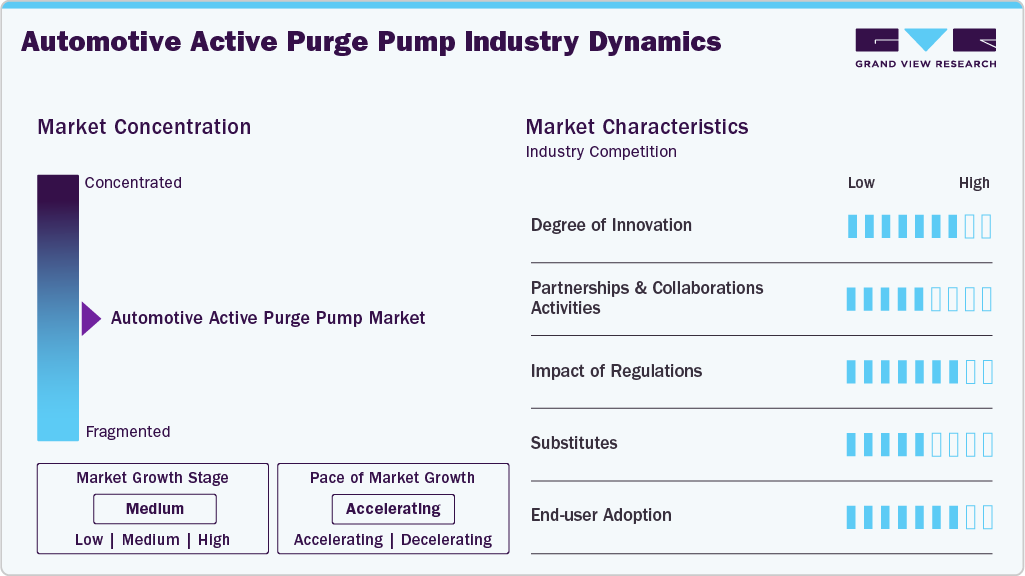
The automotive active purge pump market is moderately consolidated, with several established participants with meaningful capabilities, and a very limited number of suppliers do not dominate the competition. Market participants compete through product performance, integration capabilities, reliability, and compliance with increasingly stringent vehicle emission requirements. The degree of innovation is high, supported by ongoing improvements in pump efficiency, control precision, compact design, and integration with vehicle emission-control systems. The impact of regulations is also high, as emission-control requirements encourage automakers and component suppliers to adopt more effective evaporative-emission management solutions. In addition, end-user adoption is high, reflecting the growing integration of active purge systems across modern vehicle platforms.
 To learn more about this report, Download Free Sample Report
The market also demonstrates medium levels of partnerships, collaborations, and substitutes, suggesting that supplier relationships and technology cooperation are relevant but do not constitute the primary basis of competition. Partnerships can support the development and integration of purge-pump technologies into broader emission-control architectures, while the moderate substitute intensity suggests that alternative approaches may meet certain emission-management requirements but have limitations in replacing active purge-pump solutions across vehicle applications. Moreover, the combination of high innovation, strong regulatory influence, and high adoption supports accelerating market growth, while the presence of multiple capable suppliers maintains a moderately consolidated competitive structure.
Analyst Perspective
The automotive active purge pump market is positioned for steady growth as vehicle manufacturers place greater emphasis on evaporative emissions control and precise fuel vapor management. Increasing electronic integration is shifting the technology from basic vapor-management components to compact systems that incorporate pumping, sensing, and control capabilities. Active purge architectures that operate independently of manifold vacuum can provide greater flexibility in managing hydrocarbon vapor flow across different vehicle operating conditions. Future investment is expected to focus on compact, efficient, durable, and electronically controlled systems, while suppliers with broad automotive component capabilities are likely to strengthen their competitive positioning.
Component Insights
The DC Motor segment accounted for the largest share of 42.0% in 2025. The DC motor segment is supported by demand for electronically controlled purge-pump systems that require reliable and responsive operation. Automakers are focusing on compact motor configurations that can provide consistent pump performance while minimizing energy consumption and packaging requirements. Increasing integration of electronic emission-control systems is expected to support the use of DC motor-based active purge pump assemblies across modern vehicle platforms.
The sensors segment is expected to grow at a significant CAGR during the forecast period. The sensors segment is gaining importance as automakers seek greater control over fuel-vapor management and purge-system operation. Sensor integration can support more accurate monitoring of system conditions and enable the vehicle control system to adjust purge operation according to operating requirements. Increasing electronic integration within emission-control systems is therefore supporting demand for sensor-equipped active purge pump solutions.
Material Type Insights
The non-metal segment accounted for the largest share of 64.2% in 2025. The non-metal segment is gaining traction as automakers seek lightweight and cost-efficient materials for emission-control components. Advanced polymers and other non-metal materials can support weight reduction while providing flexibility in component design and manufacturing. Growing emphasis on vehicle weight optimization and efficient component packaging is expected to encourage greater use of non-metal materials in active purge pump systems.
The metal segment is expected to grow at the fastest CAGR during the forecast period. The metal segment is supported by applications requiring durability, dimensional stability, and resistance to demanding under-hood operating conditions. Metal components can provide mechanical strength and withstand exposure to temperature variations and automotive operating environments. However, manufacturers are increasingly balancing durability requirements with weight and cost considerations when selecting materials for active purge pump assemblies.
Vehicle Type Insights
The passenger cars segment accounted for the largest share of 67.3% in 2025, due to the large global vehicle population and increasing implementation of advanced evaporative emission-control systems. Stricter emission requirements are encouraging manufacturers to improve fuel-vapor management across gasoline-powered passenger vehicle platforms. Growth in hybrid passenger vehicles is also creating additional opportunities for active purge pump systems where conventional purge operation may be less effective under certain driving conditions.
The Medium & Heavy Commercial Vehicles (MHCVs) segment is projected to grow at the fastest CAGR over the forecast period. The MHCV segment is supported by increasing attention to emission reduction and fuel-system performance in commercial transportation. Fleet operators and vehicle manufacturers are facing stronger requirements to improve environmental performance while maintaining reliable vehicle operation. Adoption of advanced emission-control components, including active purge pumps, is therefore expected to increase as commercial vehicle platforms incorporate more sophisticated emission management systems.
Sales Channel Insights
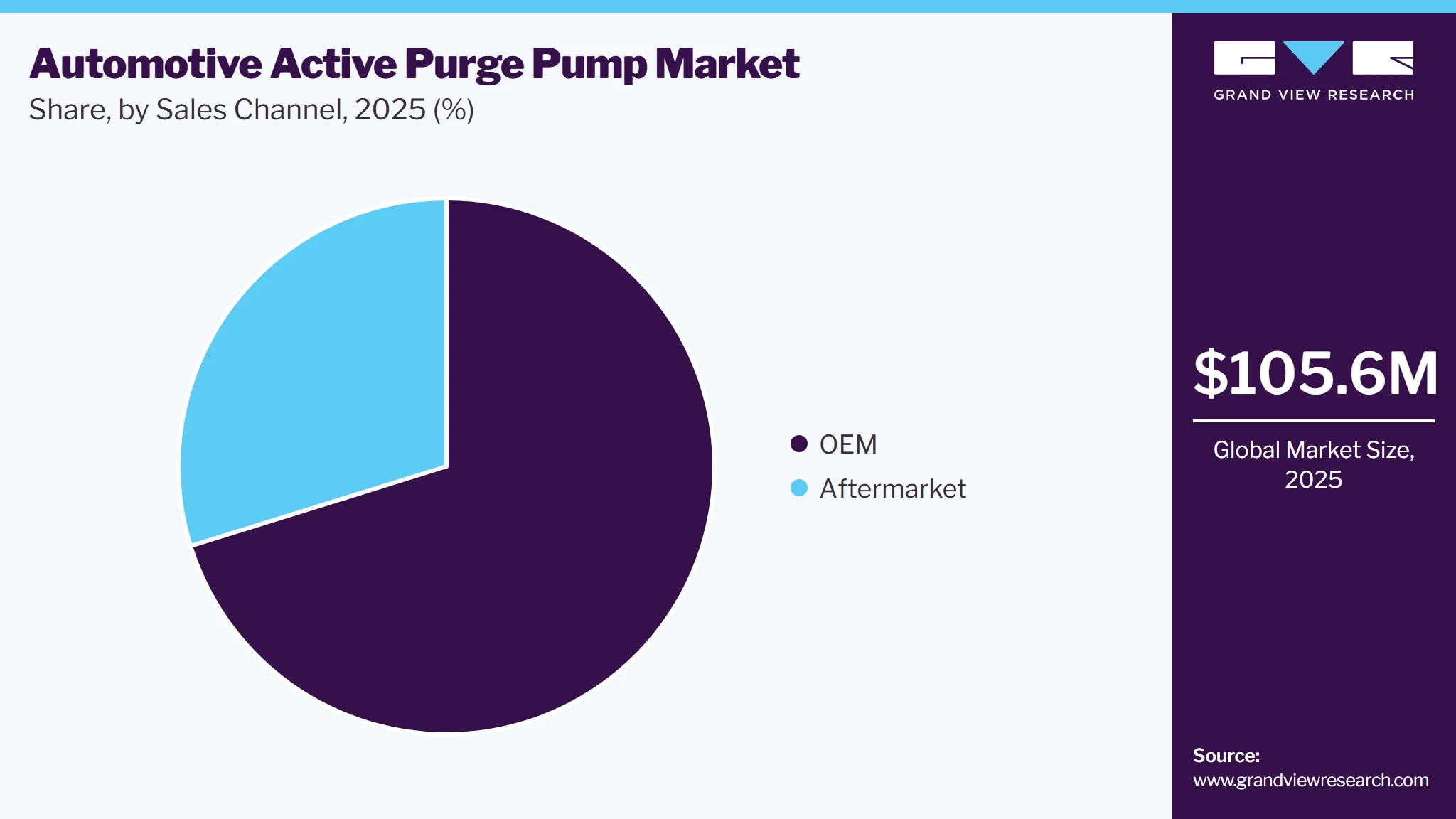
The OEMs segment dominated the market in 2025. The OEM segment is expected to grow because active purge pumps are increasingly integrated into vehicle emission-control architectures during vehicle development and production. Automakers generally require components that meet specific performance, durability, and regulatory requirements for individual vehicle platforms. Long-term supply relationships and increasing electronic integration are supporting opportunities for active purge pump manufacturers within OEM programs.
 To learn more about this report, Download Free Sample Report
The aftermarket segment is projected to grow at the fastest CAGR over the forecast period. The aftermarket segment is supported by replacement demand from vehicles requiring maintenance or replacement of emission-control components. As the installed vehicle population increases, the need for replacement components can provide recurring opportunities for suppliers and distributors. However, aftermarket growth is influenced by vehicle age, repair practices, component availability, and the preference for genuine or compatible replacement parts.
Regional Insights
Europe Automotive Active Purge Pump Market Trends
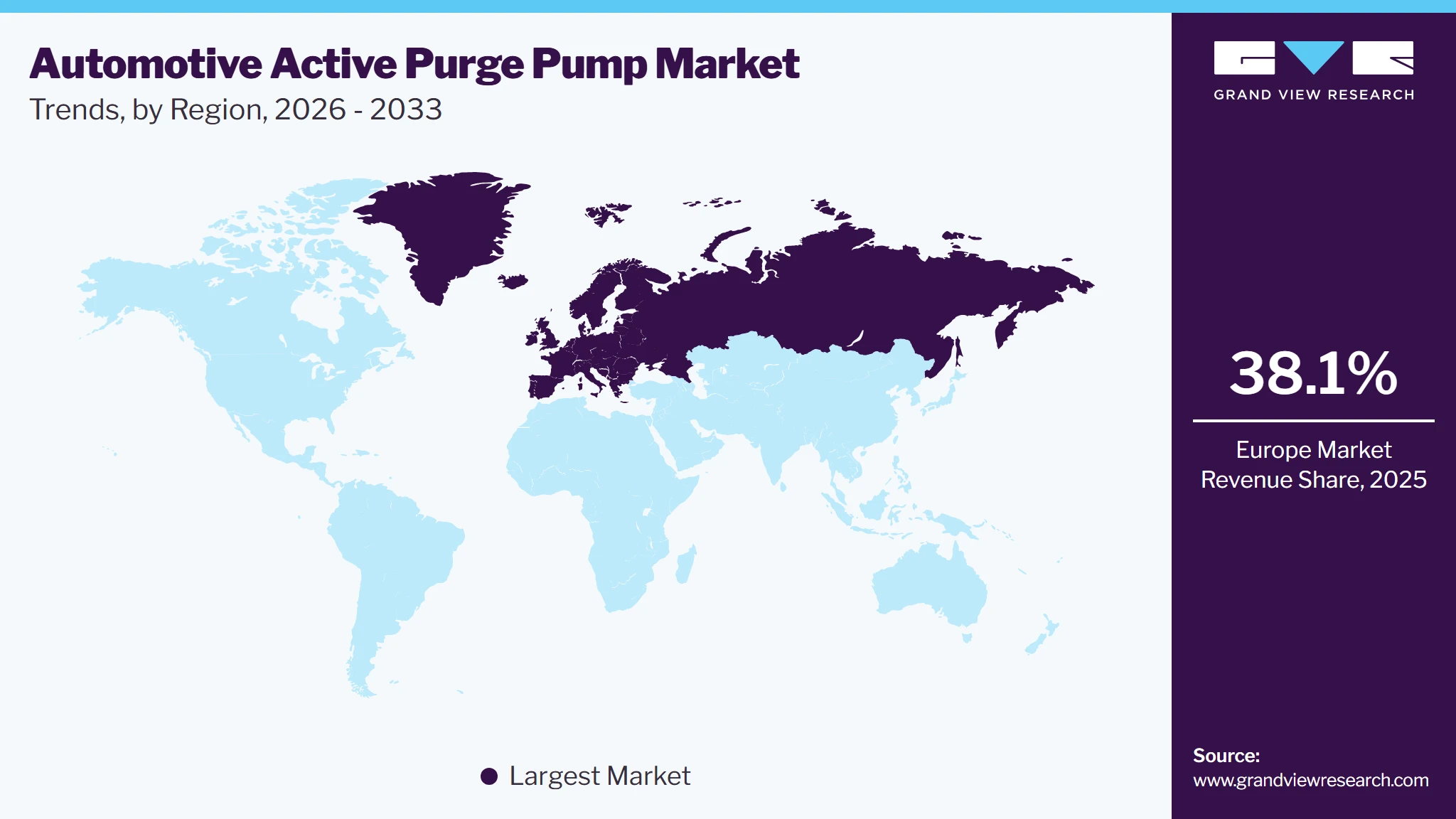
Europe Automotive Active Purge Pump market accounted for the largest share of 38.1% in 2025. Europe is supported by stringent vehicle emission regulations and continued investment in cleaner and more efficient vehicle technologies. Automakers are increasingly integrating advanced emission-control components into passenger and commercial vehicle platforms to meet evolving environmental requirements.
 To learn more about this report, Download Free Sample Report
Germany is a major automotive manufacturing hub, creating significant opportunities for suppliers of advanced emission-control components. Strong automotive engineering capabilities and stringent environmental requirements are encouraging manufacturers to incorporate sophisticated fuel-vapor management technologies into vehicle platforms.
The U.K. is experiencing growth by continued emphasis on reducing vehicle emissions and improving environmental performance across the automotive sector. Demand for advanced emission-control components is also influenced by the transition toward hybrid and lower-emission vehicle technologies.
Asia Pacific Automotive Active Purge Pump Market Trends
The Asia Pacific Automotive Active Purge Pump market is expected to grow at the fastest CAGR from 2026 to 2033, due to high vehicle production volumes, expanding automotive manufacturing capacity, and increasingly stringent emission requirements. Growing adoption of advanced emission-control technologies across major vehicle-producing economies is supporting demand for active purge pumps.
China is witnessing a market growth due to its large automotive production base and tightening vehicle emission requirements. Increasing adoption of advanced powertrain and emission-control technologies is encouraging automakers to improve fuel-vapor management across passenger vehicle platforms.
Japan is automotive active purge pump market is driven by an established automotive industry and strong emphasis on vehicle efficiency and emission reduction. Automakers are continuing to develop advanced powertrain and emission-control systems, creating opportunities for electronically controlled active purge pump technologies.
North America Automotive Active Purge Pump Market Trends
The North America automotive active purge pump market has a significant amount of market share in the global market, due to stringent evaporative emission requirements and the presence of a mature automotive manufacturing base. Demand is supported by continued development of advanced fuel-vapor management systems across gasoline-powered and hybrid vehicle platforms.
The U.S. automotive active purge pump industry held a dominant position in 2025. The U.S. represents the major market within North America, supported by stringent federal and state-level requirements for evaporative emission control. Strong vehicle production, a large installed vehicle base, and continued development of emission-control technologies are supporting demand for active purge pump systems.
Key Automotive Active Purge Pump Company Insights
Key players operating in the automotive active purge pump market include Magna International Inc., Continental AG, Schaeffler AG, GMB Korea Corp., Johnson Electric Holdings Limited., Valeo, HELLA GmbH & Co. KGaA, Magna International Inc., Mitsubishi Electric Corporation, MotoRad, and Lordco Parts Ltd. Key players in the automotive active purge pump market are focusing on product development, technological integration, strategic partnerships, expansion of automotive component portfolios, and strengthening OEM and aftermarket distribution networks. Companies also emphasizing compact and efficient pump designs, enhanced sensing and control capabilities, and reliable emission-control solutions to address evolving vehicle requirements. Competitive strategies further include expanding manufacturing capabilities and developing solutions that support increasingly stringent evaporative emission-control requirements.
-
Continental AG develops emission-control technologies for internal combustion engine vehicles, including its Active Purge Pump (APP) technology. The company's APP uses a compact radial pump driven by a highly efficient brushless DC motor to actively draw hydrocarbon-loaded air from the vapor canister. It states that the system can be activated as required and enables rapid pressure buildup, supporting more effective fuel vapor removal and improved emission control.
-
HELLA GmbH & Co. KGaA has developed electric purge pump technology for automotive emission-control applications. The company identified its purge pump as part of its automotive electronics portfolio. It worked with EBM-Papst on an electric purge pump intended for series production, with the technology designed to help reduce vehicle CO₂ emissions. The company's capabilities in electric motors, actuators, sensors, and automotive electronics support its positioning in the automotive active purge pump market.
Key Automotive Active Purge Pump Companies
The following key companies have been profiled for this study on the automotive active purge pump market:
-
Continental AG
-
Schaeffler AG
-
GMB Korea Corp.
-
Johnson Electric Holdings Limited.
-
Valeo
-
HELLA GmbH & Co. KGaA
-
Magna International Inc.
-
Mitsubishi Electric Corporation
-
MotoRad
-
Lordco Parts Ltd.
Competitive Benchmarking
Operating Strategies
Competitive Edge
Weaknesses
Mature Players: Continental AG, Schaeffler AG, Valeo, HELLA GmbH & Co. KGaA
- Mature players in the automotive active purge pump market are focus on broad automotive component portfolios, OEM relationships, product development, system integration, and expansion of electronically controlled vehicle technologies.
- Mature companies gain a competitive advantage through strong OEM presence, engineering capabilities, global manufacturing networks, and ability to integrate active purge pumps with broader vehicle systems.
- These companies often face challenges due to large organizational structures and broad product portfolios can increase development complexity and make cost optimization more challenging for highly price-sensitive applications.
Emerging Players: GMB Korea Corp., Johnson Electric Holdings Limited, MotoRad
- Emerging players in the automotive active purge pump market are focus on targeted component portfolios, replacement-market opportunities, specialized electromechanical products, and expansion across selected automotive applications.
- Emerging companies gain market traction through greater specialization, flexible product development, competitive pricing, and opportunities to address specific OEM and aftermarket requirements.
- Emerging players face challenges due to limited scale, portfolio breadth, and global OEM penetration can restrict access to large vehicle programs compared with diversified Tier-1 suppliers.
Recent Developments
-
In September 2025, Valeo expanded its collaboration with Qualcomm Technologies, Inc. technology company, to develop scalable ADAS and automated driving solutions. The partnership combines Qualcomm’s computing platforms with Valeo’s expertise in sensors, ECUs, software, and system integration.
-
In April 2025, Schaeffler expanded its automotive technology portfolio at Auto Shanghai 2025 following its merger with Vitesco Technologies, strengthening its capabilities in electronics, sensors, and actuators. The portfolio expansion supports Schaeffler’s broader capabilities in electronically controlled automotive systems.
Automotive Active Purge Pump Market Report Scope
Report Attribute
Details
Market size in 2025
USD 105.6 million
Estimated market size in 2026
USD 115.4 million
Projected market size by 2033
USD 231.3 million
Growth Rate
CAGR of 10.4% from 2026 to 2033
Base year for estimation
2025
Historical data
2021 - 2024
Forecast period
2026 - 2033
Quantitative units
Revenue in USD million and CAGR from 2026 to 2033
Report coverage
Revenue forecast, company ranking, competitive landscape, growth factors, and trends
Segments covered
Component, material type, vehicle type, sales channel, region
Regional scope
North America, Europe, Asia Pacific, Latin America, MEA
Country scope
U.S., Canada, Mexico, Germany, U.K., France, China, Japan, India, South Korea, Australia, Brazil, KSA, UAE, South Africa
Key companies profiled
Continental AG; Schaeffler AG; GMB Korea Corp.; Johnson Electric Holdings Limited.; Valeo; HELLA GmbH & Co. KGaA; Magna International Inc.; Mitsubishi Electric Corporation; MotoRad; Lordco Parts Ltd.
Customization scope
Free report customization (equivalent up to 8 analysts working days) with purchase. Addition or alteration to country, regional & segment scope.
Pricing and purchase options
Avail customized purchase options to meet your exact research needs. Explore purchase options
Global Automotive Active Purge Pump Market Report Segmentation
This report forecasts revenue growth at the global, regional, and country levels and provides an analysis of the latest industry trends in each of the sub-segments from 2021 to 2033. For this study, Grand View Research has segmented the global automotive active purge pump market report based on component, material type, vehicle type, sales channel, and region.
-
Component Outlook (Revenue, USD Million, 2021 - 2033)
-
DC Motor
-
Sensors
-
Actuator
-
Vapor Canister
-
Others
-
-
Material Type Outlook (Revenue, USD Million, 2021 - 2033)
-
Metal
-
Non-Meta
-
-
Vehicle Type Outlook (Revenue, USD Million, 2021 - 2033)
-
Passenger Cars
-
Light Commercial Vehicles (LCVs)
-
Medium & Heavy Commercial Vehicles (MHCVs)
-
-
Sales Channel Outlook (Revenue, USD Million, 2021 - 2033)
-
OEM
-
Aftermarket
-
-
Regional Outlook (Revenue, USD Million, 2021 - 2033)
-
North America
-
U.S.
-
Canada
-
Mexico
-
-
Europe
-
Germany
-
U.K.
-
France
-
-
Asia Pacific
-
China
-
Japan
-
India
-
South Korea
-
Australia
-
-
Latin America
-
Brazil
-
-
Middle East and Africa (MEA)
-
KSA
-
UAE
-
South Africa
-
-
Research Methodology
The automotive active purge pump market figures in this report are based on a proven research process that combines executive interviews with secondary research from proprietary databases, company filings, and recognized regulatory and institutional sources. Market size is built through value-chain sizing-reconciling supply-side and demand-side estimates-and triangulated with bottom-up and top-down approaches. Every estimate passes multiple levels of expert validation before publication, with each automotive active purge pump segment quantified using the revenue-capture definitions in the table below.
Segment Definition
Segment - Component
Revenue capture definition
DC Motor
The segment revenue is generated from the sale of DC motor units used to provide the mechanical power required to operate active purge pump assemblies, including integrated or separately supplied automotive-grade motors.
Sensors
The segment revenue is generated from sensors supplied for monitoring pressure, flow, operating conditions, or other parameters associated with active purge pump and evaporative emission control systems.
Actuator
The segment revenue is generated from electrically controlled actuator components used to regulate vapor movement, purge operation, or related functions within the active purge system.
Vapor Canister
The segment revenue is generated from vapor canister assemblies that capture and temporarily store fuel vapors before controlled regeneration through the purge system.
Others
The segment revenue is generated from other components used within active purge pump systems, including electronic control elements, housings, connectors, brackets, valves, tubing interfaces, and supporting components not classified under the other segments.
Segment - Material Type
Revenue capture definition
Metal
The segment revenue is generated from metal-based components and assemblies used in active purge pump systems, including structural, mechanical, motor, housing, mounting, and connection components manufactured from metals or metal alloys.
Non-Meta
The segment revenue is generated from plastic, polymer, rubber, composite, and other non-metallic components used in pump housings, seals, tubing, connectors, valves, canister-related components, and other system parts.
Segment - Vehicle Type
Revenue capture definition
Passenger Cars
The segment revenue is generated from active purge pump systems installed in passenger vehicles, including sedans, hatchbacks, SUVs, and other light passenger vehicles equipped with applicable evaporative emission-control systems.
Light Commercial Vehicles (LCVs)
The segment revenue is generated from active purge pump systems installed in light commercial vehicles used for goods transportation, service operations, delivery activities, and other commercial applications.
Medium & Heavy Commercial Vehicles (MHCVs)
The segment revenue is generated from active purge pump systems installed in medium- and heavy-duty commercial vehicles, including trucks and other higher-capacity vehicles, where applicable evaporative emission-control systems are used.
Segment - Sales Channel
Revenue capture definition
OEM
The segment revenue is generated from active purge pump systems supplied directly to vehicle manufacturers or their designated Tier-1 suppliers for installation in new vehicles during vehicle production.
Aftermarket
The segment revenue is generated from replacement active purge pumps, components, and related systems sold through distributors, retailers, workshops, service networks, and other aftermarket channels for vehicles already in operation.
Estimation Model
Layer Name
Key Question
Description
Vehicle Production & Installed Base
What is the addressable vehicle base?
The first layer evaluates vehicle production, vehicle parc, and the addressable population of vehicles using applicable evaporative emission-control systems. It considers passenger cars, LCVs, and MHCVs separately to identify the relevant vehicle base for active purge pump adoption. Regional vehicle production and powertrain composition are also considered because active purge pumps are primarily associated with applicable internal-combustion-based emission architectures.
System & Component Penetration
How widely are active purge pumps integrated?
This layer evaluates the penetration of active purge pumps within applicable evaporative emission systems. It considers the adoption of DC motors, sensors, actuators, vapor canisters, and other supporting components. The assessment also considers differences between conventional purge arrangements and actively controlled pumping architectures.
Revenue per System
What is the value captured per vehicle system?
This layer estimates the revenue contribution associated with active purge pump systems installed in individual vehicles. It considers component configuration, system integration, material type, electronic content, and OEM versus aftermarket supply. Differences in system complexity and supplier integration levels are incorporated to determine the revenue captured per installed system.
Market Revenue Validation
Does the calculated market value align with industry conditions?
The final layer consolidates vehicle volumes, active purge pump penetration, system value, replacement demand, and distribution-channel revenue. The resulting market value is cross-checked against supplier portfolios, vehicle applications, production trends, and publicly available industry information. Adjustments are made where necessary to maintain consistency across vehicle types, components, regions, and sales channels.
Delivered Customizations
This report has been delivered with the following In-depth customizations
Client Request
Customization Delivered
Value Adds
Automotive OEM / Tier-1 Supplier
Evaluation of active purge pump technologies and evaporative emission-control systems
Analysis of pump, motor, sensor, actuator, and vapor-management component integration
Assessment of OEM adoption requirements and emission-control technology trends
Identified opportunities for advanced active purge pump integration
Supported evaluation of electronically controlled emission-management solutions
Enabled improved alignment with evolving vehicle emission requirements
Automotive Component Manufacturer
Evaluation of active purge pump component portfolios and product capabilities
Benchmarking of pump efficiency, electronic control, sensing, and system integration technologies
Analysis of competitive positioning across OEM and aftermarket applications
Identified product-development and portfolio expansion opportunities
Supported technology benchmarking against competing automotive suppliers
Strengthened understanding of component-level growth opportunities
Automotive Aftermarket Supplier
Evaluation of replacement demand for active purge pumps and related emission-control components
Analysis of aftermarket product coverage across passenger cars and commercial vehicles
Assessment of distribution opportunities for pumps, sensors, actuators, and related components
Identified high-potential aftermarket applications
Supported expansion of replacement-component portfolios
Enabled improved targeting of vehicle-specific and universal aftermarket opportunities
About the Author(s)
Automotive & Transportation Research Team
Technology · Automotive & TransportationThis report was authored by the automotive & transportation research team at Grand View Research - comprising two research analysts, one senior research analyst, and one industry expert - with specialized expertise in the automotive & transportation segment of the technology industry. All findings are based on proprietary technology databases, executive interviews, and regulatory analysis, subject to internal peer review prior to publication.
Last Updated:
Speak to Analyst

Customize this report to your needs - add regions, segments, or data points, with 20% free customization.
Or view our licence options:


ISO 9001:2015 & 27001:2022 Certified
We are GDPR and CCPA compliant! Your transaction & personal information is safe and secure. For more details, please read our privacy policy.


