
- Home
- »
- Advanced Interior Materials
- »
-
Automotive Exterior Materials Market Size Report, 2026-2033GVR Report cover

Automotive Exterior Materials Market (2026 - 2033)
Size, Share & Trends Analysis Report By Product (Steel, Aluminum, Plastics, Glass Composites, Carbon Composites), By Application (Bumpers, Fenders, Doors, Hoods), By Region, And Segment Forecasts
Market Size, 2025
$16.1BMarket Estimate, 2026
$17.1BMarket Forecast, 2033
$27.1BCAGR, 2026–2033
6.8%Automotive Exterior Materials Market Summary
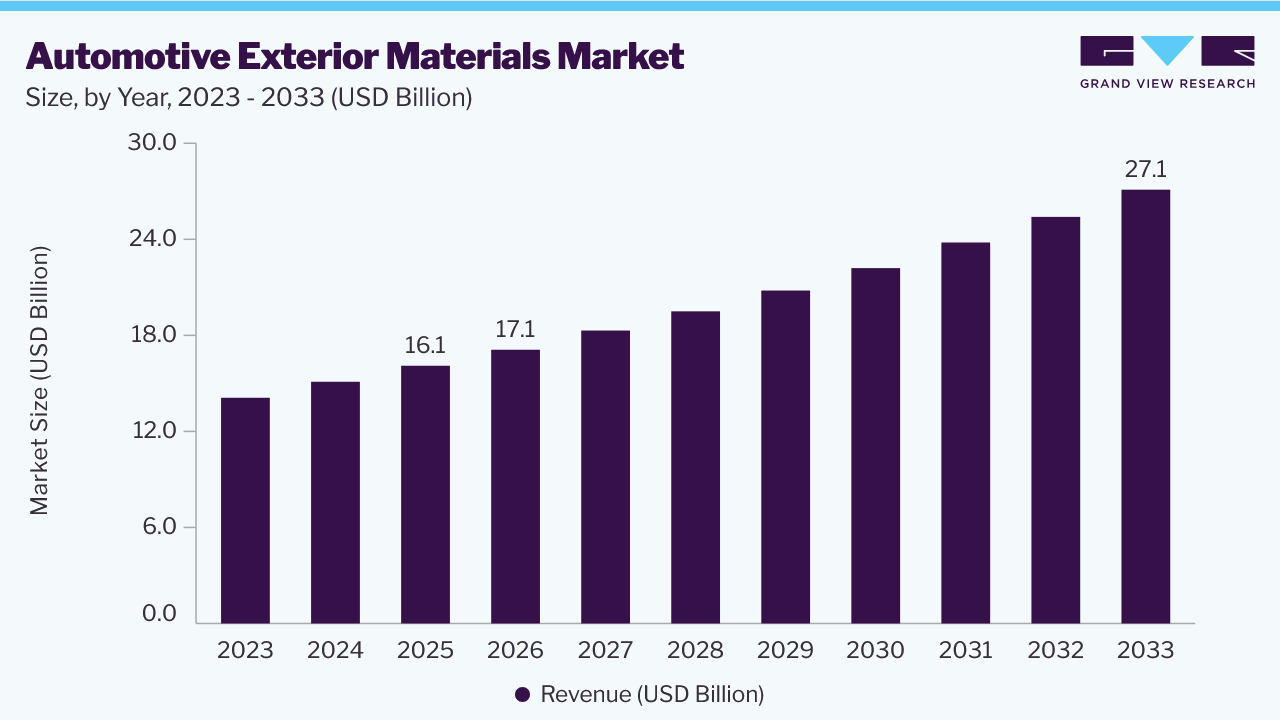
The global automotive exterior materials market size was valued at USD 16.1 billion in 2025 and is projected to grow from USD 17.1 billion in 2026 to USD 27.1 billion in 2033, at a CAGR of 6.8% from 2026 to 2033. Asia Pacific dominated the market, accounting for a revenue share of 50.0% in 2025. As automakers expand their operations into new regions, they are exposed to diverse environmental conditions, consumer preferences, and regulatory landscapes.
 Source: Grand View Research, IR Documents, Primary Interviews, Paid DatabasesTo learn more about this report,
 Download Free Sample Report
Key Market Trends & Insights
- By product: The steel segment held the largest market share of around 35.0% in 2025.
- By application: The doors segment held the largest market share in 2025.
Regional Highlights
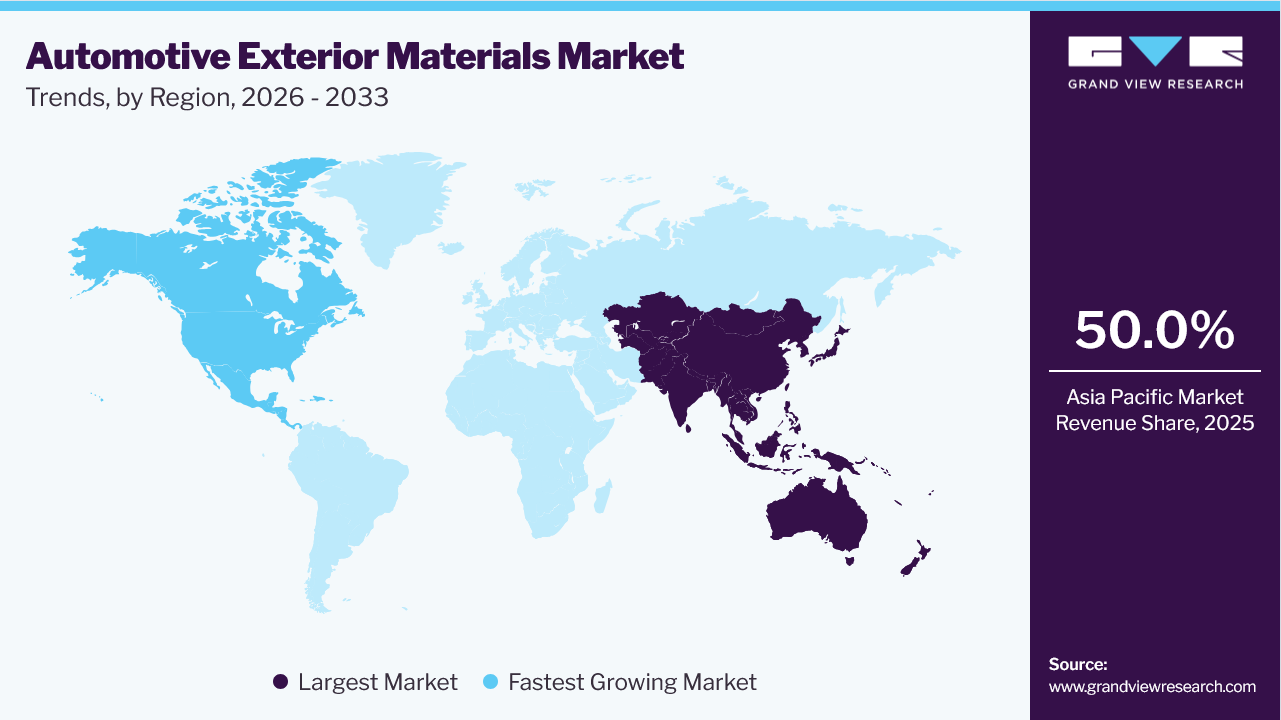
- Largest regional market: Asia Pacific (50.0% revenue share, 2025)
- Fastest-growing regional market: North America (highest CAGR, 2026-2033)
Market Size & Forecast
- Market size in 2025: USD 16.1 Billion
- Estimated market size in 2026: USD 17.1 Billion
- Projected market size by 2033: USD 27.1 Billion
- CAGR (2026-2033): 6.8%
Prism AI by Grand View Research Free to tryAsk a question about the automotive exterior materials marketTry asking✓Every figure cited from GVR research Prefer the report? Download free sample →This necessitates using materials that meet varied requirements across different markets. The globalization of the automotive industry also plays an essential role in driving the automotive exterior materials market. Materials that offer superior impact resistance, corrosion resistance, and durability are crucial in ensuring vehicle safety and longevity. Advances in material science have led to the development of exterior materials that can absorb impact energy more effectively, reducing the severity of accidents. Additionally, materials with high resistance to environmental factors, such as UV radiation and extreme temperatures, are essential for maintaining vehicles' structural integrity and appearance over time. Safety remains a top priority for consumers and regulators, influencing the materials used in automotive exteriors.
EV manufacturers are exploring new materials to enhance vehicles' aesthetic appeal and functional performance. Materials that offer high impact resistance, weather resistance, and thermal management properties are in high demand. Additionally, the need to improve EV range and efficiency drives the use of lightweight, aerodynamic materials for exterior applications. The transition to EVs also requires materials that support new design requirements, such as integrated sensors and cameras for autonomous driving.
Analyst Perspective
The automotive exterior materials market is gradually shifting toward advanced materials that can improve vehicle efficiency, durability, and design flexibility. Automakers are increasingly focusing on lightweight, high-performance materials to meet fuel-efficiency targets and support the growing production of electric vehicles. At the same time, exterior components are expected to offer better weather resistance, safety, and aesthetic appeal. Companies with strong material development capabilities, stable supplier relationships, and the ability to meet evolving automotive standards are likely to strengthen their market position. As vehicle manufacturers continue to balance performance, sustainability, and cost, demand is expected to favor materials that deliver long-term durability while meeting modern vehicle design and manufacturing requirements.
Product Insights
The steel segment dominated the market, accounting for around 35.0% of revenue in 2025. Steel is preferred for automotive exteriors due to its cost-effectiveness and favorable strength-to-weight ratio. Traditional steel, high-strength steel (HSS), and advanced high-strength steel (AHSS) offer a balance between affordability and performance, making them ideal for mass production. Compared to other lightweight materials, steel's affordability makes it a go-to choice for automakers aiming to produce durable and economical vehicles. This cost advantage is particularly crucial in producing mid-range and budget vehicles.
The glass composites segment is expected to register a significant CAGR during the forecast period. Glass composites offer superior design flexibility, a significant advantage for automakers seeking to create innovative and attractive vehicle exteriors. The material's versatility allows for complex shapes and designs that are difficult to achieve with traditional materials. Additionally, glass composites are molded to achieve smooth, high-quality finishes that enhance the vehicle's visual appeal. This flexibility in design and finish makes glass composites particularly valuable in producing components for premium and luxury vehicles, where the design is a key selling point.
Application Insights
The doors segment accounted for the largest market revenue share in 2025. Doors are critical structural components that protect occupants during side-impact collisions, among the most severe types of accidents. As a result, automakers are increasingly turning to high-strength materials such as advanced high-strength steel, aluminum, and composites to enhance door durability. These materials provide superior energy absorption and resistance to deformation, which is essential for meeting stringent safety standards and ensuring passenger protection.
The fenders segment is anticipated to register the fastest CAGR over the forecast period. EV manufacturers are particularly focused on optimizing aerodynamics and reducing weight to maximize their vehicles' range and efficiency. Due to their lightweight and aerodynamic properties, fenders made from advanced materials such as thermoplastic polymers and composites are increasingly adopted in EVs. Additionally, the design flexibility of these materials enables the integration of aerodynamic features directly into the fender, further improving the vehicle's efficiency. As the EV market continues to expand, the demand for specialized fenders that meet the unique requirements of electric vehicles is expected to grow.
Regional Insights
The Asia Pacific automotive exterior materials market accounted for the largest revenue share, at around 50.0%, in 2025. The region's aftermarket and repair industry is strong, with a significant demand for replacement exterior materials such as bumpers, fenders, and panels. This demand is driven by the large number of vehicles on the road, the frequency of accidents, and consumers' preference for keeping their vehicles in top condition. The aftermarket segment plays a crucial role in the overall automotive exterior materials market, requiring materials that balance cost, quality, and performance. The strong presence of a well-established repair and aftermarket industry in the Asia Pacific ensures steady demand for exterior materials, contributing to market growth.
 To learn more about this report, Download Free Sample Report
China Automotive Exterior Materials Market Trends
China automotive exterior materials market accounted for the largest revenue share in 2025. A strong consumer preference for premium vehicles with high customization characterizes the country's market. This trend drives the demand for high-quality exterior materials for unique finishes, colors, and textures. Consumers are increasingly looking for vehicles that offer extended options, and automakers are responding by offering a wide range of exterior customization options. Materials that enable these customizations, while also providing durability and protection against environmental factors, are in high demand. The country's growing popularity of luxury and high-performance vehicles increases the need for premium exterior materials. For instance, in March 2025, BASF Coatings expanded production capacity for polyester and polyurethane resins at its Caojing facility in Shanghai, China, increasing annual capacity to 18,800 metric tons. The resins are used in automotive coatings and exterior finishing applications, enabling improved durability, weather resistance, and appearance of vehicle exterior components. The expansion was undertaken to support growing automotive demand in China and the broader Asia Pacific region.
North America Automotive Exterior Materials Market Trends
The North America automotive exterior materials market is expected to witness significant growth over the forecast period. North America is home to the world’s leading automotive manufacturers, such as General Motors, Ford, and Tesla. These companies are at the forefront of automotive innovation and continuously invest in developing new materials to enhance vehicle performance, safety, and aesthetics. The presence of these automotive giants drives the demand for advanced exterior materials as they pursue differentiation in a highly competitive market. Moreover, ongoing collaborations between automakers and materials science companies in the region further drive innovation and adoption of new materials.
The U.S. automotive exterior materials market is expected to grow significantly over the forecast period. The development and use of high-strength materials in exterior components, including bumpers, fenders, and panels, are crucial to enhancing a vehicle’s durability. Manufacturers increasingly invest in materials that provide superior impact resistance and energy absorption during collisions. For instance, in March 2025, Novelis announced the production of the world's first aluminum coil manufactured entirely from 100% recycled end-of-life automotive scrap. The material was specifically developed for automotive exterior body-panel applications and meets stringent requirements for surface quality, strength, and formability. The innovation supports the growing adoption of sustainable lightweight materials in vehicle exteriors while advancing circularity across the automotive value chain. This focus on safety significantly drives the market, as automakers in North America strive to meet and exceed safety standards, ensuring their vehicles provide maximum protection for occupants.
Key Automotive Exterior Materials Market Company Insights
The automotive exterior materials industry features a range of global, regional, and local players, making it highly competitive. The world’s leading companies are using partnerships, collaborations, acquisitions, mergers, and agreements as strategies to withstand the intense competition and increase their market share. Automotive exterior materials manufacturers are investing heavily in product enhancements and new product development.
Key Automotive Exterior Materials Companies
The following key companies have been profiled for this study on the automotive exterior materials market:
-
HAYAKAWA EASTERN RUBBER CO., LTD
-
IDEAL Automotive GmbH
-
Kotobukiya Fronte Co., Ltd.
-
SHANDONG EXCEEDING AUTO INTERIOR PARTS CO., LTD
-
Suminoe Textile Co., Ltd.
-
HAYASHI TELEMPU CORPORATION
-
Magna International Inc.
-
Shanghai Shenda Co., Ltd.
-
BOSHOKU CORPORATION
-
KAP Ltd.
Recent Developments
-
In March 2026, SABIC unveiled new LNP ELCRIN SLX compounds based on post-consumer recycled content at PIAE 2026. The materials were developed to enhance aesthetics, durability, and sustainability in automotive exterior components while supporting emissions-reduction and circularity initiatives across the automotive industry.
-
In April 2025, Covestro introduced a new range of TÜV-certified post-consumer recycled polycarbonates derived from end-of-life automotive headlamps. Containing up to 50% recycled content, the materials were developed for automotive exterior and lighting applications. They were undergoing validation by automotive manufacturers, including Volkswagen and NIO, supporting sustainability and circular economy goals.
-
In February 2025, SABIC launched NORYL GTX LMX310 resin, the first grade in a new family of conductive resins designed for inline-paintable automotive exterior components. The material offers high heat resistance, enhanced dimensional stability, and low moisture absorption, meeting the growing demand for lightweight, durable exterior materials for electric vehicles.
-
In May 2024, LyondellBasell collaborated with a Chinese Tier I supplier to develop a lightweight plastic engine hood for new energy vehicles. The product was designed to provide high rigidity and dimensional stability under varying environmental conditions while supporting light weighting trends in automotive exterior materials.
-
In February 2024, KRAIBURG TPE introduced new thermoplastic elastomer (TPE) products containing at least 73% recycled content under its Recycling Content TPE for Automotive series. The materials were developed for automotive applications such as floor mats and inlay cases, reflecting the growing demand for sustainable, recycled automotive exterior materials.
Automotive Exterior Materials Market Report Scope
Report Attribute
Details
Market size in 2025
USD 16.1 billion
Estimated market size in 2026
USD 17.1 billion
Projected market size by 2033
USD 27.1 billion
Growth rate
CAGR of 6.8% from 2026 to 2033
Base year for estimation
2025
Actual data
2021 – 2024
Forecast period
2026 – 2033
Quantitative units
Revenue in USD billion, and CAGR from 2026 to 2033
Report coverage
Revenue forecast, company ranking, competitive landscape, growth factors, and trends
Segments covered
Product, application, region
Regional Scope
North America, Europe, Asia Pacific, Latin America, Middle East & Africa
Country Scope
U.S.; Canada; Mexico; UK; Germany; France; Italy; Spain; China; Japan; India; Argentina; Brazil; Saudi Arabia; South Africa
Key companies profiled
HAYAKAWA EASTERN RUBBER CO.; LTD, IDEAL Automotive GmbH; Kotobukiya Fronte Co., Ltd.; SHANDONG EXCEEDING AUTO INTERIOR PARTS CO., LTD; Suminoe Textile Co., Ltd.; HAYASHI TELEMPU CORPORATION; Magna International Inc.; Shanghai Shenda Co. Ltd.; BOSHOKU CORPORATION; KAP Ltd.
Customization scope
Free report customization (equivalent up to 8 analysts working days) with purchase. Addition or alteration to country, regional & segment scope.
Pricing and purchase options
Avail of customized purchase options to meet your exact research needs. Explore purchase options
Global Automotive Exterior Materials Market Report Segmentation
This report forecasts revenue growth at global, regional, and country levels and provides an analysis of the latest industry trends and opportunities in each of the sub-segments from 2021 to 2033. For this study, Grand View Research has segmented the global automotive exterior materials market report based on product, application, and region:
-
Product Outlook (Revenue, USD Billion, 2021 - 2033)
-
Steel
-
Aluminum
-
Plastics
-
Glass Composites
-
Carbon Composites
-
Others
-
-
Application Outlook (Revenue, USD Billion, 2021 - 2033)
-
Bumpers
-
Fenders
-
Doors
-
Hoods
-
Tailgates
-
Others
-
-
Regional Outlook (Revenue, USD Billion, 2021 - 2033)
-
North America
-
U.S.
-
Canada
-
Mexico
-
-
Europe
-
UK
-
Germany
-
France
-
Italy
-
Spain
-
-
Asia Pacific
-
China
-
Japan
-
India
-
-
Latin America
-
Argentina
-
Brazil
-
-
The Middle East & Africa
-
Saudi Arabia
-
South Africa
-
-
Frequently Asked Questions About This Report
The global automotive exterior materials market size was valued at USD 16.1 billion in 2025 and is estimated at USD 17.1 billion for 2026.
The global automotive exterior materials market is expected to grow at a CAGR of 6.8% from 2026 to 2033, reaching USD 27.1 billion.
The steel automotive exterior materials segment accounted for the largest revenue share of around 30.0% in 2025.
Asia Pacific dominated with around 50.0% revenue share in 2025.
Key players in the market include HAYAKAWA EASTERN RUBBER CO., LTD, IDEAL Automotive GmbH, Kotobukiya Fronte Co., Ltd., SHANDONG EXCEEDING AUTO INTERIOR PARTS CO., LTD, Suminoe Textile Co., Ltd., HAYASHI TELEMPU CORPORATION, Magna International Inc., Shanghai Shenda Co., Ltd., BOSHOKU CORPORATION, KAP Ltd., and others.
About the Author(s)
Advanced Interior Materials Research Team
Advanced Materials · Advanced Interior MaterialsThis report was authored by the advanced interior materials research team at Grand View Research - comprising two research analysts, one senior research analyst, and one industry expert - with specialized expertise in the advanced interior materials segment of the advanced materials industry. All findings are based on proprietary advanced materials databases, executive interviews, and regulatory analysis, subject to internal peer review prior to publication.
Last Updated:
Speak to Analyst

Customize this report to your needs - add regions, segments, or data points, with 20% free customization.
Or view our licence options:


ISO 9001:2015 & 27001:2022 Certified
We are GDPR and CCPA compliant! Your transaction & personal information is safe and secure. For more details, please read our privacy policy.


