
- Home
- »
- Automotive & Transportation
- »
-
Automotive Transmission Market Size & Share Report, 2033GVR Report cover

Automotive Transmission Market (2026 - 2033) Size, Share & Trends Analysis Report By Transmission (Manual, Automatic), By Fuel (Gasoline, Diesel), By Vehicle (Passenger Cars, LCVs, HCVs), By Region (North America, Europe, APAC, Latin America, MEA), And Segment Forecasts
Market Size, 2025
$178.6BMarket Estimate, 2026
$189.0BMarket Forecast, 2033
$307.5BCAGR, 2026–2033
7.2%Automotive Transmission Market Summary
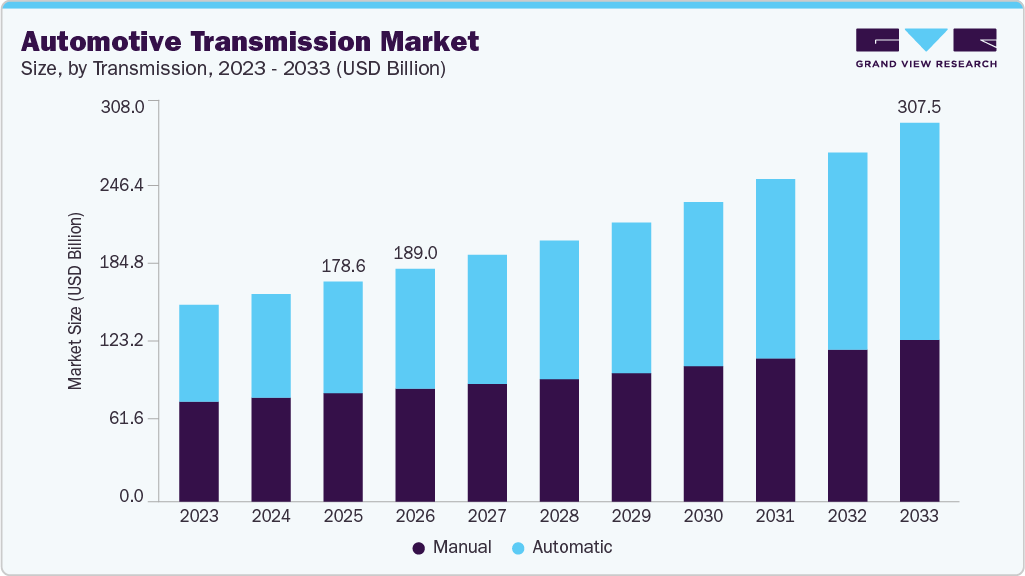
The global automotive transmission market size was valued at USD 178.6 billion in 2025 and is projected to grow from USD 189.0 billion in 2026 to USD 307.5 billion by 2033, at a CAGR of 7.2% from 2026 to 2033. Asia Pacific dominated the global market and accounted for a share of 33.0% in 2025. This growth is attributable to advancements in automotive transmission technology, including the development of efficient and sophisticated systems such as Dual-Clutch Transmissions (DCT) and Continuously Variable Transmissions (CVT).
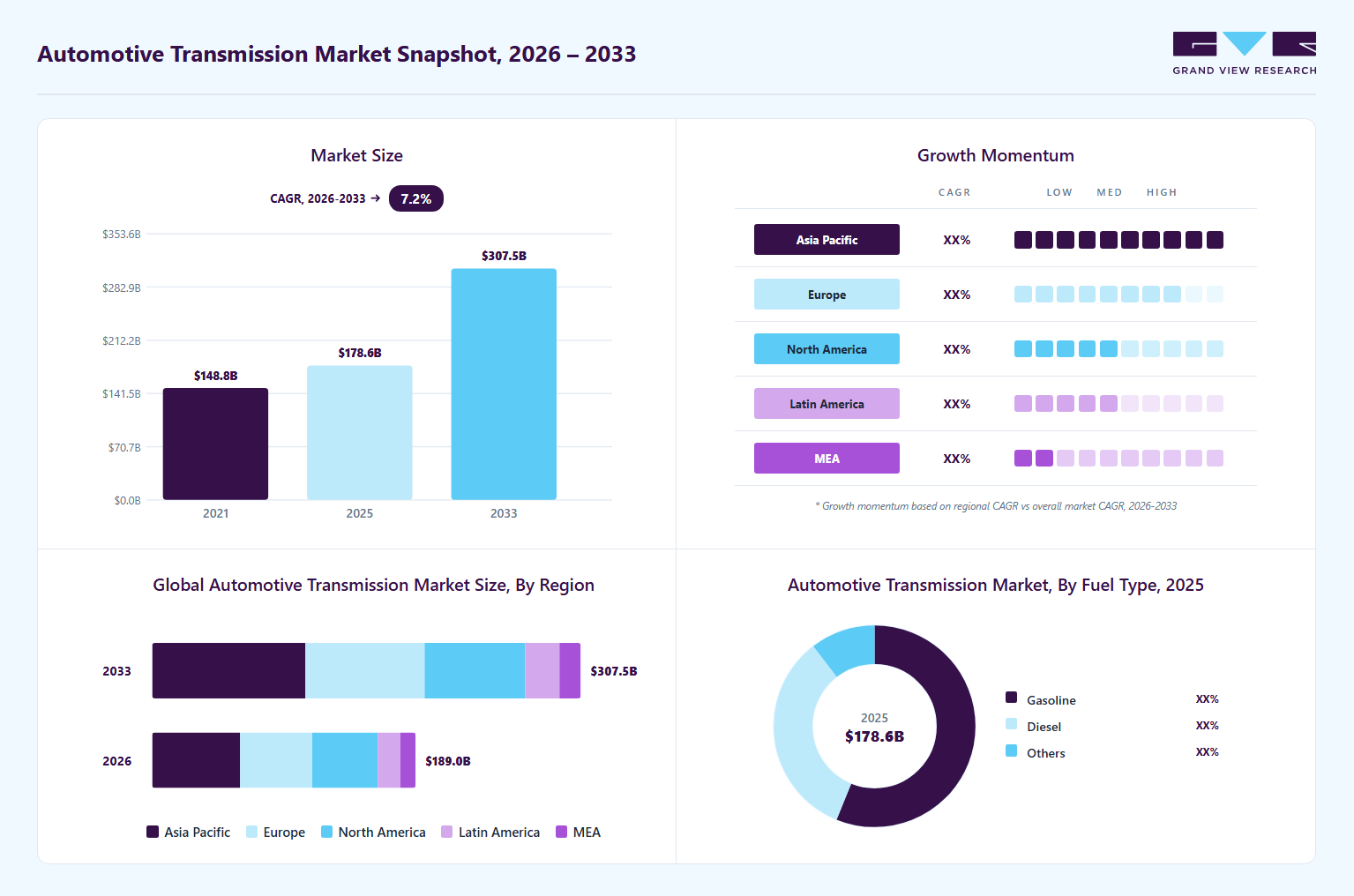 Source: Grand View Research, IR Documents, Primary Interviews, Paid DatabasesTo learn more about this report,
 Download Free Sample Report
Key Market Trends & Insights
- By vehicle type : Automatic segment of the automotive transmission industry dominated the market in 2025, with a revenue share of 50.7%.
- By fuel type: Gasoline segment dominated the market in 2025 and accounted for the largest share of 56.1%.
- By transmission type: Passenger cars segment accounted for the largest market share in 2025
Regional Highlights
- Largest regional market: Asia Pacific (33.0% revenue share, 2025)
- By country: India is anticipated to experience the fastest growth in the automotive transmission market over the forecast period.
Market Size & Forecast
- Market size in 2025: USD 178.6 Billion
- Estimated market size in 2026: USD 189.0 Billion
- Projected market size by 2033: USD 307.5 Billion
- CAGR (2026-2033): 7.2%
Three ways to get this report
Buy it, customize it, or ask a question.Ask an Analyst
Analyst response in 1 business day
- AccessReport author, directly
- Reply timeWithin 1 working day
- No sales callDirect answer only
- FormatEmail reply
- CostFree, no cost
Get the Full Report
What the study covers
- FormatsPDF · Excel · Dashboard
- Timeline2026–2033 annual, 2025 base
- Coverage20+ countries, 5 regions
- Companies10+ key players profiled
Customize the Report
20% free customization
- IncludeCountries, segments, points
- TailorTo your product definition
- ExtendDeeper competitor detail
- OrA fully bespoke study
- Turnaround5–10 working days
These innovations enhance vehicle performance, fuel efficiency, and driving comfort, making modern vehicles more appealing to consumers. The increasing implementation of stringent emission regulations worldwide compels manufacturers to adopt advanced transmission technologies that can help reduce greenhouse gas emissions while maintaining optimal engine performance.Another significant factor influencing the automotive transmission market is consumers' rising demand for automatic transmissions. With increasing urbanization and busy lifestyles, drivers prefer convenient, easy-to-use vehicles, especially in crowded cities. Automatic transmissions provide smoother gear shifts and eliminate the need for manual gear changes, making them more attractive to a broader audience. This trend is particularly evident in emerging markets where rising disposable incomes enable more consumers to purchase passenger vehicles equipped with automatic transmission systems. The growing adoption of automatic transmission vehicles is also positively impacting the automotive transmission oil filter market, as transmission oil filters play a critical role in maintaining transmission efficiency, preventing contamination, and extending the operational lifespan of advanced transmission systems.
 To learn more about this report, Download Free Sample Report
Consequently, manufacturers focus on producing more automatic transmissions to meet this growing demand. Furthermore, the expansion of electric and hybrid vehicles is reshaping the automotive transmission landscape. As automakers shift toward electrification to comply with environmental standards and cater to changing consumer preferences, there is a notable increase in the development of specialized transmission systems designed for electric powertrains. These systems are essential for optimizing energy efficiency and performance in electric vehicles (EVs) and hybrids. The growing popularity of EVs and advancements in battery technology are expected to drive substantial growth in the automotive transmission industry as manufacturers seek innovative solutions that enhance vehicle capabilities while addressing sustainability concerns.
Market Dynamics
The growth of global automobile production and the increasing emphasis on fuel efficiency are major factors driving the automotive transmission market. Automakers are continuously investing in advanced transmission technologies to improve vehicle performance, optimize fuel consumption, and comply with stringent emission regulations imposed across major automotive markets, thereby supporting the expansion of the automotive transmission system market. Modern transmission systems such as continuously variable transmissions (CVTs), dual-clutch transmissions (DCTs), and advanced automatic transmissions are gaining significant adoption due to their ability to deliver smoother gear shifts, enhanced driving comfort, and improved fuel economy. This trend is particularly strengthening the automotive automatic transmission system market, as consumers increasingly prefer vehicles equipped with automatic and semi-automatic transmission technologies. Rising consumer preference for premium passenger vehicles equipped with advanced transmission systems is further accelerating market expansion. In addition, increasing urbanization and traffic congestion in emerging economies are encouraging the adoption of automatic transmission vehicles, particularly in densely populated metropolitan areas where driving convenience is a key purchasing factor. The rapid growth of hybrid and electric vehicles is also creating strong demand for specialized transmission architectures capable of supporting electrified powertrains and regenerative braking systems, further contributing to the long-term growth of the automotive transmission system market.
The automotive transmission market faces significant challenges due to the rising shift toward vehicle electrification and the high development costs associated with advanced transmission technologies. The growing adoption of battery electric vehicles (BEVs), which generally require simpler single-speed transmission systems compared to conventional internal combustion engine vehicles, is reducing demand for complex multi-speed transmission architectures. This transition is creating substantial pressure on traditional transmission manufacturers that have historically relied on automatic and manual transmission platforms for revenue generation. In addition, the development of advanced transmission systems such as dual-clutch transmissions, intelligent automatic gearboxes, and hybrid-compatible drivetrains requires considerable investments in research, engineering, testing, and software integration. Increasing complexity in transmission design also raises manufacturing costs, maintenance requirements, and repair expenses, which can negatively impact consumer adoption in price-sensitive markets. Automakers are simultaneously under pressure to balance fuel efficiency improvements, emission compliance, and affordability, making transmission optimization increasingly challenging.
The rapid expansion of hybrid and electric vehicle production is creating substantial growth opportunities for the automotive transmission market. Although fully electric vehicles utilize simpler drivetrain systems, hybrid vehicles continue to require highly efficient and specialized transmission technologies capable of integrating electric motors with internal combustion engines. This is encouraging transmission manufacturers to develop next-generation electrified transmission systems that improve energy efficiency, driving performance, and power management. Increasing government incentives, emission reduction targets, and investments in sustainable mobility are further accelerating the adoption of hybrid and plug-in hybrid vehicles across major automotive markets. In addition, growing consumer demand for enhanced driving comfort and fuel-efficient mobility solutions is supporting the transition from manual transmissions to advanced automatic and automated manual transmission systems, particularly in emerging economies. The integration of smart electronics, artificial intelligence, and predictive transmission control technologies also presents new opportunities for manufacturers to differentiate their products through intelligent drivetrain optimization and connected vehicle capabilities.
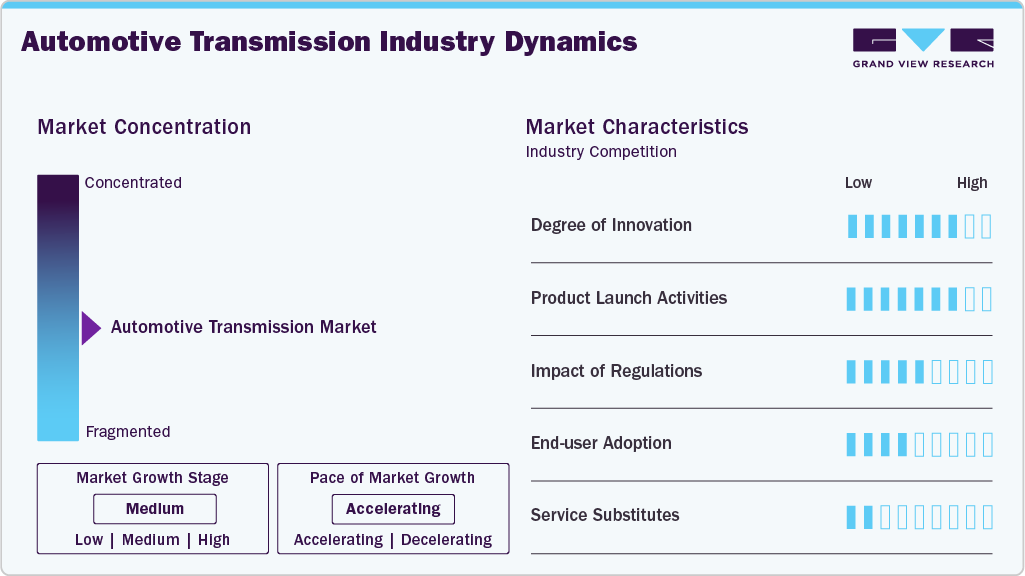
Market Concentration & Characteristics
The automotive transmission market is moderately consolidated, with the presence of several global automotive component manufacturers, transmission system suppliers, and integrated drivetrain technology providers competing across passenger and commercial vehicle segments. Major industry participants maintain strong market positions through long-term supply agreements with automotive OEMs, extensive manufacturing capabilities, and continuous investments in advanced transmission technologies. Leading companies are increasingly focusing on the development of fuel-efficient automatic transmissions, hybrid-compatible drivetrains, and intelligent transmission control systems to strengthen their competitive positioning. At the same time, regional manufacturers and emerging suppliers are expanding their presence through cost-competitive solutions, localized production facilities, and strategic partnerships with vehicle manufacturers.
 To learn more about this report, Download Free Sample Report
The market is characterized by rapid technological advancements, increasing vehicle electrification, and growing consumer preference for enhanced driving comfort and fuel efficiency. Companies are actively investing in lightweight transmission components, electronic control integration, and software-based gear optimization technologies to improve drivetrain performance and reduce emissions. In addition, stringent fuel economy regulations and evolving emission standards across major automotive markets are accelerating the adoption of advanced automatic and electrified transmission systems. Strategic collaborations between automakers, transmission suppliers, semiconductor companies, and electric powertrain developers are also supporting innovation in next-generation mobility solutions. Furthermore, increasing penetration of hybrid vehicles and premium passenger cars is driving demand for sophisticated transmission architectures with improved torque management and seamless shifting capabilities globally.
Transmission Insights
The automatic segment of the automotive transmission industry dominated the market in 2025, with a revenue share of 50.7%. This dominance can be attributed to the growing consumer preference for automatic transmissions due to their ease of use and convenience, especially in urban driving conditions. As more drivers seek comfort and efficiency, manufacturers increasingly focus on developing advanced automatic transmission technologies. In addition, integrating smart technologies in automatic systems will enhance performance and appeal to tech-savvy consumers. This trend is expected to continue, further reinforcing the dominance of the automatic segment in the market.
The manual segment of the automotive transmission industry is anticipated to experience a significant CAGR during the forecast period. This growth is attributable to the continued popularity of manual transmissions among driving enthusiasts who value control and engagement while driving. In addition, manual transmissions are often more cost-effective and can provide better fuel efficiency in certain applications. As a result, manufacturers continue to produce manual options to cater to this dedicated market segment. Despite the rise of automatics, the manual segment remains relevant due to its unique advantages and loyal customer base.
Fuel Insights
The gasoline segment dominated the market, with significant revenue share of 56.1% in 2025. This growth can be attributed to the increasing adoption of gasoline-powered vehicles, which remain popular due to their affordability and widespread availability. This dominance in the fuel market is further reinforced by its easy availability and well-established infrastructure. In addition, the growing demand for personal transportation, particularly in emerging economies, is expected to sustain this segment's growth. As consumers prioritize convenience and cost-effectiveness, gasoline is preferable in vehicles worldwide.
The diesel segment is anticipated to experience a significant CAGR during the forecast period. This growth is attributable to the increasing reliance on Diesel engines in heavy-duty vehicles and industrial applications, where high power output and fuel efficiency are critical. The automotive transmission industry benefits from this trend, as manufacturers continue to develop advanced Diesel transmission systems designed to enhance performance and reduce emissions. Moreover, the expansion of transportation infrastructure, particularly in emerging markets, further drives the demand for Diesel fuel. With businesses prioritizing efficiency and durability, the Diesel segment is expected to remain a substantial component of the transportation landscape.
Vehicle Insights
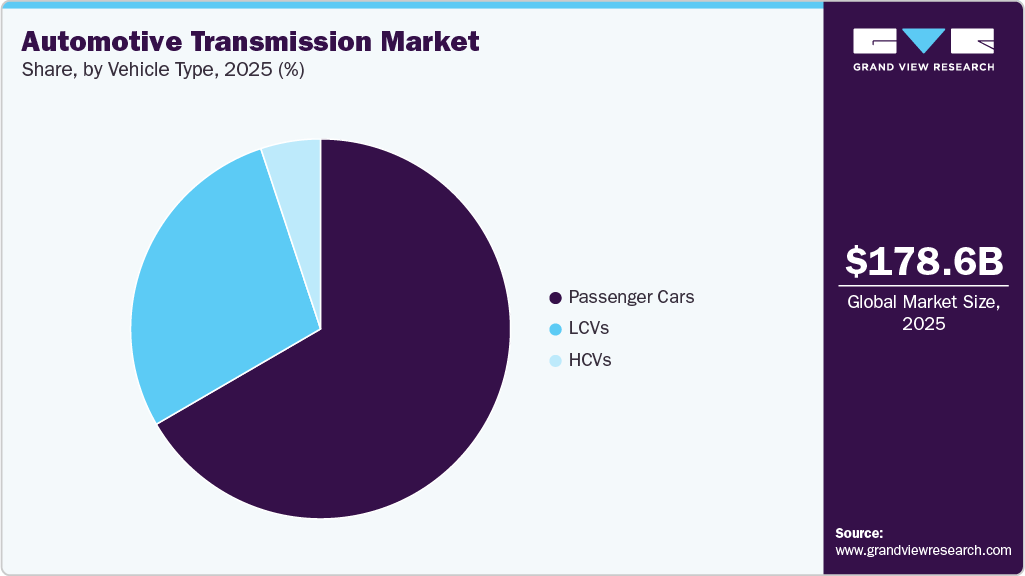
The passenger cars segment held the largest market share in 2025 within the automotive transmission industry. This growth is driven by the ongoing advancements in automotive technology, particularly in transmission systems that enhance vehicle performance and comfort. The popularity of automatic transmissions, including CVTs and DCTs, has contributed to this dominance, as consumers increasingly favor these options for their efficiency and ease of use. Furthermore, passenger cars represent the largest category in production and sales volume, leading to a higher demand for automotive transmissions than other vehicle segments. As the automotive market continues to evolve, the passenger car segment is expected to maintain its leading position throughout the forecast period.
 To learn more about this report, Download Free Sample Report
The HCVs segment is anticipated to experience the fastest CAGR during the forecast period. This growth is attributable to the increasing demand for HCVs due to rising global manufacturing and infrastructure development activities. As economies expand, there is a greater need for efficient transportation solutions to support logistics and supply chains. In addition, advancements in automotive transmission technology, particularly in automatic- and automated-manual transmissions, are enhancing the performance and fuel efficiency of HCVs. This trend is expected to attract more investments and innovations within the automotive transmission industry, further propelling the growth of the HCV segment.
Regional Insights
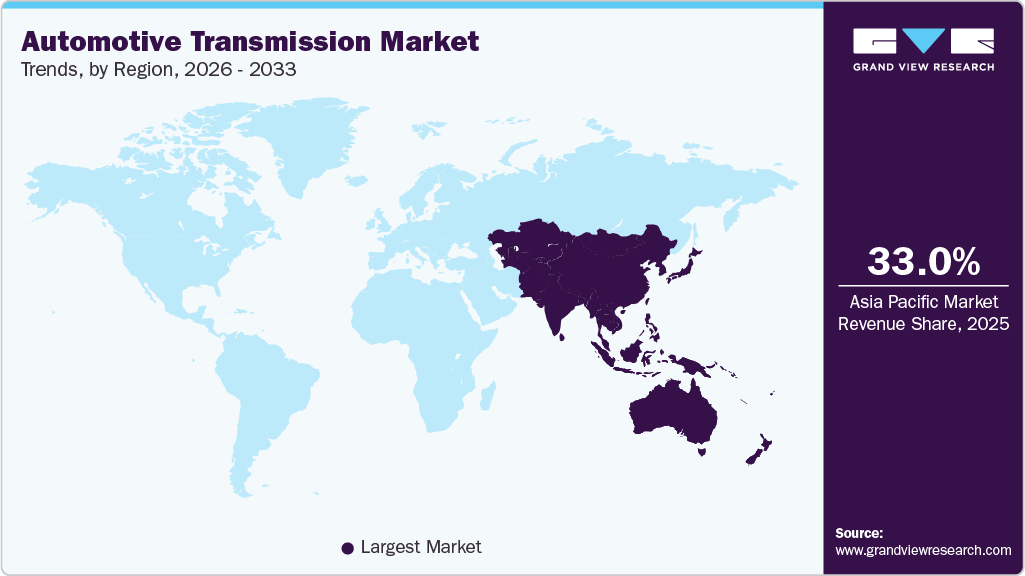
The Asia Pacific automotive transmission market held the largest revenue share of 33.04% in 2025. This dominance can be attributed to rapid urbanization, rising disposable incomes, and an expanding middle class, leading to increased vehicle ownership and demand for passenger and commercial vehicles. The region is witnessing a strong preference for automatic transmissions due to traffic congestion and the desire for smoother driving experiences. In addition, stringent government regulations to improve fuel efficiency encourage manufacturers to innovate their transmission systems. Countries such as China, India, and Japan significantly contribute to this market growth, reflecting evolving consumer preferences and a shift toward advanced transmission technologies.
 To learn more about this report, Download Free Sample Report
India Automotive Transmission Market Trends
India is anticipated to experience the fastest growth in the automotive transmission market over the forecast period. This surge is attributable to increasing urbanization, rising disposable incomes, and a growing consumer preference for automatic transmission vehicles. The market for automatic transmissions is expected to expand significantly as traffic congestion in urban areas makes these systems more appealing for their convenience and ease of use. In addition, technological advancements and a focus on fuel efficiency encourage automakers to innovate their transmission offerings.
North America Automotive Transmission Market Trends
The North America automotive transmission market is expected to grow significantly over the forecast period. This growth is attributable to the increasing adoption of electrified systems, particularly hybrid vehicles, as consumers prioritize fuel efficiency and reduced emissions. The strong preference for automatic transmissions further supports market expansion, bolstered by advancements in DCT and CVT technologies. In addition, regulatory pressures to meet fuel economy standards are prompting manufacturers to innovate their transmission systems. North America is set to remain a key player in the global automotive transmission landscape.
The U.S. automotive transmission market dominated the regional market in 2025. This growth can be attributed to the high demand for automatic transmissions, as most Americans prefer vehicles equipped with these systems. The passenger vehicle segment is expected to be a significant contributor, accounting for a substantial market share due to the increasing sales of electric and hybrid vehicles. In addition, advancements in transmission technology are enhancing fuel efficiency and performance, further supporting market expansion. As the automotive industry evolves, the U.S. market is expected to experience steady growth in the coming years.
Europe Automotive Transmission Market Trends
The Europe automotive transmission market is expected to grow significantly in 2025. This growth is attributable to technological advancements and increasing demand for efficient transmission systems. In addition, Germany's strong automotive manufacturing sector further thrives on market expansion. The region is also witnessing a shift toward EVs, prompting manufacturers to innovate and adapt their transmission technologies. Furthermore, government regulations aimed at reducing emissions influence the types of transmissions offered in the market. As consumer preferences evolve, the European automotive transmission landscape is set to transform significantly in the coming years.
The UK automotive transmission market accounted for significant market share in 2025. The increasing adoption of hybrid vehicles, premium passenger cars, and advanced automatic transmission systems is a major driver for the UK automotive transmission market. The UK automotive industry is undergoing a significant transition toward low-emission and fuel-efficient mobility solutions due to stringent carbon reduction targets and government regulations promoting vehicle electrification. Consumers in the country are increasingly preferring automatic and hybrid vehicles because of improved driving comfort, enhanced fuel efficiency, and better performance in urban traffic conditions. This trend is accelerating demand for advanced transmission technologies such as dual-clutch transmissions (DCTs), continuously variable transmissions (CVTs), and hybrid-compatible gear systems.
The Germany automotive transmission market accounted for a major market share in 2025. Germany’s strong automotive manufacturing ecosystem and the rising demand for premium and high-performance vehicles are major drivers for the automotive transmission market. As one of the world’s leading automotive production hubs, Germany is home to several globally recognized automobile manufacturers that continuously invest in advanced drivetrain and transmission technologies to enhance vehicle efficiency, driving dynamics, and emission performance. The country’s strong focus on engineering innovation and precision manufacturing is accelerating the adoption of sophisticated transmission systems such as dual-clutch transmissions (DCTs), automatic transmissions, and hybrid-compatible drivetrains across passenger and commercial vehicles.
Key Automotive Transmission Company Insights
Some key companies in the automotive transmission market are AISIN CORPORATION; Allison Transmission, Inc.; BorgWarner Inc.; and Continental AG. These organizations are focusing on expanding their customer base and gaining a competitive edge in the market. In order to achieve this, key players are actively pursuing several strategic initiatives, such as mergers and acquisitions, as well as forming partnerships with other leading companies.
-
AISIN CORPORATION is renowned for its innovative automotive solutions. The company specializes in manufacturing advanced components, including transmissions, braking systems, and engine parts, catering to both traditional and EVs. AISIN integrates cutting-edge technologies into its products, enhancing vehicle performance, safety, and efficiency. Serving global automakers, the company supports the evolving needs of the automotive industry with a focus on sustainability and reliability.
-
Allison Transmission, Inc. is a leading manufacturer of fully automatic transmissions and hybrid propulsion systems for commercial and military vehicles. The company specializes in producing advanced driveline solutions that enhance vehicle performance, reliability, and efficiency. Serving industries such as construction, transportation, and defense, Allison Transmission integrates innovative technologies to meet the evolving demands of its global customer base.
Key Automotive Transmission Companies
The following key companies have been profiled for this study on the automotive transmission market.
-
AISIN CORPORATION
-
Allison Transmission, Inc.
-
BorgWarner Inc.
-
Continental AG
-
Eaton
-
Magna International Inc.
-
GKN Automotive Limited (Dowlais Group plc)
-
JATCO Ltd
-
Schaeffler AG
-
ZF Friedrichshafen AG
Competitive Benchmarking
Operating Strategies
Competitive Edge
Weaknesses
Mature Players: AISIN CORPORATION; ZF Friedrichshafen AG; BorgWarner Inc.; Schaeffler AG; Continental AG
- Mature players in the automotive transmission market focus on expanding advanced drivetrain and transmission portfolios by integrating automatic transmissions, hybrid-compatible systems, intelligent electronic controls, and lightweight transmission technologies.
- These companies are heavily investing in research and development to support electrified mobility, fuel-efficient powertrains, and software-driven transmission optimization systems.
- Mature players gain a competitive advantage through strong relationships with global automotive manufacturers, extensive production capabilities, advanced engineering expertise, and diversified drivetrain technology portfolios.
- Their ability to provide integrated powertrain solutions, including automatic transmissions, dual-clutch systems, e-axles, and hybrid drivetrains, enables them to maintain leadership in premium and high-volume vehicle platforms.
- These companies often face challenges associated with high research and development costs, increasing pressure from vehicle electrification, and the gradual decline in demand for conventional multi-speed transmission systems.
- Their large manufacturing structures and dependence on internal combustion engine vehicle platforms can reduce operational flexibility during the transition toward electric mobility.
Emerging Players: KN Automotive Limited and JATCO Ltd
- Emerging players in the automotive transmission market focus on developing compact, lightweight, and cost-efficient transmission systems for hybrid vehicles, compact passenger cars, and performance mobility applications.
- Emerging companies gain competitiveness through flexible product development, faster adaptation to electrification trends, competitive pricing strategies, and specialized engineering capabilities.
- Their ability to rapidly integrate new technologies such as hybrid transmission modules, electric drive units, and smart control software supports differentiation in evolving automotive markets.
- Emerging players face limitations related to lower global brand visibility, comparatively smaller production capacities, and restricted long-term supply agreements with major automotive OEMs.
- Limited financial resources and lower economies of scale can also constrain investments in advanced research, large-scale manufacturing expansion, and global distribution networks.
Recent Development
-
In January 2026, Allison Transmission Holdings, Inc., announced the acquisition of Dana Incorporated, Off-Highway Drive & Motion Systems business. This acquisition is expected to help company strengthen its position in the automotive market.
-
In January 2026, Schaeffler announced the hybrid transmission production in Taicang to support global electrified vehicle demand. The newly launched transmission has been engineered on a shared platform capable of supporting both PHEV and HEV applications, allowing the product to serve varying regulatory and consumer demands across global markets.
-
In October 2024, Schaeffler AG completed the acquisition of Vitesco Technologies Group AG, marking a significant consolidation in the automotive transmission market. This merger aimed at creating a leading motion technology company, enhancing Schaeffler's capabilities in powertrain technologies, including advanced transmission systems. The integration is expected to drive innovation and collaboration, positioning the combined entity better to meet the evolving demands of the automotive industry.
-
In June 2023, AISIN CORPORATION announced a USD 200 million investment to establish two new production lines at its North Carolina facility. Scheduled to commence in April 2025, the lines will manufacture 30,000 two-motor hybrid transmissions monthly. This initiative aligns with AISIN's electrification strategy and carbon neutrality objectives, incorporating advanced automation and specialized workforce training.
Automotive Transmission Market Report Scope
Report Attribute
Details
Market size in 2025
USD 178.6 billion
Estimated Market size in 2026
USD 189.0 billion
Projected Market size by 2033
USD 307.5 billion
Growth rate
CAGR of 7.2% from 2026 to 2033
Base year for estimation
2025
Historical data
2021 - 2024
Forecast period
2026 - 2033
Quantitative units
Revenue in USD billion and CAGR from 2026 to 2033
Report coverage
Revenue forecast, company ranking, competitive landscape, growth factors, and trends
Segments covered
Transmission, fuel, vehicle, region
Regional scope
North America; Europe; Asia Pacific; Latin America; Middle East and Africa
Country scope
U.S.; Canada; Mexico; Germany; UK; France; China; Japan; India; Australia; South Korea; Brazil; UAE; KSA; South Africa
Key companies profiled
AISIN CORPORATION; Allison Transmission, Inc.; BorgWarner Inc.; Continental AG; Eaton; Magna International Inc.; GKN Automotive Limited (Dowlais Group plc); Jatco Ltd.; Schaeffler AG; ZF Friedrichshafen AG
Customization scope
Free report customization (equivalent up to 8 analysts working days) with purchase. Addition or alteration to country, regional and segment scope.
Pricing and purchase options
Avail customized purchase options to meet your exact research needs. Explore purchase options
Global Automotive Transmission Market Report Segmentation
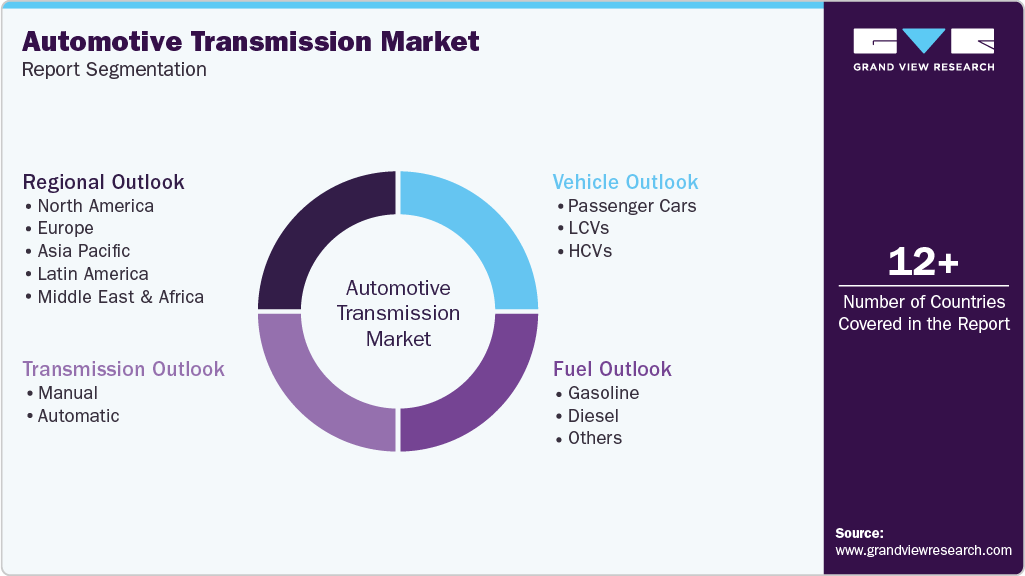
This report forecasts revenue growth at global, regional, and country levels and provides an analysis of the latest industry trends in each of the sub-segments from 2021 to 2033. For this study, Grand View Research has segmented the global automotive transmission market report based on transmission, fuel, vehicle, and region:
 To learn more about this report, Download Free Sample Report
-
Transmission Outlook (Revenue, USD Billion, 2021 - 2033)
-
Manual
-
Automatic
-
-
Fuel Outlook (Revenue, USD Billion, 2021 - 2033)
-
Gasoline
-
Diesel
-
Others
-
-
Vehicle Outlook (Revenue, USD Billion, 2021 - 2033)
-
Passenger Cars
-
LCVs
-
HCVs
-
-
Regional Outlook (Revenue, USD Billion, 2021 - 2033)
-
North America
-
U.S.
-
Canada
-
Mexico
-
-
Europe
-
Germany
-
UK
-
France
-
-
Asia Pacific
-
China
-
Japan
-
India
-
Australia
-
South Korea
-
-
Latin America
-
Brazil
-
-
Middle East and Africa (MEA)
-
UAE
-
KSA
-
South Africa
-
-
Delivered Customizations
This report has been delivered with the following In-depth customizations
Client Request
Customization Delivered
Value Adds
Passenger Vehicle OEM Enhancing Fuel Efficiency and Driving Performance
Evaluation of advanced automatic transmission technologies including CVT, DCT, and multi-speed automatic systems
Analysis of lightweight transmission materials, electronic control units, and drivetrain optimization technologies
Identified opportunities to improve vehicle fuel economy and driving comfort.
Supported development of next-generation transmission platforms.
Enabled enhanced compliance with emission and fuel efficiency regulations.
Commercial Vehicle Manufacturer Improving Operational Efficiency
Assessment of heavy-duty transmission systems for logistics, construction, and transportation applications
Analysis of torque management technologies, automated manual transmissions, and durability optimization solutions
Strengthened fleet fuel efficiency and operational reliability
Reduced maintenance costs and transmission downtime
Supported optimization of vehicle load-handling and long-haul performance
Electric & Hybrid Vehicle Manufacturer Expanding Electrified Mobility Portfolio
Market readiness assessment for hybrid and electric vehicle transmission technologies
Analysis of e-axle systems, regenerative braking integration, and intelligent power distribution architectures
Identified growth opportunities in electrified mobility solutions
Supported strategic investment planning for next-generation transmission technologies.
Frequently Asked Questions About This Report
The global automotive transmission market size was estimated at USD 178.6 billion in 2025 and is expected to reach USD 189.0 billion in 2026.
The global automotive transmission market is expected to grow at a compound annual growth rate of 7.2% from 2026 to 2033 to reach USD 307.5 billion by 2033.
Some key players operating in the automotive transmission market include Allison Transmission Inc., Aisin Seiki Co., Ltd., Continental AG, BorgWarner Inc., Eaton Corporation PLC, GKN PLC, Getrag, Jatco Ltd., Magna International Inc., and ZF Friedrichshafen AG.
Key factors include stringent government standards associated with carbon emission and the growing number of commercial and passenger vehicles.
Asia Pacific accounted for the largest revenue share of more than 29% in 2025.
The passenger cars segment held the highest market share in 2025, while HCVs is the fastest-growing segment.
The gasoline segment held the highest market share of 56.1% in 2025, while diesel is the fastest-growing segment.
The automatic segment held the highest market share of 50.7% in 2025, while manual is significant growing.
About the Author(s)
Automotive & Transportation Research Team
Technology · Automotive & TransportationThis report was authored by the automotive & transportation research team at Grand View Research - comprising two research analysts, one senior research analyst, and one industry expert - with specialized expertise in the automotive & transportation segment of the technology industry. All findings are based on proprietary technology databases, executive interviews, and regulatory analysis, subject to internal peer review prior to publication.
Last Updated:
Speak to Analyst

Customize this report to your needs - add regions, segments, or data points, with 20% free customization.
Or view our licence options:


ISO 9001:2015 & 27001:2022 Certified
We are GDPR and CCPA compliant! Your transaction & personal information is safe and secure. For more details, please read our privacy policy.


