
- Home
- »
- IT Services & Applications
- »
-
B2B SaaS Market Size, Share & Trends Report, 2026-2033GVR Report cover

B2B Software As A Service Market (2026 - 2033)
Size, Share & Trends Analysis Report By Software Type (CRM, ERP, HCM, SCM, Collaboration & Productivity, Cybersecurity & Identity Management), By Deployment Model, By Enterprise Size, By End-use, By Region, And Segment Forecasts
Market Size, 2025
$395.3BMarket Estimate, 2026
$434.4BMarket Forecast, 2033
$931.5BCAGR, 2026–2033
11.5%B2B Software As A Service (SaaS) Market Summary
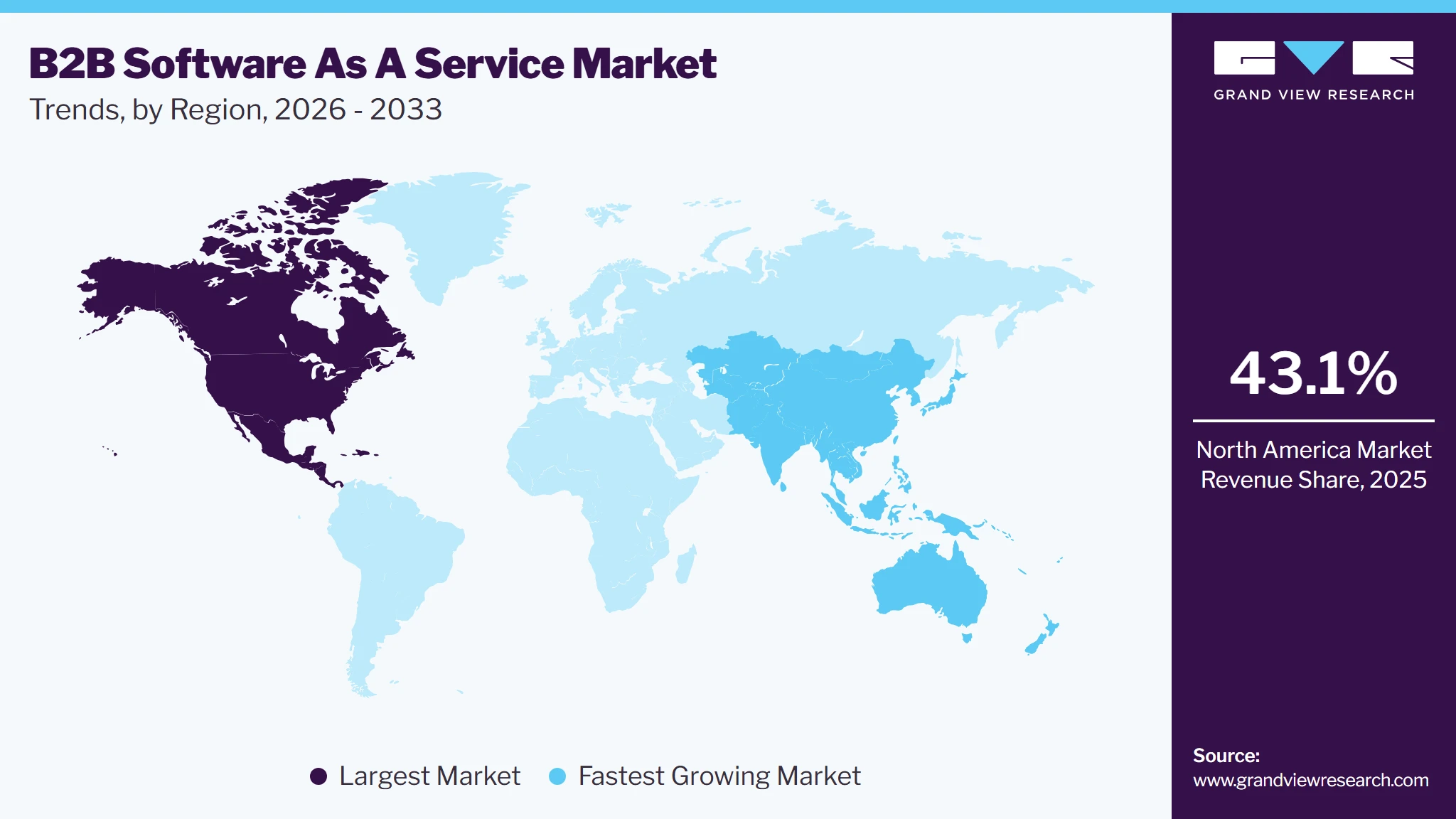
The global B2B Software as a Service (SaaS) market size was valued at USD 395.3 billion in 2025 and is projected to grow from USD 434.4 billion in 2026 to USD 931.5 billion by 2033, at a CAGR of 11.5% from 2026 to 2033. North America dominated the market, accounting for a revenue share of 43.1% in 2025. The global market is evolving from conventional cloud-based application delivery toward AI-enabled, intelligent, and increasingly autonomous enterprise software.
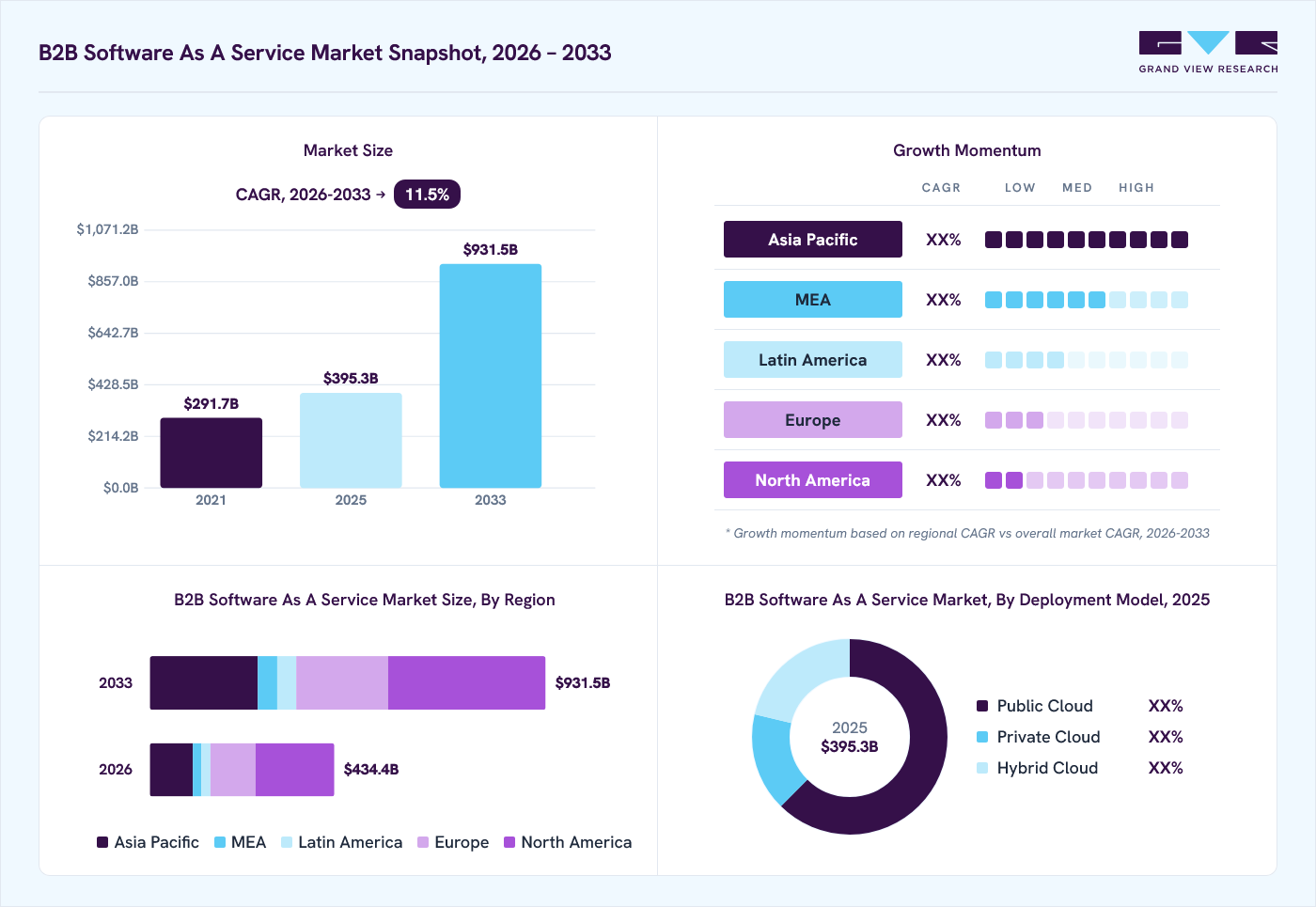 Source: Grand View Research, IR Documents, Primary Interviews, Paid DatabasesTo learn more about this report,
 Download Free Sample Report
 Key Market Trends & Insights
- By software type: Customer Relationship Management (CRM) held the largest share of 29.0% in 2025.
- By deployment model: Public cloud segment held the largest market revenue share of 62.4% in 2025.
- By enterprise size: Large enterprises segment held the largest revenue share in 2025.
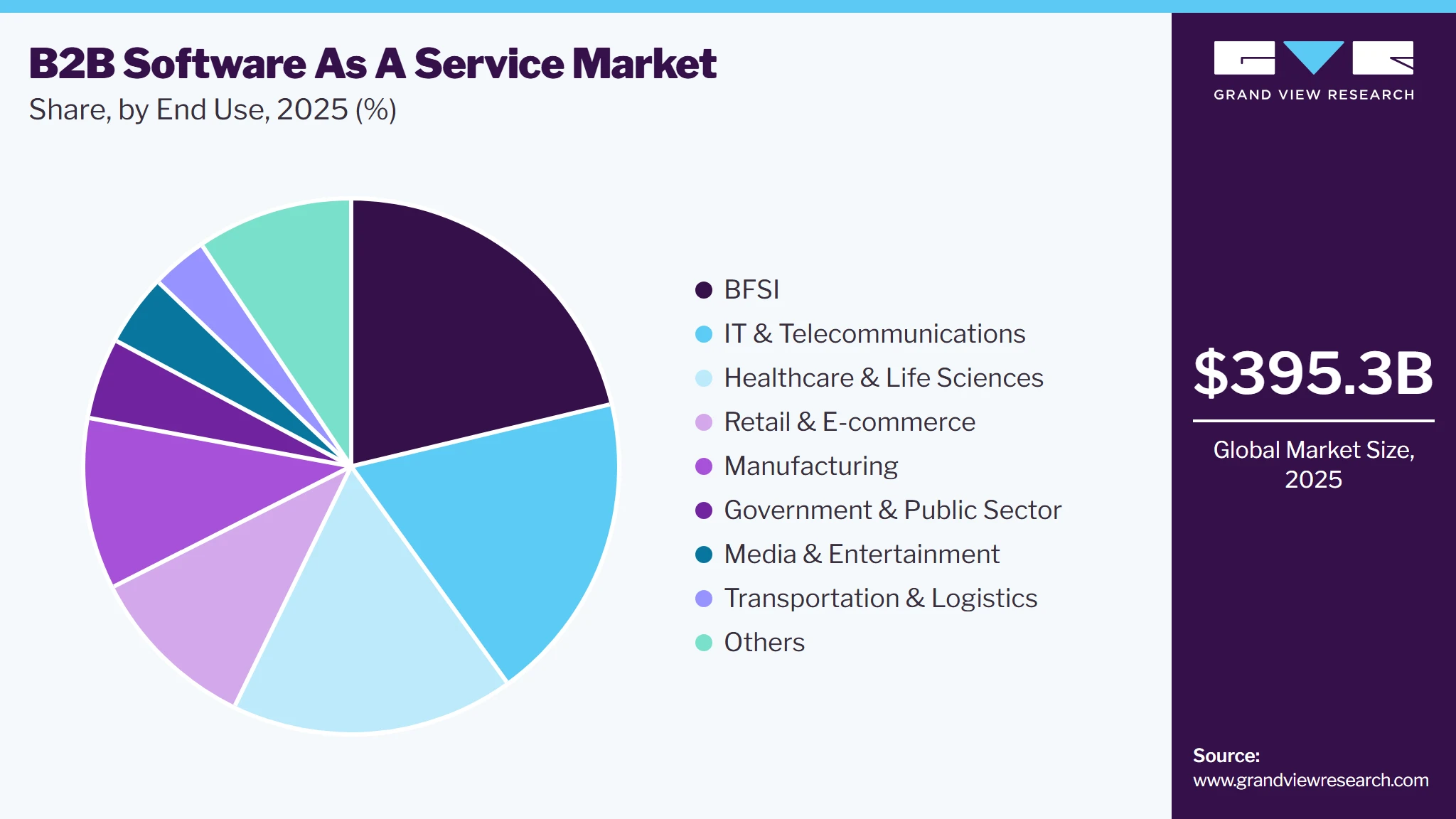
- By end use: BFSI segment held the largest revenue share of 21.3% in 2025.
Regional Highlights
- Largest regional market: North America (43.1% revenue share, 2025)
- Fastest-growing regional market: Asia Pacific (fastest CAGR, 2026-2033)
- By country: The U.S. held the largest share in 2025.
Market Size & Forecasts
- Market size in 2025: USD 395.3 Billion
- Estimated market size in 2026: USD 434.4 Billion
- Projected market size by 2033: USD 931.5 Billion
- CAGR (2026-2033): 11.5%
Three ways to get this report
Buy it, customize it, or ask a question.Ask an Analyst
A direct answer, usually in 1 working day
- AccessReport author, directly
- Reply timeWithin 1 working day
- No sales callDirect answer only
- FormatEmail reply
- CostFree, no cost
Get the Full Report
What the study covers
- FormatsPDF · Excel · Dashboard
- Timeline2026–2033 annual, 2025 base
- Coverage20+ countries, 5 regions
- Companies10+ key players profiled
Customize the Report
20% free customization
- IncludeCountries, segments, points
- TailorTo your product definition
- ExtendDeeper competitor detail
- OrA fully bespoke study
- Turnaround5–10 working days
Organizations continue to adopt SaaS to improve scalability, operational flexibility, collaboration, and cost efficiency, while AI is becoming a core differentiator across CRM, ERP, HCM, analytics, cybersecurity, and workflow-management platforms.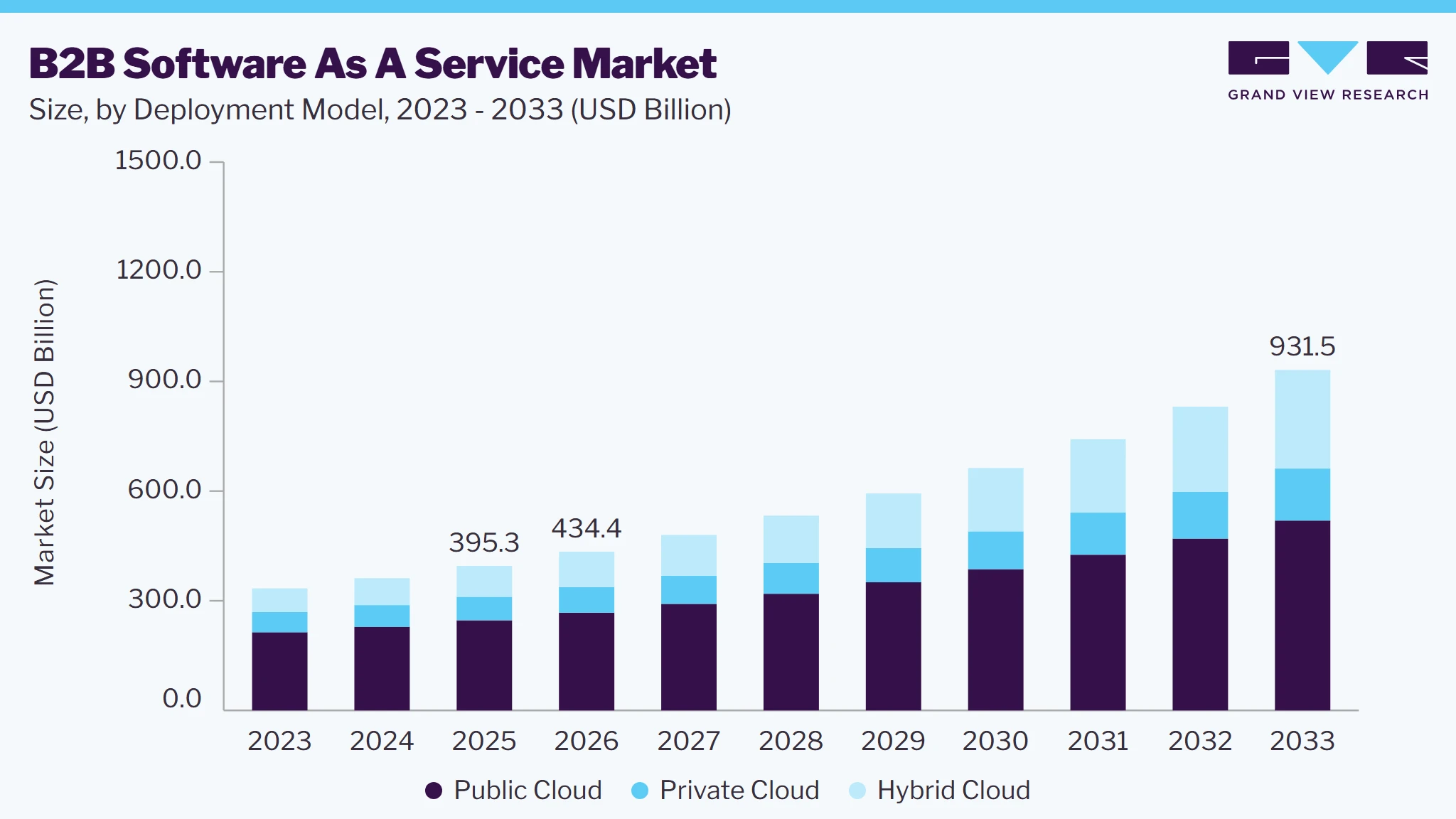 To learn more about this report, Download Free Sample Report
 A major trend shaping the B2B software as a service (SaaS) industry in 2026 is the integration of generative AI and agentic AI into B2B SaaS platforms. SaaS providers are increasingly embedding AI copilots and autonomous agents that can execute workflows, interact with enterprise data, and coordinate tasks across multiple applications. The market is also witnessing a shift toward outcome-oriented pricing, vertical SaaS, stronger cybersecurity, and integrated cloud ecosystems. As enterprises deploy AI across business processes, requirements for data governance, identity management, security, interoperability, and AI-readiness are becoming increasingly important.
Market Dynamics
The rapid transition from traditional on-premises software deployments to cloud-based, subscription-driven models is a primary growth driver for the B2B SaaS market. Enterprises across industries are increasingly prioritizing SaaS solutions to minimize upfront capital expenditure on hardware and IT infrastructure, while shifting to predictable, operational expenditure-based pricing models. This shift is further reinforced by the widespread adoption of remote and hybrid work models, which have created sustained demand for cloud-native platforms that support seamless collaboration, real-time data access, and device-agnostic functionality.
Additionally, SaaS platforms offer inherent scalability, allowing organizations to adjust usage and licensing as business needs evolve without significant reinvestment. Automatic updates, reduced reliance on in-house IT maintenance, and faster deployment timelines than legacy systems further enhance the value proposition. As digital transformation becomes a strategic imperative across sectors such as BFSI, healthcare, retail, and manufacturing, enterprises are increasingly consolidating their software stacks around SaaS-based ecosystems, driving consistent, broad-based demand across software categories, including CRM, ERP, HCM, and collaboration tools.
Despite strong adoption momentum, data security and privacy concerns remain a significant restraint, particularly for large enterprises and organizations operating in highly regulated sectors such as BFSI, healthcare, and government. Multi-tenant cloud architectures, while cost-efficient, raise concerns around data isolation, unauthorized access, and potential breaches, especially as organizations migrate increasingly sensitive and mission-critical workloads to SaaS platforms.
Compounding this challenge is the growing complexity of regulatory compliance. Frameworks such as the General Data Protection Regulation (GDPR) in Europe, HIPAA in the U.S. healthcare sector, and various region-specific data localization and sovereignty laws (particularly across Asia Pacific and the Middle East) often require SaaS vendors to offer region-specific data storage, enhanced encryption protocols, and audit-ready compliance documentation. Meeting these requirements may necessitate hybrid or private cloud deployments, additional customization, and dedicated compliance infrastructure, all of which increase implementation costs and timelines. For risk-averse enterprises and public sector organizations, these concerns can slow procurement cycles, extend vendor evaluation periods, and in some cases, favor on-premises or hybrid alternatives over full SaaS adoption.
The growing integration of generative AI, machine learning, and advanced analytics capabilities into core SaaS offerings represents a substantial opportunity for market expansion. Vendors are increasingly embedding AI-powered features such as predictive analytics, intelligent automation, natural language processing, and conversational AI assistants directly into their platforms, enabling customers to derive greater operational value without needing separate, specialized tools.
This trend is particularly significant for small and mid-sized enterprises (SMEs) in emerging economies across Asia Pacific, Latin America, and the Middle East & Africa, many of which have historically lacked the capital or technical expertise to invest in sophisticated, custom-built analytics or automation systems. AI-embedded SaaS platforms lower this barrier to entry, allowing SMEs to access enterprise-grade capabilities such as automated customer insights, demand forecasting, and workflow optimization on a scalable, pay-as-you-go basis.
Market Concentration & Characteristics
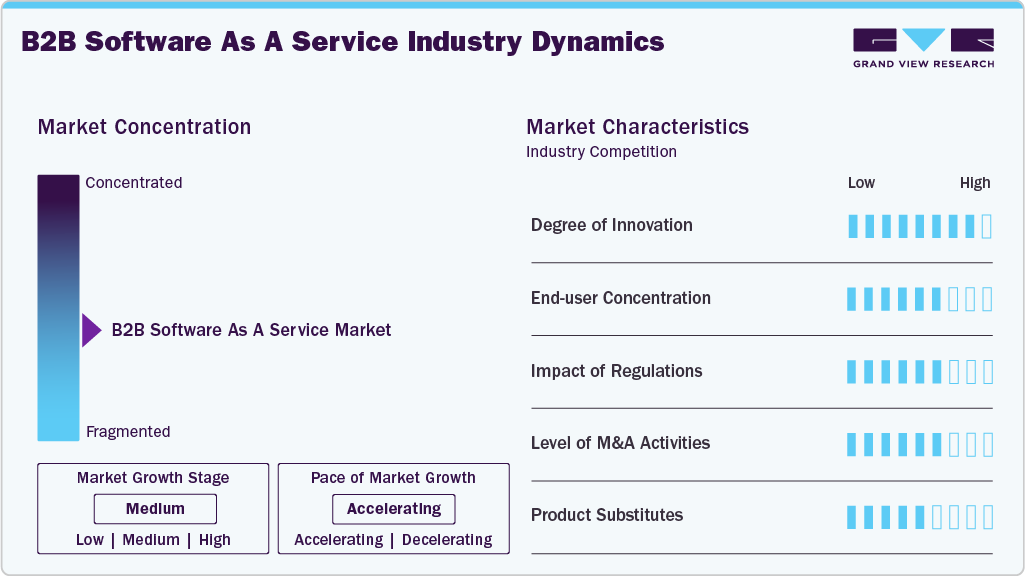
The global B2B SaaS market is fragmented to moderately concentrated, comprising large diversified cloud and enterprise software vendors alongside numerous specialized, category-focused providers. Leading players such as Salesforce, Microsoft, SAP, Oracle, Adobe, ServiceNow, Workday, HubSpot, Atlassian, Zoho, Freshworks, and SAP SuccessFactors compete across CRM, ERP, HCM, collaboration, and analytics segments, alongside a long tail of niche vendors serving specific industries or functional workflows. The competitive landscape includes vertically integrated technology giants with broad platform ecosystems and strong enterprise relationships, as well as agile, category-specific players competing on depth of functionality, ease of integration, and pricing flexibility. Increasing partnerships among hyperscale cloud providers, system integrators, and independent software vendors are further shaping the market, with ecosystem strategies increasingly centered on platform interoperability, API-driven integrations, and embedded AI capabilities.
 To learn more about this report, Download Free Sample Report
 The B2B software as a service (SaaS) industry is characterized by continuous technological development centered on the integration of artificial intelligence, low-code/no-code customization, API-first architectures, and industry-specific (vertical) SaaS solutions. Vendors are expanding offerings from standalone point solutions toward unified, platform-based ecosystems that consolidate multiple business functions, while advancements in generative AI, predictive analytics, and workflow automation are enhancing product differentiation. At the same time, data security, multi-cloud interoperability, customer retention, and pricing model innovation (usage-based vs. subscription-based) remain key areas of ongoing industry focus as the market matures from initial digitization toward deeper enterprise-wide platform consolidation.
Analyst Perspective
The B2B SaaS market is entering a maturation phase characterized by platform consolidation and AI-driven differentiation rather than pure category expansion. While core segments such as CRM and ERP continue to grow steadily on the back of legacy migration, the sharpest gains are emerging in cybersecurity, analytics, and AI-embedded productivity tools, reflecting a broader shift in enterprise buying priorities toward intelligence and risk mitigation over basic workflow digitization. Vendors that successfully embed generative AI and offer flexible, usage-based pricing are best positioned to capture share, particularly among SMEs in underpenetrated emerging markets. However, sustained growth will hinge on vendors' ability to address data security and regulatory compliance concerns, which remain the primary friction point slowing enterprise-wide adoption, especially in regulated industries and jurisdictions with strict data localization requirements.
Software Type Insights
Customer Relationship Management (CRM) accounted for the largest market share of 29.0% in 2025. This dominance is driven by the widespread and long-standing adoption of CRM platforms across virtually every industry vertical, as organizations continue to prioritize customer data centralization, sales pipeline visibility, and personalized engagement to drive revenue growth. Furthermore, the integration of AI-powered features such as predictive lead scoring, automated customer segmentation, and conversational AI assistants into modern CRM platforms has enhanced their value proposition, encouraging both new adoption among SMEs and deeper platform utilization among existing enterprise customers. As a result, CRM is expected to maintain its position as the leading software type within the B2B SaaS market throughout the forecast period, supported by continuous innovation and its foundational role in enterprise customer engagement strategies.
Cybersecurity & identity management is projected to grow at the fastest CAGR over the forecast period. This accelerated growth is primarily fueled by the escalating frequency and sophistication of cyber threats, coupled with the rapid expansion of enterprise SaaS ecosystems that inherently widen the attack surface, requiring continuous monitoring and protection. Additionally, increasing regulatory mandates around data protection, identity governance, and zero-trust security architectures are compelling organizations across all industries, particularly BFSI, healthcare, and government, to prioritize investment in cloud-native security and identity management solutions. Consequently, cybersecurity & identity management is expected to outpace other software type segments over the forecast period, as enterprises increasingly treat security infrastructure as a foundational rather than supplementary component of their SaaS technology stack.
Deployment Model Insights
Public cloud accounted for the largest revenue share of the B2B software as a service (SaaS) market in 2025, driven by the inherent cost-efficiency, scalability, and rapid deployment capabilities that public cloud infrastructure offers, allowing organizations to avoid substantial upfront capital investment in dedicated IT infrastructure while benefiting from on-demand resource allocation. Moreover, the growing maturity of public cloud security frameworks, coupled with major hyperscale providers' continuous investments in compliance certifications and advanced data protection measures, has significantly alleviated earlier enterprise concerns around data security and reliability in shared cloud environments. As a result, public cloud is expected to retain its dominant share throughout the forecast period, as organizations of all sizes increasingly standardize their SaaS consumption around public cloud infrastructure to maximize flexibility and minimize operational overhead.
Hybrid cloud is projected to grow at the fastest CAGR over the forecast period, driven by enterprises' increasing need to balance the scalability and cost benefits of public cloud with the data sovereignty, security, and compliance requirements associated with sensitive workloads, particularly in regulated sectors such as BFSI, healthcare, and government. Additionally, hybrid cloud architectures enable organizations to modernize incrementally by integrating legacy on-premises systems with cloud-native SaaS applications without the operational disruption of a full migration, making them a pragmatic choice for large, complex enterprises with existing IT investments. Consequently, hybrid cloud is expected to outpace other deployment models over the forecast period, as more organizations adopt this flexible approach to address diverse regulatory, operational, and security considerations across their technology environments.
Enterprise Size Insights
Large enterprises accounted for the largest revenue share of the B2B software as a service (SaaS) industry in 2025. This dominance stems from large enterprises' greater financial capacity and organizational complexity, which drive substantial demand for comprehensive, integrated SaaS solutions spanning CRM, ERP, HCM, and analytics to manage large-scale operations, extensive customer bases, and multi-departmental workflows. Furthermore, large enterprises typically possess more mature digital transformation strategies and dedicated IT budgets, enabling them to invest in enterprise-grade SaaS platforms with advanced customization, robust security features, and extensive third-party integrations that smaller organizations may not yet require or afford. As a result, large enterprises are expected to continue accounting for the largest revenue share throughout the forecast period, supported by their sustained investment in scalable, feature-rich SaaS ecosystems to maintain competitive advantage.
The Small & Medium Enterprises (SMEs) segment is projected to grow at the fastest CAGR over the forecast period. This accelerated growth is primarily driven by the declining cost of cloud-based software and the proliferation of affordable, subscription-based SaaS solutions that lower the barrier to entry for smaller organizations previously unable to invest in enterprise-grade software. Additionally, growing digital literacy, increasing competitive pressure to modernize operations, and the availability of AI-powered, self-service SaaS platforms tailored to SME needs are enabling faster and more widespread adoption across this segment, particularly in emerging economies. Consequently, SMEs are expected to outpace large enterprises in growth rate over the forecast period, as SaaS vendors increasingly design scalable, cost-effective solutions to capture this large and rapidly digitizing customer base.
End-use Insights
BFSI accounted for the largest market share in 2025, driven by the sector's early and extensive adoption of digital technologies to manage complex financial transactions, regulatory reporting, and customer relationship management at scale, thereby driving sustained demand for CRM, ERP, analytics, and cybersecurity-focused SaaS solutions. Furthermore, the highly regulated nature of the BFSI industry has compelled institutions to invest heavily in compliance-oriented software, fraud detection systems, and identity management platforms, reinforcing their reliance on sophisticated, cloud-based SaaS ecosystems to meet evolving regulatory and customer expectations. As a result, BFSI is expected to maintain its dominant share throughout the forecast period, supported by continuous investment in digital transformation and risk management infrastructure across banking, insurance, and financial services organizations.
 To learn more about this report, Download Free Sample Report
 Healthcare & life sciences is projected to grow at the fastest CAGR over the forecast period, primarily driven by the sector's rapid digital transformation, including the increasing adoption of cloud-based electronic health records, telehealth platforms, and patient relationship management systems to improve care coordination and operational efficiency. Additionally, rising regulatory requirements for data interoperability and patient data security, combined with the growing demand for AI-powered analytics to support clinical decision-making and drug discovery, are prompting healthcare and life sciences organizations to adopt specialized SaaS solutions across CRM, analytics, and cybersecurity. Consequently, Healthcare & Life Sciences is expected to outpace other end-use segments over the forecast period, as the industry continues to prioritize digital innovation to enhance patient outcomes and streamline complex operational and compliance processes.
Regional Insights
The North America B2B software as a service (SaaS) market held the largest global revenue share of 43.1% in 2025, driven by high cloud maturity, a strong concentration of leading vendors, and early adoption across industries such as BFSI, healthcare, and technology. Key trends include accelerating integration of generative AI into core SaaS platforms, rising demand for cybersecurity and identity management solutions amid growing data privacy regulations, and increasing adoption of vertical-specific SaaS offerings.
 To learn more about this report, Download Free Sample Report
 U.S. B2B Software as a Service Market Trends
The U.S. B2B software as a service (SaaS)market is gaining momentum, driven by sustained enterprise digital transformation, the deep integration of generative AI across CRM, analytics, and productivity platforms, and strong venture capital support that fuels innovation among both established vendors and emerging startups. Growing regulatory focus on data privacy, alongside rising cybersecurity threats, is further accelerating investment in identity management and compliance-driven SaaS solutions. As enterprises increasingly consolidate their software stacks around integrated, AI-powered platforms, the U.S. is expected to remain the primary growth driver within the broader North American SaaS market throughout the forecast period.
Asia Pacific B2B Software as a Service Market Trends
The Asia Pacific B2B software as a service (SaaS) industry is expected to grow at the fastest CAGR over the forecast period, driven by rapid enterprise cloud migration, a large and expanding SME base transitioning from traditional to digital operations, and increasing government-led digitalization initiatives across countries such as India, China, Japan, and Southeast Asian markets. Rising internet penetration, growing cloud infrastructure investment by both global hyperscalers and regional providers, and a young, digitally native workforce are further accelerating SaaS adoption across CRM, collaboration, and analytics categories. While enterprise-grade adoption remains relatively nascent compared to North America, increasing affordability of subscription-based models and growing demand for localized, industry-specific solutions are enabling faster penetration among small and mid-sized businesses. Consequently, Asia Pacific is expected to continue outpacing other regions in growth rate, positioning it as an increasingly critical market for global and regional SaaS vendors over the forecast period.
The China B2B software as a service (SaaS) marketis witnessing increasing interest driven by accelerating enterprise digital transformation, strong government support for cloud adoption under national digitalization initiatives, and rapid growth of domestic cloud infrastructure providers such as Alibaba Cloud, Tencent Cloud, and Huawei Cloud. Increasing demand from manufacturing, retail, and financial services sectors for integrated CRM, ERP, and analytics solutions is further fueling adoption, as enterprises seek to enhance operational efficiency and competitiveness. Additionally, growing investment in AI-powered SaaS platforms and rising adoption among small and mid-sized enterprises are expected to sustain strong momentum in the China B2B SaaS market throughout the forecast period.
The B2B software as a service (SaaS) market in Indiais at an emerging stage characterized by rapidly growing adoption among startups and SMEs, driven by increasing digitalization, expanding internet and cloud infrastructure, and government initiatives such as Digital India promoting enterprise technology adoption. The presence of a large, cost-competitive domestic SaaS talent pool has also spurred the emergence of homegrown SaaS providers alongside the growing penetration of global vendors targeting India's price-sensitive yet high-volume market. As enterprises across BFSI, retail, and IT services increasingly prioritize cloud-based CRM, HCM, and collaboration tools to improve efficiency and scalability, the India B2B SaaS market is expected to witness strong long-term growth, supported by rising enterprise digital maturity and expanding SME digitization over the forecast period.
Europe B2B Software as a Service Market Trends
Europe represents a mature and steadily growing B2B software as a service (SaaS) market, characterized by strong enterprise adoption across BFSI, manufacturing, and public sector organizations, alongside a well-established regulatory environment shaped by GDPR that continues to influence vendor data handling and deployment strategies. Growing emphasis on data sovereignty has accelerated demand for regional and hybrid cloud deployment models, as enterprises seek to balance compliance requirements with the scalability benefits of public cloud infrastructure. Additionally, increasing investment in AI-powered analytics, cybersecurity, and identity management solutions reflects the region's heightened focus on data protection and operational resilience amid rising cyber threats. While growth trails that of faster-expanding regions such as Asia Pacific, continued digital transformation initiatives across the UK, Germany, and France, along with rising SME cloud adoption, are expected to support the steady expansion of the Europe B2B SaaS market throughout the forecast period.
Key B2B Software As A Service Companies
The following key companies have been profiled for this study on the B2B Software as a Service (SaaS) Market.
-
Adobe Inc.
-
Atlassian Corporation
-
HubSpot, Inc.
-
Intuit Inc.
-
Microsoft Corporation
-
Oracle Corporation
-
Salesforce, Inc.
-
SAP SE
-
ServiceNow Inc.
-
Shopify Inc.
-
Snowflake Inc.
-
Veeva Systems Inc.
-
Workday, Inc.
-
Zoho Corporation
-
Zoom Communications, Inc.
Competitive Benchmarking
Operating Strategies
Competitive Edge
Weaknesses
Mature Players: Microsoft Corporation; Salesforce, Inc.; Oracle Corporation; SAP SE; ServiceNow, Inc.; Adobe Inc.
- Expanding integrated B2B SaaS portfolios across CRM, ERP, HCM, collaboration, cybersecurity, analytics, workflow automation, and industry-specific applications.
- Increasing investments in generative AI, AI copilots, agentic workflows, automation, and AI-native enterprise applications to enhance productivity and automate business processes.
- Large installed customer bases and established relationships with enterprises across multiple industries and geographies.
- Broad product portfolios enable integration across business functions, supporting cross-selling, platform consolidation, and higher customer retention.
- Large and complex product portfolios can result in higher implementation complexity, integration requirements, and longer enterprise deployment cycles.
- Extensive legacy customer environments can create challenges in migrating customers toward newer cloud-native and AI-enabled applications.
Emerging Players: HubSpot, Inc.; Monday.com Ltd.; Freshworks Inc.; Asana, Inc.; Datadog, Inc.
- Focusing on specialized SaaS applications, AI-enabled workflows, developer tools, customer engagement, collaboration, IT operations, and industry-specific business processes.
- Increasing adoption of freemium, product-led growth, self-service onboarding, and usage-based expansion strategies to accelerate customer acquisition, particularly among SMEs and mid-market organizations.
- Product-led growth and intuitive user experiences can reduce adoption barriers and shorten deployment timelines for customers.
- Greater organizational agility enables emerging vendors to rapidly incorporate generative AI, automation, and new SaaS delivery models into their platforms.
- Greater dependence on cloud infrastructure providers, technology partners, and third-party integrations can increase ecosystem and platform dependencies.
- Intense competition from established SaaS platforms and increasing feature convergence can create challenges in maintaining differentiation and customer retention.
Recent Developments
-
In August 2026, Salesforce and Anthropic expanded their partnership under the name Claudeforce, embedding Claude as the reasoning model inside Salesforce products (Agentforce, Agent Builder, Slack) while Salesforce ships a plugin with 37 prebuilt sales skills directly inside Claude's interface. It launched to pilot customers with an open beta set for September 2026, and coincided with Salesforce's Q2 earnings, sending its stock up roughly 12% in after-hours trading that day.
-
In June 2026, Adobe launched Adobe Brand Visibility, a new tool combining Semrush's AI-search data with Adobe's content optimization to help brands track and improve how they're mentioned across AI platforms like ChatGPT, Google AI Mode, and Perplexity. It's part of Adobe CX Enterprise, a new end-to-end agentic AI system for managing the full customer lifecycle.
-
In May 2026, ServiceNow and Lenovo expanded their multi-year agreement to combine Lenovo's real-time device intelligence and lifecycle management with ServiceNow's AI Control Tower and workflow automation, targeting up to 30% lower IT support costs and 50% faster employee onboarding. The collaboration launches first across Australia, New Zealand, Hong Kong, Singapore, and Ireland, with broader global expansion planned.
B2B Software As A Service Market Report Scope
Report Attribute
Details
Market size in 2025
USD 395.3 billion
Estimated market size in 2026
USD 434.4 billion
Projected market size by 2033
USD 931.5 billion
Growth rate
CAGR of 11.5% from 2026 to 2033
Actual data
2021 - 2025
Forecast period
2026 - 2033
Quantitative units
Revenue in USD billion, and CAGR from 2026 to 2033
Report coverage
Revenue forecast, company share, competitive landscape, growth factors, and trends
Segments covered
Software type, deployment model, enterprise size, end-use, region
Regional scope
North America; Europe; Asia Pacific; Latin America; Middle East & Africa
Country scope
U.S.; Canada; Mexico; UK; Germany; France; China; Japan; India; South Korea; Australia; Brazil; UAE; KSA; South Africa
Key companies profiled
Adobe Inc.; Atlassian Corporation; HubSpot, Inc.; Intuit Inc.; Microsoft Corporation; Oracle Corporation; Salesforce, Inc.; SAP SE; ServiceNow Inc.; Shopify Inc.; Snowflake Inc.; Veeva Systems Inc.; Workday, Inc.; Zoho Corporation; Zoom Communications, Inc.
Customization scope
Free report customization (equivalent to up to 8 analyst working days) with purchase. Addition or alteration to country, regional & segment scope.
Pricing and purchase options
Avail customized purchase options to meet your exact research needs. Explore purchase options
Global B2B Software as a Service Market Report Segmentation
This report forecasts revenue growth at global, regional, and country levels and provides an analysis of the latest industry trends in each of the sub-segments from 2021 to 2033. For this study, Grand View Research has segmented the global B2B software as a service (SaaS) market report by software type, deployment model, enterprise size, end-use, and region:
-
Software Type Outlook (Revenue, USD Billion, 2021 - 2033)
-
Customer Relationship Management (CRM)
-
Enterprise Resource Planning (ERP)
-
Human Capital Management (HCM)
-
Supply Chain Management (SCM)
-
Collaboration & Productivity
-
Cybersecurity & Identity Management
-
Analytics & Business Intelligence
-
Others
-
-
Deployment Model Outlook (Revenue, USD Billion, 2021 - 2033)
-
Public Cloud
-
Private Cloud
-
Hybrid Cloud
-
-
Enterprise Size Outlook (Revenue, USD Billion, 2021 - 2033)
-
Large Enterprises
-
Small & Medium Enterprises (SMEs)
-
-
End-use Outlook (Revenue, USD Billion, 2021 - 2033)
-
BFSI
-
IT & Telecommunications
-
Healthcare & Life Sciences
-
Retail & E-commerce
-
Manufacturing
-
Government & Public Sector
-
Media & Entertainment
-
Transportation & Logistics
-
Others
-
-
Regional Outlook (Revenue, USD Billion, 2021 - 2033)
-
North America
-
U.S.
-
Canada
-
Mexico
-
-
Europe
-
UK
-
Germany
-
France
-
-
Asia Pacific
-
China
-
Japan
-
India
-
South Korea
-
Australia
-
-
Latin America
-
Brazil
-
-
Middle East and Africa
-
UAE
-
KSA
-
South Africa
-
-
Research Methodology
The B2B software as a service (SaaS) market figures in this report are based on a proven research process that combines executive interviews with secondary research from proprietary databases, company filings, and recognized regulatory and institutional sources. Market size is built through value-chain sizing-reconciling supply-side and demand-side estimates-and triangulated with bottom-up and top-down approaches. Every estimate passes multiple levels of expert validation before publication, with each B2B software as a service (SaaS) segment quantified using the revenue-capture definitions in the table below.
Segment Definition
Software Type
Revenue Capture Definition
Customer Relationship Management (CRM)
Revenue generated from cloud-based customer relationship management software used for sales, marketing, customer service, lead management, and customer engagement.
Enterprise Resource Planning (ERP)
Revenue generated from cloud-based enterprise resource planning software supporting finance, accounting, procurement, inventory, supply chain, and other core business functions.
Human Capital Management (HCM)
Revenue generated from cloud-based human capital management software covering payroll, workforce management, talent management, recruitment, and employee engagement.
Supply Chain Management (SCM)
Revenue generated from cloud-based supply chain management software supporting planning, sourcing, logistics, inventory, procurement, and supply chain visibility.
Collaboration & Productivity
Revenue generated from SaaS platforms supporting workplace collaboration, communication, project management, document management, workflow, and employee productivity.
Cybersecurity & Identity Management
Revenue generated from cloud-delivered cybersecurity, identity, access management, threat protection, and related security SaaS solutions.
Analytics & Business Intelligence
Revenue generated from cloud-based analytics, business intelligence, reporting, data visualization, and decision-support platforms.
Others
Revenue generated from B2B SaaS applications not classified above, including specialized industry, legal, compliance, marketing, engineering, and other business applications.
Deployment Model
Revenue Capture Definition
Public Cloud
Revenue generated from B2B SaaS applications hosted on shared public cloud infrastructure and delivered to customers through subscription or usage-based models.
Private Cloud
Revenue generated from SaaS solutions deployed on dedicated private cloud infrastructure for individual organizations or restricted enterprise environments.
Hybrid Cloud
Revenue generated from SaaS solutions integrating public and private cloud environments to support enterprise applications, data, and workloads across multiple infrastructures.
Enterprise Size
Revenue Capture Definition
Large Enterprises
Revenue generated from B2B SaaS solutions purchased or subscribed to by large organizations for enterprise-wide applications, workflows, analytics, security, and business process management.
Small & Medium Enterprises (SMEs)
Revenue generated from B2B SaaS solutions purchased or subscribed to by small and medium-sized businesses for business operations, collaboration, productivity, and specialized functions.
End Use
Revenue Capture Definition
BFSI
Revenue generated from B2B SaaS solutions deployed by banks, financial institutions, insurance companies, and other financial service providers.
IT & Telecommunications
Revenue generated from B2B SaaS solutions used by IT service providers, software companies, telecom operators, and digital technology organizations.
Healthcare & Life Sciences
Revenue generated from SaaS solutions used by healthcare providers, pharmaceutical companies, biotechnology firms, laboratories, and other life sciences organizations.
Retail & E-commerce
Revenue generated from SaaS solutions supporting retail, e-commerce, merchandising, customer engagement, inventory, and digital commerce operations.
Manufacturing
Revenue generated from SaaS solutions supporting manufacturing operations, supply chain, workforce, quality, production, and enterprise management.
Government & Public Sector
Revenue generated from SaaS solutions adopted by government agencies and public-sector organizations for administration, collaboration, citizen services, and operational management.
Media & Entertainment
Revenue generated from SaaS solutions used for content management, marketing, advertising, collaboration, digital media, and entertainment operations.
Transportation & Logistics
Revenue generated from SaaS solutions supporting fleet management, logistics, transportation planning, supply chain visibility, and related operations.
Others
Revenue generated from B2B SaaS solutions used across other industries, including professional services, education, construction, real estate, and hospitality.
Estimation Model
Layer
Key Questions
Description
B2B Software Infrastructure Layer (TAM)
Who might require B2B SaaS solutions?
Businesses across industries, including enterprises, SMEs, government organizations, and professional service providers requiring software applications for business operations, productivity, collaboration, customer management, analytics, security, and other functions.
B2B SaaS Requirement Layer (SAM)
Who can technically and commercially adopt B2B SaaS solutions?
Organizations deploying high-speed switch ASICs, AI accelerators, GPUs/XPUs, and data center networks where optical integration can address bandwidth, power, latency, and signal-integrity requirements.
Active B2B SaaS Adoption Layer (SOM)
Who actively uses or purchases B2B SaaS today?
Enterprises and SMEs currently subscribing to cloud-based business applications, including organizations adopting SaaS for core business processes, workflow automation, collaboration, cybersecurity, analytics, and AI-enabled applications.
Revenue Realization Layer
How is revenue generated?
Revenue is generated through SaaS subscriptions, usage-based pricing, per-user or per-seat licensing, tiered plans, enterprise contracts, and consumption-based models, along with implementation, integration, support, and premium AI or advanced-feature services where applicable.
Delivered Customizations
This report has been delivered with the following in-depth customizations
Client Request
Customization Delivered
Value Adds
B2B SaaS market strategy and enterprise application assessment
Assessment of B2B SaaS adoption across CRM, ERP, HCM, SCM, collaboration & productivity, cybersecurity, analytics & BI, and other enterprise applications.
Evaluation of SaaS demand across SMEs and large enterprises and key industries, including BFSI, IT & telecommunications, healthcare, retail, manufacturing, government, and other sectors.
Developed a B2B SaaS market strategy aligned with enterprise cloud adoption, digital transformation, AI integration, workflow automation, and increasing demand for scalable subscription-based software.
Identified growth opportunities across AI-enabled SaaS, enterprise applications, cybersecurity, analytics, and industry-specific SaaS solutions.
B2B SaaS technology and vendor benchmarking
Comparative assessment of leading SaaS providers based on product portfolio, AI capabilities, cloud architecture, integrations, scalability, security, pricing models, and enterprise functionality.
Benchmarking of established and emerging players across enterprise applications, SMEs, cloud environments, and key industry verticals.
Delivered a structured vendor evaluation and technology benchmarking framework to support competitive positioning and SaaS investment decisions.
Identified vendors based on product breadth, innovation capabilities, AI integration, customer base, ecosystem partnerships, scalability, and industry alignment.
B2B SaaS use-case, technology, and adoption assessment
Assessment of key SaaS use cases across customer management, enterprise resource planning, workforce management, collaboration, cybersecurity, analytics, and business process automation.
Evaluation of adoption drivers and technology requirements, including cloud readiness, integration, data security, AI capabilities, interoperability, scalability, and user experience.
Provided actionable recommendations for prioritizing SaaS opportunities based on enterprise adoption, AI maturity, digital transformation requirements, deployment preferences, and industry-specific needs.
Identified high-priority opportunities across SaaS application categories, deployment models, enterprise sizes, and end-use industries.
About the Author(s)
IT Services & Applications Research Team
Technology · IT Services & ApplicationsThis report was authored by the it services & applications research team at Grand View Research - comprising two research analysts, one senior research analyst, and one industry expert - with specialized expertise in the it services & applications segment of the technology industry. All findings are based on proprietary technology databases, executive interviews, and regulatory analysis, subject to internal peer review prior to publication.
Last Updated:
Speak to Analyst

Customize this report to your needs - add regions, segments, or data points, with 20% free customization.
Or view our licence options:


ISO 9001:2015 & 27001:2022 Certified
We are GDPR and CCPA compliant! Your transaction & personal information is safe and secure. For more details, please read our privacy policy.


