
- Home
- »
- Alcohol & Tobacco
- »
-
Baijiu Market Size, Share & Trends Report, 2026-2033GVR Report cover

Baijiu Market (2026 - 2033)
Size, Share & Trends Analysis Report By Price Point (Economy, Mid-Premium, Super-Premium, Ultra-Premium), By Distribution Channel (On-Trade, Off-Trade), By Price Point - Distribution Channel, By Region, And Segment Forecasts
Market Size, 2025
$164.9BMarket Estimate, 2026
$172.5BMarket Forecast, 2033
$225.4BCAGR, 2026–2033
3.9%Baijiu Market Summary
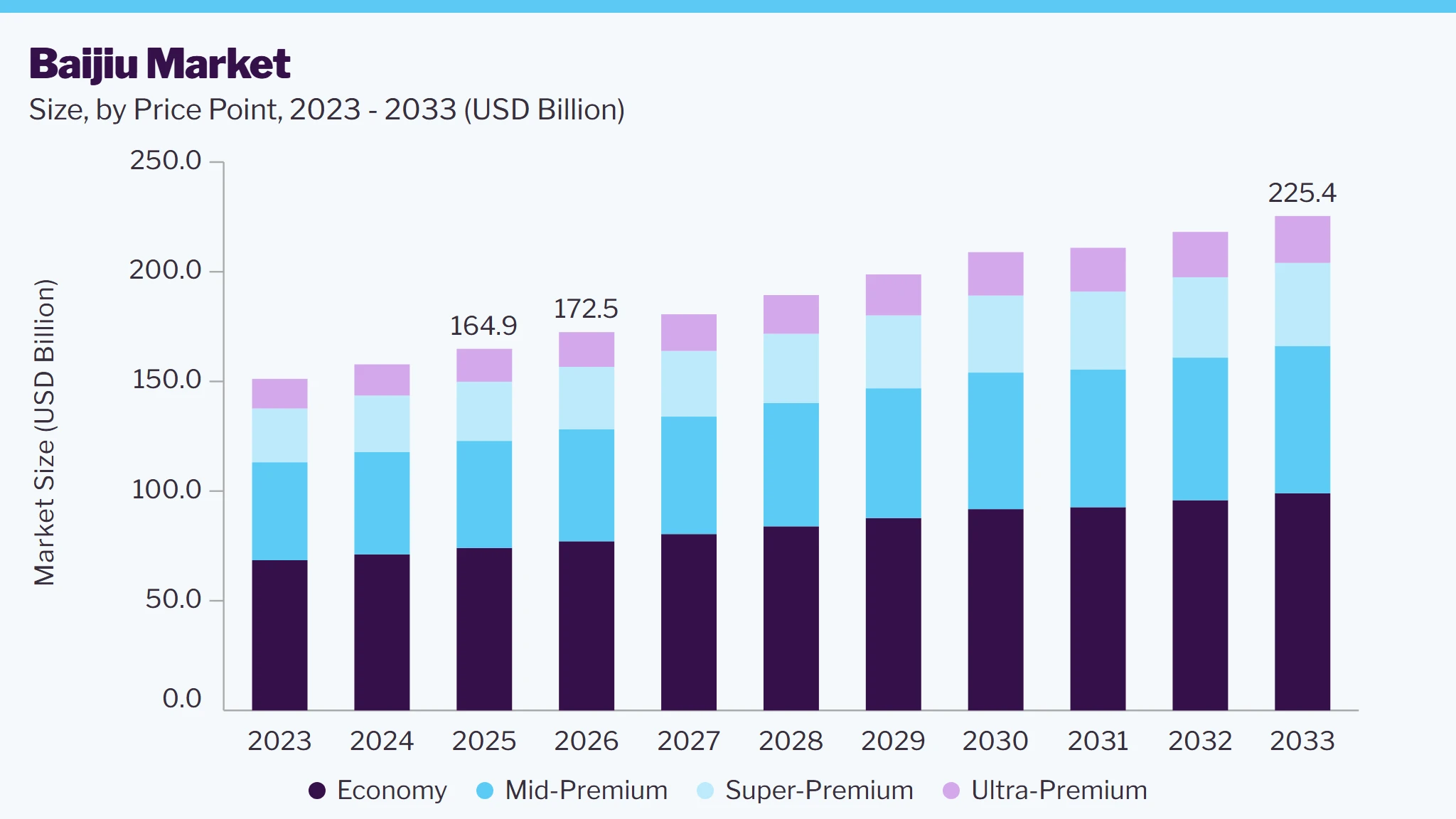
The global Baijiu market size was valued at USD 164.9 billion in 2025 and is projected to grow from USD 172.5 billion in 2026 to USD 225.4 billion by 2033, at a CAGR of 3.9% from 2026 to 2033. Asia Pacific dominated the market, accounting for a revenue share of 98.7% in 2025. The market is deeply rooted in China's cultural and traditional heritage, where baijiu remains an integral part of festivals, weddings, and business banquets.
 Source: Grand View Research, IR Documents, Primary Interviews, Paid DatabasesTo learn more about this report,
 Download Free Sample Report
Key Market Trends & Insights
- By price point: Economy segment led the market with the largest revenue share of 44.9% in 2025.
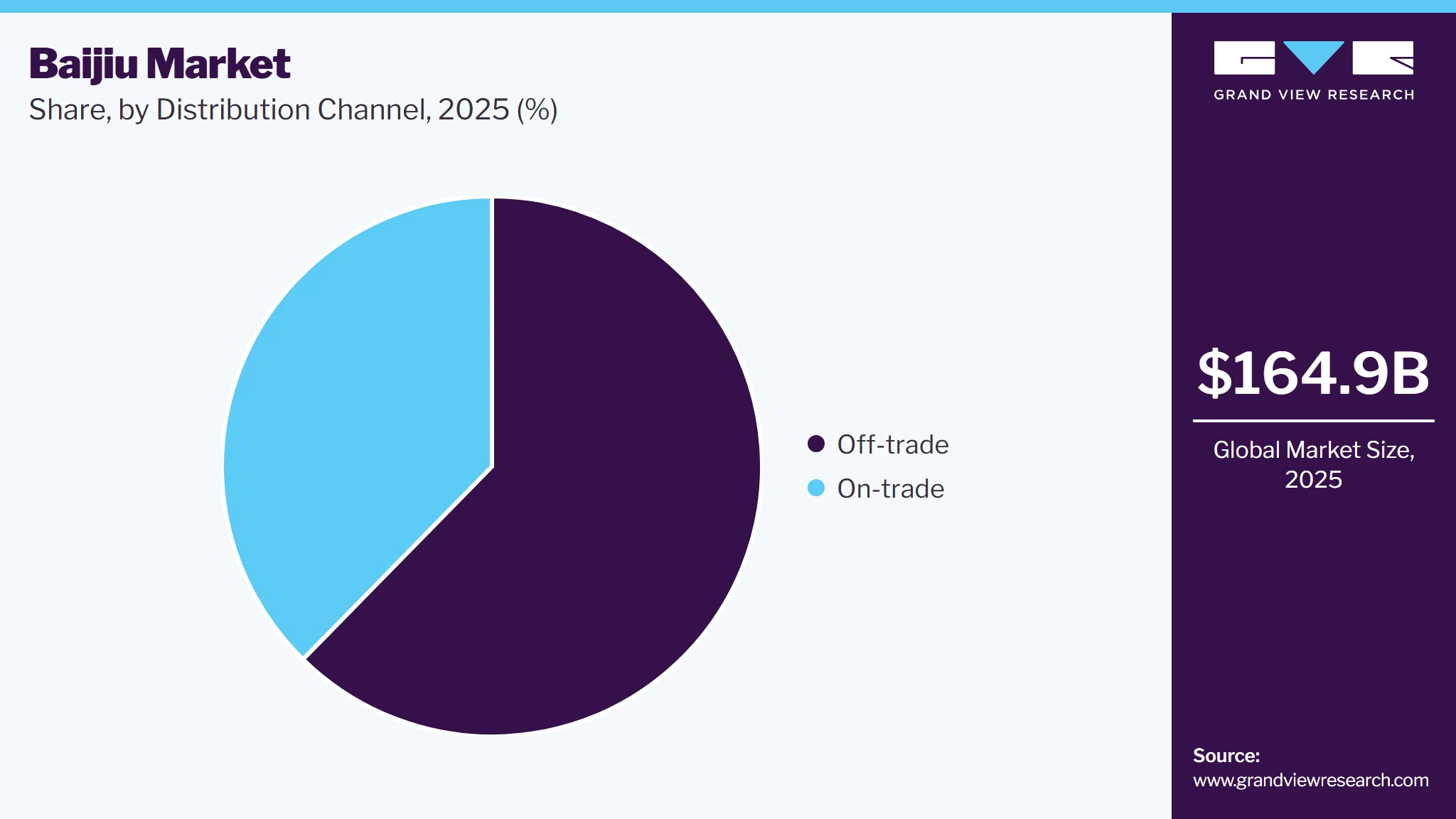
- By distribution channel: Off-trade segment led the market with the largest revenue share of 62.3% in 2025.
Regional Highlights
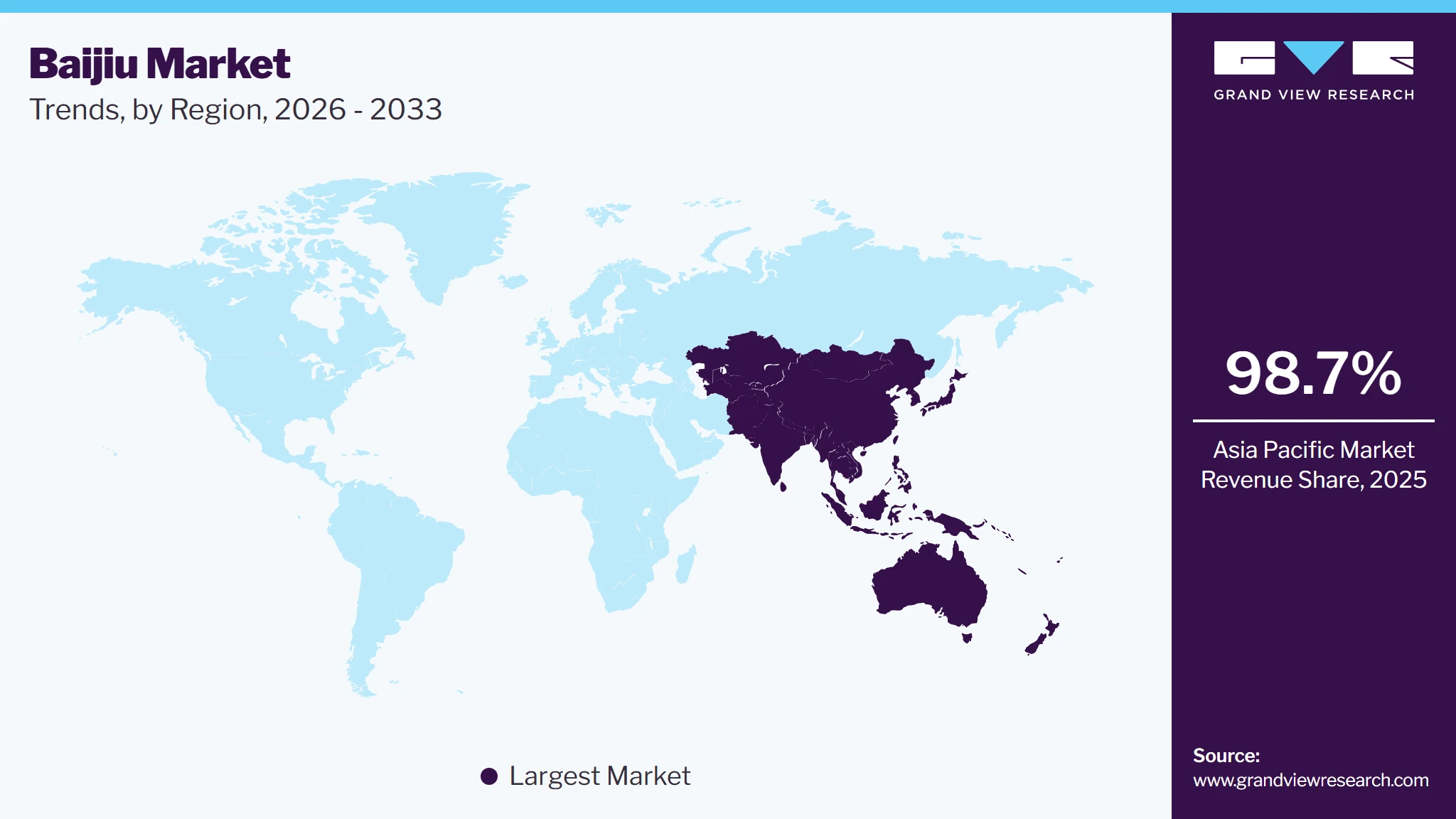
- Largest regional market: Asia Pacific (98.7% revenue share, 2025)
- By country: China held the largest market share in 2025.
Market Size & Forecast
- Market size in 2025: USD 164.9 Billion
- Estimated market size in 2026: USD 172.5 Billion
- Projected market size by 2033: USD 225.4 Billion
- CAGR (2026-2033): 3.9%
GVR research-powered AIAsk Prism AI about the baijiu marketGet cited answers from GVR research on market growth, segments, regulations and forecasts.Start with✓ Source-linked answers ✓ Market-specific context ✓ Traceable figuresExplore Prism AI ↗
The category is also witnessing a clear shift toward premiumization, with consumers increasingly favoring high-end and collectible brands, such as Moutai and Wuliangye, driven by rising incomes and traditional gifting practices. Also, strong regional brand heritage and local loyalty reinforce consumer attachment, as many distilleries hold long-standing reputations and dominate their respective provincial markets.Baijiu manufacturers are increasingly expanding into global markets by catering to overseas Chinese communities, who already have a cultural familiarity with the spirit, and gradually introducing it to mainstream Western drinkers through cocktail bars, mixologists, and trendy hotel menus. For example, brands like Ming River have positioned themselves in the U.S. and Europe by promoting Baijiu in cocktails and educating consumers about how to drink it. Meanwhile, major Chinese distilleries are entering distribution channeling partnerships with global distributors and hotel chains to place baijiu in duty-free shops and high-end venues, thereby boosting awareness and availability abroad.
 To learn more about this report, Download Free Sample Report
Manufacturers are also actively modernizing their portfolios to attract younger consumers through product innovation and contemporary branding. This includes developing flavored, lower-alcohol, and cocktail-friendly variants that are easier to consume and more suitable for social settings. Modern packaging with sleek, minimalist designs and digital-first marketing, including e-commerce, social media, and influencer collaborations, is helping to refresh baijiu’s traditional image, making it more relevant to a younger audience that values lifestyle and experience over heritage alone.
For instance, in October 2025, Wuliangye launched a 29% ABV product line called Crush On, targeting millennials with fruit-infused, ready-to-drink options and stylish packaging. Other brands, such as Moutai and Jiangxiaobai, are experimenting with baijiu-based cocktails and flavored liqueurs to bridge the gap between traditional and modern drinking cultures.
Market Dynamics
The baijiu market is experiencing sustained growth due to rising demand for premium alcoholic beverages, increasing disposable incomes, and the strong cultural significance of baijiu in social, business, and ceremonial occasions. Baijiu, a traditional Chinese distilled spirit made primarily from grains such as sorghum, wheat, rice, and corn, remains one of the most consumed spirits globally by volume. The market is benefiting from premiumization trends, growing consumer interest in heritage beverages, and expanding distribution channels. In addition, increasing international awareness of Chinese cuisine and culture is creating opportunities for baijiu producers to expand beyond traditional domestic markets and attract new consumer segments.
The growing consumer preference for premium and high-quality alcoholic beverages is a major driver of the baijiu market. As disposable incomes rise and consumers increasingly seek authentic drinking experiences, demand for premium, aged, and luxury baijiu products continues to grow. Baijiu is deeply embedded in Chinese culture and is frequently consumed during festivals, family gatherings, business events, and formal celebrations, supporting consistent market demand.
Furthermore, the expanding middle-class population and increasing expenditure on premium alcoholic beverages are encouraging consumers to trade up to higher-value baijiu brands. Manufacturers are introducing premium product lines, limited editions, and heritage-focused branding strategies to cater to evolving consumer preferences. The growing popularity of traditional and craft spirits globally is also supporting market growth by attracting consumers interested in culturally distinctive alcoholic beverages.
Limited consumer awareness outside China remains a significant restraint for the baijiu market. Despite its large domestic consumption base, baijiu has relatively low recognition in many international markets compared to whisky, vodka, rum, gin, and tequila. Many consumers unfamiliar with baijiu may find its production methods, flavor characteristics, and consumption traditions difficult to understand.
In addition, baijiu's strong aroma and distinctive taste profile may present challenges for adoption among consumers accustomed to Western spirits. Variations in flavor categories, alcohol content, and production styles can further complicate consumer acceptance in new markets. Regulatory requirements, import duties, and distribution barriers in international markets may also limit expansion opportunities for baijiu manufacturers seeking global growth.
The increasing globalization of Asian cuisine and beverage culture presents substantial opportunities for the baijiu market. Growing consumer interest in authentic international food and beverage experiences is encouraging restaurants, bars, and retailers to introduce baijiu to broader audiences. Educational marketing initiatives, tasting events, and cocktail innovations are helping increase consumer awareness and improve market penetration outside traditional consumption regions.
The premiumization trend is creating additional opportunities for high-end, aged, and craft baijiu products. Consumers are increasingly willing to pay premium prices for products that offer unique heritage, craftsmanship, and quality attributes. Furthermore, manufacturers are developing modern packaging, lower-alcohol variants, and cocktail-friendly formulations to appeal to younger consumers and international markets. The expansion of e-commerce platforms, duty-free retail channels, and global distribution networks is expected to further support long-term growth in the baijiu market.
Analyst Perspective
The baijiu market remains one of the most valuable segments within the global spirits industry, supported by strong cultural significance, premiumization trends, and growing consumer demand for high-quality alcoholic beverages in China. Premium and ultra-premium baijiu products continue to benefit from their association with gifting, celebrations, business occasions, and social status, and support long-term consumption growth. At the same time, manufacturers are increasingly introducing modern product formats and branding strategies to attract younger consumers.
The market's most sustainable competitive advantage will belong to companies that successfully balance heritage, quality, and innovation. While established producers benefit from centuries-old production expertise, protected geographic identities, and powerful brand equity, future growth opportunities will increasingly depend on expanding baijiu's appeal beyond traditional consumer segments and geographic markets. International expansion, product premiumization, and the development of more accessible flavor profiles are expected to become critical growth drivers. Companies capable of preserving authenticity while modernizing marketing, enhancing consumer education, and strengthening global distribution networks will be best positioned to capture long-term value in the evolving baijiu market.
Consumer Insights
 To learn more about this report, Download Free Sample Report
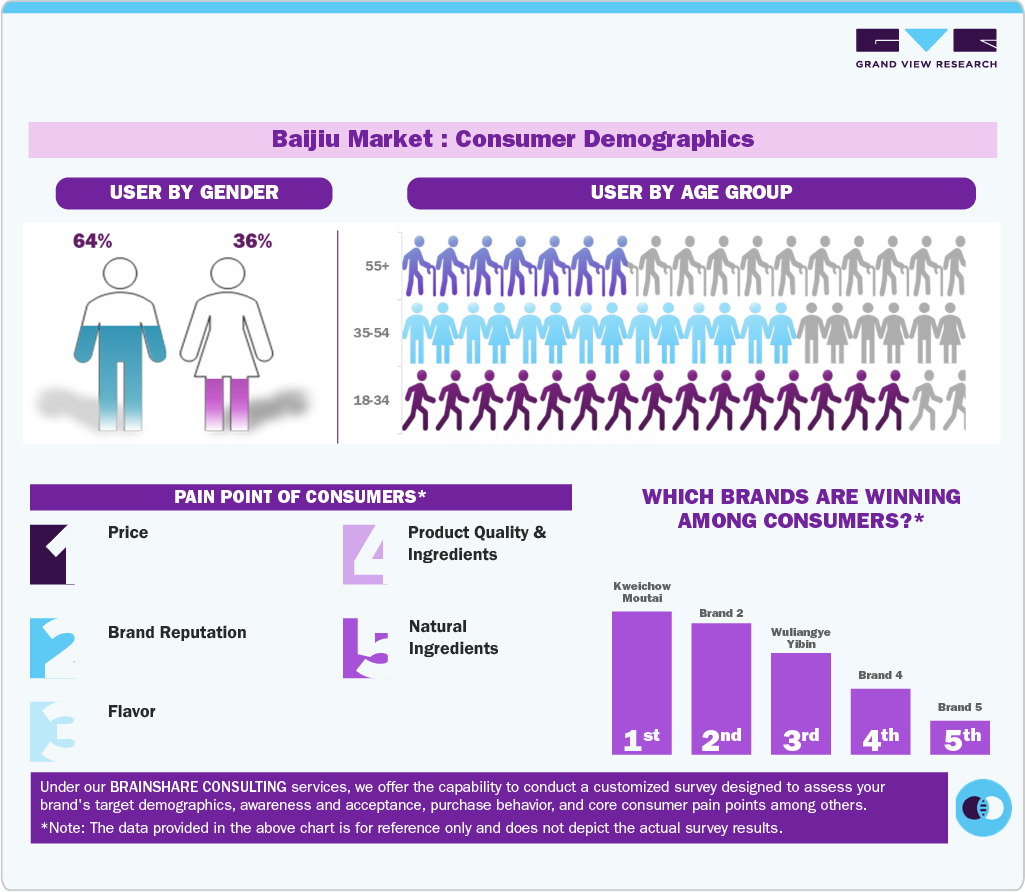
Consumer insights reveal that the global baijiu industry is fundamentally bifurcated, driven by drastically different motivations in its primary and secondary markets. Within China, where consumption generates major share of worldwide revenue, baijiu is intertwined with cultural ritual, status, and celebratory gifting; key consumers are often older, affluent males for whom the spirit’s high proof and complex fermentation profile signify prestige and history.
However, these specific usage contexts create significant barriers for international adoption, where consumers perceive the product as overly potent, lacking mixability, and unfamiliar in aroma compared to established Western spirits. Successful global insights therefore, focus acutely on overcoming this sensory hurdle through education, primarily targeting the growing segment of curious, wealthy consumers in North America and Europe who prioritize authenticity and deep historical narratives in their drinking habits.
To bridge this gap, modern consumer insights suggest that global expansion must rely heavily on repositioning baijiu as a diverse category, moving away from its monolithic perception as simply a high-proof spirit. Strategic success is achieved by segmenting the market: introducing lighter aroma styles (such as rice or light aroma Baijiu) as approachable bases for craft cocktails, thereby appealing directly to younger urban demographics and professional mixologists seeking exotic ingredients.
Furthermore, international consumers respond strongly to insights focused on provenance and terroir, necessitating premiumization strategies that emphasize the centuries-old production processes and traits that align baijiu with high-end spirits like single malt whisky or mezcal.
Price Point Insights
By price point, the economy segment led the market with the largest revenue share of 44.9% in 2025, primarilydue to its affordability, high consumption frequency, and widespread accessibility. This price range majorly caters to a broad consumer base, including middle- and lower-income groups. It is commonly consumed during daily meals, family gatherings, festivals, and business banquets, where large quantities are typically served. This segment also plays a crucial role in introducing baijiu to international markets, especially among overseas Chinese communities, where lower-priced options make it easier for new consumers to experience the spirit without a significant financial commitment. For instance, Erguotou, a popular Beijing-based Baijiu brand, is sold at low prices, enjoys high domestic and international consumption, and serves as an entry point for consumers before they explore mid- or premium-tier offerings.
The ultra-premium baijiu is anticipated to witness at the fastest CAGR of 4.5% from 2025 to 2033,due to status-driven consumption, gifting culture, and investment appeal. Wealthier consumers in China and abroad are increasingly viewing ultra-premium baijiu not just as a drink, but as a symbol of prestige, social status, and refined taste, particularly during business banquets, luxury events, and special celebrations. The gifting culture further drives demand, as limited-edition and collectible bottles are highly sought after for corporate or personal gifting. In addition, some ultra-premium Baijiu brands, like Kweichow Moutai, have become investment-like assets, with certain aged bottles appreciating over time, making them attractive to collectors.
Distribution Channel Insights
By distribution channel, the sales through off-trade channels led the market with the largest revenue share of 62.3% in 2025. The off-trade channel comprises supermarkets, hypermarkets, convenience stores, and e-commerce platforms, such as JD.com and Tmall. The market is expanding due to its wide accessibility, convenience, and cost-effectiveness. Consumers often prefer purchasing Baijiu from these channels for home consumption, gifts, or social occasions, where buying in bulk or at competitive prices is easier than in on-trade venues like bars or restaurants. The rise of e-commerce and online grocery platforms has further accelerated this trend, making it easier for domestic and international consumers to purchase Baijiu without geographic constraints. For instance, during the “June 18 shopping festival,” Baijiu sales on JD.com rose by 40%, while sales of Baijiu on Meituan Instant Shopping soared tenfold, highlighting the growing demand for off-trade channels in Baijiu distribution.
 To learn more about this report, Download Free Sample Report
The on-trade segment is expected to grow at the fastest CAGR of 3.8% from 2026 to 2033. Younger and urban consumers seek social and experiential drinking occasions, preferring to enjoy Baijiu in premium settings where it can be paired with meals or crafted into cocktails. On-trade venues also serve as educational platforms, where mixologists and sommeliers introduce Baijiu’s flavors, aromas, and drinking culture to new audiences, especially in international markets. In addition, the rise of lifestyle dining, high-end bars, and cocktail culture boosts on-trade visibility, helping traditional brands modernize their image and attract aspirational consumers.
Regional Insights
The baijiu market in North America is expected to grow at a substantial CAGR of 6.8% from 2025 to 2033. In North America, Baijiu producers increasingly focus on brand innovation and consumer education to make the spirit more appealing to Western audiences. Companies are reformulating products to suit local palates, offering tasting sessions, cocktail-friendly variants, and marketing collaborations with Western brands and influencers. At the same time, efforts to educate consumers about Baijiu’s unique flavor profiles and cultural significance, through events, mixologist-led tastings, and experiential promotions, are helping overcome initial unfamiliarity and build acceptance. For example, Wuliangye, one of China’s most renowned Baijiu producers, has actively promoted its products in the United States. In June 2024, the company launched marketing campaigns targeting American consumers, including collaborations with U.S.-based bars and restaurants to introduce Baijiu-based cocktails, aiming to familiarize American palates with Baijiu’s unique flavor profile and increase its presence in the U.S. spirits market.
Asia Pacific Baijiu Market Trends
Asia Pacific dominated the baijiu market with the largest revenue share of 98.7% in 2025. The baijiu market in the U.S. held the largest share in the North America region in 2025. The Asia-Pacific market is evolving with a strong focus on premium investment value, youth-driven innovation, and regional market expansion. In APAC, Baijiu has become a major stored liquor investment. According to the 2024 AIFIAN report , nearly 50% of all stored liquor investments in the region are in Baijiu, reflecting its deep cultural value and investor confidence in its long-term appreciation potential. At the same time, distillers are modernizing to attract younger consumers by launching lower-alcohol, fruit-flavored, and stylishly packaged Baijiu variants, supported by influencer-led and digital marketing campaigns. Moreover, growing urbanization and rising incomes in Tier-2 and Tier-3 cities across China and Southeast Asia are driving greater demand for mid-range and premium Baijiu, as consumers seek products that combine traditional heritage with contemporary appeal.
 To learn more about this report, Download Free Sample Report
The baijiu market in China accounted for the largest market revenue share of 93.6% in Asia Pacific in 2024. Culturally, Baijiu remains an indispensable element in the Chinese social fabric, central to business banquets, family gatherings, and gifting rituals, where its role as a symbol of respect and hospitality is paramount. Rising disposable incomes across China further fuel the premiumization trend, enabling consumers to invest in more expensive and prestigious brands as a display of wealth and taste. Moreover, aggressive brand building, innovative marketing strategies, and product differentiation, including single-grain expressions and artistic packaging, are actively cultivating new usage occasions and attracting a broader consumer base, marrying tradition with modern lifestyle aspirations.
Moreover, consumers are increasingly gravitating towards high-end, aged, and distinctively branded Baijiu, driven by a desire for superior quality, craftsmanship, and status symbol association. Simultaneously, there's a growing appeal among younger demographics for more diverse and accessible options, including lower-alcohol variants, innovative flavor profiles, and products that offer a modern twist on traditional spirits. This evolving landscape is further influenced by the expanded reach and convenience of e-commerce platforms, which facilitate wider product discovery and cater to changing consumer purchasing habits beyond traditional retail.
Europe Baijiu Market Trends
The baijiu market in Europe is anticipated to grow at the fastest CAGR during the forecast period, driven by premiumization, cultural exchange, and cocktail innovation. Chinese producers are positioning Baijiu as a luxury spirit through high-end packaging, limited-edition releases, and collaborations with European mixologists to craft Baijiu-based cocktails suited to local tastes. Growing participation in international spirits fairs, tasting events, and cultural showcases is helping increase awareness among European consumers who value craftsmanship and heritage. For instance, in May 2025, Fenjiu, one of China’s leading Baijiu brands, expanded its European footprint by showcasing its products in Milan during the “Chinese Brands Going Global Worldwide Tour”, promoting its rich brewing tradition and refined flavor profile to appeal to premium spirit enthusiasts.
Key Baijiu Company Insights
Leading players in the baijiu industry include Kweichow Moutai Co., Ltd., Wuliangye Yibin Co., Ltd., and Luzhou Laojiao Co., Ltd. The global baijiu industry remains highly competitive, with leading players focusing on expanding their distribution across both online and offline channels to enhance accessibility. Companies are increasingly investing in product innovation, modern distillation techniques, and flavor diversification to appeal to younger and international consumers. The market is further driven by rising demand for premium and ultra-premium Baijiu, growing cultural exports, and the integration of Baijiu-based cocktails in global hospitality and bar settings.
Key Baijiu Companies:
The following key companies have been profiled for this study on the baijiu market.
-
Kweichow Moutai Co., Ltd.
-
Wuliangye Yibin Co., Ltd.
-
Luzhou Laojiao Co., Ltd.
-
Yanghe Distillery Co., Ltd.
-
Jiannanchun Group Co., Ltd.
-
Gujinggong Liquor Co., Ltd.
-
Shui Jing Fang Co., Ltd.
-
Shede Spirits Co., Ltd.
-
Ming River Baijiu
-
Jiangxiaobai
Competitive Benchmarking
Category
Operating Strategies
Competitive Edge
Weakness
Established Players (Kweichow Moutai Co., Ltd., Wuliangye Yibin Co., Ltd., Luzhou Laojiao Co., Ltd., Yanghe Distillery Co., Ltd., Jiannanchun Group Co., Ltd., Gujinggong Liquor Co., Ltd., Shui Jing Fang Co., Ltd., Shede Spirits Co., Ltd.)
- Expand premium and ultra-premium baijiu portfolios while strengthening domestic distribution and international market penetration through brand-building initiatives and strategic partnerships
- Invest in production capacity expansion, heritage preservation, product innovation, and digital marketing to attract both traditional consumers and younger demographics
- Strong brand heritage, deep cultural significance, and established consumer loyalty in the Chinese spirits market
- Extensive distribution networks, large-scale production capabilities, and premium brand positioning support strong profitability and market leadership
- High dependence on the Chinese market and sensitivity to economic fluctuations affecting premium alcohol consumption
- Challenges in expanding global adoption due to limited international consumer familiarity with baijiu's flavor profile and cultural context
Emerging Players (Ming River Baijiu, Jiangxiaobai)
- Focus on modern branding, approachable flavor profiles, cocktail applications, and international consumer education to broaden baijiu's appeal
- Leverage social media marketing, e-commerce channels, and collaborations with bars, restaurants, and mixologists to target younger consumers and overseas markets
- Greater agility in adapting products and marketing strategies to evolving consumer preferences
- Strong differentiation through contemporary branding, innovative packaging, and efforts to position baijiu as a globally accessible spirit
- Limited production scale, lower brand recognition, and smaller distribution footprints compared to traditional industry leaders
- Significant investment required to educate consumers and build awareness in markets where baijiu remains relatively unfamiliar
Recent Developments
-
In August 2025, Chinese liquor giants such as Wuliangye and Yanghe have launched new low-alcohol Baijiu products (around 26%-33.8% ABV) to attract younger, health-conscious consumers. These launches feature trendy packaging, celebrity endorsements, and digital marketing strategies designed to resonate with Gen Z and millennials. The move comes amid declining demand for traditional high-proof spirits, with companies positioning low-alcohol offerings as a new growth engine to modernize China’s Baijiu industry.
-
In September 2024, Shede Spirits officially launched its dual-brand Tuopai and Shede in Malaysia at a high-profile event in Kuala Lumpur. This marks a significant step in Shede's international expansion strategy, with Malaysia being the first overseas market the company has actively cultivated. The event, themed "Sharing Chinese Wisdom with the World," was attended by approximately 300 guests, including industry leaders and cultural figures. Shede's President, Tang Hui, emphasized the company's commitment to global growth, highlighting Malaysia's role as a model market in Shede's global strategy.
Baijiu Market Report Scope
Report Attribute
Details
Market size in 2025
USD 164.9 billion
Estimated market size in 2026
USD 172.5 billion
Projected market size by 2033
USD 225.4 billion
Growth rate
CAGR of 3.9% from 2026 to 2033
Base year for estimation
2025
Historical data
2021 - 2024
Forecast period
2026 - 2033
Quantitative units
Revenue in USD million/billion and CAGR from 2026 to 2033
Report coverage
Revenue forecast, company ranking, competitive landscape, growth factors, and trends
Segments covered
Price point, distribution channel, region
Regional scope
North America; Europe; Asia Pacific; Central & South America; Middle East & Africa
Country scope
U.S.; Canada; Mexico; Germany; UK; France; Italy; Spain; China; Japan; India; South Korea; Australia & New Zealand; Brazil; Argentina; South Africa; UAE
Key companies profiled
Kweichow Moutai Co., Ltd.; Wuliangye Yibin Co., Ltd.; Luzhou Laojiao Co., Ltd.; Yanghe Distillery Co., Ltd.; Jiannanchun Group Co., Ltd.; Gujinggong Liquor Co., Ltd.; Shui Jing Fang Co., Ltd.; Shede Spirits Co., Ltd.; Ming River Baijiu; and Jiangxiaobai.
Customization scope
Free report customization (equivalent up to 8 analysts' working days) with purchase. Addition or alteration to country, regional & segment scope.
Pricing and purchase options
Avail customized purchase options to meet your exact research needs. Explore purchase options
Global Baijiu Market Report Segmentation
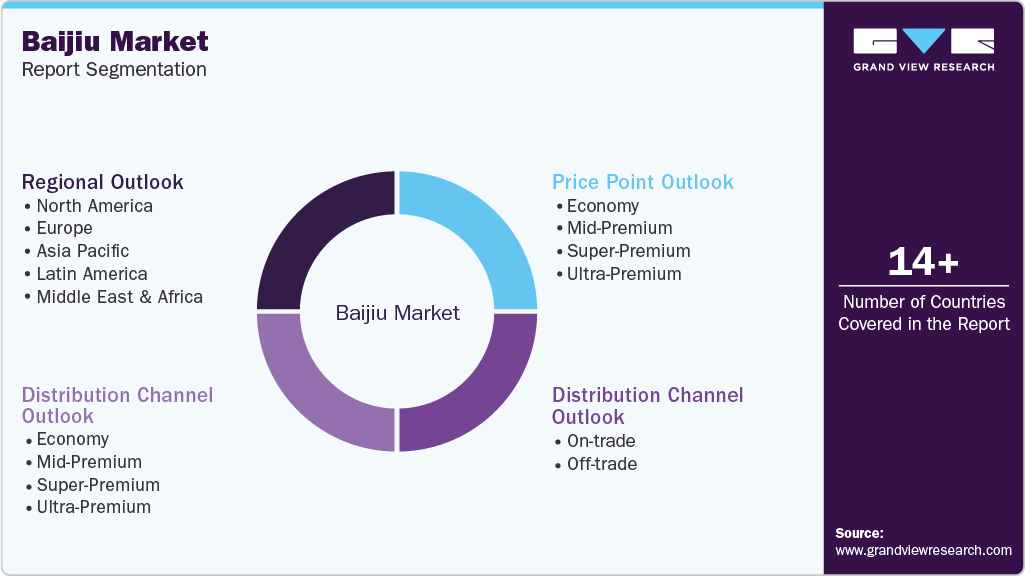
This report forecasts revenue growth at regional levels and provides an analysis of the latest trends and opportunities in each sub-segment from 2021 to 2033. For this study, Grand View Research has segmented the global baijiu market report based on the price point, distribution channel, price point-distribution channel, and region.
 To learn more about this report, Download Free Sample Report
-
Price Point Outlook (Volume, Million 9-Liter Cases; Revenue, USD Million, 2021 - 2033)
-
Economy
-
Mid-Premium
-
Super-Premium
-
Ultra-Premium
-
-
Distribution Channel Outlook (Volume, Million 9-Liter Cases; Revenue, USD Million, 2021 - 2033)
-
On-trade
-
Off-trade
-
-
Price Point - Distribution Channel Outlook (Volume, Million 9-Liter Cases; Revenue, USD Million, 2021 - 2033)
-
Economy
-
On-trade
-
Off-trade
-
-
Mid-Premium
-
On-trade
-
Off-trade
-
-
Super-Premium
-
On-trade
-
Off-trade
-
-
Ultra-Premium
-
On-trade
-
Off-trade
-
-
-
Regional Outlook (Volume, Million 9-Liter Cases; Revenue, USD Million, 2021 - 2033)
-
North America
-
U.S.
-
Canada
-
Mexico
-
-
Europe
-
Germany
-
UK
-
France
-
Italy
-
-
Asia Pacific
-
China
-
Japan
-
India
-
Australia & New Zealand
-
South Korea
-
-
Latin America
-
Brazil
-
-
Middle East and Africa (MEA)
-
South Africa
-
-
Research Methodology
The baijiu market figures in this report are based on a proven research process that combines executive interviews with secondary research from proprietary databases, company filings, and recognized regulatory and institutional sources. Market size is built through value-chain sizing - reconciling supply-side and demand-side estimates - and triangulated with bottom-up and top-down approaches. Every estimate passes multiple levels of expert validation before publication, with each baijiu segment quantified using the revenue-capture definitions in the table below.
Segment Definition
Segment - Price Point
Revenue capture definition
Economy
This segment includes the sales of affordable baijiu products targeted toward value-conscious consumers.
Mid-Premium
This segment includes the sales of baijiu products offering enhanced quality at moderate prices.
Super-Premium
This segment includes the sales of high-quality baijiu products positioned for premium consumption occasions.
Ultra-Premium
This segment includes the sales of luxury baijiu products featuring exceptional craftsmanship, heritage, and exclusivity.
Estimation Model
Alcoholic Beverage Consumer Layer
Market Access Layer
Baijiu Adoption Layer
Monetisation Layer
Who consumes alcoholic beverages?
Who can access baijiu products?
Who actively purchases baijiu?
How much revenue is generated?
Identify the legal drinking-age population that consumes alcoholic beverages across target markets. Analyze drinking habits, cultural traditions, social consumption patterns, and preferences for distilled spirits to define the potential consumer pool for baijiu products.
Apply region-specific availability through liquor stores, supermarkets, restaurants, bars, specialty alcohol retailers, duty-free outlets, and e-commerce alcohol platforms (where permitted) to the eligible consumer base. Consider distribution reach, import/export networks, and regulatory frameworks to estimate the addressable baijiu market.
Apply baijiu penetration rates and consumer preferences for traditional grain-based spirits, premium alcoholic beverages, and culturally significant drinks. Factor in demand from spirit enthusiasts, business and banquet consumers, premium alcohol buyers, Chinese diaspora communities, and consumers seeking authentic Asian alcoholic beverages to convert the addressable market into active buyers.
Multiply active baijiu consumers by average annual consumption frequency and spending per consumer. Add revenue contributions from retail stores, restaurants, bars, banquet events, premium and ultra-premium baijiu brands, duty-free sales, and online alcohol channels to estimate total market revenue.
Delivered Customizations
This report has been delivered with the following In-depth customizations
Client Request
Customization Delivered
Value Adds
Traditional Spirits Consumption Trends & Consumer Preference Analysis
Conducted a focused analysis of baijiu consumption across strong aroma, light aroma, sauce aroma, rice aroma, and mixed aroma varieties, covering changing consumer preferences, premiumization trends, gifting culture, ceremonial consumption, and demand for authentic Chinese spirits.
Helps stakeholders identify high-growth product categories, evaluate evolving consumer preferences, and assess commercialization opportunities in the premium and traditional spirits market.
Premiumization, Heritage Branding & Luxury Consumption Trends
Evaluated adoption trends for premium, ultra-premium, aged, and craft baijiu products, including consumer purchasing behavior, luxury gifting trends, cultural significance, brand loyalty, and demand for high-quality spirits among affluent consumers and younger demographics.
Provides insights into emerging premium spirits trends, unmet consumer needs, and commercially attractive product segments to support product innovation, portfolio diversification, and premium brand positioning strategies.
Distribution Expansion, International Growth & Market Opportunity Assessment
Assessed demand across restaurants, bars, hotels, liquor stores, duty-free outlets, e-commerce platforms, and export markets, along with trends in premium packaging, cross-border marketing, international consumer awareness, and strategic partnerships to expand global baijiu consumption.
Supports investment and expansion strategies by identifying high-potential sales channels, evaluating consumer acceptance in domestic and international markets, and strengthening long-term growth opportunities in the global distilled spirits industry.
Frequently Asked Questions About This Report
By distribution channel, the sales through off-trade channels led the market with the largest revenue share of 62.3% in 2025.
Asia Pacific dominated the baijiu market with the largest revenue share of 98.7% in 2025.
Europe is the fastest-growing region in the baijiu market?
The global baijiu market was estimated at USD 164.9 billion in 2025 and is expected to reach USD 172.5 billion in 2026.
The global baijiu market is expected to grow at a compound annual growth rate of 3.9% from 2026 to 2033 to reach USD 225.4 billion by 2033.
By price point, the economy segment led the market with the largest revenue share of 44.9% in 2025.
Some of the key players in the U.S. baijiu market include Kweichow Moutai Co., Ltd.; Wuliangye Yibin Co., Ltd.; Luzhou Laojiao Co., Ltd.; Yanghe Distillery Co., Ltd.; Jiannanchun Group Co., Ltd.; Gujinggong Liquor Co., Ltd.; Shui Jing Fang Co., Ltd.; Shede Spirits Co., Ltd.; Ming River Baijiu; and Jiangxiaobai.
The market is influenced by the rising demand for premium alcoholic beverages, increasing disposable incomes, and the strong cultural significance of baijiu in social, business, and ceremonial occasions.
About the Author(s)
Alcohol & Tobacco Research Team
Consumer Goods · Alcohol & TobaccoThis report was authored by the alcohol & tobacco research team at Grand View Research - comprising two research analysts, one senior research analyst, and one industry expert - with specialized expertise in the alcohol & tobacco segment of the consumer goods industry. All findings are based on proprietary consumer goods databases, executive interviews, and regulatory analysis, subject to internal peer review prior to publication.
Last Updated:
Speak to Analyst

Customize this report to your needs - add regions, segments, or data points, with 20% free customization.
Or view our licence options:


ISO 9001:2015 & 27001:2022 Certified
We are GDPR and CCPA compliant! Your transaction & personal information is safe and secure. For more details, please read our privacy policy.


