
- Home
- »
- Advanced Interior Materials
- »
-
Ball Screw Market Size, Share & Trends Report, 2026-2033GVR Report cover

Ball Screw Market (2026 - 2033)
Size, Share & Trends Analysis Report By Type (Ground Ball Screws, Rolled Ball Screws), By End Use (Semiconductor & Electronics, Automotive, Aerospace & Defense, Industrial, Medical & Healthcare), By Region, And Segment Forecasts
Market Size, 2025
$1.8BMarket Estimate, 2026
$1.9BMarket Forecast, 2033
$3.0BCAGR, 2026–2033
6.8%Ball Screw Market Summary
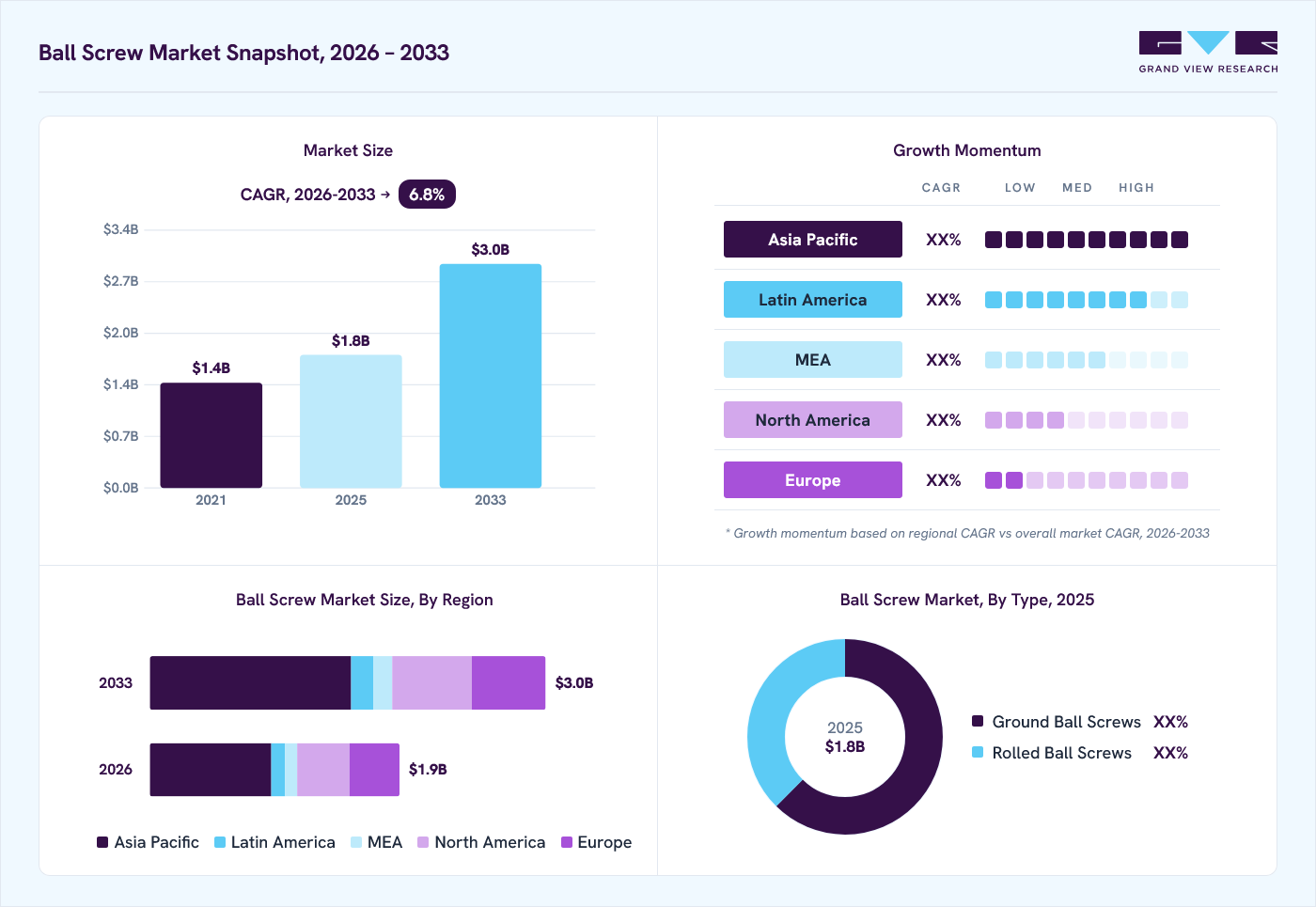
The global ball screw market size was valued at USD 1.8 billion in 2025 and is projected to grow from USD 1.9 billion in 2026 to USD 3.0 billion by 2033, growing at a CAGR of 6.8% from 2026 to 2033. Asia Pacific dominated the market, accounting for the largest revenue share of 48.4%% in 2025. The global ball screw market is primarily driven by the increasing adoption of industrial automation, robotics, and computer numerical control (CNC) machine tools, where precise, efficient, and repeatable linear motion is essential.
 Source: Grand View Research, IR Documents, Primary Interviews, Paid DatabasesTo learn more about this report,
 Download Free Sample Report
 Key Market Trends & Insights
- By type: Ground ball screws segment led the market with the largest revenue share of 62.4% in 2025.
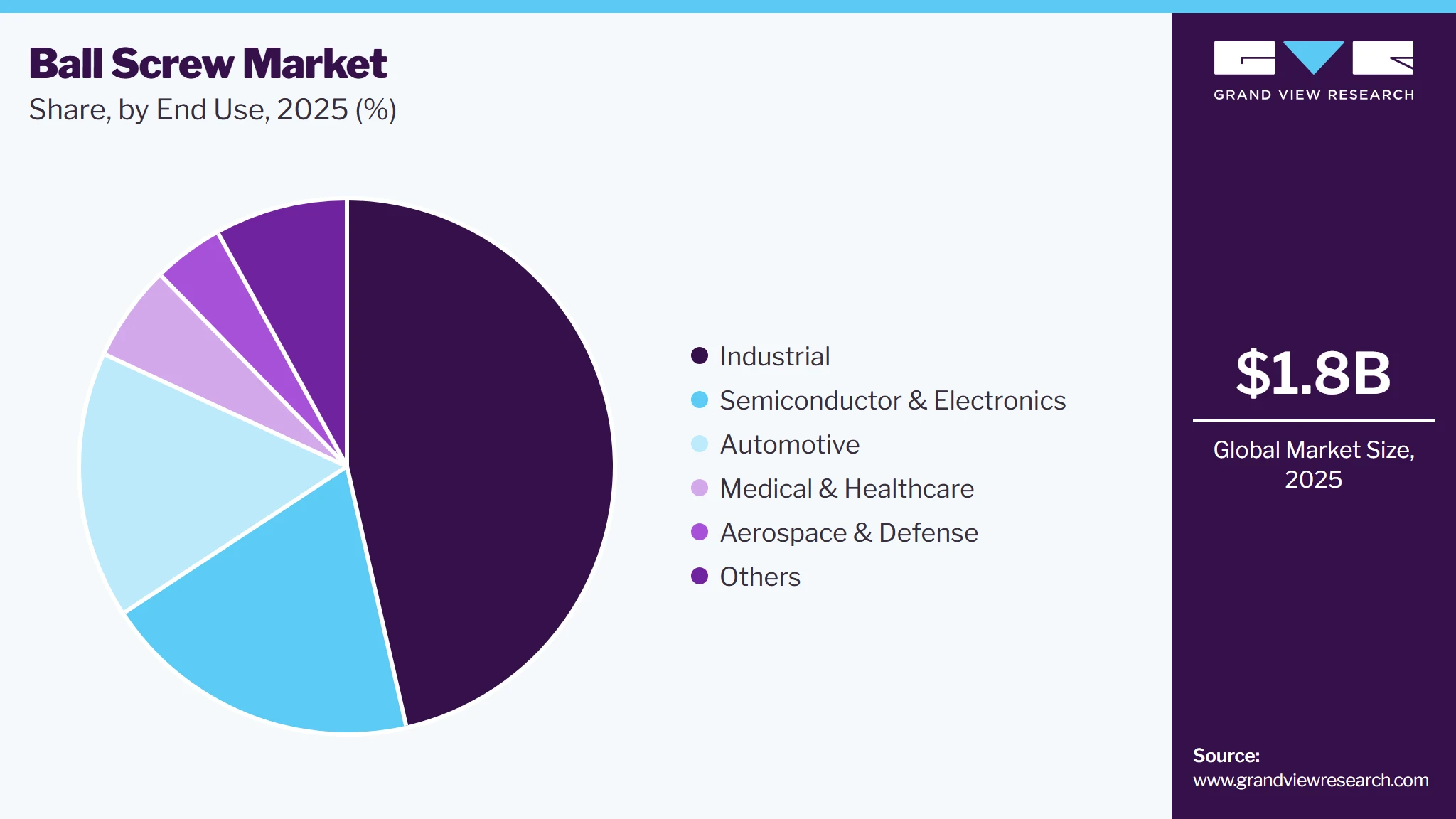
- By end use: Industrial segment led the market with the largest revenue share of 46.4% in 2025.
Regional Highlights
- Largest regional market: Asia Pacific held the largest share, 48.4% of the global ball screw market.
- By country: The China ball screw market held the largest market share in 2025.
Market Size & Forecast
- Market size in 2025: USD 1.8 Billion
- Estimated market size in 2026: USD 1.9 Billion
- Projected market size by 2033: USD 3.0 Billion
- CAGR (2026-2033): 6.8%
Three ways to get this report
Buy it, customize it, or ask a question.Ask an Analyst
Analyst response in 1 business day
- AccessReport author, directly
- Reply timeWithin 1 working day
- No sales callDirect answer only
- FormatEmail reply
- CostFree, no cost
Get the Full Report
What the study covers
- FormatsPDF · Excel · Dashboard
- Timeline2026–2033 annual, 2025 base
- Coverage20+ countries, 5 regions
- Companies10+ key players profiled
Customize the Report
20% free customization
- IncludeCountries, segments, points
- TailorTo your product definition
- ExtendDeeper competitor detail
- OrA fully bespoke study
- Turnaround5–10 working days
 To learn more about this report, Download Free Sample Report
The shift toward advanced manufacturing and Industry 4.0 is boosting demand for high-accuracy ball screws in automated production systems, semiconductor equipment, and precision machinery. In addition, the growing replacement of hydraulic and pneumatic systems with energy-efficient electromechanical actuators, alongside increasing vehicle electrification and demand for precision actuation, is creating additional application opportunities for ball screws.Market Dynamics
The ball screws market is shaped by the growing need for precision, speed, load capacity, efficiency, and reliability across CNC machine tools, robotics, and automated manufacturing systems. Demand is also influenced by the shift toward electromechanical actuation, which favors ball screws over less efficient hydraulic or pneumatic systems. Technological development is pushing manufacturers toward high-speed, high-accuracy, low-backlash, thermally stable, and sensor-enabled designs, while application requirements determine the choice between ground and rolled ball screws, screw diameter, lead, nut configuration, and preload. Capital expenditure in manufacturing, semiconductor fabrication, automotive, and other precision industries consequently remains a key demand determinant.
The rising adoption of industrial automation and robotics is a strong driver for the ball screws market, as automated production systems require precise, repeatable, and efficient linear motion. Increasing automation across manufacturing, semiconductor production, automotive assembly, medical equipment, and aerospace applications is expanding the use of ball screws in positioning and motion-control systems. As manufacturers automate a greater share of production processes, the installation base of CNC machines, robotic systems, automated assembly equipment, and other motion-controlled machinery continues to expand, increasing both new-equipment demand and subsequent replacement requirements for ball screws.
The availability of alternative motion technologies poses a moderate restraint on the ball screws market, as lead screws, linear motors, and roller screws can meet specific application requirements more effectively in certain cases. Lead screws can offer a lower-cost solution for applications with moderate speed and precision requirements, while linear motors are advantageous where very high speeds and acceleration are required. Roller screws can compete in demanding applications requiring exceptionally high load capacity and durability. However, these alternatives generally address specific performance or cost requirements rather than serving as direct substitutes across all applications, limiting the overall restraining impact on the ball screws market.
Growing demand for customized ball screw assemblies provides manufacturers with opportunities to address specific load, speed, accuracy, dimensional, environmental, and integration requirements. Customization can involve screw diameter and lead, preload, materials, coatings, lubrication, mounting configuration, and travel length, making it particularly relevant to robotics, precision machinery, semiconductor equipment, and specialized automation. Suppliers with application-engineering and design capabilities can consequently differentiate beyond standard products and capture higher-value applications.
Market Concentration & Characteristics
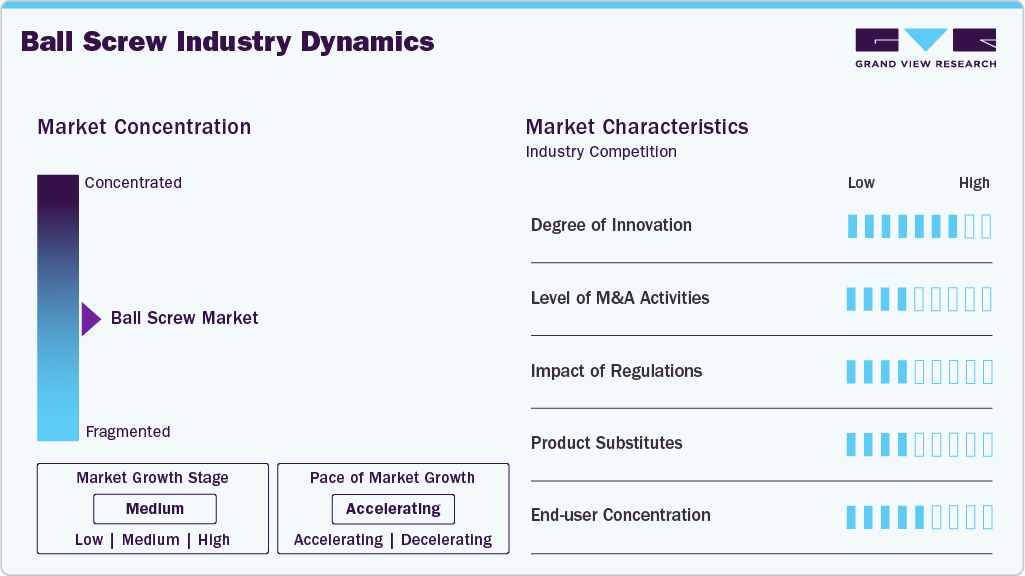
The ball screws market is moderately concentrated, with established players such as NSK Ltd. and THK Co., Ltd holding strong positions across precision motion applications. Entry barriers are relatively high in premium segments due to the need for precision grinding, advanced metrology, manufacturing expertise, and established customer qualification. Competition therefore centers more on accuracy, reliability, customization, lead time, and application support than on price alone.
The threat from alternatives is moderate but application-dependent. Lead screws remain suitable for lower-cost and lower-precision applications, while linear motors can replace ball screws where very high speed, acceleration, and frictionless motion are prioritized; roller screws can compete in high-load applications. However, ball screws retain a strong position because they provide a favorable combination of efficiency, precision, load capacity, and cost, limiting substitution in CNC machine tools, robotics, and industrial automation. Regulatory influence is relatively limited, with the market shaped primarily by technical standards such as ISO 3408, JIS, and DIN that establish dimensional, accuracy, testing, and performance requirements.
 To learn more about this report, Download Free Sample Report
 Technology development is increasingly focused on higher-speed operation, improved precision, reduced backlash, longer service life, optimized lubrication, and condition monitoring, including sensor-enabled solutions and predictive maintenance. Mature companies are responding through expanded precision-product portfolios, application-specific customization, manufacturing and geographic expansion, and integration of ball screws with broader linear-motion and automation systems.
Analyst Perspective
The ball screw market is expected to benefit from rising industrial automation, robotics, CNC machine tool adoption, semiconductor manufacturing, and demand for precision motion systems, while high manufacturing costs, maintenance requirements, and competition from lead screws, linear motors, and roller screws can constrain growth in selected applications. Market development is influenced by manufacturing capital expenditure, automation penetration, demand for higher accuracy and speed, and the shift toward energy-efficient electromechanical actuation. Technological progress is centered on higher-speed and higher-precision designs, improved preload and backlash control, enhanced lubrication, thermal management, and sensor-enabled condition monitoring, with ground ball screws retaining importance in precision-intensive applications and rolled ball screws benefiting from cost-sensitive, higher-volume uses.
Type Insights
The ground ball screws segments led the global revenue share in 2025 holding 62.4% of the overall market. Ground ball screws are widely used in applications requiring high positioning accuracy, repeatability, and smooth motion, as the grinding process enables tighter dimensional tolerances and higher precision than conventional rolled products. They are therefore particularly relevant to precision-intensive applications such as semiconductor manufacturing, aerospace equipment, medical equipment, and high-end machine tools. Their higher manufacturing cost, however, generally positions them toward applications where performance requirements justify the premium.
The rolled ball screws segment is expected to register the rapid growth at CAGR of 7.4% over the forecast period since their manufacturing process enables higher production volumes and comparatively lower costs than ground ball screws. They are well suited to applications where moderate-to-high precision, efficiency, durability, and cost effectiveness are required, including industrial machinery, automation equipment, and automotive production systems. Continued automation and demand for economical motion-control solutions support their adoption, although ground ball screws retain an advantage in applications requiring the highest levels of accuracy.
End Use Insights
The industrial segment dominated the ball screw market in 2025 accounting for 46.4% of the market revenue due to their extensive deployment in CNC machine tools, industrial automation equipment, material-handling machinery, and other manufacturing systems. Growing factory automation and the increasing use of precision motion-control systems are supporting demand for ball screws to achieve accurate positioning, repeatability, and efficient linear movement. Demand is also supported by investments in manufacturing capacity and modernization of production equipment across industries.
 To learn more about this report, Download Free Sample Report
 The semiconductor & electronics segment is projected to grow at a CAGR of 7.8% from 2026 to 2033 in terms of revenue. Ball screws are used in equipment involved in wafer handling, inspection, positioning, assembly, and other precision processes, with ground ball screws particularly relevant where extremely tight positioning tolerances are required. Continued investment in semiconductor manufacturing capacity, advanced packaging, and automated electronics production is expected to support demand for precision motion components.
Regional Insights
The North American ball screw market is supported by the region’s strong base of advanced manufacturing across automotive, aerospace, semiconductor, and industrial machinery, alongside ongoing reshoring and supply-chain localization. The U.S. remains the primary demand center due to investments in domestic semiconductor and advanced manufacturing capacity, while Mexico’s expanding automotive and industrial manufacturing base and its integration into North American production supply chains are increasing demand for CNC machinery, automation, and precision motion components. Canada further contributes through its aerospace, automotive, and advanced manufacturing activities, while the region-wide emphasis on productivity and automation continues to support adoption of ball screws in precision equipment.
The U.S. ball screw market benefits from reshoring of advanced manufacturing, semiconductor capacity expansion, and continued investment in aerospace, automotive, and industrial automation. The push to strengthen domestic supply chains is particularly relevant: a 2026 U.S.-Taiwan agreement includes at least USD 250 billion in planned Taiwanese investment in U.S. semiconductor, energy, and artificial intelligence production and innovation capacity. This creates demand for precision manufacturing equipment and motion-control components, although elevated capital costs, trade uncertainty, and skilled-labor shortages can constrain equipment investment
Europe Ball Screw Market Trends
Europe's established automotive, aerospace, machine-tool, and precision engineering industries provide a strong application base for ball screws. Demand is further supported by manufacturers' focus on automation and productivity improvements amid relatively high labor costs, alongside efforts to strengthen domestic semiconductor and advanced manufacturing capabilities. These trends favor precision motion components capable of delivering reliable and repeatable movement in sophisticated production equipment.
Germany remains a high-value market for ball screws, underpinned by its globally established machine-tool, automotive, industrial machinery, and precision-engineering industries. The market is currently transitioning from a prolonged period of industrial weakness toward a tentative recovery, with improving machine-tool orders and renewed domestic investment providing some support. At the same time, high energy costs, intense competition from China, trade uncertainty, and structural pressure on the automotive sector continue to constrain industrial investment. The country's push toward semiconductor sovereignty, industrial automation, and advanced manufacturing provides additional opportunities for high-precision ball screws, particularly in equipment used for semiconductor and automotive applications.
Spain offers a steadily developing demand base for ball screws, anchored by automotive manufacturing, industrial machinery, and increasing automation. The country's automotive industry remains particularly relevant, with more than 1.95 million vehicles exported in 2025 as per Invest in Spain, while the transition toward electrified vehicles is encouraging manufacturers and suppliers to upgrade production technologies. Spain's broader economic position is comparatively supportive of industrial investment, although its ball screw demand remains smaller than Germany's because of a less extensive precision-machinery and machine-tool ecosystem.
Asia Pacific Ball Screw Market Trends
Asia Pacific benefits from the concentration of global manufacturing and semiconductor production, with China, Japan, South Korea, and Taiwan serving as major centers for electronics, machine tools, and precision equipment. Rapid expansion of electric vehicle and electronics manufacturing, together with extensive deployment of CNC systems, robotics, and automated production lines, is generating substantial requirements for ball screws. India's expanding manufacturing and automation ecosystem provides an additional source of incremental demand.
 To learn more about this report, Download Free Sample Report
 China is the largest and one of the most strategically significant markets for ball screws, supported by its sizeable manufacturing base and rapid shift toward higher-value, automated production. Government programs are actively promoting smart factories, artificial intelligence integration, and advanced manufacturing, while investment continues across semiconductors, electric vehicles, electronics, robotics, and industrial machinery. The economy nevertheless faces pressure from property-sector weakness, trade tensions, and overcapacity in some manufacturing industries; however, the scale of domestic production and ongoing localization of precision equipment is expected to sustain substantial ball screw demand.
India is expected to emerge as a high-growth market for ball screws, supported by manufacturing expansion, electronics localization, automotive production, and increasing automation. Manufacturing activity remains in expansion territory, while government measures continue to encourage electronics manufacturing and investment. For instance, the August 2026 tax amendments, were intended to encourage domestic electronics production and foreign investment. The relatively lower penetration of advanced automation compared with China, Japan, Germany, or the U.S. leaves considerable room for CNC equipment and automated production systems to expand, although infrastructure gaps, skills availability, and cost sensitivity remain relevant constraints.
Middle East & Africa Ball Screw Market Trends
In the Middle East & Africa, economic diversification and localization of manufacturing are creating new applications for ball screws. Saudi Arabia and the UAE are developing manufacturing, aerospace, defense, and other non-oil industries through national industrial strategies, increasing requirements for precision machinery and automated equipment. Meanwhile, growing automotive and aerospace manufacturing clusters in Morocco and South Africa are providing additional opportunities, although the region's relatively lower level of industrial automation limits near-term demand compared with developed markets.
Saudi Arabia represents an emerging opportunity for the ball screw market, supported by industrial diversification and localization under Vision 2030. The country is positioning itself as a regional manufacturing hub, with more than 12,700 active plants in 2025 and a target of over SAR 1.3 trillion in industrial-sector investment, according to Invest Saudi; the localization of machinery and equipment is also explicitly identified as an investment priority. The expansion of manufacturing, defense, automotive, and other non-oil industries is expected to gradually increase demand for CNC machinery and automated equipment. However, the domestic precision-manufacturing ecosystem remains at an earlier stage of development, leaving the market more dependent on imported equipment and components than mature manufacturing economies.
Latin America Ball Screw Market Trends
Demand in Latin America is closely tied to industrial modernization, particularly in Brazil and Argentina, where automotive, metalworking, machinery, and electronics manufacturing are investing in more productive production systems. Greater use of CNC equipment and automation is increasing requirements for reliable linear-motion components, while efforts to improve manufacturing efficiency and competitiveness are encouraging gradual replacement and upgrading of older machinery.
Brazil's ball screw market is supported by industrial modernization and the gradual adoption of automation, robotics, and Industry 4.0 technologies, particularly across automotive, electronics, machinery, and metalworking. The country's established machinery and equipment ecosystem provides a base for demand, while manufacturers are increasingly prioritizing productivity, energy efficiency, process optimization, and flexible production, creating opportunities for precision motion components. However, adoption of advanced manufacturing technologies remains uneven, with smaller manufacturers generally lagging larger industrial companies, while economic volatility, financing conditions, and dependence on imported precision components can moderate investment in new equipment.
Key Ball Screw Company Insights
Some of the key players operating in the market include THK Co., Ltd and NSK Ltd.
-
THK Co., Ltd. is a Japanese precision motion technology company with a product portfolio spanning various applications including machine tools, industrial robots, semiconductor manufacturing equipment, medical equipment, transportation systems, and other advanced machinery. Moreover, has a broad global operating footprint, with sales and production bases spanning Japan, North America, Latin America, Europe, and Asia.
-
Headquartered in Tokyo, Japan, NSK Ltd. (Nippon Seikō Kabushiki-gaisha) is a global machinery manufacturer and Japan's largest producer of rolling bearings. Operating through two main business segments - Industrial Machinery and Automotive, the company produces a broad range of high-precision products, including industrial ball and roller bearings, ball screws, linear motion guides, electric power steering systems, and automotive drivetrain components. With more than 26,000 employees and several manufacturing facilities worldwide, NSK leverages its motion and control technologies to serve diverse global markets, including robotics, semiconductor equipment, aerospace, healthcare, and automotive manufacturing.
Key Ball Screw Companies
The following key companies have been profiled for this study on the ball screw market:
-
WMH Herion GmbH
-
THK CO., LTD.
-
PBC Linear
-
KURODA Precision Industries Ltd
-
NSK Ltd
-
KSK Precise Motion, a.s
-
MPS
-
SHUTON
-
TBI MOTION TECHNOLOGY CO.,LTD
-
UMBRAGROUP
-
DYNATECT MANUFACTURING, INC.
-
August Steinmeyer GmbH & Co. KG
-
Berger Holding
-
Barnes Industries, Inc.
-
RACO-ELEKTRO-MASCHINEN GmbH
Competitive Benchmarking
Category
Operating Strategies
Competitive Edge
Weakness
Established Players (e.g., NSK Ltd., THK Co., Ltd)
- Mature players typically expand their portfolios across precision, high-speed, high-load, and rolled ball screws to address a broad range of application requirements.
- They continuously invest in precision manufacturing, product innovation, quality control, and process optimization to maintain performance advantages.
- They strengthen global manufacturing and distribution networks while maintaining long-term relationships with major original equipment manufacturers (OEMs)..
- Mature players benefit from strong brand recognition and established customer trust in precision motion products.
- Their broad product portfolios and strong financial capacity allow them to serve customers with different accuracy, speed, load, and dimensional requirements.
- Their established engineering, manufacturing, and metrology capabilities support consistent quality and complex product development.
- Their extensive geographic presence and established OEM and distributor relationships provide broad market access.
- Mature players tend to face higher operating costs due to advanced precision manufacturing requirements and extensive global operations.
- Their larger organizational structures can make highly customized product development and rapid responses to niche requirements comparatively slower.
- Their established premium positioning can make them less competitive in highly price-sensitive applications.
Emerging & Regional Players (e.g., KSK Precise Motion, a.s., PBC Linear)
- Emerging players typically focus on niche applications and underserved customer requirements rather than attempting to compete across the entire product spectrum.
- They emphasize customized and application-specific ball screw solutions to differentiate themselves from larger suppliers.
- They tend to compete through responsiveness, shorter customization cycles, and competitive pricing.
- Emerging players can offer greater flexibility in customization and niche engineering.
- Their comparatively focused organizational structures can allow them to respond quickly to niche application requirements.
- Their lower-cost structures can provide an advantage in price-sensitive applications where the capabilities of mature suppliers may be excessive
- Emerging players generally have smaller manufacturing and distribution footprints than established global suppliers.
- Their more limited financial and technical resources can constrain large-scale R&D, capacity expansion, and geographic localization.
- Their narrower customer and application bases can increase dependence on specific markets or customer groups.
Recent Developments
-
In May 2026, NSK and NTN, both manufacturers of ball screws and other precision-motion components, announced a basic agreement to integrate their businesses through a jointly established holding company. The move is intended to improve resource utilization, strengthen supply-chain resilience, and accelerate technology development amid subdued automotive and industrial machinery markets and intensifying competition.
-
In April 2025, NSK launched MT-Frix, a low-friction ball screw designed for machining applications, featuring optimized internal specifications developed through analysis of ball-and-groove contact conditions. The product reduces dynamic friction torque and heat generation while maintaining nut rigidity and positioning accuracy, with NSK reporting up to a 50% reduction in CO₂ emissions associated with friction torque compared with conventional products.
Ball Screw Market Report Scope
Report Attribute
Details
Market size in 2025
USD 1.8 billion
Estimated market size in 2026
USD 1.9 billion
Projected market size by 2033
USD 3.0 billion
Growth rate
CAGR of 6.8% from 2026 to 2033
Historical data
2021 - 2024
Forecast period
2026 - 2033
Quantitative units
Revenue in USD million/billion and CAGR from 2026 to 2033
Report coverage
Revenue forecast, company ranking, competitive landscape, growth factors, and trends
Segments covered
Type, end use, and region
Regional scope
North America; Europe; Asia Pacific; Latin America; Middle East & Africa; Africa
Country scope
U.S.; Canada; Mexico; UK; Germany; France; Spain; Italy; China; Japan; India; Australia; South Korea; Brazil; Argentina; Saudi Arabia; UAE; South Africa
Key companies profiled
WMH Herion GmbH; THK CO., LTD.; PBC Linear; KURODA Precision Industries Ltd; NSK Ltd; KSK Precise Motion, a.s; MPS; SHUTON; TBI MOTION TECHNOLOGY CO., LTD; UMBRAGROUP; DYNATECT MANUFACTURING, INC.; August Steinmeyer GmbH & Co. KG; Berger Holding; Barnes Industries, Inc.; RACO-ELEKTRO-MASCHINEN GmbH
Customization scope
Free report customization (equivalent up to 8 analysts working days) with purchase. Addition or alteration to country, regional & segment scope.
Pricing and purchase options
Avail customized purchase options to meet your exact research needs. Explore purchase options
Global Ball Screw Market Report Segmentation
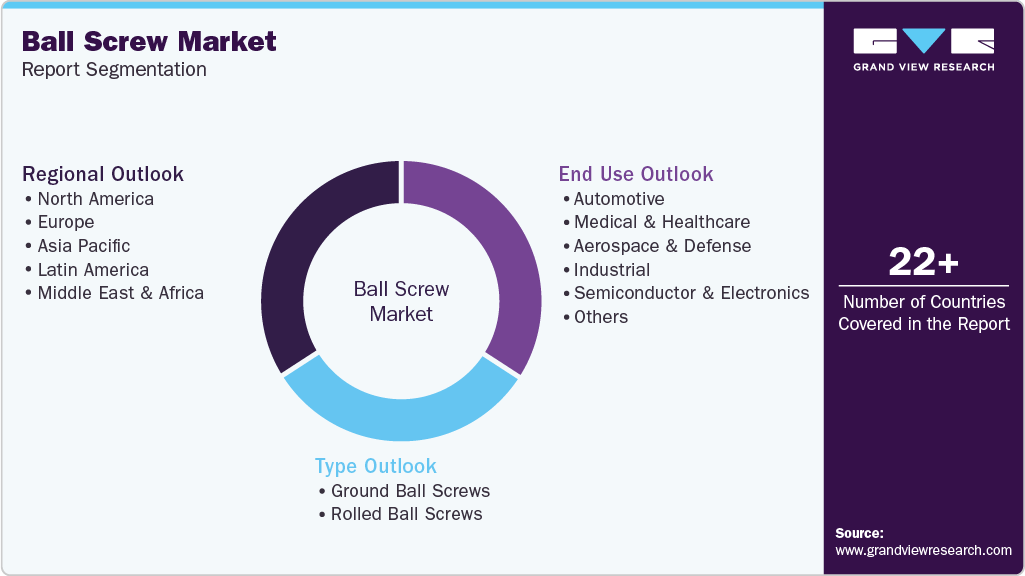
This report forecasts revenue growth at global, regional, and country levels and provides an analysis of the latest industry trends in each of the sub-segments from 2021 to 2033. For this study, Grand View Research has segmented the ball screw market report based on type, end-use, and region
 To learn more about this report, Download Free Sample Report
 -
Type Outlook (Revenue, USD Billion, 2021 - 2033)
-
Ground Ball Screws
-
Rolled Ball Screws
-
-
End Use Outlook (Revenue, USD Billion, 2021 - 2033)
-
Automotive
-
Medical & Healthcare
-
Aerospace & Defense
-
Industrial
-
Semiconductor & Electronics
-
Others
-
-
Regional Outlook (Revenue, USD Billion, 2021 - 2033)
-
North America
-
U.S.
-
Canada
-
Mexico
-
-
Europe
-
Germany
-
France
-
Italy
-
Spain
-
UK
-
- Asia Pacific
-
China
-
India
-
Japan
-
South Korea
-
Australia
-
- Latin America
-
Brazil
-
Argentina
-
Middle East & Africa
-
Saudi Arabia
-
UAE
-
South Africa
-
-
Research Methodology
The ball screw market figures in this report are based on a proven research process that combines executive interviews with secondary research from proprietary databases, company filings, and recognized regulatory and institutional sources. Market size is built through value-chain sizing-reconciling supply-side and demand-side estimates-and triangulated with bottom-up and top-down approaches. Every estimate passes multiple levels of expert validation before publication, with each ball screw segment quantified using the revenue-capture definitions in the table below.
Segment Definition
Type
Revenue Capture Definition
Ground Ball Screws
Ground ball screws are linear motion components consisting of a threaded screw shaft and ball nut, in which recirculating balls reduce friction and enable precise rotary-to-linear motion. This segment represents the revenue captured from the sale of ground ball screws.
Rolled Ball Screws
Rolled ball screws are ball screw assemblies that use recirculating balls between a threaded screw shaft and nut to convert rotary motion into precise linear movement. This segment represents the revenue captured from the sale of rolled ball screws.
End Use
Revenue Capture Definition
Automotive
The automotive segment comprises ball screws used in vehicle manufacturing, machining, assembly, testing, and other automotive production equipment requiring controlled linear motion. This segment represents the revenue captured from the sale of ball screws for automotive applications.
Medical & Healthcare
The medical & healthcare segment comprises ball screws used in medical equipment, diagnostic systems, surgical and rehabilitation equipment, and precision healthcare machinery requiring accurate linear positioning. This segment represents the revenue captured from the sale of ball screws for medical and healthcare applications.
Aerospace & Defense
The aerospace & defense segment comprises ball screws used in aircraft manufacturing equipment, flight-control systems, actuation systems, testing equipment, and defense machinery requiring precise and reliable motion. This segment represents the revenue captured from the sale of ball screws for aerospace and defense applications.
Industrial
The industrial segment comprises ball screws used in CNC machine tools, industrial machinery, automation systems, robotics, and other industrial equipment. This segment represents the revenue captured from the sale of ball screws for industrial applications.
Semiconductor & Electronics
The semiconductor & electronics segment comprises ball screws used in semiconductor manufacturing, wafer processing and handling, inspection equipment, electronics assembly, and related precision equipment. This segment represents the revenue captured from the sale of ball screws for semiconductor and electronics applications.
Others
The others segment comprises ball screws used in energy & power, food & beverage processing, printing & packaging and research & laboratory equipment segments. This segment represents the revenue captured from the sale of ball screws for these other applications.
Estimation Model
Layer Name
Key Question
Description
Industry & Demand Assessment
What is the underlying demand for ball screws?
Assess demand generated by major applications such as CNC machine tools, industrial automation and robotics, semiconductor and electronics equipment, automotive production machinery, medical equipment, and aerospace & defense systems. Use a top-down approach by analyzing manufacturing output, machinery production, automation penetration, semiconductor equipment investment, and relevant industrial activity, while using installed equipment bases and ball screw usage per machine as bottom-up demand proxies.
Segment & Regional Assessment
How is demand distributed across product types, end uses, and regions?
Estimate demand across ground and rolled ball screws, the defined end-use industries, and major geographic markets. Apply bottom-up calculations using machine/equipment volumes, ball screw utilization rates, replacement cycles, and product mix, while validating the resulting distribution through top-down indicators such as regional manufacturing output, capital expenditure, CNC machine tool consumption, semiconductor investment, and automation adoption.
Supply & Distribution Assessment
How does ball screw supply reach the market?
Assess manufacturers' production capabilities, product portfolios, geographic manufacturing footprints, distributor networks, direct sales, and replacement/aftermarket channels to determine the flow of ball screws from manufacturers to equipment OEMs and end users. Use bottom-up supply-side triangulation based on company revenues attributable to ball screws, production capacity, shipment volumes, and product-level information, and cross-check against industry production and demand estimates.
Revenue Estimation & Triangulation
What is the final ball screw market revenue?
Calculate the market value using both bottom-up and top-down approaches. The bottom-up calculation aggregates revenue across manufacturers, product types, end uses, and geographies, while the top-down calculation applies ball screw penetration, utilization, replacement, and expenditure assumptions to relevant machinery and equipment markets. Reconcile both approaches through company revenues, industry demand, import/export data, production volumes, pricing/product mix, and market-level benchmarks to arrive at the final market size and forecasts.
Delivered Customizations
This report has been delivered with the following In-depth customizations
Client Request
Customization Delivered
Value Adds
Regional Segmentation
Developed a multi-level geographic assessment covering major regions and priority countries, with country-specific analysis of manufacturing activity, automation adoption, semiconductor and automotive investments, and other factors influencing ball screw demand.
Enabled the client to distinguish established demand centers from emerging growth markets, prioritize geographic expansion opportunities, and understand the underlying factors shaping regional performance.
Competitive Benchmarking
A comparative analysis was done of mature and emerging ball screw manufacturers across product portfolios, ground and rolled screw capabilities, end-use exposure, geographic footprint, technology focus, and strategic initiatives, highlighting areas of competitive strength and differentiation.
Gave the client a clear view of the competitive landscape and positioning of key players, helping identify competitive gaps, differentiation opportunities, and potential areas for strengthening its market position.
Opportunity Assessment
Assessed opportunities across ball screw types, end-use industries, geographies, and emerging applications, linking market potential with automation, precision manufacturing, semiconductor investment, and other demand-side developments.
Helped the client prioritize the most attractive pockets of future growth, supporting decisions around product development, geographic expansion, target industries, and allocation of commercial resources.
Frequently Asked Questions About This Report
The global ball screw market was valued at USD 1.8 billion in 2025 and is estimated to reach USD 1.9 billion in 2026.
The global ball screw market is projected to grow at a compound annual growth rate (CAGR) of 6.8% from 2026 to 2033, reaching approximately USD 3.0 billion by 2033.
Asia Pacific held the largest regional share, accounting for 48.4% of the global ball screw market in 2025, supported by industrialization, expanding manufacturing activities, and increasing workplace safety awareness.
Asia Pacific is expected to register the fastest growth during the forecast period.
China held the largest country-level share of the ball screw market in 2025, supported by its extensive manufacturing base and high demand for CNC machine tools.
The ground ball screws segment dominated the market in 2025, accounting for 62.4% of global revenue.
The industrial segment held the largest share of global revenue among end-use segments in 2025, accounting for 46.4% of the global market.
Some of the key players operating in the global ball screw market include WMH Herion GmbH, THK CO., LTD., PBC Linear, KURODA Precision Industries Ltd, NSK Ltd, KSK Precise Motion, a.s, MPS, SHUTON, TBI MOTION TECHNOLOGY CO., LTD, UMBRAGROUP, DYNATECT MANUFACTURING, INC., August Steinmeyer GmbH & Co. KG, Berger Holding, Barnes Industries, Inc., and RACO-ELEKTRO-MASCHINEN GmbH.
The global ball screw market is primarily driven by the increasing adoption of industrial automation, robotics, and computer numerical control (CNC) machine tools, which require precise, efficient, and repeatable linear motion.
About the Author(s)
Advanced Interior Materials Research Team
Advanced Materials · Advanced Interior MaterialsThis report was authored by the advanced interior materials research team at Grand View Research - comprising two research analysts, one senior research analyst, and one industry expert - with specialized expertise in the advanced interior materials segment of the advanced materials industry. All findings are based on proprietary advanced materials databases, executive interviews, and regulatory analysis, subject to internal peer review prior to publication.
Last Updated:
Speak to Analyst

Customize this report to your needs - add regions, segments, or data points, with 20% free customization.
Or view our licence options:


ISO 9001:2015 & 27001:2022 Certified
We are GDPR and CCPA compliant! Your transaction & personal information is safe and secure. For more details, please read our privacy policy.


