
- Home
- »
- Advanced Interior Materials
- »
-
Bamboo Construction Materials Market Size Report, 2033GVR Report cover

Bamboo Construction Materials Market (2026 - 2033)
Size, Share & Trends Analysis Report By Product Type (Bamboo Lumber & Panels, Bamboo Flooring), By End Use (Residential Construction, Non-Residential Construction, Interior Applications), By Region, And Segment Forecasts
Market Size, 2025
$100.5BMarket Estimate, 2026
$105.0BMarket Forecast, 2033
$142.9BCAGR, 2026–2033
4.5%Bamboo Construction Materials Market Summary
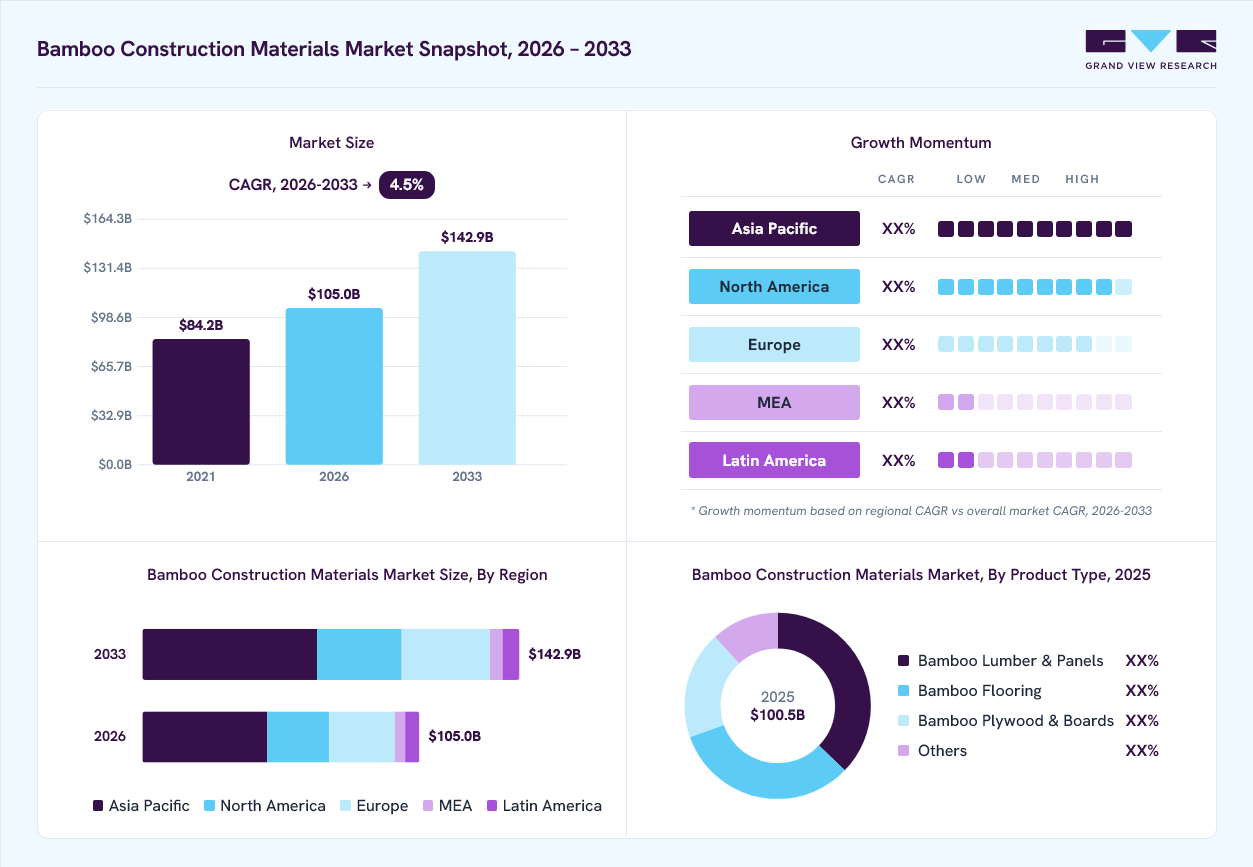
The global bamboo construction materials market size was valued at USD 100.5 billion in 2025 and is projected to grow from USD 105.0 billion in 2026 to USD 142.9 billion by 2033, at a CAGR of 4.5% from 2026 to 2033. The market in Asia Pacific dominated with a revenue share of 44.9% in 2025. The growing emphasis on sustainable construction practices is one of the primary factors driving the global bamboo construction materials market.
 Source: Grand View Research, IR Documents, Primary Interviews, Paid DatabasesTo learn more about this report,
 Download Free Sample Report
 Key Market Trends & Insights
- By product type: Bamboo lumber & panels segment held the largest market share of 37.2% in 2025.
- By end use: Residential construction segment held the largest market share of 46.0% in 2025.
Regional Highlights
- Largest regional market: Asia Pacific (44.9% revenue share, 2025)
- By country: China held the largest market share in 2025
Market Size & Forecast
- Market size in 2025: USD 100.5 Billion
- Estimated market size in 2026: USD 105.0 Billion
- Projected market size by 2033: USD 142.9 Billion
- CAGR (2026-2033): 4.5%
Three ways to get this report
Buy it, customize it, or ask a question.Ask an Analyst
A direct answer, usually in 1 working day
- AccessReport author, directly
- Reply timeWithin 1 working day
- No sales callDirect answer only
- FormatEmail reply
- CostFree, no cost
Get the Full Report
What the study covers
- FormatsPDF · Excel · Dashboard
- Timeline2026–2033 annual, 2025 base
- Coverage20+ countries, 5 regions
- Companies10+ key players profiled
Customize the Report
20% free customization
- IncludeCountries, segments, points
- TailorTo your product definition
- ExtendDeeper competitor detail
- OrA fully bespoke study
- Turnaround5–10 working days
With increasing awareness about climate change and the depletion of non-renewable resources, bamboo has emerged as an eco-friendly alternative to conventional building materials such as steel, concrete, and timber. Its rapid renewability, high carbon sequestration capacity, and low environmental footprint make it a preferred choice for green buildings and eco-conscious projects. Governments and international organizations are also promoting bamboo-based materials through green building certifications and sustainability initiatives, further accelerating market adoption.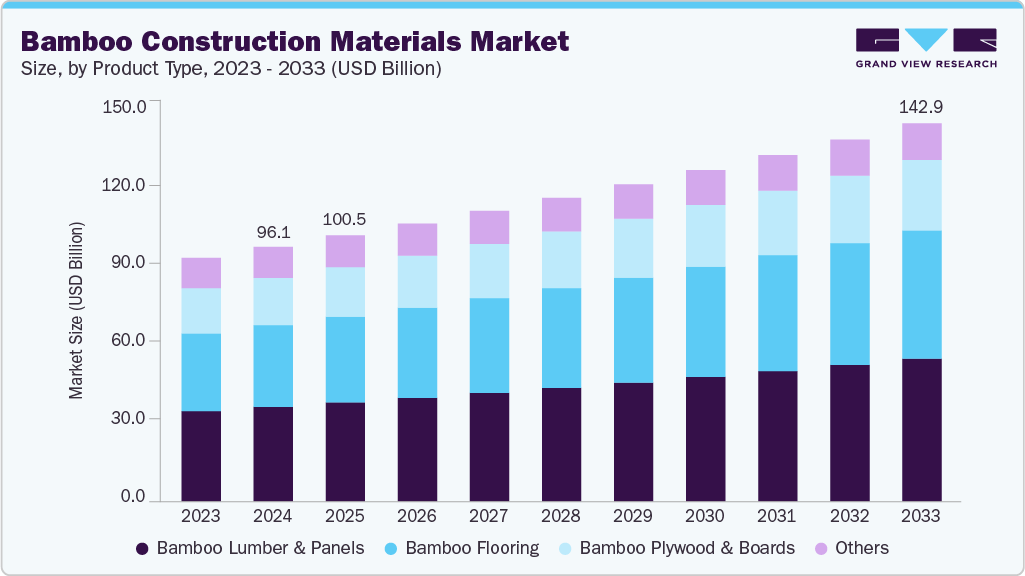 To learn more about this report, Download Free Sample Report
 Technological advancements in bamboo processing and treatment have significantly enhanced its structural strength, durability, and resistance to environmental factors, thereby boosting its suitability for modern construction. Innovations in engineered bamboo products-such as laminated bamboo lumber, bamboo composites, and cross-laminated bamboo panels-are expanding the scope of applications in Residential Construction, commercial, and infrastructure projects. These advancements have addressed earlier limitations related to termite attacks, moisture absorption, and inconsistent quality, positioning bamboo as a viable structural material comparable to traditional timber and steel in terms of performance and longevity.
Rising urbanization and infrastructure development, particularly in Asia-Pacific and Latin America, are also propelling the demand for bamboo construction materials. Countries such as China, India, Indonesia, and Vietnam have abundant bamboo resources and are integrating bamboo into affordable housing projects and rural infrastructure due to its cost-effectiveness and local availability. Moreover, growing demand for aesthetically appealing and culturally significant building designs has led to a surge in the use of bamboo in resorts, pavilions, and eco-tourism facilities, thereby contributing to the overall market expansion.
Market Dynamics
The bamboo construction materials market is witnessing robust growth, driven by the increasing demand for sustainable building materials, rising adoption of green construction practices, and growing emphasis on reducing the environmental footprint of the construction industry. Bamboo is increasingly being utilized as an alternative to conventional materials such as timber, steel, and concrete due to its rapid renewability, high strength-to-weight ratio, durability, flexibility, and carbon sequestration capabilities. The material is gaining traction across residential, commercial, institutional, and infrastructure projects for applications including structural components, flooring, wall panels, roofing, scaffolding, and decorative architectural elements. Growing investments in sustainable urban development, coupled with supportive government initiatives promoting eco-friendly construction materials, are further contributing to market expansion. In addition, advancements in bamboo treatment, preservation technologies, and engineered bamboo products are improving material performance, longevity, and structural reliability, thereby broadening its application scope in modern construction.
Governments, developers, and architects are increasingly adopting renewable and low-carbon building materials to comply with green building standards and sustainability targets. Bamboo offers significant environmental advantages, including rapid growth cycles, low resource requirements, high carbon absorption capacity, and reduced greenhouse gas emissions compared to traditional construction materials. Additionally, growing consumer awareness regarding environmentally responsible construction practices is accelerating the use of bamboo in residential and commercial projects. Rapid urbanization, coupled with increasing investments in affordable housing and sustainable infrastructure development, particularly across Asia-Pacific, Latin America, and Africa, is further fueling market demand. The material’s combination of sustainability, strength, aesthetic appeal, and cost-effectiveness makes it an attractive solution for modern construction applications.
The bamboo construction materials market faces several challenges, including the lack of uniform construction standards, limited awareness among builders and contractors, and concerns regarding long-term durability. Variations in bamboo species, quality, treatment methods, and harvesting practices can lead to inconsistencies in structural performance and product reliability. Additionally, untreated bamboo remains susceptible to moisture, fungal attack, insect infestation, and weathering, requiring specialized preservation and treatment processes that can increase project costs. Regulatory barriers and the absence of widely accepted building codes in several countries also restrict broader adoption in large-scale structural applications. Furthermore, perceptions regarding bamboo as a traditional rather than modern construction material continue to hinder acceptance in certain developed markets, limiting its penetration in mainstream construction projects.
The growing adoption of green building concepts and advancements in engineered bamboo products are creating significant opportunities for the bamboo construction materials market. Increasing demand for environmentally certified buildings, net-zero energy structures, and sustainable urban infrastructure is driving the use of bamboo as a renewable construction material. Engineered bamboo products, such as laminated bamboo lumber, bamboo panels, bamboo composites, and structural bamboo beams, offer enhanced strength, dimensional stability, and durability, enabling their use in high-performance construction applications. Furthermore, rising investments in eco-resorts, sustainable commercial buildings, educational institutions, and public infrastructure projects are expanding market opportunities globally. The growing integration of bamboo into modern architectural designs, supported by innovations in processing technologies and improved structural engineering capabilities, is expected to unlock substantial long-term growth potential for the global bamboo construction materials market.
Market Concentration & Characteristics
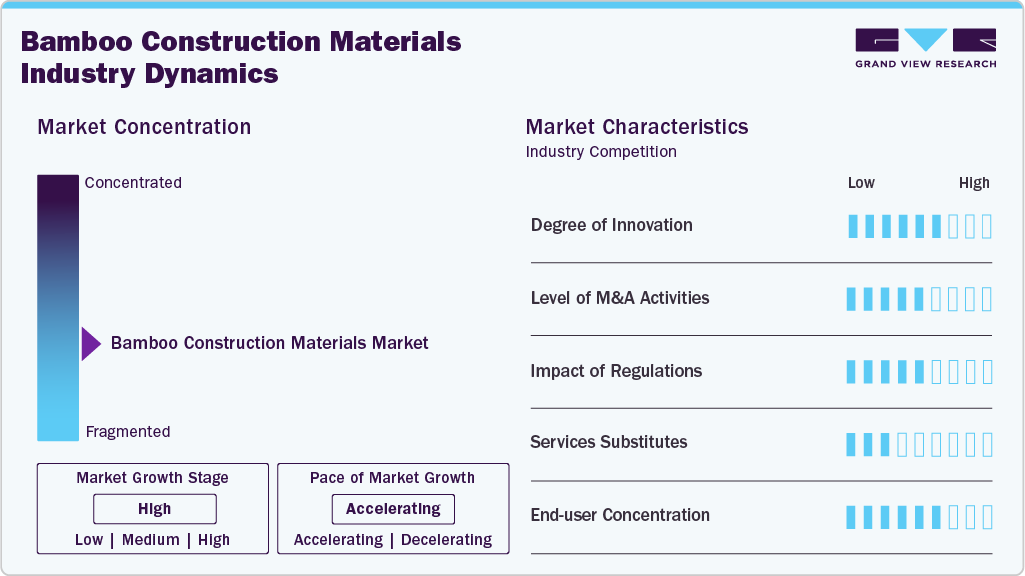
The global bamboo construction materials market is moderately fragmented, with a mix of regional manufacturers, local artisans, and emerging industrial-scale producers. The degree of innovation in the market is increasing, driven by advancements in engineered bamboo products such as laminated bamboo lumber and structural composites that enhance durability, consistency, and load-bearing capacity. Research collaborations between construction technology firms and academic institutions are fostering innovation in treatment, preservation, and processing techniques. However, the industry still faces challenges in scaling standardized production processes globally. Mergers and collaborations are relatively limited but gradually increasing as companies seek to consolidate their supply chains and expand international distribution networks to cater to the growing demand for sustainable construction materials.
 To learn more about this report, Download Free Sample Report
 Regulatory frameworks have a significant impact on the market, as sustainability standards, green building certifications, and national construction codes increasingly recognize bamboo as a legitimate and sustainable material. These policies encourage broader acceptance and investment in bamboo-based solutions. While substitutes such as timber, steel, and recycled composites exist, bamboo’s eco-friendly and renewable nature gives it a distinct advantage in sustainability-driven projects. End-user concentration is relatively diverse, encompassing Residential Construction, commercial, and public infrastructure developers who prioritize low-carbon and aesthetic design solutions. The market is expected to evolve toward greater consolidation and technological sophistication as global demand for sustainable construction intensifies and regulatory alignment improves across regions.
Analyst Perspective
Bamboo construction materials is emerging as a key beneficiary of the global shift toward sustainable and low-carbon construction practices. Increasing adoption of green building standards, coupled with growing demand for renewable alternatives to traditional materials, is driving the use of bamboo across residential, commercial, and interior applications. Advancements in engineered bamboo products are enhancing structural performance, durability, and design flexibility, enabling wider acceptance in modern construction projects. As regulatory focus on sustainability intensifies and developers seek environmentally responsible building solutions, companies with strong sourcing capabilities, advanced processing technologies, and certified product portfolios are expected to gain a competitive advantage in this evolving market.
Product Type Insights
Based on product type, the bamboo lumber & panels segment led the market with the largest revenue share of 37.2% in 2025 and is expected to grow at a CAGR of 4.7% over the forecast period, driven by the rising adoption of engineered bamboo products as sustainable alternatives to conventional timber and plywood. Advances in manufacturing technologies such as cross-lamination, resin infusion, and heat treatment have improved bamboo’s structural stability, strength, and resistance to warping. These properties make bamboo panels suitable for use in structural frameworks, furniture, and decorative surfaces. In addition, increasing environmental regulations promoting renewable construction materials are encouraging builders to choose bamboo-based panels for green building certifications.
Bamboo flooring segment is expected to grow at fastest CAGR of 5.1% over the forecast period, driven by the increasing consumer preference for natural, renewable, and visually appealing flooring solutions. Bamboo offers the aesthetic appeal of hardwood with superior sustainability and affordability, making it attractive for residential and commercial interiors. Technological innovations in strand-woven bamboo flooring have significantly enhanced its hardness, durability, and moisture resistance, allowing it to compete effectively with premium wood species. The rise in eco-conscious home renovation trends, especially in North America and Europe, has further accelerated demand.
End Use Insights
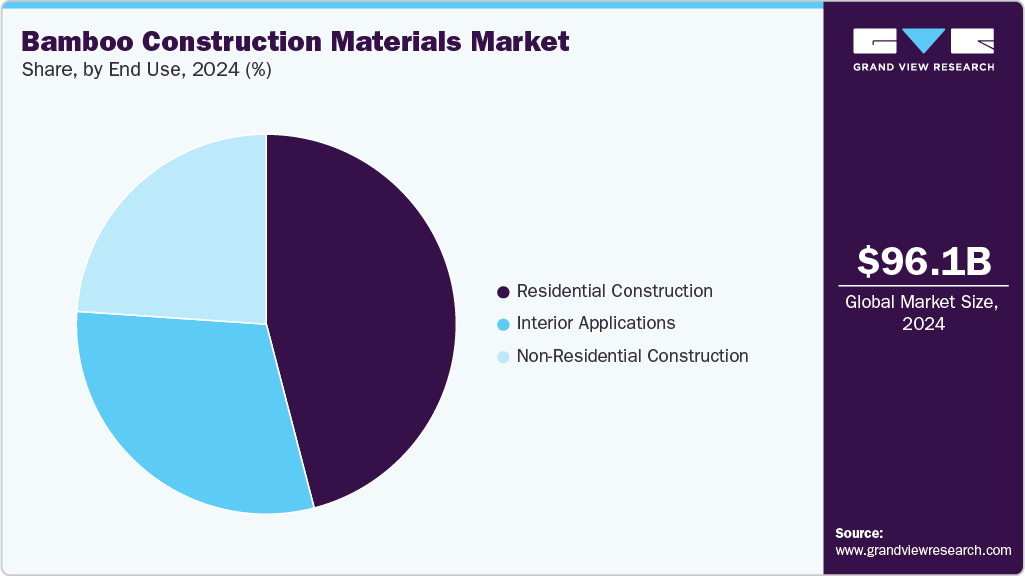
Based on end use, the residential construction segment led the market with the largest revenue share of 46.0% in 2025 and is expected to grow at a CAGR of 4.6% over the forecast period, driven by the growing demand for sustainable and energy-efficient housing solutions. Homeowners and developers are increasingly turning to bamboo as a cost-effective and renewable material for flooring, roofing, wall panels, and framing applications. Its high tensile strength and natural insulation properties make it suitable for both tropical and temperate climates. Government-backed initiatives promoting green housing and carbon-neutral developments are also supporting bamboo adoption in new residential projects.
 To learn more about this report, Download Free Sample Report
 Interior applications segment is expected to grow at fastest CAGR of 5.0% over the forecast period, driven by the growing integration of bamboo in modern architectural and design projects for its versatility and aesthetic value. Bamboo’s natural texture, color variety, and design flexibility make it a preferred material for wall claddings, ceiling panels, furniture, and decorative elements. Increasing trends in sustainable interior design, coupled with demand for biophilic and minimalist aesthetics, are fueling the segment’s growth. Manufacturers are offering a wider range of treated and laminated bamboo products tailored for interior use, ensuring resistance to humidity and pests.
Regional Insights
Asia Pacific Bamboo Construction Materials Market Trends
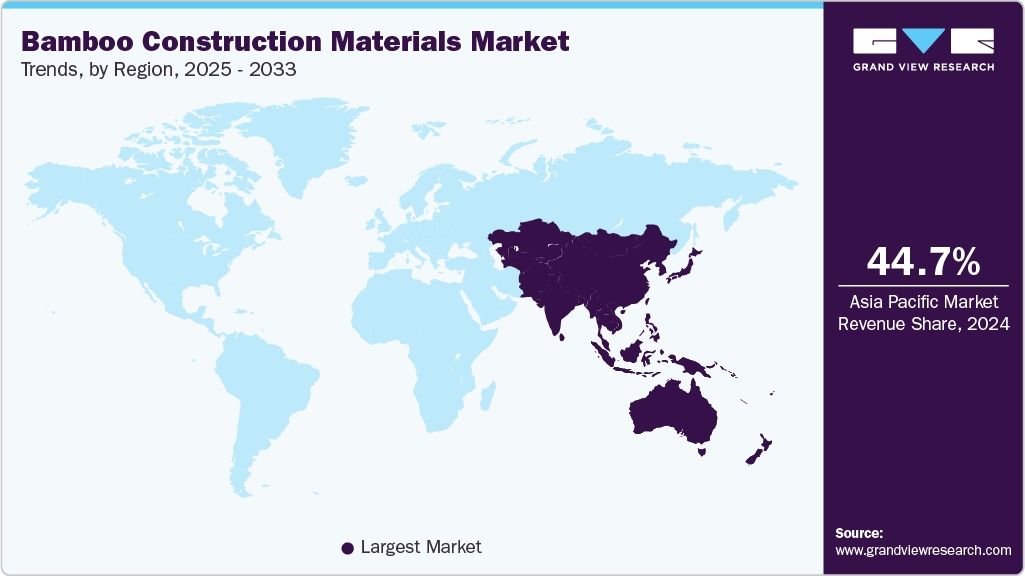
Asia Pacific dominated the bamboo construction materials market with the largest revenue share of 44.9% in 2025, due to abundant bamboo resources, supportive government policies, and rising infrastructure development. Countries such as China, India, Indonesia, and Vietnam actively promote bamboo as a sustainable alternative to timber for affordable housing and rural development projects. The rapid pace of urbanization, coupled with low-cost production and labor advantages, further strengthens regional growth. Investments in bamboo treatment technologies and engineered bamboo innovations enhance structural integrity and expand usage in commercial and residential construction projects. Growing export potential and international collaborations are also driving market expansion across the region.
 To learn more about this report, Download Free Sample Report
 The bamboo construction materials market in China held the largest share in the Asia Pacific region in 2025. China is a leading producer and consumer of bamboo construction materials, driven by its rich bamboo reserves and strong government initiatives promoting green construction. The country’s push toward carbon neutrality by 2060 has accelerated the use of renewable materials such as bamboo in public infrastructure and housing projects. Continuous innovation in engineered bamboo products and large-scale manufacturing capabilities have made China a global hub for sustainable material exports. Moreover, the integration of bamboo in eco-tourism, landscaping, and prefabricated structures is gaining popularity. Domestic demand is further supported by favorable policies encouraging local communities to cultivate and process bamboo for value-added construction applications.
North America Bamboo Construction Materials Market Trends
The North America bamboo construction materials market is driven by a growing commitment to sustainable building practices and green certifications such as LEED and WELL. Rising environmental awareness among consumers and builders is encouraging the adoption of renewable and low-carbon materials. Advances in engineered bamboo technologies, including laminated and cross-laminated panels, have expanded applications in Residential Construction and commercial architecture. The region’s emphasis on sustainable urban development and net-zero construction is fostering greater use of bamboo in interior design, flooring, and structural components. Additionally, the increasing collaboration between U.S. and Canadian firms with Asian suppliers supports market growth through knowledge transfer and improved material availability.
U.S. Bamboo Construction Materials Market Trends
In the U.S., the market is driven by the rapid integration of bamboo products into sustainable and modular construction systems. Growing federal and state-level initiatives promoting eco-friendly infrastructure and carbon-neutral building materials are strengthening the market. The rising trend of using natural and aesthetic materials in home remodeling and commercial design also fuels demand. Furthermore, the availability of imported engineered bamboo products from Asia and technological advancements in local manufacturing have improved accessibility and quality. The U.S. green construction industry’s focus on circular economy models and material recycling provides an additional boost to the adoption of bamboo-based solutions.
Europe Bamboo Construction Materials Market Trends
The Europe bamboo construction materials market is driven by strict environmental regulations, increasing demand for sustainable materials, and the European Green Deal initiatives. Growing emphasis on reducing construction-related emissions is prompting architects and developers to incorporate bamboo in sustainable building designs. Technological innovations, such as bamboo-reinforced composites and hybrid materials, are enhancing performance and durability under European climate conditions. The expanding eco-tourism and hospitality sectors are also using bamboo in interior and outdoor architectural applications. Moreover, collaborations with Asian manufacturers are enabling European firms to access high-quality engineered bamboo products for large-scale projects.
In Germany, the bamboo construction materials market is propelled by strong sustainability policies, innovative architecture trends, and high consumer awareness regarding eco-friendly materials. The country’s advanced engineering capabilities are facilitating the use of bamboo in high-performance composites, furniture, and modular structures. Support from government-backed initiatives focused on green construction and energy-efficient buildings further strengthens market growth. Increasing demand for biobased materials in both Residential Construction and commercial sectors complements Germany’s goal of reducing dependence on traditional timber and concrete. In addition, research institutions and design firms are exploring bamboo’s potential in circular economy models and climate-resilient architecture.
Latin America Bamboo Construction Materials Market Trends
The Latin America bamboo construction materials market is driven by the region’s abundant bamboo availability and the growing trend of sustainable housing initiatives. Governments in countries such as Colombia, Ecuador, and Brazil are encouraging bamboo cultivation and usage for low-cost, resilient housing solutions. Rising eco-tourism and sustainable resort projects are also creating new opportunities for bamboo-based construction. Moreover, bamboo’s natural resilience to seismic activity makes it a favorable material in earthquake-prone areas. Increasing community-level manufacturing, coupled with international funding for sustainable development, further boosts regional market growth and adoption across rural and urban sectors.
Middle East & Africa Bamboo Construction Materials Market Trends
The Middle East & Africa market is witnessing growing interest in bamboo construction materials due to increasing sustainability awareness and diversification of building materials. Rapid urbanization and a rising focus on green infrastructure projects are encouraging the adoption of eco-friendly materials such as bamboo for landscaping, interiors, and modular housing. In regions facing resource scarcity, bamboo offers a lightweight, renewable, and cost-effective alternative to traditional materials. Support from global organizations promoting sustainable development and carbon-neutral construction is also accelerating market penetration. Furthermore, tourism-oriented projects, especially in Africa, are integrating bamboo structures to enhance eco-aesthetic appeal and reduce environmental impact.
Key Bamboo Construction Material Company Insights
Some of the key players operating in market include Smith & Fong Co., Inc., Dasso Group
-
Smith & Fong Co., Inc. specializes in sustainable bamboo architectural materials under its brand Plyboo. The company produces bamboo panels, flooring, wall systems, and acoustic panels designed for both commercial and Residential Construction use. Smith & Fong focuses on innovation, offering environmentally responsible products that combine aesthetic appeal with high structural integrity, certified by third-party sustainability programs.
-
Dasso Group is a pioneer in engineered bamboo technology, known for its patented fusion bamboo products. The company offers outdoor decking, cladding, and structural materials that are resistant to weathering, decay, and pests. Dasso’s advanced thermal and resin treatment processes enhance the material’s strength and longevity, positioning it as a sustainable alternative to tropical hardwoods in global construction markets.
Bamboo Australia Pty Ltd., Teragren LLC are some of the emerging market participants in bamboo construction materials market.
-
Bamboo Australia Pty Ltd. is a leading producer and distributor of raw and processed bamboo products. The company provides construction-grade bamboo poles, laminated boards, and custom-processed materials for architectural and landscaping projects. It emphasizes environmental sustainability through eco-friendly cultivation practices and supports the growing demand for renewable materials.
-
Teragren LLC manufactures high-quality bamboo building materials with a focus on environmental responsibility and superior craftsmanship. Its product portfolio includes bamboo flooring, countertops, panels, and veneer sheets designed for sustainable construction and interior applications.
Key Bamboo Construction Material Companies:
The following key companies have been profiled for this study on the bamboo construction materials market.
-
MOSO International B.V.
-
Smith & Fong Co., Inc.
-
Dasso Group
-
Bamboo Australia Pty Ltd.
-
Teragren LLC
-
Plyboo (Smith & Fong’s brand)
-
Bamboo Revolution
-
Xiamen Yusheng Bamboo Products Co., Ltd.
-
Guangxi Fenglin Wood Industry Group
Competitive Benchmarking
Category
Operating Strategies
Competitive Edge
Weakness
Established Players (Smith & Fong Co., Inc., Dasso Group)
- Invest in engineered bamboo products such as laminated bamboo lumber, strand-woven bamboo, and structural bamboo systems.
- Focus on product innovation, sustainability certifications, and compliance with international building standards to enhance market acceptance.
- Strong brand recognition and extensive experience in engineered bamboo manufacturing.
- Diversified product portfolios covering structural bamboo, flooring, panels, decking, and architectural applications
- Established global distribution networks and strong relationships with developers, architects, and sustainable construction stakeholders.
- High dependence on construction and real estate market cycles.
- Higher production costs associated with advanced processing technologies and quality control requirements.
Emerging Players (Bamboo Australia Pty Ltd., Teragren LLC)
- Focus on niche bamboo construction applications and region-specific sustainable building solutions.
- Develop customized bamboo products for residential, commercial, and interior design projects.
- Expand market presence through eco-friendly branding, local partnerships, and green building initiatives.
- Agile operations enabling quicker response to evolving customer preferences and regional demand patterns.
- Strong sustainability positioning and growing recognition in environmentally conscious construction markets.
- Limited manufacturing scale and distribution capabilities compared to established players.
Recent Developments
-
In August 2025, Veribambu introduced its outdoor anti-slip bamboo decking series, developed for exterior applications including gardens, patios, balconies, and commercial outdoor environments. Crafted from high-strength natural bamboo, the decking is specially treated to enhance weather resistance and surface grip, offering improved durability and safety performance in outdoor conditions.
Bamboo Construction Materials Market Report Scope
Report Attribute
Details
Market size in 2025
USD 100.5 billion
Estimated market size in 2026
USD 105.0 billion
Projected market size by 2033
USD 142.9 billion
Growth rate
CAGR of 4.5% from 2026 to 2033
Base year for estimation
2025
Historical data
2021 - 2024
Forecast period
2026 - 2033
Quantitative units
Revenue in USD million/billion and CAGR from 2026 to 2033
Report coverage
Revenue forecast, company ranking, competitive landscape, growth factors, and trends
Segments covered
Product, end use, region
Regional scope
North America; Europe; Asia Pacific; Central & South America; Middle East & Africa
Country scope
U.S.; Canada; Mexico; UK; Germany; France; Italy; China; India; Japan
Key companies profiled
MOSO International B.V.; Smith & Fong Co., Inc.; Dasso Group; Bamboo Australia Pty Ltd.; Teragren LLC; Plyboo; Bamboo Revolution; Xiamen Yusheng Bamboo Products Co., Ltd.; Guangxi Fenglin Wood Industry Group
Customization scope
Free report customization (equivalent up to 8 analysts' working days) with purchase. Addition or alteration to country, regional & segment scope.
Pricing and purchase options
Avail customized purchase options to meet your exact research needs. Explore purchase options
Global Bamboo Construction Materials Market Report Segmentation
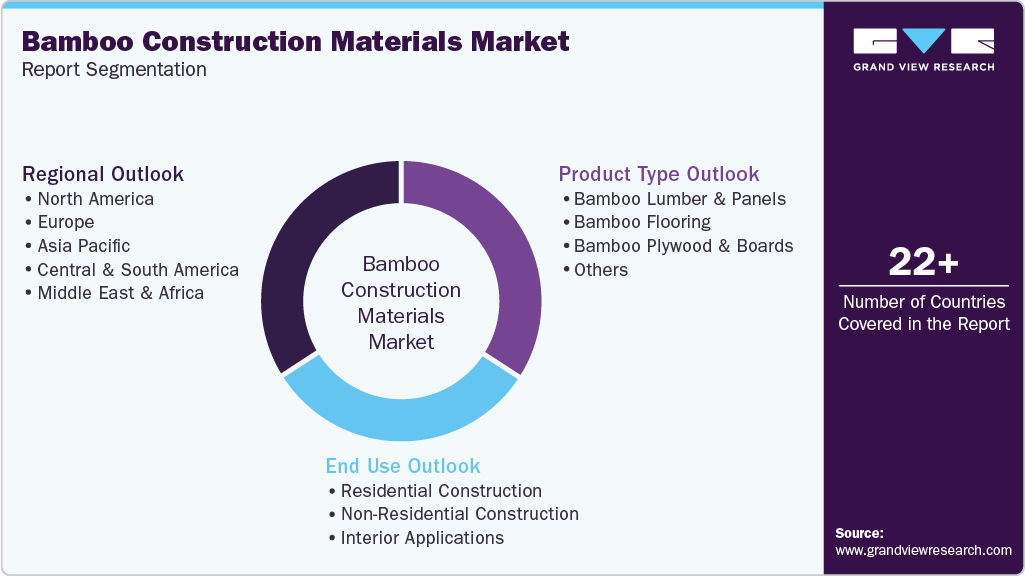
This report forecasts revenue growth at global, regional, and country levels and provides an analysis of the latest industry trends in each of the sub-segments from 2021 to 2033. For this study, Grand View Research has segmented the global bamboo construction materials market report based on product type, end use, and region.
 To learn more about this report, Download Free Sample Report
 -
Product Type Outlook (Revenue, USD Billion, 2021 - 2033)
-
Bamboo Lumber & Panels
-
Bamboo Flooring
-
Bamboo Plywood & Boards
-
Others
-
-
End Use Outlook (Revenue, USD Billion, 2021 - 2033)
-
Residential Construction
-
Non-Residential Construction
-
Interior Applications
-
-
Regional Outlook (Revenue, USD Billion, 2021 - 2033)
-
North America
-
U.S.
-
Canada
-
Mexico
-
-
Europe
-
Germany
-
UK
-
France
-
Italy
-
Spain
-
-
Asia Pacific
-
China
-
Japan
-
India
-
-
Central & South America
-
Middle East & Africa
-
Research Methodology
The bamboo construction materials market figures in this report are based on a proven research process that combines executive interviews with secondary research from proprietary databases, company filings, and recognized regulatory and institutional sources. Market size is built through value-chain sizing - reconciling supply-side and demand-side estimates - and triangulated with bottom-up and top-down approaches. Every estimate passes multiple levels of expert validation before publication, with each bamboo construction materials segment quantified using the revenue-capture definitions in the table below.
Segment Definition
Segment - Product Type
Revenue Capture Definition
Bamboo Lumber & Panels
Revenue generated from bamboo lumber, structural bamboo beams, laminated bamboo panels, and engineered bamboo products used in load-bearing structures, wall systems, roofing frameworks, partitions, and sustainable building applications. This segment captures revenues from manufacturers and suppliers offering high-strength, durable, and eco-friendly bamboo construction materials for residential, commercial, and infrastructure projects.
Bamboo Flooring
Revenue generated from bamboo flooring products used in residential, commercial, hospitality, educational, and institutional buildings. This segment captures revenues from suppliers offering solid bamboo flooring, engineered bamboo flooring, strand-woven bamboo flooring, and decorative flooring solutions valued for their durability, aesthetic appeal, and sustainability attributes.
Bamboo Plywood & Boards
Revenue generated from bamboo plywood, bamboo boards, bamboo composite panels, and sheet materials used in wall cladding, ceilings, cabinetry, furniture, partitions, and interior construction applications. This segment captures revenues from manufacturers providing lightweight, moisture-resistant, and sustainable panel products for both structural and non-structural building uses.
Others
Revenue generated from other bamboo-based construction materials including bamboo roofing products, bamboo scaffolding, bamboo fencing, bamboo veneer, bamboo composites, decorative architectural components, and specialty engineered bamboo solutions. This segment captures revenues from niche and emerging bamboo construction applications across residential, commercial, and infrastructure developments.
Segment - End Use
Revenue Capture Definition
Residential Construction
Revenue generated from bamboo construction materials used in single-family homes, multi-family housing, affordable housing projects, villas, apartments, and residential renovations. This segment captures revenues from bamboo products utilized in structural frameworks, flooring, wall systems, roofing, decking, and other residential building components.
Non-Residential Construction
Revenue generated from bamboo construction materials used in commercial buildings, offices, hotels, educational institutions, healthcare facilities, retail spaces, public buildings, industrial facilities, and infrastructure projects. This segment captures revenues from bamboo products employed for structural, architectural, and decorative applications in non-residential developments.
Interior Applications
Revenue generated from bamboo materials used in interior design and fit-out applications, including flooring, wall panels, ceilings, partitions, cabinetry, furniture components, decorative finishes, and acoustic solutions. This segment captures revenues from suppliers serving residential, commercial, hospitality, and institutional interior construction and renovation projects.
Estimation Model
Layer Name
Key Question
Description
Global Sustainable Construction Materials Market
What is the total market size of sustainable construction materials used across global building and infrastructure projects?
This layer represents the broader sustainable construction materials ecosystem, including engineered wood, bamboo materials, recycled building products, green concrete, low-carbon steel, natural fiber composites, and other environmentally friendly construction materials used across residential, commercial, industrial, and infrastructure projects globally. It captures demand generated from green building initiatives, sustainable urban development, and environmentally conscious construction practices.
Global Bamboo Construction Materials Market
What portion of the sustainable construction materials market is represented by bamboo-based construction products?
This layer narrows the focus to bamboo construction materials used across structural, architectural, and decorative building applications. It includes bamboo lumber, engineered bamboo products, bamboo panels, bamboo flooring, bamboo plywood, bamboo boards, and other bamboo-based construction materials utilized in residential, commercial, and infrastructure projects. Demand is driven by sustainability objectives, renewable material adoption, and increasing acceptance of bamboo as an alternative to conventional construction materials.
Engineered Bamboo Construction Materials Market
What share of the bamboo construction materials market consists of engineered and processed bamboo products?
This layer focuses specifically on value-added and engineered bamboo construction products such as laminated bamboo lumber (LBL), strand-woven bamboo, bamboo composite panels, bamboo plywood, structural bamboo beams, and prefabricated bamboo building components. It captures demand generated from applications requiring enhanced strength, dimensional stability, durability, and compliance with modern building standards across residential and non-residential construction projects.
Bamboo Construction Materials Market (End-Use Commercialization)
What is the market value of bamboo construction materials commercialized across end-use applications globally?
This final layer represents revenues generated from bamboo construction materials deployed across residential construction, non-residential construction, and interior applications. The market is driven by increasing adoption of sustainable building materials, growth in green-certified construction projects, rising demand for eco-friendly interiors, and expanding utilization of engineered bamboo products in modern architectural and infrastructure developments worldwide.
Delivered Customizations
This report has been delivered with the following In-depth customizations
CLIENT REQUEST
CUSTOMIZATION DELIVERED
VALUE ADDS
Competitive Landscape & Strategic Benchmarking
Benchmarking of leading bamboo construction material manufacturers based on product portfolio, engineered bamboo capabilities, production capacity, geographic presence, certification portfolio, distribution networks, sustainability initiatives, and strategic positioning.
Delivered actionable competitive intelligence to support market entry strategies, partnership identification, supplier evaluation, acquisition opportunities, and competitive differentiation initiatives.
Sustainability Assessment & Green Building Alignment
Evaluation of bamboo's environmental benefits, carbon footprint reduction potential, sustainability certifications, responsible sourcing practices, and alignment with green building frameworks such as LEED, BREEAM, WELL, and other regional sustainability standards.
Assisted clients in strengthening ESG positioning, aligning product offerings with sustainable construction trends, enhancing green building participation, and supporting environmentally focused marketing and investment strategies.
Future Technology & Innovation Outlook
Assessment of emerging innovations including engineered bamboo products, laminated bamboo lumber, bamboo composites, advanced preservation technologies, prefabricated bamboo construction systems, and digital design integration for sustainable buildings.
Enabled clients to anticipate technology shifts, prioritize R&D investments, identify high-growth application areas, and capitalize on long-term opportunities within the evolving sustainable construction ecosystem.
Frequently Asked Questions About This Report
Asia Pacific dominated the bamboo construction materials market with a 44.9% revenue share in 2025.
Asia Pacific is the fastest-growing region in the bamboo construction materials market with a CAGR of 4.9% over the forecast period.
The residential construction segment led with a 46.0% revenue share in 2025, while the interior applications is the fastest-growing segment.
Bamboo flooring is the fastest-growing product segment in the bamboo construction materials market, with a CAGR of 5.1% over the forecast period.
Bamboo lumber & panels segment led the market and accounted for the largest revenue share of 37.2% in 2025, driven by the rising adoption of engineered bamboo products as sustainable alternatives to conventional timber and plywood.
The global bamboo construction materials market size was valued at USD 100.5 billion in 2025 and is estimated at USD 105.0 billion for 2026.
The global bamboo construction materials market is expected to grow at a CAGR of 4.5% from 2026 to 2033, reaching USD 142.9 billion by 2033.
Some of key players in the bamboo construction materials market are MOSO International B.V., Smith & Fong Co., Inc., Dasso Group, Bamboo Australia Pty Ltd., Teragren LLC, Plyboo, Bamboo Revolution, Xiamen Yusheng Bamboo Products Co., Ltd., and Guangxi Fenglin Wood Industry Group.
The key factors driving the bamboo construction materials market include growing demand for sustainable and renewable building materials, advancements in engineered bamboo technologies, supportive government regulations promoting green construction, and rising adoption of eco-friendly design practices across residential and commercial projects.
About the Author(s)
Advanced Interior Materials Research Team
Advanced Materials · Advanced Interior MaterialsThis report was authored by the advanced interior materials research team at Grand View Research - comprising two research analysts, one senior research analyst, and one industry expert - with specialized expertise in the advanced interior materials segment of the advanced materials industry. All findings are based on proprietary advanced materials databases, executive interviews, and regulatory analysis, subject to internal peer review prior to publication.
Last Updated:
Speak to Analyst

Customize this report to your needs - add regions, segments, or data points, with 20% free customization.
Or view our licence options:


ISO 9001:2015 & 27001:2022 Certified
We are GDPR and CCPA compliant! Your transaction & personal information is safe and secure. For more details, please read our privacy policy.


