
- Home
- »
- Nutraceuticals & Functional Foods
- »
-
Barley Market Size, Share, Trends, Growth Report, 2026-2033GVR Report cover

Barley Market (2026 - 2033)
Size, Share & Trends Analysis Report By Type (Whole Grain, Flakes, Flour, Malted), By Application (Food, Feed, Beverages), By Distribution Channel (Food & Beverage Industry, Retail), By Region, And Segment Forecasts
Market Size, 2025
$151.0BMarket Estimate, 2026
$155.2BMarket Forecast, 2033
$196.4BCAGR, 2026–2033
3.4%Barley Market Summary
The global barley market size was estimated at USD 151.0 billion in 2025 and is projected to grow from USD 155.2 billion in 2026 to USD 196.4 billion by 2033, growing at a CAGR of 3.4% from 2026 to 2033. Europe dominated the market, accounting for a revenue share of 60% in 2025. The growth of the market for barley is majorly driven by factors such as the growing usage of barley in the brewing and distilling industry, paired with rising demand for malted barley in several food and beverage applications.
Key Market Trends & Insights
- By type: The malted barley segment held the largest revenue share at approximately 60.0% in 2025.
- By application: The beverage segment held the largest revenue share of over 58.0% in 2025.
- By distribution channel: The food & beverage segment held the largest revenue share of approximately 80.0% in 2025.
Regional Highlights
- Largest regional market: Europe (over 60% revenue share, 2025)
- Fastest-growing regional market: Asia Pacific (highest CAGR, 2026-2033)
Market Size & Forecast
- Market size in 2025: USD 151.0 Billion
- Estimated market size in 2026: USD 155.2 Billion
- Projected market size by 2033: USD 196.4 Billion
- CAGR (2026-2033): 3.4%
Three ways to get this report
Buy it, customize it, or ask a question.Ask an Analyst
Analyst response in 1 business day
- AccessReport author, directly
- Reply timeWithin 1 working day
- No sales callDirect answer only
- FormatEmail reply
- CostFree, no cost
Get the Full Report
What the study covers
- FormatsPDF · Excel · Dashboard
- Timeline2026–2033 annual, 2025 base
- Coverage20+ countries, 5 regions
- Companies10+ key players profiled
Customize the Report
20% free customization
- IncludeCountries, segments, points
- TailorTo your product definition
- ExtendDeeper competitor detail
- OrA fully bespoke study
- Turnaround5–10 working days
High consumption of alcoholic beverages, including craft beer and premium spirits, is expected to promote market growth. Barley is used for malt production, which is a key ingredient in beer and alcoholic beverages. This growth fuels the demand for barley in the food and beverage sector. Barley is the major crop used in the feed of animals, including poultry, pigs, and cattle, and its cultivation worldwide plays an important role in livestock production. The demand for meat and dairy products, particularly in developing countries, has been increasing due to population growth and rising incomes. This trend drives the demand for barley as a feed grain. According to the USDA, close to 70% of barley traded is used primarily in the feed industry, with the least used for human food. Switzerland-based Syngenta offers a hybrid feed barley variety colossus in the UK market. The hybrid variety enhances the performance of the barley grain.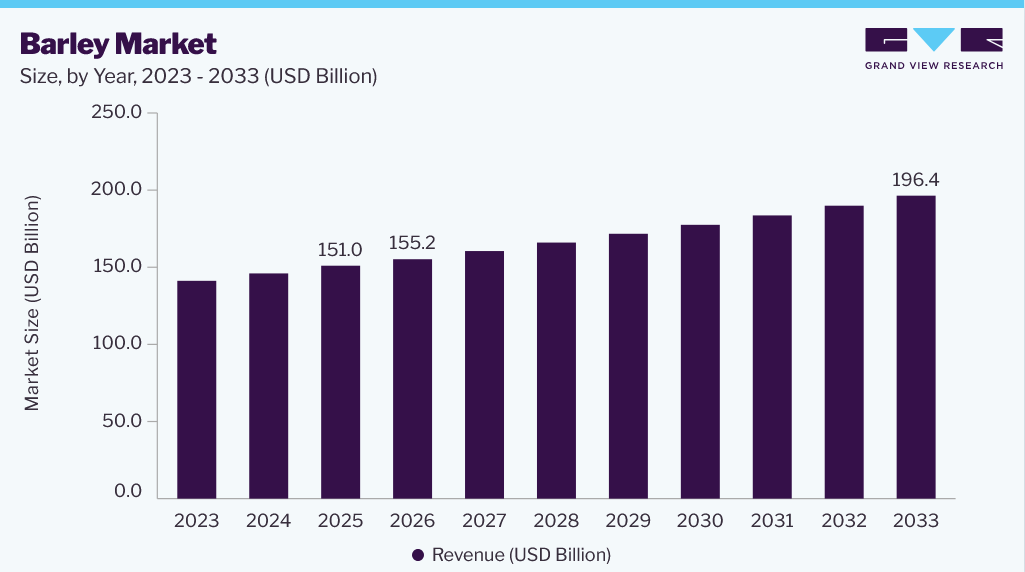 Source: Grand View Research, IR Documents, Primary Interviews, Paid DatabasesTo learn more about this report,
 Download Free Sample Report
 The combination of starch and protein barley provides a balanced nutrient profile for animals. This makes barley an attractive choice for formulating animal diets, as it offers both energy and protein to support growth, milk production, and overall animal health. Moreover, the relatively high energy density of barley enables efficient feed utilization by livestock, promoting optimal performance and productivity. In addition, Barley's adaptability to diverse pedo-climatic conditions further enhances its value as a feed ingredient. It can be successfully grown in regions where other cereal crops may face challenges, thereby expanding its feed grain availability.
Market Dynamics
The increasing demand for barley from the brewing, malting, and livestock feed industries remains a key driver of the global barley market. Barley is a critical raw material for malt production, which is extensively used in beer, whiskey, and other alcoholic beverages. The brewing sector accounts for a significant share of global malted barley consumption, highlighting the grain's importance in beverage production. Many companies are shifting from using tradition barley to regenerative barley for beer brewing. For instance, in June 2025, Carlsberg launched it new line of Danish beer made from 100% regenerative barley. The company planned to brew 100 million liters of beer made from regenerative barley by 2026. Similarly, in 2024, Molson Coors launched an industry-leading barley program. The company is aiming to make the U.S. self-sufficient in barley production. A notable example of sustained industry demand was the 2025 partnership announced between Soufflet Malt and Heineken to establish a new malting facility in South Africa, sourcing barley from local farmers and strengthening regional malt supply chains. Such programs are expected to boost the demand for barley for the beverage industry.
The barley market remains highly dynamic, pertaining to the trade challenges, export restrictions, dynamic tariffs, sanctions, and evolving import regulations, which can disrupt global supply chains and create market uncertainty. In addition, the declining demand for barley from the brewing industry is emerging as a key restraint. Food, alcohol, and industrial (FAI) applications have become a major end-use segment for barley, particularly in malt production for beer. However, beer production in key markets such as the U.S. has been declining over the past decade. According to data from the U.S. Department of the Treasury's Alcohol and Tobacco Tax and Trade Bureau (TTB), the U.S. beer production declined by more than 13% between marketing years 2016/17 and 2023/24. Furthermore, production trends through early 2025 indicate continued weakness in beer output. As the brewing industry is a significant demand driver for malting barley, and sustained declines in beer production may limit growth opportunities for the barley market.
The increasing focus on sustainable energy and low-carbon fuels is creating new opportunities for the barley market. Governments across the world are promoting biofuels to reduce greenhouse gas emissions and support decarbonization goals. According to the International Energy Agency (IEA), global biofuel production needs to grow significantly to meet the Net Zero Emissions by 2050 scenario, with production expected to exceed 10 EJ by 2030. In addition, the use of advanced and non-food feedstocks is expected to increase, creating opportunities for a wider range of agricultural crops and residues.
Countries such as India, Brazil, the U.S., and Canada are actively expanding biofuel consumption through supportive policies and investment programs. For example, India achieved 20% ethanol blending ahead of schedule in 2024 and is working toward a higher blending target. Similarly, the U.S. Inflation Reduction Act provides substantial incentives for biofuel production and investment. These developments may create additional demand opportunities for barley as biofuel technologies continue to evolve.
Analyst Perspective
Supported by strong demand from the animal feed, malting, and food processing industries, barley market is expected to grow consistently over the coming years. Rising consumption of livestock products and the continued use of barley in beer and malt production. Growing consumer demand for healthy and fiber-rich grains is also encouraging the use of barley in functional foods and beverages. Additionally, emerging opportunities in sustainable agriculture and biofuel applications are expected to support long-term market growth despite challenges such as trade uncertainties and fluctuations in brewing demand.
Type Insights
In 2025, the malted barley segment held the largest share, accounting for approximately 60.0% of revenue. The rise in artisanal beverages and craft beverages is favoring the growth of the market for barley. Factors such as rising demand for beverages such as craft beer and whiskey, coupled with the enhancement of texture and flavor provided by malted barley, are driving the demand in the segment. Additionally, growing demand for health and functional beverages is also expected to drive the demand. For instance, in 2024, REBEL, a functional beverage company introduce its 26g Protein Shakes made from upcycled barley.
The whole-grain barley segment is expected to post the fastest CAGR of over 4.0% during the forecast period. Increasing awareness of the health benefits associated with whole grains has led to a growing demand for whole-grain products, including barley. Whole grain barley retains all parts of the grain, including the bran, germ, and endosperm, which are rich in fiber, vitamins, minerals, and antioxidants. Consumers seeking nutritious, wholesome food options prefer whole-grain barley because it supports digestive health, reduces the risk of chronic diseases such as heart disease and diabetes, and promotes overall well-being.
Application Insights
The beverage segment held the largest share, over 58.0%, of revenue in 2025. The rise in artisanal beverages and craft beverages is favoring the growth of the market for barley. Manufacturers are adopting the use of both traditional breeding methods and innovative technologies, such as the production of hybrid barley varieties, enhanced malting traits, and genomic tools to produce the ideal barley required for beverages. For instance, hybrid varieties produced through controlled crossbreeding have improved yield potential, disease resistance, and tolerance to environmental stresses. These hybrids can offer enhanced performance and higher yields, thereby increasing barley availability for beverage production.
The food segment is expected to showcase the fastest CAGR of approximately 4.0% during the forecast period. The rise in plant-based diets, coupled with the growing demand for natural and clean-label foods, has contributed to the demand for barley in the food industry. Barley can be used as a plant-based ingredient in various food products, including plant-based meat alternatives, soups, stews, salads, and baked goods.
Distribution Channel Insights
The distribution channel segment is bifurcated into the food & beverage industry and the retail segment. The food & beverage segment accounted for the largest revenue share, approximately 80.0%, in 2025. The growing popularity of plant-based diets and the increasing number of individuals opting for vegetarian or vegan meals have driven the demand for barley in the food & beverage industry. Barley is a valuable ingredient in vegetarian and plant-based dishes, providing a substantial filling component. It can be utilized in plant-based protein bowls, veggie burgers, grain-based salads, and other meatless alternatives, providing texture, flavor, and nutritional value.
The retail segment is anticipated to grow at a CAGR of over 3.5% during the forecast period. The rising demand for gluten-free and plant-based diets is fueling the demand for barley-based food and beverages. Several retailers are offering a variety of gluten-free and plant-based barley options.
Regional Insights
North America is expected to witness a CAGR of over 3.0% during the forecast period, owing to the high demand for barley in the feed industry in the United States. Barley is widely used as a feed grain for various livestock, including cattle, poultry, and pigs. The increasing demand for meat and dairy products, coupled with the livestock industry growth, has contributed to the need for barley as a feed ingredient.
Europe Barley Market Trends
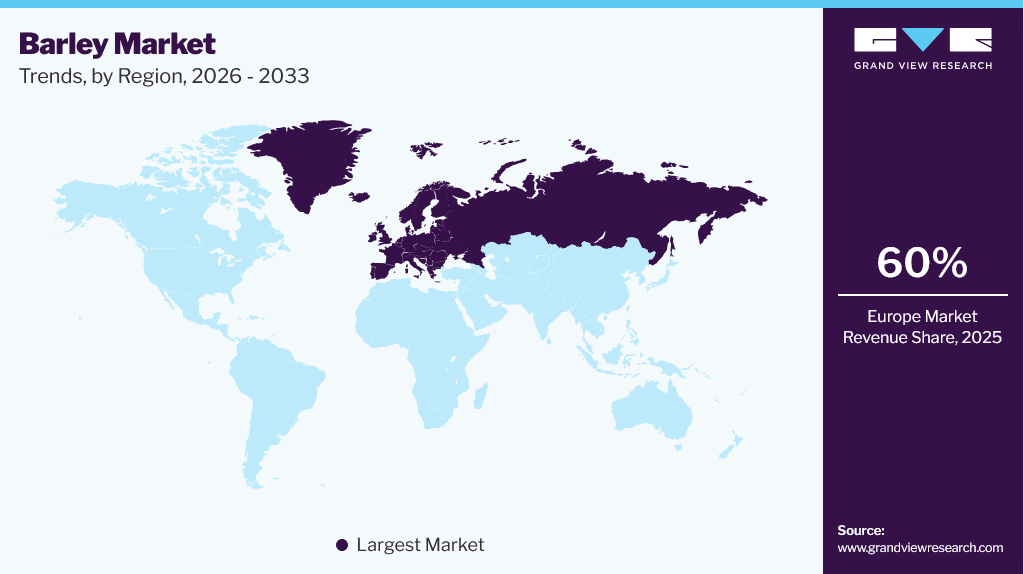
TheEurope market held a dominant revenue share of approximately 60.0% in 2025. The popularity of craft beer and artisanal spirits has been on the rise in the region. The expansion of microbreweries, brewpubs, and small-scale distilleries has fueled the need for barley to meet the growing demand for unique and high-quality beverages.
 To learn more about this report, Download Free Sample Report
 The Germany’s market is expected to showcase a significant CAGR over the forecast period. The rise in the number of craft breweries and the presence of new players in the country is driving the demand for the market in the country.
Key Barley Company Insights
The global barley market is characterized by intense competition, largely due to the presence of several players. Various companies have launched innovative products to cater to consumer demand.
Key Barley Companies
The following key companies have been profiled for this study on the barley market.
-
Soufflet Group
-
GrainCorp Limited
-
Cargill
-
Boortmalt Group
-
Malteurop Groupe
-
Crisp Malting Group
-
Muntons Plc
-
Maltexco S.A.
-
Grain Millers Inc
-
Malt Products Corp
-
Bries Malt & Ingredients Co.
Recent Developments
-
In October 2024, REBEL functional beverage company launched its 26g protein shake made from upcycled barley. The company claims the beverage is an eco-friendly and Non-GMO protein shake for health and environmental conscious consumers.
-
In July 2025, Armored Fresh and Pureture announced to launch a line of new products including yeast-based casein, barley-derived coffee, and clean-label, complete plant proteins. The barley brew coffee will be available under the brand functional food JustAlt.
Barley Market Report Scope
Report Attribute
Details
Market size in 2025
USD 151.0 billion
Estimated market size in 2026
USD 155.2 billion
Projected market size by 2033
USD 196.4 billion
Growth rate
CAGR of 3.4% from 2026 to 2033
Base year for estimation
2025
Historical data
2021 - 2024
Forecast period
2026 - 2033
Quantitative units
Revenue in USD billion, volume in Kilotons, and CAGR from 2023 to 2030
Report coverage
Revenue forecast, company ranking, competitive landscape, growth factors, and trends
Segments covered
Type, application, distribution channel, region
Regional Scope
North America; Europe; Asia Pacific; Central & South America; Middle East & Africa
Country scope
U.S.; Canada; Mexico; UK; Germany; France; Italy; Spain; China; India; Japan; Australia & New Zealand; South Korea; Argentina; Brazil; Turkey; Kazakhstan
Key companies profiled
Soufflet Group; GrainCorp Limited; Cargill; Boortmalt Group; Malteurop Groupe; Crisp Malting Group; Muntons Plc; Maltexco S.A.; Grain Millers Inc; Malt Products Corp; Bries Malt & Ingredients Co.
Customization scope
Free report customization (equivalent up to 8 analysts working days) with purchase. Addition or alteration to country, regional & segment scope.
Pricing and purchase options
Avail of customized purchase options to meet your exact research needs. Explore purchase options
Global Barley Market Report Segmentation
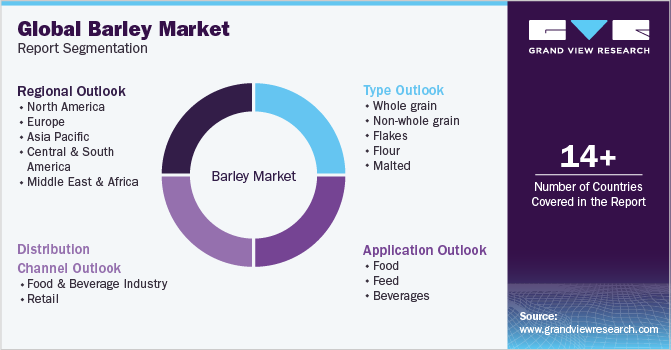
This report forecasts revenue growth at the global, regional, and country levels and provides an analysis of the latest industry trends and opportunities in each of the sub-segments from 2021 to 2033. For this study, Grand View Research has segmented the global barley market report based on type, application, distribution channel, and region:
 To learn more about this report, Download Free Sample Report
 -
Type Outlook (Revenue, USD Billion, 2021 - 2033)
-
Whole grain
-
Non-whole grain
-
Flakes
-
Flour
-
Malted
-
-
Application Outlook (Revenue, USD Billion, 2021 - 2033)
-
Food
-
Feed
-
Beverages
-
-
Distribution Channel Outlook (Revenue, USD Billion, 2021 - 2033)
-
Food & Beverage Industry
-
Retail
-
Online
-
Hypermarkets/Supermarkets
-
Wholesale Stores
-
Others
-
-
-
Regional Outlook (Revenue, USD Billion, 2021 - 2033)
-
North America
-
U.S.
-
Canada
-
Mexico
-
-
Europe
-
Germany
-
UK
-
France
-
Italy
-
Spain
-
-
Asia Pacific
-
China
-
Japan
-
India
-
Australia & New Zealand
-
South Korea
-
-
Latin America
-
Argentina
-
Brazil
-
-
Middle East & Africa
-
Turkey
-
Kazakhstan
-
-
Frequently Asked Questions About This Report
The global barley market is expected to grow at a CAGR of 3.4% from 2026 to 2033, reaching USD 196.4 billion.
type dominated the barley market with a share of 60.0% in 2025, while food is the fastest-growing segment.
The rising popularity of plant-based diets coupled with popularity of clean label ingredients among all age groups is supporting the demand for the market.
Europe dominated with a 60.0% revenue share in 2025.
The global barley market size was valued at USD 151.0 billion in 2025 and is estimated at USD 155.2 billion for 2026.
Key players include Soufflet Group, GrainCorp Limited, Cargill, Boortmalt Group, Malteurop Groupe, Crisp Malting Group, Muntons Plc, Maltexco S.A., Grain Millers Inc, Malt Products Corp, and Bries Malt & Ingredients Co
About the Author(s)
Nutraceuticals & Functional Foods Research Team
Consumer Goods · Nutraceuticals & Functional FoodsThis report was authored by the nutraceuticals & functional foods research team at Grand View Research - comprising two research analysts, one senior research analyst, and one industry expert - with specialized expertise in the nutraceuticals & functional foods segment of the consumer goods industry. All findings are based on proprietary consumer goods databases, executive interviews, and regulatory analysis, subject to internal peer review prior to publication.
Last Updated:
Speak to Analyst

Customize this report to your needs - add regions, segments, or data points, with 20% free customization.
Or view our licence options:


ISO 9001:2015 & 27001:2022 Certified
We are GDPR and CCPA compliant! Your transaction & personal information is safe and secure. For more details, please read our privacy policy.


