
- Home
- »
- Beauty & Personal Care
- »
-
Beauty And Personal Care Products Market Report, 2033GVR Report cover

Beauty And Personal Care Products Market (2026 - 2033)
Size, Share & Trends Analysis Report By Type (Conventional, Organic), By Product (Skin Care, Hair Care, Color Cosmetics), By Distribution Channel (Hypermarkets & Supermarkets, Specialty Stores, E-commerce), By Region, And Segment Forecasts
Market Size, 2025
$543.1BMarket Estimate, 2026
$580.0BMarket Forecast, 2033
$993.9BCAGR, 2026–2033
8.0%Beauty And Personal Care Products Market Summary
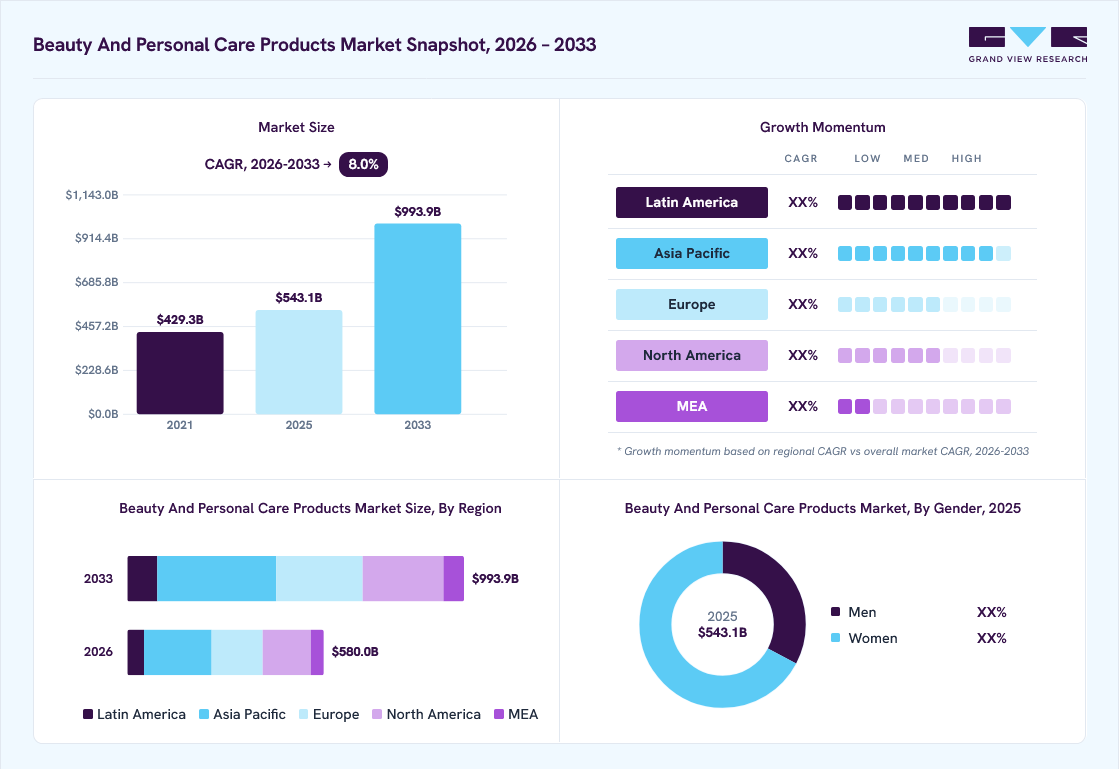
The global beauty and personal care products market size was valued at USD 543.1 billion in 2025 and is projected to grow from USD 580.0 billion in 2026 to USD 993.9 billion by 2033, at a CAGR of 8.0% from 2026 to 2033. Asia Pacific dominated the market, accounting for a revenue share of 34.3% in 2025. The global market is driven by rising consumer awareness regarding personal grooming, hygiene, appearance, and overall well-being, along with increasing disposable incomes and the growing influence of social media and digital beauty platforms.
 Source: Grand View Research, IR Documents, Primary Interviews, Paid DatabasesTo learn more about this report,
 Download Free Sample Report
 Key Market Trends & Insights
- By product: Skin Care segment led the market with the largest revenue share of 32.9% in 2025.
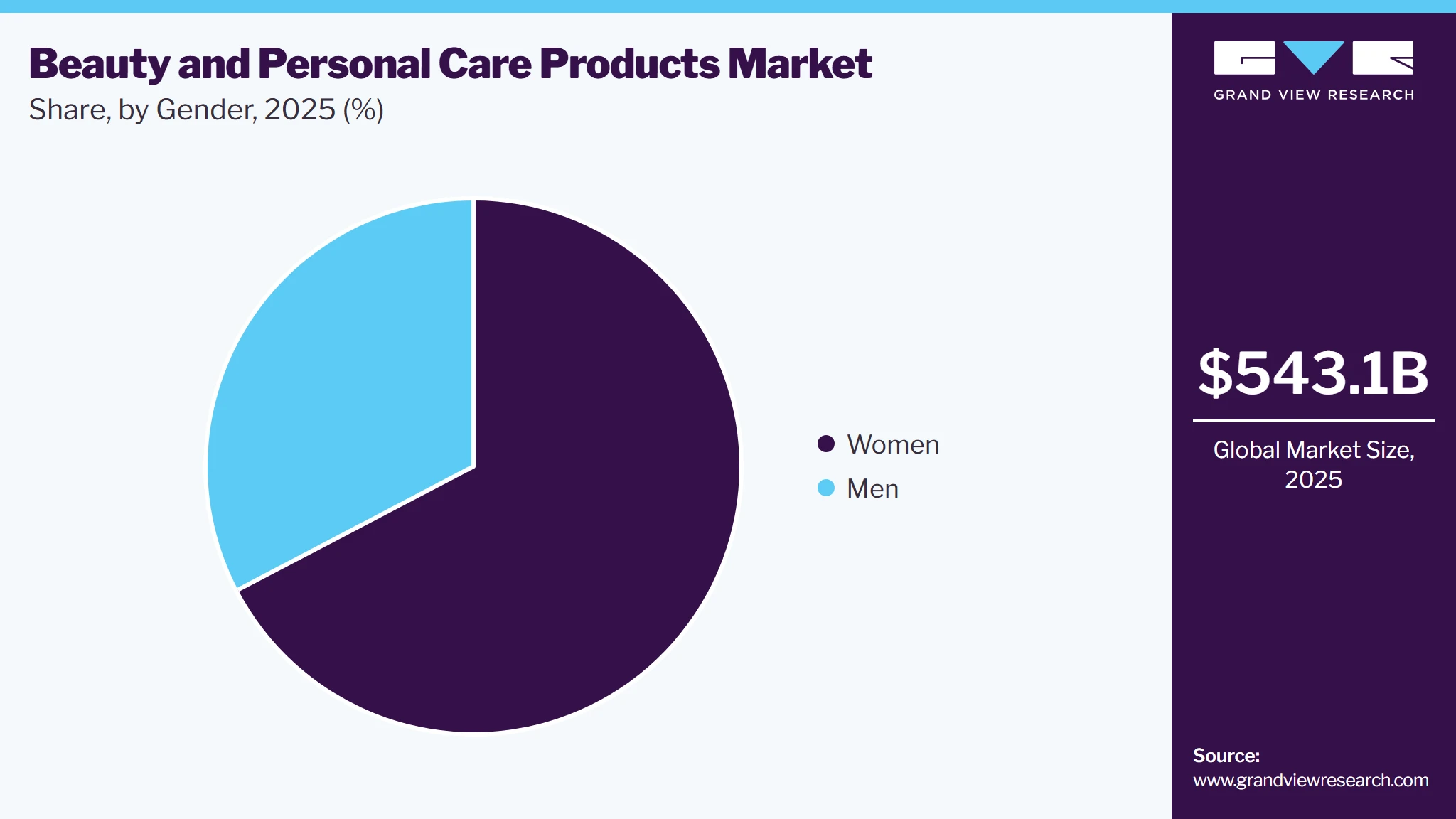
- By gender: Women segment led the market with the largest revenue share of 67.3% in 2025.
Regional Highlights
- Largest regional market: Asia Pacific (34.3% revenue share, 2025)
- By country: The China held the largest market share in 2025.
Market Size & Forecast
- Market size in 2025: USD 543.1 Billion
- Estimated market size in 2026: USD 580.0 Billion
- Projected market size by 2033: USD 993.9 Billion
- CAGR (2026-2033): 8.0%
Three ways to get this report
Buy it, customize it, or ask a question.Ask an Analyst
Analyst response in 1 business day
- AccessReport author, directly
- Reply timeWithin 1 working day
- No sales callDirect answer only
- FormatEmail reply
- CostFree, no cost
Get the Full Report
What the study covers
- FormatsPDF · Excel · Dashboard
- Timeline2026–2033 annual, 2025 base
- Coverage20+ countries, 5 regions
- Companies10+ key players profiled
Customize the Report
20% free customization
- IncludeCountries, segments, points
- TailorTo your product definition
- ExtendDeeper competitor detail
- OrA fully bespoke study
- Turnaround5–10 working days
Market growth is further supported by rising demand for skincare, haircare, color cosmetics, fragrances, and personal care products, as well as increasing consumer preference for personalized, natural, organic, clean-label, and scientifically backed formulations. For instance, L’Oréal introduced Cell BioPrint in 2025, a skin analysis technology designed to provide personalized insights and support tailored skincare recommendations, reflecting the growing adoption of technology-driven and personalized beauty solutions. The expansion of e-commerce, social commerce, direct-to-consumer channels, sustainable packaging, and product innovation is also contributing to continued market growth across developed and emerging economies.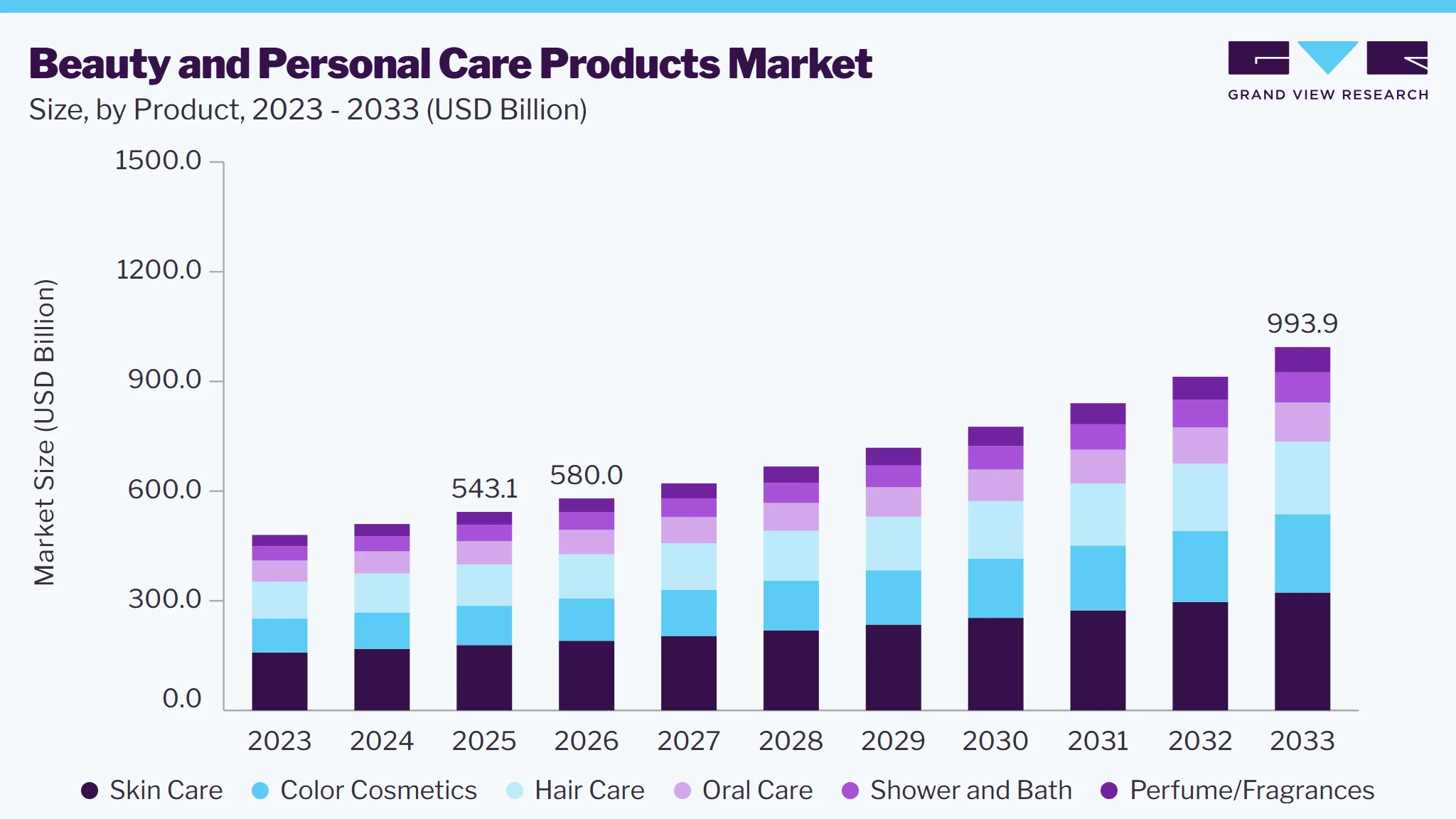 To learn more about this report, Download Free Sample Report
 The global beauty and personal care products industry is growing as consumers increasingly prioritize self-care, personal appearance, wellness, and preventive skincare. Rising demand for science-backed and efficacy-driven formulations is encouraging manufacturers to invest in advanced skin science and biotechnology. For instance, in June 2025, L’Oréal introduced Lancôme Absolue Longevity The Soft Cream, incorporating PDRN technology inspired by regenerative aesthetics. The formulation is designed to support cellular longevity by targeting skin-aging mechanisms and improving skin vitality. The development reflects the growing investment in biotechnology, advanced active ingredients, and science-backed formulations as consumers increasingly seek skincare products with demonstrated efficacy and preventive benefits.
The growing preference for personalized and technology-enabled beauty solutions is further supporting market expansion. Consumers increasingly seek products and recommendations tailored to their individual skin concerns and preferences. Reflecting this trend, L’Oréal introduced Noli, an AI-powered multi-brand beauty marketplace that uses data from more than 1 billion face-scan data points and analysis of thousands of product formulations to match consumers with suitable beauty products. This development demonstrates the increasing role of artificial intelligence and digital diagnostics in delivering personalized beauty experiences.
The increasing focus on sustainability and responsible consumption is also emerging as a key trend in the market. For instance, in May 2025, Shiseido expanded the use of its LiquiForm technology to pump dispenser containers, combining bottle molding and filling into a single process. Technology reduces the amount of plastic used in the containers by approximately 56% compared with conventional containers, while maintaining product design and functionality. This development highlights the growing focus of beauty manufacturers on packaging innovation, material reduction, and lower environmental impact.
Market Dynamics
The beauty and personal care products market is undergoing rapid transformation as consumers increasingly prioritize skincare efficacy, ingredient transparency, wellness-oriented formulations, and personalized beauty routines. Demand is shifting beyond conventional cosmetics toward multifunctional products that combine aesthetic benefits with skin health, sun protection, hydration, microbiome support, and anti-aging properties. The growing influence of social media, beauty influencers, dermatologist-backed recommendations, and e-commerce has accelerated product discovery and purchasing decisions. Additionally, continuous innovation in clean-label formulations, biotechnology-derived ingredients, and sustainable packaging is reshaping product development and strengthening long-term market growth.
Growing consumer awareness regarding skin health, preventive skincare, and ingredient efficacy is a primary driver of the beauty and personal care products market. Consumers are increasingly seeking products formulated with clinically validated active ingredients such as retinol, niacinamide, ceramides, peptides, hyaluronic acid, salicylic acid, and vitamin C to address concerns including acne, hyperpigmentation, skin aging, sensitivity, and barrier repair. This shift has fueled strong demand for dermocosmetics and dermatologist-recommended brands across both developed and emerging markets.
At the same time, rising disposable incomes and premiumization trends have encouraged consumers to invest in high-performance skincare, haircare, and personal hygiene products offering measurable benefits. The expanding male grooming segment, increasing awareness of sun protection, and the growing popularity of preventive anti-aging routines among younger consumers are further supporting sustained market expansion across multiple product categories.
The beauty and personal care products market faces significant challenges due to evolving regulatory requirements governing ingredient safety, product claims, labeling standards, and environmental compliance. Regulatory authorities across major markets are imposing stricter controls on the use of ingredients such as PFAS compounds, formaldehyde-releasing preservatives, certain UV filters, and synthetic fragrances, requiring manufacturers to continually reformulate products while ensuring efficacy and consumer acceptance.
Additionally, increasing consumer scrutiny regarding allergens, endocrine-disrupting chemicals, microplastics, and misleading marketing claims has heightened reputational risks for manufacturers. Frequent product recalls, litigation related to ingredient safety, and growing demand for full ingredient transparency increase compliance costs and lengthen product development timelines, particularly for multinational companies operating across diverse regulatory environments.
The convergence of artificial intelligence, biotechnology, and digital beauty diagnostics is creating substantial opportunities in the beauty and personal care products market. AI-powered skin analysis, virtual consultations, and personalized product recommendation platforms are enabling brands to deliver customized skincare and haircare regimens based on individual skin type, lifestyle, climate, and consumer preferences. This level of personalization is improving customer engagement, retention, and premium product adoption.
Simultaneously, advances in biotechnology are driving the development of next-generation cosmetic ingredients produced through precision fermentation, bioengineered peptides, plant stem cells, and microbiome-friendly actives that offer improved efficacy while reducing environmental impact. Combined with refillable packaging systems, waterless formulations, and sustainable ingredient sourcing, these innovations are enabling manufacturers to differentiate their portfolios and capture growing demand for high-performance, environmentally responsible beauty solutions.
Analyst Perspective
The beauty and personal care products market is witnessing premiumization alongside strong demand for science-backed and ingredient-transparent formulations, reshaping competitive positioning across skincare, haircare, and cosmetics. Consumer preference is shifting toward multifunctional products that combine efficacy with convenience, driving innovation in hybrid cosmetics, microbiome-friendly skincare, and scalp health solutions. Digital commerce and social commerce have shortened product development cycles, enabling indie brands to rapidly capture niche demand while pressuring established players to accelerate launches. At the same time, refillable packaging, biotechnology-derived ingredients, and AI-driven personalized beauty solutions are becoming key differentiators, particularly in premium segments where consumers increasingly prioritize performance, sustainability, and customization over brand legacy alone.
Consumer Insights
The gender distribution in the beauty and personal care products industry reflects broad consumer demand across skincare, haircare, cosmetics, fragrances, and personal hygiene products, with female consumers accounting for a higher share of market consumption due to strong engagement across multiple beauty categories.
-
Female consumers account for 61% of the market, primarily driven by higher demand for skincare, color cosmetics, haircare, fragrances, and specialized beauty products. Increasing interest in preventive skincare, personalized beauty solutions, ingredient-focused formulations, and social media-driven beauty trends further supports female participation in the market.
-
Male consumers account for 39% of the market, supported by the growing adoption of skincare, haircare, grooming, fragrances, and personal hygiene products. Rising awareness of personal appearance, self-care, and skin health is encouraging male consumers to expand their beauty routines and adopt specialized products tailored to concerns such as acne, aging, hair loss, and beard care.
Type Insights
The conventional beauty and personal care products segment accounted for the largest revenue share of 84.1% in 2025, supported by their broad product availability, established brand presence, proven formulations, and consistent performance across skincare, haircare, fragrances, color cosmetics, and personal hygiene categories. In 2025, Beiersdorf expanded its conventional skincare portfolio with the launch of NIVEA Cellular Epigenetics Rejuvenating Serum, featuring the epigenetic ingredient EPICELLINE® and three types of hyaluronic acid. The product was designed to address skin aging and support skin longevity, with the rollout planned across 30 countries by the end of 2025. The launch highlights the continued integration of advanced ingredient science and clinically oriented formulations into established beauty brands, strengthening the appeal of conventional products among consumers seeking effective and scientifically supported skincare solutions.
The organic products segment is expected to grow at a CAGR of 10.2% from 2026 to 2033, driven by rising consumer awareness of ingredient transparency, sustainability, responsible sourcing, and clean-label formulations. Increasing preference for naturally derived and plant-based ingredients is encouraging manufacturers to expand organic product portfolios across skincare, haircare, body care, and other personal care categories. For instance, in March 2025, Weleda AG partnered with Madeleine Bernadotte to launch minLen, a natural multi-generational skincare brand in Europe, offering face cream, shampoo and body wash, body lotion, lip balm, and body oil formulated with naturally derived botanical ingredients such as flax flower, wild blueberry, and sea buckthorn. The launch highlights the growing emphasis on natural formulations, responsible ingredient sourcing, and sustainable product innovation within the beauty and personal care industry.
Product Insights
Based on product, the Skin Care segment led the market with the largest revenue share of 32.9% in 2025 and is expected to grow at the fastest CAGR over the forecast period. The skin care segment accounts for the largest share of the beauty and personal care products market owing to growing consumer emphasis on skin health, preventive skincare, and daily self-care routines. Rising awareness regarding concerns such as acne, hyperpigmentation, premature aging, sun damage, and skin sensitivity has encouraged consumers to adopt multi-step skincare regimens comprising cleansers, moisturizers, serums, sunscreens, toners, and treatment products. The increasing influence of social media, beauty influencers, dermatologists, and skincare-focused digital content has further accelerated product adoption across all age groups. In addition, innovations in active ingredients such as niacinamide, retinol, peptides, ceramides, hyaluronic acid, probiotics, and vitamin C, along with growing demand for clean-label, organic, vegan, and dermatologist-recommended formulations, continue to support premiumization within the category. Expanding e-commerce channels, personalized skincare solutions, and increasing male participation in skincare routines are further contributing to the segment's strong growth outlook.
The fragrances segment is expected to grow at a CAGR of 9.0% from 2026 to 2033, driven by increasing consumer interest in personal expression, scent personalization, premiumization, and innovative fragrance formats. Product innovation is further expanding consumer engagement through diverse scent profiles and layering options. For instance, in July 2025, Coty Inc. launched Origen, a new consumer fragrance brand inspired by destinations and scent stories from around the world. The collection comprises five signature fragrances Amazonian Water Lily, Yucatan Midnight Amber, Amalfi Love Bloom, Sahara Mystery Oud, and Himalayan Jasmine Serenade available in Eau de Parfum and Fragrance Hair & Body Mist formats. The products can be worn individually or layered, enabling consumers to create personalized fragrance experiences. Initially launched exclusively on Walmart.com in the U.S., the collection was subsequently planned for expansion into physical retail stores, highlighting the industry's focus on fragrance personalization, versatile formats, and experiential product innovation.
Gender Insights
Based on gender, the Women segment led the market with the largest revenue share of 67.3% in 2025, due to higher spending on skincare, hair care, cosmetics, fragrances, personal hygiene, and anti-aging products throughout different stages of life. Demand is supported by increasing beauty consciousness, growing disposable incomes, rapid product innovation, and the availability of specialized products targeting concerns such as hydration, pigmentation, acne, menopause-related skin changes, and age-related skincare needs. The widespread influence of social media platforms, celebrity endorsements, beauty influencers, and online beauty communities has accelerated product discovery and encouraged more frequent purchases. Furthermore, the expansion of premium and luxury beauty brands, subscription-based beauty services, personalized product recommendations, and omnichannel retail strategies has strengthened consumer engagement, enabling the women's segment to maintain its leading market share.
 To learn more about this report, Download Free Sample Report
 Distribution Channel Insights
The hypermarkets & supermarkets segment accounted for a revenue share of 32.7% in 2025, supported by their extensive product assortments, competitive pricing, convenient one-stop shopping experience, and widespread accessibility across beauty and personal care categories. These retail formats enable consumers to purchase skincare, haircare, fragrances, color cosmetics, and personal hygiene products alongside routine household items, while retailers are increasingly strengthening their beauty offerings through premium brands and emerging product lines. For instance, in March 2025, Walmart Inc. expanded its beauty portfolio by introducing new premium beauty brands and strengthening its in-store and online assortment, including brands such as La Roche-Posay, Buxom, Tizo, and FHI Heat. Walmart also launched the third cohort of its Walmart Start beauty accelerator program, providing emerging beauty brands with merchandising, mentorship, and retail launch support. The expansion highlights the continued role of hypermarket distribution networks in improving beauty product accessibility, broadening consumer choice, and supporting the retail expansion of both established and emerging beauty brands.
The sales through e-commerce segment is expected to grow at a CAGR of 10.3% from 2026 to 2033, driven by increasing consumer reliance on digital platforms for product discovery, comparison, and purchasing. Digital beauty shopping is becoming increasingly research-driven, with consumers using ratings, reviews, pricing information, and product comparisons before making purchase decisions. According to the Podean Beauty eCommerce Report 2025, 51% of beauty consumers review product ratings and customer feedback immediately after discovering a product, while 47% compare prices across multiple retailers before completing a purchase. In addition, 40% of shoppers begin their purchase journey with a specific brand or product in mind, whereas 35% browse product categories to discover new products, highlighting the growing importance of digital merchandising, product discoverability, and transparent product information in the market.
Regional Insights
North America Beauty and Personal Care Products Market Trends
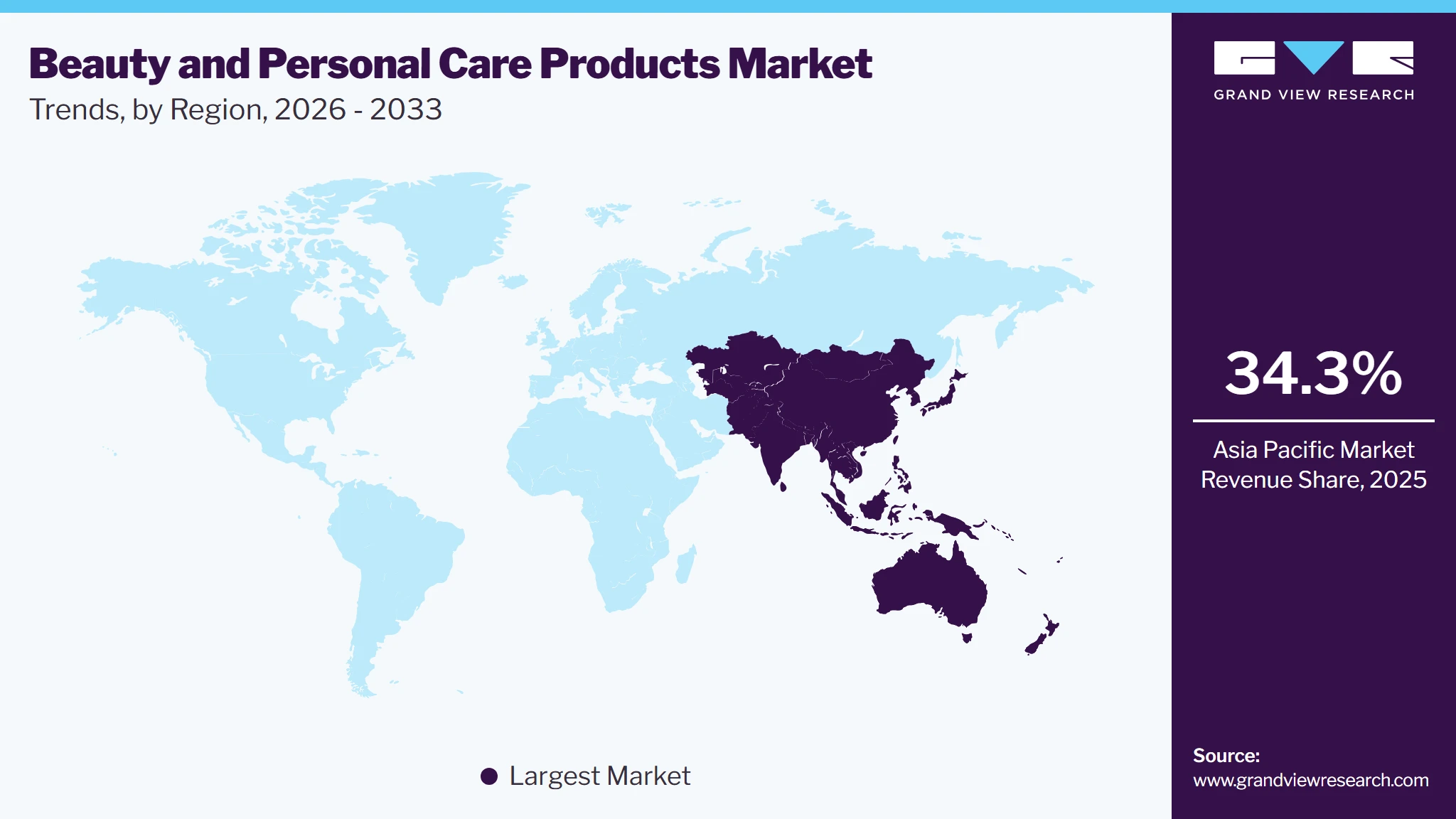
Asia Pacific dominated the Beauty and Personal Care Products market with the largest revenue share of 34.3% in 2025. Asia Pacific accounted for the largest share of the beauty and personal care products market due to its large consumer base, rising disposable incomes, rapid urbanization, and growing beauty consciousness across both developed and emerging economies. The region has witnessed significant growth in demand for skincare, hair care, cosmetics, fragrances, and personal hygiene products, driven by changing lifestyles, increasing participation of women in the workforce, and a growing middle-class population. The widespread adoption of e-commerce, social commerce, and mobile shopping platforms has improved product accessibility, while the influence of K-beauty, J-beauty, and regional beauty trends continues to shape consumer preferences. In addition, manufacturers are introducing products formulated with natural ingredients, multifunctional benefits, and personalized solutions to cater to diverse skin types and climatic conditions, further supporting market growth across the region.
U.S. Beauty and Personal Care Products Market Trends
The U.S. beauty and personal care products industry held an 80.6% market share in 2025, supported by a large and highly engaged consumer base and the continued expansion of omnichannel beauty retail. According to Ulta Beauty, there are approximately 140 billion beauty enthusiasts in the U.S., highlighting the substantial consumer base for beauty and personal care products. To serve this demand, Ulta Beauty operates more than 1,500 stores across the U.S., while strengthening its digital channels. In fiscal 2025, 19% of loyalty members shopped through both physical stores and digital platforms, demonstrating the growing adoption of integrated omnichannel shopping experiences among U.S. beauty consumers.
The Mexico beauty and personal care products industry is anticipated to grow at a CAGR of 7.5% during the forecast period, supported by expanding demand for branded beauty solutions, dermatological skincare, local manufacturing, and sustainable product innovation. L’Oréal has strengthened its presence in the country with a portfolio of 25 brands spanning professional beauty, skincare, consumer products, and luxury segments, supported by two manufacturing facilities producing dermatological, personal care, and hair-color products for more than 15 brands.
The company is also advancing sustainable manufacturing in Mexico through initiatives including 100% renewable energy use and water recycling, while expanding professional beauty networks and omnichannel distribution to improve product accessibility. These developments highlight the growing emphasis on local production, sustainability, and wider beauty product availability in the Mexican market.
China Beauty and Personal Care Products Market Trends
The Beauty and Personal Care Products market in the China held the largest share in the Asia Pacific region in 2025. China remains the leading market within Asia Pacific owing to its large population, expanding middle-income consumer base, and strong demand for premium and innovative beauty products. Consumers are increasingly investing in skincare, anti-aging solutions, functional cosmetics, and premium personal care products as awareness of skin health and appearance continues to rise. The country's highly developed digital retail ecosystem, supported by e-commerce platforms, live-stream shopping, and social commerce, has accelerated product adoption and enabled both domestic and international brands to reach a broad consumer base. Furthermore, increasing demand for clean beauty, products containing traditional botanical ingredients, and science-backed formulations, along with continuous product innovation by leading manufacturers, continues to strengthen China's position as the largest contributor to the regional beauty and personal care products market.
Europe Beauty and Personal Care Products Market Trends
The Europe beauty and personal care products industry accounted for a significant share of 25.2% in 2025, supported by strong consumer demand for premium skincare, sustainable beauty, ingredient transparency, and advanced beauty solutions. Demand for dermatologist-led skincare and premium beauty products remains strong, supported by established brands and extensive omnichannel retail networks. For instance, L’Oréal Groupe launched its #JoinTheRefillMovement campaign in June 2025, bringing together multiple brands across skincare, fragrance, makeup, and haircare to promote refillable beauty products through retail and online channels. The campaign highlighted that 78% of consumers are interested in purchasing more sustainable products, reinforcing the growing importance of sustainability in the European beauty market.
Omnichannel beauty retail is also expanding across the region. DOUGLAS, Europe’s leading omnichannel premium beauty retailer, operates around 1,960 stores alongside extensive e-commerce platforms, while its e-commerce sales increased 6.2% in the first quarter of fiscal 2025. These developments are improving consumer access to premium skincare, fragrances, haircare, and other beauty products across European markets.
The Germany beauty and personal care products industry held a 17.9% market share in 2025, supported by strong consumer spending, established drugstore networks, and rising demand for skincare, premium beauty, and sustainable products. Germany recorded EUR 18.0 billion in retail sales of cosmetics and personal care products in 2025, making it the largest European market. Consumer interest in social media-driven beauty trends is also encouraging retailers to introduce globally popular brands. For instance, in September 2025, dm-drogerie markt announced the exclusive launch of SHEGLAM in approximately 1,500 stores across Germany, alongside availability on dm.de and the dm app, expanding access to trend-driven beauty products among digitally engaged consumers.
The France beauty and personal care products industry held a 14.6% market share in 2025, supported by strong demand for luxury beauty, premium fragrances, strategic brand acquisitions, and product innovation. France's established beauty ecosystem and concentration of leading luxury houses continue to attract investment in high-value beauty and fragrance assets. For instance, in March 2026, L’Oréal completed the acquisition of Kering Beauté, including the House of Creed, and secured 50-year exclusive licenses to develop and distribute beauty and fragrance products under the Bottega Veneta and Balenciaga brands. The transaction strengthens L’Oréal’s luxury beauty portfolio and expands its presence in high-end fragrances, while the companies also agreed to explore opportunities in wellness and longevity, highlighting the growing focus on premiumization and next-generation beauty solutions.
Asia Pacific Beauty and Personal Care Products Market Trends
The Asia Pacific beauty and personal care products industry is expected to grow at a CAGR of 9.0% from 2026 to 2033, supported by growing consumer demand for sustainable and environmentally responsible beauty solutions. Increasing awareness of plastic waste and environmental issues is encouraging manufacturers to adopt refillable packaging and circular product formats. For instance, South Korea-based Amorepacific has expanded refillable packaging across brands including Sulwhasoo, Hanyul, and Primera. Its refillable Sulwhasoo cream packaging reduces plastic usage by more than 50% compared with conventional packaging, while the caps, covers, and refill capsule containers are made using 100% recycled plastic. These initiatives highlight the growing adoption of circular packaging solutions across the Asia Pacific beauty market.
 To learn more about this report, Download Free Sample Report
 The China beauty and personal care products industry is expected to grow at a CAGR of 8.3% from 2026 to 2033, driven by increasing demand for science-backed formulations, localized product development, and digitally enabled beauty retail. For instance, in 2025, L’Oréal introduced 19 new products and services at the China International Import Expo (CIIE), including innovations across skincare, makeup, haircare, and dermatological beauty. In addition, its Shanghai Research & Innovation Center develops more than 300 exclusive formulas tailored for Chinese consumers each year. These developments highlight the growing importance of localized innovation, advanced formulations, and technology-driven beauty solutions in supporting the growth of China’s beauty and personal care products industry.
The India beauty and personal care products industry is expected to grow at a CAGR of 10.3% from 2026 to 2033, driven by increasing consumer demand for innovative, science-backed, and digitally accessible beauty and personal care products. For instance, in June 2026, L’Oréal announced an agreement to acquire a majority stake in Innovist, an Indian digital-first personal care company behind brands such as Bare Anatomy and Chemist at Play. Innovist offers science-led products with transparent formulations tailored to Indian consumers and is distributed through direct-to-consumer platforms, e-commerce and quick-commerce channels, and offline retail partnerships. The acquisition highlights the growing attractiveness of India's beauty market and the increasing importance of digital-first, locally developed, and science-backed beauty and personal care brands.
Central & South America Beauty and Personal Care Products Market Trends
The Central & South America beauty and personal care products industry is expected to expand at a CAGR of 8.2% from 2026 to 2033, driven by the growing professional beauty industry, increasing digitalization, and expanding financial support for beauty entrepreneurs. For instance, in November 2025, Mastercard and L’Oréal partnered to launch the L’Oréal Mastercard BusinessCard for beauty professionals across Latin America and the Caribbean. Initially introduced in Mexico through fintech company Clara, the card provides salon owners, hairstylists, beauty creators, and distributors with access to business financing, digital payment solutions, and rewards on professional beauty product purchases. The initiative also offers working capital support and exclusive access to product launches, highlighting the increasing focus on financial inclusion and digital transformation within the region's professional beauty ecosystem.
Key market indicators supporting K-beauty growth in Central and South America, 2026
Indicator
Statistics
Growth in Brazil's imports of South Korean skincare products (2024)
+57% YoY
Growth in TikTok posts using #koreanskincare in Brazil (Jul 2025 vs. Jul 2023)
+130%
Growth in global posts using #kbeauty (Jul 2025 vs. Jul 2023)
+200%
Growth in K-beauty sales value in Brazil (2025/26)
+135%
Source: Qogita
The Brazil beauty and personal care products industry is expected to expand at a CAGR of 7.5% from 2026 to 2033, by the strong presence of domestic beauty brands, sustainable product innovation, and expanding omnichannel distribution. For instance, in April 2026, Natura announced that it had been recognized by Euromonitor International as the leading beauty and personal care brand in Latin America for the ninth consecutive year. Brazil, along with Argentina, accounts for 50% of the region's beauty and personal care segment, with Natura retaining its leadership position in the Brazilian market. The company's continued investment in sustainable product innovation, biodiversity-based ingredients, and omnichannel retail highlights the importance of Brazil as a key market within Latin America's beauty industry.
Key Brazilian botanical ingredients used in dermocosmetics and their benefits
Ingredient
Key Benefits / Bioactive Properties
Common Applications
Açaí Extract
Rich in antioxidants that help protect skin cells from oxidative stress, support anti-aging formulations, and reinforce the skin's natural defense mechanisms.
Anti-aging skincare, antioxidant serums, facial creams, protective skincare products
Passion Fruit Oil
Rich in essential fatty acids with moisturizing and soothing properties that help nourish and soften the skin Dry skin care, sensitive skin formulations, moisturizing creams, body lotions
Andiroba Oil
Contains bioactive compounds including limonoids, fatty acids, and triterpenoids, offering moisturizing and skin-conditioning properties.
Skin repair products, moisturizing lotions, body care, soothing skincare formulations
Sources: Emotion Master
Middle East & Africa Beauty and Personal Care Products Market Trends
The Middle East & Africa beauty and personal care products industry accounted for a share of 7.2% in 2025, driven by increasing adoption of beauty technology, digital commerce, AI-enabled solutions, and sustainable innovation across the region. For instance, in May 2026, L’Oréal launched the third edition of its Big Bang Beauty Tech Innovation Program across the South Asia Pacific, Middle East, and North Africa (SAPMENA) region. The program invites startups to develop solutions across areas including AI-powered commerce, creator and affiliate platforms, science-driven beauty, connected consumer experiences, and innovation for sustainability. Selected startups can secure a fully funded commercial pilot with one of L’Oréal’s brands, potential expansion across 35 SAPMENA markets, and year-long mentorship from senior leaders. The initiative highlights the growing role of beauty technology, digital innovation, and startup collaboration in transforming the Middle East and North Africa beauty and personal care market.
Key Beauty and Personal Care Products Company Insights
-
The beauty and personal care products industry is characterized by a highly competitive landscape comprising multinational consumer goods companies, specialized beauty manufacturers, luxury beauty brands, and emerging digital-first players. Companies compete through product innovation, brand positioning, ingredient and formulation development, extensive distribution networks, digital engagement, and expansion across skincare, haircare, color cosmetics, fragrances, and personal hygiene categories. The market includes companies catering to mass-market, premium, professional, and luxury consumer segments.
-
Global Consumer Goods & Personal Care Leaders: Companies such as Unilever and Procter & Gamble hold strong positions across mass-market beauty, personal hygiene, skincare, and haircare categories. These companies leverage diversified product portfolios, globally recognized brands, extensive retail distribution networks, and significant investments in product innovation and consumer marketing to maintain a broad international presence.
-
Global Beauty & Cosmetics Specialists: L'Oréal S.A. is a major player with a diversified portfolio spanning skincare, haircare, color cosmetics, and dermatological beauty. The company competes through scientific innovation, advanced formulations, strong brand portfolios, and a multi-channel distribution strategy, serving consumers across mass-market, professional, premium, and luxury beauty segments.
-
Prestige & Luxury Beauty Companies: Estée Lauder maintains a strong prestige beauty segment, particularly across skincare, makeup, fragrances, and haircare. The company differentiates through high-end brand positioning, product innovation, premium consumer experiences, and a strong presence across department stores, specialty beauty retailers, travel retail, and digital channels.
Overall, competition in the beauty and personal care products industry is increasingly shaped by innovation in personalized and science-backed formulations, clean and sustainable product offerings, digital beauty experiences, influencer-led marketing, and omnichannel distribution strategies. Established multinational companies continue to strengthen their positions through portfolio expansion and brand development, while emerging and niche brands contribute to market fragmentation by targeting specific consumer preferences and product categories.
Key Beauty and Personal Care Products Companies:
The following key companies have been profiled for this study on the beauty and personal care products market
- Unilever
- Procter & Gamble
- L'Oréal S.A.
- Estée Lauder
- Kao Corporation
- Shiseido
- Beiersdorf
- Coty Inc.
- colgate-palmolive
- Natura & Co Holding SA
Competitive Benchmarking
Category
Operating Strategies
Competitive Edge
Weakness
Established Players (Unilever; L'Oréal S.A.; Procter & Gamble; Estée Lauder; Shiseido; Kao Corporation)
- Expand diversified product portfolios across skincare, haircare, oral care, cosmetics, fragrances, and personal hygiene through continuous product innovation and premiumization.
- Strengthen omnichannel presence through supermarkets, specialty beauty retailers, pharmacies, e-commerce, and direct-to-consumer platforms while investing in sustainability, AI-driven consumer insights, and strategic acquisitions to expand geographic reach.
- Strong global brand recognition, extensive distribution networks, and diversified product portfolios across mass-market, premium, and luxury segments.
- Significant R&D capabilities, marketing investments, and economies of scale enable rapid product commercialization, consumer loyalty, and strong negotiating power across global retail channels.
- High operating and advertising costs associated with maintaining global brands and extensive supply chains.
- Slower response to rapidly evolving consumer trends and niche beauty segments due to complex organizational structures and large-scale operations.
Emerging & Challenger Players (Coty Inc.; Revlon; AVON PRODUCTS, INC.; ORIFLAME COSMETICS S.A.)
- Focus on strengthening premium cosmetics, fragrances, skincare, and direct-selling portfolios through targeted product launches, digital transformation, influencer collaborations, and expansion across online retail channels.
- Leverage personalized beauty solutions, social commerce, and region-specific product offerings to enhance customer engagement while optimizing distribution strategies and brand repositioning initiatives.
- Strong heritage brands with established customer recognition in cosmetics, fragrances, and direct-selling channels.
Greater flexibility in launching trend-driven products, adapting marketing strategies, and targeting specific consumer demographics through digital-first and relationship-based selling models.
- Comparatively lower financial resources and global market presence than multinational industry leaders.
- Greater dependence on successful brand repositioning, distributor engagement, and competitive pricing to maintain market share amid intense competition from diversified global beauty companies.
Recent Developments
-
In May 2026, Amazon India expanded its beauty portfolio by announcing the addition of more than 100 new beauty brands, including Dolce & Gabbana, Laura Mercier, Elemis, Urban Decay, Aveda, La Roche-Posay, Biodance, Eucerin, and Paula’s Choice. The expansion strengthens the availability of international beauty, skincare, haircare, and fragrance products through e-commerce and highlights the growing accessibility of diverse beauty offerings across India.
-
In May 2026, L’Oréal expanded its NYX Professional Makeup portfolio with a new range of hair and body mists, priced at approximately US$15 for an 80 ml product, targeting younger consumers seeking accessible and affordable fragrance options. The launch reflects the beauty industry's increasing focus on Gen Z preferences, affordable fragrance formats, and the convergence of fragrance with everyday personal care.
-
In June 2026, L’Oréal announced an agreement to acquire a majority stake in Innovist, an Indian digital-first personal care company operating science-backed brands such as Bare Anatomy and Chemist at Play. The acquisition strengthens L’Oréal’s presence in India while expanding its portfolio with locally developed skincare, haircare, and personal care products tailored to Indian consumer needs.
Beauty and Personal Care Products Market Report Scope
Report Attribute
Details
Market size in 2025
USD 543.1 billion
Estimated market size in 2026
USD 580.0 billion
Projected market size by 2033
USD 993.9 billion
Growth rate
CAGR of 8.0% from 2026 to 2033
Base year for estimation
2025
Historical data
2021 - 2024
Forecast period
2026 - 2033
Quantitative units
Revenue in USD million/billion and CAGR from 2026 to 2033
Report coverage
Revenue forecast, company ranking, competitive landscape, growth factors, and trends
Segments covered
Product, type, gender, distribution channel, and region
Regional scope
North America; Europe; Asia Pacific; Central & South America; Middle East & Africa
Country scope
U.S., Canada, Mexico, Germany, UK, France, Italy, Spain, China, India, Japan, South Korea, Australia & New Zealand, Brazil, Argentina, South Africa, UAE
Key companies profiled
Unilever; The Estée Lauder Companies Inc.; Shiseido; MacAndrews & Forbes (Revlon); L’Oréal S.A.; Coty Inc.; Procter & Gamble; Kao Corporation; Oriflame Cosmetics S.A.; Avon Products, Inc.
Customization scope
Free report customization (equivalent up to 8 analysts' working days) with purchase. Addition or alteration to country, regional & segment scope.
Pricing and purchase options
Avail customized purchase options to meet your exact research needs. Explore purchase options
Global Beauty and Personal Care Products Market Report Segmentation
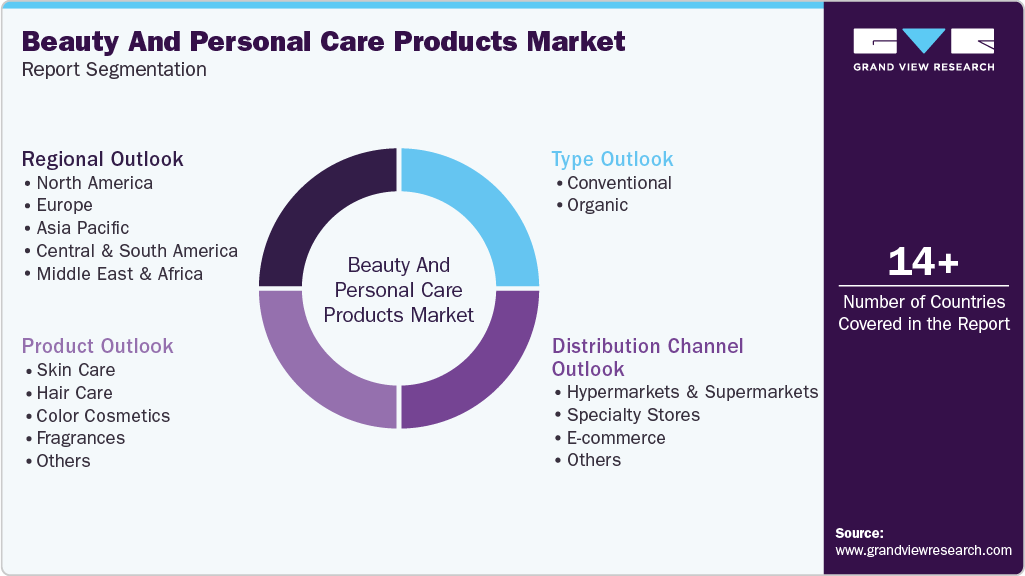
This report forecasts revenue growth at the global, regional & country levels and analyzes the latest trends and opportunities in each sub-segment from 2026 to 2033. For this study, Grand View Research has segmented the beauty and personal care products market report based on type, product, distribution channel, and region.
 To learn more about this report, Download Free Sample Report
 -
Type Outlook (Revenue, USD Billion, 2021 - 2033)
-
Conventional
-
Organic
-
-
Product Outlook (Revenue, USD Billion, 2021 - 2033)
-
Skin Care
-
Face Skin Care
-
Face Creams & Moisturizers
-
Cleansers & Face Wash
-
Sunscreen/Sun Care
-
Others (Masks, Serum, Scrub, etc.)
-
-
Body Skin Care
-
Body Washes & Shower Gels
-
Hair Removal Products
-
Creams & Moisturizers
-
Body Sunscreen/Sun Care
-
Others (Serum, Body Scrub, Oils, etc.)
-
-
-
Hair Care
-
Shampoo
-
Conditioner
-
Oils
-
Serums
-
Others (Hair Masks, Peels, Etc.)
-
-
Color Cosmetics
-
Fragrances
-
Others
-
-
Distribution Channel Outlook (Revenue, USD Billion, 2021 - 2033)
-
Hypermarkets & Supermarkets
-
Specialty Stores
-
E-commerce
-
Others
-
-
Regional Outlook (Revenue, USD Billion, 2021 - 2033)
-
North America
-
U.S.
-
Canada
-
Mexico
-
-
Europe
-
Germany
-
UK
-
France
-
Italy
-
Spain
-
-
Asia Pacific
-
China
-
Japan
-
India
-
South Korea
-
Australia & New Zealand
-
-
Central & South America
-
Brazil
-
Argentina
-
-
Middle East & Africa
-
South Africa
-
UAE
-
-
Research Methodology
The beauty and personal care products market figures in this report are based on a proven research process that combines executive interviews with secondary research from proprietary databases, company filings, and recognized regulatory and institutional sources. Market size is built through value-chain sizing - reconciling supply-side and demand-side estimates - and triangulated with bottom-up and top-down approaches. Every estimate passes multiple levels of expert validation before publication, with each beauty and personal care products segment quantified using the revenue-capture definitions in the table below.
Segment Definition
Segment – Product
Revenue capture definition
Skin Care
Covers facial and body skin care products including cleansers, moisturizers, serums, sunscreens, masks, exfoliators, toners, anti-aging formulations, acne treatments, lip care, and specialty dermatological cosmetics. Includes products sold through retail, pharmacies, e-commerce, salons, and professional skincare channels for daily and treatment-oriented applications.
Hair Care
Covers shampoos, conditioners, hair oils, hair masks, scalp treatments, styling products, hair colorants, hair sprays, gels, mousses, and leave-in formulations. Includes consumer and salon-grade products designed for cleansing, conditioning, styling, coloring, repair, and scalp maintenance across all hair types.
Oral Care
Covers toothpaste, toothbrushes, mouthwash, dental floss, whitening products, denture care products, breath fresheners, tongue cleaners, and oral hygiene accessories. Includes preventive, cosmetic, and therapeutic oral care products distributed through retail, pharmacies, dental clinics, and online platforms.
Color Cosmetics
Covers facial makeup, eye makeup, lip products, nail cosmetics, makeup primers, setting products, contouring products, foundations, concealers, powders, blushes, mascaras, eyeliners, eyeshadows, lipsticks, glosses, and nail polishes. Includes mass-market, premium, and professional cosmetic product categories.
Shower and Bath
Covers soaps, body washes, shower gels, bath salts, bath oils, body scrubs, bubble bath products, intimate hygiene products, deodorizing washes, and exfoliating cleansers. Includes products intended for personal cleansing, body hygiene, skin conditioning, and everyday bathing routines across consumer markets.
Perfume/Fragrances
Covers perfumes, eau de parfum, eau de toilette, eau de cologne, body mists, fragrance sprays, deodorant fragrances, roll-ons, and scented body products. Includes luxury, premium, mass-market, designer, celebrity, and niche fragrance offerings marketed for personal use across various distribution channels.
Segment – Type
Revenue capture definition
Conventional
Covers beauty and personal care products formulated using standard cosmetic ingredients, synthetic actives, fragrances, preservatives, colorants, and widely used chemical formulations. Includes products across all beauty categories marketed through mass retail, premium brands, pharmacies, supermarkets, specialty stores, and e-commerce platforms.
Organic
Covers beauty and personal care products formulated with certified organic or naturally derived ingredients, botanical extracts, plant-based oils, mineral components, and naturally sourced fragrances. Includes products complying with recognized organic or natural cosmetic standards across skincare, haircare, oral care, cosmetics, bath, and fragrance categories.
Estimation Model
01 – Beauty & Personal Care Consumer Base Layer
02 – Retail Accessibility & Spending Layer
03 – Category Adoption & Consumption Layer
04 – Monetisation Layer
Who regularly purchases beauty and personal care products?
Which consumers have purchasing power and access to organized beauty retail?
Who actively purchases products across beauty and personal care categories?
How much revenue is generated?
Begin with the global population segmented by age, gender, and income groups. Apply urbanization rates, working population, beauty-conscious consumer demographics, and personal hygiene adoption to identify individuals with regular demand for beauty and personal care products. This establishes the potential consumer base across skincare, hair care, oral care, fragrances, cosmetics, and bath & shower products.
Filter the eligible population using disposable income levels, organized retail penetration, e-commerce adoption, modern trade availability, and regional consumer expenditure on beauty and personal care products. This derives the addressable market with regular access to branded products through supermarkets, pharmacies, specialty stores, and online platforms.
Apply category-specific penetration rates across skincare, hair care, oral care, color cosmetics, fragrances, and bath & shower products. Consider purchase frequency, repeat buying behavior, premiumization, and increasing preference for natural and organic formulations to estimate annual product consumption per consumer.
Multiply annual product consumption by blended average selling prices (ASPs) across all product categories. Adjust for premium product mix, organic offerings, luxury beauty products, direct-to-consumer brands, and omnichannel retail sales to estimate total market revenue.
Delivered Customizations
This report has been delivered with the following In-depth customizations
Client Request
Customization Delivered
Value Adds
Consumer & Product Category Cross-Segmentation Analysis
Comprehensive cross-segmentation analysis of the global beauty and personal care products market across product categories (skin care, hair care, oral care, color cosmetics, shower & bath, perfumes/fragrances), product type (conventional vs. organic), distribution channels, and regional markets. The study further evaluates category penetration by consumer demographics, premium vs. mass-market positioning, and evolving purchase preferences across North America, Europe, Asia Pacific, Latin America, and the MEA.
Identifies the highest-growth combinations such as premium organic skincare, mass-market hair care, and prestige fragrances across key regions. The analysis enables companies to prioritize product investments, optimize category portfolios, and understand how consumer preferences differ by geography, income level, and retail channel.
Brand Portfolio Benchmarking & Competitive Positioning Analysis
In-depth benchmarking of leading multinational beauty companies, prestige beauty brands, mass-market FMCG players, dermatologist-led brands, and emerging digital-first beauty companies. The assessment compares product portfolio breadth, innovation pipeline, pricing architecture, sustainability initiatives, geographic presence, omnichannel strategy, ingredient positioning, and brand equity across major product categories.
Helps distinguish global portfolio leaders from category specialists and identifies competitive white spaces across skincare, hair care, cosmetics, and fragrances. The analysis also highlights how companies are differentiating through clean beauty, ingredient transparency, premiumization, dermatological efficacy, and personalized beauty solutions, supporting competitive strategy and partnership evaluation.
Channel Strategy, Pricing & Premiumization Opportunity Assessment
Detailed evaluation of pricing architecture across economy, mass-premium, premium, prestige, and luxury product segments, mapped against hypermarkets & supermarkets, specialty beauty retailers, e-commerce, pharmacies, and other retail channels. The study analyzes promotional intensity, online-exclusive product launches, subscription models, bundled offerings, and omnichannel purchasing behavior across different beauty categories.
Enables clients to identify the most profitable pricing strategies and channel mix by product category and geography. The assessment highlights where premiumization is accelerating, where online channels are driving incremental category growth, and how specialty retail continues to influence premium beauty purchases through product experience, expert consultation, and brand discovery.
Frequently Asked Questions About This Report
The global beauty and personal care products market size was valued at USD 644.6 billion in 2025 and is estimated at USD 693.9 billion in 2026.
The global beauty and personal care products market is expected to grow at a CAGR of 7.9% from 2026 to 2033, reaching USD 1,181.6 billion by 2033.
Asia Pacific dominated the market with a 35.2% revenue share in 2025.
The Skin Care segment led the market with a 35.4% revenue share in 2025, while Color Cosmetics is projected to be the fastest-growing product segment during the forecast period.
The Women segment dominated the beauty and personal care products market with a 67.3% revenue share in 2025, driven by higher spending on skincare, color cosmetics, hair care, fragrances, and premium personal care products.
Color Cosmetics is expected to witness the fastest growth during the forecast period, driven by increasing premiumization, social media influence, rising demand for innovative makeup products, and expanding product portfolios across face, lip, eye, and nail cosmetics.
Asia Pacific is the fastest-growing regional market over the forecast period, driven by expanding middle-class populations, rising disposable incomes, and increasing beauty product consumption across China, India, Southeast Asia, and South Korea.
Key players include L'Oréal S.A., The Procter & Gamble Company, Unilever PLC, The Estée Lauder Companies Inc., Beiersdorf AG, Shiseido Company, Limited, Coty Inc., Kao Corporation, Amorepacific Corporation, Johnson & Johnson, Colgate-Palmolive Company, and Henkel AG & Co. KGaA.
Key factors include rising consumer spending on personal grooming, increasing demand for premium and clean-label beauty products, rapid growth of e-commerce and social commerce, product innovation in skincare and cosmetics, growing influence of beauty influencers, and rising demand for multifunctional and personalized beauty solutions.
About the Author(s)
Beauty & Personal Care Research Team
Consumer Goods · Beauty & Personal CareThis report was authored by the beauty & personal care research team at Grand View Research - comprising two research analysts, one senior research analyst, and one industry expert - with specialized expertise in the beauty & personal care segment of the consumer goods industry. All findings are based on proprietary consumer goods databases, executive interviews, and regulatory analysis, subject to internal peer review prior to publication.
Last Updated:
Speak to Analyst

Customize this report to your needs - add regions, segments, or data points, with 20% free customization.
Or view our licence options:


ISO 9001:2015 & 27001:2022 Certified
We are GDPR and CCPA compliant! Your transaction & personal information is safe and secure. For more details, please read our privacy policy.


