
- Home
- »
- Power Generation & Storage
- »
-
Behind-the-Meter Energy Storage Market Report, 2026-2033GVR Report cover

Behind-the-Meter Energy Storage Market (2026 - 2033)
Size, Share & Trends Analysis Report By Battery Type (Lithium-ion Batteries, Lead-acid Batteries, Others), By End Use, By Region, And Segment Forecasts
Market Size, 2025
$18.1BMarket Estimate, 2026
$21.4BMarket Forecast, 2033
$69.7BCAGR, 2026–2033
18.4%Behind-the-Meter Energy Storage Market Summary
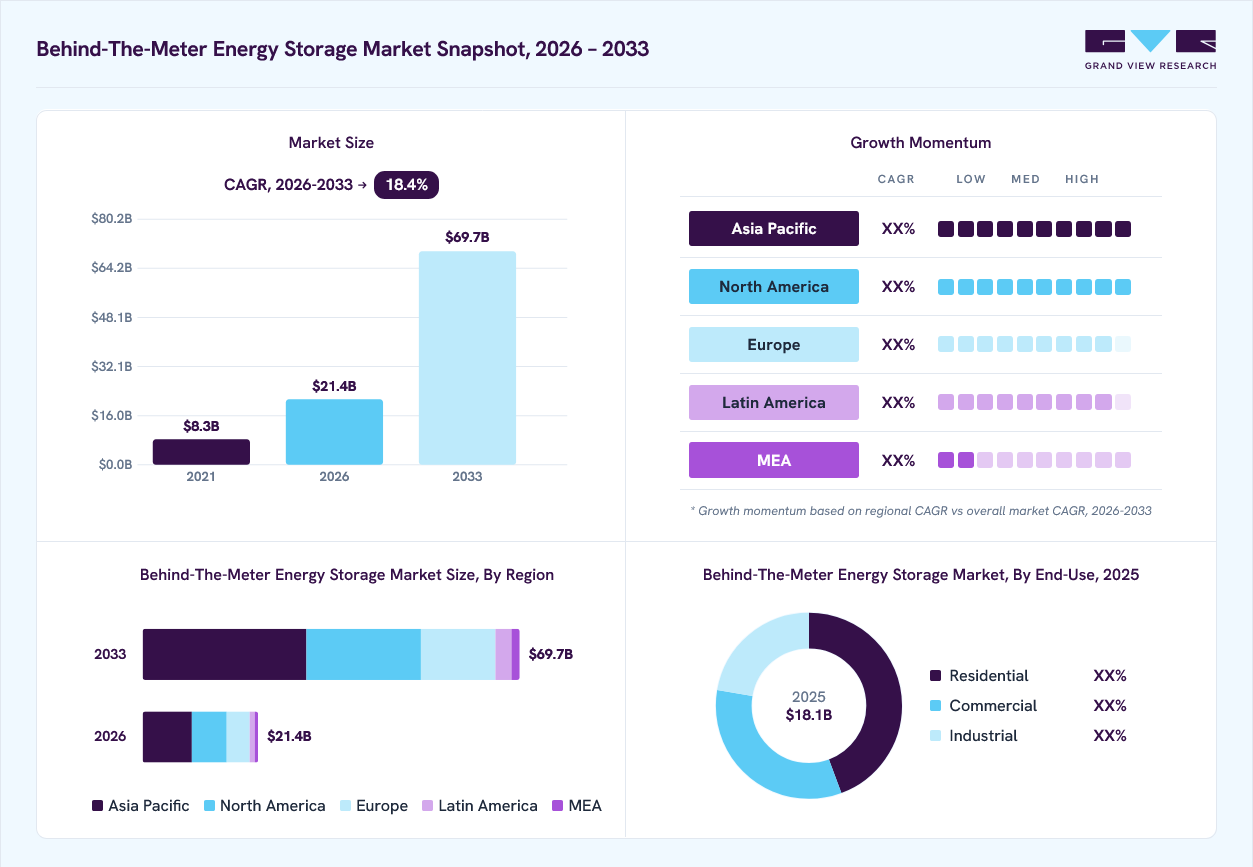
The global Behind-the-Meter energy storage market size was valued at USD 18.1 billion in 2025 and is projected to grow from USD 21.4 billion in 2026 to USD 69.7 billion by 2033, at a CAGR of 18.4% from 2026 to 2033. The market in Asia Pacific dominated with a revenue share of 42.5% in 2025.
 Source: Grand View Research, IR Documents, Primary Interviews, Paid DatabasesTo learn more about this report,
 Download Free Sample Report
Key Market Trends & Insights
- By battery type: Lithium-ion batteries segment held the largest market share of 95.5% in 2025.
- By end use: Residential segment held the largest market share of 44.3% in 2025.
Regional Highlights
- Largest regional market: Asia Pacific (42.5% revenue share, 2025)
- By country: China held the largest market share in 2025
Market Size & Forecast
- Market Size in 2025: USD 18.1 Billion
- Estimated Market Size in 2026: USD 21.4 Billion
- Projected Market Size by 2033: USD 69.7 Billion
- CAGR (2026-2033): 18.4%
Three ways to get this report
Buy it, customize it, or ask a question.Ask an Analyst
Analyst response in 1 business day
- AccessReport author, directly
- Reply timeWithin 1 working day
- No sales callDirect answer only
- FormatEmail reply
- CostFree, no cost
Get the Full Report
What the study covers
- FormatsPDF · Excel · Dashboard
- Timeline2026–2033 annual, 2025 base
- Coverage20+ countries, 5 regions
- Companies10+ key players profiled
Customize the Report
20% free customization
- IncludeCountries, segments, points
- TailorTo your product definition
- ExtendDeeper competitor detail
- OrA fully bespoke study
- Turnaround5–10 working days
Behind-the-meter energy storage systems enable end-users including commercial, industrial, and residential consumers, to store electricity for self-consumption, load shifting, and backup power. This capability reduces energy bills and peak demand charges and enhances reliability and energy independence. The growing penetration of renewable energy sources, particularly rooftop solar, with declining lithium-ion battery costs and improved energy management software, has accelerated global adoption. Moreover, the shift toward electrification and the emergence of prosumer models further fuel demand for BTM solutions across developed and emerging economies.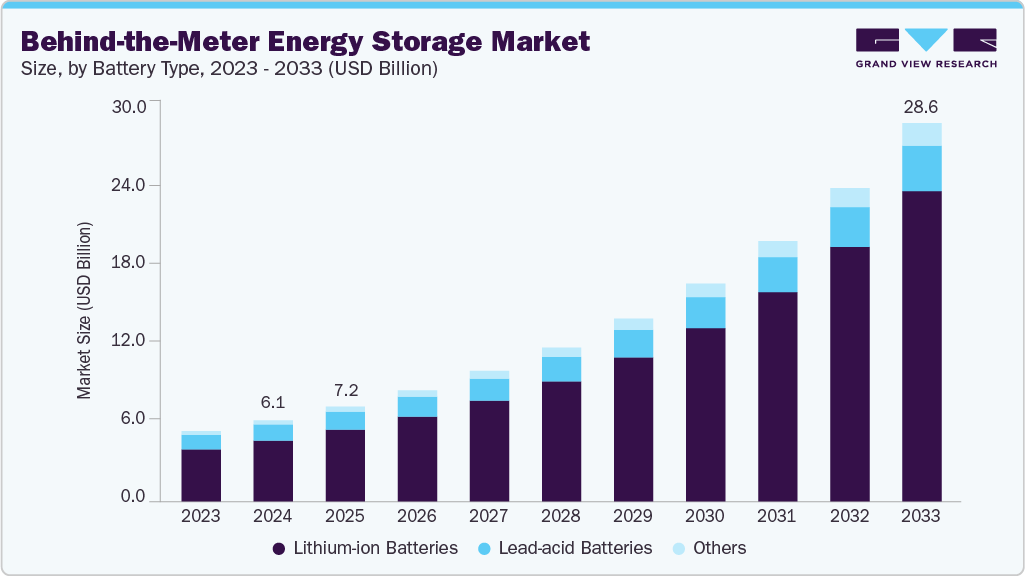 To learn more about this report, Download Free Sample Report
In North America, the market benefits from robust policy support, evolving grid infrastructure, and the rapid adoption of distributed renewable generation. The United States leads regional deployment with strong participation from commercial and industrial sectors seeking to mitigate high electricity costs and demand charges. State-level incentives, such as California’s Self-Generation Incentive Program (SGIP) and New York’s NYSERDA storage initiatives, have catalyzed installations, while growing corporate sustainability commitments continue to boost adoption. Canada is also witnessing rising interest in BTM systems as utilities expand distributed energy resource (DER) integration and support customer-owned storage projects.
Europe is another significant market, propelled by the continent’s stringent decarbonization targets and supportive regulatory frameworks promoting energy self-sufficiency. Countries like Germany, the United Kingdom, and Italy are at the forefront of deploying BTM storage with solar PV for residential and small business users. Time-of-use pricing models and grid flexibility needs have driven installations, particularly in regions with high renewable penetration. The European Union’s clean energy package and ongoing advancements in smart grid technologies are expected to enhance BTM adoption further. Partnerships between utilities, energy aggregators, and technology providers foster the development of virtual power plants (VPPs), establishing Europe as a key growth hub for the global behind-the-meter energy storage market.
Market Dynamics
The behind-the-meter (BTM) energy storage market is experiencing strong growth as consumers increasingly seek greater control over their electricity costs and energy reliability. Rising electricity prices, frequent grid disruptions, and the rapid adoption of rooftop solar systems are driving demand for battery storage solutions that allow homes and businesses to store and use their own electricity when needed. Commercial and industrial users are also investing in BTM systems to reduce peak demand charges and improve operational resilience. A key market trend is the growing integration of battery storage with energy management software and smart energy systems, enabling users to optimize energy consumption, maximize savings, and participate in demand response programs.
Rising electricity prices and increasing concerns over grid reliability are accelerating the adoption of BTM energy storage systems worldwide. Homes, businesses, and industrial facilities are increasingly investing in battery storage to reduce electricity costs by storing energy during low-tariff periods or from on-site renewable sources and using it during peak demand. In addition to lowering energy bills, BTM systems provide backup power during outages, improve energy resilience, and help consumers maximize the value of rooftop solar installations.
In July 2025, Enphase Energy began shipping its IQ Battery 5P with higher domestic content to comply with new U.S. federal requirements for clean energy tax incentives. The 5 kWh modular battery is designed for behind-the-meter residential applications, enabling homeowners to store rooftop solar electricity, reduce reliance on the grid, and optimize self-consumption through intelligent energy management. The launch demonstrates how supportive government policies and consumer demand for energy independence are accelerating the deployment of behind-the-meter energy storage solutions.
The high upfront cost of BTM energy storage systems remains one of the biggest barriers to market growth. Purchasing batteries, inverters, power management systems, and installation services requires a significant initial investment, making adoption difficult for many households and small- and medium-sized businesses. Although lower electricity bills and operational savings can offset these costs over time, the long payback period often discourages investment. For instance, an IEEFA report found that nearly 75% of India’s battery energy storage capacity allocated in 2025 was financially risky due to tariffs below project costs, highlighting how high capital requirements and financing challenges continue to restrain broader energy storage deployment.
As utilities increasingly adopt distributed energy resources, behind-the-meter batteries are becoming valuable assets for VPPs. By connecting thousands of residential and commercial battery systems through software, utilities can aggregate stored energy to balance the grid, reduce peak demand, and provide ancillary services. This creates new revenue opportunities for battery owners while improving grid flexibility and accelerating the adoption of BTM energy storage. The growing commercialization of VPP platforms is transforming behind-the-meter batteries from standalone backup systems into revenue-generating grid assets, unlocking additional value for both consumers and utilities.
Analyst Perspective
The behind-the-meter (BTM) energy storage market is growing as consumers look for greater control over their energy costs and reliability. Rising electricity prices and the increasing use of rooftop solar are encouraging homes and businesses to install battery storage systems that reduce dependence on the grid. The market is also evolving beyond backup power, with battery systems increasingly being used to lower electricity bills, manage peak demand, and optimize energy usage. A key trend is the growing adoption of virtual power plants (VPPs), where connected battery systems can support the grid while creating additional revenue opportunities for customers.
Battery Type Insights
Based on battery type, the lithium-ion batteries segment led the market with the largest revenue share of 95.5% in 2025, dominating the battery type segment in the global behind-the-meter (BTM) Energy Storage market. This dominance is driven by lithium-ion’s superior energy density, high efficiency, long lifecycle, and rapid response capabilities, key attributes for commercial, industrial, and residential storage applications. The technology’s flexibility to support peak shaving, demand response, and renewable energy integration has made it the preferred choice for BTM installations worldwide. Continuous innovation in lithium-ion chemistry and battery management systems (BMS) further enhances performance, safety, and cost-effectiveness, solidifying its position as the industry benchmark for distributed energy storage solutions.
Declining battery costs, large-scale manufacturing expansion, and increased deployment of distributed renewable systems such as rooftop solar PV further support the segment’s growth. Government incentives, time-of-use tariff structures, and corporate sustainability goals also accelerate adoption across key markets, including the U.S., China, Germany, and Japan. As consumers and utilities seek flexible, reliable, and decentralized energy solutions, lithium-ion batteries remain central to enabling grid resilience and energy independence. Their scalability across small residential systems to large commercial facilities ensures continued market leadership in the global BTM energy storage landscape.
End Use Insights
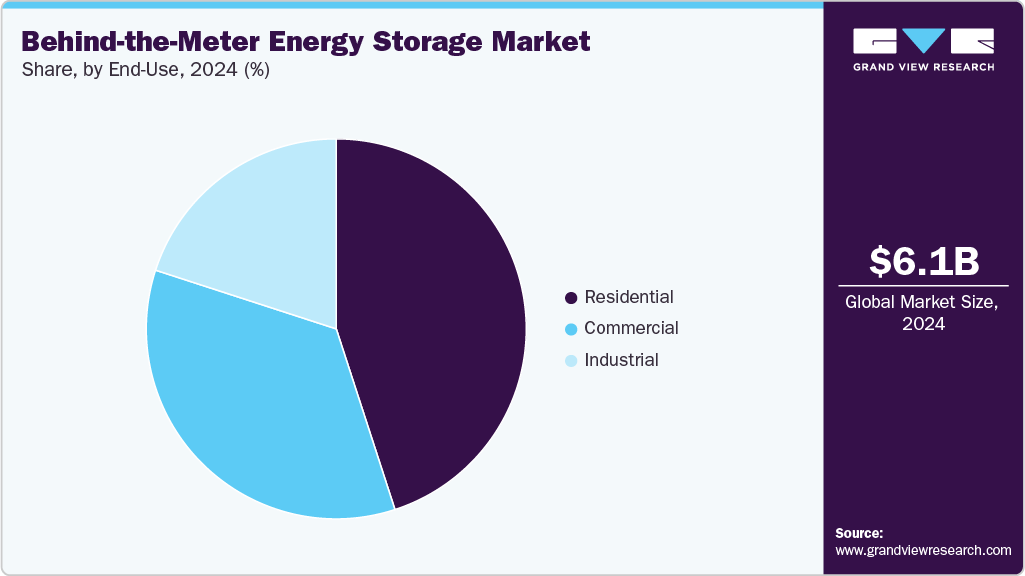
Based on end use, the residential segment led the market with the largest revenue share of 44.3% in 2025. This dominance is primarily attributed to the rapid adoption of residential solar-plus-storage systems, driven by the increasing focus on energy independence, rising electricity costs, and the growing availability of net-metering and time-of-use tariff programs. Homeowners are increasingly deploying BTM energy storage systems to store excess solar energy, enhance self-consumption, and ensure reliable backup power during outages. Lithium-ion battery systems have become the preferred choice for residential users due to their compact design, long cycle life, and integration compatibility with rooftop solar and smart home energy management systems.
 To learn more about this report, Download Free Sample Report
The segment’s growth is further reinforced by government incentives, tax credits, and subsidy programs promoting distributed renewable generation and household-level energy resilience. Advancements in digital energy management platforms and declining battery prices have made residential BTM systems more accessible and cost-effective. In regions such as North America, Europe, and Asia-Pacific, the increasing frequency of power outages, coupled with expanding prosumer energy models, is propelling residential storage adoption. As consumers prioritize sustainable and self-sufficient energy solutions, the residential segment will remain a key growth driver in the global BTM energy storage market.
Regional Insights
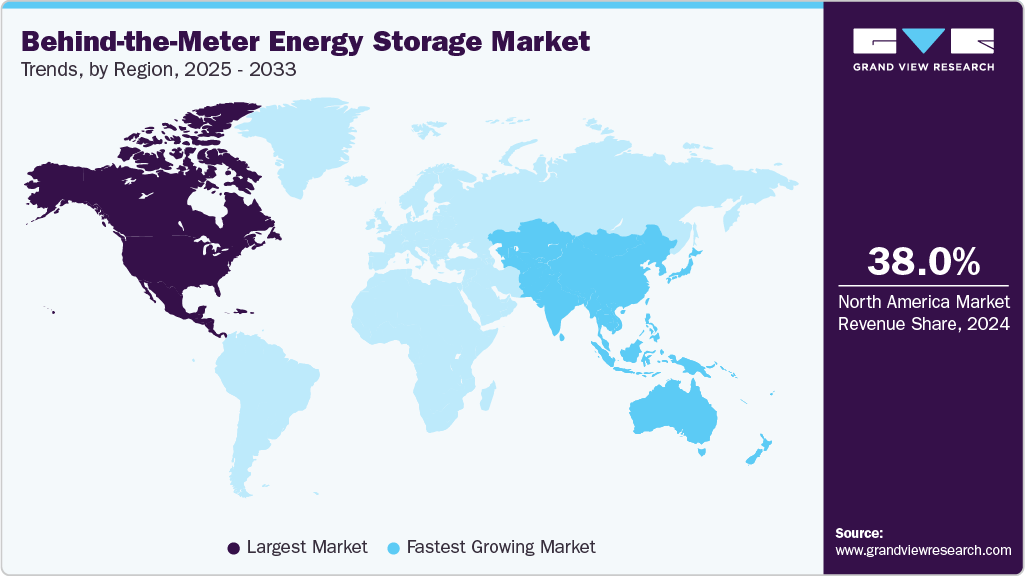
North America held the substantial share of approximately 30.1% in the global BTM Energy Storage market in 2025, driven by strong policy support, advanced grid infrastructure, and the rapid integration of renewable energy sources. The United States leads the market with substantial investments enabled by the Inflation Reduction Act (IRA), offering tax credits and incentives for residential, commercial, and industrial storage systems. Utilities and corporations increasingly deploy storage to improve grid stability, manage peak demand, and achieve decarbonization targets. Canada also contributes through provincial energy storage programs and growing investment in clean energy projects, strengthening North America’s position as the leading regional market.
 To learn more about this report, Download Free Sample Report
Falling lithium-ion battery costs, expanding solar-plus-storage adoption, and advancements in energy management systems are accelerating market growth. Increasing electricity prices and frequent grid interruptions are prompting residential and commercial users to invest in BTM storage for backup power and energy cost optimization. Strategic collaborations between technology providers, utilities, and government agencies further enhance deployment, ensuring North America maintains its leadership in the global market over the forecast period.
U.S. Behind-the-Meter Energy Storage Market Trends
The United States is the largest single-country market for BTM energy storage, benefiting from federal and state-level incentives, corporate renewable energy commitments, and the growing integration of distributed solar. Incentives under the Inflation Reduction Act, renewable portfolio standards, and funding for long-duration storage projects have created a favorable environment for rapid deployment. Utilities leverage BTM systems for grid stabilization, peak load management, and ancillary services. At the same time, industrial and commercial users adopt storage to improve energy efficiency and reliability. Technological innovation, hybrid storage solutions, and infrastructure expansion further support market growth. With abundant renewable energy resources and strong policy backing, the U.S. will remain a leading and dynamic market throughout the forecast period.
Europe Behind-the-Meter Energy Storage Market Trends
Europe accounted for approximately an 19.9% share of the global BTM energy storage market in 2025, supported by ambitious decarbonization goals, strict emission regulations, and strong investment in distributed storage solutions. Countries such as Germany, France, the Netherlands, and the UK actively deploy BTM systems to integrate intermittent renewable energy, stabilize grids, and provide ancillary services. Policy incentives, subsidies, research funding, and mature electricity infrastructure create a favorable residential, commercial, and utility-scale adoption environment. Europe’s focus on sustainable energy transition, energy security, and smart grid modernization continues to drive market expansion and maintain its competitive position globally.
Asia-Pacific Behind-the-Meter Energy Storage Market Trends
Asia Pacific dominated the behind-the-meter energy storage market with the largest revenue share of 42.5% in 2025. Countries including China, Japan, India, and South Korea invest heavily in BTM storage to improve grid stability and optimize renewable energy utilization. Government incentives, infrastructure expansion, and research programs accelerate deployment across residential, commercial, and industrial sectors. Rising electricity demand, energy security needs, and corporate sustainability initiatives further support market growth, positioning Asia-Pacific as a critical contributor to the global BTM energy storage landscape.
Latin America Behind-the-Meter Energy Storage Market Trends
Latin America held around 4.0% share in 2025, driven by abundant renewable energy resources, particularly in Brazil, Mexico, and Argentina. Investment in distributed and large-scale storage systems helps balance variable generation from solar and wind projects. Regional energy programs, government incentives, and international collaborations encourage BTM adoption across commercial, industrial, and residential applications. Growing electricity demand and energy access challenges in some areas further support market expansion, indicating steady growth potential in the region over the forecast period.
Middle East & Africa Behind-the-Meter Energy Storage Market Trends
The Middle East & Africa (MEA) region accounted for roughly 3.0% share in 2025, with the gradual adoption of BTM energy storage driven by energy diversification goals and renewable integration initiatives. Key economies such as the UAE, Saudi Arabia, South Africa, and Egypt are investing in distributed storage solutions to enhance grid reliability and support industrial and residential energy needs. Sub-Saharan Africa is leveraging smaller-scale and off-grid storage projects to improve energy access. Policy support, international funding, and public-private collaborations are expected to drive steady adoption, positioning the MEA region for consistent BTM energy storage market growth.
Key Behind-the-Meter Energy Storage Company Insights
Some of the key players operating in the global behind-the-meter energy storage market include Tesla, Inc., LG Energy Solution Ltd., BYD Company Ltd., Sonnen GmbH, Enphase Energy, Inc., Schneider Electric SE, Siemens AG, Panasonic Holdings Corporation, ABB Ltd., and Samsung SDI Co., Ltd. These companies focus on advancing residential, commercial, and industrial energy storage solutions, emphasizing innovations in lithium-ion battery technologies, intelligent energy management systems, and solar-plus storage integration.
Key Behind-the-Meter Energy Storage Companies:
The following are the leading companies in the behind-the-meter energy storage market. These companies collectively hold the largest market share and dictate industry trends.
-
ABB Ltd.
-
BYD Company Ltd.
-
Enphase Energy, Inc.
-
LG Energy Solution Ltd.
-
Panasonic Holdings Corporation
-
Samsung SDI Co., Ltd.
-
Schneider Electric SE
-
Siemens AG
-
Sonnen GmbH
-
Tesla, Inc.
Competitive Benchmarking
Category
Operating Strategies
Competitive Edge
Weakness
Established Players (Tesla, Inc.; LG Energy Solution Ltd.; BYD Company Ltd.; Schneider Electric SE; Siemens AG; Panasonic Holdings Corporation; ABB Ltd.; Samsung SDI Co., Ltd.)
- Focus on vertically integrated solutions combining batteries, inverters, software, and energy management platforms.
- Expand manufacturing capacity and global distribution networks to meet growing residential and commercial demand.
- Strengthen partnerships with utilities, EPCs, and solar installers to deliver integrated solar-plus-storage solutions.
- Strong global brand recognition and extensive customer base.
- Advanced R&D capabilities and broad product portfolios across multiple battery technologies and energy management solutions.
- Well-established manufacturing, supply chain, and after-sales service networks.
- Higher operating and manufacturing costs compared to niche competitors.
- Large organizational structures can slow product innovation and market responsiveness.
- Heavy dependence on global raw material supply chains exposes them to price volatility and geopolitical risks.
Emerging Players (
Generac Holdings Inc., Stem, Inc.)
- Focus on behind-the-meter storage, virtual power plants, and software-driven energy management solutions across residential and commercial applications.
- Differentiate through software-driven energy optimization and customer-centric digital platforms.
- Expand through strategic partnerships with utilities, solar installers, and distributed energy service providers.
- Greater flexibility to rapidly adopt new technologies and business models.
- Strong expertise in distributed energy resources, VPPs, and intelligent battery management.
- Ability to deliver highly customized solutions for residential and small commercial customers.
- Limited scale and narrower product portfolios compared to vertically integrated established competitors.
- Greater dependence on third-party battery suppliers and component manufacturers.
- Lower financial resources can constrain large-scale expansion and global market penetration.
Recent Developments
-
In June 2025, Tesla, Inc. announced the deployment of an advanced behind-the-meter (BTM) energy storage project in California, featuring its latest Powerwall 3 and Powerpack systems. The installation, designed for both residential and commercial applications, aims to enhance local grid reliability and optimize solar energy self-consumption. The project integrates Tesla’s AI-driven energy management platform, enabling real-time monitoring, demand response participation, and backup power during outages.
Behind-the-Meter Energy Storage Report Scope
Report Attribute
Details
Market Definition
The global behind-the-meter energy storage market represents the revenue generated from the sale of battery energy storage systems installed on the customer side of the electricity meter.
Market size in 2025
USD 18.1 billion
Estimated market size in 2026
USD 21.4 billion
Projected market size by 2033
USD 69.7 billion
Growth rate
CAGR of 18.4% from 2026 to 2033
Base year for estimation
2025
Historical data
2021 - 2024
Forecast period
2026 - 2033
Quantitative units
Revenue in USD Billion and CAGR from 2026 to 2033
Report coverage
Revenue forecast, company ranking, competitive landscape, growth factors, and trends
Segments covered
Type, End Use, Region
Regional scope
North America, Europe, Asia Pacific, Latin America, Middle East & Africa
Country scope
U.S., Canada, Mexico, Germany, UK, France, China, Japan, South Korea, India, Brazil, Saudi Arabia, UAE
Key companies profiled
Tesla, Inc., LG Energy Solution Ltd., BYD Company Ltd., Shell plc, Enphase Energy, Inc., Schneider Electric SE, Siemens AG, Panasonic Holdings Corporation, ABB Ltd., Samsung SDI Co., Ltd.
Customization scope
Free report customization (equivalent up to 8 analysts' working days) with purchase. Addition or alteration to country, regional & segment scope.
Pricing and purchase options
Avail customized purchase options to meet your exact research needs. Explore purchase options
Global Behind-the-Meter Energy Storage Market Report Segmentation
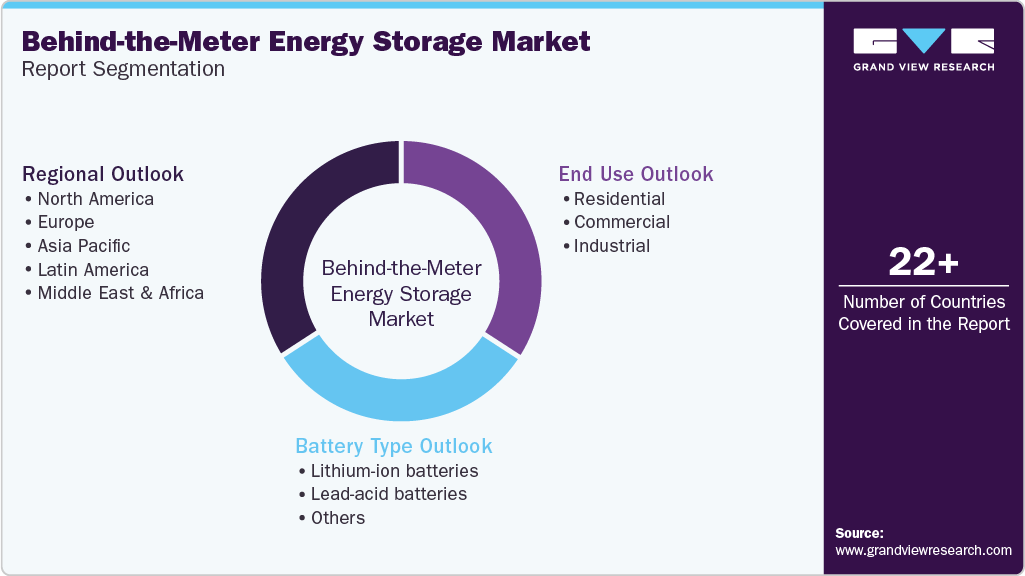
This report forecasts revenue growth at global, regional, and country levels and provides an analysis of the latest industry trends in each of the sub-segments from 2021 to 2033. For the purpose of this study, Grand View Research has segmented the global behind-the-meter energy storage market report on the basis of battery type, end use and region:
 To learn more about this report, Download Free Sample Report
-
Battery Type Outlook (Revenue, USD Million, 2021 - 2033)
-
Lithium-ion batteries
-
Lead-acid batteries
-
Others
-
-
End Use Outlook (Revenue, USD Million, 2021 - 2033)
-
Residential
-
Commercial
-
Industrial
-
-
Regional Outlook (Revenue, USD Million, 2021 - 2033)
-
North America
-
U.S.
-
Canada
-
Mexico
-
-
Europe
-
Germany
-
UK
-
France
-
-
Asia Pacific
-
China
-
India
-
Japan
-
South Korea
-
-
Latin America
-
Brazil
-
-
Middle East & Africa
-
Saudi Arabia
-
UAE
-
-
Research Methodology
The behind-the-meter energy storage market figures in this report are based on a proven research process that combines executive interviews with secondary research from proprietary databases, company filings, and recognized regulatory and institutional sources. Market size is built through value-chain sizing - reconciling supply-side and demand-side estimates - and triangulated with bottom-up and top-down approaches. Every estimate passes multiple levels of expert validation before publication, with each behind-the-meter energy storage segment quantified using the revenue-capture definitions in the table below.
Segment Definition
Segment – Type
Revenue capture definition
Lithium-ion batteries
Lithium-ion batteries are widely used in behind-the-meter energy storage systems due to their high energy density, long cycle life, and fast charging capability. Revenue is generated through the sale of lithium-ion battery energy storage systems installed on the customer side of the electricity meter.
Lead-acid batteries
Designed for cost-effective backup power and energy storage applications, lead-acid batteries are deployed across residential, commercial, and industrial facilities. Revenue is generated through the sale of lead-acid battery energy storage systems installed on the customer side of the electricity meter.
Others
This segment includes alternative battery chemistries such as sodium-ion, flow batteries, nickel-based batteries, and other emerging energy storage technologies. Revenue is generated through the sale of these customer-side battery energy storage systems for behind-the-meter applications.
Segment – End Use
Revenue capture definition
Residential
Residential installations enable homeowners to store electricity from rooftop solar or the grid for self-consumption, backup power, and electricity bill savings. Revenue is generated through the sale of behind-the-meter battery energy storage systems for residential customers.
Commercial
This segment covers battery energy storage systems installed in commercial buildings to reduce peak demand charges, optimize energy use, and improve power reliability. Revenue is generated through the sale of behind-the-meter battery energy storage systems for commercial facilities.
Industrial
Industrial facilities utilize behind-the-meter energy storage to manage peak loads, improve energy resilience, and support uninterrupted operations. Revenue is generated through the sale of behind-the-meter battery energy storage systems for industrial end users.
Estimation Model
Layer Name
Key Question
Description
Customer-Side Deployment Layer
What forms the demand base for BTM energy storage systems?
Assess residential, commercial, and industrial installations of battery energy storage systems on the customer side of the electricity meter. Evaluate rooftop solar adoption, electricity tariff structures, grid outage frequency, demand charge exposure, and backup power requirements to determine the underlying demand for BTM energy storage.
Battery Technology Adoption Layer
Which battery technologies are being used?
Analyze the adoption of lithium-ion, lead-acid, and other battery technologies across residential, commercial, and industrial users. Assess battery cost, energy density, cycle life, safety, charging performance, replacement frequency, and suitability for customer-side energy storage applications to determine segment-wise demand.
End-Use Layer
Where are BTM energy storage systems being deployed?
Evaluate deployment across residential homes, commercial buildings, and industrial facilities. Analyze use cases such as solar self-consumption, backup power, peak shaving, demand charge management, time-of-use optimization, and participation in demand response or virtual power plant programs to estimate end-use contribution.
Revenue Layer
How is market revenue generated?
Market revenue is quantified through the sale of battery energy storage systems installed on the customer side of the electricity meter. The overall market value is determined by battery type, system capacity, installation volume, end-use adoption, battery pricing, power electronics, software integration, and demand across residential, commercial, and industrial customers.
Customization Table
Client Request
Customization Delivered
Value Adds
Competitive Landscape Assessment
Analyzed major manufacturers and solution providers based on product portfolio, battery technology, pricing strategy, partnerships, geographic presence, and innovation initiatives. Evaluated competitive positioning and market share dynamics.
Supported benchmarking against competitors and informed product differentiation and market entry strategies.
Battery Technology Benchmarking Assessment
Compared lithium-ion, lead-acid, and emerging battery technologies based on cost, energy density, cycle life, safety, charging speed, and application suitability. Assessed technology maturity and performance across residential, commercial, and industrial deployments.
Helped identify the most suitable battery technologies for different end-use applications and investment strategies.
Cross-Segmentation Assessment
Analyzed the adoption of lithium-ion, lead-acid, and other battery technologies across residential end users. Evaluated deployment patterns, technology preferences, system requirements, and application-specific demand to identify high-growth segment combinations.
Helped identify the most attractive battery type–end use combinations, enabling targeted product development, market prioritization, and investment strategies.
Frequently Asked Questions About This Report
China dominated the Asia Pacific region market with a revenue share of 58.6% in 2025.
Asia Pacific is anticipated to register the fastest CAGR of 18.7% over the forecast period.
Based on battery type, the lithium-ion batteries segment accounted for the largest revenue share of 95.5% in 2025.
Based on end use, the residential segment accounted for largest revenue share of 44.3% in 2025.
The key players operating in the behind-the-meter energy storage market are Tesla, Inc., LG Energy Solution Ltd., BYD Company Ltd., Schneider Electric SE, Siemens AG, Panasonic Holdings Corporation, ABB Ltd., Samsung SDI Co., Ltd., Shell plc, Enphase Energy, Inc., and others.
The behind-the-meter energy storage market size was valued at USD 18.1 billion in 2025 and is expected to reach USD 21.4 billion in 2026.
The behind-the-meter energy storage market is expected to grow at a CAGR of 18.4% from 2026 to 2033 to reach USD 69.7 billion by 2033.
The behind-the-meter energy storage market is primarily driven by rising electricity prices, increasing rooftop solar adoption, and the growing demand for reliable, cost-efficient, and resilient energy solutions across residential, commercial, and industrial sectors.
The Asia Pacific region dominated the behind-the-meter energy storage market with a revenue share of 42.5% in 2025.
About the Author(s)
Power Generation & Storage Research Team
Energy & Power · Power Generation & StorageThis report was authored by the power generation & storage research team at Grand View Research - comprising two research analysts, one senior research analyst, and one industry expert - with specialized expertise in the power generation & storage segment of the energy & power industry. All findings are based on proprietary energy & power databases, executive interviews, and regulatory analysis, subject to internal peer review prior to publication.
Last Updated:
Speak to Analyst

Customize this report to your needs - add regions, segments, or data points, with 20% free customization.
Or view our licence options:


ISO 9001:2015 & 27001:2022 Certified
We are GDPR and CCPA compliant! Your transaction & personal information is safe and secure. For more details, please read our privacy policy.


