
- Home
- »
- Clothing, Footwear & Accessories
- »
-
Belts And Wallets Market Size & Share Report, 2026-2033GVR Report cover

Belts And Wallets Market (2026 - 2033)
Size, Share & Trends Analysis Report By Product (Wallets, Belts), By Material (Leather, Non-Leather), By End Use (Men, Women), By Distribution Channel, By Region, And Segment Forecasts
Market Size, 2025
$27.5BMarket Estimate, 2026
$29.3BMarket Forecast, 2033
$45.3BCAGR, 2026–2033
6.4%Belts & Wallets Market Summary
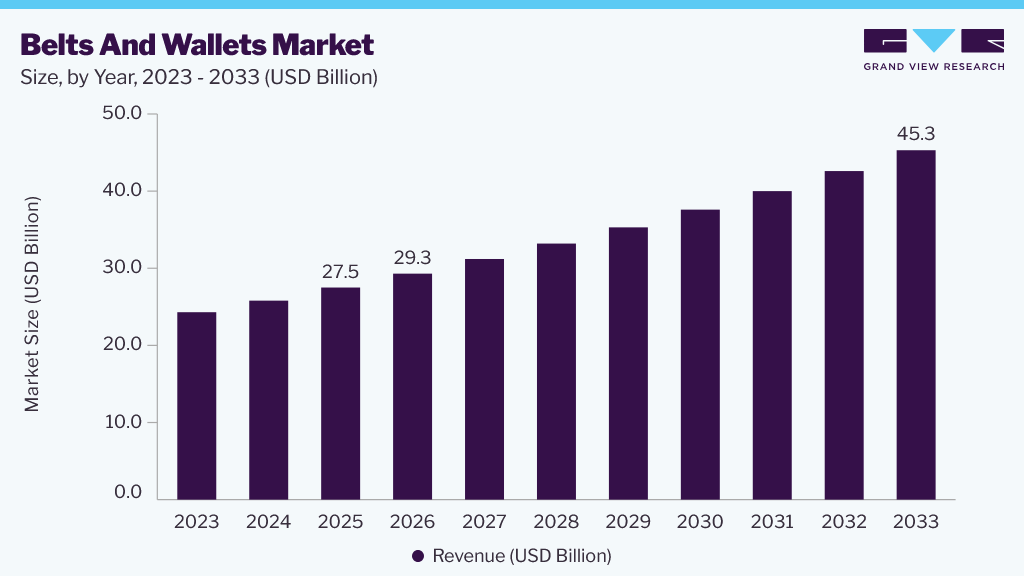
The global belts and wallets market size was valued at USD 27.5 billion in 2025 and is projected to grow from USD 29.3 billion in 2026 to USD 45.3 billion by 2033, at a CAGR of 6.4% from 2026 to 2033. Asia Pacific dominated the market, accounting for a revenue share of around 45.0% in 2025. The global market growth is primarily driven by evolving fashion trends, rising consumer spending on lifestyle accessories, and increasing demand for premium personal accessories across both developed and emerging economies.
 Source: Grand View Research, IR Documents, Primary Interviews, Paid DatabasesTo learn more about this report,
 Download Free Sample Report
Key Market Trends & Insights
- By product: The belts segment dominated the market, with a revenue share of about 60.0% in 2025.
- By material: The leather segment held the largest market share of over 73.0% in 2025.
- By end use: The men segment held the largest revenue share of around 64.0% in 2025.
- By distribution channel: The offline segment held the largest revenue share of around 72.0% in 2025.
Regional Highlights
- Largest regional market: Asia Pacific (45.0% revenue share, 2025)
- By country: China held the largest share in the Asia Pacific region.
Market Size & Forecast
- Market size in 2025: USD 27.5 Billion
- Estimated market size in 2026: USD 29.3 Billion
- Projected market size by 2033: USD 45.3 Billion
- CAGR (2026-2033): 6.4%
GVR research-powered AIAsk Prism AI about the belts and wallets marketGet cited answers from GVR research on market growth, segments, regulations and forecasts.Start with✓ Source-linked answers ✓ Market-specific context ✓ Traceable figuresExplore Prism AI ↗
The growing emphasis on sustainability is creating significant opportunities for manufacturers in the belts-and-wallets industry. Rising consumer preference for eco-friendly and cruelty-free products is driving demand for sustainable leather alternatives and ethically produced accessories. Vegan leather and accessories made from bio-based or recycled materials have gained considerable popularity, particularly among millennials and Gen Z consumers who prioritize environmental responsibility alongside style.Leather remains the preferred material for premium belts and wallets owing to its durability, flexibility, and refined appearance. Unlike materials such as nylon or hard plastics, leather offers greater comfort for everyday use because it remains soft and flexible even when folded, making it more convenient to carry in pockets while maintaining long-term durability and aesthetic appeal.
Furthermore, growing concerns over digital payment security and contactless card technology have accelerated the adoption of RFID-enabled wallets. These wallets incorporate RFID-blocking technology to help protect credit cards, debit cards, passports, and other RFID-enabled documents from unauthorized scanning and identity theft. As a result, leading brands such as Buffway, Travando, and HIMI have expanded their portfolios with RFID-protected leather wallets, reflecting the increasing consumer demand for accessories that combine security, functionality, and premium design.
Market Dynamics
The belts and wallets market is experiencing steady growth, driven by rising consumer demand for premium, functional fashion accessories. Rising adoption of luxury grooming habits is encouraging the use of belts and wallets. In addition, the growing popularity of plant-based leather belts and wallets, along with innovations in smart tracking technology, is further supporting market expansion.
Growing awareness of fashion is a major reason the market is doing well. People now see these items as important parts of their style and self-expression, not just as things that serve a basic function. Stuff like living in cities, following social media, and keeping up with celebs pushes folks to constantly refresh their accessory game. You know millennials and Gen Z especially love it when products are trendy and good-looking, so whether it’s high-end or mid-range, there’s a huge market for those things. When fashion brands come together for seasonal collections or drop limited editions, it keeps customers interested. All this means that companies offering a wide range of design choices are in a sweet spot to cash in on this never-ending trend, which should help the market expand.
The market faces fierce competition from numerous global, regional, and local brands. Luxury giants are going head-to-head with more budget-friendly options, which really fragments the market. This setup squeezes everyone on pricing and marketing spend, plus it pushes companies to constantly innovate. That makes life tough for newcomers trying to get a piece of the action. Also, knock-offs and generic products in developing countries erode customer trust and weaken brand equity. On top of that, fashion trends change lightning fast, and so do consumer tastes. To stay relevant, brands must keep revamping designs and materials, jacking up their costs, and elongating their development timelines. The small firm finds it hard to stay visible, too, since the big-budget players own most of the retail and online spaces. Navigating this crowded field while keeping a strong brand image and turning a profit is super tricky.
The growing demand for sustainable luxury and functional personal accessories presents a significant market opportunity for the belts and wallets segment. Growing consumer preference for premium everyday items with aesthetically and structurally sophisticated design creates demand for high-quality, durable personal accessories. Today's belts and wallets feature durable top-grain leather, plant-based eco-materials, RFID-blocking technology, and minimalist modular structures, all aligned with current trends in ethical sourcing and highly sophisticated personal products that ensure security and durability. Advancements in material processing and smart manufacturing have enabled companies to enhance the performance, durability, and texture of both new and conventional leather materials, and to expand the applications across segments such as corporate apparel, casual wear, travel accessories, and luxury gifts. Moreover, growing interest in environmentally conscious behavior and smart EDC solutions has spurred the development of new sustainable products focused on structural durability, privacy protection, and eco-friendly production processes. With customers seeking premium, ethical, and organized products for their lifestyles, there are numerous growth opportunities to add advanced materials and functions to traditional accessories through the forecast period.
Product Insights
The belts segment dominated the market in 2025, accounting for around 60.0% of global revenue. The considerable demand for belts among working professionals, youth, and ladies is the key factor driving the market. Also, it is anticipated that throughout the forecast period, women's rising demand for fashionable, comfortable, and fancy belts would positively affect the belt market.
The wallets segment is expected to witness healthy growth during the forecast period from 2026 to 2033. Wallets remain an essential everyday accessory for both men and women, offering a convenient and secure way to carry cash, payment cards, identification documents, and other personal belongings. Growing consumer preference for functional, premium and technologically advanced accessories is further supporting market growth. In particular, increasing concerns regarding unauthorized scanning of contactless payment cards have accelerated the adoption of RFID-blocking wallets, creating significant growth opportunities for manufacturers. For instance, in July 2024, ESR, a global leader in mobile accessories, launched the Geo Wallet with Find My on Kickstarter. The wallet integrates with Apple's Find My network, enabling users to easily locate misplaced wallets while enhancing security and convenience, reflecting the growing demand for smart wallet solutions.
Material Insights
Among materials, the leather segment led the market and accounted for over 73.0% share of the global revenue in 2025. The demand for exclusive leather for making a variety of products, including belts and wallets, significantly drives the growth of the global market. The increasing population and the rising income levels of consumers are some of the key factors that drive the demand for leather wallets and belts.
Consumer awareness of fashion and personal style continues to drive demand for premium belts and wallets, encouraging manufacturers to diversify their product portfolios with innovative designs and high-quality materials. Alongside established luxury brands, smaller and emerging manufacturers are gaining market share by offering affordable, design-oriented leather accessories that appeal to a broad consumer base. Leather belts and wallets remain highly preferred for their durability, premium appeal, and ability to complement both formal and casual attire. For instance, in 2024, Hermès opened its 23rd leather goods workshop in Riom, France, as part of its continued investment in expanding its leather goods and saddlery production. The facility is expected to create approximately 280 jobs, reinforcing the company's commitment to meeting growing global demand for premium leather accessories.
End Use Insights
The men segment led the market and accounted for around 64.0% share of the global revenue in 2025. The market is primarily driven by men's major wallet and belt usage trends as well as the widespread use of belts and wallets by men in professional occupations. Moreover, the availability of various product designs and categories in the main belts and wallets segment further contributed to the largest market share. Continuously evolving personal grooming as well as fashion habits among men and their subsequent demand for comfort wear have been driving the growth of belts among men.
The women end use segment is anticipated to grow at a CAGR of 7% from 2026 to 2033. One of the key factors influencing the market's expansion is the rising demand for belts and wallets among working women and the growing popularity of these accessories among women in general. Also, it is anticipated that a rise in the number of women pursuing higher education will increase their participation in the labor force. The buying power of women for luxury and distinctive styles, including leather accessories like belts and wallets, is likely to expand, which is likely to have a favorable effect on the market.
Distribution Channel Insights
Offline distribution channels, which accounted for around 72.0% of global revenue in 2025, dominated the market. Locating belts and wallets in physical retail establishments that offer a selection of brands and models is one of the most common distribution techniques. Before making a purchase, customers can choose from a large selection of brands at these establishments. Supermarkets typically offer discounts and other incentives to attract customers and boost product sales. They act as distribution centers for parent companies and offer a large range of brands in one area. Due to the wide range of products available and ease of use, offline distribution had the largest market share.
The online distribution channel is expected to witness the fastest CAGR over the forecast period. E-commerce retail channels play a significant role in the distribution of belts and wallets, as a considerable amount of the market revenue is generated through these channels. Customers no longer need to physically visit retail locations to browse through millions of products, which can be attributed to the growth of online sales platforms. One of the key consumer groups propelling the expansion of online merchants has been millennials.
Regional Insights
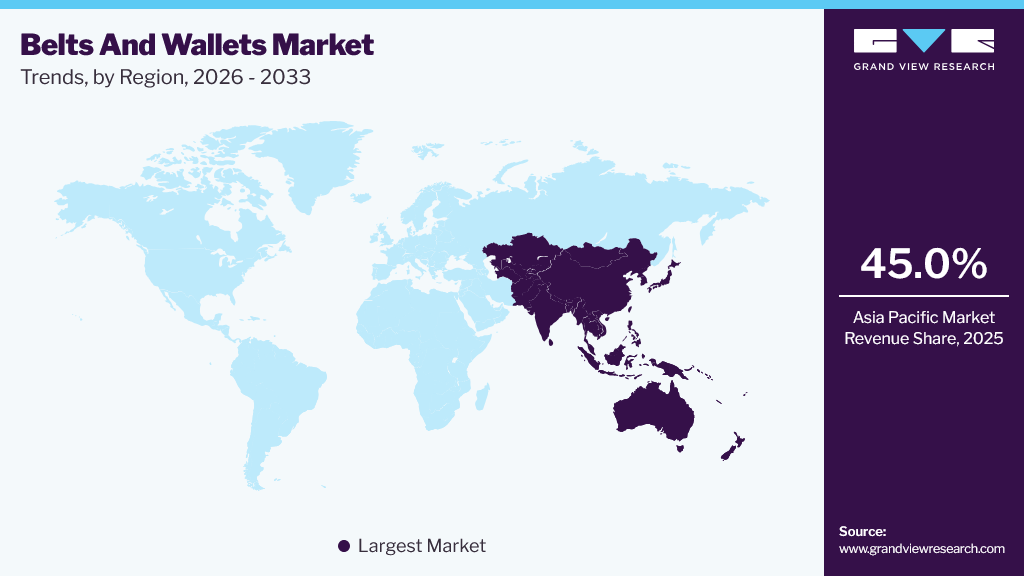
The belts and wallets industry in Asia Pacific dominated the global market, accounting for approximately 45.0% of revenue in 2025. The region's leadership is supported by its large consumer base, expanding working population, rising disposable incomes, and growing demand for premium fashion accessories across countries such as China and India. Increasing urbanization, evolving fashion preferences, and rising consumer spending on branded and luxury products continue to drive market growth. Furthermore, China remains one of the world's largest manufacturers of leather goods, including belts and wallets, benefiting from well-established manufacturing capabilities, integrated supply chains, and economies of scale that strengthen the region's competitive position in the global market.
 To learn more about this report, Download Free Sample Report
North America Belts and Wallets Market Trends
The belts and wallets industry in North America is expected to register steady growth during the forecast period. Market growth is driven by increasing consumer preference for premium leather accessories, rising fashion consciousness, and the expanding adoption of online shopping platforms. Growing demand for branded belts and wallets, supported by higher disposable incomes and strong spending on lifestyle products in the U.S. and Canada, continues to create growth opportunities. In addition, the increasing popularity of sustainable and premium leather goods, coupled with the expansion of omnichannel retail strategies, is expected to further support market growth across the region.
Key Belts and Wallets Company Insights
The belts and wallets industry is highly competitive, with the presence of both global luxury brands and regional manufacturers competing through product innovation, premium materials, brand positioning, and expanding distribution networks. Companies are increasingly investing in sustainable materials, RFID-enabled wallets, personalized designs, and omnichannel retail strategies to strengthen their market presence. Strong brand recognition, extensive retail footprints, and well-established online distribution channels enable leading players to reach a broad consumer base while maintaining a competitive advantage in both mature and emerging markets.
Key Belts And Wallets Companies:
The following key companies have been profiled for this study on the belts and wallets market:
-
Tommy Hilfiger Licensing, LLC (PVH)
-
Aditya Birla Group
-
PUMA SE
-
Titan Company
-
Marshall Wallet (ABC INTERNATIONAL)
-
LEVI STRAUSS & CO.
-
Guccio Gucci S.p.A. (KERING)
-
Burberry PLC
-
Diesel Fashion India Reliance Pvt.Ltd
-
Ralph Lauren Corp.
Recent Developments
- In March 2025, Tommy Hilfiger, part of PVH Corp., launched the "Sofia for Tommy" capsule collection in collaboration with Sofia Richie Grainge. The collection features apparel and accessories that strengthen the brand's premium lifestyle positioning and expand its fashion accessories portfolio
- In 2025, Titan Company continued expanding its premium leather accessories portfolio through its brands, including Fastrack and Titan, while strengthening its retail footprint across India. The expansion supports rising consumer demand for branded wallets, belts, and lifestyle accessories.
Global Belts and Wallets Market Report Scope
Report Attribute
Details
Market size value in 2025
USD 27.5 billion
Market size value in 2026
USD 29.3 billion
Revenue forecast in 2033
USD 45.3 billion
Growth rate
CAGR of 6.4% from 2026 to 2033
Base year for estimation
2025
Historical data
2021 - 2024
Forecast period
2026 - 2033
Quantitative units
Revenue in USD billion and CAGR from 2026 to 2033
Report coverage
Revenue forecast, company ranking, competitive landscape, growth factors, and trends
Segments covered
Product, material, end use, distribution channel, region
Regional Scope
North America; Europe; Asia Pacific; Latin America; Middle East & Africa
Country Scope
U.S.; Germany; UK; France; China; Japan; India; Brazil; South Africa
Key companies profiled
Tommy Hilfiger Licensing, LLC (PVH); Aditya Birla Group; PUMA SE; Titan Company; Marshall Wallet (ABC INTERNATIONAL); LEVI STRAUSS & CO.; Guccio Gucci S.p.A. (KERING); Burberry PLC; Diesel Fashion India Reliance Pvt. Ltd; Ralph Lauren Corp.
Customization scope
Free report customization (equivalent to 8 analyst working days) with purchase. Addition or alteration to country, regional & segment scope.
Pricing and purchase options
Avail of customized purchase options to meet your exact research needs. Explore purchase options
Global Belts and Wallets Market Report Segmentation
This report forecasts revenue growth at the regional and country levels and provides an analysis of the latest industry trends and opportunities in each of the sub-segments from 2021 to 2033. For this study, Grand View Research has segmented the global belts and wallets market report based on product, material, end use, distribution channel, and region:
- Product Outlook (Revenue, USD Billion, 2021 - 2033)
- Wallets
- Bifold Wallets
- Trifold Wallets
- Card Holders
- Smart Wallets
- Others
- Belts
- Formal Belts
- Casual Belts
- Utility/Tactical Belts
- Others
- Wallets
- Material Outlook (Revenue, USD Billion, 2021 - 2033)
- Leather
- Non-Leather
- End Use Outlook (Revenue, USD Billion, 2021 - 2033)
- Men
- Women
- Distribution Channel Outlook (Revenue, USD Billion, 2021 - 2033)
- Offline
- Online
- Regional Outlook (Revenue, USD Billion, 2021 - 2033)
- North America
- U.S.
- Europe
- Germany
- UK
- France
- Asia Pacific
- China
- Japan
- India
- Central & South America
- Brazil
- Middle East & Africa
- South Africa
- North America
Frequently Asked Questions About This Report
The global belts and wallets market size was valued at USD 27.5 billion in 2025 and is estimated at USD 29.3 billion for 2026.
The global belts and wallets market is expected to grow at a CAGR of 6.4% from 2026 to 2033, reaching USD 45.3 billion by 2033.
Asia Pacific dominated with an approximately 45.0% revenue share in 2025.
Key players in the market include Tommy Hilfiger Licensing, LLC (PVH), Aditya Birla Group, PUMA SE, Titan Company, Marshall Wallet (ABC INTERNATIONAL), LEVI STRAUSS & CO., Guccio Gucci S.p.A. (KERING), Burberry PLC, Diesel Fashion India Reliance Pvt. Ltd, Ralph Lauren Corp.
The belts segment accounted for the largest revenue share of approximately 60.0% in 2025.
About the Author(s)
Clothing, Footwear & Accessories Research Team
Consumer Goods · Clothing, Footwear & AccessoriesThis report was authored by the clothing, footwear & accessories research team at Grand View Research - comprising two research analysts, one senior research analyst, and one industry expert - with specialized expertise in the clothing, footwear & accessories segment of the consumer goods industry. All findings are based on proprietary consumer goods databases, executive interviews, and regulatory analysis, subject to internal peer review prior to publication.
Last Updated:
Speak to Analyst

Customize this report to your needs - add regions, segments, or data points, with 20% free customization.
Or view our licence options:


ISO 9001:2015 & 27001:2022 Certified
We are GDPR and CCPA compliant! Your transaction & personal information is safe and secure. For more details, please read our privacy policy.


