
- Home
- »
- Advanced Interior Materials
- »
-
Bending Machines Market Size & Share Report, 2026-2033GVR Report cover

Bending Machines Market (2026 - 2033)
Size, Share & Trends Analysis Report By Product (Sheet Metal / Press Brake Bending Machines, Plate / Roll Bending Machines), By Type (Computer Numerical Control (CNC), Conventional), By End Use, By Region, And Segment Forecasts
Market Size, 2025
$6.3BMarket Estimate, 2026
$6.6BMarket Forecast, 2033
$10.0BCAGR, 2026–2033
6.0%Bending Machines Market Summary
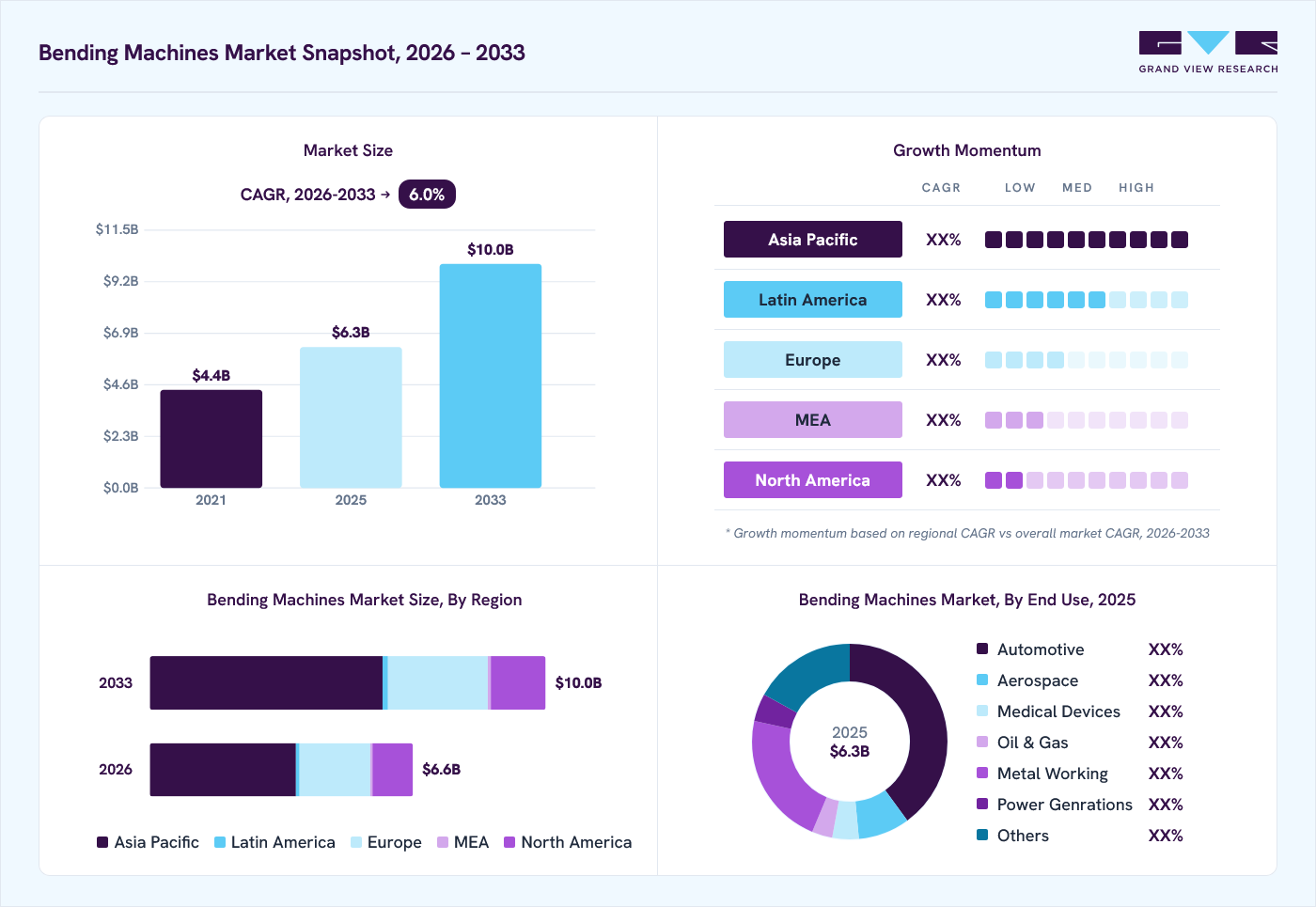
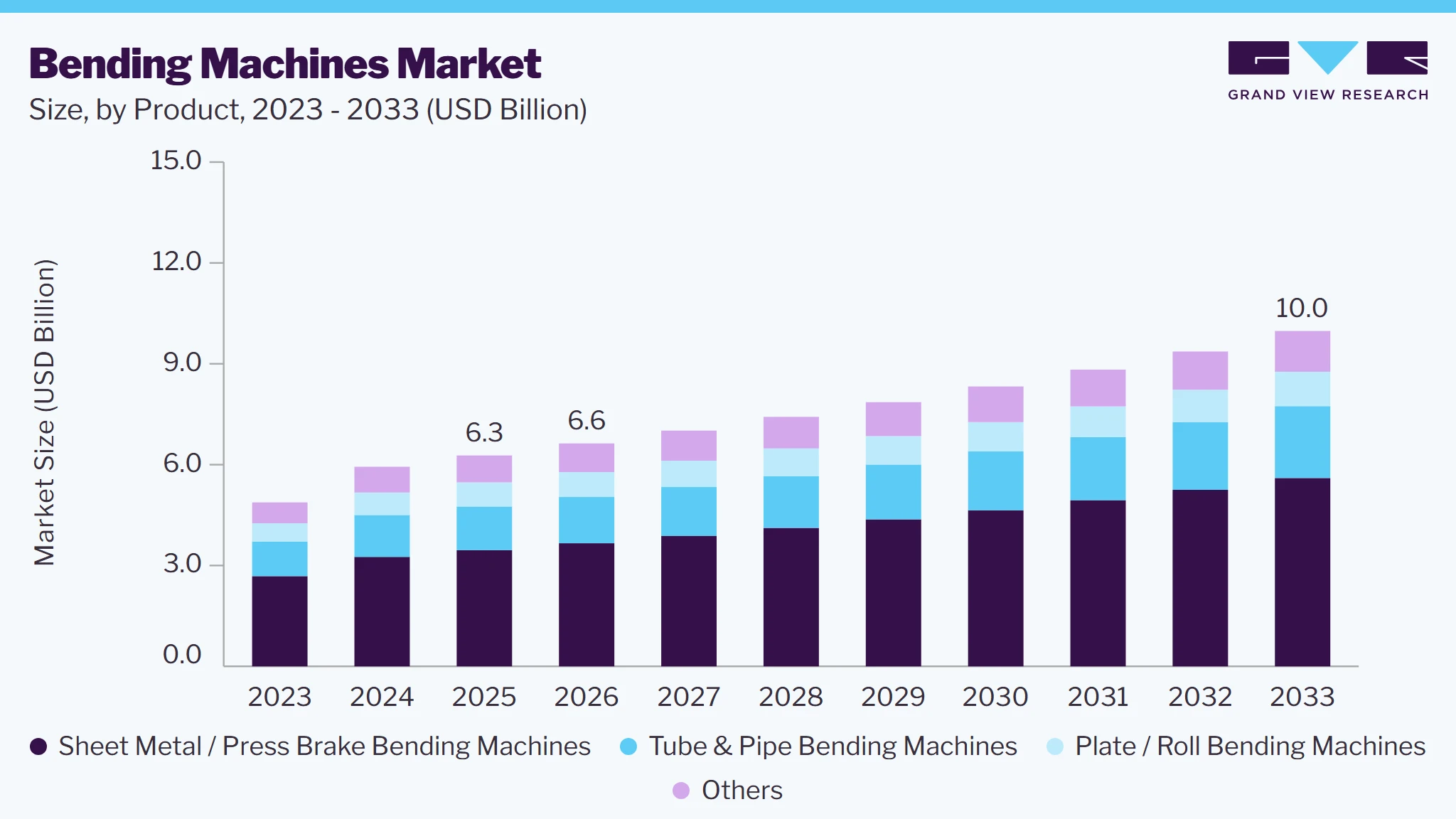
The global bending machines market size was valued at USD 6.3 billion in 2025 and is projected to grow from USD 6.6 billion in 2026 to USD 10.0 billion by 2033, at a CAGR of 6.0% from 2026 to 2033. Asia Pacific dominated the market, accounting for a revenue share of 55.0% in 2025. Growing demand for precision metal fabrication is driving the adoption of bending machines across automotive, aerospace, industrial equipment, construction, and general metalworking applications.
 Source: Grand View Research, IR Documents, Primary Interviews, Paid DatabasesTo learn more about this report,
 Download Free Sample Report
 Key Market Trends & Insights
- Based on product: Sheet metal / press brake bending machines segment led the market with the largest revenue share of 55.1% in 2025.
- Based on type: Computer numerical control segment led the market with the largest revenue share of 85.7% in 2025.
- Based on end use: Automotive segment led the market with the largest revenue share of 39.9% in 2025.
Regional Highlights
- Largest Regional Market: Asia Pacific (55.0% revenue share, 2025)
- By Country: China held the largest market share in 2025
Market Size & Forecast
- Market Size in 2025: USD 6.3 Billion
- Estimated market size in 2026: USD 6.6 Billion
- Projected Market Size by 2033: USD 10.0 Billion
- CAGR (2026-2033): 6.0%
Three ways to get this report
Buy it, customize it, or ask a question.Ask an Analyst
Analyst response in 1 business day
- AccessReport author, directly
- Reply timeWithin 1 working day
- No sales callDirect answer only
- FormatEmail reply
- CostFree, no cost
Get the Full Report
What the study covers
- FormatsPDF · Excel · Dashboard
- Timeline2026–2033 annual, 2025 base
- Coverage20+ countries, 5 regions
- Companies10+ key players profiled
Customize the Report
20% free customization
- IncludeCountries, segments, points
- TailorTo your product definition
- ExtendDeeper competitor detail
- OrA fully bespoke study
- Turnaround5–10 working days
Manufacturers are increasingly seeking equipment capable of producing complex geometries with consistent dimensional accuracy while reducing material waste and production time. The expansion of automated manufacturing facilities and the increasing use of CNC-controlled bending systems are further supporting demand, particularly for high-volume and precision-oriented production.
 To learn more about this report, Download Free Sample Report
 Rising automation and modernization of manufacturing facilities are another key growth factor for the market. Manufacturers are replacing conventional equipment with CNC and digitally controlled bending machines to improve productivity, repeatability, and operational efficiency. Integration with CAD/CAM systems, automated tool changing, robotic material handling, and smart production technologies is also encouraging investment in advanced bending equipment, particularly among manufacturers seeking greater flexibility and reduced dependence on manual operations.
Market Dynamics
The bending machines market is evolving with the shift toward automated metal forming, higher production accuracy, shorter manufacturing cycles, and greater flexibility in handling different material thicknesses and component geometries. Demand is also being influenced by equipment modernization, replacement of aging machinery, and the growing adoption of digitally controlled production systems. At the same time, high initial investment, tooling requirements, operator skill needs, and differences in machine capabilities across applications can affect purchasing decisions.
Manufacturers are increasingly adopting CNC-based bending equipment to achieve consistent forming quality, repeatable dimensions, and faster production cycles. Programmable controls allow operators to handle multiple bending sequences with fewer manual adjustments, making these machines suitable for production environments where accuracy and throughput are important. Automation also helps reduce setup errors and improve utilization of production equipment.
The development of servo-electric drives, automated tool changing, robotic part handling, and software-enabled production planning is further strengthening the business case for advanced bending machines. Integration with CAD/CAM and manufacturing execution systems allows bending operations to become part of more connected production workflows, encouraging equipment upgrades among manufacturers seeking greater process control and productivity.
The relatively high purchase cost of advanced CNC bending machines can restrict adoption, particularly among small and medium-sized fabrication businesses. In addition to the machine itself, investments may be required for tooling, software, installation, training, and supporting automation equipment. Complex systems can also require skilled operators and technicians, increasing the overall cost of ownership.
The increasing integration of Industry 4.0 technologies presents an opportunity for bending-machine manufacturers to develop connected and intelligent equipment. Real-time production monitoring, predictive maintenance, remote diagnostics, automated parameter selection, and production-data analytics can improve machine utilization and process visibility. Manufacturers that integrate bending equipment with robotics, digital controls, and connected software can meet the growing demand for flexible, data-driven manufacturing systems.
Market Concentration & Characteristics
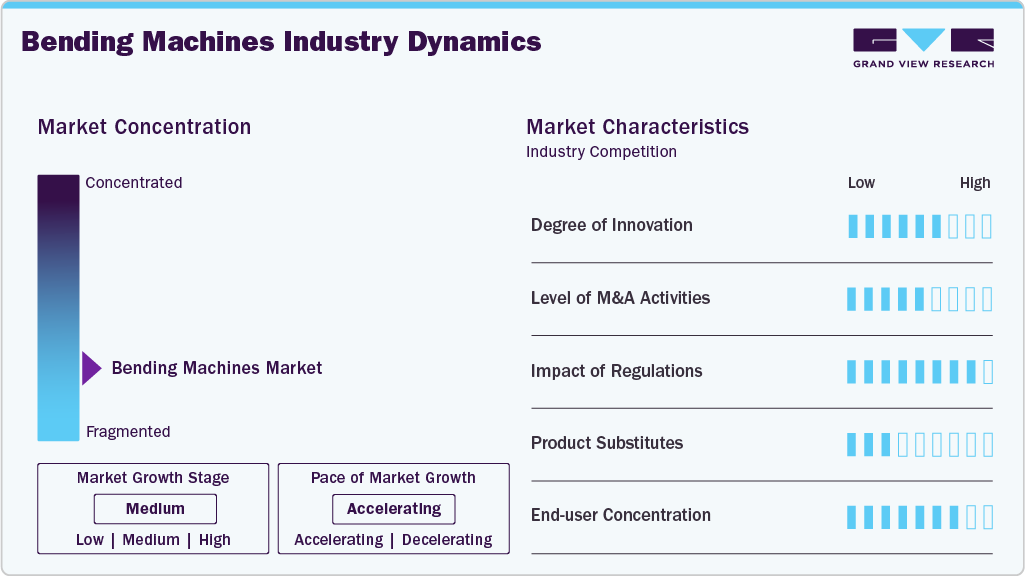
The bending machines market is fragmented, with a mix of established global manufacturers and regional machine-tool suppliers competing across different bending technologies. Leading companies maintain strong positions through broad product portfolios, CNC capabilities, automation solutions, and established distribution networks, while numerous regional manufacturers compete on customization, pricing, and application-specific equipment. The presence of specialized suppliers for press brakes, tube and pipe bending, and plate rolling further contributes to market fragmentation.
The bending machines industry has a high degree of innovation, supported by advances in CNC controls, servo-electric systems, automated tooling, robotics, and digital production monitoring. Manufacturers are focusing on improving bending accuracy, cycle times, energy efficiency, and machine flexibility, while integration with CAD/CAM and smart-factory platforms is increasing the capabilities of modern equipment.
 To learn more about this report, Download Free Sample Report
 Regulatory requirements have a moderate impact on the industry, primarily through machinery safety, electrical systems, workplace protection, noise, and energy-efficiency requirements. Compliance influences machine design, control systems, guarding, and certification, particularly for manufacturers selling equipment across multiple international markets.
End-user concentration is relatively low to moderate, as demand is distributed across fabrication workshops, machinery producers, component manufacturers, and various industrial production activities. Large manufacturing companies can generate substantial equipment orders, but a broad base of smaller and mid-sized fabricators reduces dependence on a limited number of customers.
Analyst Perspective
The bending machines market is transitioning toward CNC-controlled, automated, and digitally integrated equipment, as manufacturers seek higher precision, repeatability, productivity, and flexibility in metal-forming operations. Press brake machines continue to account for a major share of demand, while tube and pipe bending equipment is gaining momentum as manufacturers adopt more complex and lightweight component designs. Asia Pacific remains a key growth center due to its large manufacturing base, while established markets in Europe and North America continue to invest in automation and equipment modernization. Going forward, manufacturers that combine advanced CNC controls, robotics, energy-efficient technologies, and software integration are likely to strengthen their competitive positioning as fabrication processes become increasingly automated.
Product Insights
The sheet metal/press brake bending machines segment accounted for the largest market share of 55.1% in 2025, supported by their broad use in general metal fabrication and the production of formed sheet components. Their ability to perform precise angular bends across different material thicknesses, combined with the availability of hydraulic, electric, and CNC configurations, makes them a core part of modern fabrication operations. Demand is further supported by the ongoing replacement of conventional equipment with programmable and automated press brake systems.
Tube & pipe bending machines are expected to register the fastest growth at a CAGR of 6.5% over the forecast period, driven by increasing requirements for accurately formed tubular components and more complex geometries. Advances in CNC control, multi-axis bending, and automated material handling are improving productivity while minimizing deformation and setup time. The growing need for lightweight tubular structures and customized pipe assemblies is also encouraging investment in more flexible tube-bending equipment.
Type Insights
The computer numerical control (CNC) segment dominated the market with a revenue share of 85.7% in 2025, supported by its ability to deliver consistent bending accuracy, repeatable production, and faster setup for complex operations. Programmable controls also enable manufacturers to manage multiple bending sequences with greater process consistency, making CNC systems well-suited to precision-oriented and automated production environments.
Conventional bending machines are expected to grow at a moderate pace, with a 5.1% CAGR over the forecast period, mainly supported by replacement demand and continued use in basic fabrication applications. Their comparatively simple operation and lower upfront cost make them practical for smaller workshops and applications with straightforward bending requirements, although adoption is gradually shifting toward programmable equipment, where greater flexibility and automation are required.
End Use Insights
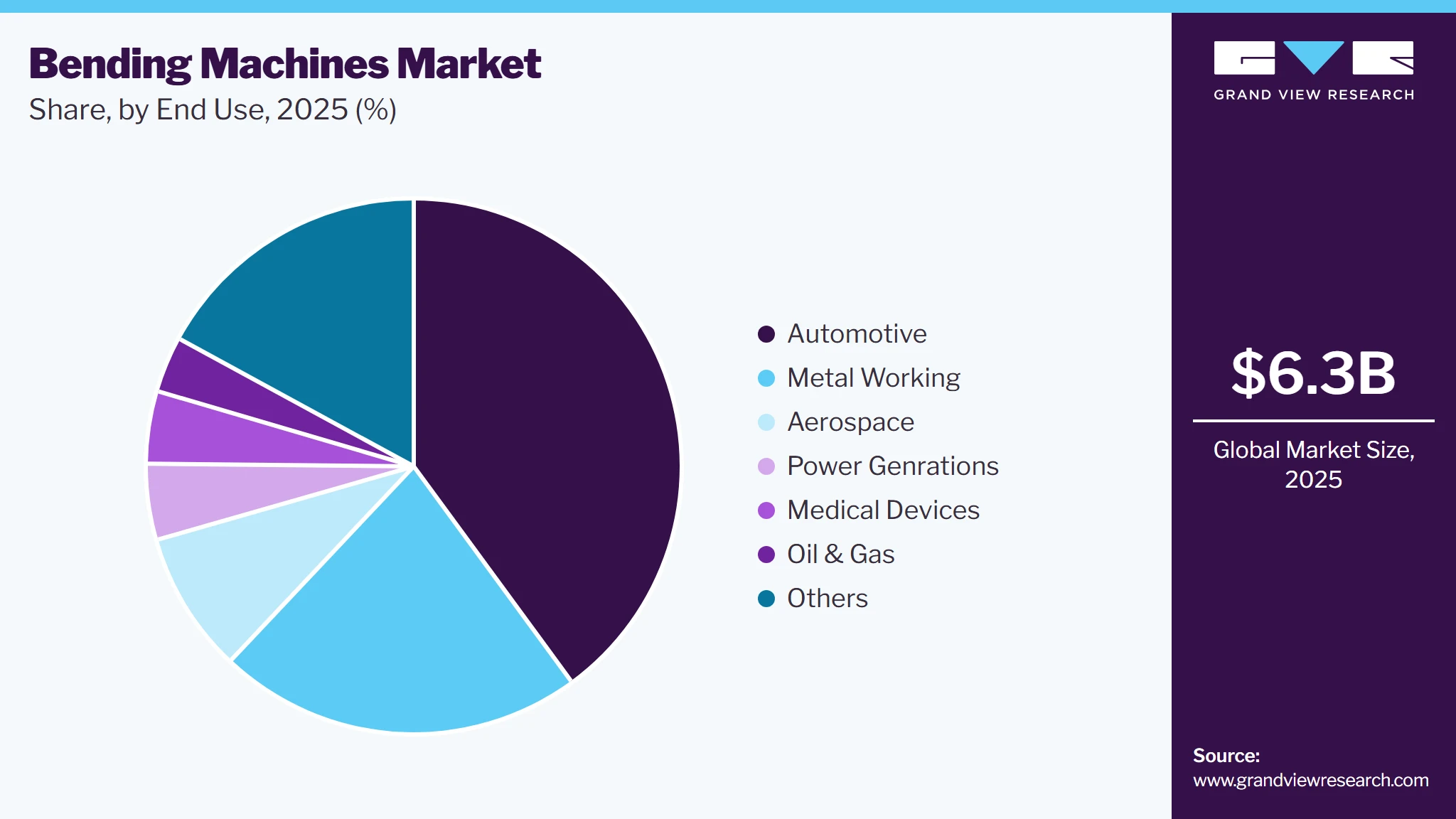
The automotive segment dominated the bending machines market with a revenue share of 39.9% in 2025, underpinned by extensive use of formed metal components across vehicle manufacturing and component production. High-volume manufacturing requires consistent bending accuracy and repeatable output. The shift toward lightweight vehicle structures is also increasing demand for precisely formed sheets, tubes, and profiles. CNC and automated bending systems are therefore gaining wider adoption across production lines.
 To learn more about this report, Download Free Sample Report
 Aerospace is expected to be the fastest-growing end-use segment at a CAGR of 7.3% over the forecast period, driven by increasing aircraft production and demand for lightweight, accurately formed components. Aerospace manufacturing requires tight dimensional control and consistent forming quality for complex metal parts. Advancements in CNC and multi-axis bending technologies are improving the ability to produce intricate geometries. Rising investment in aircraft manufacturing capacity is further supporting equipment demand.
Regional Insights
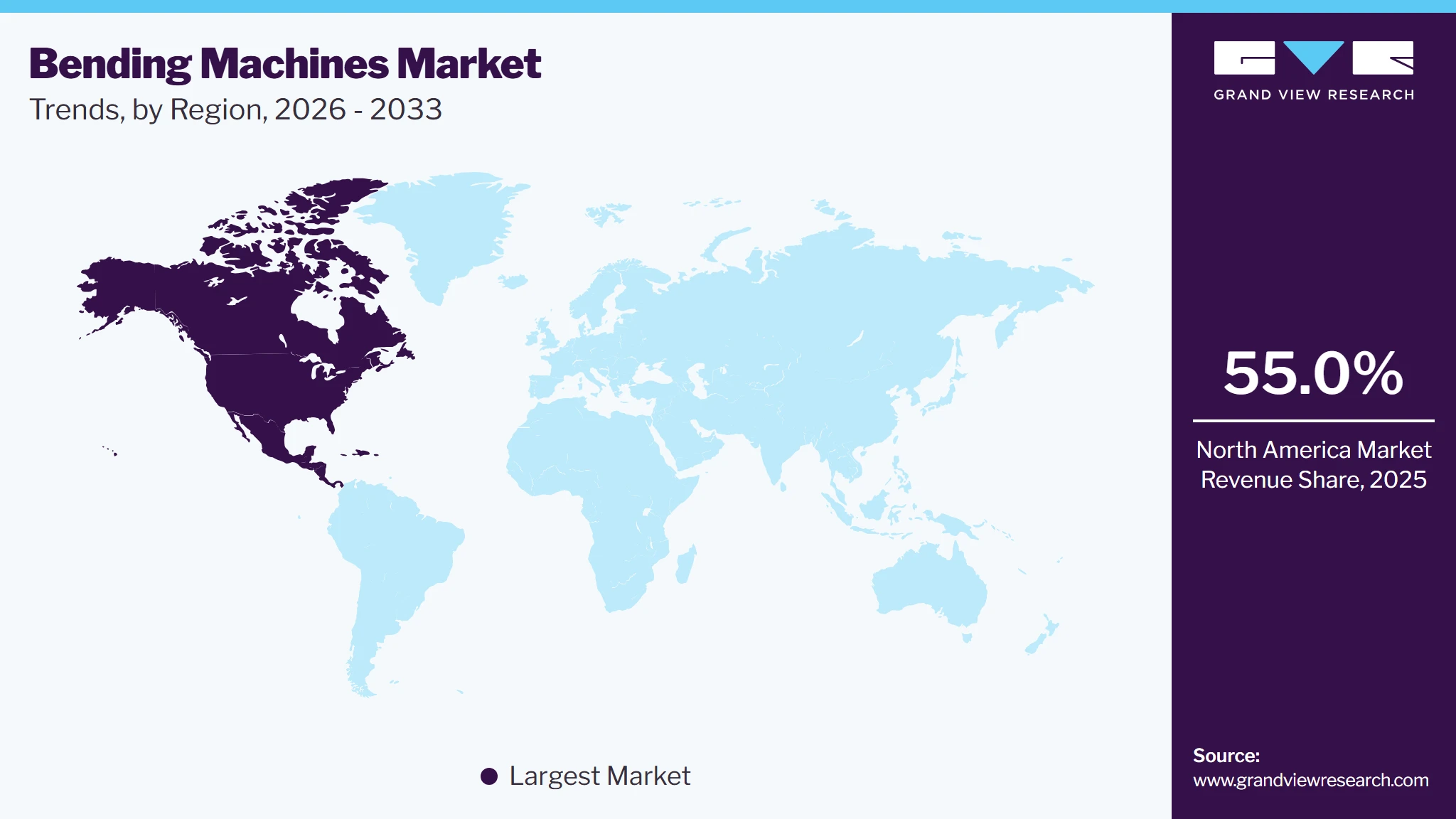
Asia Pacific dominated the bending machines market with a revenue share of 55.0% in 2025, and it is expected to remain the fastest-growing region, supported by its large manufacturing base and continued expansion of metal fabrication capacity. Investments in factory automation and modernization are encouraging the adoption of CNC and digitally controlled equipment. Strong machinery production networks and the presence of established machine-tool suppliers further support regional demand.
 To learn more about this report, Download Free Sample Report
 The China bending machines market led the Asia Pacific region, supported by its extensive manufacturing base and large-scale automotive production. According to China’s Ministry of Industry and Information Technology (MIIT), the country produced 34.5 million vehicles in 2025, up 10.4% year-on-year, while vehicle sales reached 34.4 million units, increasing 9.4%. New-energy vehicle production reached 16.6 million units, up 29.0%, highlighting the continued expansion of automotive manufacturing and the associated requirement for precision metal-forming equipment.
The bending machines market in India is expected to witness strong growth, supported by the expansion of its automotive manufacturing base. According to the Ministry of Heavy Industries, India produced around 31 million vehicles in FY2024-25, while the automotive industry had a turnover of approximately USD 240 billion and supported around 30 million jobs. More recently, the Society of Indian Automobile Manufacturers (SIAM) reported that total automobile production reached 347.1 million units in FY2025-26, including 5.54 million passenger vehicles and 11.70 million commercial vehicles. Passenger-vehicle production increased from 5.06 million in FY2024-25 to 5.54 million in FY2025-26, supporting demand for precision metal-forming and bending equipment.
North America Bending Machines Market Trends
The bending machines market in North America is growing through investments in manufacturing modernization, reshoring initiatives, and automated fabrication processes. Manufacturers are increasingly upgrading older equipment to improve productivity and reduce dependence on manual operations. Demand for flexible CNC systems is also supported by the need to handle shorter production runs and varied component designs.
U.S. Bending Machines Market Trends
The bending machines market in the U.S. dominated the North American region, fueled by its substantial machinery and metal-fabrication base. According to the U.S. Bureau of Labor Statistics, the country had approximately 151,000 employees in metalworking machinery manufacturing in December 2025, including around 41,700 employees in machine-tool manufacturing. In addition, Bureau of Economic Analysis (BEA) data shows that manufacturing accounted for 52.5% of total new foreign direct investment expenditures in the U.S. in 2025, equivalent to USD 121.8 billion, highlighting continued investment in domestic production capacity. These manufacturing and machinery activities support demand for advanced bending and metal-forming equipment.
Europe Bending Machines Market Trends
The bending machines market in Europe is witnessing steady growth as manufacturers focus on precision engineering, production efficiency, and advanced automation. The region's established machine-tool industry supports the continuous development of high-performance bending technologies. Demand for energy-efficient electric systems and automated production solutions is also encouraging equipment upgrades.
The Germany bending machines market dominated the European industry, supported by its strong industrial and machinery manufacturing base. According to Germany’s Federal Statistical Office (Destatis), manufacturing value added increased by 1.0% quarter-on-quarter in Q1 2025, while investment in machinery and equipment rose 0.7% during the same period. The country also exported EUR 146.2 billion (~USD 165.3 billion) of goods to the U.S. in 2025, with machinery and automotive products representing major export categories, highlighting the scale of Germany’s industrial production ecosystem.
The bending machines market in Italy is expected to record steady growth in the European market, supported by its established industrial and metalworking base and continued investment in productive capacity. Istat (Istituto Nazionale di Statistica) reported that Italy's gross fixed investment increased 3.9% in volume terms in 2025, while value added in manufacturing and other industrial activities increased 0.4%. Industrial production also showed a 7.4% year-on-year increase in metallurgy and fabricated metal products in December 2025, indicating continued activity in metal-intensive manufacturing that supports demand for bending equipment.
Middle East & Africa Bending Machines Market Trends
The bending machines market in the Middle East & Africa is expected to continue to grow as industrial diversification and infrastructure development create new requirements for metal fabrication equipment. Investment in manufacturing capabilities is encouraging the adoption of modern forming machinery, while demand for locally produced metal components is supporting equipment purchases. The gradual modernization of fabrication facilities is also creating opportunities for CNC-based solutions.
The South Africa bending machines market dominated the Middle East & Africa region, supported by its established manufacturing, metal fabrication, mining equipment, automotive, and industrial machinery base. The country has a developed network of metalworking and engineering businesses that use bending equipment for producing structural parts, machinery components, enclosures, pipes, and fabricated assemblies. Ongoing industrial modernization and efforts to strengthen local manufacturing capabilities are also supporting demand for CNC and automated bending systems.
Latin America Bending Machines Market Trends
The bending machines market in Latin America is experiencing gradual market expansion alongside the development of manufacturing and fabrication activities. Increasing investment in industrial machinery and upgrades to existing production facilities is creating opportunities for bending-equipment suppliers. Demand is particularly strong among manufacturers seeking to improve production efficiency without making major changes to their existing fabrication processes.
The Brazil bending machines market dominated the Latin American industry, underpinned by its diversified manufacturing base and established metal fabrication ecosystem. The country's automotive, machinery, construction equipment, and industrial manufacturing activities generate demand for equipment for forming sheets, plates, tubes, and profiles. The expansion of domestic production capacity and the modernization of fabrication facilities are also encouraging manufacturers to adopt CNC-controlled bending systems to improve accuracy and productivity.
Key Bending Machines Company Insights
Some of the key players operating in the market include TRUMPF, Bystronic Group, and LVD Group NV.
-
TRUMPF is a Germany-based industrial technology company founded in 1923 and a major manufacturer of machine tools, laser technology, and industrial electronics. The company develops technologies for cutting, joining, shaping, and digitally connecting production processes, with bending machines included in its machine-tool portfolio. In fiscal year 2024/25, TRUMPF generated USD 4,893.9 billion in sales and employed 18,303 people worldwide. The company operates through more than 70 subsidiaries across Europe, the Americas, and Asia, supporting its global manufacturing and technology presence.
-
LVD Group is a Belgium-based, family-owned manufacturer of sheet metal fabrication equipment, established in 1952. The company began as a precision press brake manufacturer and has since expanded its portfolio to include press brakes, panel benders, laser-cutting machines, punch presses, shearing machines, automation, and CAD/CAM software. LVD operates production facilities in Belgium, the U.S., Italy, Slovakia, China, and India, with direct representation in more than 47 countries. Its bending portfolio includes stand-alone press brakes, robotic bending systems, XXL press brakes, and cobot bending systems, supporting applications across transportation, machinery, construction, fabricated metal products, and other industrial sectors.
Key Bending Machines Companies
The following key companies have been profiled for this study on the bending machines market
-
TRUMPF
-
Amada (India) Pvt. Ltd.
-
Bystronic Group
-
LVD Group NV
-
ADH Machine Tool
-
Salvagnini Italia SPA
-
Prima Industrie S.p.A.
-
DURMAPRESS
-
Cincinnati Incorporated
-
Accurpress
-
Ermaksan
-
BLM GROUP
-
AMOB
-
Numalliance
-
YLM Group
Competitive Benchmarking
Category
Operating Strategies
Competitive Edge
Weakness
Established Players (e.g., TRUMPF; Amada (India) Pvt. Ltd.; Bystronic Group; LVD Group NV; Salvagnini Italia SPA)
- Expand CNC, robotic, and automated bending solutions to improve productivity and process flexibility.
- Invest in digital controls, software integration, and energy-efficient bending technologies.
- Strengthen global manufacturing, distribution, and customer-support networks.
- Broad product portfolios covering press brakes, panel benders, automation, and integrated sheet-metal solutions.
- Strong brand recognition and established relationships with industrial manufacturers.
- Greater R&D capabilities supporting advanced automation and precision-bending technologies.
- Advanced equipment generally involves higher upfront investment.
- Automated systems can require skilled operators and specialized technical support.
- Complex product portfolios and global operations can result in longer implementation and service processes.
Emerging & Regional Players (e.g., ADH Machine Tool; DURMAPRESS; Ermaksan; AMOB; Numalliance)
- Focus on customized bending equipment and application-specific machine configurations.
- Compete through competitive pricing and flexible solutions for regional manufacturers.
- Expand international presence through distributors, partnerships, and specialized product offerings.
- Greater flexibility in adapting machines to specific customer requirements.
- Competitive pricing can support adoption among cost-sensitive manufacturers.
- Specialized expertise in tube, pipe, wire, or sheet-metal bending provides opportunities in niche applications.
- More limited global distribution and service networks compared with established players.
- Lower financial and R&D resources can constrain large-scale technology development.
- Lower brand visibility in some international markets may limit access to major equipment contracts.
Recent Developments
-
In July 2025, Prima Power expanded its Bending Product Unit in Cologna Veneta, Italy, inaugurating an additional 2,500 sq. m. of production space in July 2025. The expansion increased the facility’s production capacity by 50% and includes a new 1,000 sq. m. service building and a 150 kW photovoltaic system. The facility produces Prima Power’s full range of bending solutions, including press brakes, robotic bending cells, and automated panel benders.
-
In September 2025, TRUMPF launched a new generation of bending machines at Blechexpo 2025, led by the redesigned TruBend 3000. The new machine is designed to deliver higher productivity, with throughput time reduced by around 40% compared with the previous generation.
Bending Machines Market Report Scope
Report Attribute
Details
Market size value in 2025
USD 6.3 billion
Estimated market size in 2026
USD 6.6 billion
Projected market size by 2033
USD 10.0 billion
Growth rate
CAGR of 6.0% from 2026 to 2033
Historical data
2021 - 2024
Forecast period
2026 - 2033
Quantitative units
Revenue in USD billion and CAGR from 2026 to 2033
Report coverage
Revenue forecast, company ranking, competitive landscape, growth factors, and trends
Segments covered
Product, type, end use, region
Regional scope
North America; Europe; Asia Pacific; Latin America; Middle East & Africa; Africa
Country scope
U.S.; Canada; Mexico; UK; Germany; France; Spain; Italy; China; Japan; India; South Korea; Australia; Brazil; Argentina; Saudi Arabia; UAE; South Africa
Key companies profiled
TRUMPF; Amada (India) Pvt. Ltd.; Bystronic Group; LVD Group NV; ADH Machine Tool; Salvagnini Italia SPA; Prima Industrie S.p.A.; DURMAPRESS; Cincinnati Incorporated; Accurpress; Ermaksan; BLM GROUP; AMOB; Numalliance; YLM Group.
Customization scope
Free report customization (equivalent up to 8 analysts working days) with purchase. Addition or alteration to country, regional & segment scope.
Pricing and purchase options
Avail customized purchase options to meet your exact research needs. Explore purchase options
Global Bending Machines Market Report Segmentation
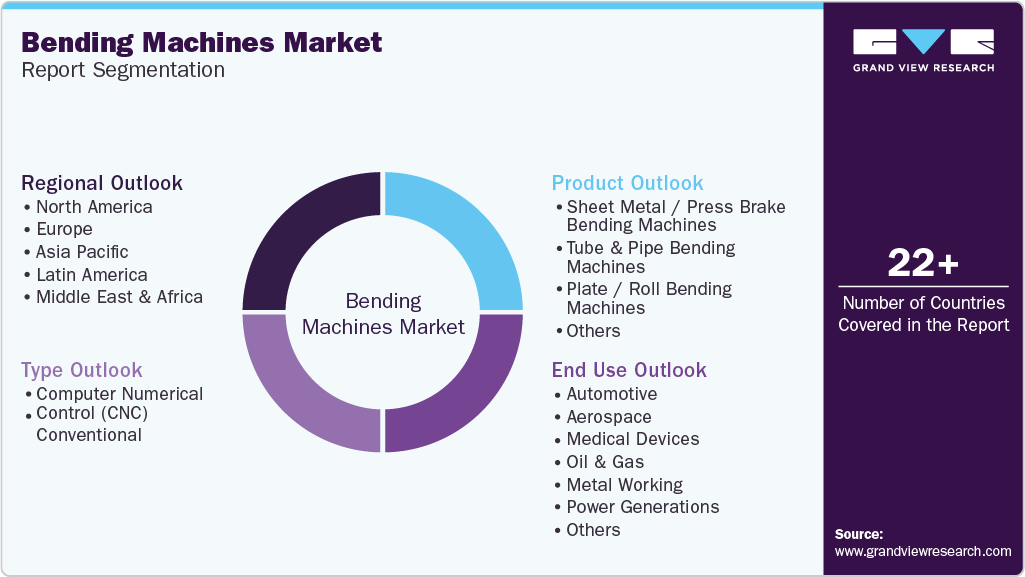
This report forecasts revenue growth at global, regional, and country levels and provides an analysis of the latest industry trends in each of the sub-segments from 2021 to 2033. For this study, Grand View Research has segmented the global bending machines market report based on product, type, end use, and region
 To learn more about this report, Download Free Sample Report
 -
Product Outlook (Revenue, USD Billion, 2021 - 2033)
-
Sheet Metal / Press Brake Bending Machines
-
Tube & Pipe Bending Machines
-
Plate / Roll Bending Machines
-
Others
-
-
Type Outlook (Revenue, USD Billion, 2021 - 2033)
-
Computer Numerical Control (CNC)
-
Conventional
-
-
End Use Outlook (Revenue, USD Billion, 2021 - 2033)
-
Automotive
-
Aerospace
-
Medical Devices
-
Oil & Gas
-
Metal Working
-
Power Generations
-
Others
-
-
Regional Outlook (Revenue, USD Billion, 2021 - 2033)
-
North America
-
U.S.
-
Canada
-
Mexico
-
-
Europe
-
Germany
-
France
-
Italy
-
Spain
-
UK
-
-
Asia Pacific
-
-
China
-
India
-
Japan
-
Australia
-
South Korea
-
-
Latin America
-
Brazil
-
Argentina
-
-
Middle East & Africa
-
Saudi Arabia
-
UAE
-
South Africa
-
-
Research Methodology
The bending machines marketfigures in this report are based on a proven research process that combines executive interviews with secondary research from proprietary databases, company filings, and recognized regulatory and institutional sources. Market size is built through value-chain sizing-reconciling supply-side and demand-side estimates-and triangulated with bottom-up and top-down approaches. Every estimate passes multiple levels of expert validation before publication, with eachbending machines segment quantified using the revenue-capture definitions in the table below.
Segment Definition
Product
Revenue Capture Definition
Sheet Metal / Press Brake Bending Machines
Revenue generated from the sale of machines designed to bend, fold, and form flat metal sheets into specified angles, profiles, and geometries. This includes hydraulic, electric, servo-electric, hybrid, CNC, and automated press brake systems used for different sheet thicknesses and production requirements.
Tube & Pipe Bending Machines
Revenue generated from the sale of machines designed to bend metal tubes and pipes into specified angles, radii, and configurations. This includes CNC, hydraulic, electric, rotary-draw, mandrel, and multi-axis tube and pipe bending equipment.
Plate / Roll Bending Machines
Revenue generated from the sale of machines used to bend, curve, and roll metal plates or sheets into cylindrical, conical, or other curved shapes. This includes three-roll, four-roll, and other plate-rolling systems used for forming medium- and heavy-gauge materials.
Others
Revenue generated from the sale of specialized bending machines that are not classified under sheet metal, tube and pipe, or plate and roll bending. This includes equipment designed for bending profiles, sections, wires, bars, and other specialized metal components.
Type
Revenue Capture Definition
Computer Numerical Control (CNC)
Revenue generated from the sale of bending machines equipped with computerized numerical control systems that automate machine positioning, bending sequences, tooling movements, and operating parameters. These systems include CNC press brakes, CNC tube benders, and other programmable bending equipment.
Conventional
Revenue generated from the sale of manually operated or mechanically, hydraulically, or electrically controlled bending machines without integrated CNC-based automated control. These machines are generally used for relatively straightforward bending operations and production requirements.
End Use
Revenue Capture Definition
Automotive
Revenue generated from the sale of bending machines used to manufacture vehicle and automotive components, including body parts, chassis components, exhaust systems, brackets, structural parts, and tubular assemblies.
Aerospace
Revenue generated from the sale of bending machines used to manufacture aircraft, spacecraft, and related aerospace components. This includes equipment used for forming structural parts, tubes, ducts, brackets, profiles, and other precision metal components.
Medical Devices
Revenue generated from the sale of bending machines used to manufacture metal components and assemblies for medical devices and equipment. Applications include precision tubing, instrument components, equipment frames, brackets, and specialized metal parts.
Oil & Gas
Revenue generated from the sale of bending machines used to manufacture and form pipes, tubes, pressure-related components, vessels, structural parts, and other metal components used across petroleum and gas-related infrastructure.
Metal Working
Revenue generated from the sale of bending machines to metal fabrication, machining, and metal-processing companies for producing bent sheets, plates, tubes, pipes, profiles, frames, brackets, and other fabricated components.
Power Generations
Revenue generated from the sale of bending machines used to manufacture and form components for power-generation equipment and facilities. This includes pipes, pressure vessels, structural components, ducts, and other formed metal parts.
Others
Revenue generated from the sale of bending machines used across applications outside the defined end-use segments, including construction equipment, transportation, furniture, appliances, industrial machinery, and general fabrication activities.
Estimation Model
Layer Name
Key Question
Description
End-Use Industry & Manufacturing Activity
What is the underlying demand for bending equipment?
Assess manufacturing output, metal fabrication activity, automotive production, machinery investment, and industrial capacity across key countries and regions to establish the underlying requirement for bending equipment.
Bending Machine Demand & Installed Base
How many bending machines are required and used across applications?
Estimate demand based on machine installations, replacement requirements, production-capacity additions, technology upgrades, and adoption of CNC, press brake, tube & pipe, and plate/roll bending machines.
Manufacturer & Product-Level Revenue Capture
What portion of equipment sales is captured by bending-machine manufacturers?
Analyze company product portfolios, reported machine-tool revenues, bending-machine sales, shipment activity, new product launches, regional presence, and the share attributable to bending equipment to estimate market-level equipment sales.
Bending Machines Market Revenue
What is the total market revenue?
Aggregate estimated revenue from the sale of sheet metal/press brake, tube & pipe, plate/roll, and other bending machines across CNC and conventional technologies and all defined end-use industries and regions.
Delivered Customizations
This report has been delivered with the following In-depth customizations
Client Request
Customization Delivered
Value Adds
Regional Segmentation
Delivered a comprehensive regional and country-level assessment covering North America, Europe, Asia Pacific, Latin America, and Middle East & Africa, with country-level insights for key markets including the U.S., Germany, Italy, China, India, Brazil, and South Africa.
Provides a clear understanding of regional demand patterns, manufacturing activity, growth opportunities, and country-level market dynamics, enabling clients to identify priority geographic markets.
Competitive Benchmarking
Delivered a detailed competitive assessment of key bending-machine manufacturers, including TRUMPF, AMADA, Bystronic, LVD, Salvagnini, Prima Power, Ermaksan, BLM GROUP, AMOB, and Numalliance, covering product portfolios, recent product launches, expansions, partnerships, and strategic developments.
Enables comparison of market participants based on product capabilities, technology adoption, automation focus, geographic presence, and strategic initiatives, supporting competitor positioning and market-entry analysis.
Opportunity Assessment
Delivered an opportunity assessment covering products, CNC versus conventional technology, end-use applications, regional markets, automation, and emerging demand areas, supported by market dynamics, growth drivers, restraints, industry characteristics, and segment-level insights.
Helps identify areas with stronger demand potential, technology transition opportunities, and application-level growth prospects while supporting strategic planning, investment decisions, and product positioning.
Frequently Asked Questions About This Report
The global bending machines market size was valued at 6.3 billion in 2025 and is estimated at USD 6.6 billion in 2026.
The global bending machines market is expected to grow at a CAGR of 6.0% from 2026 to 2033, reaching USD10.0 billion by 2033.
Asia Pacific was the largest regional market, accounting for 55.0% of global revenue in 2025.
The sheet metal/press brake bending machines segment dominated the market, accounting for 55.1% of global revenue in 2025. Their broad applicability across metal fabrication and industrial production, along with increasing adoption of CNC and automated press brake systems, supports their leading position.
Computer numerical control (CNC) segment dominated the market with a revenue share of 85.7% in 2025 and conventional bending machines is second fastest growing market
The automotive segment dominated the bending machines market with a revenue share of 39.9% in 2025 while aerospace segment is expected to be the fastest-growing market.
Some of the key players operating in the global bending machines market include TRUMPF; Amada (India) Pvt. Ltd.; Bystronic Group; LVD Group NV; ADH Machine Tool; Salvagnini Italia SPA; Prima Industrie S.p.A.; DURMAPRESS; Cincinnati Incorporated; Accurpress; Ermaksan; BLM GROUP; AMOB; Numalliance; YLM Group.
Increasing adoption of CNC and automated bending systems, growing metal fabrication activity, rising demand for precision components, manufacturing capacity expansion, and modernization of conventional machinery are key factors driving the market. Integration of robotics, digital controls, and smart manufacturing technologies is also encouraging manufacturers to upgrade bending equipment.
About the Author(s)
Advanced Interior Materials Research Team
Advanced Materials · Advanced Interior MaterialsThis report was authored by the advanced interior materials research team at Grand View Research - comprising two research analysts, one senior research analyst, and one industry expert - with specialized expertise in the advanced interior materials segment of the advanced materials industry. All findings are based on proprietary advanced materials databases, executive interviews, and regulatory analysis, subject to internal peer review prior to publication.
Last Updated:
Speak to Analyst

Customize this report to your needs - add regions, segments, or data points, with 20% free customization.
Or view our licence options:


ISO 9001:2015 & 27001:2022 Certified
We are GDPR and CCPA compliant! Your transaction & personal information is safe and secure. For more details, please read our privacy policy.


