
- Home
- »
- Next Generation Technologies
- »
-
BFSI Crisis Management Market Size & Share Report, 2033GVR Report cover

BFSI Crisis Management Market (2026 - 2033)
Size, Share & Trends Analysis Report By Component (Software, Services), By Deployment, By Enterprise Size, By Application (Risk & Compliance Management, Disaster Recovery & Business Continuity), By End-user, By Region, And Segment Forecasts
Market Size, 2025
$20.0BMarket Estimate, 2026
$23.5BMarket Forecast, 2033
$81.4BCAGR, 2026–2033
19.4%BFSI Crisis Management Market Summary
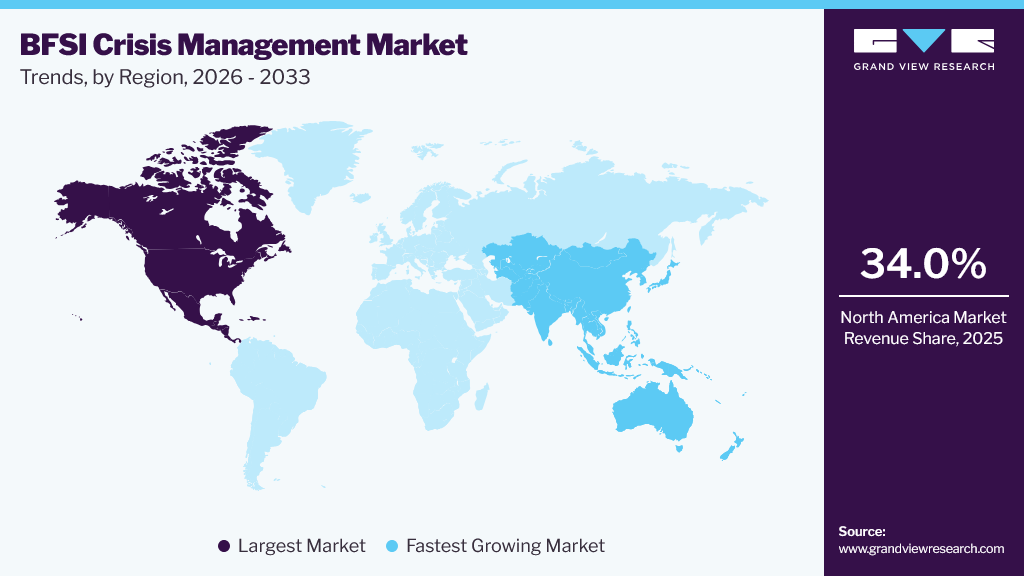
The global BFSI crisis management market size was valued at USD 20.0 billion in 2025 and is projected to grow from USD 23.5 billion in 2026 to USD 81.4 billion in 2033, at a CAGR of 19.4% from 2026 to 2033. North America held the largest revenue share of around 34.0% in 2025. Factors such as the growth in the digitization of banks and financial services, and the remote working culture leading to more cybercrimes are driving the demand for banking, financial services, and insurance (BFSI) crisis management.
Key Market Trends & Insights
- By component: Software held the largest market share of over 70.0% in 2025.
- By deployment: Cloud held the largest revenue share of around 60.0% in 2025.
- By enterprise size: Large enterprise held the largest revenue share of around 58.0% in 2025.
- By application: Risk & compliance management held the largest share of over 30.5% in 2025.
- By application: Banks held the largest revenue share of around 52.0% in 2025.
Regional Highlights
- Largest regional market: North America (34.0% revenue share, 2025)
- Fastest-growing regional market: Asia Pacific (fastest CAGR, 2026-2033)
Market Size & Forecast
- Market size in 2025: USD 20.0 Billion
- Estimated market size in 2026: USD 23.5 Billion
- Projected market size by: USD 81.4 Billion
- CAGR (2026-2033): 19.4%
GVR research-powered AIAsk Prism AI about the BFSI crisis management marketGet cited answers from GVR research on market growth, segments, regulations and forecasts.Start with✓ Source-linked answers ✓ Market-specific context ✓ Traceable figuresExplore Prism AI ↗
Furthermore, the introduction of cybercrime policies, initiatives, and regulations by the governments for the BFSI sector and crisis management solution providers is boosting the demand for crisis management services worldwide. Crisis management is a service that offers solutions for risk assessments, crisis notification alerts, crisis-tracking dashboards, business continuity and disaster recovery plans, and risk and compliance management solutions.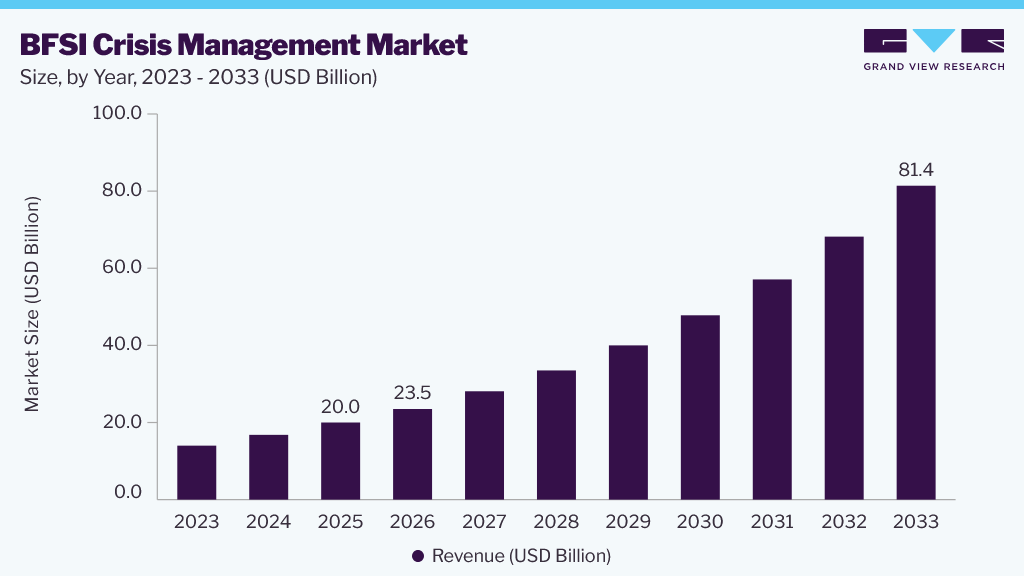 Source: Grand View Research, IR Documents, Primary Interviews, Paid DatabasesTo learn more about this report,
 Download Free Sample Report
BFSI organizations are focusing more on keeping business operations running during system failures, cyber incidents, natural disasters, and geopolitical disruptions. The heavy reliance on constant financial services makes downtime very costly, both financially and in terms of reputation. Crisis management solutions help institutions create organized response plans, practice risk scenarios, and quickly recover essential operations. The growing use of resilience-focused strategies, such as disaster recovery and incident response planning, is significantly boosting the BFSI crisis management market worldwide.
Market Dynamics
The growing number, scale, and complexity of cyberattacks targeting banks, insurers, and other financial institutions are driving demand for crisis management solutions across the BFSI sector. As organizations expand digital banking services, cloud-based operations, and interconnected financial systems, the risk of data breaches, ransomware attacks, operational disruptions, and reputational harm has risen significantly. As a result, financial institutions are investing in crisis management platforms to improve incident response, business continuity planning, cyber resilience, and stakeholder communication.
Recent cyber incidents highlight the need for solid crisis preparedness. For instance, in April 2026, Texas Capital Bank, which had about USD 33.4 billion in assets, revealed a data breach that exposed sensitive personal information of more than 91,000 people, including Social Security numbers. This increased the risk of identity theft and financial fraud. Similarly, in August 2025, Marquis faced a ransomware attack that impacted at least 672,075 individuals, compromising personal and financial information, including banking details and Social Security numbers. These incidents show the growing operational and reputational risks for financial institutions. They reinforce the need for effective crisis management solutions to ensure a quick response, minimize business disruptions, maintain regulatory compliance, and protect customer trust.
The growing complexity of regulatory requirements in global financial markets is a major challenge for the BFSI crisis management market. Financial institutions operating across different jurisdictions must comply with a variety of rules governing cybersecurity, data protection, operational resilience, incident reporting, and third-party risk management. The need to align crisis management frameworks with regional requirements increases implementation costs, adds administrative duties, and complicates operations. Frequent regulatory updates also demand ongoing investments in compliance monitoring, employee training, technology upgrades, and governance processes. For multinational banks and insurers, creating consistent crisis response strategies across various regulatory settings can be especially tough, often prolonging deployment timelines and increasing resource needs.
Growing economic uncertainty, geopolitical tensions, interest rate fluctuations, and changing financial risks are creating significant opportunities for crisis management solution providers in the BFSI sector. Financial institutions are increasingly investing in operational resilience frameworks, stress-testing tools, scenario analysis platforms, contingency planning systems, and enterprise-wide crisis response solutions to improve their readiness for potential disruptions. These solutions help organizations evaluate weaknesses, simulate negative events, coordinate response strategies, and maintain business continuity during market instability. Regulators are also stressing the importance of resilience planning and proactive risk management. They encourage financial institutions to improve their crisis preparedness. For instance, in June 2026, the Bank for International Settlements (BIS) noted that banks need to strengthen scenario analysis and operational resilience planning amid ongoing geopolitical uncertainty, inflationary pressures, and interest rate changes. This increasing emphasis on resilience and preparedness is likely to create substantial opportunities for vendors offering crisis management, risk monitoring, and coordinated response platforms throughout the BFSI sector.
Analyst Perspective
The BFSI crisis management market is growing steadily, driven by rising financial fraud, cyberattacks, regulatory pressures, and operational disruptions in banking and insurance. Financial organizations are focusing on strong crisis preparedness, real-time risk monitoring, and effective incident response systems to protect operations and maintain customer trust. As digital banking, mobile payments, and cloud-based financial services become more common, the exposure to systemic risks also rises. This makes crisis management solutions vital. Furthermore, stricter regulatory compliance requirements are pushing BFSI firms to invest in integrated risk and crisis management platforms. Solution providers can find opportunities by creating AI-driven predictive risk analytics, automated incident response systems, and unified crisis communication platforms that improve resilience, ensure compliance, and reduce financial and reputational losses.
Component Insights
The software segment dominated the BFSI crisis management industry, accounting for a revenue share of over 70.0% in 2025, as the crisis management software enables the key stakeholders to stay informed, assists the crisis teams to coordinate response activities, and puts important documentation in the hands of all employees with the help of a simple and effective cloud platform. The growing need for real-time incident management, operational resilience, cyber risk monitoring, and regulatory compliance is driving demand for crisis management software in the BFSI sector. Financial institutions are increasingly adopting integrated platforms that provide risk assessment, incident response automation, scenario planning, business continuity management, and crisis communication capabilities. The rising complexity of cyber threats and regulatory requirements is further speeding up software adoption.
The services segment is projected to register the highest CAGR of over 21.0% over the forecast period. The growth of the services segment can be attributed to the increased focus of technology companies on the development of technology as a service (TaaS). The increasing need for crisis preparedness, regulatory compliance, and business continuity planning is boosting demand for professional and managed services. BFSI organizations are turning to consulting, implementation, training, incident response, and resilience assessment services to strengthen crisis management frameworks and ensure effective responses to operational, cyber, and financial disruptions.
Deployment Insights
The cloud segment dominated the BFSI crisis management market, accounting for a revenue share of around 60.0% in 2025, and is projected to register the fastest CAGR of around 21.0% over the forecast period. There is significant growth in the cloud segment as the cloud provides a high level of backup and redundancy at a minimal cost. The growing use of digital banking, remote operations, and cloud-based financial services is driving demand for cloud-deployed crisis management solutions. Cloud platforms provide scalability, real-time access, lower deployment costs, and faster implementation, allowing financial institutions to efficiently monitor risks, coordinate crisis response activities, and maintain business continuity across geographically diverse operations.
The on-premises segment held a significant market share in 2025. Large financial institutions continue to prefer on-premises crisis management solutions due to strict data security, privacy, and regulatory requirements. Banks and insurers handling highly sensitive customer and transaction data often favor on-premises deployments to maintain greater control over their infrastructure, ensure compliance with data sovereignty regulations, and reduce exposure to external cybersecurity risks.
Enterprise Size Insights
The large enterprises segment accounted for the largest revenue share of around 58.0% in 2025. This is attributed to the trend of adopting the multi-cloud and hybrid cloud strategy among large enterprises as they are deploying workloads on multiple public clouds while also storing some data on the private cloud. Large banks, insurance companies, and financial institutions are increasingly investing in crisis management solutions to handle complex operational environments, extensive regulatory obligations, and rising cyber threats. The need to protect large customer bases, continue business operations, and ensure resilience across the enterprise is driving significant adoption among large organizations.
The small and medium enterprises segment is projected to grow at the fastest CAGR of over 20.5% over the forecast period. This segment is expected to give high returns to overcome business shocks, and to achieve this goal, small and medium firms require a crisis management plan and team. The growing digitalization of financial services and increasing exposure to cyber risks are pushing SMEs in the BFSI sector to adopt crisis management solutions. Affordable cloud-based platforms and managed services help smaller financial institutions and fintech firms improve incident response capabilities, enhance regulatory compliance, and reduce operational disruptions without major infrastructure investments.
Application Insights
The risk and compliance segment dominated the BFSI crisis management industry, accounting for the largest revenue share of over 30.5% in 2025. The growing complexity of regulatory requirements, operational resilience mandates, and risk governance frameworks is increasing the need for risk and compliance management solutions in the BFSI sector. Financial institutions are investing in new technologies to simplify regulatory monitoring, improve compliance efficiency, and reduce operational and reputational risks. For instance, in June 2026, Wolters Kluwer’s Financial & Corporate Compliance division launched NILS AI Assist. This AI-powered solution allows users to conduct regulatory research with natural language queries, get clear insights, and find relevant compliance information more effectively. These innovations help financial institutions improve compliance management, speed up regulatory responses, and prepare better for crises. This support drives growth in the risk and compliance management segment.
The crisis communication segment is projected to register the fastest CAGR of around 20.5% during the forecast period. The rising number of cyber incidents, operational disruptions, and linked financial risks is increasing the need for better crisis communication solutions in the BFSI sector. Financial institutions focus on real-time alert systems, automated communication processes, and coordinated response platforms. These tools help share important information quickly with employees, customers, regulators, and stakeholders during crises. For instance, in April 2026, Everbridge, Inc. improved its High Velocity Critical Event Management platform. This upgrade enables faster risk detection, automated response coordination, and improved disruption management. The platform has shown incident response times that are up to 15 times faster and a 90% improvement in risk identification and employee alerts. These innovations are boosting crisis communication abilities and supporting segment growth.
End-user Insights
The banks segment dominated the BFSI crisis management market, accounting for the largest revenue share of around 52.0% in 2025 as they largely adopt digital platforms and networked solutions. The rising frequency of cyberattacks, fraud incidents, regulatory scrutiny, and operational disruptions is leading banks to adopt crisis management solutions. These institutions need reliable tools to support incident response, business continuity planning, risk monitoring, and crisis communication while ensuring uninterrupted financial services and customer confidence.
The financial service providers segment is expected to grow at the fastest CAGR of around 21.0% over the forecast period. This is owing to the increase in the number of investments in fintech in the Asia Pacific region. Financial services providers, including fintech companies, payment processors, investment firms, and wealth management organizations, are increasingly investing in crisis management solutions as digital transactions and interconnected financial systems continue to grow. The need to protect sensitive financial data, maintain service availability, comply with regulations, and quickly respond to emerging threats is driving adoption in this sector.
Regional Insights
North America dominated the global BFSI crisis management market with a share of around 34.0% in 2025, owing to the presence of prominent crisis management services and software providers. The market growth is also driven by the fast growth of digital banking, fintech platforms, and cloud-based financial systems. This growth has greatly increased exposure to cyber threats, fraud, and operational disruptions. Financial institutions in the region are investing heavily in crisis management solutions to boost cyber resilience, ensure regulatory compliance, and maintain uninterrupted financial services. The existence of large banking networks, strict regulatory frameworks, and frequent major cyber incidents is speeding up adoption. Furthermore, the growing emphasis on real-time incident response, business continuity planning, and crisis communication is driving strong market growth across the region.
 To learn more about this report, Download Free Sample Report
Asia Pacific BFSI Crisis Management Market Trends
The Asia Pacific BFSI crisis management industry is projected to grow at the fastest CAGR of over 21.0% during the forecast period. The market growth can be attributed to the rapid digital transformation, increased use of mobile banking, and the expansion of financial inclusion initiatives in emerging economies. The growing use of digital payment systems and fintech services has significantly raised operational risks, cyber vulnerabilities, and system disruptions, leading to high demand for crisis management solutions. Also, the growing regulatory focus on financial stability, data protection, and operational resilience is prompting BFSI institutions to adopt more robust risk monitoring and incident response methods. Increased investments in banking infrastructure and the rapid rise of cross-border financial transactions are also supporting market growth in the region.
Key BFSI Crisis Management Company Insights
The competitive landscape of the BFSI crisis management market is fragmented, featuring several global and regional players. The key participants are entering into strategic collaborations, partnerships, and mergers & acquisitions to expand their business footprint and survive the highly competitive environment. Moreover, service providers are investing significantly in research & development to incorporate new technologies into their offerings and develop advanced solutions to gain a competitive advantage over other market players.
-
In April 2026, Oriserve (ORI) introduced a specialized solution designed for BFSI operations, focusing on revenue-generating workflows rather than traditional support or chatbot applications. The platform aims to enable financial institutions to directly link automation capabilities with measurable business performance outcomes. Oriserve’s platform is aligned with GDPR, Reserve Bank of India (RBI) guidelines, and ISO 27001 requirements, addressing a critical priority for technology leaders, balancing innovation with robust governance, data protection, and security compliance.
-
In October 2025, IBM announced the launch of IBM Digital Asset Haven, a platform designed to help financial institutions, governments, and companies securely manage and grow their digital asset operations. This solution offers a unified system for handling the entire digital asset lifecycle, including custody, transactions, and settlement. It also supports compliance needs and integrates smoothly with existing systems. IBM Digital Asset Haven was developed in partnership with Dfns, a leading digital wallet provider. It combines IBM’s security and infrastructure skills with Dfns’ technology for management and digital asset custody.
Key BFSI Crisis Management Companies
The following key companies have been profiled for this study of the BFSI crisis management market.
-
Accenture plc
-
Deloitte Touche Tohmatsu Limited
-
Everbridge, Inc.
-
Fusion Risk Management, Inc.
-
IBM Corporation
-
MetricStream, Inc.
-
Microsoft Corporation
-
LogicGate, Inc.
-
SAS Institute Inc.
-
ServiceNow, Inc.
BFSI Crisis Management Market Report Scope
Report Attribute
Details
Market size in 2025
USD 20.0 billion
Estimated market size in 2026
USD 23.5 billion
Projected market size by 2033
USD 81.4 billion
Growth Rate
CAGR of 19.4% from 2026 to 2033
Base year for estimation
2025
Historical data
2021 - 2024
Forecast period
2026 - 2033
Quantitative units
Revenue in USD billion, and CAGR from 2026 to 2033
Report coverage
Revenue forecast, company ranking, competitive landscape, growth factors, and trends
Segments covered
component, deployment, enterprise size, application, end-user, region
Regional Scope
North America; Europe; Asia Pacific; Latin America; Middle East & Africa
Country Scope
U.S.; Canada; UK; Germany; France; Italy; China; India; Japan; Brazil; Mexico
Key companies profiled
Accenture plc; Deloitte Touche Tohmatsu Limited; Everbridge, Inc.; Fusion Risk Management, Inc.; IBM Corporation; MetricStream, Inc.; Microsoft Corporation; LogicGate, Inc.; SAS Institute Inc.; ServiceNow, Inc.
Customization scope
Free report customization (equivalent up to 8 analysts working days) with purchase. Addition or alteration to country, regional & segment scope.
Pricing and purchase options
Avail of customized purchase options to meet your exact research needs. Explore purchase options
Global BFSI Crisis Management Market Report Segmentation
This report forecasts revenue growth at the global, regional & country levels and provides an analysis of the latest industry trends in each of the sub-segments from 2021 to 2033. For this study, Grand View Research has segmented the global BFSI crisis management market report based on component, deployment, enterprise size, application, end-user, and region:
- Component Outlook (Revenue, USD Billion, 2021 - 2033)
- Software
- Services
- Deployment Outlook (Revenue, USD Billion, 2021 - 2033)
- On-Premise
- Cloud
- Enterprise Size Outlook (Revenue, USD Billion, 2021 - 2033
- Large Enterprises
- Small & Medium Enterprises
- Application Outlook (Revenue, USD Billion, 2021 - 2033)
- Risk & Compliance Management
- Disaster Recovery & Business Continuity
- Incident Management & Response
- Crisis Communication
- Others
- End-user Outlook (Revenue, USD Billion, 2021 - 2033)
- Banks
- Insurance Companies
- Financial Services Providers
- Regional Outlook (Revenue, USD Billion, 2021 - 2033)
- North America
- U.S.
- Canada
- Europe
- UK
- Germany
- France
- Italy
- Asia Pacific
- China
- India
- Japan
- Latin America
- Brazil
- Mexico
- Middle East & Africa
- North America
Frequently Asked Questions About This Report
The global BFSI crisis management market is estimated to grow at a CAGR of 19.4% from 2026 to 2033 and reach USD 81.4 billion by 2033.
The global BFSI crisis management market size was valued at USD 20.0 billion in 2025 and is witnessed to the value of USD 23.5 billion in 2026.
the risk & compliance management held the largest share of over 30.5% in 2025.
North America dominated the BFSI crisis management with a share of 34.0% in 2025. This is attributable to the presence of prominent crisis management services and software providers.
Some key players operating in the BFSI crisis management market are Accenture plc; Deloitte Touche Tohmatsu Limited; Everbridge, Inc.; Fusion Risk Management, Inc.; IBM Corporation; MetricStream, Inc.; Microsoft Corporation; LogicGate, Inc.; SAS Institute Inc.; and ServiceNow, Inc.
About the Author(s)
Next Generation Technologies Research Team
Technology · Next Generation TechnologiesThis report was authored by the next generation technologies research team at Grand View Research - comprising two research analysts, one senior research analyst, and one industry expert - with specialized expertise in the next generation technologies segment of the technology industry. All findings are based on proprietary technology databases, executive interviews, and regulatory analysis, subject to internal peer review prior to publication.
Last Updated:
Speak to Analyst

Customize this report to your needs - add regions, segments, or data points, with 20% free customization.
Or view our licence options:


ISO 9001:2015 & 27001:2022 Certified
We are GDPR and CCPA compliant! Your transaction & personal information is safe and secure. For more details, please read our privacy policy.


