
- Home
- »
- Plastics, Polymers & Resins
- »
-
Bimodal HDPE Market Size, Share, Trends Report 2026-2033GVR Report cover

Bimodal HDPE Market (2026 - 2033)
Size, Share & Trends Analysis Report By Processing Method (Extrusion, Blow Molding, Injection Molding), By Application (Packaging, Automotive, Construction), By Region, And Segment Forecasts
Market Size, 2025
$11.4BMarket Estimate, 2026
$12.5BMarket Forecast, 2033
$19.6BCAGR, 2026–2033
6.7%Bimodal HDPE Market Summary
The global bimodal HDPE market size was valued at USD 11.4 billion in 2025 and is projected to grow from USD 12.5 billion in 2026 to USD 19.6 billion by 2033, growing at a CAGR of 6.7% from 2026 to 2033. The Asia Pacific market held the largest share of 37.8% of the global market in 2025. The long-term performance under harsh conditions and rising demand from the renewable energy sector are driving bimodal HDPE use in durable conduit and cable jacketing for solar and wind installations.
 Source: Grand View Research, IR Documents, Primary Interviews, Paid DatabasesTo learn more about this report,
 Download Free Sample Report
 Key Market Trends & Insights
- By processing method: The extrusion segment led the market with the largest revenue share of 52.6% in 2025.
- By application: The packaging segment led the market with the largest revenue share of 49.2% in 2025.
Regional Highlights
- Largest regional market: Asia Pacific (37.8% revenue share, 2025)
- By country: The China held the largest market share in 2025.
Market Size & Forecast
- Market size in 2025: USD 11.4 Billion
- Estimated market size in 2026: USD 12.5 Billion
- Projected market size by 2033: USD 19.6 Billion
- CAGR (2026-2033): 6.7%
Three ways to get this report
Buy it, customize it, or ask a question.Ask an Analyst
Analyst response in 1 business day
- AccessReport author, directly
- Reply timeWithin 1 working day
- No sales callDirect answer only
- FormatEmail reply
- CostFree, no cost
Get the Full Report
What the study covers
- FormatsPDF · Excel · Dashboard
- Timeline2026–2033 annual, 2025 base
- Coverage20+ countries, 5 regions
- Companies10+ key players profiled
Customize the Report
20% free customization
- IncludeCountries, segments, points
- TailorTo your product definition
- ExtendDeeper competitor detail
- OrA fully bespoke study
- Turnaround5–10 working days
In addition, increasing agricultural investments boost demand for high-strength geomembranes and irrigation tubing made from bimodal HDPE. The market is witnessing a pronounced shift toward high-performance applications, driven by the material’s exceptional balance of stiffness and toughness. Manufacturers are adopting advanced gas-phase and slurry-phase polymerization technologies to produce grades with optimized molecular weight distributions. This evolution enables producers to tailor resin properties for specific end uses, such as pressure piping and heavy-duty blow molding. Regional expansion in developing economies, particularly in Asia Pacific, is fueling capacity additions, while established players in North America and Europe focus on sustainability through recycled content incorporation and energy-efficient production methods. To learn more about this report, Download Free Sample Report
 Market Dynamics
Bimodal HDPE demand is anchored in polyolefin substitution, where converters need a resin that combines stiffness, toughness, and processability across packaging, pipe, and molded parts. The market is shaped by high-end use intensity in pressure pipe, rigid packaging, and industrial containers, with procurement decisions tied to performance qualification rather than spot buying alone. Demand remains concentrated in Asia Pacific and the Middle East, where integrated resin capacity and downstream conversion are expanding, while North America and Europe remain more specification-led. Commercially, the market is organized around long-term supply agreements, grade premiums, and producer technical support.
The strongest growth driver is the continued migration toward bimodal HDPE in pressure pipe, where utilities and industrial users require higher crack resistance, better slow crack growth performance, and longer service life. Bimodal molecular structure improves balance between stiffness and toughness, which supports use in water, gas, and drainage infrastructure. This performance profile is particularly relevant in large diameter networks and replacement projects that demand lower failure risk and reduced maintenance exposure.
Infrastructure renewal, urban utility expansion, and rising specification pressure are reinforcing this shift. Bimodal grades also support thinner wall designs and better process stability, which helps pipe manufacturers lower resin usage without compromising durability. As a result, buyers increasingly favor certified grades that can meet PE100 and similar performance thresholds, creating a premium market for suppliers with consistent quality, technical service, and qualification support.
Bimodal HDPE adoption is constrained by the long qualification cycle required in pressure pipe, food contact packaging, and other specification driven applications. Buyers test melt behavior, environmental stress crack resistance, odor, purity, and dimensional stability before approving new grades, which slows supplier switching and reduces short-term volume capture. This creates a strong incumbent advantage and limits pricing flexibility for entrants.
The restraint is compounded by feedstock-linked cost volatility and the need for tightly controlled reactor performance. Producers must maintain narrow property windows to preserve customer confidence, which increases operating discipline and limits rapid portfolio changes. In practice, this makes market penetration slower in high-value applications where certification, field performance, and customer trust matter more than nominal price competitiveness.
A meaningful opportunity is the shift toward recyclable mono material packaging structures, where bimodal HDPE can replace more complex multilayer formats in caps, closures, rigid bottles, and industrial packaging. Its balance of rigidity, impact strength, and processability supports downgauging and easier recycling compatibility. Brand owners are increasingly prioritizing circularity, which creates room for bimodal grades that deliver stable blow molding performance, PCR readiness, and consistent quality.
Market Characteristics
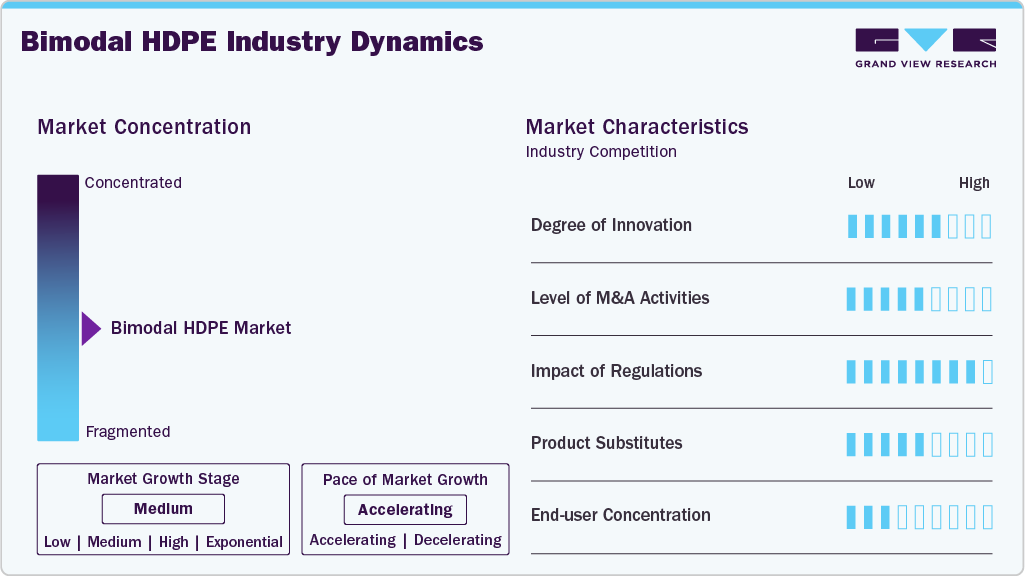
The growth stage of the bimodal HDPE industry is medium, and the pace is accelerating. The market is slightly fragmented, with key players dominating the industry landscape. Major companies Dow Inc., Chevron Phillips Chemical Company, SABIC, Exxon Mobil Corporation, Dynalab Corp., LyondellBasell Industries N.V., INEOS AG, SINOPEC Beijing Yanshan Company, PetroChina Company Ltd., Braskem S.A., Formosa Plastics Corporation, Daelim Industrial Co. Ltd., Mitsui Chemicals Inc., and others play a significant role in shaping the market dynamics. These leading players often drive innovation, introducing new products, technologies, and materials to meet evolving industry demands.
In pressure-pipe applications, bimodal HDPE increasingly faces competition from cross-linked polyethylene (PEX) and polypropylene random copolymer (PPR), offering comparable long-term hydrostatic performance but with varying cost structures. PEX’s superior thermal stability makes it a preferred choice for hot-water plumbing, while PPR benefits from weldable fittings and lower raw material costs in some regions. In packaging, biaxially oriented polypropylene (BOPP) films and high-crystallinity PP blends challenge bimodal HDPE by providing higher temperature resistance and lower density for thin-gauge film. Consequently, resin producers must continuously optimize grade formulations to preserve HDPE’s edge in stress-crack resistance and processing ease.
 To learn more about this report, Download Free Sample Report
 Recent environmental mandates-such as the EU’s Directive on Single-Use Plastics and extended producer responsibility (EPR) schemes-are compelling resin producers to integrate recycled content and enhance the recyclability of bimodal HDPE grades. In North America, stricter EPA standards on chemical leachate and microplastic emissions have led to more rigorous certification protocols for pipe liners and geomembranes, pushing manufacturers to demonstrate lifecycle compliance.
Analyst Perspective
The bimodal HDPE market is moving from basic volume expansion toward a more performance-led and specification driven phase. Demand will continue to be anchored by pressure pipe, packaging, and industrial molding, but value creation will increasingly depend on resin consistency, qualification support, and application-specific grades rather than commodity pricing alone. Over the forecast period, leaders are likely to differentiate through reactor technology, supply integration, regional manufacturing presence, and the ability to support circular packaging and high durability infrastructure systems. Sustainability pressure will favor grades that support downgauging, recyclability, and PCR compatibility, while procurement teams will continue to scrutinize lifecycle cost and reliability. Profitability will remain exposed to ethylene volatility, energy cost swings, conversion oversupply in some regions, and substitution from alternative polymers where performance requirements are less demanding.
Processing Method Insights
Based on the processing method, the extrusion segment led the market with the largest revenue share of 52.6% in 2025. The global market, categorized by processing methods, is largely driven by applications that depend on extrusion, particularly pipe and blown film extrusion. The demand for pipe extrusion is primarily fueled by the increasing use of PE-100 and PE-4710 grades in infrastructure projects centered on water and gas distribution, accelerated by urban development and the replacement of aging metal pipelines in regions such as Asia Pacific, the Middle East, and North America.
The blow molding segment is expected to grow at a considerable CAGR of 8.35% throughout the forecast period. The blow molding technique greatly influences the market, which is widely used to produce large containers, fuel tanks, drums, and household and industrial packaging. Due to its high molecular weight and improved melt strength, bimodal HDPE is particularly well-suited for blow molding applications that necessitate exceptional stiffness, impact resistance, and long-term environmental stress crack resistance (ESCR). The increasing demand for durable and lightweight packaging across industries such as chemicals, lubricants, food and beverages, and personal care is fueling growth in this area.
Application Insights
Based on application, the packaging segment led the market with the largest revenue share of 49.2% in 2025, due to rising global demand for lightweight, impact-resistant containers that offer enhanced shelf-life and product protection. In the fast-moving consumer goods (FMCG) sector, particularly in food, personal care, and cleaning products, manufacturers favor bimodal HDPE for its superior rigidity-to-weight ratio and stress-crack resistance, which allows for thinner, more cost-efficient bottles and jerry cans.
 To learn more about this report, Download Free Sample Report
 The automotive segment is projected to witness a rapid CAGR of 8.34% through the forecast period. The push toward vehicle lightweighting and improved fuel efficiency drives increased use of bimodal HDPE in components such as fuel tanks, air ducts, and battery casings. OEMs capitalize on the material’s high impact strength, chemical resistance, and dimensional stability to replace heavier metal parts without compromising safety or performance. As electric vehicle (EV) production scales rapidly across Asia and Europe, bimodal HDPE's suitability for high-voltage cable protection and thermal shielding is also gaining traction. This aligns with automakers’ dual goals of reducing emissions and meeting circular economy targets by integrating recyclable, durable thermoplastics.
Regional Insights
Asia Pacific dominated the bimodal HDPE market with the largest revenue share of 37.8% in 2025, owing to the rapid urbanization and infrastructure expansion in India, Southeast Asia, and China. Major highway and railway projects demand robust HDPE piping systems for efficient water management, while burgeoning e-commerce activities drive packaging needs for lightweight, high-strength containers. Government initiatives, such as India’s National Infrastructure Pipeline and Indonesia’s push for domestic polymer production, have spurred capacity additions, ensuring resilient supply chains. Moreover, increasing consumer environmental awareness has prompted brand owners to prefer recyclable materials, thereby boosting demand for HDPE grades with enhanced recyclability.
 To learn more about this report, Download Free Sample Report
 The bimodal HDPE market in China held the largest share in the Asia Pacific region in 2025. In China, the 14th Five-Year Plan’s emphasis on comprehensive industrialization and smart infrastructure catalyzes the adoption of bimodal HDPE in large-scale water and gas distribution projects. Domestic resin manufacturers ramp up capacity for advanced bimodal grades to meet urban construction and municipal engineering demand.
North America Bimodal HDPE Market Trends
The bimodal HDPE market in North America is primarily driven by the region’s advanced manufacturing infrastructure and strong emphasis on sustainable packaging solutions. Major polymer producers invest heavily in R&D, and high-performance grades tailored for food and beverage containers are continuously developed to meet tightening recyclability targets.
The U.S. bimodal HDPE market benefits from abundant shale gas reserves that provide cost-competitive ethylene feedstock, enabling producers to offer competitively priced resins. Recent expansions by leading petrochemical firms into advanced mechanical and chemical recycling facilities have further strengthened domestic supply chains by ensuring a steady stream of sustainable resin. The automotive industry’s shift toward lighter-weight components for improved fuel efficiency continues stimulating the adoption of bimodal HDPE in under-the-hood and fuel-system applications.
Europe Bimodal HDPE Market Trends
The bimodal HDPE market in Europe is anchored by stringent environmental regulations, such as the EU’s directive on single-use plastics, which compel manufacturers to incorporate higher recycled content in packaging. The construction sector’s growing reliance on high-density polymer piping for underground utilities and geomembrane solutions underscores its appeal due to its excellent stress-crack resistance and extended service life. Investment in bio-based and circular-economy initiatives, especially in Germany, France, and the UK, has led polymer producers to launch eco-optimized grades that align with corporate ESG goals.
Key Bimodal HDPE Company Insights
The market is highly competitive, with several key players dominating the landscape. Major companies include Dow Inc., Chevron Phillips Chemical Company, SABIC, Exxon Mobil Corporation, Dynalab Corp., LyondellBasell Industries N.V., INEOS AG, SINOPEC Beijing Yanshan Company, PetroChina Company Ltd., Braskem S.A., Formosa Plastics Corporation, Daelim Industrial Co. Ltd., and Mitsui Chemicals Inc.. The market is characterized by a competitive landscape with several key players driving innovation and growth. Major companies in this sector are investing heavily in research and development to enhance their types' performance, cost-effectiveness, and sustainability.
Key Bimodal HDPE Companies
The following key companies have been profiled for this study on the bimodal HDPE market.
-
Dow Inc.
-
Chevron Phillips Chemical Company
-
SABIC
-
Exxon Mobil Corporation
-
Dynalab Corp.
-
LyondellBasell Industries N.V.
-
INEOS AG
-
SINOPEC Beijing Yanshan Company
-
PetroChina Company Ltd.
-
Braskem S.A.
-
Formosa Plastics Corporation
-
Daelim Industrial Co., Ltd.
-
Mitsui Chemicals Inc.
Competitive Benchmarking
Category
Operating Strategies
Competitive Edge
Weakness
Established Players (Exxon Mobil Corporation, SABIC, Dow Inc., LyondellBasell Industries N.V., INEOS AG, Chevron Phillips Chemical Company, SINOPEC Beijing Yanshan Company, PetroChina Company Ltd., Formosa Plastics Corporation)
Expand portfolio breadth through premium grades, technical support, and wide distribution coverage.
Use partnerships, installer networks, and channel development to protect market access.
Invest in product consistency, application training, and regional supply reliability.
Strong brand recognition and customer trust across premium and commercial accounts.
Better integration of R&D, manufacturing, and downstream channel support.
Stronger ability to defend specification driven business and long-term contracts.
Higher overhead structure and slower response to niche local demand.
Greater exposure to compliance burden and portfolio complexity.
Premium positioning can face price resistance in cost-sensitive segments.
Emerging Players (Braskem S.A., Mitsui Chemicals Inc., Daelim Industrial Co., Ltd., Dynalab Corp.)
Focus on niche finishes, targeted product lines, and differentiated visual performance.
Use digital channels, community marketing, and installer relationships to build visibility.
Compete on flexible pricing, fast launches, and localized customer response.
Faster product iteration and greater agility in emerging niches.
More room to customize colors, textures, and application-specific offerings.
Leaner operating models support sharper pricing in selected segments.
Smaller scale limits global reach and supply chain leverage.
Lower brand depth can slow adoption in premium channels.
Less integration can constrain technical support and long-cycle customer retention.
Recent Developments
-
In June 2024, Bharat Petroleum Corporation Ltd. (BPCL) chose Univation's UNIPOL PE Process Technology for two production lines at BPCL's Bina Refinery in India. The units have a combined production capacity of 1,150,000 tons per year of polyethylene (PE)
-
In May 2025, Univation Technologies launched a new world-scale licensed design for its UNIPOL PE Process platform with a capacity of 800,000 tons per year, surpassing its previous top capacity of 650,000 tons per year. This next-generation design offers polyethylene producers significantly higher output, improved economies of scale, and flexible production capabilities for various polyethylene resins, including unimodal and bimodal HDPE, LLDPE, and metallocene PE.
Bimodal HDPE Market Report Scope
Report Attribute
Details
Market size value in 2025
USD 11.4 billion
Estimated market size in 2026
USD 12.5 billion
Projected market size by 2033
USD 19.6 billion
Growth rate
CAGR of 6.7% from 2026 to 2033
Base year for estimation
2025
Historical data
2021 - 2024
Forecast period
2026 - 2033
Quantitative units
Revenue in USD million/billion, volume in kilotons, and CAGR from 2026 to 2033
Report coverage
Revenue forecast, company ranking, competitive landscape, growth factors, and trends
Segments covered
Processing method, application, region
Regional scope
North America; Europe; Asia Pacific; Latin America; Middle East & Africa
Country scope
U.S.; Canada; Mexico; Germany; UK; France; Italy; Spain; China; India; Japan; South Korea; Australia; Brazil; Argentina; Saudi Arabia; South Africa; UAE
Key companies profiled
Dow Inc.; Chevron Phillips Chemical Company; SABIC; Exxon Mobil Corporation; Dynalab Corp.; LyondellBasell Industries N.V.; INEOS AG; SINOPEC Beijing Yanshan Company; PetroChina Company Ltd.; Braskem S.A.; Formosa Plastics Corporation; Daelim Industrial Co. Ltd.; Mitsui Chemicals Inc.
Customization scope
Free report customization (equivalent up to 8 analysts' working days) with purchase. Addition or alteration to country, regional & segment scope.
Pricing and purchase options
Avail customized purchase options to meet your exact research needs. Explore purchase options
Global Bimodal HDPE Market Report Segmentation
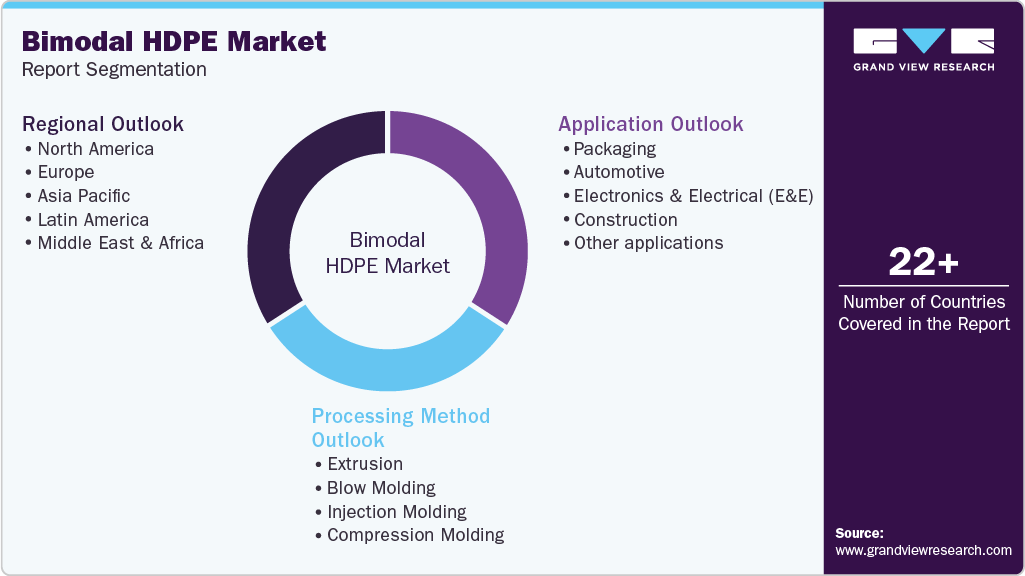
This report forecasts volume & revenue growth at the global, regional, and country levels and provides an analysis of the latest industry trends in each of the sub-segments from 2021 to 2033. For this study, Grand View Research has segmented the global bimodal HDPE market report based on processing method, application, and region:
 To learn more about this report, Download Free Sample Report
 -
Processing Method Outlook (Volume, Kilotons; Revenue, USD Million, 2021 - 2033)
-
Extrusion
-
Blow Molding
-
Injection Molding
-
Compression Molding
-
-
Application Outlook (Volume, Kilotons; Revenue, USD Million, 2021 - 2033)
-
Packaging
-
Automotive
-
Electronics & Electrical (E&E)
-
Construction
-
Other applications
-
-
Regional Outlook (Volume, Kilotons; Revenue, USD Million, 2021 - 2033)
-
North America
-
U.S.
-
Canada
-
Mexico
-
-
Europe
-
Germany
-
UK
-
France
-
Italy
-
Spain
-
-
Asia Pacific
-
China
-
India
-
Japan
-
South Korea
-
Australia
-
-
Latin America
-
Brazil
-
Argentina
-
-
Middle East & Africa
-
Saudi Arabia
-
South Africa
-
UAE
-
-
Research Methodology
Segment Definition
Segment – Processing Method
Revenue capture definition
Extrusion
Revenue is captured through resin sales to pipe, film, sheet, and profile converters that require stable melt strength, uniform output, and high mechanical performance.
Blow Molding
Revenue is generated through demand from bottle, jerrycan, drum, and tank producers that value impact resistance, stress crack resistance, and wall thickness control.
Injection Molding
Revenue is realized through the supply of molded components such as crates, caps, closures, industrial parts, and technical goods that need repeatable flow and dimensional stability.
Compression Molding
Revenue is captured where heavy-wall molded parts, industrial fittings, and specialty formed items require toughness, shrink control, and consistent part integrity.
Segment - Application
Revenue capture definition
Packaging
Revenue is driven by resin demand from rigid and flexible packaging converters using bimodal HDPE for mono material structures, containers, closures, and downgauged formats.
Automotive
Revenue is captured through supply for fuel system parts, fluid containers, ducts, liners, and molded components that need chemical resistance and long-term durability.
Electronics & Electrical (E&E)
Revenue is generated through applications in cable protection, insulating parts, housings, and protective packaging, where chemical resistance and process consistency matter.
Construction
Revenue is captured through pressure pipe, drainage pipe, geomembranes, sheets, conduit, and infrastructure products that depend on crack resistance and long service life.
Other applications
Revenue is earned through agriculture, consumer goods, industrial packaging, and specialty molded goods that do not fall within the primary end-use buckets.
Estimation Model
Layer Name
Key Question
Description
Demand Layer
Where is demand concentrated?
This layer maps application consumption across packaging, pipe, and molded goods to identify where resin demand is structurally concentrated.
Supply Layer
Who controls market supply?
This layer evaluates producer capacity, reactor configuration, integration level, and trade flow to isolate the commercial source of available resin.
Price Layer
What drives revenue realization?
This layer links ethylene cost, energy intensity, grade premium, and qualification complexity to estimate revenue realization and margin potential.
Validation Layer
How are estimates verified?
This layer triangulates producer disclosures, converter feedback, import data, and channel checks to confirm adoption, pricing, and regional weighting.
Delivered Customizations
This report has been delivered with the following In-depth customizations
CLIENT REQUEST
CUSTOMIZATION DELIVERED
VALUE ADDS
Add regional demand split
Expanded the regional outlook by identifying demand concentration across mature and emerging consumption centers, with a commercial context on where specification intensity and conversion capacity are highest.
Improves market prioritization and supports go-to-market planning by region.
Add application-level prioritization
Reframed the application landscape by ranking end uses based on resin intensity, qualification burden, and pricing potential across the value chain.
Helps isolate the most attractive revenue pools and premium-grade opportunities.
Add a competitive positioning matrix
Classify market participants by scale, integration, and market presence to clarify which players lead in premium supply and which compete through niche positioning.
Strengthens competitor benchmarking and investment screening.
Frequently Asked Questions About This Report
Some key players operating in the bimodal HDPE market include Dow Inc., Chevron Phillips Chemical Company, SABIC, Exxon Mobil Corporation, Dynalab Corp., LyondellBasell Industries N.V., INEOS AG, SINOPEC Beijing Yanshan Company, PetroChina Company Ltd., Braskem S.A., Formosa Plastics Corporation, Daelim Industrial Co. Ltd., and Mitsui Chemicals Inc.
Rising demand from the renewable energy sector is driving the use of bimodal HDPE in durable conduit and cable jacketing for solar and wind installations, thanks to its long-term performance under harsh conditions. Additionally, increasing agricultural investments are boosting demand for high-strength geomembranes and irrigation tubing made from bimodal HDPE.
Packaging dominated the application segmentation in revenue, accounting for a market share of 49.2% in 2025, due to rising global demand for lightweight, impact-resistant containers that offer enhanced shelf-life and product protection.
Asia Pacific dominated the global bimodal HDPE market and accounted for the largest revenue share of 37.8% in 2025, owing to the rapid urbanization and infrastructure expansion in India, Southeast Asia, and China.
The Asia Pacific region is expected to grow at the fastest CAGR of 7.1% over the forecast period.
Growing emphasis on sustainable packaging presents a compelling opportunity for bimodal HDPE producers to penetrate the rigid container and blow molding markets. As consumer goods companies seek lightweight, high-durability packaging solutions that can withstand mechanical stresses during transit, bimodal HDPE’s tailored molecular architecture enables superior processability and thinner-walled containers without compromising performance.
The global bimodal HDPE market size was estimated at USD 11.4 billion in 2025 and is expected to reach USD 12.5 billion in 2026.
The global bimodal HDPE market is expected to grow at a compound annual growth rate of 6.7% from 2026 to 2033, reaching USD 19.6 billion by 2033.
Extrusion dominated the bimodal HDPE market across the processing method segmentation in terms of revenue, capturing a market share of 52.6% in 2025. The global bimodal HDPE market, categorized by processing methods, is largely driven by applications that depend on extrusion, particularly in pipe and blown film extrusion.
About the Author(s)
Plastics, Polymers & Resins Research Team
Bulk Chemicals · Plastics, Polymers & ResinsThis report was authored by the plastics, polymers & resins research team at Grand View Research - comprising two research analysts, one senior research analyst, and one industry expert - with specialized expertise in the plastics, polymers & resins segment of the bulk chemicals industry. All findings are based on proprietary bulk chemicals databases, executive interviews, and regulatory analysis, subject to internal peer review prior to publication.
Last Updated:
Speak to Analyst

Customize this report to your needs - add regions, segments, or data points, with 20% free customization.
Or view our licence options:


ISO 9001:2015 & 27001:2022 Certified
We are GDPR and CCPA compliant! Your transaction & personal information is safe and secure. For more details, please read our privacy policy.


