
- Home
- »
- Advanced Interior Materials
- »
-
Bio-based Insulation Materials Market Report 2026-2033GVR Report cover
![Bio-based Insulation Materials Market (2026 - 2033)Report]()
Bio-based Insulation Materials Market (2026 - 2033)
Size, Share & Trends Analysis Report By Material Type (Wood Fiber, Cellulose, Hemp Fiber, Sheep Wool, Cork), By Product Form (Batts & Rolls, Boards & Panels, Loose-fill), By Application, By Region, And Segment Forecasts
Market Size, 2025
$3.0BMarket Estimate, 2026
$3.2BMarket Forecast, 2033
$5.4BCAGR, 2026–2033
7.7%Bio-based Insulation Materials Market Summary
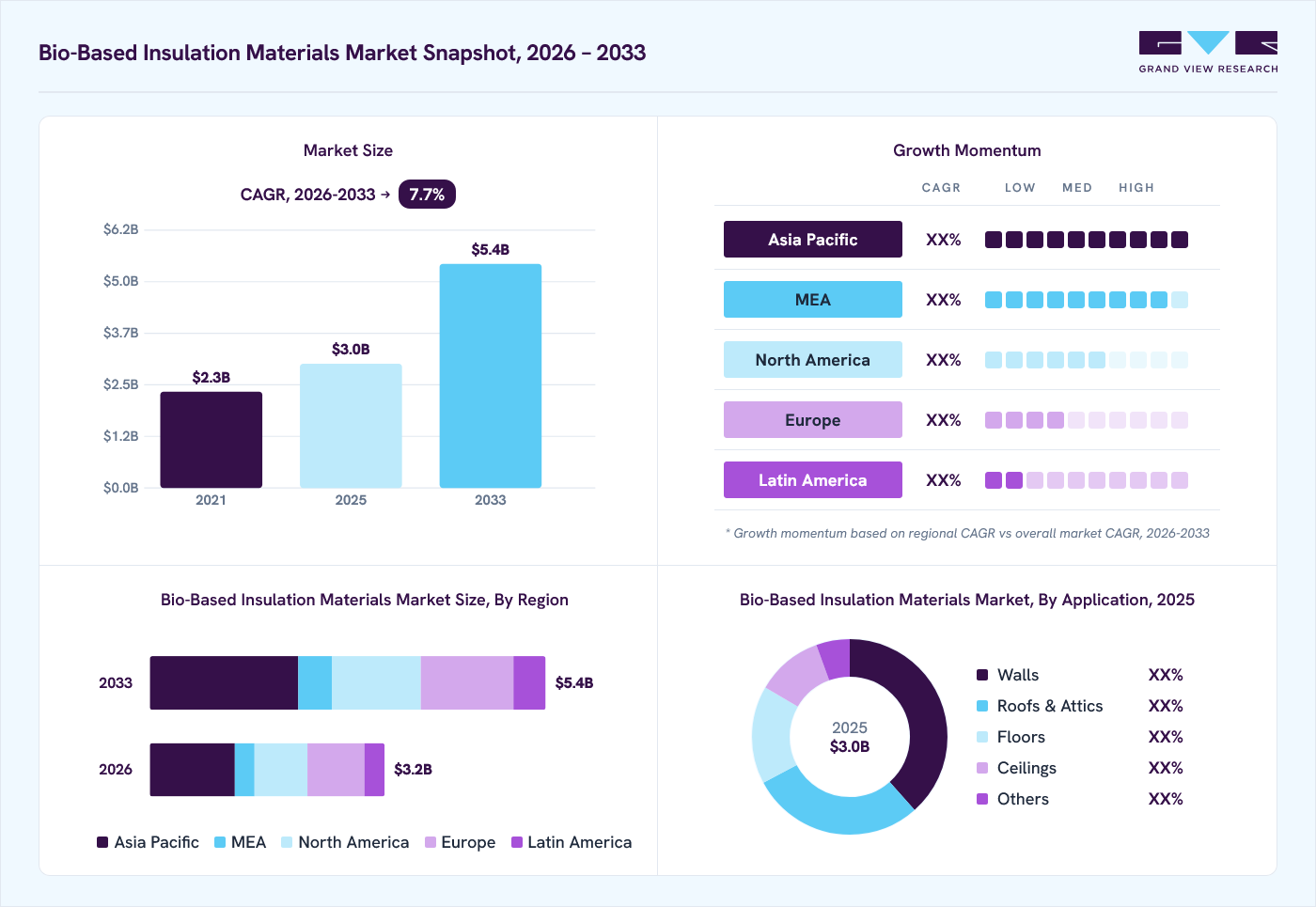
The global bio-based insulation materials market size was valued at USD 3.0 billion in 2025 and is projected to grow from USD 3.2 billion in 2026 to USD 5.4 billion by 2033, at a CAGR of 7.7% from 2026 to 2033. Asia Pacific dominated the market, accounting for the largest revenue share of 36.0% in 2025. The demand for bio-based insulation materials is increasing as the construction industry shifts toward sustainable and low-carbon building solutions.
Key Market Trends & Insights
- By product form: Batts & rolls segment held the largest revenue share of 42.7% in 2025.
- By application: Walls segment dominated the market with a revenue share of 38.4% in 2025.
- By material type: Cellulose segment held the largest revenue share of 36.9% in 2025.
Regional Highlights
- Largest regional market: Asia Pacific (36.0% revenue share, 2025)
- By country: China held the largest market share in 2025
Market Size & Forecast
- Market size in 2025: USD 3.0 Billion
- Estimated market size in 2026: USD 3.2 Billion
- Projected market size by 2033: USD 5.4 Billion
- CAGR (2026-2033): 7.7%
Governments, developers, and homeowners are increasingly adopting environmentally friendly -insulation products to improve energy efficiency while reducing the environmental impact of buildings. Growing awareness regarding indoor air quality and the use of renewable raw materials has further strengthened the adoption of bio-based insulation across residential, commercial, and industrial construction. The market is also benefiting from the rising preference for green buildings and sustainable infrastructure development.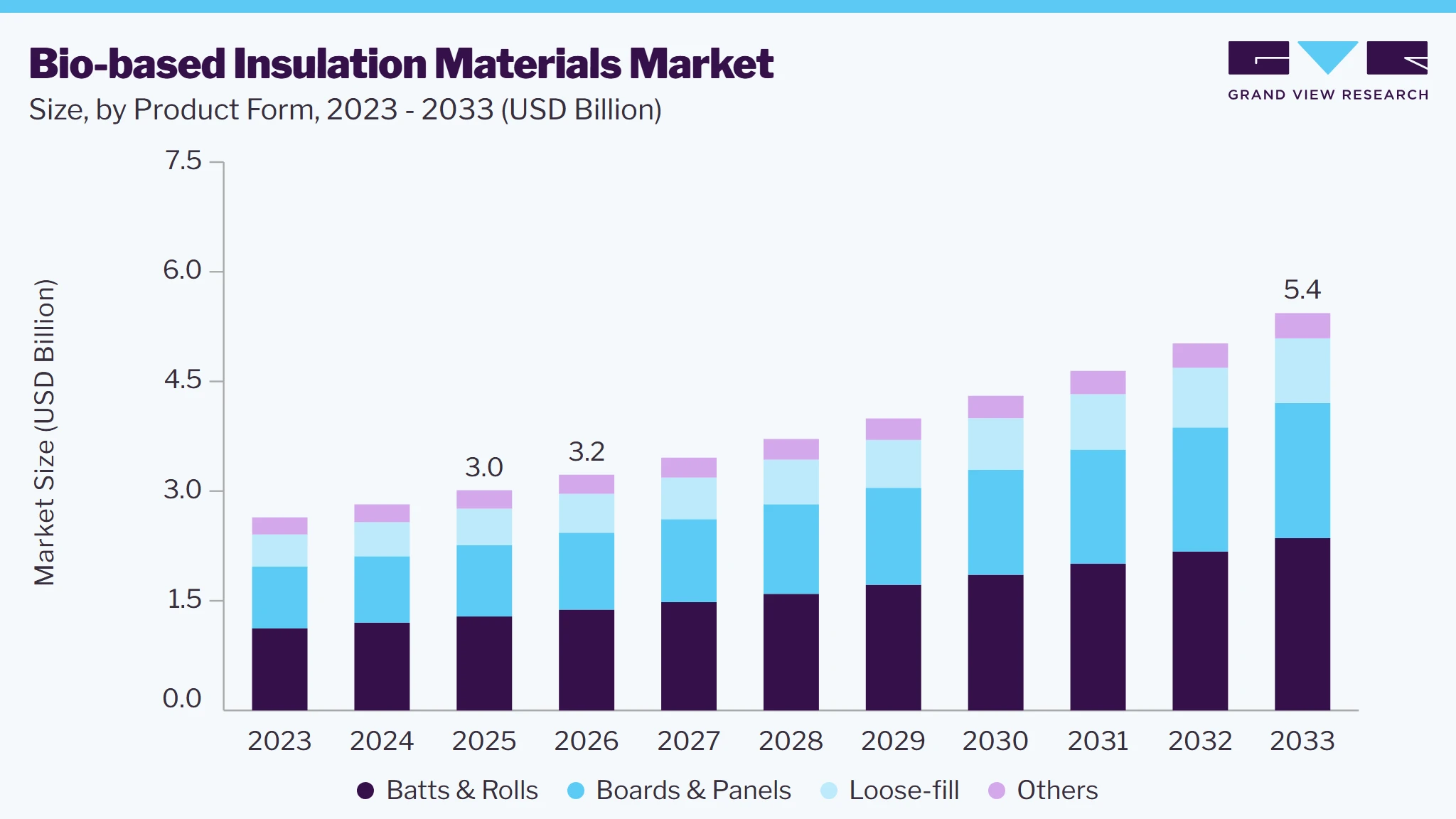
The market is primarily driven by stringent energy efficiency regulations and the growing emphasis on reducing greenhouse gas emissions from buildings. Construction companies are increasingly adopting bio-based insulation materials such as cellulose, hemp, wood fiber, sheep wool, cork, and flax to meet sustainability certifications and improve thermal performance. Rising investments in energy-efficient building renovations and increasing consumer preference for natural construction materials continue to create favorable growth opportunities for manufacturers worldwide.
Ongoing technological advancements are improving the durability, moisture resistance, fire performance, and thermal efficiency of bio-based insulation materials. Manufacturers are investing in innovative production technologies and advanced treatment processes to enhance product performance while maintaining environmental sustainability. The increasing use of recycled agricultural waste, natural fibers, and biodegradable materials is expanding product applications across residential, commercial, and industrial buildings. Digital manufacturing techniques and life-cycle assessment tools are also supporting product innovation and sustainable construction practices.
Market Dynamics
The bio-based insulation materials market is witnessing continuous innovation through the development of advanced natural fiber composites, improved cellulose processing technologies, and enhanced bio-based binders. Manufacturers are focusing on improving fire resistance, moisture resistance, thermal conductivity, and acoustic insulation while maintaining product sustainability. The growing integration of recycled agricultural waste and renewable feedstocks is strengthening circular economy practices within the construction sector. Increasing investments in sustainable building technologies and carbon-neutral construction materials are further expanding the application scope of bio-based insulation products.
One of the major drivers of the bio-based insulation materials market is the increasing global demand for sustainable and energy-efficient buildings. Governments across various regions are implementing stricter building energy codes and environmental regulations that encourage the use of renewable construction materials with lower carbon footprints. Green building certification programs are further promoting the adoption of natural insulation materials in residential, commercial, and institutional projects.
In addition, growing consumer awareness regarding indoor air quality, environmental protection, and long-term energy savings is accelerating the transition toward bio-based insulation solutions. Builders and developers are increasingly selecting renewable insulation products to improve building performance, reduce operational energy consumption, and meet sustainability objectives. This shift continues to create significant growth opportunities for manufacturers offering innovative natural insulation materials.
A major restraint for the bio-based insulation materials market is their relatively high upfront cost compared with conventional insulation products such as fiberglass and mineral wool, which can limit adoption among cost-sensitive consumers and construction projects. Variations in the availability of natural raw materials, seasonal agricultural production, and limited manufacturing capacity can also affect product pricing and supply consistency. Moreover, performance concerns related to moisture management and fire resistance in certain applications may limit adoption in price-sensitive construction projects.
The rapid expansion of green building initiatives and net-zero energy construction projects is driving governments, private developers, and infrastructure investors to increasingly prioritize low-carbon construction materials to meet climate goals and sustainability targets. Continued advancements in bio-based insulation technologies, combined with growing investments in eco-friendly building materials, are expected to create significant long-term opportunities across both new construction and building renovation markets.
Market Concentration & Characteristics
The bio-based insulation materials market is moderately fragmented, with both established insulation manufacturers and specialized producers of natural fiber-based insulation products. Global companies continue to expand their product portfolios through research, partnerships, and capacity expansion, while regional manufacturers leverage locally available renewable raw materials to strengthen their market presence. Product innovation, sustainability certifications, and compliance with green building standards remain the key competitive factors influencing market positioning.
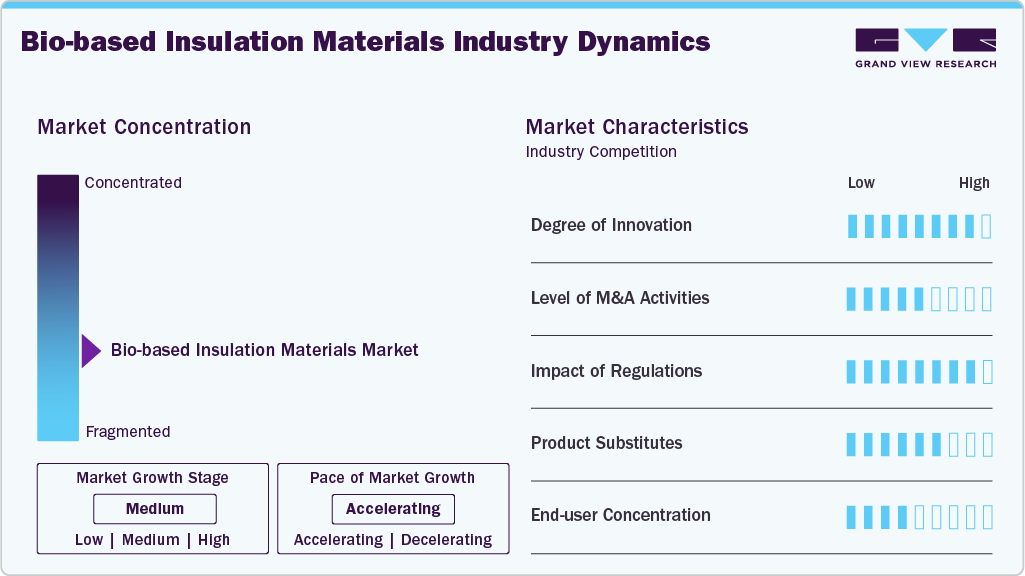
The primary substitutes for bio-based insulation materials include mineral wool, fiberglass insulation, expanded polystyrene, extruded polystyrene, polyurethane foam, and other conventional synthetic insulation products. These alternatives often offer lower upfront costs and established supply chains, making them widely adopted across construction projects. However, increasing environmental concerns, stricter sustainability regulations, and growing demand for renewable materials are gradually improving the competitive position of bio-based insulation materials despite pricing challenges.
Analyst Perspective
The bio-based insulation materials market is expected to witness sustained growth as the global construction industry increasingly prioritizes energy efficiency, carbon reduction, and sustainable building practices. Rising adoption of green building certifications, supportive government regulations, and growing consumer preference for renewable construction materials are accelerating market expansion. Manufacturers are focusing on product innovation to improve fire resistance, moisture performance, durability, and ease of installation while maintaining environmental benefits. In the coming years, increasing investments in net-zero buildings, building renovations, and circular economy initiatives are expected to strengthen the adoption of bio-based insulation materials across both developed and emerging markets.
Material Type Insights
The cellulose segment held the largest revenue share of 36.9% in 2025, due to its widespread adoption in residential and commercial construction. Manufactured primarily from recycled paper, cellulose insulation offers excellent thermal and acoustic insulation while supporting circular economy initiatives. Its cost-effectiveness, ease of installation, and high recycled content make it an attractive alternative to conventional insulation materials. Growing renovation activities and increasing demand for sustainable building products have further strengthened the segment's market leadership.
The hemp fiber segment is expected to grow at a CAGR of 8.5% over the forecast period, owing to increasing demand for renewable and carbon-negative building materials. Hemp insulation provides superior moisture regulation, thermal performance, and indoor air quality while requiring relatively low agricultural inputs during cultivation. Rising investments in sustainable construction and net-zero building projects are driving its adoption across residential and commercial applications. Ongoing product innovation and expanding hemp cultivation in several regions are improving product availability and reducing production costs.
Product Form Insights
The batts & rolls segment held the largest revenue share of 42.7% in 2025, due to its extensive use in wall, roof, ceiling, and floor insulation across residential and commercial buildings. These products are easy to transport, handle, and install, making them the preferred choice for both new construction and renovation projects. Their compatibility with standard building structures and framing systems further supports widespread adoption. Increasing investments in energy-efficient housing and green building construction continue to strengthen demand for batts and rolls.
The boards & panels segment is expected to grow at a CAGR of 8.4% from 2026 to 2033, due to increasing demand for high-performance rigid insulation solutions in energy-efficient buildings. Bio-based insulation boards provide superior structural stability, moisture resistance, and long-term thermal performance, making them suitable for external walls, façades, roofs, and flooring systems. Growing adoption of prefabricated construction and passive house designs is further supporting market expansion.
Application Insights
The walls segment held the highest revenue market share of 38.4% in 2025, as wall insulation represents one of the most critical components for improving building energy efficiency and occupant comfort. Bio-based insulation materials are increasingly used in interior and exterior wall assemblies to minimize heat transfer, enhance acoustic insulation, and regulate indoor humidity. Growing construction of energy-efficient residential and commercial buildings has significantly increased demand for sustainable wall insulation solutions.
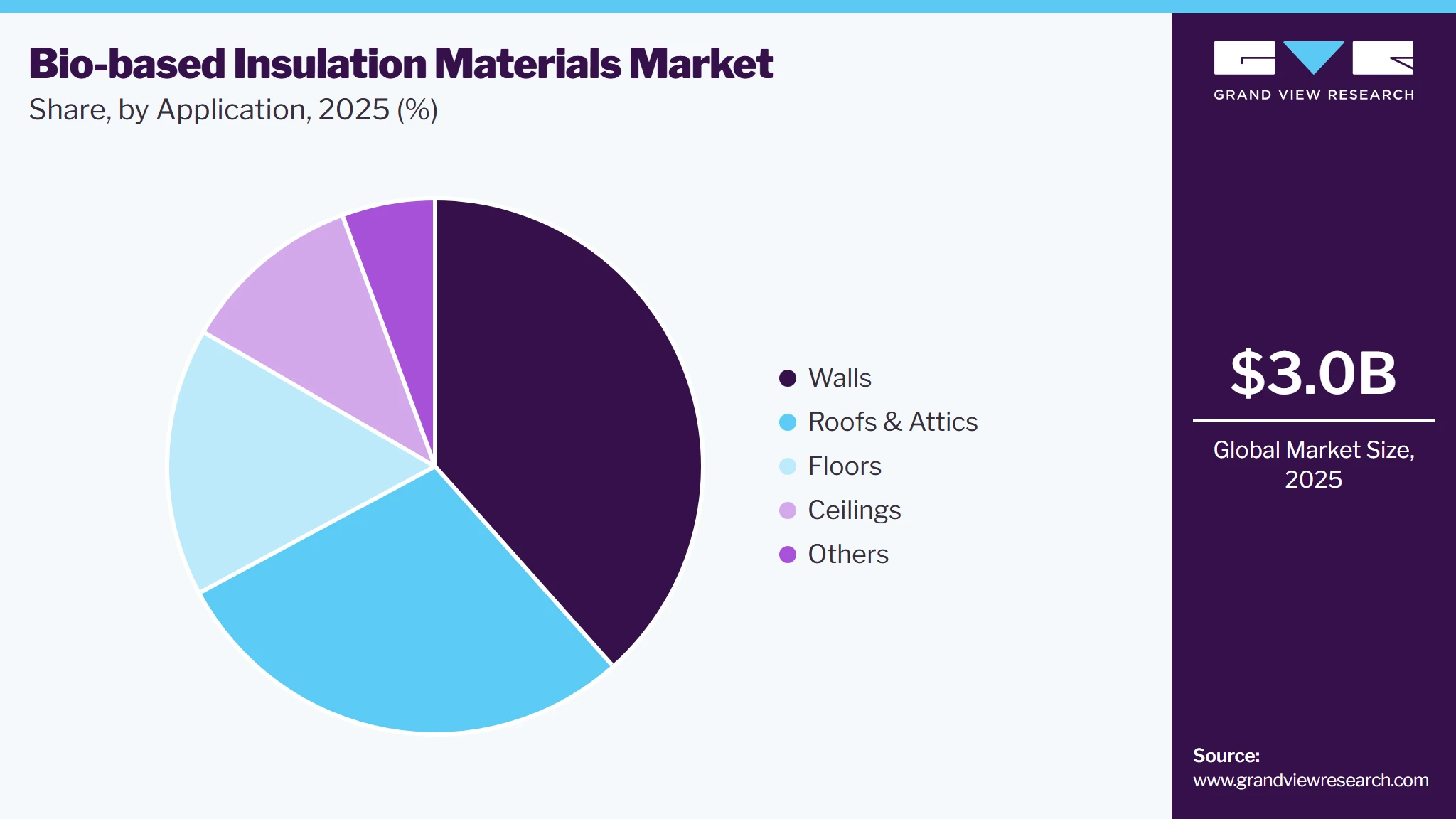
The roofs & attics segment is expected to grow at a CAGR of 7.9% over the forecast period, due to increasing emphasis on reducing building heat loss and improving overall energy performance. Roof insulation plays a crucial role in minimizing heating and cooling requirements, making it a key focus area in sustainable building design. Bio-based insulation materials such as cellulose, wood fiber, hemp, and cork are increasingly being adopted for attic and roof applications because of their excellent thermal efficiency and moisture management properties.
Regional Insights
Asia Pacific bio-based insulation materials market dominated the global market with the largest revenue share of 36.0% in 2025, due to rapid urbanization, increasing investments in sustainable infrastructure, and growing adoption of green building practices. Expanding residential and commercial construction activities, supported by stricter energy efficiency standards, are encouraging the use of renewable insulation materials. Rising environmental awareness and government initiatives promoting low-carbon buildings continue to strengthen regional demand. The availability of abundant agricultural raw materials also supports local manufacturing and market expansion.

China Bio-based Insulation Materials Market Trends
Bio-based insulation materials market in China represents a major market in APAC, owing to its extensive construction industry and strong focus on carbon neutrality and energy-efficient buildings. Government policies supporting green construction, sustainable urban development, and environmentally friendly building materials continue to drive product adoption. Domestic manufacturers are investing in advanced production technologies and expanding manufacturing capacities to meet rising demand. Increasing renovation activities and sustainable housing projects further contribute to market growth.
North America Bio-based Insulation Materials Market Trends
North America is experiencing steady growth due to increasing investments in sustainable construction and energy-efficient building renovation projects. Stringent building energy codes, high consumer awareness regarding environmentally friendly products, and strong adoption of green building certifications support market expansion. Continuous innovation in insulation technologies and growing demand for renewable building materials are encouraging wider commercial adoption across the region.
The United States remains a significant contributor due to increasing adoption of green buildings, sustainable residential construction, and energy conservation initiatives. Federal and state-level energy efficiency programs continue to encourage the use of renewable insulation materials. Rising investments in retrofitting aging buildings and improving indoor environmental quality are creating favorable growth opportunities for bio-based insulation manufacturers.
Europe Bio-based Insulation Materials Market Trends
Europe is one of the most mature markets for bio-based insulation materials due to ambitious climate policies, strict building energy regulations, and widespread adoption of sustainable construction practices. The region continues to prioritize low-carbon buildings and circular economy principles, encouraging the use of renewable insulation materials. Growing renovation of existing building stock and increasing investments in energy-efficient housing further support long-term market growth.
Bio-based insulation materials market in Germany is a leading European market driven by stringent energy efficiency regulations, advanced sustainable construction practices, and strong consumer preference for environmentally responsible building materials. Government support for renewable construction technologies and energy-efficient renovation projects is accelerating the adoption of bio-based insulation products. Continuous product innovation and growing investments in green infrastructure further strengthen the country's market position.
Central & South America Bio-based Insulation Materials Market Trends
Bio-based insulation materials market in Central and South America is gradually emerging, due to increasing awareness of sustainable construction, expanding urban infrastructure, and growing investments in energy-efficient residential projects. Governments and developers are increasingly recognizing the long-term economic and environmental benefits of renewable insulation materials. Improving construction standards and rising environmental consciousness are expected to support future market growth.
Middle East & Africa Bio-based Insulation Materials Market Trends
The Middle East & Africa market is expanding with increasing investments in sustainable urban development, green buildings, and energy-efficient infrastructure projects. Governments are promoting environmentally responsible construction practices to reduce energy consumption and improve building performance. Growing commercial developments, smart city initiatives, and rising awareness regarding sustainable construction materials are creating new opportunities for bio-based insulation material manufacturers across the region.
Key Bio-based Insulation Materials Company Insights
Some of the key players operating in the market include BASF SE and Knauf Insulation
-
BASF SE is one of the world's leading chemical companies, offering innovative materials and solutions for the construction industry, including insulation materials, performance chemicals, and sustainable building technologies.
-
Knauf Insulation is a global manufacturer of insulation solutions, providing glass mineral wool, rock mineral wool, wood wool, and advanced insulation products designed to improve building energy efficiency, indoor comfort, and sustainability.
GUTEX and STEICO are some of the emerging market participants in the bio-based insulation materials market.
-
GUTEX is a Germany-based manufacturer specializing in sustainable wood fiber insulation products for residential and commercial buildings, with a strong focus on environmentally friendly construction solutions.
-
STEICO is a leading European producer of wood fiber insulation and engineered wood products, recognized for its renewable, high-performance insulation materials that support energy-efficient and low-carbon building construction.
Key Bio-based Insulation Materials Companies
The following key companies have been profiled for this study on the bio-based insulation materials market.
-
BASF SE
-
Knauf Insulation
-
Kingspan Group
-
Saint-Gobain
-
Johns Manville
-
Owens Corning
-
STEICO
-
GUTEX
-
Greenfiber
-
Isovlas
Competitive Benchmarking
Category
Operating Strategies
Competitive Edge
Weakness
Established Players (BASF SE, Knauf Insulation, Kingspan Group, Saint-Gobain, Johns Manville, Owens Corning)
Invest in advanced bio-based insulation technologies to improve thermal performance, fire resistance, moisture management, and product durability.
Expand manufacturing capacity and regional distribution networks through strategic partnerships, acquisitions, and sustainable construction collaborations.
Strengthen sustainability initiatives by incorporating renewable raw materials, recycled content, and low-carbon manufacturing processes while expanding certified green product portfolios.
Strong global brand recognition and extensive experience in insulation and building materials manufacturing.
Broad product portfolios serving residential, commercial, and industrial construction with well-established distribution networks.
Significant investment capabilities in R&D, regulatory compliance, product certifications, and advanced manufacturing technologies.
Higher production costs associated with sustainable raw materials and advanced manufacturing processes.Large organizational structures may slow the commercialization of new bio-based innovations.Dependence on fluctuating availability and pricing of renewable raw materials can impact profitability.
Emerging Players (STEICO, GUTEX, Greenfiber, Isovlas)
Focus on specialized bio-based insulation products such as wood fiber, cellulose, hemp, cork, and other natural fiber insulation solutions for green buildings.
Expand presence through partnerships with sustainable construction firms, distributors, and green building certification programs.
Develop innovative insulation products with enhanced acoustic performance, carbon storage capabilities, recyclability, and simplified installation for energy-efficient buildings.
Strong specialization in renewable and environmentally friendly insulation materials with a clear sustainability focus.
Greater flexibility in responding to changing market demands and rapidly introducing innovative natural insulation solutions.
Strong positioning in the growing green building, passive house, and net-zero construction segments.
Limited manufacturing capacity and geographic reach compared to multinational insulation manufacturers.
Lower brand recognition in mainstream construction markets and dependence on regional distribution channels.
Greater exposure to supply chain disruptions and variability in sourcing renewable natural fibers and agricultural feedstocks.
Recent Developments
-
In May 2025, Knauf Insulation announced the expansion of its glass mineral wool insulation production capacity in Europe to meet increasing demand for sustainable and energy-efficient building insulation solutions.
-
In October 2024, Kingspan Group expanded investments in low-carbon insulation technologies and circular manufacturing initiatives as part of its Planet Passionate sustainability program.
Bio-Based Insulation Materials Market Report Scope
Report Attribute
Details
Market size in 2025
USD 3.0 billion
Estimated Market size in 2026
USD 3.2 billion
Projected market size by 2033
USD 5.4 billion
Growth rate
CAGR of 7.7% from 2026 to 2033
Base year for estimation
2025
Actual estimates/Historical data
2021 - 2024
Forecast period
2026 - 2033
Quantitative units
Revenue in USD billion and CAGR from 2026 to 2033
Report coverage
Revenue forecast, company ranking, competitive landscape, growth factors, and trends
Segments covered
Material type, product form, application, region.
Regional scope
North America; Europe; Asia Pacific; Central & South America; Middle East & Africa
Country scope
U.S.; Canada; Mexico; Germany; UK; France; Italy; Spain; China; Japan; India; South Korea; Brazil; Saudi Arabia
Key companies profiled
BASF SE; Knauf Insulation; Kingspan Group; Saint-Gobain; Johns Manville; Owens Corning; STEICO; GUTEX; Greenfiber; Isovlas
Customization scope
Free report customization (equivalent up to 8 analysts working days) with purchase. Addition or alteration to country, regional & segment scope.
Pricing and purchase options
Avail customized purchase options to meet your exact research needs. Explore purchase options
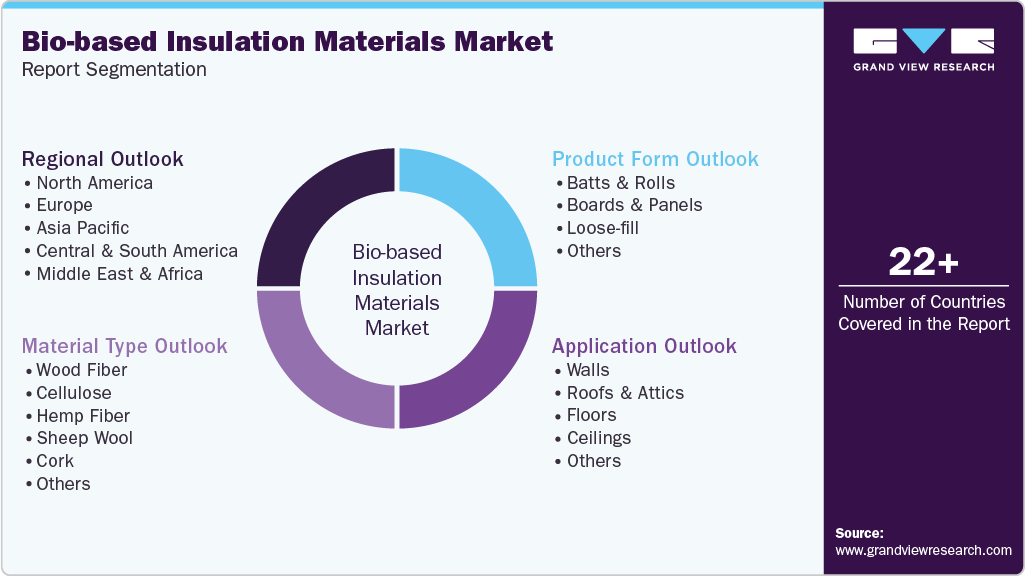
Global Bio-Based Insulation Materials Market Report SegmentationThis report forecasts revenue growth at global, regional, and country levels and provides an analysis on the industry trends in each of the sub-segments from 2021 to 2033. For this study, Grand View Research has segmented the global bio-based insulation materials market report based on material type, product form, application, and region:
-
Material Type Outlook (Revenue, USD Billion, 2021 - 2033)
-
Wood Fiber
-
Cellulose
-
Hemp Fiber
-
Sheep Wool
-
Cork
-
Others
-
-
Product Form Outlook (Revenue, USD Billion, 2021 - 2033)
-
Batts & Rolls
-
Boards & Panels
-
Loose-fill
-
Others
-
-
Application Outlook (Revenue, USD Billion, 2021 - 2033)
-
Walls
-
Roofs & Attics
-
Floors
-
Ceilings
-
Others
-
-
Regional Outlook (Revenue, USD Billion, 2021 - 2033)
-
North America
-
U.S.
-
Canada
-
Mexico
-
-
Europe
-
UK
-
Germany
-
France
-
Italy
-
Spain
-
-
Asia Pacific
-
China
-
Japan
-
India
-
South Korea
-
-
Central and South America
-
Brazil
-
-
Middle East and Africa
-
Saudi Arabia
-
-
Research Methodology
The bio-based insulation materials marketfigures in this report are based on a proven research process that combines executive interviews with secondary research from proprietary databases, company filings, and recognized regulatory and institutional sources. Market size is built through value-chain sizing—reconciling supply-side and demand-side estimates—and triangulated with bottom-up and top-down approaches. Every estimate passes multiple levels of expert validation before publication, with eachbio-based insulation materials segment quantified using the revenue-capture definitions in the table below.
Segment Definition
Segment - Material Type
Revenue capture definition
Wood Fiber
Revenue generated from the sale of wood fiber insulation materials manufactured from processed wood fibers for residential, commercial, and industrial buildings. This includes revenues from wood fiber boards, batts, panels, and other wood-based insulation products used for thermal insulation, acoustic performance, moisture regulation, and energy efficiency.
Cellulose
Revenue generated from the sale of cellulose insulation materials produced primarily from recycled paper and treated with fire-retardant additives. This includes revenues from loose-fill cellulose, dense-pack cellulose, spray-applied cellulose, and other cellulose-based insulation products used for thermal insulation, soundproofing, and sustainable building applications.
Hemp Fiber
Revenue generated from the sale of hemp fiber insulation products manufactured from natural hemp fibers for sustainable construction applications. This includes revenues from hemp insulation batts, rolls, panels, and other hemp-based insulation solutions used for thermal insulation, humidity regulation, acoustic insulation, and indoor air quality improvement.
Sheep Wool
Revenue generated from the sale of sheep wool insulation materials manufactured from natural wool fibers for residential, commercial, and specialty construction projects. This includes revenues from wool batts, rolls, and other sheep wool insulation products used for thermal insulation, moisture control, sound absorption, and environmentally friendly building applications.
Cork
Revenue generated from the sale of cork insulation materials manufactured from natural cork granules or expanded cork for residential, commercial, and institutional buildings. This includes revenues from cork insulation boards, panels, blocks, and other cork-based insulation products used for thermal insulation, acoustic performance, moisture resistance, and sustainable construction.
Others
Revenue generated from the sale of other bio-based insulation materials, including flax fiber, cotton fiber, straw, coconut fiber, rice husk, kenaf, and other renewable natural insulation products. This includes revenues from various bio-based insulation solutions designed to improve energy efficiency, indoor comfort, and environmental sustainability.
Segment - Product Form
Revenue capture definition
Batts & Rolls
Revenue generated from the sale of bio-based insulation materials supplied in batts and rolls for walls, roofs, floors, and ceilings. This includes revenues from pre-cut insulation batts, continuous rolls, and flexible insulation products designed for easy installation and high thermal performance.
Boards & Panels
Revenue generated from the sale of rigid bio-based insulation boards and panels manufactured for structural and non-structural building insulation applications. This includes revenues from wood fiber boards, cork panels, hemp boards, and other rigid insulation products used for thermal insulation, soundproofing, and moisture management.
Loose-fill
Revenue generated from the sale of loose-fill bio-based insulation materials designed for installation in enclosed cavities, attics, roofs, and retrofit construction projects. This includes revenues from cellulose, wood fiber, and other loose insulation materials applied using blowing or injection equipment for effective thermal and acoustic insulation.
Others
Revenue generated from the sale of other forms of bio-based insulation materials, including spray-applied insulation, molded insulation components, composite insulation systems, and customized insulation products developed for specialized construction requirements.
Segment - Application
Revenue capture definition
Walls
Revenue generated from the installation and sale of bio-based insulation materials used in interior and exterior wall systems of residential, commercial, and industrial buildings. This includes insulation products designed to improve thermal efficiency, acoustic insulation, moisture control, and overall building energy performance.
Roofs & Attics
Revenue generated from the installation and sale of bio-based insulation materials used in roofs, attics, and roof assemblies. This includes insulation products designed to minimize heat transfer, improve building energy efficiency, regulate indoor temperatures, and enhance overall roof insulation performance.
Floors
Revenue generated from the installation and sale of bio-based insulation materials used beneath flooring systems and structural floor assemblies. This includes insulation products that provide thermal insulation, sound reduction, moisture management, and improved occupant comfort across residential and commercial buildings.
Ceilings
Revenue generated from the installation and sale of bio-based insulation materials used in ceiling systems and suspended ceiling applications. This includes insulation products designed to improve thermal performance, acoustic comfort, fire resistance, and indoor environmental quality.
Others
Revenue generated from the installation and sale of bio-based insulation materials used in other building applications, including partitions, crawl spaces, basements, HVAC systems, prefabricated building components, and specialized insulation applications requiring sustainable thermal and acoustic performance.
Estimation Model
Layer Name
Key Question
Description
Parent Market Analysis
What is the overall size and growth outlook of the global insulation materials and sustainable building materials market?
The estimation begins by evaluating the broader insulation materials and sustainable construction materials market. Macroeconomic indicators, building construction activity, energy-efficient building initiatives, green building adoption, and infrastructure investments are analyzed to establish the total addressable market for bio-based insulation materials.
Product Penetration Analysis
What proportion of the insulation materials market is represented by bio-based insulation materials across different product types and forms?
This layer estimates the penetration of wood fiber, cellulose, hemp fiber, sheep wool, cork, and other bio-based insulation materials by assessing their adoption across batts & rolls, boards & panels, loose-fill, and other insulation forms in residential, commercial, and industrial construction projects.
Regional & Application Demand Assessment
Which regions and building applications contribute the highest demand for bio-based insulation materials?
Market demand is evaluated across major regions based on construction activity, green building regulations, energy efficiency standards, renewable material adoption, and product availability. Demand is further segmented into walls, roofs & attics, floors, ceilings, and other building applications to determine overall revenue contribution.
Company Revenue Validation & Market Forecasting
How is the final market size validated and forecast?
The final market estimates are validated using company revenues, manufacturing capacities, product portfolios, distribution networks, trade analysis, sustainability certifications, and secondary research. Bottom-up and top-down approaches are triangulated to generate reliable market size estimates and long-term forecasts for the bio-based insulation materials market.
Delivered Customizations
This report has been delivered with the following In-depth customizations
Client Request
Customization Delivered
Value Adds
Competitive landscape assessment
In-depth profiling of leading manufacturers, including product portfolios, strategic initiatives, production capabilities, partnerships, acquisitions, geographic presence, and competitive benchmarking across the bio-based insulation materials market.
Supports competitive intelligence, strategic positioning, partnership evaluation, and identification of market gaps for business growth.
Sustainability and regulatory analysis
Detailed evaluation of green building standards, environmental regulations, building energy efficiency codes, circular economy initiatives, and sustainability trends influencing the adoption of bio-based insulation materials across major regions.
Helps stakeholders align product development, compliance strategies, and long-term investments with evolving sustainability and regulatory requirements.
Supply chain and raw material analysis
Comprehensive assessment of the bio-based insulation value chain, including raw material sourcing, supplier landscape, manufacturing processes, distribution channels, and key challenges related to feedstock availability and pricing.
Assists in supply chain optimization, procurement planning, risk mitigation, and improving operational efficiency through better sourcing strategies.
Frequently Asked Questions About This Report
The bio-based insulation materials market size was estimated at USD 3.0 billion in 2025 and is expected to reach USD 3.2 billion in 2026.
The bio-based insulation materials market is expected to grow at a compound annual growth rate of 7.7% from 2026 to 2033 to reach USD 5.4 billion by 2033.
The batts & rolls segment accounted for the highest revenue share of 42.7% in 2025.
Asia Pacific held the highest revenue market share of 36.0% in 2025, driven by rapid urbanization, expanding construction activities, supportive green building policies, and growing adoption of sustainable and energy-efficient building materials across the region.
Key factors driving the bio-based insulation materials market include growing demand for energy-efficient, low-carbon, and sustainable buildings, supported by stringent green building regulations and increasing adoption of renewable construction materials.
Some key players in the bio-based insulation materials market include BASF SE, Knauf Insulation, Kingspan Group, Saint-Gobain, Johns Manville, Owens Corning, STEICO, GUTEX, Isovlas, and Greenfiber.
The walls segment is the fastest-growing application in the bio-based insulation materials market.
The hemp fiber segment is the fastest growing material type in the bio-based insulation materials market.
The walls segment accounted for the largest revenue share of 38.4% in 2025, as wall insulation represents one of the most critical components for improving building energy efficiency and occupant comfort.
About the Author(s)
Advanced Interior Materials Research Team
Advanced Materials · Advanced Interior MaterialsThis report was authored by the advanced interior materials research team at Grand View Research - comprising two research analysts, one senior research analyst, and one industry expert - with specialized expertise in the advanced interior materials segment of the advanced materials industry. All findings are based on proprietary advanced materials databases, executive interviews, and regulatory analysis, subject to internal peer review prior to publication.
Last Updated:
Speak to Analyst

Customize this report to your needs — add regions, segments, or data points, with 20% free customization.
Or view our licence options:


ISO 9001:2015 & 27001:2022 Certified
We are GDPR and CCPA compliant! Your transaction & personal information is safe and secure. For more details, please read our privacy policy.












