
- Home
- »
- Advanced Interior Materials
- »
-
Hemp Fiber Market Size, Share And Trends Report, 2033GVR Report cover

Hemp Fiber Market (2026 - 2033)
Size, Share & Trends Analysis Report By Application (Fashion & Textile, Sportswear, Workwear, E-textiles), By Region (North America, Asia Pacific, Central & South America), And Segment Forecasts
Market Size, 2025
$450.7MMarket Estimate, 2026
$530.6MMarket Forecast, 2033
$1,986.5MCAGR, 2026–2033
20.8%Hemp Fiber Market Summary
The global hemp fiber market size was valued at USD 450.7 million in 2025 and is projected to grow from USD 530.6 million in 2026 to USD 1,986.5 million by 2033, at a CAGR of 20.8% from 2026 to 2033. Asia Pacific dominated the market, accounting for a revenue share of 38.9% in 2025. This growth can be attributed to the increasing utilization of hemp fiber across industries such as textiles, automotive, construction, and personal care.
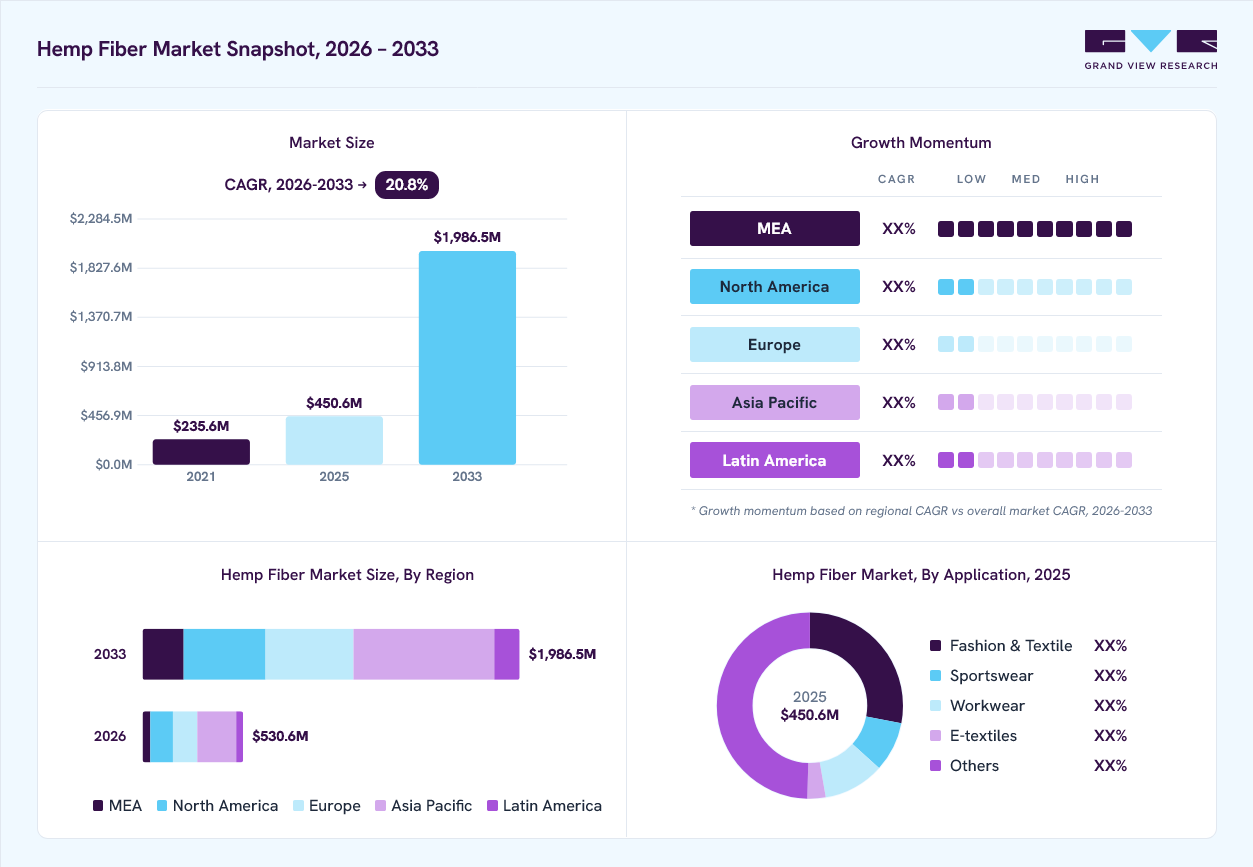 Source: Grand View Research, IR Documents, Primary Interviews, Paid DatabasesTo learn more about this report,
 Download Free Sample Report
Key Market Trends & Insights
- By application: Fashion & textile segment led the market with the largest revenue share of 28.0% in 2025.
Regional Highlights
- Largest regional market: Asia Pacific (38.9% revenue share, 2025)
- By country: China held the largest market share in 2025.
Market Size & Forecast
- Market size in 2025: USD 450.7 Million
- Estimated market size in 2026: USD 530.6 Million
- Projected market size by 2033: USD 1,986.5 Million
- CAGR (2026-2033): 20.8%
Three ways to get this report
Buy it, customize it, or ask a question.Ask an Analyst
Analyst response in 1 business day
- AccessReport author, directly
- Reply timeWithin 1 working day
- No sales callDirect answer only
- FormatEmail reply
- CostFree, no cost
Get the Full Report
What the study covers
- FormatsPDF · Excel · Dashboard
- Timeline2026–2033 annual, 2025 base
- Coverage20+ countries, 5 regions
- Companies10+ key players profiled
Customize the Report
20% free customization
- IncludeCountries, segments, points
- TailorTo your product definition
- ExtendDeeper competitor detail
- OrA fully bespoke study
- Turnaround5–10 working days
Hemp fiber is valued for its sustainability, durability, and biodegradability, making it an attractive alternative to synthetic fibers. The push for eco-friendly materials, especially in fashion and packaging, is accelerating demand, particularly in regions focused on reducing carbon footprints and plastic dependency. Technological advancements in fiber processing and material blending have enhanced the performance and versatility of hemp-based products. In construction, hempcrete and insulation materials are gaining traction for their thermal properties and low environmental impact. Government support through subsidies and favorable regulations for industrial hemp cultivation further propels market expansion, reinforcing its role in the transition toward a circular and green economy. To learn more about this report, Download Free Sample Report
Prominent players in the market are investing in product innovation and vertical integration to strengthen their competitive edge and ensure quality control across the value chain. By overseeing cultivation, processing, and final product manufacturing, companies can maintain consistency, reduce dependency on third-party suppliers, and achieve cost efficiencies. This integrated approach also enables quicker adaptation to regulatory changes and shifting consumer demands.
In parallel, many manufacturers are forming strategic partnerships with sustainable fashion brands, automotive OEMs, and green construction firms to expand their application reach. These collaborations not only open new revenue streams but also reinforce hemp fiber’s positioning as a versatile, eco-friendly material aligned with global sustainability goals.
Market Dynamics
The hemp fiber market is experiencing strong growth due to increasing demand for sustainable, biodegradable, and renewable materials across textiles, automotive, construction, paper, and packaging industries. Rising environmental concerns, stricter regulations on synthetic materials, and growing consumer preference for eco-friendly products are encouraging manufacturers to adopt hemp fibers. Technological advancements in fiber processing and expanding industrial applications are further strengthening market demand. Government support for hemp cultivation and increasing investments in sustainable manufacturing continue to create favorable conditions for market expansion.
Growing environmental awareness has significantly increased the adoption of hemp fiber as industries seek renewable alternatives to synthetic fibers. Hemp requires relatively less water, fewer pesticides, and improves soil health, making it an attractive raw material for sustainable manufacturing. Manufacturers across textiles, composites, and packaging are increasingly incorporating hemp fibers to reduce carbon emissions and meet sustainability targets.
The automotive and construction industries are also accelerating hemp fiber consumption due to its lightweight, high-strength, and recyclable properties. Hemp-based composites improve fuel efficiency in vehicles while supporting circular economy initiatives. As governments introduce stricter environmental regulations and companies pursue ESG objectives, demand for hemp fiber continues to expand across multiple end-use industries.
Despite increasing cultivation, the hemp fiber market faces challenges due to insufficient processing facilities and fragmented supply chains in several regions. Fiber extraction and decortication require specialized equipment and investments, limiting production capacity. Additionally, varying regulations governing industrial hemp cultivation, THC limits, licensing requirements, and international trade create uncertainties for producers and manufacturers. These factors increase operational costs and restrict the consistent availability of high-quality hemp fiber.
The increasing use of natural fiber composites presents significant growth opportunities for hemp fiber manufacturers. Automotive OEMs, construction material producers, and consumer goods companies are investing in hemp-reinforced composites to replace glass fiber and petroleum-based materials. Continuous innovations in fiber treatment technologies, bio-resins, and composite manufacturing are improving product performance, durability, and compatibility with advanced industrial applications. Emerging demand for sustainable materials in electric vehicles and green buildings is expected to create substantial long-term market opportunities.
Market Concentration & Characteristics
The industry is moderately fragmented, with a mix of established players and emerging startups contributing to the industry’s growth. While no single company dominates the global market, regional clusters of production, especially in North America, Europe, and parts of Asia, are driving innovation and competitive differentiation. Market participants are investing in supply chain optimization, quality certification, and brand positioning to secure long-term contracts with industries such as automotive, construction, and textiles. However, regulatory uncertainties and inconsistent global policies regarding hemp cultivation continue to influence market concentration levels.
 To learn more about this report, Download Free Sample Report
Despite hemp fiber’s eco-friendly and durable nature, it faces competition from both natural and synthetic substitutes. Traditional materials like cotton, jute, and flax remain strong contenders in the natural fiber category, especially due to established processing infrastructure. On the other hand, synthetic fibers like polyester offer scalability and cost advantages, posing a challenge to hemp’s widespread adoption. Nonetheless, growing consumer preference for sustainable alternatives and rising environmental regulations are gradually shifting the balance in favor of hemp-based products, especially in premium and niche market segments.
Analyst Perspective
The hemp fiber market is expected to witness sustained growth as industries increasingly transition toward renewable, biodegradable, and low-carbon raw materials. Rising adoption across textiles, automotive composites, construction materials, paper, and bioplastics is broadening the market's application base, while supportive government policies for industrial hemp cultivation are improving raw material availability. Continued advancements in fiber extraction, decortication, and processing technologies are enhancing product quality and expanding commercial viability. Although regulatory inconsistencies and limited processing infrastructure remain challenges in some regions, increasing investments in sustainable manufacturing and circular economy initiatives are expected to strengthen long-term market growth and create new opportunities for hemp fiber producers worldwide.
Application Insights
Based on application, the fashion & textile segment led the market with the largest revenue share of 28.0% in 2025 and is expected to grow at a CAGR of 21.2% over the forecast period, driven by the rising demand for sustainable and biodegradable materials. Hemp’s natural durability, breathability, and antibacterial properties make it an ideal substitute for cotton and synthetic fabrics in eco-conscious apparel. Leading fashion brands are integrating hemp into their product lines as part of broader sustainability initiatives, while startups are capitalizing on its low environmental impact to attract green consumers. Additionally, hemp fiber’s versatility allows it to be blended with other natural or recycled fibers, expanding its application in clothing, home textiles, and accessories.
The e-textiles segment is expected to grow significantly at a CAGR of 22.6% over the forecast period. Innovations in conductive yarns and textile-based electronics are opening new avenues for integrating natural fibers into wearable technology. Hemp’s compatibility with nanomaterials and functional coatings makes it suitable for use in temperature-regulating fabrics, biometric monitoring wearables, and active sportswear. As R&D investments increase, especially in bio-based smart fabrics, hemp is gaining traction as a sustainable and functional alternative in this high-tech niche.
Regional Insights
North America hemp fiber market holds a significant share in the global industry, with the U.S. at the forefront following the 2018 legalization of industrial hemp. The region is witnessing rapid growth in applications such as green construction (hempcrete), sustainable fashion, and automotive bio-composites. There is a strong focus on building domestic supply chains, developing fiber decortication infrastructure, and enhancing value-added product innovation. Canada also contributes with established cultivation practices and a growing export focus. However, industry fragmentation, processing limitations, and evolving regulatory frameworks remain key areas for improvement.
 To learn more about this report, Download Free Sample Report
U.S. Hemp Fiber Market Trends
The hemp fiber market in the U.S. has seen rapid expansion since the legalization of industrial hemp under the 2018 Farm Bill. Growing demand for sustainable materials in the construction, automotive, and apparel sectors is driving domestic cultivation and innovation. However, a lack of widespread fiber processing infrastructure and regulatory variations across states present growth challenges. To address this, investments are being made in decortication technologies and regional value chains to scale production and meet rising consumer demand.
Asia Pacific Hemp Fiber Market Trends
Asia Pacific dominated the hemp fiber market with the largest revenue share of 38.9% in 2025, driven by strong demand for sustainable textiles, bioplastics, and construction materials. While China leads in production and export capabilities with its well-developed infrastructure and policy support, other countries like India, Thailand, and Australia are emerging as new growth hubs. These nations are introducing favorable regulations, investing in industrial hemp cultivation, and exploring applications in eco-friendly packaging and apparel. The region benefits from low-cost labor and favorable climatic conditions, but challenges such as limited processing capacity and regulatory inconsistencies still need to be addressed for broader market maturity.
The hemp fiber market in China held the largest share in the Asia Pacific region in 2025. China hemp fiber market is supported by decades of cultivation experience and strong government backing in key provinces like Heilongjiang and Yunnan. The country has a well-established supply chain, from large-scale farming to advanced fiber processing facilities, making it a key exporter of hemp textiles and industrial materials. Ongoing investments in automation, eco-friendly processing, and textile innovation continue to solidify China’s leadership in the global hemp fiber market.
Europe Hemp Fiber Market Trends
The hemp fiber market in Europe is a mature and innovation-driven industry, with Germany leading in both cultivation and industrial applications. Strong sustainability mandates and EU-wide support for carbon-neutral materials are boosting the use of hemp in automotive interiors, construction materials like hempcrete, and biodegradable textiles. Collaborations between manufacturers, farmers, and research institutions are fueling R&D in high-performance hemp-based products.
Germany hemp fiber industry leads through strong environmental policies, advanced R&D, and integration into high-value sectors like automotive and green construction. Hemp is increasingly used in insulation panels, non-woven fabrics, and interior vehicle components. The country also promotes innovation through research collaborations focused on bio-composites and smart textiles. Germany’s commitment to climate targets and sustainable materials makes it a central hub for hemp fiber development in the EU.
Latin America Hemp Fiber Market Trends
The hemp fiber market in Latin America is growing, with countries like Brazil, Uruguay, and Colombia gradually developing industrial hemp sectors. Favorable climates, agricultural expertise, and growing investor interest position the region well for cultivation. The focus is on supplying hemp for textiles, eco-construction, and export markets. However, regulatory delays, limited processing infrastructure, and a lack of market awareness currently restrain large-scale growth.
Middle East & Africa Hemp Fiber Market Trends
The hemp fiber market in the Middle East & Africa is still at a nascent stage but shows promising potential. Countries like South Africa, Morocco, and Malawi are initiating hemp cultivation projects amid growing interest in sustainable agriculture and green building materials. While regulatory frameworks are still evolving, pilot projects and increasing government openness suggest a gradual path toward commercialization. Infrastructure development and awareness will be crucial to unlocking this region’s future market potential.
Key Hemp Fiber Companies Insights
Key players operating in the hemp fiber market are undertaking various initiatives to strengthen their presence and increase the reach of their products and services. Strategies such as expansion activities and partnerships are key in propelling the market growth.
Key Hemp Fiber Companies:
The following key companies have been profiled for this study on the hemp fiber market.
-
HempFlax
-
Ecofibre
-
Hemp Inc.
-
GenCanna
-
HempCo
-
Konoplex
-
Dun Agro Hemp Group
-
Cavac Biomateriaux
-
BaFa
-
American Hemp, LLC
Competitive Benchmarking
Category
Operating Strategies
Competitive Edge
Weakness
Established Players (HempFlax; Ecofibre; Hemp Inc.; GenCanna; HempCo)
- Invest in advanced hemp cultivation, decortication, and fiber processing technologies to improve fiber quality and production efficiency.
- Expand cultivation acreage and strengthen partnerships with textile manufacturers, composite producers, and industrial customers.
- Focus on sustainable production, product innovation, and vertical integration to broaden global market presence.
- Strong expertise across the hemp value chain with established processing infrastructure.
- Long-term relationships with textile, construction, automotive, and industrial customers.
- Well-established brands and financial capabilities support R&D, capacity expansion, and product diversification.
- High dependence on agricultural yield and seasonal raw material availability.
- Operations are influenced by varying hemp cultivation regulations across countries.
- Significant investments are required for processing facilities and supply chain development.
Emerging Players (Konoplex; Dun Agro Hemp Group; Cavac Biomateriaux; BaFa; American Hemp, LLC)
- Expand regional cultivation and processing capacity to serve growing domestic demand.
- Develop partnerships with local textile mills, composite manufacturers, and distributors.
- Compete through specialized fiber grades, sustainable sourcing, competitive pricing, and customized product offerings.
- Strong regional presence enables efficient sourcing and customer responsiveness.
- Flexible operations support customized solutions for niche textile and industrial applications.
- Growing focus on sustainability helps capture opportunities in emerging bio-based material markets.
- Limited international presence and smaller production capacities compared to established competitors.
- Greater reliance on regional demand and local agricultural conditions.
- Limited financial resources and distribution networks may slow expansion into global markets.
Hemp Fiber Market Report Scope
Report Attribute
Details
Market size in 2025
USD 450.7 million
Estimated market size in 2026
USD 530.6 million
Projected market size by 2033
USD 1,986.5 million
Growth rate
CAGR of 20.8% from 2026 to 2033
Base year for estimation
2025
Historical data
2021 - 2024
Forecast period
2026 - 2033
Quantitative units
Revenue in USD million/billion, and CAGR from 2026 to 2033
Report coverage
Revenue forecast, company ranking, competitive landscape, growth factors, and trends
Segments covered
Application, region
Regional scope
North America; Europe; Asia Pacific; Central & South America; Middle East & Africa
Country scope
U.S.; Canada; Mexico; Germany; UK; France; China; Japan; South Korea; Brazil; UAE
Key companies profiled
HempFlax; Ecofibre; Hemp Inc.; GenCanna; HempCo; Konoplex; Dun Agro Hemp Group; Cavac Biomateriaux; BaFa; American Hemp, LLC
Customization scope
Free report customization (equivalent up to 8 analysts' working days) with purchase. Addition or alteration to country, regional & segment scope.
Pricing and purchase options
Avail customized purchase options to meet your exact research needs. Explore purchase options
Global Hemp Fiber Market Report Segmentation
This report forecasts revenue growth at the global, regional & country levels and provides an analysis of the industry trends in each of the sub-segments from 2021 to 2033. For this study, Grand View Research has segmented the global hemp fiber market report on the basis of application and region:
 To learn more about this report, Download Free Sample Report
-
Application Outlook (Revenue, USD Million, 2021 - 2033)
-
Fashion & Textile
-
Sportswear
-
Workwear
-
E-textiles
-
Others
-
-
Regional Outlook (Revenue, USD Million, 2021 - 2033)
-
North America
-
U.S.
-
Canada
-
Mexico
-
-
Europe
-
UK
-
Germany
-
France
-
-
Asia Pacific
-
China
-
Japan
-
South Korea
-
-
Central & South America
-
Brazil
-
-
Middle East & Africa
-
UAE
-
-
Research Methodology
The hemp fiber market figures in this report are based on a proven research process that combines executive interviews with secondary research from proprietary databases, company filings, and recognized regulatory and institutional sources. Market size is built through value-chain sizing - reconciling supply-side and demand-side estimates - and triangulated with bottom-up and top-down approaches. Every estimate passes multiple levels of expert validation before publication, with each hemp fiber segment quantified using the revenue-capture definitions in the table below.
Segment Definition
Segment Application
Revenue capture definition
Fashion & Textile
Revenue generated from the sale of hemp fiber used in apparel, fashion garments, home textiles, yarns, fabrics, and textile blends, where sustainability, durability, breathability, and natural fiber performance are key purchasing factors.
Sportswear
Revenue generated from the sale of hemp fiber incorporated into sportswear and activewear products, including performance apparel and athletic clothing, where moisture management, comfort, durability, and eco-friendly material properties are critical.
Workwear
Revenue generated from the sale of hemp fiber used in industrial workwear, protective clothing, uniforms, and utility apparel, where strength, abrasion resistance, comfort, and long service life are essential performance requirements.
E-textiles
Revenue generated from the sale of hemp fiber used in electronic textiles and smart fabrics integrated with conductive components, sensors, or wearable technologies, where flexibility, sustainability, and compatibility with advanced textile manufacturing are important.
Others
Revenue generated from the sale of hemp fiber used in other textile applications, including accessories, footwear, upholstery, bags, nonwoven products, and specialty fabrics, where renewable raw materials, durability, and environmental sustainability support product value.
Estimation Model
Layer Name
Key Question
Description
Raw Material & Hemp Fiber Production
What is the production capacity and supply of hemp fiber by product type?
Estimates the supply of hemp fiber by evaluating industrial hemp cultivation, harvesting volumes, fiber extraction and decortication capacity, retting technologies, processing efficiency, raw material availability, and production output of long and short hemp fibers across key regions.
Distribution & Commercial Supply Chain
How much hemp fiber is supplied through direct sales and distribution channels?
Evaluates the distribution of hemp fiber through direct manufacturer sales, textile mills, composite manufacturers, industrial distributors, wholesalers, and authorized channel partners by analyzing procurement practices, long-term supply agreements, inventory management, commercial trade, and supply across major end-use industries.
End-Use Application Demand
Which applications generate the highest demand for hemp fiber?
Measures demand across fashion & textiles, sportswear, workwear, e-textiles, and other applications by assessing apparel production, sustainable textile adoption, industrial fabric manufacturing, smart textile development, consumer demand, and application-specific usage across major regions.
Regional Revenue Validation
What is the final market value by region and segment?
Validates market estimates through regional hemp fiber production volumes, pricing trends, manufacturer revenues, distributor sales, import-export analysis, industrial hemp cultivation, end-user demand, and consumption patterns to derive the final market size by product type, application, end-use industry, and region.
Delivered Customizations
This report has been delivered with the following In-depth customizations
Client Request
Customization Delivered
Value Adds
Technology and processing landscape analysis
Comprehensive evaluation of hemp fiber extraction methods, decortication technologies, retting processes, and processing innovations adopted by leading manufacturers
Helps companies benchmark production technologies, improve operational efficiency, and identify modernization opportunities
Competitive market share analysis
Detailed assessment of leading manufacturers by production capacity, regional presence, product portfolio, and strategic initiatives
Helps benchmark competitors, identify market leaders, and support strategic business planning
Sustainability and innovation assessment
In-depth analysis of sustainable manufacturing practices, bio-based material trends, technological advancements in fiber processing, and emerging product innovations
Supports product development, ESG planning, innovation strategies, and long-term competitive positioning in the hemp fiber market
Frequently Asked Questions About This Report
Asia Pacific held the highest revenue market share of 38.9% in 2025, driven by extensive industrial hemp cultivation and increasing demand for sustainable natural fibers across China, India, and other regional economies.
The hemp fiber market is expected to grow at a compound annual growth rate of 20.8% from 2026 to 2033 to reach USD 1,986.5 million by 2033.
Some key players in the hemp fiber market include HempFlax, Ecofibre, Hemp Inc., GenCanna, HempCo, Konoplex, Dun Agro Hemp Group, Cavac Biomateriaux, BaFa, and American Hemp, LLC.
China accounted for the largest revenue share in the Asia Pacific hemp fiber market.
The fashion & textile segment held the highest revenue market share of 28.0% in 2025, driven by rising demand for sustainable, biodegradable, and durable natural fibers in apparel, home textiles, and fashion products, supported by growing consumer preference for eco-friendly materials.
Key factors driving the hemp fiber market include increasing demand for sustainable bio-based materials, expanding industrial hemp cultivation, supportive government regulations, and growing adoption across textiles, automotive, construction, and composite applications.
The hemp fiber market size was estimated at USD 450.7 million in 2025 and is expected to reach USD 530.6 million in 2026.
About the Author(s)
Advanced Interior Materials Research Team
Advanced Materials · Advanced Interior MaterialsThis report was authored by the advanced interior materials research team at Grand View Research - comprising two research analysts, one senior research analyst, and one industry expert - with specialized expertise in the advanced interior materials segment of the advanced materials industry. All findings are based on proprietary advanced materials databases, executive interviews, and regulatory analysis, subject to internal peer review prior to publication.
Last Updated:
Speak to Analyst

Customize this report to your needs - add regions, segments, or data points, with 20% free customization.
Or view our licence options:


ISO 9001:2015 & 27001:2022 Certified
We are GDPR and CCPA compliant! Your transaction & personal information is safe and secure. For more details, please read our privacy policy.


