
- Home
- »
- Advanced Interior Materials
- »
-
Bioelectrochemical Systems For Wastewater Treatment Market Report, 2033GVR Report cover
![Bioelectrochemical Systems For Wastewater Treatment Market Size, Share & Trends Report]()
Bioelectrochemical Systems For Wastewater Treatment Market (2025 - 2033) Size, Share & Trends Analysis Report By Type (Microbial Fuel Cells, Microbial Electrolysis Cells), By Application (Industrial Wastewater, Municipal Wastewater), By Region, And Segment Forecasts
- Report ID: GVR-4-68040-701-3
- Number of Report Pages: 100
- Format: PDF
- Historical Range: 2021 - 2023
- Forecast Period: 2025 - 2033
- Industry: Advanced Materials
- Report Summary
- Table of Contents
- Interactive Charts
- Methodology
- Download FREE Sample
-
 Download Sample Report
Bioelectrochemical Systems For Wastewater Treatment Market Summary
The global bioelectrochemical systems for wastewater treatment market size was estimated at USD 1,292.5 million in 2024 and is projected to reach USD 3,451.9 million by 2033, growing at a CAGR of 11.9% from 2025 to 2033. Market growth is primarily driven by increasing demand for sustainable and energy-efficient treatment solutions.
Key Market Trends & Insights
- North America dominated the bioelectrochemical systems for wastewater treatment market with the largest revenue share of 36.9% in 2024.
- The bioelectrochemical systems for wastewater treatment in the U.S. is expected to grow at a substantial CAGR of 9.3% from 2025 to 2033.
- By type, microbial fuel cells (MFCs) segment is expected to grow at a considerable CAGR of 12.0 % from 2025 to 2033 in terms of revenue.
- By application, industrial wastewater segment is expected to grow at a considerable CAGR of 12.3% from 2025 to 2033 in terms of revenue.
Market Size & Forecast
- 2024 Market Size: USD 1,292.5 Million
- 2033 Projected Market Size: USD 3,451.9 Million
- CAGR (2025-2033): 11.9%
- North America: Largest market in 2024
- Asia Pacific: Fastest growing market
These systems combine biological and electrochemical processes to recover resources such as energy and nutrients from wastewater. Rising environmental regulations, technological advancements, and the push for circular economy practices are further accelerating market adoption across municipal and industrial sectors. Ongoing research and pilot initiatives are improving the efficiency and scalability of bioelectrochemical systems (BES), positioning them as practical solutions for decentralized and off-grid wastewater treatment. These advancements make BES more adaptable to varied settings. In addition, government support through favorable policies and funding for sustainable technologies is accelerating the adoption and commercial viability of BES across multiple sectors.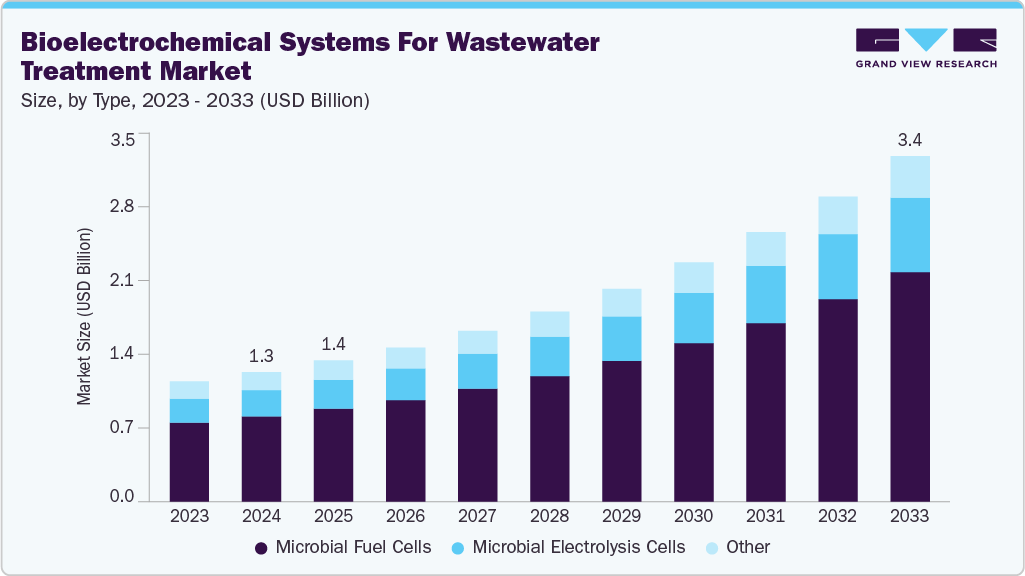
Market Concentration & Characteristics
The bioelectrochemical systems (BES) for wastewater treatment market is moderately fragmented, characterized by a diverse mix of startups, academic institutions, and specialized environmental technology companies. Innovation is largely driven by ongoing research and pilot projects. This fragmentation encourages technological experimentation and regional collaboration. As commercial viability improves and demand for sustainable treatment grows, the market may gradually consolidate.
The bioelectrochemical systems for wastewater treatment is highly innovative, driven by advancements in microbial fuel cells, electrode materials, and energy recovery technologies. Research institutions and startups are pioneering scalable solutions that improve treatment efficiency, reduce energy consumption, and enable resource recovery, positioning BES as a sustainable alternative to conventional methods.
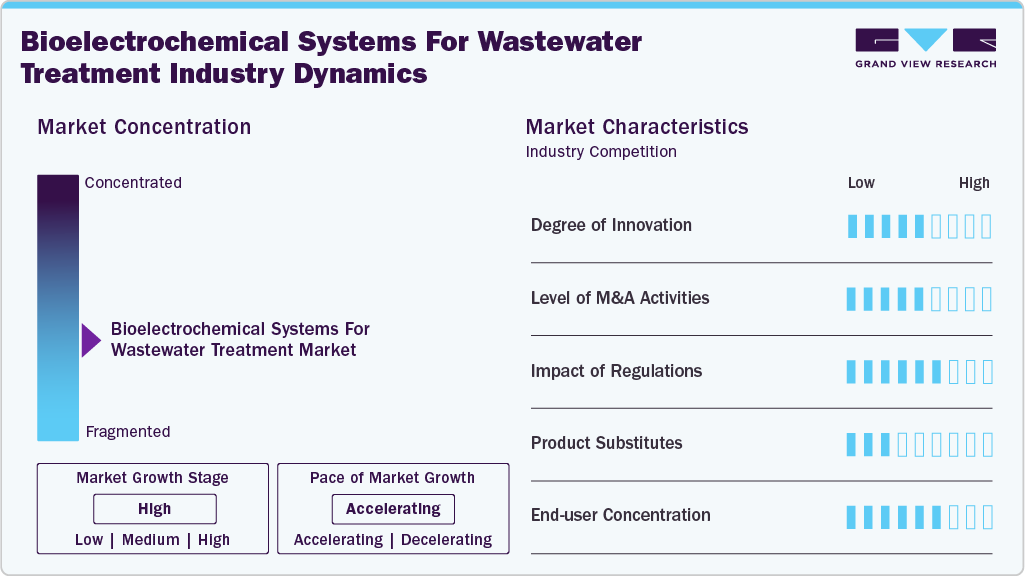
Mergers and acquisitions in the bioelectrochemical systems for wastewater treatment market are gradually increasing as larger environmental technology firms seek to acquire innovative startups and research spin-offs. These acquisitions aim to integrate cutting-edge BES technologies, accelerate commercialization, and expand capabilities in energy-efficient, sustainable wastewater treatment solutions for industrial and municipal applications
Environmental regulations are significantly shaping the BES market by encouraging the adoption of low-energy, resource-recovering wastewater treatment solutions. Government mandates on reducing carbon emissions, improving water reuse, and promoting circular economy practices are pushing industries and utilities to explore advanced technologies such as BES that align with regulatory compliance and sustainability goals.
Drivers, Opportunities & Restraints
Rising environmental concerns and stricter wastewater discharge regulations are driving demand for sustainable treatment technologies. Bioelectrochemical systems offer energy-efficient wastewater treatment with simultaneous energy and resource recovery, making them attractive alternatives to traditional methods. Increasing focus on reducing carbon footprints and operational costs in municipal and industrial sectors is boosting BES adoption globally.
Growing interest in decentralized and off-grid wastewater treatment systems presents a significant opportunity for BES technology. Its ability to treat wastewater while generating electricity or valuable byproducts suits remote areas lacking infrastructure. In addition, expanding research funding and technological improvements enhance scalability and cost-effectiveness, enabling wider market penetration in emerging economies.
High initial costs and technical complexities are significant barriers to the large-scale adoption of bioelectrochemical systems (BES) for wastewater treatment. The advanced materials and specialized components required increase upfront investment, making it challenging for many municipalities and industries to justify.
Type Insights
Microbial fuel cells (MFCs) dominated the market in 2024, accounting for the highest revenue share at 65.8%due to its ability to simultaneously treat wastewater and generate electricity, offering a sustainable and cost-effective solution. MFCs are widely researched and increasingly adopted in municipal and industrial applications because they reduce energy consumption compared to conventional treatments.
Microbial electrolysis cells (MECs) segment is expected to witness significant growth during the forecast period due to its ability to produce valuable byproducts like hydrogen and methane while effectively treating wastewater. MECs require low external voltage, making them energy-efficient compared to traditional methods. Their growing use in industrial wastewater treatment and renewable energy generation is attracting interest from researchers and utilities.
Application Insights
The industrial wastewater segment dominated the bioelectrochemical systems for wastewater treatment market in 2024, holding the largest revenue share at 42.5% due to increasing industrial activities and stringent environmental regulations. Bioelectrochemical systems offer efficient treatment of complex industrial effluents by simultaneously removing pollutants and generating energy. Their ability to handle high-strength wastewater from sectors like chemical, and food processing makes them an attractive, sustainable solution for industries seeking to reduce costs and environmental impact.
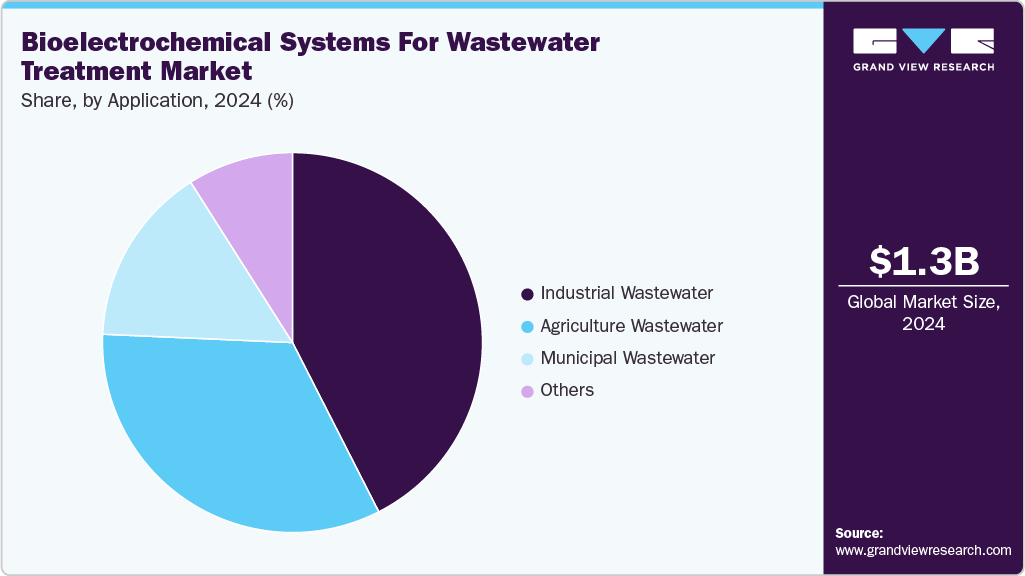
The municipal wastewater segment is expected to grow with a CAGR 12.0% over the forecast period in the bioelectrochemical systems for wastewater treatment market. This is attributed to urban populations growth and the increasing demand for sustainable sewage treatment. Bioelectrochemical systems provide effective organic matter removal and energy recovery, making them ideal for municipal wastewater plants aiming to improve treatment efficiency and reduce operational costs.
Regional Insights
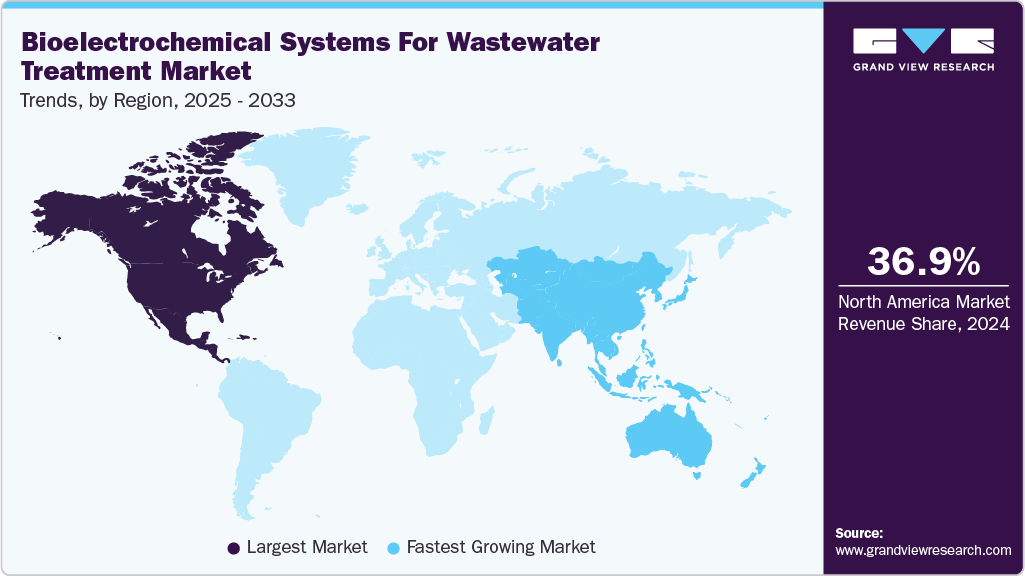
North America dominated bioelectrochemical systems for wastewater treatment market over the forecast period accounting for 36.9% market share in 2024, due to increasing investment in sustainable wastewater treatment technologies, strong R&D initiatives, and supportive environmental policies. The region's focus on energy-efficient infrastructure and circular economy goals is driving adoption, with pilot projects and university-industry collaborations accelerating commercialization across both municipal and industrial sectors.
U.S. Bioelectrochemical Systems For Wastewater Treatment Market Trends
The bioelectrochemical systems for wastewater treatment market in the U.S. is expected to grow at a CAGR of 9.3% from 2025 to 2033. U.S. is poised for strong growth due to strong demand in water reuse, industrial wastewater treatment, and advanced pharmaceutical processes. Federal and state regulations on clean water, combined with R&D investments and a well-established industrial base, support rapid adoption of innovative membrane solutions across sectors.
Mexico is anticipated to experience growing demand for bioelectrochemical systems for wastewater treatment driven by increasing industrial activities, urbanization, and stringent environmental regulations. The adoption of BES technologies, such as microbial fuel cells and microbial electrolysis cells, offers efficient treatment of complex industrial effluents while simultaneously recovering energy and valuable by-products.
Europe Bioelectrochemical Systems For Wastewater Treatment Market Trends
Europe is witnessing strong growth in the bioelectrochemical systems for wastewater treatment market driven by strict environmental regulations, ambitious sustainability goals, and significant investment in research and development. Countries such as Germany, the UK, and France are leading efforts by implementing pilot projects and integrating BES technologies into existing wastewater infrastructure to enhance energy recovery and reduce environmental impact.
Germany’s bioelectrochemical systems for wastewater treatment market is growing rapidly with active development and deployment of bioelectrochemical systems supported by numerous research institutions and technology providers. The country's focus on sustainability, government incentives, and funding encourages innovation and adoption of BES technologies in both municipal and industrial wastewater treatment facilities.
UK’s bioelectrochemical systems for wastewater treatment market growth is fueled by stringent environmental regulations, increasing concerns about water scarcity, and the push for sustainable wastewater management solutions. Government support through funding and policy initiatives promotes BES adoption.
Asia Pacific Bioelectrochemical Systems For Wastewater Treatment Market Trends
Asia Pacific is growing at a CAGR of 16.3% from 2025 to 2033, driven by rapid industrialization, urbanization, and increasing water scarcity. Governments across the region are supporting modular and decentralized BES solutions, particularly in areas lacking centralized infrastructure. The technology is gaining traction for its ability to support nutrient recovery and energy-efficient wastewater recycling.
China is advancing in the BES market through significant investments in wastewater treatment technologies to meet strict environmental regulations and resource recovery goals. Both municipal and industrial sectors are adopting BES systems as part of a broader strategy to enhance water quality, reduce pollution, and improve energy efficiency. China is becoming a major player in implementing advanced biological treatment solutions.
India is witnessing growing adoption of BES technologies due to increasing demand for sustainable and decentralized wastewater treatment solutions. National initiatives and public-private partnerships are supporting the integration of BES into urban and rural treatment systems. Rising urban population, water reuse needs, and environmental concerns are propelling India’s BES market forward, especially in the context of pollution control and water conservation.
Middle East & Africa Bioelectrochemical Systems For Wastewater Treatment Market Trends
Middle East and Africa regions are seeing growing interest in bioelectrochemical systems (BES) for wastewater treatment, driven by rapid urbanization, industrial expansion, and escalating water scarcity challenges. Governments across the region are investing in sustainable and efficient treatment solutions. BES technologies are gaining traction due to their ability to treat complex effluents while enabling resource recovery such as energy or nutrient value, particularly in areas with limited centralized infrastructure.
Saudi Arabia is emerging as a regional leader in BES adoption, with pioneering pilot projects and research initiatives testing microbial electrochemical systems to treat municipal and industrial wastewater with minimal energy input. Institutions such as KAUST are developing zero‑energy BES systems that treat city-scale volumes while generating renewable energy. Government-driven water reuse and circularity goals are strongly accelerating these deployments
Latin America Bioelectrochemical Systems For Wastewater Treatment Market Trends
Latin America’s bioelectrochemical systems (BES) market for wastewater treatment is expanding steadily. Rapid urbanization, industrial growth, and heightened regulatory pressure are pushing governments and industries to explore BES technologies. These systems are increasingly adopted in both municipal and industrial contexts for their ability to enhance treatment efficiency while recovering resources like energy or nutrients.
Brazil is projected to experience significant growth in the bioelectrochemical systems for wastewater treatment market d driven by strict environmental policies, rising industrial activity, and government-backed wastewater initiatives. This has spurred deployment of advanced biological treatment technologies, including bioelectrochemical approaches. The country’s focus on water reuse, pollution control, and infrastructure upgrades makes it a key hub for BES innovation and implementation.
Key Bioelectrochemical Systems For Wastewater Treatment Company Insights
Some of the key players operating in the market include Cambrian Innovation, MFC Systems GmbH, Applied CleanTech.
-
Cambrian Innovation is a U.S.-based company specializing in advanced wastewater treatment and resource recovery solutions. Cambrian was acquired by Pennybacker Capital Management, LLC (Pennybacker) in November 2023. It is known for developing innovative technologies like EcoVolt, a modular bioelectrochemical system that treats industrial wastewater while generating renewable energy. Cambrian’s systems are widely used in sectors such as food and beverage, helping companies reduce water consumption and lower environmental impact.
-
MFC Systems GmbH is a Germany-based technology company focused on developing microbial fuel cell (MFC) technologies for sustainable wastewater treatment and energy recovery. The company provides innovative solutions that harness the metabolic activity of microorganisms to treat wastewater while simultaneously generating electricity. MFC Systems GmbH collaborates with research institutions and industries to integrate its technologies into real-world applications, particularly in decentralized and small-scale treatment systems.
Key Bioelectrochemical Systems For Wastewater Treatment Companies:
The following are the leading companies in the bioelectrochemical systems for wastewater treatment market. These companies collectively hold the largest market share and dictate industry trends.
- Cambrian Innovation
- MFC Systems GmbH
- Applied CleanTech
- Electrochaea GmbH
- METawater Co., Ltd.
- Paques BV
- Biowater Technology AS
- AquaVenture Holdings Limited
- Organica Water
- Genesis Water Technologies, Inc.
Recent Developments
-
In June 2025, Cambrian partnered with ING Capital LLC, and secured a USD 150 million credit facility to accelerate its Water-Energy Purchase Agreement (WEPA) offerings. This strategic partnership brings significant investment and financial support, enabling Cambrian to expand its innovative wastewater treatment, water reuse, and energy recovery solutions for industrial clients more rapidly and effectively.
-
In June 2023, Pennybacker Capital Management acquired Cambrian. Along with the acquisition, Cambrian received a USD 200 million growth equity commitment to support its expansion and accelerate the development of sustainable water and energy solutions for industrial clients.
Bioelectrochemical Systems For Wastewater Treatment Market Report Scope
Report Attribute
Details
Market size value in 2025
USD 1,408.9 million
Revenue forecast in 2033
USD 3,451.9 million
Growth rate
CAGR of 11.9% from 2025 to 2033
Historical data
2021 - 2023
Forecast period
2025 - 2033
Quantitative units
Revenue in USD million/billion and CAGR from 2025 to 2033
Report coverage
Revenue forecast, company ranking, competitive landscape, growth factors, and trends
Segments covered
Type, application, region
Regional scope
North America; Europe; Asia Pacific; Latin America; Middle East & Africa
Country scope
U.S.; Canada; Mexico; UK; Germany; France; Spain; Italy; China; Japan; India; Australia; South Korea; Brazil; Argentina; Saudi Arabia; South Africa; UAE; Qatar; Oman; Kuwait; Israel
Key companies profiled
Cambrian Innovation; MFC Systems GmbH; Applied CleanTech; Electrochaea GmbH; METawater Co., Ltd.; Paques BV; Biowater Technology AS; AquaVenture Holdings Limited; Organica Water; Genesis Water Technologies, Inc.
Customization scope
Free report customization (equivalent up to 8 analysts working days) with purchase. Addition or alteration to country, regional & segment scope.
Pricing and purchase options
Avail customized purchase options to meet your exact research needs. Explore purchase options
Global Bioelectrochemical Systems For Wastewater Treatment Market Report Segmentation
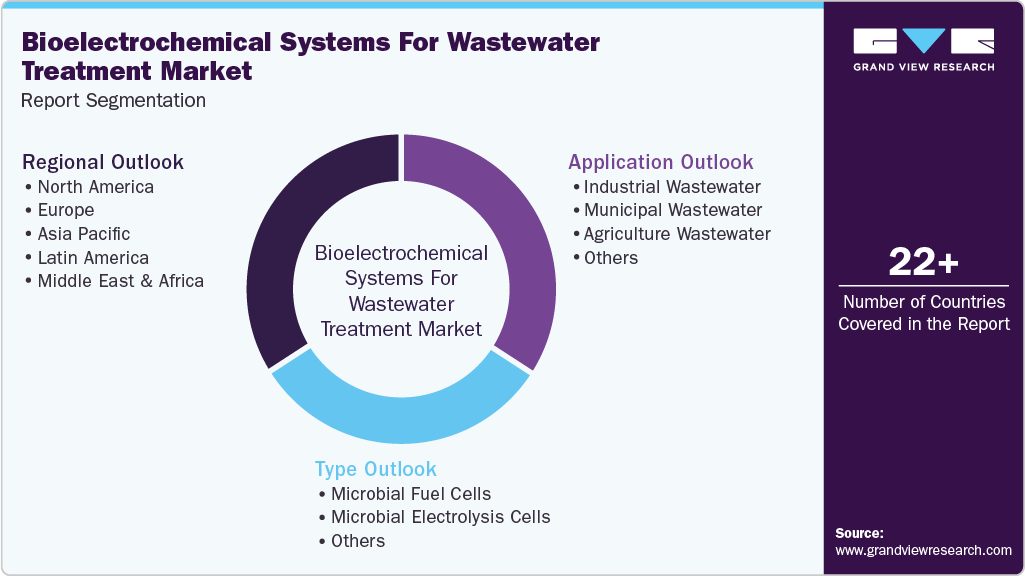
This report forecasts revenue growth at global, regional, and country levels and provides an analysis of the latest industry trends in each of the sub-segments from 2021 to 2033. For this study, Grand View Research has segmented the global bioelectrochemical systems for wastewater treatment market report based on type, application, and region:
-
Type Outlook (Revenue, USD Million, 2021 - 2033)
-
Microbial Fuel Cells
-
Microbial Electrolysis Cells
-
Others
-
-
Application Outlook (Revenue, USD Million, 2021 - 2033)
-
Industrial Wastewater
-
Municipal Wastewater
-
Agriculture Wastewater
-
Others
-
-
Regional Outlook (Revenue, USD Million, 2021 - 2033)
-
North America
-
U.S.
-
Canada
-
Mexico
-
-
Europe
-
Germany
-
UK
-
France
-
Italy
-
Spain
-
-
Asia Pacific
-
China
-
India
-
Japan
-
Australia
-
South Korea
-
-
Latin America
-
Brazil
-
Argentina
-
-
Middle East and Africa
-
Saudi Arabia
-
South Africa
-
UAE
-
Qatar
-
Oman
-
Kuwait
-
Israel
-
-
Frequently Asked Questions About This Report
b. The global bioelectrochemical systems for wastewater treatment market size was estimated at USD 1,292.5 million in 2024 and is expected to be USD 1,408.9 million in 2025.
b. The global bioelectrochemical systems for wastewater treatment market, in terms of revenue, is expected to grow at a compound annual growth rate of 11.9% from 2025 to 2033 to reach USD 3,451.9 million by 2033.
b. Microbial Fuel Cells (MFCs) dominated the market in 2024, accounting for the highest revenue share at 65.8% due to its ability to simultaneously treat wastewater and generate electricity, offering a sustainable and cost-effective solution. MFCs are widely researched and increasingly adopted in municipal and industrial applications because they reduce energy consumption compared to conventional treatments.
b. Some of the key players operating in the global bioelectrochemical systems for wastewater treatment market include Cambrian Innovation, MFC Systems GmbH, Applied CleanTech, Electrochaea GmbH, METawater Co., Ltd., Paques BV, Biowater Technology AS, AquaVenture Holdings Limited, Organica Water, Genesis Water Technologies, Inc.
b. Key factors driving the global bioelectrochemical systems for wastewater treatment market include rising water scarcity, strict environmental regulations, growing demand for energy-efficient treatment technologies, increasing industrial wastewater generation, and the need for sustainable solutions that enable resource recovery and decentralized wastewater management.


Share this report with your colleague or friend.
Need a Tailored Report?
Customize this report to your needs — add regions, segments, or data points, with 20% free customization.


ISO 9001:2015 & 27001:2022 Certified
We are GDPR and CCPA compliant! Your transaction & personal information is safe and secure. For more details, please read our privacy policy.
Trusted market insights - try a free sample
See how our reports are structured and why industry leaders rely on Grand View Research. Get a free sample or ask us to tailor this report to your needs.













