
- Home
- »
- Petrochemicals
- »
-
Biomethane Market Size And Share, Industry Report, 2030GVR Report cover

Biomethane Market (2025 - 2030) Size, Share & Trends Analysis Report By Source (Energy Crops, Animal Manure, Municipal Waste, Waste Water Sludge), By End-use (Construction, Industrial, Power Generation, Transport), By Region, And Segment Forecasts
Market Size, 2024
$7,994.9MMarket Estimate, 2026
$9.1MMarket Forecast, 2030
$17,031.9MCAGR, 2025–2030
13.5%Biomethane Market Summary
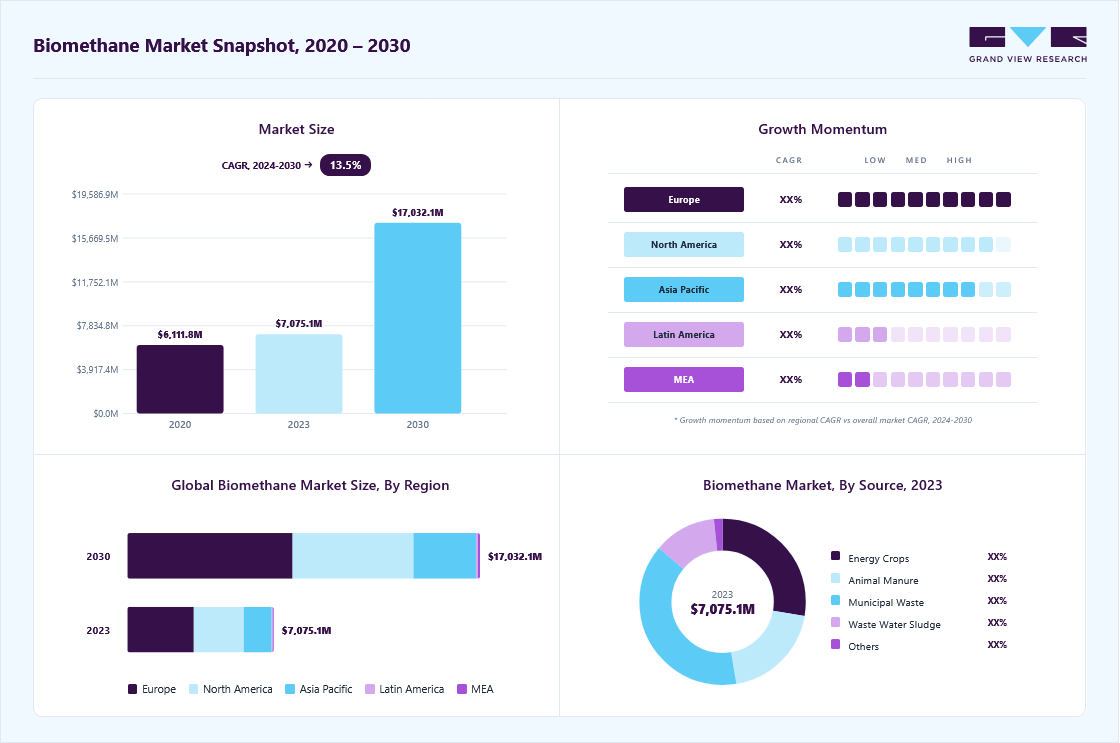
The global biomethane market size was estimated at USD 7,994.9 million in 2024 and is projected to reach USD 17,031.9 million by 2030, growing at a CAGR of 13.5% from 2025 to 2030. Biomethane is a renewable source that is used for diverse applications such as construction, power generation, transportation, and industrial applications.
 Source: Grand View Research, IR Documents, Primary Interviews, Paid DatabasesTo learn more about this report,
 Download Free Sample Report
 Key Market Trends & Insights
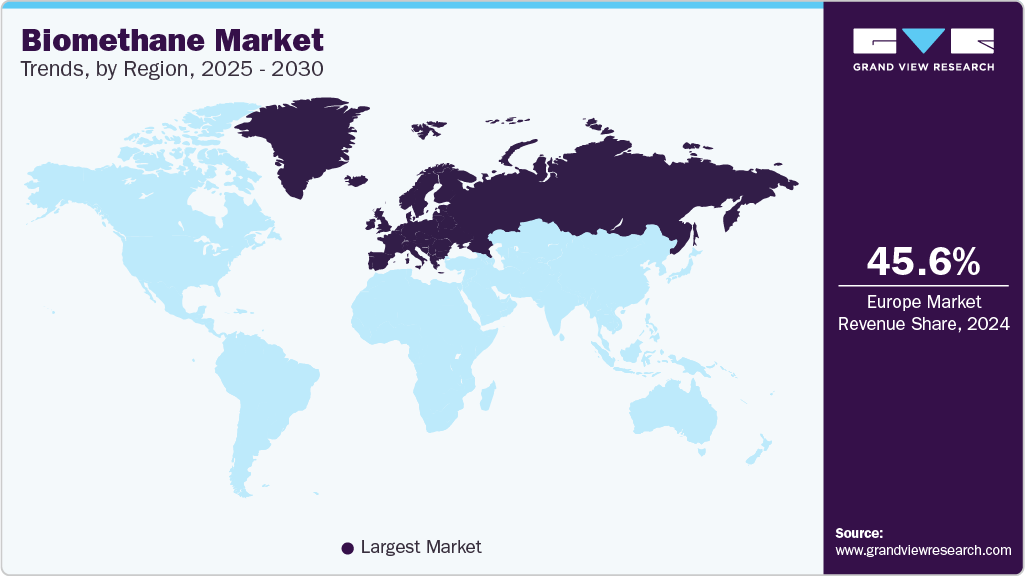
- Europe biomethane market dominated the global industry and accounted for over 45.6% revenue share in 2024.
- By source, the municipal waste accounted for the highest revenue share of about 39.0% in 2024.
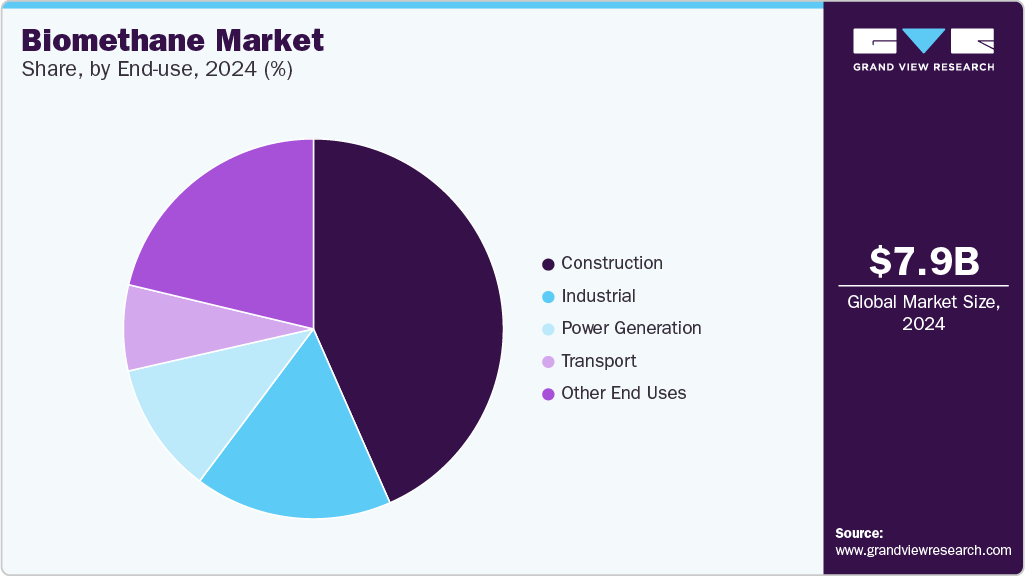
- By end use, the construction accounted for the highest revenue share of over 43.0% in 2024
Market Size & Forecast
- 2024 Market Size: USD 7,994.9 Million
- 2030 Projected Market Size: USD 17,031.9 Million
- CAGR (2025-2030): 13.5%
- Europe: Largest market in 2024
Three ways to get this report
Buy it, customize it, or ask a question.Ask an Analyst
Analyst response in 1 business day
- AccessReport author, directly
- Reply timeWithin 1 working day
- No sales callDirect answer only
- FormatEmail reply
- CostFree, no cost
Get the Full Report
What the study covers
- FormatsPDF · Excel · Dashboard
- Timeline2025–2030 annual, 2024 base
- Coverage20+ countries, 5 regions
- Companies10+ key players profiled
Customize the Report
20% free customization
- IncludeCountries, segments, points
- TailorTo your product definition
- ExtendDeeper competitor detail
- OrA fully bespoke study
- Turnaround5–10 working days
The growing demand for efficient power transmission is anticipated to boost the market over the forecast period. Biomethane is a type of gas derived from the biological breakdown of organic matter, such as agricultural waste, food waste, sewage, and other organic materials. It is a renewable energy source and is considered a sustainable alternative to fossil fuels. Biomethane is produced through a renewable process called anaerobic digestion, where microorganisms break down organic matter in the absence of oxygen, resulting in the production of biogas.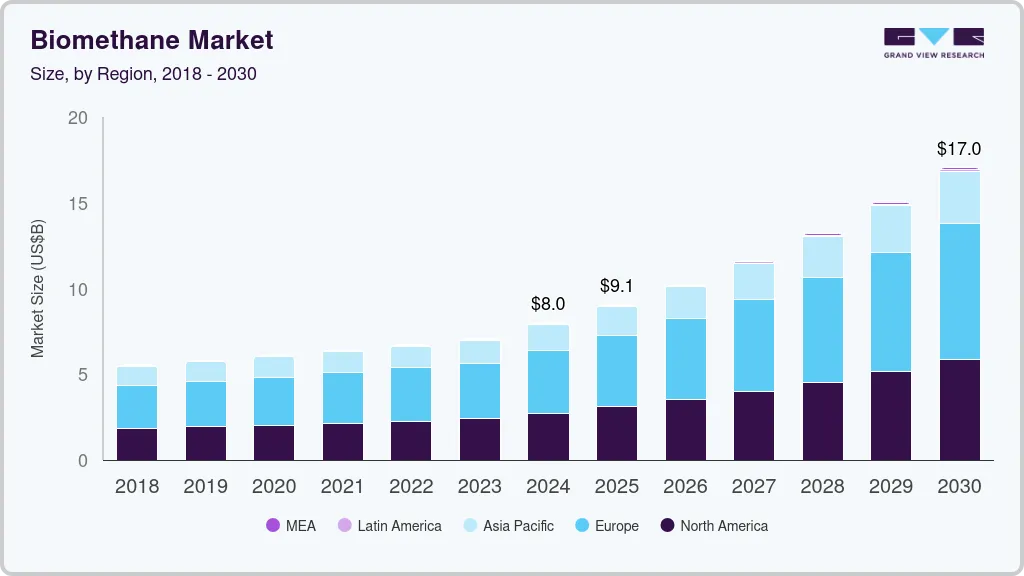 To learn more about this report, Download Free Sample Report
 Market Dynamics
The biomethane market is being driven by the growing implementation of decarbonization policies and renewable energy transition programs across major economies. Governments in Europe and North America have introduced incentive frameworks, renewable fuel standards, carbon reduction targets, and grid injection policies to accelerate adoption of renewable natural gas and low-carbon fuels. Regulatory support for organic waste utilization and methane emission reduction is encouraging investments in biomethane production from agricultural waste, municipal waste, landfill gas, and wastewater sludge.
Industrial operators, utilities, and transportation companies are increasingly integrating biomethane into their energy mix to reduce greenhouse gas emissions and meet sustainability commitments. Expansion of renewable gas infrastructure, including upgrading facilities and biomethane injection networks, is further strengthening commercial deployment. The growing focus on circular economy practices and conversion of waste streams into energy resources continues to create long-term growth opportunities for biomethane producers and technology providers.
A major restraint for the biomethane market is the high capital investment required for anaerobic digestion plants, gas upgrading systems, and pipeline injection infrastructure. Biomethane production involves complex purification and compression processes to meet grid-quality standards, increasing project development costs and extending payback periods. Smaller developers and independent producers often face financial challenges in scaling operations, particularly in regions with limited policy incentives or underdeveloped renewable gas infrastructure.
Feedstock availability and supply consistency also remain critical operational challenges. Biomethane production depends heavily on stable access to agricultural waste, manure, municipal waste, and sludge, which can fluctuate based on seasonal patterns, waste collection efficiency, and regional agricultural activity. Variability in feedstock quality and transportation logistics can affect production efficiency and operating costs, creating uncertainty for long-term project planning and commercial viability.
Source Insights
Municipal waste accounted for the highest revenue share of about 39.0% in 2024.The municipal waste segment is expected to register the fastest CAGR of 14.7% during the forecast period. Municipal waste is a key source segment in the biomethane market, driven by increasing urbanization and the need for sustainable waste management solutions. Organic fractions of municipal solid waste (OFMSW), such as food scraps, garden waste, and biodegradable packaging, are processed through anaerobic digestion to produce biogas, which is then upgraded to biomethane. This approach not only reduces landfill dependency and methane emissions but also supports circular economy goals by converting waste into renewable energy.
Many municipalities across Europe and Asia are investing in biogas plants to meet renewable energy targets and comply with waste reduction mandates. As a result, municipal waste is emerging as a scalable and policy-supported feedstock for biomethane production.
End-use Insights
Construction accounted for the highest revenue share of over 43.0% in 2024. According to the IEA, bioenergy accounted for around 10% of the world’s primary energy demand in 2023. Most of the bioenergy is used in the form of biogas, i.e., biomethane. In the construction industry, biomethane is used for cooking and heating applications, and a vast portion is also used as an additive in the gas network as a transport fuel.
 To learn more about this report, Download Free Sample Report
 The industrial sectors, such as food, drink, and chemicals, produce byproducts with a high organic content that can be used for the production of biomethane. At the same time, the demand for biomethane within the industrial sector is anticipated to be generated by its increasing role in the reduction of greenhouse gas emissions and the focus on sustainable production methods.
Regional Insights
Europe biomethane market dominated the global industry and accounted for over 45.6% revenue share in 2024. This growth is anticipated to continue over the forecast period owing to the increasing sources of biomethane and the emphasis on alternate and renewable energy sources. To cut down on the cost of technology, European universities and research institutes are investing in conducting cutting-edge research for which they are provided grants and funding for R&D by the European Commission.
 To learn more about this report, Download Free Sample Report
 North America Biomethane Market Trends
The biomethane market in North America is anticipated to witness a CAGR of 13.6% over the forecast period. It is expected to be driven by the renewable energy transition and green material usage in industries that are the current trend in the U.S.
U.S. Biomethane Market Trends
The biomethane market in the U.S is growing, as according to the American Biogas Council, about USD 1.8 billion in capital investment worth biogas projects came online in 2023. This includes methane capture system projects for the production of biomethane. The U.S. biomethane market is being driven by the increased usage of recyclable construction infrastructure and the requirement to reduce carbon emissions.
Asia Pacific Biomethane Market Trends
According to the World Biogas Association, the Asia Pacific region has immense potential to increase the generation of biogas and subsequently improve biomethane demand. This can be aligned with its waste management policies and help combat climate change.
Key Biomethane Company Insights
Key players operating in the biomethane market are undertaking various initiatives to strengthen their presence and increase the reach of their products and services. Strategies such as expansion activities and partnerships are key in propelling the market growth.
Key Biomethane Companies:
The following are the leading companies in the biomethane market. These companies collectively hold the largest market share and dictate industry trends.
- Air Liquide
- Engie
- Nature Energy Biogas A/S
- Gasum
- Terega Solutions
- Waga Energy
- TotalEnergies
- Chevron
- Kinder Morgan
- Archea Energy
- Envitec Biogas AG
- Future Biogas Ltd.
- E.ON SE
- Verbio Vereinigte Bioenergie AG
- South Hills RNG
Competitive Benchmarking
Operating Strategies
Competitive Edge
Weaknesses
Mature Players: Air Liquide, Engie, TotalEnergies, Chevron, Kinder Morgan, E.ON SE, Gasum, Nature Energy Biogas A/S, Verbio Vereinigte Bioenergie AG, Envitec Biogas AG
- Focused on large-scale biomethane production, gas upgrading, and grid injection infrastructure.
- Expanded through partnerships with utilities, municipalities, and industrial customers.
- Invested in agricultural waste, landfill gas, and renewable natural gas projects.
- Strong financial strength and established gas distribution infrastructure.
- Advanced upgrading and purification technologies supported operational efficiency.
- Broad geographic presence strengthened feedstock access and long-term contracts.
- High capital investment requirements increased project payback periods.
- Strong dependence on government incentives and renewable fuel policies.
- Large operational structures reduced flexibility in smaller decentralized projects.
Emerging Players: Waga Energy, Terega Solutions, Archea Energy, Future Biogas Ltd., South Hills RNG
- Focused on landfill gas recovery, decentralized RNG systems, and waste-to-energy projects.
- Expanded through technology partnerships and regional project development.
- Emphasized specialized methane capture and upgrading technologies.
- Greater flexibility and faster deployment of niche biomethane projects.
- Strong focus on methane reduction and circular economy initiatives.
- Proprietary upgrading technologies supported differentiation in regional markets.
- Limited financial capacity for large-scale infrastructure expansion.
- Smaller geographic presence restricted feedstock diversification.
- Higher dependence on external financing and regional policy support.
Recent Developments
-
In April 2024, France-based AirLiquide announced the expansion of its production capacity of biomethane in the U.S. with the construction of two new plants in Pennsylvania and Michigan. These plants will cater to the industrial and transport sectors in the region.
-
In January 2023, France-based Arkema signed a long-term agreement with France-based ENGIE for the supply of 300 GWh/year of biomethane. This deal is considered to be one of the largest agreements in Europe in the biomethane market and is aimed at enabling the former to reduce its carbon footprint in the chemical industry.
Biomethane Market Report Scope
Report Attribute
Details
Market size value in 2025
USD 9.05 billion
Revenue forecast in 2030
USD 17.03 billion
Growth rate
CAGR of 13.5% from 2025 to 2030
Base year for estimation
2024
Historical data
2018 - 2023
Forecast period
2025 - 2030
Quantitative Units
Revenue in USD million/billion and CAGR from 2025 to 2030
Report coverage
Revenue forecast, competitive landscape, growth factors, and trends
Segments covered
Source, end-use, region
Regional scope
North America; Europe; Asia Pacific; Latin America; Middle East & Africa
Country scope
U.S.; Canada; Mexico; Germany; France; Italy; Denmark; Netherlands; China; India; Japan; South Korea; Brazil; Argentina; South Africa; Saudi Arabia.
Key companies profiled
Air Liquide; Engie; Nature Energy Biogas A/S; Gasum; Terega Solutions; Waga Energy; TotalEnergies; Chevron; Kinder Morgan; Archea Energy; Envitec Biogas AG; Future Biogas Ltd.; E.ON SE; Verbio Vereinigte Bioenergie AG; South Hills RNG
Customization scope
Free report customization (equivalent up to 8 analysts working days) with purchase. Addition or alteration to country, regional & segment scope.
Pricing and purchase options
Avail customized purchase options to meet your exact research needs. Explore purchase options
Global Biomethane Market Report Segmentation
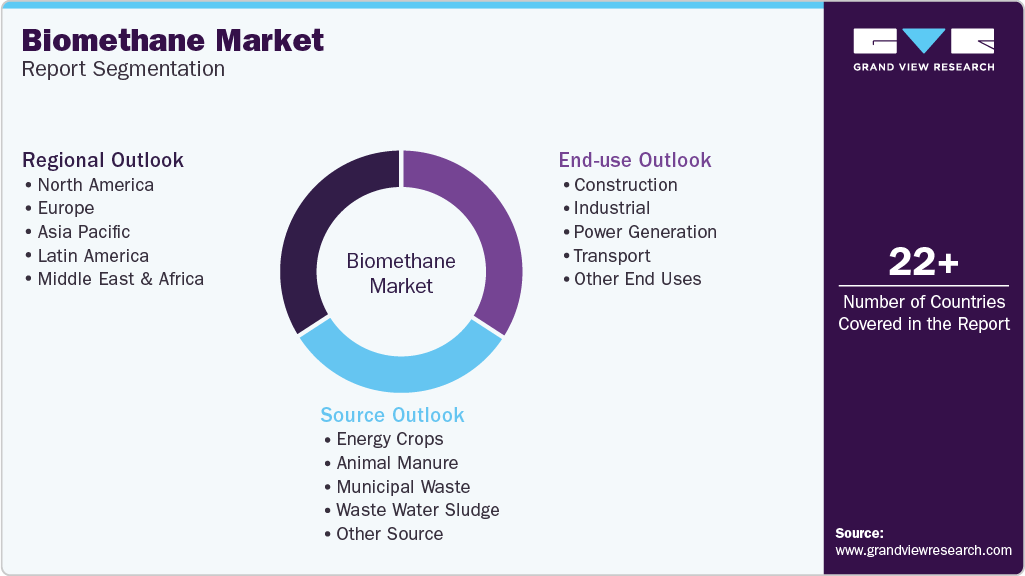
This report forecasts revenue growth at the global, regional, and country levels and provides an analysis of the latest trends in each of the sub-segments from 2018 to 2030. For this study, Grand View Research has segmented the global biomethane market report on the basis of source, end use, and region.
 To learn more about this report, Download Free Sample Report
 -
Source Outlook (Revenue, USD Billion, 2018 - 2030)
-
Energy Crops
-
Animal Manure
-
Municipal Waste
-
Waste Water Sludge
-
Other Source
-
-
End-use Outlook (Revenue, USD Billion, 2018 - 2030)
-
Construction
-
Industrial
-
Power Generation
-
Transport
-
Other End Uses
-
-
Regional Outlook (Revenue, USD Billion, 2018 - 2030)
-
North America
-
U.S.
-
Canada
-
Mexico
-
-
Europe
-
Germany
-
France
-
Italy
-
Denmark
-
Netherlands
-
-
Asia Pacific
-
China
-
India
-
Japan
-
South Korea
-
-
Latin America
-
Brazil
-
Argentina
-
-
Middle East & Africa
-
South Africa
-
Saudi Arabia
-
-
Delivered Customizations
This report has been delivered with the following In-depth customizations
Client Request
Customization Delivered
Value Adds
Regional Segmentation
A detailed regional assessment of the biomethane market was conducted across North America, Europe, Asia Pacific, Latin America, and Middle East & Africa, with additional country-level analysis for major producing and consuming economies. The study evaluated feedstock availability, government incentive programs, biomethane grid injection infrastructure, waste management practices, and end-use demand trends across transport, industrial, power generation, and construction sectors.
Assisted in identifying high-potential regional markets and country-specific investment opportunities. Supported strategic expansion planning through deeper visibility into policy support, infrastructure readiness, and regional demand concentration trends.
Competitive Benchmarking
Key biomethane producers and renewable gas developers were benchmarked based on production capacity, feedstock sourcing strategies, upgrading technologies, regional presence, distribution partnerships, sustainability initiatives, and participation in renewable natural gas infrastructure projects. The evaluation also reviewed strategic collaborations, plant expansion activities, and integration across waste-to-energy value chains.
Supported identification of competitive positioning gaps and operational best practices within the biomethane ecosystem. Enabled improved benchmarking of technology capabilities, infrastructure strength, and partnership-driven growth strategies.
Opportunity Assessment
An opportunity analysis was conducted focusing on renewable transport fuel adoption, decarbonization of industrial heating systems, landfill gas utilization, agricultural waste monetization, and expansion of biomethane injection into national gas grids. The assessment also reviewed growth potential linked to carbon reduction targets, circular economy initiatives, and renewable energy transition programs.
Enabled identification of high-growth investment areas and emerging application segments within the renewable gas ecosystem. Supported strategic planning for future capacity expansion, sustainability positioning, and long-term market development.
About the Author(s)
Petrochemicals Research Team
Bulk Chemicals · PetrochemicalsThis report was authored by the petrochemicals research team at Grand View Research - comprising two research analysts, one senior research analyst, and one industry expert - with specialized expertise in the petrochemicals segment of the bulk chemicals industry. All findings are based on proprietary bulk chemicals databases, executive interviews, and regulatory analysis, subject to internal peer review prior to publication.
Last Updated:
Speak to Analyst

Customize this report to your needs - add regions, segments, or data points, with 20% free customization.
Or view our licence options:


ISO 9001:2015 & 27001:2022 Certified
We are GDPR and CCPA compliant! Your transaction & personal information is safe and secure. For more details, please read our privacy policy.


