
- Home
- »
- Medical Devices
- »
-
Body Fat Measurement Market Size, Growth Report, 2026-2033GVR Report cover

Body Fat Measurement Market (2026 - 2033)
Size, Share & Trends Analysis Report By Product Type (Calipers, Bioimpedance Analyzers, Hydrostatic Weighing, DEXA), By End Use (Hospitals & Clinics, Fitness Centers & Gymnasiums), By Region, And Segment Forecasts
Market Size, 2025
$761.3MMarket Estimate, 2026
$810.1MMarket Forecast, 2033
$1,250.6MCAGR, 2026–2033
6.4%Body Fat Measurement Market Summary
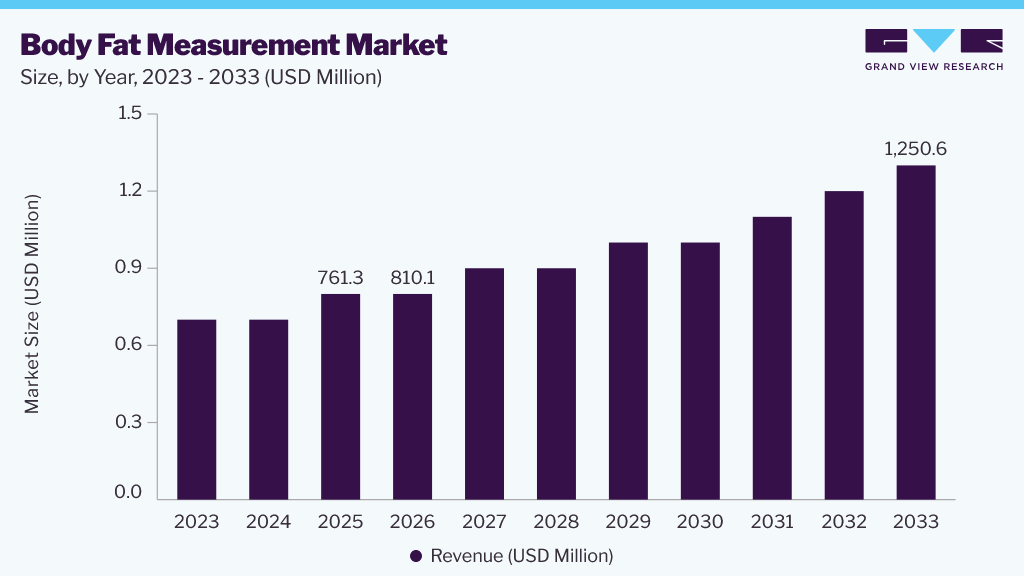
The global body fat measurement market size was valued at USD 761.3 million in 2025 and is projected to grow from USD 810.1 million in 2026 to USD 1,250.6 million by 2033, at a CAGR of 6.4% from 2026 to 2033. North America dominated the market, accounting for the largest revenue share of more than 32.0% in the global market in 2025. The growing awareness of bodyweight management and the accuracy of Bioelectrical Impedance Analysis (BIA) devices are key factors driving market growth.
Key Market Trends & Insights
- By product: The bioimpedance analyzers (BIA) segment held the largest market share of approximately 22.0% in 2025.
- By end use: The hospitals & clinics segment held the largest market share of more than 40.0% in 2025.
Regional Insights
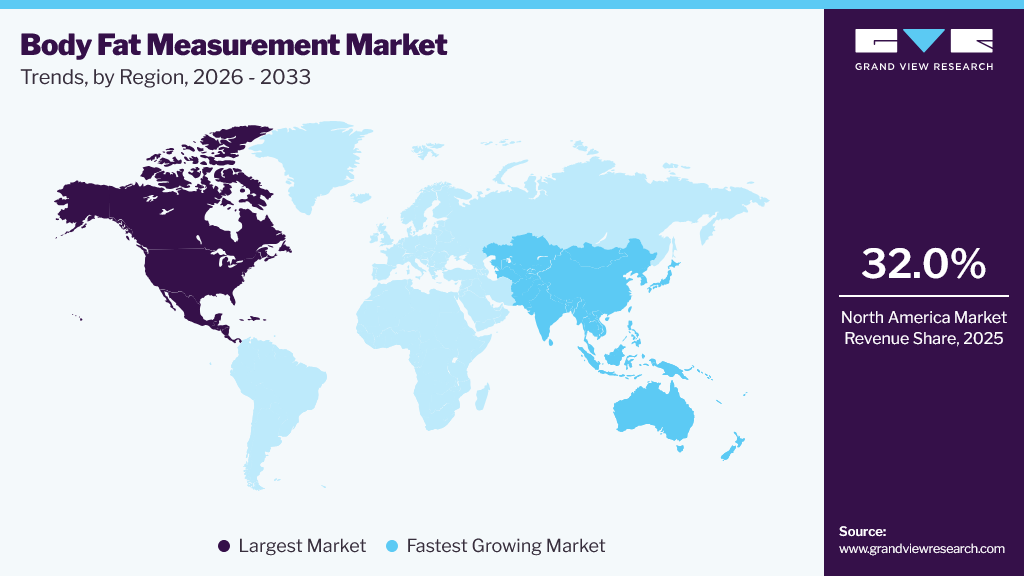
- Largest regional market: North America (32.0% revenue share, 2025)
- Fastest-growing regional market: Asia Pacific (highest CAGR, 2026-2033)
Market Size & Forecast
- Market size in 2025: USD 761.3 Million
- Estimated market size in 2026: USD 810.1 Million
- Projected market size by 2033: USD 1,250.6 Million
- CAGR (2026-2033): 6.4%
Three ways to get this report
Buy it, customize it, or ask a question.Ask an Analyst
Analyst response in 1 business day
- AccessReport author, directly
- Reply timeWithin 1 working day
- No sales callDirect answer only
- FormatEmail reply
- CostFree, no cost
Get the Full Report
What the study covers
- FormatsPDF · Excel · Dashboard
- Timeline2026–2033 annual, 2025 base
- Coverage20+ countries, 5 regions
- Companies10+ key players profiled
Customize the Report
20% free customization
- IncludeCountries, segments, points
- TailorTo your product definition
- ExtendDeeper competitor detail
- OrA fully bespoke study
- Turnaround5–10 working days
The introduction of highly accurate and effective BIA devices for measuring body fat is expected to contribute to industry growth. For instance, in 2024, SeCA launched their mBCA Alpha, an integrated Body Composition Screening platform capable of delivering a patient’s body composition in just 24 seconds.The growing prevalence of obesity and lifestyle-related health issues is a key driver of the body fat measurement industry. Increasingly sedentary lifestyles, coupled with the widespread adoption of work-from-home arrangements, have contributed to rising rates of obesity, cardiovascular diseases, diabetes, and other chronic health conditions. As a result, consumers are becoming more health-conscious and actively monitoring body composition as part of their daily fitness routines.
 Source: Grand View Research, IR Documents, Primary Interviews, Paid DatabasesTo learn more about this report,
 Download Free Sample Report
The increasing focus on preventive healthcare and personal fitness has boosted demand for body fat measurement solutions across fitness centers, health clubs, wellness programs, and home settings. Technologies such as bioelectrical impedance analysis (BIA) devices are gaining popularity in North America and Europe for their ability to provide precise assessments of body fat, muscle mass, and overall body composition. These measurements help individuals to recalibrate their diet and exercise programs while identifying potential health risks associated with excess body fat.
Technological advancements are further supporting market growth by making body composition analysis more accessible and user-friendly. In April 2025, Fit3D partnered with Prism Labs to launch SNAP, a tablet-based 3D body-scanning platform that provides body fat percentage and other body measurements without requiring dedicated scanning hardware. Similarly, in October 2024, Noom introduced an AI-powered Body Scan feature that enables users to track body fat and muscle mass using a smartphone camera. Such innovations ensure easy access to body composition monitoring by offering affordable, convenient, and digital solutions for both consumers and healthcare providers.
As body composition assessment becomes an increasingly important component of fitness, weight management, and preventive healthcare programs, demand for advanced body fat measurement technologies is expected to grow steadily during the forecast period.
Market Dynamics
The growing adoption of smart body composition devices integrated with mobile health applications, wearables, and telehealth platforms presents a significant opportunity for the body fat measurement industry, driven by increasing consumer demand for convenient, home-based health monitoring and personalized wellness management.
Obesity and issues associated with it are growing at a rampant pace across different countries worldwide. A sedentary lifestyle, poor eating habits, and the aftereffects of the pandemic are contributing significantly to individuals' body composition. The growing trend of work-from-home and the convenience of food delivery and quick-commerce apps further contributed to high-calorie consumption, resulting in rapidly rising body mass, glucose, and cholesterol levels, as well as gastrointestinal issues. In recent years, people have begun taking steps to reduce excess body fat through various fitness and wellness activities. To maximize the effectiveness of their fitness programs, people are undergoing a whole-body composition evaluation, including fat measurements. This helps them identify their key issues and develop personalized exercise and nutrition plans tailored to their goals.
According to the World Heart Federation, more than 2.3 billion people, including children, are living with overweight or obesity. The federation also predicted that the obesity rate is expected to double by 2030 compared to the rate in 2010. These numbers highlight the necessity of continuous measurement of body fat composition to optimize diet and activity programs. Furthermore, body fat measurement devices have also become an integral part of healthcare and diagnostic centers. Consequently, the growing need for body fat measurement across commercial and personal health settings, as well as hospitals and healthcare centers, is expected to drive the body fat measurement industry.
A significant challenge to market growth is inconsistent measurement accuracy among body fat assessment methods, especially with consumer-grade devices. Variability in results due to hydration, body positioning, ethnicity, and operator skill can reduce confidence in these technologies. In addition, advanced systems such as DEXA scanners and air-displacement plethysmography require significant capital investment, specialized infrastructure, and trained personnel. These requirements limit adoption among smaller healthcare facilities and in developing regions. Cost and accuracy concerns continue to hinder broader market penetration.
A significant opportunity in the body fat measurement industry is the increasing demand for home-use and connected body composition monitoring devices. Consumers are becoming more proactive about managing their health and fitness, driving demand for smart scales and body-fat analyzers that integrate with smartphones, fitness apps, wearable devices, and telehealth platforms. Advances in bioelectrical impedance analysis (BIA), AI-powered health analytics, and remote patient monitoring are enabling users to track body fat, muscle mass, and other health metrics from home. This trend creates substantial growth opportunities for manufacturers to develop affordable, user-friendly, and digitally connected solutions for preventive healthcare and personalized wellness management.
Governments, universities, healthcare companies, and innovators are developing various non-invasive methods to accurately measure body fat with minimal hardware requirements. For instance, a recent study published in the National Library of Medicine highlights a method for estimating body fat percentage using artificial intelligence to analyze 2D photos. In addition, companies are introducing the next generation of body composition scales for personal use, offering precise body composition measurements, including fat measurements. Products such as the Withings Body Scan, the Hume Health Body Pod, and the Oxiline Scale MD Pro provide a range of metrics, including body fat, visceral fat, muscle mass, and metabolic age. These scales are more affordable and accessible on a daily basis compared to advanced methods such as DEXA. This provides multiple opportunities for the overall market to grow over the coming years.
Analyst Perspective
The global body fat measurement industry is evolving from a niche diagnostic tool into an essential part of preventive healthcare and personalized wellness.
Growing limitations of BMI are driving demand for detailed body composition data, including lean tissue, bone density, and visceral fat. Clinical-grade DEXA systems continue to play a key role in hospitals and specialized obesity care. However, portable and IoT-enabled Bioelectrical Impedance Analysis (BIA) devices are driving rapid market-volume growth. Despite high capital costs for advanced diagnostic equipment, demand for accurate body composition monitoring continues to rise. The increasing prevalence of metabolic and lifestyle diseases is further supporting market expansion. Growing healthcare and fitness infrastructure in Asia-Pacific creates strong growth opportunities for industry innovators and stakeholders.Product Type Insights
The Bioimpedance Analyzers (BIA) segment led the market with the largest revenue share of approximately 22.0% in 2025. BIA measures the person’s body composition based on the rate at which electrical current travels through the body. There are two types of BIA devices: hand-to-hand and foot-to-foot. Developing segmental analysis for 4- to 8-sensor or electrode BIA devices, such as the in-Body series, is a high-impact rendering driver for the market. Moreover, the introduction of highly accurate and effective BIA devices for measuring body fat is expected to contribute to segment growth.
The dual-energy X-ray absorptiometry (DEXA) segment is anticipated to register at the fastest CAGR during the forecast period. Dual-energy X-ray absorptiometry uses X-rays emitted through the body at two or more frequencies to measure the body composition of the individual being tested. This method is primarily used to measure bone density in orthopedic cases of osteoporosis, bone strength testing, and other cases where bone densitometry analysis is required. High usage rates in large healthcare establishments and the high accuracy exhibited by these devices are key factors expected to drive segment growth over the coming years.
Distribution Channel Insights
The hospitals & clinics segment led the market with the largest revenue share of 40.0% in 2025. Patient weight is important in various aspects of medication management, such as fluid balance, prescribing appropriate dosages, and nutritional assessment. Therefore, recording patient weight is standard for all patient visits or hospital admissions. DEXA is the gold standard for measuring body composition. By measuring the absorption of each beam in different parts of the body, physicians can obtain precise estimates of bone mineral density, lean body mass, and fat mass. Furthermore, according to the British Heart Foundation, Bioelectrical Impedance Analysis (BIA) is the most commonly used test by dietitians and nutritionists to assess body fat composition and estimate a person’s nutritional status and physical fitness.
The fitness centers and gymnasiums segment is expected to grow at the fastest CAGR over the forecast period. Body fat is affected by lipids, and fat plays important roles in overall bodily function, including energy metabolism and digestion. Excess body fat can lower your weight-to-work ratio and increase joint stress during exercise. Therefore, the use of body fat measurement devices is expected to increase over time. Some body fat measurement devices recommended for fitness professionals include skin calipers, bioelectrical impedance, and hydrostatic weighing. Furthermore, an increasing number of fitness and gymnasium centers is expected to contribute to segment growth. For instance, in 2024, UK fitness club memberships reached an all-time high of 10.7 million members, reflecting growing consumer participation in structured fitness programs. This creates greater demand for body fat and body composition monitoring services in gyms and health clubs.
Regional Insights
North America dominated the global body fat measurement market with the largest revenue share of approximately 32.0% in 2025. This can be attributed to the increasing cases of obesity and metabolism-related diseases and growing awareness about bodyweight management. For instance, according to the CDC's 2024 Adult Obesity Prevalence Maps, every U.S. state and territory reported an adult obesity prevalence of at least 25%. This means at least one in four adults had obesity, indicating that obesity remains a widespread public health issue across the country. Furthermore, the presence of several market players in this region and the growing need for body composition assessment and obesity management solutions support market growth.
 To learn more about this report, Download Free Sample Report
Asia Pacific Body Fat Measurement Market
The body fat measurement market in the Asia Pacific is anticipated to grow at the fastest CAGR during the forecast period, owing to the presence of many BIA device manufacturers in the region. The growing population in emerging economies, such as India and China, is also driving growth in the regional market. In addition, the presence of a large target population, rising awareness of fitness and health, and the rapid expansion of technologically advanced healthcare in emerging countries are expected to drive growth in the regional market.
Key Body Fat Measurement Company Insights
Key market players are undertaking various strategic initiatives, such as entering new partnerships, collaborating, and expanding geographically, to strengthen their manufacturing capacities and gain a competitive advantage. However, investments in R&D and the launch of new products are the most prevalent strategies companies use to remain relevant in the market.
For instance, in November 2024, the Body Technologies Center in Arizona demonstrated the use of COSMED's BOD POD system for accurate, reliable body fat measurements. The center employed advanced body fat measurement technology to support fitness evaluations and individualized health programs, indicating the growing integration of body composition analysis solutions.
Key Body Fat Measurement Market Companies
The following key companies have been profiled for this study on the global body fat measurement market:
-
GE Healthcare
-
OMRON Healthcare Co., Ltd.
-
The Diagnostic Medical Systems (DMS) Group
-
Hologic Inc.
-
Xiaomi
-
Garmin Ltd.
-
Beurer GmbH
-
InBody Pvt. Ltd.
-
AccuFitness LLC
-
Bodystat
Recent Developments
-
In May 2025, SeCA launched the mBCA Alpha, a portable body composition analyzer that uses bioelectrical impedance analysis (BIA) to measure body fat, visceral fat, muscle mass, and other body composition parameters in 24 seconds. The device was developed for primary care settings to enable faster adoption of body composition screening and support growth in the body fat measurement market.
-
In April 2025, Tanita introduced a new all-black version of its flagship MC-980U Plus body composition analyzer for fitness centers, healthcare facilities, and research institutions. The device continued to offer advanced analysis of body fat percentage, visceral fat, muscle mass, and body composition using multi-frequency bioelectrical impedance technology.
-
In March 2024, InBody introduced its new InBody 380 and InBody 580 body composition analyzers. These devices offer advanced features, including body fat measurement, muscle mass analysis, visceral fat assessment, and segmental body composition evaluation. These new devices are designed for fitness, wellness, and healthcare professionals. They make it easier to access comprehensive body fat measurement solutions and help support growth in the body fat measurement market.
Body Fat Measurement Market Report Scope
Report Attribute
Details
Market size in 2025
USD 761.3 million
Estimated Market size in 2026
USD 810.1 million
Projected Market size by 2033
USD 1,250.6 million
Growth rate
CAGR of 6.4% from 2026 to 2033
Base year for estimation
2025
Historical data
2021 - 2024
Forecast period
2026 - 2033
Quantitative units
Revenue in USD million/billion, and CAGR from 2026 to 2033
Report coverage
Revenue forecast, company ranking, competitive landscape, growth factors, and trends
Segments covered
Product type, end use, region
Regional Scope
North America; Europe; Asia Pacific; Latin America; Middle East & Africa
Country scope
U.S.; Canada; UK; Germany; France; Italy; Spain; Denmark; Sweden; Norway; China; India; Japan; Australia; Thailand; South Korea; Brazil; Mexico; Argentina; South Africa, Saudi Arabia; UAE; Kuwait
Key companies profiled
GE Healthcare; OMRON Healthcare Co., Ltd.; The Diagnostic Medical Systems (DMS) Group; Hologic Inc.; Xiaomi; Garmin Ltd.; Beurer GmbH; InBody Pvt. Ltd.; AccuFitness LLC; Bodystat
Customization scope
Free report customization (equivalent up to 8 analysts working days) with purchase. Addition or alteration to country, regional & segment scope.
Pricing and purchase options
Avail of customized purchase options to meet your exact research needs. Explore purchase options
Global Body Fat Measurement Market Report Segmentation
This report forecasts revenue growth at the regional and country levels and provides an analysis on the latest industry trends and opportunities in each of the sub-segments from 2021 to 2033. For this study, Grand View Research has segmented the global body fat measurement market report based on the product type, end use, and region:
 To learn more about this report, Download Free Sample Report
-
Product Type Outlook (Revenue, USD Million, 2021 - 2033)
-
Calipers
-
Bioimpedance Analyzers
-
Hydrostatic Weighing
-
DEXA (Dual-Energy X-Ray Absorptiometry)
-
Air-displacement Plethysmography
-
Others
-
-
End Use Outlook (Revenue, USD Million, 2021 - 2033)
-
Hospitals & Clinics
-
Fitness Centers and Gymnasiums
-
Homecare Centre
-
-
Regional Outlook (Revenue, USD Million, 2021 - 2033)
-
North America
-
U.S.
-
Canada
-
-
Europe
-
UK
-
Germany
-
France
-
Italy
-
Spain
-
Denmark
-
Sweden
-
Norway
-
-
Asia Pacific
-
Japan
-
China
-
India
-
Australia
-
South Korea
-
Thailand
-
-
Latin America
-
Brazil
-
Mexico
-
Argentina
-
-
Middle East & Africa
-
South Africa
-
Saudi Arabia
-
UAE
-
Kuwait
-
-
Frequently Asked Questions About This Report
The global body fat measurement market size was valued at USD 761.3 million in 2025 and is estimated at USD 810.1 million for 2026.
The global body fat measurement market is expected to grow at a CAGR of 6.4% from 2026 to 2033, reaching USD 1,250.6 million.
The bioimpedance analysers (BIA) segment accounted for the largest revenue share of approximately 22.0% in 2025.
Key players in the market include GE Healthcare; OMRON Healthcare Co., Ltd.; The Diagnostic Medical Systems (DMS) Group; Hologic Inc.; Xiaomi; Garmin Ltd.; Beurer GmbH; InBody Pvt. Ltd.; AccuFitness LLC; Bodystat.
North America dominated with approximately 32.0% revenue share in 2025.
About the Author(s)
Medical Devices Research Team
Healthcare · Medical DevicesThis report was authored by the medical devices research team at Grand View Research - comprising two research analysts, one senior research analyst, and one industry expert - with specialized expertise in the medical devices segment of the healthcare industry. All findings are based on proprietary healthcare databases, executive interviews, and regulatory analysis, subject to internal peer review prior to publication.
Last Updated:
Speak to Analyst

Customize this report to your needs - add regions, segments, or data points, with 20% free customization.
Or view our licence options:


ISO 9001:2015 & 27001:2022 Certified
We are GDPR and CCPA compliant! Your transaction & personal information is safe and secure. For more details, please read our privacy policy.


