
- Home
- »
- Medical Devices
- »
-
Smart Scale Market Size, Growth Report, 2026-2033GVR Report cover
![Smart Scale Market Size, Share & Trends Report]()
Smart Scale Market (2026 - 2033) Size, Share & Trends Analysis Report By Product Type (Body Composition Smart Scales/ Smart Monitors, BMI Smart Scales), By Connectivity (Wi-Fi, Bluetooth, multi-connectivity), By Application, By Distribution Channel, By End-use, By Region, And Segment Forecasts
Market Size, 2025
$1.8BMarket Estimate, 2026
$1.9BMarket Forecast, 2033
$3.4BCAGR, 2026–2033
8.4%Smart Scale Market Summary
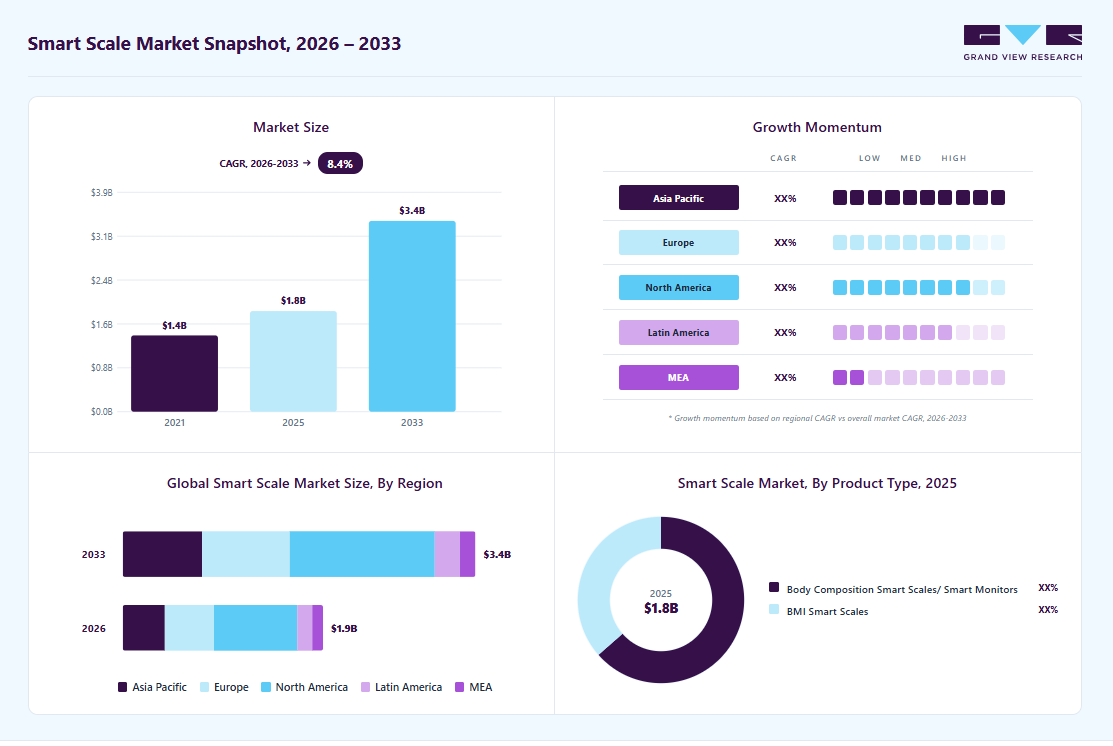
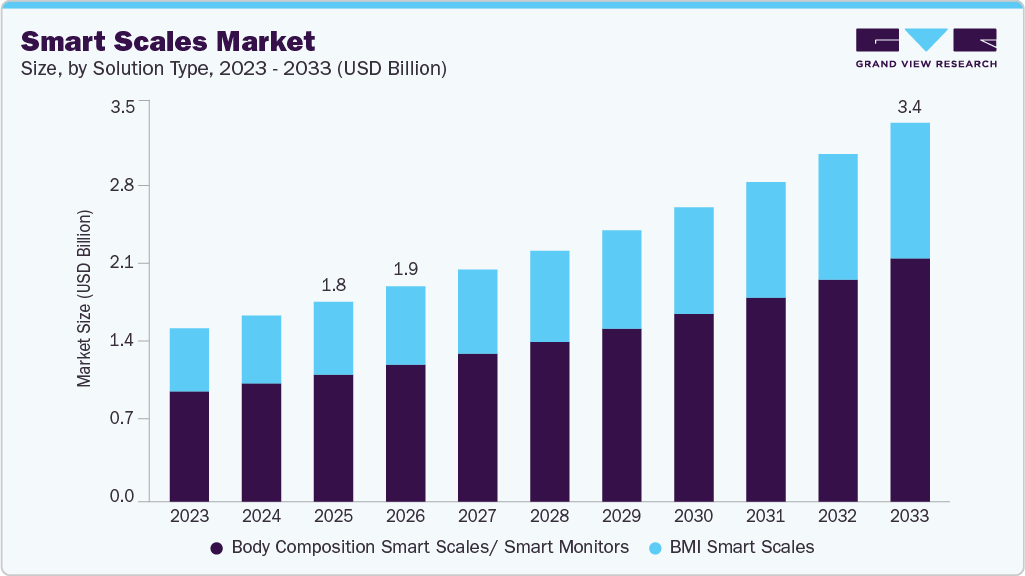
The global smart scale market size was valued at USD 1.8 billion in 2025 and is projected to grow from USD 1.9 billion in 2026 to USD 3.4 billion by 2033, at a CAGR of 8.4% from 2026 to 2033. The North America held the largest share of 41.5% of the global market in 2025. This growth is attributed to increasing consumer focus on preventive healthcare and fitness tracking, rising adoption of connected health devices, integration with mobile applications and wearable ecosystems, and growing awareness regarding obesity and lifestyle-related disorders.
Key Market Trends & Insights
- By product type: Body Composition Smart Scales/Smart Monitors segment held the largest market share of 63.5% in 2025.
- By connectivity: Bluetooth connectivity segment accounted for the largest market share in 2025.
- By application: Personal health monitoring segment accounted for the largest revenue share of 44.3% in 2025.
- By distribution channel: Online channels segment accounted for the largest revenue share in 2025.
- By end use: Homecare settings segment accounted for the largest market share in 2025.
Regional Highlights
- Largest regional market: North America (41.51% revenue share, 2025)
- Fastest-growing regional market: Asia Pacific (highest CAGR, 2026-2033)
Market Size & Forecast
- Market size in 2025: USD 1.8 Billion
- Estimated market size in 2026: USD 1.9 Billion
- Projected market size by 2033: USD 3.4 Billion
- CAGR (2026-2033): 8.4%
The rising focus on preventive healthcare and self-monitoring is driven by increasing awareness of lifestyle-related diseases and the need for early detection and continuous health tracking. Consumers are increasingly adopting smart scales to monitor parameters such as body weight, BMI, body fat, and muscle mass in real time. These devices, integrated with mobile apps and digital health platforms, enable users to track progress, gain actionable insights, and make informed lifestyle decisions, supporting a shift from reactive treatment to proactive health management.In addition, rising prevalence of obesity is a significant factor driving the growth of the smart scales market, as individuals increasingly seek tools to monitor and manage their health. According to the Centers for Disease Control and Prevention, the prevalence of obesity among adults was 40.3% during August 2021-August 2023, with higher rates observed among individuals aged 40-59 and no significant difference between men and women. This growing health concern is accelerating the adoption of smart scales, which enable users to track weight and body composition metrics, supporting informed lifestyle changes and preventive health management.
Moreover, technological advancements in smart scales are increasingly focused on expanding beyond basic weight measurement to comprehensive health monitoring through advanced sensors and analytics. The integration of multi-frequency bioelectrical impedance analysis and connectivity with digital health platforms is enhancing accuracy and user engagement. For instance, on January 5, 2026, Withings unveiled a USD 600 smart scale, Body Scan 2, capable of tracking hypertension risk, heart pumping efficiency, and metabolic health using advanced biomarker analysis. Such innovations highlight the shift toward multi-parameter devices that provide automated health insights during routine use, enhancing the role of smart scales in home-based preventive healthcare.
AI in smart scale
The integration of artificial intelligence in smart scales is transforming them from basic measurement devices into advanced health monitoring systems capable of delivering predictive and personalized insights. By analyzing multi-parameter data such as body composition, cardiovascular signals, and metabolic indicators, AI enables more accurate assessments and trend-based health recommendations. For instance, in January, 2026, Withings announced Body Scan 2, a science-backed “longevity station” that uses AI-driven analysis of over 60 biomarkers to assess cardiovascular, metabolic, and cellular health. This advancement highlights the shift toward intelligent, data-driven devices that support proactive and continuous health management in home settings.
Market Concentration & Characteristics
The chart below illustrates the relationship between market concentration, industry characteristics, and industry participants. The x-axis represents the level of industry concentration, ranging from low to high. The y-axis represents various industry characteristics, including industry competition, impact of regulations, level of partnerships & collaborations activities, degree of innovation, and regional expansion. For instance, the smart scales market is fragmented, with many providers entering the market. The degree of innovation, the level of partnerships & collaboration activities, and the impact of regulations on the industry is high. However, the regional expansion observes moderate growth.
Degree of innovation is high in the smart scales market, Advancements in sensor technologies, digital integration, remote monitoring, and AI-enabled analytics enable consumers to track multiple health parameters, support early detection of health risks, and improve overall wellness management through continuous, data-driven insights. For instance, in January 2026, Withings, launched the Body Scan 2, positioned as a “home longevity station” designed to advance preventive health monitoring. The new smart scale features a tempered glass platform and a retractable handle equipped with a display, allowing users to conveniently view their health metrics during weigh-ins.
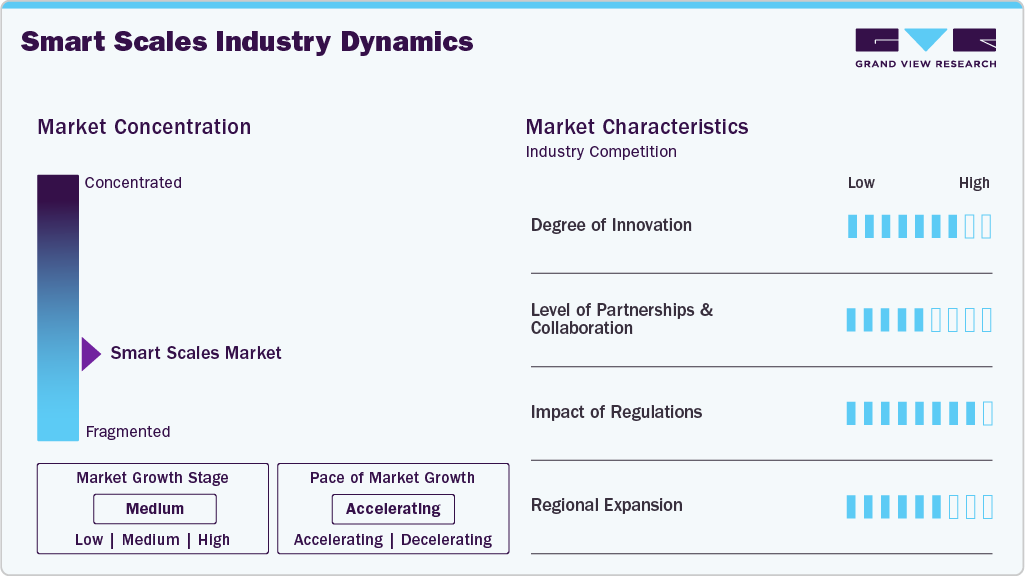
The level of partnerships and collaborations in the smart scales market is high, reflecting a strong focus on enhancing device capabilities, data integration, and comprehensive health monitoring. Companies are increasingly partnering with digital health platforms, nutrition service providers, and wearable ecosystem players to improve interoperability and deliver more actionable insights from health data. For instance, in November 2025, Withings partnered with Fay to integrate dietitian guidance with data from smart devices, including smart scales, enabling users to translate body composition metrics into personalized nutrition and health plans.
Regulations play a crucial role in the smart scales market by ensuring device accuracy, user safety, and data privacy, particularly as these devices increasingly handle sensitive health information. Regional regulatory frameworks, such as those established by the U.S. Food and Drug Administration and the European Medicines Agency, create compliance requirements related to medical device classification, data security, and wireless connectivity standards. While these regulations pose operational challenges for manufacturers, they also drive investments in product validation, secure data management, and quality assurance, ensuring that smart scales deliver reliable and clinically relevant health insights.
The smart scales market is witnessing growing expansion into emerging markets, driven by increasing demand for advanced home-based health monitoring solutions. Companies are focusing on expanding their geographic presence and improving product accessibility to a larger consumer base. These expansion are supported by rising health awareness, increasing disposable incomes, and improving digital infrastructure, which are collectively accelerating the adoption of smart health monitoring devices in home settings.
Product Types Insights
Based on product types, the Body Composition Smart Scales/ Smart Monitors/ smart monitors segment held the largest market share of 63.5% in 2025 and is expected to grow at fastest CGAR during the forecast period. The segment's dominance is driven by growing consumer demand for comprehensive health monitoring beyond basic weight measurement, including metrics such as body fat percentage, muscle mass, visceral fat, and water composition. In addition, companies are continuously innovating within this segment, which contributes to its growth. For instance, in November 2025, Wyze launched the Scale Ultra BodyScan, featuring a retractable handle and eight electrodes for segmental body composition analysis of the arms, legs, and torso, providing professional-grade health insights at an accessible price.
The BMI smart scales segment also held a prominent share in the smart scales market. Factors contributing to the segment’s share include the device’s ability to quickly calculate and display BMI using weight and height, ease of use for all age groups, low cost compared to multi-metric smart scales, compatibility with basic fitness tracking apps, and its role as a simple yet effective indicator for monitoring weight-related health risks.
Connectivity Insights
Based on the connectivity, the Bluetooth connectivity segment held the largest revenue share in 2025. This growth is attributed its widespread compatibility with smartphones, fitness trackers, and mobile health applications, enabling seamless data transfer and real-time health monitoring. In addition, Bluetooth-enabled smart scales offer user-friendly pairing, low power consumption, and reliable short-range connectivity, making them the preferred choice for consumers seeking integrated, home-based health tracking solutions.
However, the Wi-Fi Connectivity segment is expected to grow at fastest CAGR during the forecast period. This growth is driven by the increasing demand for cloud-based health data storage, multi-device synchronization, and remote monitoring capabilities. Wi-Fi-enabled smart scales allow users to automatically sync health metrics across devices and platforms, share data with healthcare providers, and access more advanced analytics, making them increasingly attractive for consumers seeking comprehensive, connected health management solutions.
Application Insights
Based on the application, the personal health monitoring segment held the largest revenue share of 44.3% in 2025. Large share of the segment is attributed to growing consumer awareness about preventive healthcare, increasing adoption of home-based health tracking devices, and the ability of smart scales to provide real-time insights into weight, body composition, and overall wellness. Moreover, integration with mobile apps and wearable ecosystems allows users to monitor trends, set personalized goals, and make informed lifestyle decisions, further driving the segment’s growth.
Moreover, the clinical health monitoring segment is expected to grow significantly over the forecast period. This growth is driven by the increasing use of smart scales in hospitals, clinics, and telehealth programs for patient monitoring, early detection of health risks, and management of chronic conditions. Integration with electronic health records (EHRs) and remote monitoring platforms enables healthcare providers to access accurate, real-time data, enhancing clinical decision-making and supporting personalized care. For instance, CareSimple’s remote patient monitoring scale transmits patient weight readings directly to clinical portals and EHR systems without requiring Bluetooth, Wi-Fi, or app setup, helping providers remotely manage chronic conditions such as obesity, diabetes, and heart failure.
Distribution channel Insights
Based on the distribution channel, the online channels segment held the largest revenue share in 2025 and is expected to grow at fastest CAGR during the forecast period. This growth is driven by factors such as increasing demand for advanced home-based health monitoring devices, easy access to a wide range of models with multi-metric and AI-enabled features, the convenience of purchasing connected devices without visiting stores, availability of detailed product specifications and user reviews, and the ability to compare functionalities such as body composition analysis, Bluetooth/Wi-Fi connectivity, and app integration.
Moreover, offline segment held a substantial share in smart scales market owing to continued preference of some consumers for hands-on experience, in-store consultations, and immediate product availability. Retail stores also provide opportunities for customers to explore different models, check build quality, and receive guidance from trained staff, complementing the convenience offered by online channels rather than competing with them.
End Use Insights
Based on end use, homecare settings held the dominant market share in 2025. The segment growth can be attributed to increasing consumer focus on preventive healthcare, rising awareness of lifestyle-related health issues, and the convenience of monitoring body weight and composition from home. In addition, the integration of smart scales with mobile apps and connected health platforms enables users to track trends, receive personalized insights, and share data with healthcare providers, further driving adoption in homecare settings.
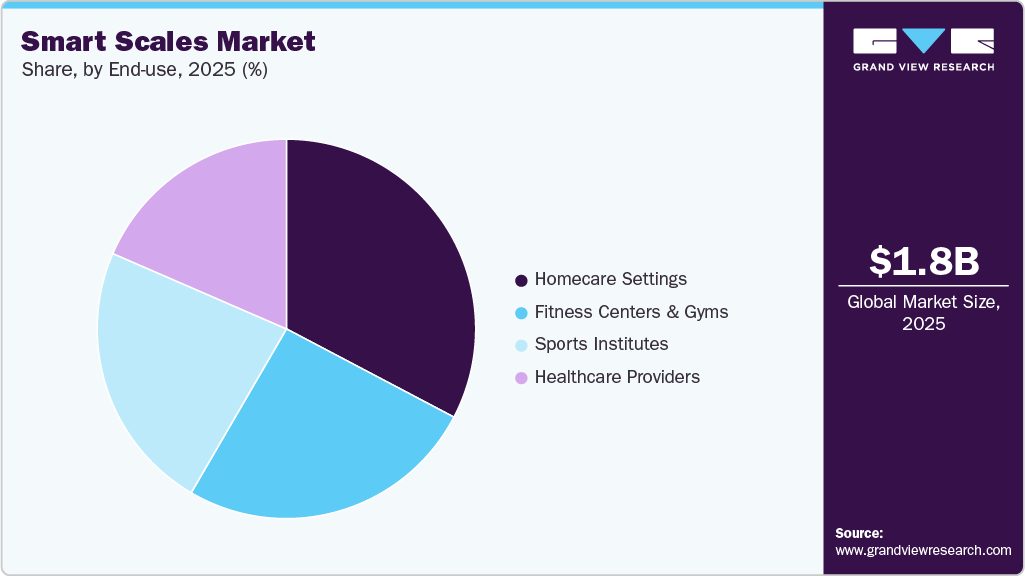
Fitness centers and gyms also held a significant share of the market driven by the need for accurate body composition tracking to support training and wellness programs. The adoption is further supported by the integration of smart scales with gym management systems and fitness apps, enabling trainers and members to monitor progress, set goals, and tailor exercise or nutrition plans based on real-time data, enhancing overall member engagement and results.
Regional Insights
North America held the largest revenue share of 41.51% in 2025 in the smart scale market, driven by strong consumer awareness of health and wellness, widespread adoption of connected devices, and the integration of smart scales with fitness apps and wearable ecosystems. The region’s established homecare, gym, and telehealth practices, along with easy access through both retail and online channels, have further supported the adoption of advanced, multi-metric smart scales.

U.S Smart Scale Market Trends
The growth of the U.S. smart scales market is driven by high consumer health awareness and the growing demand for home-based monitoring, amid rising obesity and lifestyle-related health issues. Integration with telehealth programs and digital health platforms enables healthcare providers to track patient metrics remotely, while strong e-commerce and retail channels ensure easy access to devices. Market growth is further supported by product innovations. For instance, in October 2025, RunStar launched three new smart scales in the U.S. featuring upgraded electrode pads, enhanced displays, offline data functions, and comprehensive body composition tracking, providing users with more accurate and actionable health insights.
Europe Smart Scale Market Trends
Europe held a significant share in the smart scales market, supported by strong government initiatives promoting digital health and preventive care, as well as rising demand for medically certified and clinically accurate devices. Moreover, the growth of the market is further supported by innovations from brands such as Withings and RENPHO, offering multi-metric analysis and advanced connectivity, continue to support market growth across homecare, gyms, and telehealth programs in Europe.
The smart scales market in UK is increasingly shaped by the adoption of digital health technologies in public healthcare. For instance, in May 2025, specialist NHS clinics used smart scales to help thousands of severely obese children monitor their weight at home. These scales transmitted data directly to clinical teams, enabling continuous remote monitoring and personalized feedback, which supported healthier lifestyle changes and reduced the need for frequent hospital visits.
Smart scale mart in Germany is expected to grow significantly, as consumers increasingly adopt connected devices for home-based health monitoring. Smart scales help track weight and body composition, providing insights that support lifestyle management and chronic disease care. According to the International Diabetes Federation, 6.5 million people in Germany suffered from diabetes in 2024, highlighting the growing need for tools that enable continuous monitoring and proactive health management.
Asia Pacific Smart Scale Market Trends
The Asia Pacific smart scales market is driven by rising health awareness, increasing obesity and lifestyle-related conditions, and growing disposable incomes. Integration with smartphones and wearables enables home-based tracking of weight and body composition, while government initiatives promoting digital health and widespread availability through online and retail channels further support market adoption.
Rising obesity and increasing health awareness are fueling the adoption of smart scales devices in China, as more consumers seek tools to monitor weight, track body composition, and manage lifestyle-related health risks from home. For instance, in June 2024, China launched a three-year national public weight control campaign to tackle obesity, encouraging the use of smart and wearable health devices for personalized monitoring and lifestyle management.
The India smart scales market is expanding as consumers increasingly adopt connected health devices for home-based wellness monitoring. Rising health awareness and interest in tracking multiple body metrics have encouraged the introduction of advanced smart scales with app integration and multi-user support. For instance, in March 2021, OSS Infocom launched the eOnz Elite range of smart BMI health scales in India, offering dual-frequency bioelectrical impedance analysis, comprehensive body composition tracking, and Bluetooth connectivity with the HealthU+ app, reflecting the growing demand for personalized and technology-driven health solutions.
Latin America Smart Scale Market Trends
Rising obesity rates are driving the adoption of smart scales market in Latin America, as consumers seek tools for home-based weight monitoring and preventive health management. For instance, a study presented at the International Congress on Obesity in June 2024, suggests that nearly 48% of Brazilian adults are projected to be living with obesity by 2044, with an additional 27% expected to be overweight, indicating that about three‑quarters of adults could be affected by excess weight within the next 20 years.
Middle East & Africa Smart Scale Market Trends
The smart scales market in Middle East and Africa is being driven by rising rates of obesity, diabetes, and other lifestyle-related health issues, prompting consumers to seek home-based health monitoring solutions. Governments and healthcare providers are increasingly promoting preventive care and digital wellness initiatives, while growing smartphone penetration enables integration with mobile apps for personalized tracking.
Key Smart Scale Company Insights
Key players in the smart scales market are adopting innovative strategies, offering personalized infusion formulations, mobile and in-clinic services, and digital booking platforms to enhance accessibility and patient experience. Integration of smart infusion technologies and partnerships with wellness centers, fitness facilities, and luxury providers are further driving adoption and expanding market reach.
Key Smart Scale Companies:
The following key companies have been profiled for this study on the smart scale market.
- Xiaomi
- Nureca Limited
- Omron Healthcare
- Withings
- TANITA Corporation of America, Inc
- Huawei Device Co., Ltd
- Garmin Ltd.
- Beurer
- RENPHO
- Qardio, Inc.
- Medisana
- iHealth Labs
- Blipcare
- InBody Co., Ltd.
- Taylor USA (A Division of Lifetime Brands, Inc.)
List of startup companies in the smart scale market
- iHealth Labs
- Fitbit
- Blipcare
- InBody Co., Ltd.
- Taylor USA (A Division of Lifetime Brands, Inc., PICOOC Technology Co., Ltd.),
- Yunmai
- Arboleaf
- Cult
Recent Developments
-
In January 2025, Cult (a brand from Curefit) launched its Cult Smart Weighing Scales including the Pro version that measures over 50+ body health parameters such as body fat, muscle mass and hydration via the Cult Connect App to offer detailed body composition tracking beyond just weight 2025,
-
In April 2024 French health‑tech brand Withings officially entered the Indian market, launching advanced smart scales like the Body Scan and Body Smart along with hybrid smartwatches (ScanWatch 2/Light) to bring hospital‑grade health tracking into hom
-
In August 2023, the U.S. FDA cleared Withings’ Body Scan Connected Health Station smart scale, which integrates a 6‑lead ECG to assess body composition, heart rate, vascular age and detect signs of atrial fibrillation (AFib) and other cardiovascular issues, with results viewable on the device and in a paired app.
-
In June 2022, Qardio launched the next‑generation QardioBase X smart scale, a 12‑metric body composition device that syncs with iOS and Android to help users track weight and health data for deeper insights into fitness and wellness goals.
Smart Scale Market Report Scope
Report Attribute
Details
Market size in 2025
USD 1.8 billion
Estimated market size in 2026
USD 1.9 billion
Projected market size by 2033
USD 3.4 billion
Growth rate
CAGR of 8.4% from 2026 to 2033
Actual data
2021 - 2025
Forecast period
2026 - 2033
Quantitative units
Market value in USD million/billion, and CAGR from 2026 to 2033
Report coverage
Revenue forecast, company ranking, competitive landscape, growth factors, and trends
Segments covered
Product type, connectivity, application, end use, distribution channel, region
Regional scope
North America; Europe; Asia Pacific; Latin America; MEA
Country scope
U.S.; Canada; Mexico; Germany; UK; France; Italy; Spain; Norway; Denmark; Sweden; China; Japan; India; South Korea; Australia; Thailand; Brazil; Argentina; Saudi Arabia; South Africa; UAE; Kuwait
Key companies profiled
Xiaomi; Nureca Limited; Omron Healthcare; Withings; TANITA Corporation of America, Inc; Huawei Device Co., Ltd; Garmin Ltd.; Beurer; RENPHO; Qardio, Inc.; Medisana; iHealth Labs; Blipcare; InBody Co., Ltd.; Taylor USA (A Division of Lifetime Brands, Inc.)
List of startup companies in the smart scale market:
iHealth Labs; Fitbit; Blipcare; InBody Co., Ltd.; Taylor USA (A Division of Lifetime Brands, Inc.; PICOOC Technology Co., Ltd.); Yunmai; ArboleafCult
Customization scope
Free report customization (equivalent up to 8 analysts working days) with purchase. Addition or alteration to country, regional & segment scope.
Pricing and purchase options
Avail customized purchase options to meet your exact research needs. Explore purchase options
Global Smart Scale Market Report Segmentation
This report forecasts revenue growth at global, regional, and country levels and provides an analysis of the latest industry trends in each of the sub-segments from 2021 to 2033. For this study, Grand View Research has segmented the global smart scale market report based on product type, connectivity, application, end use, distribution channel, and region:
-
Product Type Outlook (Revenue, USD Million, 2021 - 2033)
-
Body Composition Smart Scales/ Smart Monitors
-
BMI Smart Scales
-
-
Connectivity Outlook (Revenue, USD Million, 2021 - 2033)
-
Multi-connectivity
-
Bluetooth Connectivity
-
Wi-Fi Connectivity
-
-
Application Outlook (Revenue, USD Million, 2021 - 2033)
-
Personal Health Monitoring
-
Sports & Athlete Monitoring
-
Clinical Health Monitoring
-
-
End Use Outlook (Revenue, USD Million, 2021 - 2033)
-
Homecare Settings
-
Fitness Centers & Gyms
-
Healthcare Providers
-
Sports Institutes
-
-
Distribution Channel Outlook (Revenue, USD Million, 2021 - 2033)
-
Online Channels
-
Offline Channels
-
-
Regional Outlook (Revenue, USD Million, 2021 - 2033)
-
North America
-
U.S.
-
Canada
-
Mexico
-
-
Europe
-
UK
-
Germany
-
France
-
Italy
-
Spain
-
Denmark
-
Sweden
-
Norway
-
-
Asia Pacific
-
China
-
Japan
-
India
-
South Korea
-
Australia
-
Thailand
-
-
Latin America
-
Brazil
-
Argentina
-
-
Middle East and Africa (MEA)
-
South Africa
-
Saudi Arabia
-
UAE
-
Kuwait
-
-
Frequently Asked Questions About This Report
The global smart scale market size was valued at USD 1.8 billion in 2025 and is estimated at USD 1.9 billion for 2026.
The global smart scale market is expected to grow at a CAGR of 8.4% from 2026 to 2033, reaching USD 3.4 billion by 2033.
Asia Pacific is the fastest-growing region over the forecast period.
Some key players operating in the smart scales market include Xiaomi, Nureca Limited, Omron Healthcare, Withings, TANITA Corporation of America, Inc, Huawei Device Co., Ltd, Garmin Ltd., Beurer, RENPHO, Qardio, Inc., Medisana, iHealth Labs, Blipcare, InBody Co., Ltd., Taylor USA (A Division of Lifetime Brands, Inc.)
Key factors that are driving the market growth include increasing consumer focus on preventive healthcare and fitness tracking, rising adoption of connected health devices, integration with mobile applications and wearable ecosystems, and growing awareness regarding obesity and lifestyle-related disorders
The Body Composition Smart Scales/Smart Monitors segment led with a 63.5% market share in 2025.
North America dominated with a 41.51% revenue share in 2025.
The Bluetooth connectivity segment held the largest revenue share in 2025, while the Wi-Fi connectivity segment is expected to grow at the fastest CAGR during the forecast period.
The personal health monitoring segment held the largest revenue share of 44.3% in 2025.
The homecare settings segment held the dominant market share in 2025.
About the Author(s)
Medical Devices Research Team
Healthcare · Medical DevicesThis report was authored by the medical devices research team at Grand View Research - comprising two research analysts, one senior research analyst, and one industry expert - with specialized expertise in the medical devices segment of the healthcare industry. All findings are based on proprietary healthcare databases, executive interviews, and regulatory analysis, subject to internal peer review prior to publication.
Last Updated:
Speak to Analyst


Customize this report to your needs — add regions, segments, or data points, with 20% free customization.
Or view our licence options:


ISO 9001:2015 & 27001:2022 Certified
We are GDPR and CCPA compliant! Your transaction & personal information is safe and secure. For more details, please read our privacy policy.


